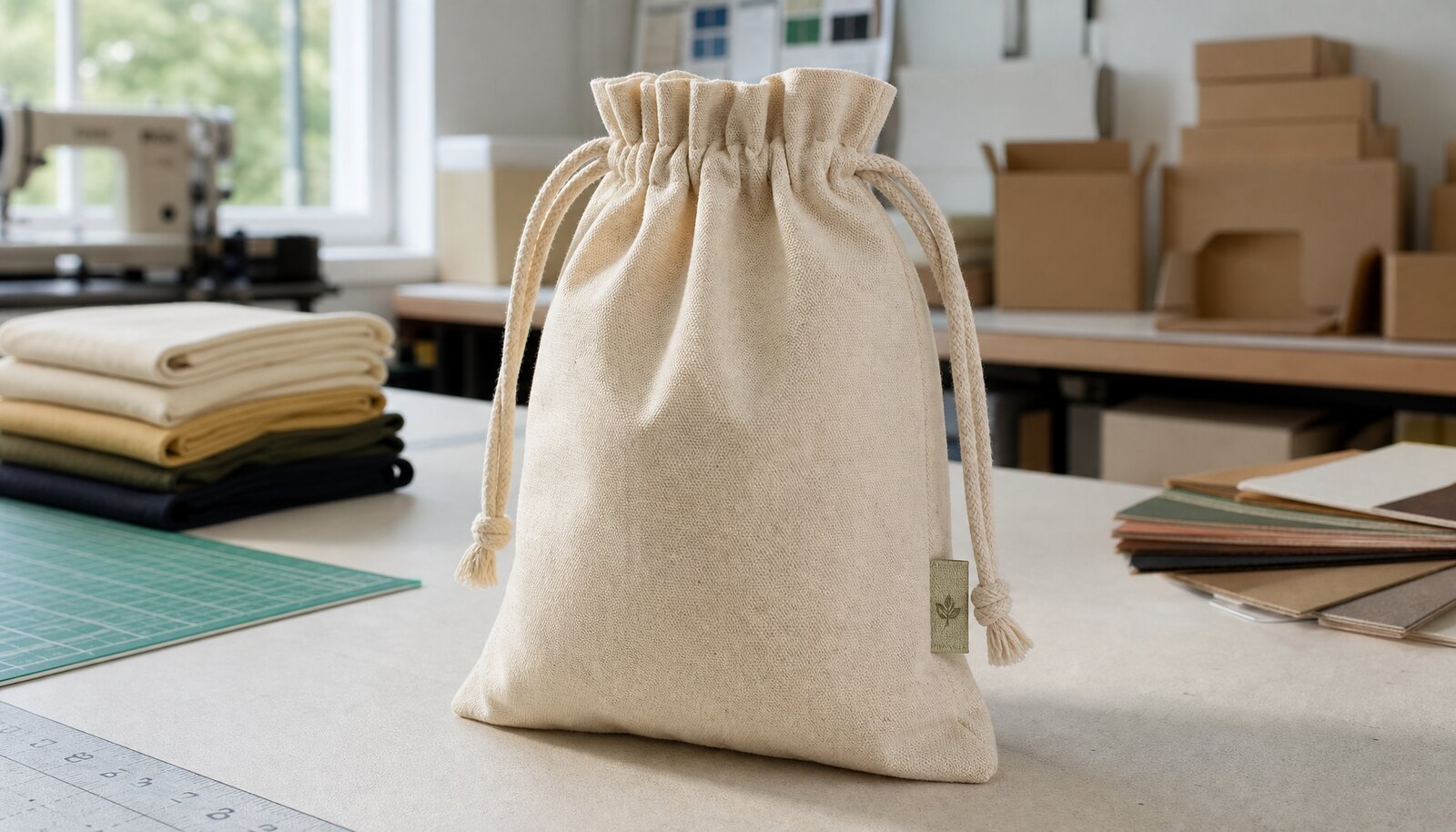
Why the carton plan matters for gifting orders
For corporate gifting, the pouch is not just a sewn item. It is a pack-out problem. Procurement teams usually lose time when the supplier quotes the pouch price but leaves carton behavior vague: how many pieces per inner pack, whether each SKU is separated, whether the outer carton can survive export, and whether the packing format supports final distribution into gift sets. If the carton plan is weak, the order may still be on spec but arrive hard to count, hard to store, or hard to kit.
The practical goal is simple: ship pouches in a format that the receiving team can count quickly, inspect without opening every carton, and move into event or campaign kits without rework. That means the RFQ should define not just the pouch size and logo, but also how the goods are folded, packed, labeled, and sealed. Buyers that lock this early usually avoid the most expensive surprises: miscounts, crushed cartons, mixed SKUs, and rush repacking at destination.
- Define whether the pouch is a standalone gift item or part of a larger kit.
- State if cartons go directly to a 3PL, office, distributor, or event venue.
- Use one packing standard across all sizes unless there is a strong operational reason to split it.
Choose the pouch spec before you ask for a quote
Cotton drawstring pouches look simple, but small spec changes move cost and performance quickly. For most corporate gifting programs, natural cotton in the 120 to 160 GSM range is the normal starting point. At the lower end, the pouch is lighter and cheaper, but the fabric can look soft or semi-transparent if the gift inside has hard edges or darker colors. At the higher end, 180 GSM and above gives a cleaner premium feel, better shape retention, and a stronger hand when the pouch sits on a desk or in a gift box.
Size and closure also matter. A 10 x 15 cm pouch can hold small accessories or samples, while 15 x 20 cm and 20 x 30 cm formats are better for apparel, skincare, or mixed gifting sets. For drawcords, cotton rope is the standard choice when the buyer wants a natural look, while polyester cord can improve consistency and reduce fuzzing. If the product will be opened and closed many times, the channel stitching and cord diameter become more important than an extra print color.
- Use 120 to 140 GSM for light promotional inserts and low-cost programs.
- Use 150 to 180 GSM for premium gifting, stronger opacity, or better shape.
- Choose one pouch size per SKU if the order will be carton-packed by campaign or region.
Compare sourcing routes before you lock the PO
The cheapest quote is not always the lowest-risk route. A factory with its own sewing, printing, and packing line usually gives the cleanest control over carton count, label accuracy, and defect handling. That matters when the buyer needs one compliant carton standard across a corporate gifting run. A trading company can still be the right answer if it manages multiple bag categories well, but then the buyer needs sharper document control and proof that the packing instruction is enforced at the factory level.
If the order is small or the timeline is compressed, local decoration on imported blanks can be workable, but the buyer should expect a higher landed cost and less packaging efficiency. A workshop can be good for a pilot run, but not for a large event where carton accuracy and repeatability matter. When the sourcing route changes, the quote structure should also change. Ask for factory price, decoration price, packing price, and carton cost separately so you can compare apples to apples.
- Prefer a direct factory if the program needs stable carton counts and export documents.
- Use a trading company only if they can name the actual production site and QC owner.
- For a pilot order, pay for speed only if the receiving process can tolerate hand-packed variance.
Build the carton packing architecture
A good carton packing plan starts with how the pouch moves through the factory. The finished item should be folded the same way every time, with the drawcord tucked in the same direction and the logo facing the same side. That sounds minor, but it affects carton density, wrinkle risk, and how quickly the receiving team can count the goods. For corporate gifting, a consistent fold is usually better than a loose, unstructured pack because the pouch looks more finished when it is pulled from the carton and placed into a set.
The outer carton should be sized for transport, not just for filling space. A carton that is too large allows the pouches to shift, which can create corner crush and mixed orientation. A carton that is too small risks compression marks, especially for heavier GSM fabric or pouches with printed logos that should not be rubbed hard against other pieces. In many programs, inner packs of 25 or 50 pieces work well, but the right number depends on the pouch size, total weight, and whether the end receiver needs small-count handling.
- Use one fold method and one orientation for all cartons in the same SKU.
- Target a carton weight that warehouse staff can lift safely without re-handling.
- Add desiccant or moisture protection when sea freight or humid storage is expected.
Print and branding choices that survive handling
For cotton pouches, screen printing is still the most practical method for most corporate gifting jobs. It is cost-efficient, readable, and durable when the artwork is simple and the logo uses one or two colors. If the design needs fine detail, gradients, or photo-like content, buyers sometimes move to heat transfer, but that should be a deliberate decision because the tactile finish and wash resistance are different from screen print. Woven labels and sewn side labels are also common when the brand wants a premium presentation without covering the fabric with ink.
The buyer should match the print method to the actual handling pattern. A pouch that will be slid in and out of a gift box may benefit from a woven label or small chest print rather than a full front flood print. A pouch that will be handled often at events should avoid thin decoration that rubs off or cracks. If the logo is positioned too close to the side seam or drawcord channel, it can look misaligned after sewing. The right acceptance standard is not just color match; it is placement consistency, edge crispness, and visual balance on a sewn item.
- Use screen print for simple logos and repeatable volume.
- Use woven or sewn labels when the brand wants durable premium signaling.
- Avoid artwork that depends on fine gradients unless the supplier has proven transfer quality.
MOQ logic and sample approval should be separated
The headline MOQ is rarely the whole story. Cotton fabric, print screens, cord materials, labels, and carton printing each carry their own setup logic. A supplier may offer a low piece MOQ but still require a higher minimum for one specific color, one artwork version, or one carton print variant. That is why buyers should ask for MOQ by size, by color, and by decoration method rather than accepting one large number that hides the real constraint.
Sampling needs the same discipline. A pre-production sample should prove the finished fabric, logo placement, cord behavior, and folding method. A photo approval is not enough for a corporate gifting order if the job will be packed in cartons and shipped long distance. For higher-value programs, the buyer should keep one gold sample that is signed and dated, then compare bulk production against that sample. If the sample is changed after approval, the supplier should issue a revised reference and the buyer should reset the approval gate.
- Separate sample fee, setup fee, and production MOQ in the quote.
- Approve one gold sample for look and one packing sample for carton behavior if the order is sensitive.
- Do not approve bulk from photos if the first shipment will be seen by a client or end customer.
Set QC thresholds that match a gifting program
A corporate gifting pouch is judged visually first, then operationally. That means QC should focus on visible defects that a recipient would notice immediately. The most common failures are uneven print, loose threads, broken drawcords, stains, and mixed or missing SKUs in a carton. AQL language helps, but the buyer should still define what is unacceptable in plain terms: no oil marks, no holes, no mispacked cartons, no unreadable carton labels, and no obvious logo shift that makes the item look off-center.
Load testing should be realistic to the use case. If the pouch holds a lightweight insert card or accessory, a mild pull test may be enough. If the pouch is expected to hold heavier items or multiple small gifts, the buyer should request a simple stress check on the cord channel and side seams using a load above the expected field use. The goal is not laboratory complexity. It is making sure the pouch behaves correctly after packing, transport, and repeated handling.
- Use AQL for appearance defects, but also define non-negotiable visual rejects.
- Check the first carton, the middle carton, and the last carton, not only the top sample.
- Verify carton count, SKU count, and packing list count before booking transport.
Lead time risk sits in artwork, packing, and carton printing
A realistic lead time for custom cotton drawstring pouches often starts with sample approval, not with the PO date. Typical sampling can take about 7 to 12 days depending on artwork, fabric availability, and whether the factory needs to source a special cord or label. Bulk production often falls in the 20 to 35 day range after final approval, but special dyeing, carton printing, or kitting can add time. Buyers should be cautious when a quote sounds fast but does not separate sample, production, and packing stages.
The schedule risk usually hides in three places: slow artwork sign-off, late carton artwork, and repeated sample revisions. If the event date is fixed, treat any design change after sample sign-off as a change order. That does not mean the order should stop. It means the buyer needs a documented impact on lead time, carton stock, and freight booking. A clean schedule is easier to protect when the supplier sees the approval path as part of the commercial plan rather than as an informal back-and-forth.
- Anchor the ship date to final artwork approval, not the first inquiry date.
- Add buffer time for carton printing if the cartons carry custom marks or logos.
- Book freight after sample approval if the event date is hard and non-movable.
What to compare in landed cost and quote data
For this kind of pouch, landed cost is shaped by more than the unit sewing price. Fabric GSM, print method, individual packaging, carton size, carton quantity, palletization, and freight method all change the final number. A low unit quote can turn into a high landed cost if the supplier underestimates carton volume, uses oversized cartons, or charges separately for every small setup item. Buyers should request quote data in a line-item format so the operational cost is visible before the PO is issued.
The quote should show the exact product spec and the packing spec together. If one supplier quotes a 140 GSM pouch with one-color screen print and 100 pieces per carton, and another quotes 160 GSM with woven label and 50 pieces per carton, the numbers are not directly comparable until you normalize them. Ask for piece weight, carton dimensions, gross weight, MOQ, sample fee, setup fee, and incoterm. That gives procurement a real basis for comparison and makes internal approval easier.
- Request unit price, sample fee, setup fee, and packing charge as separate lines.
- Compare carton size and carton count, not only piece price.
- Normalize all quotes to the same spec before deciding on the supplier.
Specification comparison for buyers
| Spec decision | Recommended option | When it fits | Buyer risk to check |
|---|---|---|---|
| Factory direct with in-house packing line | Best for carton-packed pouch programs with printed cartons, SKU labeling, and controlled counts | You need one supplier to manage fabric, print, packing, and export documents | Confirm that the same factory cuts, prints, folds, and cartons the goods, not a subcontractor mix |
| Factory direct with outsourced decoration | Use only if the mill or sewing factory lacks print capacity but can control the artwork handoff | You want basic sewing from one source and decoration from a specialist | Check print registration, color matching, and whether the decoration shop can meet the same lead time |
| Trading company with a bag network | Useful for mixed programs or when you need multiple bag types under one PO | You buy tote bags, pouches, and backpacks together and want one commercial contact | Ask who owns QC at each step and whether packing specs are enforced consistently across suppliers |
| Local decorator buying imported blanks | Good for short regional delivery windows and low-volume event runs | You need fast turnaround in one market and can accept higher unit cost | Verify blank fabric origin, shrinkage after print, and whether carton counts are manual or system-controlled |
| Low-MOQ workshop or artisanal supplier | Fit for pilot gifting runs, internal events, or very small premium programs | You are testing artwork or trying a limited launch | Expect wider size tolerance, less stable carton packing, and weaker documentation for export buyers |
| Recycled or organic cotton specialist | Best when sustainability claims are part of the buyer brief | Your brand needs fiber-traceability language or a greener retail story | Confirm certificate scope, batch traceability, and whether the cloth weight is the same across lots |
| Dual-source strategy | Useful when one source handles sampling and another handles volume | You need risk coverage for a large event or staggered regional drops | Control shade bands, print files, and carton labels so both sources ship the same product standard |
| Kitted gift-set consolidator | Best when the pouch ships with insert cards, tissue, or other gift components | You want one packed unit per event or campaign recipient | Ask who checks kit completeness and how missing components are replaced before carton close |
Buyer checklist before sampling
- Final pouch size in cm, finished after sewing, with acceptable tolerance by dimension
- Fabric weight in GSM, weave type, and whether the cotton is bleached, natural, or dyed
- Logo method, number of print colors, artwork file type, and exact print position
- Cord type, cord diameter, knot or stopper style, and whether the cord ends are heat-sealed or wrapped
- Carton pack count, inner pack count, and whether individual polybags are required
- Carton size limit, gross weight target, pallet plan, and moisture protection requirement
- Sample approval gate: pre-production sample, gold sample, or photo approval before bulk
- Incoterm, lead time from sample sign-off, and over/under shipment tolerance
Factory quote questions to send
- What is the exact fabric GSM, weave, and shrinkage expectation for the pouch body?
- Is the logo printed, woven, embroidered, or label-applied, and what is the setup fee for each option?
- How many colors are included in the quoted print price, and what is the surcharge for extra colors?
- What carton packing configuration is quoted: pieces per inner pack, inner packs per carton, and total cartons per PO?
- What are the carton dimensions, gross weight, and palletization plan for this order?
- What is the MOQ by size, by color, and by print method, not just the headline MOQ?
- What sample types are available before production, and which one is the approval reference for bulk?
- What lead time applies after art approval, after sample approval, and after deposit or PO release?
Quality-control points to confirm
- Fabric weight matches the approved spec and does not vary enough to change handfeel or opacity across cartons
- Pouch dimensions stay within the agreed tolerance after sewing and after any pre-shrink or wash process
- Drawcord runs smoothly, knots hold, and the cord does not fray or pull through the channel under normal handling
- Logo placement is centered or positioned to the approved artwork sheet and does not shift between batches
- Print coverage is even, with no color break, bleeding, pinholes, or ghosting on the cotton surface
- Stitching is straight, seam allowance is consistent, and no loose thread tails remain on visible edges
- Carton counts are exact by SKU, size, and color, with no mixed lots unless the buyer has approved a bundle pack
- Carton labels match the purchase order, carton marks are readable, and the master carton count reconciles with the packing list
- No stains, oil marks, odor, broken cords, or fabric holes are present on AQL inspection
- Sample carton should survive handling without crushed corners, torn tape, or shifting inner packs