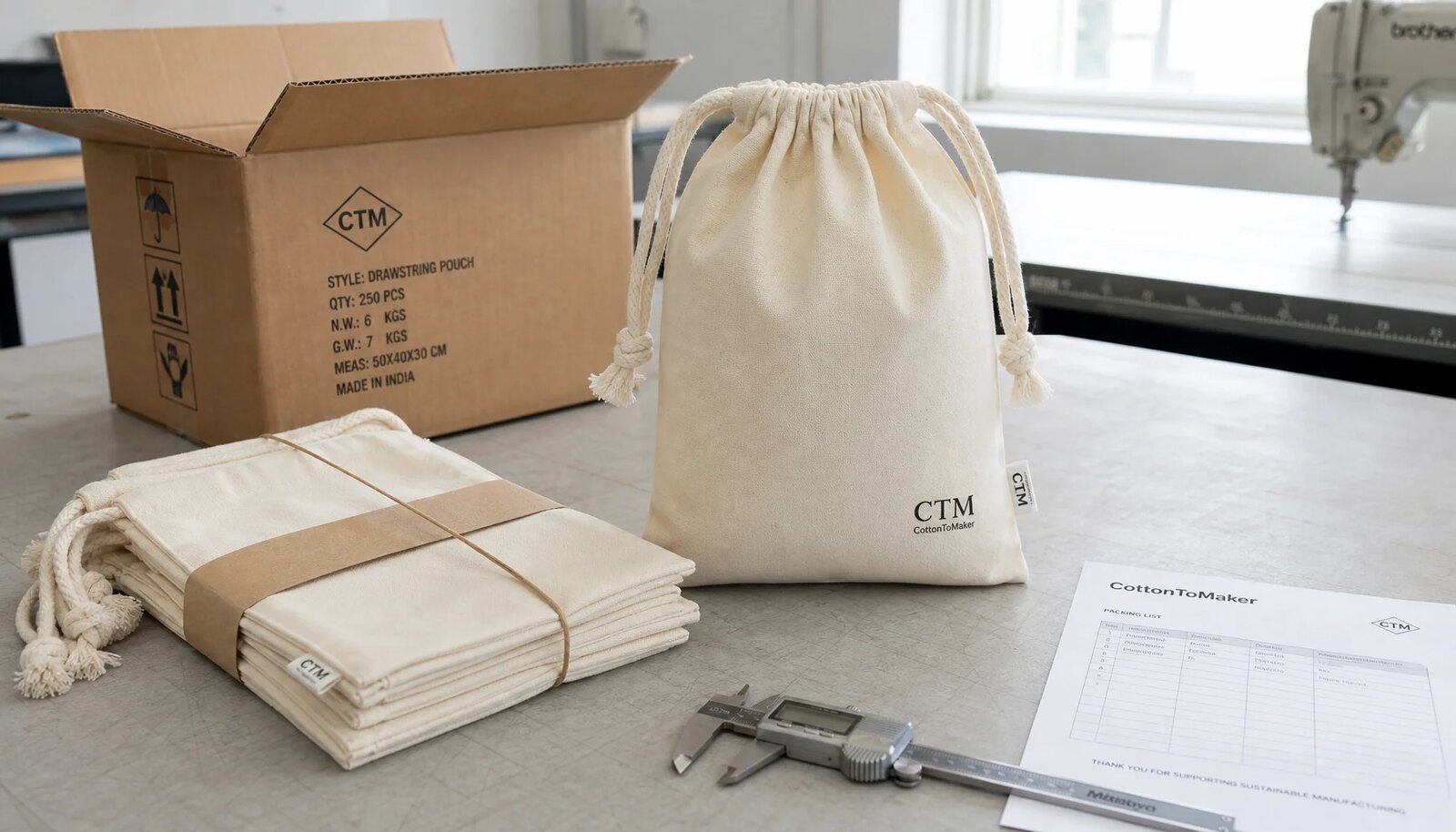
Start With the Packing Problem, Not Only the Pouch
A custom cotton drawstring pouch may look simple on a quotation sheet, but for a craft fair buyer it is also inventory. It has to be counted, shipped, stored, opened quickly, and replenished while staff are setting up displays. A nice pouch can still create problems if the carton plan is vague. Too-heavy cartons slow booth setup. Loose bulk packing invites count disputes. Mixed versions can send the spring logo to the holiday booth. Weak cartons can crush clean cotton folds before shoppers ever see the product.
That is why the RFQ should describe the journey after sewing, not just the pouch style. Will the order ship to one warehouse, several makers, a distributor, or multiple fair locations? Will cartons be opened by trained receivers, retail staff, or temporary event workers? Do cartons need to fit under a booth table, inside a van, on warehouse shelves, or on export pallets? A factory cannot design a reliable carton packing plan if the instruction stops at custom cotton pouch with logo.
For customer-facing packaging, the carton plan is part of the brand presentation. Craft fair shoppers notice stained cotton, tangled cords, crushed folds, and crooked logos. Procurement teams also notice when receiving takes twice as long because every carton has to be opened and sorted. A clear plan lets buyers compare quotes on real operating cost, including carton cube, inner packing labor, QC checks, and receiving speed.
- State the final use: product packaging, event giveaway, paid merchandise, maker sample kit, retail add-on, or booth replenishment stock.
- Identify the packed product by dimensions, weight, fragility, fragrance, oil content, and whether it has corners that may show through light cotton.
- Define who opens cartons: warehouse receivers, distributor staff, retail store teams, craft fair booth staff, or temporary event workers.
- Set handling limits early, including maximum carton gross weight, preferred carton size, pieces per carton, and whether cartons must fit vans, shelves, or booth storage.
- Tell the supplier whether speed of counting, lowest freight cube, retail presentation, or minimal packing material is the main priority.
- Require the quotation to show packing assumptions so the unit price can be evaluated together with freight, labor, and failure risk.
Choose Fabric Weight Around Display Use and Carton Cube
Fabric weight is often discussed in ounces or GSM, but procurement buyers should connect that number to both presentation and logistics. Very light cotton may be fine for a low-cost giveaway, yet it can look thin under booth lighting and show the outline of the item inside. A 5 oz to 6 oz cotton, roughly 140 to 170 GSM, is usually a practical middle range for reusable craft fair packaging. It feels more substantial, handles simple logo printing well, and still packs efficiently.
Heavier canvas-style cotton can raise perceived value for candles, ceramics, premium gifts, or paid merchandise. It is not automatically the better choice. More GSM means thicker folds, fewer pieces per carton, higher CBM per 1,000 pieces, and more weight for event teams to lift. If a supplier quotes an 8 oz pouch with the same carton quantity used for a 5 oz pouch, ask for a packing trial before accepting the number.
Shade matters too. Natural, greige, bleached, and dyed cotton do not look the same, and side-by-side cartons can reveal shade variation quickly. If the pouches support brand display, approve fabric swatches before print sampling. For dyed cotton, confirm MOQ and lead time because fabric production or dye lots may add constraints that do not apply to stock natural cotton.
- Use 120 to 140 GSM for economy giveaways where transparency, long reuse, and premium hand feel are not critical.
- Use 140 to 170 GSM for most custom cotton drawstring pouches used as reusable craft fair packaging for small goods.
- Use 200 GSM and above when the pouch is sold as merchandise, carries heavier items, or needs a more structured canvas feel.
- Ask whether GSM tolerance is defined and how the supplier verifies fabric weight before cutting.
- Request fabric swatches from the actual available stock or dye lot before approving print color and artwork placement.
- Recalculate carton quantity, gross weight, and CBM when moving from light cotton to heavier canvas so freight comparisons stay accurate.
Set Finished Size by Usable Space
Do not specify pouch size only as a flat outside measurement. A 10 cm by 15 cm pouch does not give 15 cm of usable height after the drawcord channel, seam allowance, top gather, and closure behavior are included. Many craft fair pouches need to hold a real product: a soap bar, jewelry box, candle accessory, dried flower packet, keychain, ceramic ornament, or stationery set. The spec should show flat finished size and usable internal height below the drawcord channel.
The safest approval is a physical fit test. The factory should test the pouch with the actual product or a dummy with matching size and weight. The filled pouch should close without forcing the cords, distorting the top seam, or wrinkling the logo. If the product is bulky, the channel may need to sit higher, the overall height may need to increase, or the logo may need to move lower. Those changes are cheap during sampling and expensive after sewing.
Tolerance also needs plain language. Sewn cotton goods cannot be measured like metal parts, so some cutting and sewing variation is normal. Still, the purchase order should define width, total height, usable height, cord length, and print placement tolerance. For small pouches, plus or minus 5 mm may work. For medium sizes, plus or minus 8 mm may be more realistic depending on construction. The key is agreement on the measurement method before production starts.
- Specify flat finished width and height separately from usable internal height below the drawcord channel.
- Measure usable height with the pouch laid flat and the channel identified, not by guessing from the overall height.
- Keep main logos away from side seams, bottom seams, and the top gathered area where fabric wrinkles during closure.
- Approve the pouch while filled and closed when it will hold bulky, rigid, or presentation-sensitive products.
- Define measurement points for width, total height, channel height, cord length, and print position in the spec sheet.
- State whether size variation is a minor, major, or critical defect when it prevents product fit or carton allocation.
Match Print Method to Artwork and Packing Pressure
Printing affects more than decoration. It changes hand feel, curing time, packing orientation, and inspection risk. Screen printing is usually the strongest option for solid logos, maker marks, one-color event graphics, and simple spot-color branding. It can give good opacity on natural cotton and becomes cost-effective when artwork repeats across a practical quantity. Buyers should send vector artwork, print size, print position, and color targets, while allowing for the way cotton absorbs ink.
Heat transfer can suit fine lines, gradients, multi-color graphics, or artwork that would need many screens. Digital printing may work for smaller runs or variable designs, but cotton texture can soften detail compared with paper proofs. Each method brings its own QC focus. Screen print needs registration and ink coverage checks. Heat transfer needs adhesion and edge-lift checks. Digital print needs rub, wash, and color consistency review. Approve the method on the actual fabric, not only on a mockup.
Packing pressure can damage a good print. If pouches are bundled before curing is complete, printed faces may block, stick, smell, or transfer marks. If thick ink lands on a fold line, tight cartons can create cracking or a stiff patch. For premium presentation, the supplier may need consistent face orientation, enough curing time before bundling, or less compression inside the master carton. A cheaper print is not a saving if the logo arrives scuffed.
- Require a print strike-off on the actual cotton fabric and approved fabric color before mass printing.
- Define Pantone target, acceptable shade range, logo dimensions, placement tolerance, and whether natural cotton texture may show through ink.
- Check dry rub and light wet rub resistance for pouches handled repeatedly by shoppers or booth staff.
- Avoid large heavy ink areas across fold lines when the pouch will be flat-packed tightly in cartons.
- Ask how long printed pieces cure before bundling and whether printed faces are stacked face-to-face or back-to-back.
- Include QR codes or small text only after confirming scanability, line clarity, and fabric absorption on a real sample.
Build MOQ Logic by Size, Color, and Artwork
MOQ is rarely one clean number. A factory may offer a total order minimum, but the practical constraints may apply per fabric color, pouch size, cord color, print artwork, label, or carton-mark version. Three thousand pieces in one size with one logo is a different production job from three thousand pieces split across six craft fair cities, two pouch sizes, three seasonal designs, and destination-specific cartons. The second order has more setup, separation, labeling, and QC work.
Use a quantity matrix instead of a paragraph. Show each version by item code, size, fabric color, cord color, artwork, label, destination, inner packing, and carton mark. This helps the supplier price setup charges correctly and helps production avoid mixing versions during cutting, printing, sewing, and packing. It also makes supplier comparison fair because one quote may bury setup cost inside the unit price while another lists it separately.
If the budget is tight, simplify the version plan without removing the brand story. Use one common pouch body and one common fabric color, then vary a smaller print, hangtag, paper band, or destination label. That reduces changeovers and often improves carton consistency. It also lowers the risk of leftover slow-moving artwork after the fair season.
- Clarify MOQ per fabric color because dyed cotton and special shades may have fabric or dye lot minimums.
- Clarify MOQ per print artwork because each screen, transfer setup, or digital file setup can affect cost and lead time.
- Use shared pouch bodies across craft fair themes when possible to reduce cutting, sewing, and packing complexity.
- Separate quote lines for base pouch, print setup, woven label, hangtag, inner packing, carton marking, and sample charges.
- Ask whether overage or shortage tolerance applies and whether it is calculated per total order or per individual version.
- Provide a version matrix with item code, artwork file name, quantity, destination, and carton mark before sample approval.
Approve Samples That Represent the Packed Order
A loose sample tells only part of the story. For B2B buying, the approved sample should show how the order will actually be produced, folded, bundled, labeled, and identified. Approve the fabric, cord, stitching, print, label, fold method, inner bundle, and carton label format. If several sizes or artwork versions are involved, the sample set should show how those versions will be named and separated.
Document the pre-production sample. Record finished width, total height, usable height, channel height, cord length, print size, print location, fabric weight, and folded size. Photos should show the pouch flat, filled, closed, folded, bundled, and, when possible, placed in a carton. These records give the inspection team a usable reference beyond an artwork file or email approval.
For a custom cotton drawstring pouches carton packing plan for craft fairs, a small carton trial can be more valuable than a perfect single pouch. It reveals cord tangling, fold marks, logo rub, bundle count visibility, carton bulging, and realistic gross weight. If a full trial carton is not practical, ask for a packing trial report with photos, dimensions, gross weight, net weight, pieces per inner bundle, and pieces per master carton.
- Approve one golden sample for each pouch size, fabric type, print method, and major artwork family.
- Record actual measurements, GSM, cord details, stitch density, print position, folded dimensions, and inner bundle quantity.
- Photograph the approved bundle style and carton mark so production packing follows the same visual standard.
- Confirm fit with the real product or a weight-and-size dummy before releasing bulk cutting.
- Require written approval for any factory change to fabric lot, cord type, print method, carton quantity, or inner packing.
- Keep one signed or sealed approval sample for buyer reference and one for factory QC reference during production.
Design Carton Quantity From Real Packed Volume
Carton quantity should come from real packed volume, not only theoretical weight. Cotton compresses unevenly. Cords and knots add bulk at the edges. Printed faces may need controlled orientation. A supplier might estimate that 500 small pouches fit in one carton, but the packed carton may bulge, exceed handling limits, or leave hard crease marks if the fabric is heavier than expected. A packing trial is the cleanest way to set the number.
The right carton quantity depends on the people handling the order. Event staff may need one-person lift cartons. Warehouse teams may need sizes that fit shelves or pallet patterns. Distributors may prefer carton counts that match event kits or retail-door allocations. For many craft fair programs, 25-piece or 50-piece inner bundles make receiving and booth replenishment faster. A little extra packing discipline can save hours when staff are under event pressure.
Carton strength should be specified, not assumed. A 3-ply carton may be acceptable for short domestic movement of light pouches. A 5-ply export carton is safer for international freight, courier handling, high stacking, or multi-leg distribution. Natural cotton attracts visible dirt and moisture marks, so cartons should be clean, dry, sealed well, and not overfilled. For palletized shipments, ask for pallet height, stacking pattern, stretch wrap, corner protection, and any moisture protection used.
- Set target maximum gross weight, commonly under 15 kg to 18 kg when cartons are handled by event staff or couriers.
- Request carton dimensions, gross weight, net weight, pieces per carton, and CBM per 1,000 pieces for each pouch version.
- Use 25-piece or 50-piece inner bundles when fast booth counting and replenishment matter more than minimum packing material.
- Avoid over-compression when printed logos, premium fabric presentation, or crease-sensitive folds are important.
- Specify carton strength, sealing method, and whether the carton must survive export shipping, courier handling, or pallet stacking.
- Reconfirm carton quantity after sample approval if fabric GSM, cord thickness, print area, or fold method changes.
Control Carton Marks and Version Separation
Carton marks are not decoration. They are receiving controls. A useful mark lets the team identify the order without opening every box. It should show buyer item number, purchase order, pouch size, fabric color, print version, quantity, carton number, gross weight, net weight, and destination code when needed. For craft fair programs, event code and location can prevent costly sorting mistakes when time is short.
Mixed cartons should be the exception, not the default. They can reduce carton count and help complete small destination allocations, but they increase error risk. If mixed cartons are necessary, each inner bundle should be labeled, physically separated, and listed on both the carton contents label and packing list. For urgent event delivery, single-SKU cartons are usually safer because booth teams can sort by carton mark instead of opening and recounting everything.
Version control must match the paperwork. The purchase order, commercial packing list, carton labels, and supplier production records should use the same item codes and artwork names. Avoid file names such as logo final or new version. When artwork changes, update the version code and withdraw the old file. The carton plan only works if the identification system is disciplined.
- Use one approved carton mark template before mass packing starts.
- Avoid generic descriptions such as cotton pouch when multiple sizes, colors, destinations, or print versions are in the shipment.
- Require sequential carton numbering such as 1 of 24 so missing cartons are visible during receiving.
- Show destination codes on carton marks and packing lists when shipments are split by craft fair, warehouse, distributor, or retail door.
- Label inner bundles when cartons contain more than one size, artwork, color, or event allocation.
- Require photos of representative carton marks before shipment release to catch wrong item codes or missing destination details.
Plan Lead Time Around Print and Packing Approval
Lead time starts from final approval, not from the first inquiry. A supplier can answer an RFQ quickly, but production cannot move cleanly until fabric, size, cord, artwork, sample, carton marks, and packing method are approved. A stock natural cotton pouch with one-color print may be much faster than dyed fabric, custom cord, woven labels, multiple artwork sets, or destination-specific carton packing. Ask which steps sit on the critical path.
Craft fair deadlines leave little room for recovery. If pouches miss the event, much of their immediate value disappears. Build schedule buffer for artwork correction, print strike-off, sample transit, buyer review, inspection, repacking, export booking, customs, and inland delivery. Last-minute artwork changes are especially risky because screens, transfers, or digital print files may already be prepared.
Packing approval also takes time. A trial carton may reveal bulging, excessive creasing, wrong bundle counts, unclear marks, or an unrealistic gross weight. Fixing those issues can require fewer pieces per carton, a new carton size, revised inner packing, or a different fold direction. Those changes affect freight cost and sometimes the purchase order, so packing should be treated as a production spec, not a warehouse afterthought.
- Reserve time for fabric swatch approval when natural shade, dyed color, organic claims, or recycled-content claims affect brand presentation.
- Reserve time for print strike-off approval before booking a tight craft fair delivery schedule.
- Add inspection and possible repacking time when the order includes many sizes, artworks, carton marks, or destination allocations.
- Freeze artwork, carton marks, bundle quantity, and packing method before bulk production to prevent schedule drift.
- Ask the supplier to confirm the latest safe approval date for the event deadline and the cost of any air freight backup.
- Build a timeline that includes sample transit, buyer review time, production, QC, carton packing, export booking, customs, and inland delivery.
Compare Quotes by Landed Cost and Failure Risk
The lowest FOB unit price is not always the lowest project cost. A quote may look cheaper because it assumes thinner fabric, loose bulk packing, lighter cartons, fewer QC checks, or an optimistic carton quantity. Those assumptions can create higher freight cost, more receiving labor, damaged cartons, count disputes, or unusable pouches. Compare the landed cost per usable packed pouch, not only the factory price.
A complete quotation should state fabric weight, fabric type, pouch dimensions, usable height, cord details, print method, print size, number of colors, MOQ rules, setup costs, sample cost, lead time, inner packing, carton quantity, carton dimensions, gross weight, net weight, carton strength, inspection standard, and payment terms. If carton cube or carton weight is missing, the quote is not ready for procurement comparison.
Failure risk belongs in the sourcing decision. A slightly higher quote with a clear packing trial, documented QC, accurate carton marks, and realistic lead time may be safer than a lower quote with vague packing terms. For craft fair buyers, failure can mean missed event sales, emergency repacking, expedited freight, staff overtime, and poor presentation at the booth. A strong supplier makes assumptions visible before production begins.
- Calculate CBM per 1,000 pieces and compare it against fabric GSM, carton quantity, and freight mode.
- Separate one-time setup costs from repeat order costs for screens, transfers, labels, hangtags, and custom carton marks.
- Compare inspection standards for size, stitching, stains, print rub, cord function, bundle count, and carton accuracy.
- Treat missing carton dimensions, generic packing terms, or unconfirmed carton weight as quote risks rather than minor details.
- Ask who pays for rework, replacement, or repacking if defects exceed the agreed inspection limit.
- Choose suppliers that provide measurable specifications, not only attractive photos and a low first unit price.
Specification comparison for buyers
| Spec decision | Recommended option | When it fits | Buyer risk to check |
|---|---|---|---|
| Fabric weight for reusable craft fair pouches | 5 oz to 6 oz cotton, approximately 140 to 170 GSM, with shrinkage allowance confirmed before bulk cutting | Small jewelry, soap, candle accessories, stationery, gift cards, small ceramics, and handmade goods needing a natural reusable look | Below 120 GSM can look transparent and show product corners; above 200 GSM raises carton cube and reduces pieces per carton |
| Finished size and usable height | Approve flat finished size plus usable internal height below the drawcord channel; set tolerance before PO release | Pouches that must fit product inserts, retail bins, booth shelves, prepaid event kits, or display trays | A pouch can meet flat size but fail closure if the drawcord channel, seam allowance, and fabric gather reduce usable capacity |
| Drawcord style and length | Cotton cord 3 mm to 5 mm; double draw for medium or premium pouches; knot or finish cord ends consistently | Natural branding, easy booth handling, low plastic or metal content, and repeated opening by shoppers | Uneven cord length causes poor closure; unfinished ends can fray; short cords can pull into the channel during packing |
| Print method and curing | Screen print for solid logos, heat transfer for fine multi-color art, digital print only after fabric and rub tests | Maker logos, event graphics, QR codes, seasonal branding, loyalty gifts, and small retail packaging runs | Heavy ink can stiffen light cotton; incomplete curing can cause blocking, odor, transfer marks, or print rub inside cartons |
| Inner packing format | 25-piece or 50-piece bundles in recyclable polybag, kraft band, or buyer-approved wrap, with version labels when needed | Fast receiving, booth replenishment, distributor allocation, and clear count control during craft fair setup | Loose bulk packing reduces material but increases creasing, counting disputes, mixed-size errors, and dirty fabric exposure |
| Master carton quantity | Set pieces per carton from an actual packing trial; common range is 250 to 500 for small pouches, fewer for heavy or bulky styles | Importers comparing freight, warehouse labor, pallet plans, courier limits, and event allocation by destination | Theoretical weight-based quotes may create cartons that bulge, crush, exceed handling limits, or understate CBM |
| Carton strength and protection | 5-ply export carton for international, courier, or high-stack movement; 3-ply only for light domestic movement after approval | Ocean shipment, warehouse storage, distributor repacking, mixed cartons, or multi-event craft fair calendars | Weak cartons can deform, split, pick up moisture, or leave dirty fold marks on natural cotton corners |
| Carton mark and version control | Mark style number, size, fabric color, print version, quantity, carton number, gross/net weight, destination code, and PO reference | Multiple craft fairs, retail buyers, split shipments, seasonal graphics, or replenishment cartons by booth location | Generic carton marks cause slow sorting, wrong-event allocation, shortage disputes, and wrong artwork sent to the wrong venue |
| Inspection and AQL focus | Use a defined inspection plan for size, stitching, stains, print, cord function, bundle count, carton count, and carton labels | B2B programs where pouches are customer-facing packaging and event deadlines cannot absorb rework | If packing QC is not inspected, good pouches can still fail through mixed cartons, wrong counts, crushed cartons, or dirty presentation |
Buyer checklist before sampling
- Define the exact pouch use: primary product packaging, giveaway, paid merchandise, sample kit, booth replenishment, or retail buyer packaging.
- Confirm the product going inside the pouch, including dimensions, weight, sharp corners, fragrance transfer, oil risk, and whether the pouch must close fully.
- Specify finished flat width and height, usable internal height below the drawcord channel, fabric GSM or oz, cord thickness, cord length, and closure style.
- Set print method, logo size, print position, Pantone or artwork target, acceptable color variation on natural cotton, and curing or rub-test expectations.
- Require a pre-production sample made with actual fabric, cord, stitching, logo, fold method, inner bundle, and carton label before bulk approval.
- Ask for a packing trial report showing pieces per inner bundle, pieces per master carton, carton dimensions, gross weight, net weight, and CBM per 1,000 pieces.
- Set maximum carton gross weight and carton dimensions based on warehouse racking, courier rules, van loading, or craft fair staff handling limits.
- List every size, fabric color, print artwork, event code, barcode, label, and destination in the purchase order rather than relying on email attachments.
- Define inner packing: loose, 25-piece bundle, 50-piece bundle, recyclable polybag, kraft paper band, barcode sticker, warning label, or no plastic requirement.
- Use carton marks that match the inbound receiving system, commercial packing list, event allocation plan, and any retailer or distributor routing guide.
Factory quote questions to send
- What cotton fabric weight are you quoting in GSM and oz, and is the fabric natural, greige, bleached, dyed, organic-certified, recycled-content, or conventional cotton?
- What finished size tolerance applies after sewing, and what is the usable internal height below the drawcord channel when the pouch is closed?
- What cord material, thickness, length, finish, knot style, and draw configuration are included in the quote?
- Which print method is included, how many print colors are quoted, what artwork size is assumed, and what curing or colorfastness checks are performed?
- What MOQ applies per pouch size, fabric color, cord color, print artwork, woven label, and destination-specific carton mark?
- Can you provide a pre-production sample with exact fabric, cord, stitching, logo, folded packing, inner bundle, carton label, and sample measurement report?
- How many pieces will be packed per inner bundle and per export carton after an actual packing trial, not only a theoretical estimate?
- What are the estimated carton dimensions, gross weight, net weight, and CBM per 1,000 pieces for each pouch size and fabric weight?
- What inspection standard do you use for finished size, seam strength, stains, print defects, cord length, bundle count, carton quantity, and carton marks?
- Are carton drop resistance, moisture protection, desiccant, palletization, corner protection, destination labels, and recycled packaging claims included or quoted separately?
Quality-control points to confirm
- Measure finished pouch width, total height, and usable height below the drawcord channel from at least 20 pieces per size or according to the agreed inspection plan.
- Check fabric GSM against the quoted specification using the approved method, allowing normal mill tolerance but rejecting obvious underweight substitution or mismatched shade lots.
- Confirm drawcord thickness, length, knot quality, end finishing, color, and smooth movement by opening and closing sampled pouches at least three times.
- Inspect seam strength at side seams, bottom corners, drawcord channel, bartack or reinforcement points, and areas where cords create repeated stress.
- Review print registration, ink coverage, curing, odor, blocking, dry rub, light wet rub, logo placement, and color target against the approved sample or strike-off.
- Check for oil stains, mildew smell, loose threads, broken needle risk, colored fiber contamination, dirty fold marks, shade variation, and visible fabric slubs beyond the approved limit.
- Verify that inner bundles contain the correct quantity, size, print version, color, barcode, paper band, polybag, or warning label required by the purchase order.
- Count master cartons against the packing list, including carton sequence numbers, mixed artwork separation, destination codes, and any short-packed or over-packed cartons.
- Measure carton dimensions and weight, inspect carton strength, sealing tape, strapping, corner condition, moisture exposure, and whether cartons are bulging from over-compression.
- Photograph representative packed cartons, carton labels, inner bundles, and any defects before shipment release so receiving teams can compare delivery condition.