The Real Packing Problem
For artisan bakeries, custom cotton drawstring pouches are often ordered as retail packaging, seasonal gift wrap, or reusable brand merchandise. The pouch itself is simple, but the carton packing plan can decide whether the shipment arrives clean, countable, and ready for store allocation. A good RFQ must cover not only size and logo, but also how the pouches are folded, bundled, compressed, labeled, and loaded into export cartons.
The common failure is buying pouches by unit price only. A supplier may quote a low piece price with thin fabric, loose bulk packing, high carton weights, and no defined inner pack. That looks acceptable at quotation stage, then creates warehouse complaints: inaccurate counts, wrinkled logo panels, crushed cartons, mixed sizes, or pouches that need repacking before bakery branches can use them.
- Use a carton packing plan when pouches will be distributed to multiple stores, bakery counters, franchisees, or gift packers.
- Treat packing as part of the product specification, not only a logistics detail after production.
- Request carton dimensions early because freight cost and warehouse handling cost can change the landed cost more than small unit price differences.
- Define whether the shipment is factory-to-warehouse, factory-to-3PL, factory-to-retailer, or direct to bakery stores.
Define the Pouch Before the Carton
The carton plan starts with the pouch specification. A bakery buyer should define finished width and height, whether the pouch is flat or gusseted, the drawstring channel height, seam allowance, cord material, and fabric weight. For most bakery retail uses, 5 oz to 6 oz cotton, roughly 140-170 GSM, gives enough body for a clean print while staying flexible for folding and carton loading.
Heavier cotton can be useful for premium gift sets, but it is not automatically better. An 8 oz cotton pouch increases weight, reduces pieces per carton, and can create thicker fold stacks. Lightweight cotton can work for small cookie or favor pouches, but transparency and wrinkling become more visible, especially on natural unbleached cotton with dark bakery logos.
- Small pastry or cookie pouch: often 10 x 15 cm, 12 x 17 cm, or 15 x 20 cm in 120-150 GSM cotton.
- Bread roll or retail gift pouch: often 20 x 30 cm or 25 x 35 cm in 140-170 GSM cotton.
- Premium reusable bakery pouch: often 6 oz to 8 oz cotton when the buyer accepts higher carton weight.
- Gusseted pouch: useful when the bakery product is thick, boxed, or jarred, but it changes folding and carton loading.
Fabric and Print Choices That Affect Packing
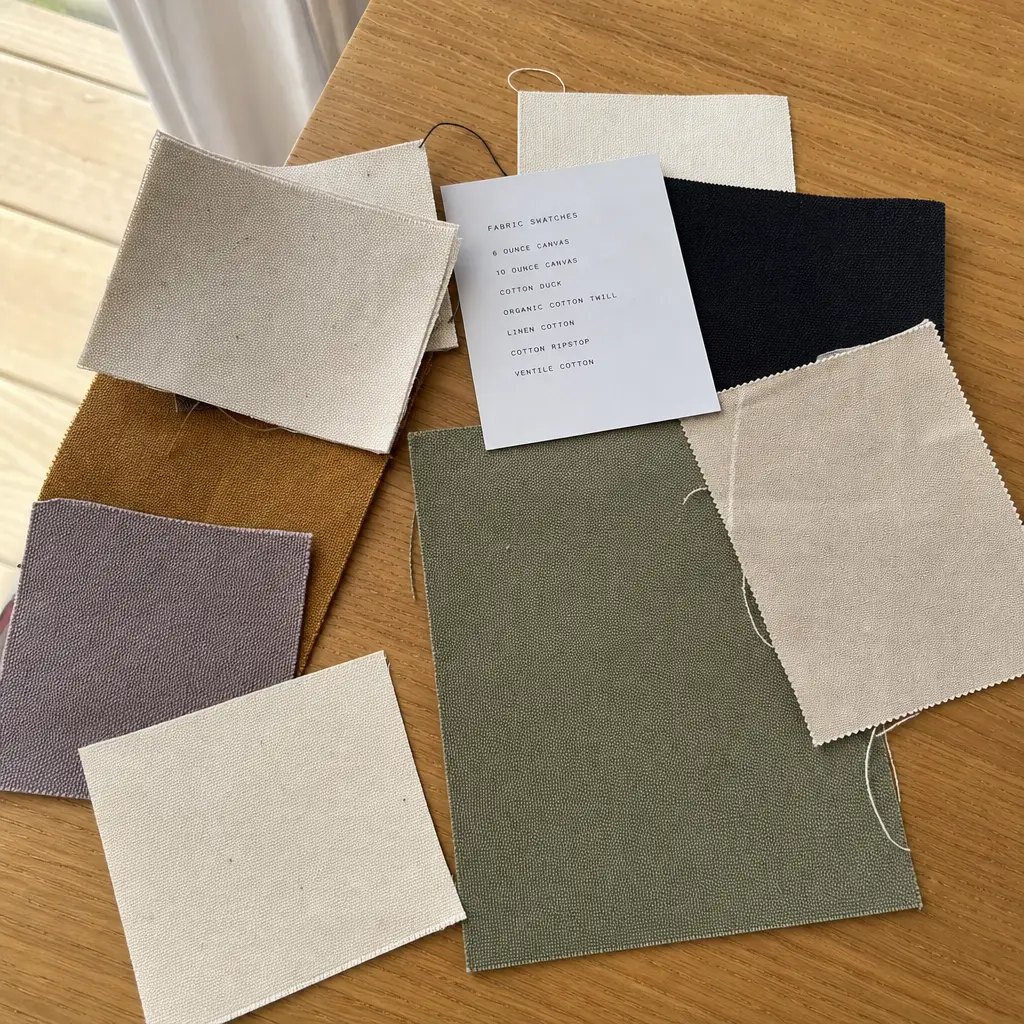
Fabric weight, surface texture, and print method all affect how pouches behave inside cartons. Natural cotton with a slub texture gives an artisan look, but it can create small print gaps on fine logo lines. Bleached cotton gives stronger contrast, while dyed cotton needs better color control and may require a higher MOQ depending on dye lot. If the pouch is food-adjacent, buyers often prefer a clean, soft print finish rather than a thick plastic-feel ink layer.
For bakery logos, water-based screen print is usually the practical choice for one or two colors. It gives a soft hand feel, handles carton compression better than thick ink deposits, and is economical for repeat orders. Heat transfer can support full-color artwork but may feel less natural on cotton and can mark under heavy compression. Embroidery is premium but adds cost, puckering risk, and thicker stacked panels in cartons.
- Screen print: strong choice for simple bakery logos, slogans, and seasonal marks.
- Digital print: useful for low-quantity multicolor artwork, but confirm wash and rub performance.
- Heat transfer: useful for complex graphics, but test against creasing and carton pressure marks.
- Woven label: useful for subtle branding, but specify label position so it is not hidden after filling.
- Embroidery: suitable for premium pouches, but avoid very small lettering on loose cotton weave.
Build MOQ Logic Into the RFQ
MOQ is not only one number. A custom cotton drawstring pouch order may have separate minimums for fabric procurement, custom dyeing, cord color, print setup, label weaving, and carton marking. Buyers who request several pouch sizes and seasonal prints should separate shared materials from variable artwork so suppliers can quote realistically and avoid hiding setup cost inside the unit price.
For example, natural cotton in a standard weight may support a lower MOQ than custom-dyed cotton. A one-color screen print may be easy to combine across sizes, while five small artwork versions can create multiple screen charges and inspection complexity. If a bakery group needs 500 pieces per store for many stores, the factory may prefer one consolidated production lot with store-level packing instructions rather than many small POs.
- State total order quantity, quantity per size, quantity per artwork, and required overage allowance.
- Separate repeat-order pricing from first-order pricing if screens, labels, or sampling are one-time costs.
- Clarify whether MOQ applies per pouch size, per print design, per fabric color, or per shipment.
- Avoid mixing too many fabric weights in one small order because cutting, sewing, and packing control become inefficient.
- If store allocation is needed, provide a packing matrix before production, not after cartons are sealed.
Carton Packing Plan That Warehouses Can Use
A strong carton plan describes the full packing sequence: fold direction, pieces per inner bundle, inner bag or paper band, master carton quantity, carton size, carton gross weight, carton label, and pallet instruction if required. For cotton drawstring pouches, folding should protect the logo panel and avoid hard creases across the printed area. If the logo is centered, many buyers prefer folding from the bottom upward or stacking flat with the print facing inward.
Carton quantity should balance freight efficiency and handling risk. A carton that is too small wastes freight volume, but a carton that is too heavy splits during export handling and slows receiving. For hand-loaded cartons, keeping gross weight under about 15 kg is a practical target. Large pouches, heavy GSM, embroidery, or individual polybags can push carton weight up quickly.
- Define inner bundle quantity such as 25 pieces or 50 pieces for fast counting.
- Use a 5-ply export carton when cartons will move through LCL, courier, or mixed cargo handling.
- Keep SKU mixing out of one carton unless the carton label and packing list clearly show the breakdown.
- Use carton marks with PO number, SKU, size, color, quantity, gross weight, net weight, carton dimensions, and carton number.
- Request a packing trial photo before full packing when the pouch is new, large, embroidered, or individually packed.
Sample Approval Should Include Packing
Many buyers approve the pouch sample but forget to approve the packing sample. That leaves the factory to choose a folding method during mass packing, often based on speed rather than the buyer’s warehouse needs. For a bakery program, the approved sample set should include one loose pouch, one folded pouch, one inner bundle, and one carton layout photo. This is especially important when the logo panel must look smooth at retail.
A proper pre-production sample should match the bulk fabric, GSM, cord, stitching, logo position, print ink, and folding method. If the sample is made from substitute fabric, the buyer should mark it as a construction sample only, not a color or hand-feel approval. A print strike-off on actual fabric is valuable because bakery logos often use warm brown, black, cream, or muted brand colors that shift on natural cotton.
- Approve actual print color under normal daylight and store lighting if possible.
- Measure finished size after sewing, not only cut panel size.
- Pull the drawstring several times to test channel smoothness and closure shape.
- Place the actual bakery product or a size dummy inside the pouch before approving dimensions.
- Photograph the approved folded bundle so production packing has a visual standard.
QC Thresholds for Bakery-Ready Pouches
Cotton pouches for bakeries should look clean, soft, and safe for a food-adjacent retail environment even when they do not directly contact unpackaged food. QC should therefore include both normal textile checks and bakery-specific appearance checks. Stains, mildew smell, oil marks, heavy lint, loose threads, and mixed fabric shade are more damaging to a bakery brand than to some industrial giveaway products.
Set measurable thresholds where possible. Finished size tolerance can commonly be plus or minus 0.5 cm for small to medium pouches, while larger pouches may need a wider tolerance depending on fabric behavior. Print position should be controlled from the top edge or side seam with an agreed tolerance. Carton-level QC should verify count, carton label, sealing, compression, and whether inner bundles match the packing instruction.
- Critical defects: mildew odor, insect contamination, wrong artwork, wrong material, unsafe metal fragment, or mixed SKU carton.
- Major defects: open seam, blocked drawstring channel, heavy stain, badly off-center print, broken cord, or wrong bundle count.
- Minor defects: loose thread, small natural cotton speck, slight shade variation within approved range, or light removable lint.
- Print QC: compare color, position, coverage, registration, dry rub resistance, and cracking after normal folding.
- Carton QC: verify carton strength, tape closure, label data, carton number sequence, and gross weight.
Quote Data Needed for Landed Cost
A low pouch price can lose value if the carton plan creates high freight volume or warehouse labor. Buyers should request estimated carton dimensions, gross weight, pieces per carton, and total carton count with the quote. That lets the importer compare suppliers on landed cost, not only ex-factory unit price. It also helps distributors quote storage and pick-pack fees before the goods arrive.
The quote should separate product cost from setup and packing cost where possible. Screen setup, sample charge, woven label setup, custom carton mark, individual polybag, barcode sticker, and store allocation packing may not be included in a simple unit price. If the supplier includes everything in one number, ask for a note confirming what is included so there are no late-stage add-ons.
- Unit price by quantity tier and pouch size.
- Fabric weight, material composition, and color basis used for the quote.
- Print method, number of print colors, print size, and setup cost.
- Inner packing method and whether plastic-free packing changes the price.
- Export carton dimensions, pieces per carton, estimated gross weight, and total CBM.
- Sample cost, sample lead time, bulk lead time, and validity period of the quote.
- Incoterm, loading port, payment terms, and whether inspection or testing support is included.
Lead Time and Schedule Risks
Lead time for custom cotton drawstring pouches is usually driven by material availability, sample approval speed, printing workload, and packing complexity. Standard natural cotton with simple screen print is faster than custom-dyed cotton, custom cord, woven labels, or multi-store allocation packing. The buyer’s approval cycle can become the longest delay if artwork, Pantone references, barcode files, and carton marks are not ready together.
A practical schedule separates sample development, material booking, cutting, printing, sewing, QC, packing, and export handover. If the bakery launch date is tied to a holiday season, allow extra time for sample correction and final inspection. Buyers should avoid approving bulk production before print strike-off and pouch size are both confirmed, because correcting printed and sewn stock is usually more expensive than delaying a few days at sample stage.
- Artwork delay risk: missing vector files, unclear print size, or no Pantone reference.
- Material risk: custom dye color, nonstandard cord, or special cotton certification requirements.
- Production risk: multiple pouch sizes, many small artwork versions, or embroidery on loose cotton.
- Packing risk: store-by-store allocation, individual barcode stickers, or plastic-free packing redesign.
- Shipping risk: cartons too heavy for courier networks or too weak for LCL consolidation.
Mistakes That Increase Cost After Approval
The most expensive mistakes usually come from vague specifications. If the RFQ says “cotton pouch with logo” but does not state GSM, finished size tolerance, drawstring type, print area, inner packing, or carton requirement, every supplier will quote a different product. The lowest quote may simply be based on lighter cotton, fewer stitches, bulk loose packing, or a weaker carton.
Another common mistake is treating retail presentation and export packing as the same thing. A pouch that looks good individually may not look good after being tightly compressed in a carton for several weeks. If the bakery sells the pouch as part of a premium gift set, the folding method and bundle pressure should be tested before shipment. This is also where a packing photo report and random carton inspection save money.
- Do not approve artwork placement from a flat drawing only; test it on a filled pouch.
- Do not allow loose master carton packing if the warehouse needs quick unit counts.
- Do not ignore carton gross weight; overweight cartons create damage and handling complaints.
- Do not change fabric GSM after sample approval without checking carton quantity and freight CBM again.
- Do not mix seasonal designs in one carton unless the allocation list and carton label are clear.
Specification comparison for buyers
| Spec decision | Recommended option | When it fits | Buyer risk to check |
|---|---|---|---|
| Fabric weight for bakery pouch | 5 oz to 6 oz cotton, about 140-170 GSM, pre-shrunk if washing is expected | Good for small bread rolls, pastry gift packs, cookie jars, and counter retail sets where softness matters | Below 120 GSM may look transparent and wrinkle heavily; above 200 GSM increases carton weight and can reduce units per carton |
| Pouch size and usable capacity | Define finished size plus tolerance, such as 20 x 30 cm with plus or minus 0.5 cm | Fits most bakery gift products when internal volume is confirmed against actual product samples | Flat dimensions do not equal usable fill volume; thick products need gusset or a larger opening |
| Drawstring construction | Double cotton cord drawstring with reinforced channel stitching | Best for retail handling, gift packs, and repeated opening at home | Thin cord can cut into fabric channel; loose channel stitching may fail during packing or customer use |
| Print method | Water-based screen print for 1-2 color bakery logos on natural cotton | Good balance of soft hand feel, food-adjacent appearance, and stable bulk production cost | Fine serif fonts, small QR codes, or dense artwork may require testing before bulk print approval |
| Logo placement | Center front print with minimum 2 cm clearance from side seam and drawstring channel | Keeps artwork visible when pouch is filled and avoids distortion near stitched areas | Artwork placed too high may disappear under cord gathers; too low may crease during carton packing |
| Inner packing | Bundle 25 or 50 pieces in a clear polybag or paper band based on receiving requirements | Works for distributors, bakery chains, and 3PL warehouses that count by bundle | Loose packing causes counting errors, print scuffing, and uneven compression inside export cartons |
| Export carton loading | Use 5-ply export carton with target gross weight under 15 kg for hand-loaded warehouse receiving | Suitable for LCL, courier cartons, or mixed bakery packaging shipments | Overweight cartons split at corners and may trigger warehouse repacking or chargebacks |
| Carton markings | Print SKU, pouch size, color, quantity, gross weight, net weight, carton number, and PO number | Allows fast inbound checks for importers, distributors, and retail buyers | Missing carton data delays receiving and makes shortage claims difficult to verify |
Buyer checklist before sampling
- Define finished pouch size, fabric GSM, cord type, seam tolerance, and print position in the RFQ, not only the artwork file.
- Send the bakery product dimensions or a filled pouch target photo so the factory can judge usable volume and carton compression.
- Approve a pre-production sample with actual fabric, actual cord, actual print method, and proposed folding style.
- Set carton gross weight limit, pieces per inner bundle, pieces per master carton, and carton marking format before production starts.
- Require carton drop-resistant construction for export handling, especially if cartons move through courier, LCL, or multiple warehouse touches.
- Confirm whether pouches need individual packaging, bundle packing, paper bands, barcode stickers, or no plastic for sustainability policy.
- Request a packing photo report before shipment showing opened carton, inner bundle, carton label, and total carton count.
- Keep one approved sample sealed for comparison against bulk fabric color, print color, stitching, and drawstring length.
Factory quote questions to send
- What fabric weight in GSM and oz is included in the quote, and is it greige, bleached, dyed, or natural unbleached cotton?
- What is the quoted finished size tolerance after sewing, and does the quote include shrinkage allowance if the fabric is washed?
- Which print method is quoted for our artwork, and what is the maximum printable area without distortion after filling?
- What is the MOQ for the pouch body, custom fabric color, cord color, print color, and private carton marking separately?
- How many pieces are packed per inner bundle and per export carton, and what are the estimated carton dimensions and gross weight?
- Can you provide a packing trial photo using the proposed folding method before mass packing starts?
- What sample types are included: size sample, print strike-off, pre-production sample, or full packing sample?
- What lead time applies after sample approval, and which material or printing step is the likely bottleneck?
- Which inspection standard and AQL level do you support for stitching, print defects, stains, size tolerance, and carton condition?
- What quote data will be shown separately for unit price, sample charge, printing setup, carton cost, inner packing, and freight-ready carton volume?
Quality-control points to confirm
- Finished pouch size should stay within the agreed tolerance, commonly plus or minus 0.5 cm for small and medium cotton pouches.
- Fabric GSM should match the approved sample and RFQ range; large variation affects opacity, hand feel, carton weight, and packing density.
- Drawstring length should be consistent enough for easy closure, with no frayed cord ends or blocked channel openings.
- Seams should have no skipped stitches, loose threads, open corners, twisted channels, or needle damage near the printed panel.
- Logo print should meet approved color, position, coverage, and rubbing performance after basic dry rub handling.
- Pouches should be clean and bakery-appropriate, with no oil marks, mildew smell, insects, heavy lint, or mixed shade panels.
- Inner bundles should match the agreed count and folding direction so warehouse receiving can count without reopening every pouch.
- Export cartons should pass visual checks for correct label, firm taping, no crushed corners, no mixed SKU, and no overweight loading.