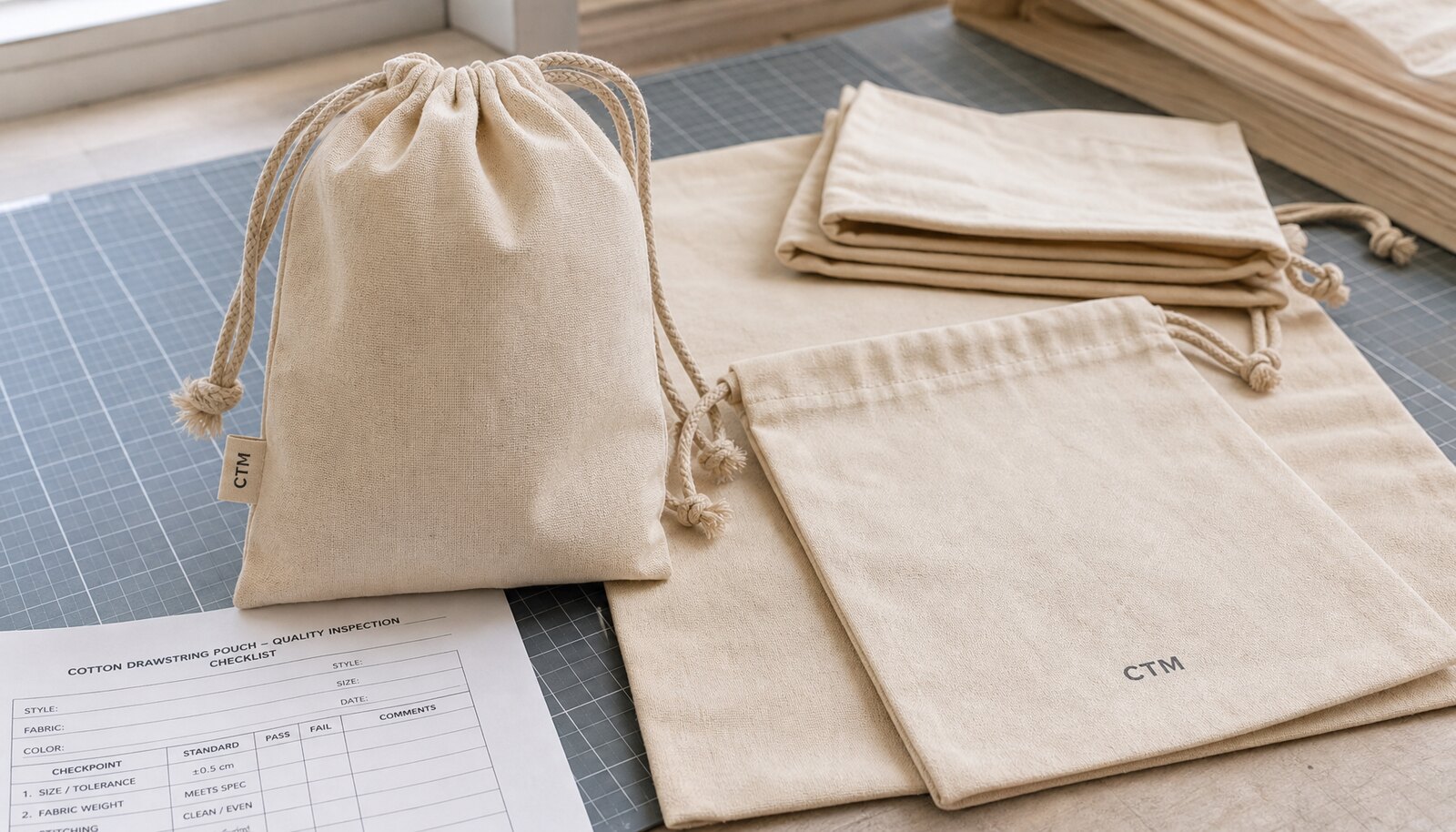
What a winery pouch has to do in the real world
For a boutique winery, a cotton drawstring pouch is not a throwaway accessory. It sits at the point where product, packaging, and brand perception meet. The pouch may be used for a single bottle sold in a tasting room, a seasonal gift set, a club shipment insert, or a premium retail add-on. In every case, it has to present well before it is ever tested for durability. That makes the procurement job more specific than buying a generic promotional bag. A pouch can look acceptable in a supplier photo and still fail when the fabric is too thin, the drawcord is rough, or the finished size is wrong for the bottle shoulder.
The practical buyer question is not whether the unit price looks low. It is whether the pouch does the job without hidden correction work. If the pouch is too loose, it looks like a stock item. If it is too tight, the seams take strain and the closure sits awkwardly. If the print looks strong on paper but weak on cotton, the branding value disappears. Treat the pouch as a packaging component with functional and presentation requirements, not as a decorative extra.
- Single-bottle, two-bottle, retail-display, and club-insert pouches should not share one vague spec.
- A pouch that looks premium on a table still needs to survive handling, stacking, and carton compression.
- The quote has to match the real use case, not the best-looking sample-room version.
Start with bottle fit, not logo size
Fit is the first control point because it determines whether the pouch feels deliberate or improvised. Measure the tallest and widest bottle in the program, then build the pouch around the real object. A practical starting point is 10 to 15 mm of width ease and 15 to 25 mm of height ease after sewing, with the exact allowance adjusted for fabric stiffness and whether the bottle is expected to stand inside the pouch or sit more loosely. A soft, open weave needs more room than a denser cloth. A heavy bottle with a wide shoulder needs more controlled clearance than a narrow tasting bottle.
Use finished sewn dimensions, not cut-panel dimensions, in the RFQ and on the sample approval record. The buyer should specify body width, body height, opening width, and cord tunnel height. If the same pouch family must fit a foil-topped bottle, a corked bottle, and a gift bottle with a broader shoulder, the largest item should drive the spec. That avoids a common failure mode where a supplier quotes a stock bag that is close enough for a drawing but wrong in hand. Bottle fit should be measured against a target item, not judged by eye from a flat mockup.
- Measure the actual bottle or gift item first and add controlled ease, not guesswork.
- Write finished sewn dimensions into the RFQ, including opening width and tunnel height.
- If the pouch is for more than one bottle style, define the largest item as the fit reference.
Fabric, weave, GSM, and cord are the real quality drivers
For custom cotton drawstring pouches, the buyer is usually balancing appearance, structure, and cost. In practice, 140 to 160 GSM is often enough for lighter retail programs and general gifting, while 160 to 180 GSM gives more body, better opacity, and a more substantial hand feel for premium winery packaging. The important point is not that one number is always better. It is that the buyer should lock the target range before asking for pricing. If the factory is allowed to substitute a lighter cloth to save cost, the pouch can become translucent, crease easily, or lose the premium feel that justifies the program.
Weave construction matters as much as weight. A tighter plain weave or similarly compact cotton usually prints cleaner and shows less variation lot to lot than a looser weave. Loose cloth can also let the contents silhouette through the bag, which is a problem for shelf presentation. Cord choice is part of the same quality system. Braided cotton or a cotton-blend cord with a neat finish usually feels more intentional than a thin, scratchy cord that frays after repeated use. Specify cord diameter, threading method, and end treatment so the closure feels designed rather than improvised.
- Use 140 to 160 GSM for lighter retail programs and 160 to 180 GSM for premium presentation.
- Prefer a tighter weave when you need cleaner print edges and less show-through.
- Specify cord material, diameter, and end finish so the closure feels intentional, not improvised.
Decoration choices should survive handling, folding, and shelf display
The artwork file is only the starting point. The buyer should judge the decoration by how it behaves after sewing, packing, transport, and repeated handling. For simple logos, one-color screen print remains the most practical method because it is usually stable in production and easier to inspect against the approved sample. It also tends to hold up better than many transfer methods when the pouch is folded and reopened repeatedly. The key risk is not whether the logo looks crisp on a digital proof. The risk is whether the chosen method can hold line thickness, edge definition, and position on cotton texture.
A woven side label or sewn label is often the better option when the brand wants a premium low-ink presentation or needs care information to stay visible after unpacking. Embroidery can work, but on lighter cotton it can distort the body if the stitch density is too high or the backing is not matched to the fabric weight. Heat transfer and other full-color methods should be treated as conditional choices, not defaults. They can be acceptable for some programs, but only if the buyer has checked rub resistance, fold resistance, and appearance after the pouch is packed with the real bottle. Decoration should be evaluated in the finished use state, not as a flat swatch on a table.
- Use screen print for simple logos and strong production control.
- Use a woven or sewn label when you want a premium low-ink presentation.
- Reject artwork that depends on very fine strokes unless the supplier proves the method can hold them on cotton.
A useful comparison starts with supplier route and control level
Procurement value improves when the buyer compares options by control, lead time, and repeat-order risk instead of by unit price alone. Direct factory sourcing is usually the cleanest route for recurring winery programs because it gives the buyer the best chance of locking a fabric lot, a print method, and a packing format that can be reproduced later. A trading company can be useful when the pouch is only one element in a broader gift set or seasonal rollout and the buyer wants a single commercial contact. A domestic decorator is often the fastest path for short runs, but the tradeoff is usually less flexibility on fabric choice and a higher landed cost.
The right channel depends on how often the pouch will be reordered and how sensitive the brand is to subtle variation. A winery that repeats the same pouch each vintage should usually optimize for repeatability and traceability. A one-time event giveaway can tolerate more commercial flexibility. What matters is that the buyer knows who owns each step, who signs off the sample, and who can actually reproduce the approved version six months later. If the supplier cannot show that clearly, the quote is too incomplete for serious comparison.
- Confirm whether sewing, printing, and packing are in-house or subcontracted.
- Ask for the actual production site address, not only the commercial office contact.
- Favor the route that gives you the best repeat-order control, not just the lowest first price.
What a useful RFQ and quote should contain
A pouch quote that only lists a unit price is not procurement-ready. It hides the variables that most often explain price gaps. A useful RFQ should require the supplier to state the finished sewn size, fabric GSM, weave, print method, cord specification, and packing format. It should also separate sample cost, setup cost, unit price, and freight assumptions. Without that structure, the lowest quote can simply be the quote that left out a detail the buyer later needs. That creates false savings followed by a correction cycle.
The RFQ should also ask the supplier to make the tradeoffs explicit. If the price changes when the buyer asks for a custom-dyed cloth, a woven label, a thicker cord, or retail-ready packing, that difference should be visible on the quote. Buyers can then decide whether the brand benefit is worth the cost. For boutique wineries, that matters because the pouch is usually supporting a premium perception rather than serving as a disposable bag. A quote that does not show its assumptions is not transparent enough to compare across suppliers.
- Request separate lines for sample fee, setup fee, unit price, packaging, and freight assumptions.
- Confirm the finished size, GSM, print method, and carton count before comparing suppliers.
- If one quote is materially lower, check whether carton markings, labels, or inspection time were left out.
QC needs measurable limits, not a list of general checks
A quality inspection checklist for custom cotton drawstring pouches for boutique wineries should start with the numbers that can be measured in receiving or at pre-shipment inspection. Dimensions are the first control point. Use the approved sample and a written tolerance, not a visual estimate. A practical baseline is +/-5 mm on body width and body height, with tighter tolerance on opening width if bottle fit is critical. The inspection sheet should say how the pouch is laid flat, where the tape measure starts and ends, and whether the drawcord is relaxed or pulled when measurement is taken.
Construction checks should be equally concrete. A sensible starting point is 7 to 9 stitches per inch, no skipped stitches, no broken seams at stress points, and no loose thread tails longer than the buyer-approved limit. The buyer should also define what happens at seam intersections and corners, because those are common failure zones when the bottle is inserted or removed. For print, do not rely on a generic statement like "good durability." Specify the print zone, acceptable placement window, and a durability method. Many teams use dry crocking or rub testing with a defined number of cycles and a white cloth, then reject visible transfer beyond the agreed threshold. If the pouch will be folded repeatedly in storage or touchpoints, a crumple check is also useful because some prints fail on crease lines before they fail on rub.
- Use tolerance limits for dimensions instead of visual-only approval.
- Set a stitch target, seam allowance range, and defect definition in the PO.
- Define a print durability test before production, not after the shipment arrives.
Use AQL, retained samples, and lot traceability to keep disputes manageable
Inspection works best when the sampling rule is fixed before production starts. For repeat winery SKUs, many buyers use ANSI/ASQ Z1.4 or ISO 2859-1 at general inspection level II, then apply AQL 2.5 for major defects and 4.0 for minor defects. Those numbers are not universal defaults; they are a common commercial baseline that only works if both sides agree to it in writing. If the pouch is a high-visibility retail item or part of a premium gift set, the buyer may want tighter limits. The important point is that the sampling rule should be in the PO and the sample approval file so there is no debate later about what counts as acceptable.
Retained samples are what make the standard usable. The buyer should keep one sealed golden sample, and the factory should keep one at the line. Both samples should match the approved fabric, cord, print method, size, and packing format. If the supplier swaps in a different fabric lot, cord supplier, or print process for bulk, that should be treated as a deviation, not an invisible substitution. Ask for lot-level traceability on the fabric, cord, and ink batch. If a batch is questioned later, traceability lets procurement isolate the issue quickly instead of reopening the entire order.
- Write the inspection standard into the PO and reference the same rule in the sample approval record.
- Keep one sealed golden sample with the buyer and one with the factory.
- Ask for lot-level traceability on fabric, cord, and ink so future reorders can be compared cleanly.
Packing and seasonal timing change the economics more than buyers expect
Packing is part of the product for winery use cases, not a separate warehouse detail. If the pouch goes to a tasting room, it may need to arrive cleaner, flatter, and more retail-ready than a pouch intended for bulk replenishment. If it is used in a gift set or club shipment, the fold direction, bundle count, and carton presentation should make downstream packing faster rather than creating extra handwork. Buyers should decide whether the pouch is meant to be unpacked once and displayed or handled repeatedly through the season. That choice drives whether individual polybags, tissue wrap, or flat bulk packing is appropriate.
Carton efficiency matters because soft goods can waste cube quickly. Ask for inner pack count, master carton count, gross weight, and carton dimensions before approval. If the carton is too large, freight cost rises. If it is too dense, the pouches can arrive wrinkled and require rework. Seasonal timing matters as well. The most common production delays are not sewing issues. They are sample revisions, artwork clarification, packing instructions, and freight booking. For harvest or holiday programs, build in a buffer rather than treating the lead time as a hard promise with no margin.
- Choose the packing format based on the actual destination: warehouse, tasting room, or gift-set line.
- Check carton dimensions and gross weight before final approval, not after the goods are finished.
- Leave time buffer before holiday, harvest, or club-shipment deadlines.
Common failure modes to watch before you place the PO
The most common failures are predictable and preventable. First, the pouch is the wrong size because the quote was based on cut dimensions rather than sewn dimensions. Second, the cloth is too light because the GSM target was never locked. Third, the print looks weak because the art was approved on a screen proof without a sample test on actual cotton. Fourth, the packaging looks careless because the buyer never specified fold direction, bundle count, or retail readiness. None of those are exotic factory problems. They are specification gaps.
The fastest way to prevent them is to force clarity before release. Ask for a pre-production sample made from the same fabric, cord, and print method that will run in bulk. Ask the supplier to show the exact finished dimensions and the measurement method. Ask for the inspection rule in writing and attach it to the purchase order. Then compare all quotes against the same sheet. That is the discipline that turns a custom cotton drawstring pouches quality inspection checklist for boutique wineries into a usable procurement control, rather than a document that only looks complete.
- Do not approve a pouch from artwork alone.
- Do not compare quotes that use different size or GSM assumptions.
- Do not release bulk production until the sample, carton plan, and inspection rule are all locked.
Specification comparison for buyers
| Sourcing option | Best fit for | Buyer upside | Buyer tradeoff | What to verify before award |
|---|---|---|---|---|
| Direct factory | Repeat winery SKUs, seasonal reorders, and tighter control on fabric, print, and packing | Best chance of consistent lots, clearer traceability, and fewer handoffs | Requires the buyer to manage spec detail and approval discipline | Confirm factory address, process ownership, line capacity, and who controls fabric and print inputs |
| Trading company | Multi-item gift programs, basket bundles, or buyers who want one commercial contact | Easier coordination across pouches, boxes, and inserts | Production may be split across multiple sites, which can weaken accountability | Ask which steps are subcontracted, where the goods are sewn, and who signs off final QC |
| Domestic decorator | Short runs, urgent events, or local sourcing requirements | Fast communication and easier sample iteration | Higher unit cost and less flexibility on custom fabric or finish | Check decorating method limits, minimums, reprint policy, and whether dimensions are cut or sewn in-house |
| Mill-direct custom fabric | Programs that need matched color, heavier hand feel, or a specific woven appearance | Better control over brand color and texture | Longer lead time and more technical coordination | Request lab dip or strike-off approval, lot consistency data, and shrinkage behavior by fabric type |
| Stock cotton body with custom decoration | Fast-turn retail pouches and promo runs where schedule matters more than exact fabric spec | Shorter lead time and lower setup burden | Limited control over weave, shade, and exact hand feel | Verify the stock fabric grade, print area, and whether future reorders will match the same base cloth |
| Material | 6-10 oz cotton canvas, 210D polyester, rPET, or blended cotton with shrinkage and colorfastness expectations set before sampling | Before price comparison | Different cloth weights, backing, or certification claims make quotes hard to compare | |
| Construction | cord diameter, eyelet or reinforced channel, bottom corner reinforcement, seam allowance, bar-tack position, and load target | Before sampling | Weak stress points create returns and failed inspections | |
| Decoration | screen print, transfer, embroidery, woven label, or drawstring tag tested against folding and abrasion | Before artwork approval | The wrong method can crack, bleed, pucker, or fail on the chosen fabric |
Buyer checklist before sampling
- Define the exact use case: single bottle, two-bottle gift set, tasting-room retail pouch, membership insert, or event giveaway.
- Measure the bottle or gift item first and build the finished pouch size from the actual product, not from a supplier stock size.
- Lock the finished size after sewing, including body width, body height, opening width, and cord tunnel height.
- Approve the fabric in GSM, weave, color method, shrinkage behavior, and hand feel before moving to bulk pricing.
- Specify the drawcord material, diameter, cord finish, threading method, and whether the cord end is knotted, heat-sealed, or capped.
- Choose the decoration method based on durability and presentation, not only on artwork appearance in a flat sample.
- Request a pre-production sample or sealed golden sample made from the same fabric, cord, and print method that will run in bulk.
- Confirm the carton count, inner pack count, fold direction, and whether the pouch must arrive retail-ready or bulk-packed.
- Write the inspection standard into the PO, including dimension tolerance, stitch criteria, print durability, and AQL sampling rule.
- Ask for supplier traceability on fabric lot, cord lot, ink batch, and whether any step is subcontracted.
Factory quote questions to send
- What is the exact finished size after sewing, and what tolerance do you hold on width, height, and opening width?
- What is the fabric GSM, weave type, color method, and expected shrinkage or dimensional change after conditioning?
- Is the quoted fabric stock natural cotton, custom dyed cotton, or a specific mill lot with traceable batch identification?
- Which print method is included, how many colors are allowed, and what line thickness or minimum text size can you reliably hold?
- What are the stitch specifications, seam allowance target, and stitch-per-inch range used on this pouch?
- What is the drawcord material, diameter, end finish, and whether the cord is produced in-house or sourced from a separate supplier?
- What is the MOQ by size, artwork version, and total order value, and can MOQ be shared across several print variants?
- What sample fee applies, what is the sampling lead time, and is the sample fee refundable against bulk production?
- What inspection standard do you use, and can you share your major and minor defect criteria in writing?
- What is the rub-test or durability standard for the print, and will you accept buyer-defined acceptance thresholds before PO release?
Quality-control points to confirm
- Finished dimensions should meet the approved sample and the PO tolerance, typically within +/-5 mm for body width and body height, with tighter control on opening width when the pouch must fit a specific bottle.
- Use the approved sewn sample as the dimension reference, not the flat cut panel, and confirm that the measurement method is written on the inspection sheet.
- Seam allowance should be consistent across the lot, with no visible drift greater than about 1 to 2 mm from the approved construction sample.
- Stitch quality should be straight and even, with a practical target of 7 to 9 stitches per inch and no skipped stitches, loose thread ends, or broken seams at stress points.
- The bottom corners, seam intersections, and cord tunnel should show no puckering, fraying, or seam opening when the pouch is loaded with the approved bottle or gift item.
- The drawcord must slide smoothly, sit centered, and hold its position without twisting, binding, or uneven exit length between the left and right sides.
- Print placement should stay inside the agreed print zone, with no more than the defined placement tolerance from the golden sample and no ghosting, smearing, or offset.
- For simple logos, agree on a dry-rub threshold before shipment, such as no visible transfer after 20 cycles using a buyer-approved dry crocking method and a standard white rub cloth.
- If the pouch will be handled frequently, define a fold or crumple durability check, and reject any print that cracks, flakes, or peels after repeated handling.
- Material shrinkage should be controlled to the buyer's agreed limit, typically no more than 3 percent after the specified conditioning or wash test if one is required.