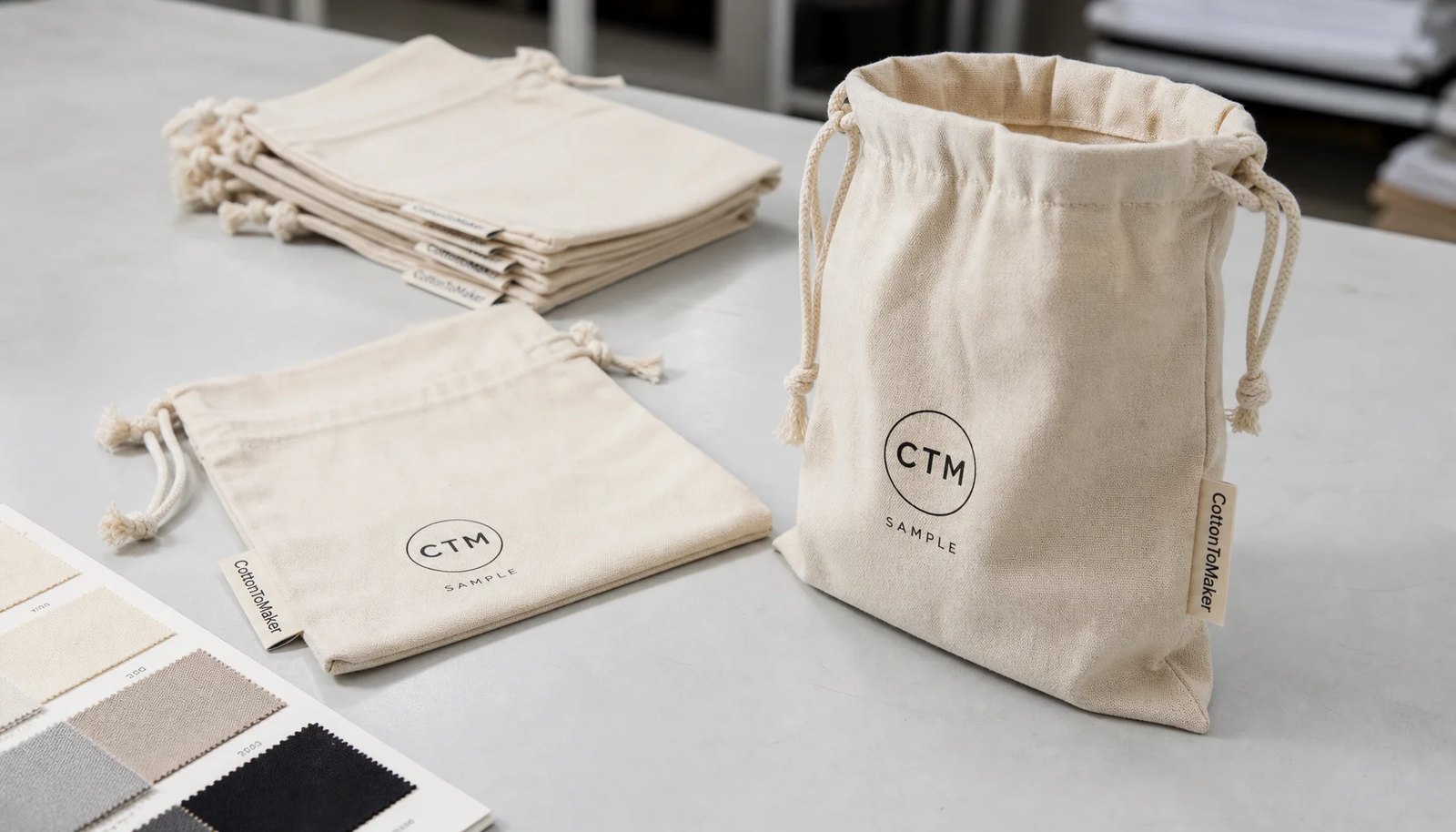
Price Starts With the Bookstore Job, Not the Pouch
A cotton drawstring pouch is an easy item to underestimate. It looks simple on a quote sheet, yet the same pouch can serve very different roles inside a university bookstore program. It may be sold as a retail accessory, used as packaging for graduation items, packed into orientation kits, handed to alumni, or used to organize department merchandise. Each use changes what matters: fabric weight, print precision, cord function, packing format, receiving labels, and the inspection standard.
That is why a custom cotton drawstring pouches bulk pricing plan for university bookstores should begin with the use case. A resale pouch needs a cleaner face fabric, consistent logo placement, scannable retail labeling if required, and a presentation that looks intentional on the sales floor. A pouch for orientation may not need individual packaging, but it does need exact counts, carton labels that a campus team can read quickly, and delivery that lands before move-in. Gift packaging sits somewhere between the two: the pouch should protect the item and lift the perceived value without adding unnecessary labor.
Internal handling matters too. Before requesting a price, map what happens after delivery. Will cartons go to one bookstore dock, a third-party fulfillment center, multiple campus departments, or event staff? Does receiving need cartons split by SKU, PO, destination, or artwork version? Can the bookstore accept bulk inner bags, or does every pouch need a barcode or hangtag? These are not small details. If they are added after production, they become repacking costs, schedule pressure, and avoidable inventory confusion.
- Retail resale: specify clean fabric, tighter logo placement, SKU separation, barcode or hangtag needs, and shelf-ready presentation.
- Gift packaging: test opacity, handfeel, product fit, drawcord closure, and the finished look with the real item inside.
- Orientation and admissions events: prioritize fixed-count inner bags, readable carton labels, fast counting, and on-time delivery.
- Merchandise bundles: confirm the pouch can hold the heaviest or bulkiest item without seam strain or cord slippage.
- Department programs: standardize one pouch body where possible, then vary artwork only when price efficiency matters.
Choose Cotton Fabric With GSM, Finish, and Realistic Appearance Standards
Fabric is one of the main drivers of both unit price and customer perception. For most university bookstore applications, 5 oz to 7 oz cotton, roughly 170 to 240 GSM depending on weave and finishing, is a practical middle range. It gives enough structure for branded packaging, gift bundles, and reusable campus merchandise without making the pouch stiff, bulky, or expensive to ship. Lighter 3 oz to 4 oz cotton, roughly 100 to 140 GSM, can work for very small items such as pins, gift cards, jewelry cards, or light event giveaways, but it may look thin and semi-transparent. Heavy 8 oz to 10 oz canvas, roughly 270 to 340 GSM, feels more rugged, yet the added weight can increase sewing time, carton volume, and freight cost.
Do not let a quote rely on ounce weight alone. Cotton sheeting, canvas, and twill can feel different at similar GSM. Finishing also changes the hand. Ask the supplier to state composition, weave if known, target GSM or ounce weight, fabric color, finish, and whether the stated weight is measured before or after finishing. That wording prevents a common problem: one supplier prices a light natural sheeting while another prices a heavier canvas, and the buyer is left comparing numbers that do not describe the same product.
Natural cotton has its own look. It may include cottonseed specks, small slubs, and mild shade variation. Many bookstores like that because it supports a casual, reusable packaging feel. Others need a cleaner white or a dyed school color. Neither choice is wrong; the key is approving the appearance before bulk production. For dyed fabric, request a lab dip or physical shade sample, then review print opacity on that exact fabric. White ink on navy, maroon, black, or green cotton can look weaker than it does on a digital proof, so a physical sample is worth the time.
- 3 oz to 4 oz cotton: use for light promotional items only after checking transparency and seam strength.
- 5 oz to 7 oz cotton: a reliable default for bookstore retail packaging, branded bundles, and reusable pouches.
- 8 oz to 10 oz canvas: stronger handfeel, but higher fabric cost, sewing effort, carton volume, and freight impact.
- Natural cotton: approve specks, slubs, shade range, fabric odor, and handfeel from a physical swatch.
- Dyed cotton: allow time for shade approval, cord matching, print-opacity review, and colorfastness expectations.
Quote Finished Size and Product Fit Instead of Guessing From Flat Measurements
Finished size is where many pouch programs go wrong. A 6 x 8 inch pouch does not hold a full 6 x 8 inch object once seams, the cord channel, fabric thickness, and product depth are involved. The problem becomes more obvious with mugs, boxed chargers, calculators, graduation accessories, folded apparel, cosmetics sets, and multi-item welcome kits. The pouch can measure correctly on a table and still fail the job because the contents are too bulky to close cleanly.
Always specify finished flat size after sewing, not cut size. Common bookstore ranges include 5 x 7 inches for gift cards and small accessories, 8 x 10 inches for stationery or care-kit items, and 10 x 12 inches for larger merchandise bundles. Practical tolerances are often about +/-0.5 cm for small pouches and +/-1 cm for larger pouches, but a tight product-fit program may need a narrower tolerance. If fit is critical, write the function into the specification. For example: the pouch must hold one 4 x 6 x 1 inch box and close fully, with at least 2 inches of exposed cord remaining after closure.
Construction affects fit as much as size. A flat pouch is usually the best value for bookstore packaging and light resale goods. For thicker contents, a gusseted or boxed-bottom pouch may perform better than simply increasing the width of a flat pouch. Overlocked seams are efficient; turned seams look cleaner; French seams and reinforced corners add labor. The right choice depends on the contents, the price target, and how visible the inside of the pouch will be to the customer.
- State finished flat width and height after sewing, including tolerance and measurement points.
- Confirm channel width, often about 2.5-3.5 cm depending on cord diameter and pouch size.
- Send actual contents, dimensions, and weight when fit affects acceptance.
- For heavier items, specify seam type, bottom-corner strength, stitch quality, and a functional load test.
- For bulky products, compare a gusseted sample with a larger flat pouch before approving production.
Treat Drawcords as a Functional Specification
Drawcords are easy to overlook in a price request. They are also one of the first things a customer touches. A cotton cord gives a soft, natural look and pairs well with unbleached cotton. A polyester cord may provide smoother pulling, stronger color matching, and better options for school-color programs. Either material can be correct. What creates risk is leaving the cord undefined and assuming the factory will choose what the bookstore has in mind.
The RFQ should name the cord material, diameter, color, exposed length, knot method, and closure type. Single-draw pouches are usually lower cost and fine for many light uses. Double-draw pouches feel more balanced and are easier to open and close from both sides, especially for retail presentation. The channel must match the cord. Too narrow, and the pouch catches or bunches. Too wide, and the top looks loose and uneven. A sample should be opened and closed repeatedly with the intended contents inside, not tested empty for two seconds.
Cord color deserves its own approval when school colors matter. A written description such as navy, royal blue, gold, or maroon is not precise enough for a university brand program. Cotton cord can be harder to match exactly than printed ink, while polyester may offer a more consistent shade but a less natural story. If color is important, request a cord swatch or a finished sample. It is cheaper to settle the cord early than to discover a mismatch after thousands of pouches have been sewn.
- Define cotton or polyester cord, diameter, color, exposed length, knot style, and single-draw or double-draw closure.
- Check that cord ends do not pull into the channel during normal opening and closing.
- Test closure with the actual contents, especially for bulky or heavy kits.
- Approve cord color from a physical swatch when brand color consistency matters.
- Reject tight channels, broken channel stitching, severe twisting, loose knots, or heavy bunching.
Match Logo Method to Cotton Texture, Detail, and Licensing Rules
Screen printing is often the best value for bulk custom cotton drawstring pouches when the artwork uses one to three solid colors. It works well for bookstore names, simple mascot graphics, orientation campaigns, alumni marks, and department lockups. The limitation is the surface. Cotton texture can soften edges, and fine reversed text or small mascot details may fill in. Before quoting, the supplier should review line weight, text size, print area, and whether the artwork needs an underbase on dark fabric.
Heat transfer may be a better choice for gradients, small detail, or artwork that needs sharper edges than screen print can deliver on cotton. It can also change the handfeel and sometimes shows a film edge, so the physical sample matters. Embroidery can look premium on heavier canvas, but it adds handling and can pucker lighter fabric. A woven label is often useful when a licensed mark, department seal, or small logo must remain crisp at a small size. In some programs, a simple front screen print plus a small sewn label is the cleanest compromise.
University licensing should be handled before production pressure builds. A digital proof confirms layout, but it does not prove ink opacity, print adhesion, color appearance on fabric, or placement after sewing. The approved physical pre-production sample should become the control sample for production and inspection. If Pantone references are supplied, clarify whether the target is Pantone coated, uncoated, or the approved physical sample. Ink on cotton will not look identical to ink on paper, and the approval process should allow for that reality.
- Screen print: strong value for 1-3 solid colors and moderate detail on cotton.
- Heat transfer: useful for gradients, small text, and complex art; sample handfeel and edge visibility.
- Woven label: good for sharp small marks, department seals, or licensed artwork with fine detail.
- Embroidery: premium on heavier canvas; confirm cost, puckering risk, and minimum artwork size.
- Artwork package: vector file, Pantone references, print size, placement, line-weight limits, and approval authority.
Build Bulk Price Tiers Around the Variables That Actually Create Cost
Bulk pricing is not just fabric plus sewing. A realistic unit cost includes fabric consumption, cutting yield, cord cost, print setup, print handling, waste allowance, packing labor, carton materials, inspection, and order complexity. A low quote may exclude screens, sample fees, artwork cleanup, barcode labels, hangtags, carton marks, or export packing. For university procurement, the better comparison is landed cost per accepted usable pouch, delivered in time for the bookstore calendar.
MOQ should be reviewed by version, not only by total quantity. A 5,000-piece order in one size, one fabric color, one cord color, one print, and bulk packing is efficient. A 5,000-piece order split across ten department logos, three pouch colors, two cord colors, and several barcode versions may behave like a group of small runs. Each variation can require separate setup, staging, counting, packing, and inspection. That is where budget surprises usually enter.
Ask suppliers to quote clear tiers: 500, 1,000, 3,000, 5,000, and 10,000 pieces per version. These tiers show where real price breaks appear and whether it is worth combining semester needs with orientation, graduation, homecoming, or holiday retail quantities. The lowest unit price is not always the right buy if it creates dead inventory, but price tiers give procurement a practical basis for consolidation conversations across departments.
- Request unit price, setup cost, sample cost, screen charge, packing cost, and delivery basis as separate line items.
- Clarify whether MOQ applies per size, fabric color, cord color, artwork, print color count, or packing method.
- Lower-cost structure: one size, one fabric, one cord, one print position, bulk packing, and one destination.
- Higher-cost structure: dyed fabric, multiple logos, small SKU splits, individual barcodes, hangtags, and destination sorting.
- Compare FOB, delivered, and distributor offers using landed cost per accepted pouch, not headline unit price.
Write an RFQ a Factory Can Price Without Filling in the Blanks
A strong RFQ makes supplier quotes comparable. Instead of asking for custom cotton bags, give a complete pouch specification: finished size, fabric weight, fabric color, cord type, cord color, closure type, seam construction, print method, print colors, print size, print placement, quantity by version, packing method, delivery term, inspection requirement, and required arrival date. Without those details, suppliers will make different assumptions, and the cheapest quote may simply describe a different product.
Quantity breakdown is especially important for university bookstores. Departments often want their own mark, and retail teams may need separate SKUs. If the total order is 3,000 pieces but includes six logos, two pouch colors, two cord colors, and two packing formats, the supplier needs that information before pricing. A blended total hides setup work and can lead to a revised quote after internal budget approval. It is better to identify small department versions early and decide whether to consolidate, produce them later, or handle them through a different decoration method.
Ask for carton data before issuing the PO. Estimated carton dimensions, gross weight, net weight, pieces per carton, carton count, and CBM help the bookstore compare landed cost, plan storage, and schedule receiving labor. Final measurements may shift slightly after production, but early data is still useful. During peak academic periods, dock space and staff time can be as scarce as production capacity.
- Include finished size, tolerance, fabric GSM, fabric color, cord details, seam construction, and channel width.
- Attach vector art and list print method, colors, placement, print dimensions, and licensing approval requirements.
- Break quantity down by every variable: size, fabric color, cord color, logo, packing, barcode, and destination.
- Ask suppliers to state included charges and exclusions in writing.
- Request carton dimensions, pieces per carton, gross/net weight, CBM, carton marks, and packing-list format before PO approval.
Use Samples to Approve Fit, Not Just Appearance
A pre-production sample should prove the pouch works. It should not be approved only because the photo looks good. During sample review, pack the intended contents, close the pouch, reopen it, and check whether the seams strain, the cord moves smoothly, the item sits neatly, and the logo remains in the right visual position. Then inspect the fabric handfeel, shade, print opacity, small text, stitch quality, cord length, and any packing components.
A practical approval set may include a fabric swatch, a blank size sample, a printed pre-production sample, and a full packing sample if barcodes, hangtags, warning labels, or retail bags are required. Keep the approved sample and label it with the date, version, fabric, print method, and approval status. For natural cotton, the sample should show the approved range of specks and shade. For dyed cotton, retain the shade standard. For licensed marks, the approved printed sample should be treated as the control reference for bulk production.
Write sample comments as measurable instructions. Instead of saying the logo is too low, state the required distance from the pouch opening or the required center point. Instead of saying the cord feels short, state the minimum exposed cord length when open and when closed. Specific comments prevent repeated sample revisions and protect the launch calendar.
- Fit test: pack the actual item set, close the pouch three times, and check seam strain and presentation.
- Print test: inspect opacity, edge quality, small text, placement, skew, and dry-rub resistance.
- Cord test: open and close repeatedly; check knot security, channel stitching, cord length, and smooth pull.
- Packing test: scan barcode if used, inspect hangtag placement, verify inner-bag count, and read carton marks.
- Approval record: photograph and label approved samples; state whether approval covers fabric, size, print, cord, and packing.
Set QC Defects, AQL Levels, and Tolerances Before Production
Cotton drawstring pouches are simple, but defects can be very visible. Stains, mildew odor, skewed logos, broken stitches, missing cords, wrong counts, and mixed artwork can stop receiving or create retail presentation problems. Define critical, major, and minor defects before bulk production. Critical defects may include mold odor, unsafe contamination, unauthorized artwork, wrong licensed logo, or a pouch that cannot close. Major defects may include visible front stains, open seams, missing cords, wrong size, unreadable barcode, or print skew beyond tolerance. Minor defects may include small loose threads or natural cotton slubs that remain within the approved appearance range.
AQL inspection is commonly used for pre-shipment checks. The exact inspection level and acceptable quality limits should be agreed with the supplier or third-party inspector before production begins. A retail resale pouch usually deserves stricter appearance standards than an internal event pouch. The point is not to copy a generic inspection template. The defect list should match the bookstore’s actual use and customer visibility.
Some problems are too expensive to fix at final inspection. Fabric shade, print opacity, print registration, cord channel function, and carton-label format should be checked at the beginning of production. For larger orders, ask for an in-line inspection or first-production photos and measurements. Catching a tight channel or off-center print after 200 pieces is manageable. Catching it after 10,000 pieces is a claim.
- Fabric weight: target GSM or ounce weight with agreed tolerance, commonly +/-5% unless specified tighter.
- Size: measure finished flat pouch after sewing; use agreed tolerance such as +/-0.5 cm small and +/-1 cm larger pouches.
- Print placement: define measurement points and tolerance, often +/-3 mm to +/-5 mm for small centered logos.
- Function: sampled pouches should open and close repeatedly without cord slippage, channel failure, or seam stress.
- Carton audit: verify SKU, artwork, quantity, inner-bag count, carton marks, barcode labels, and packing list before shipment.
Plan Packing, Receiving, Freight, and Documentation Together
Packing choices affect cost, waste, storage, and receiving speed. Individual polybags can protect retail pieces and keep barcodes clean, but they add material, labor, carton volume, and disposal burden. For event giveaways or in-house bundling, bulk packing by 50 or 100 pieces per inner bag is often simpler and cheaper. If the order ships to a distribution center or multiple campus departments, carton labels should show the PO number, SKU, artwork version, pouch color, quantity, carton number, total carton count, and destination.
Cotton goods also need basic protection in transit. Export cartons should be strong enough for stacking, and inner bags should keep the fabric clean and dry. Ask for carton length, width, height, gross weight, net weight, pieces per carton, carton count, and estimated CBM before shipment. Oversized cartons can increase freight cost by volume. Tiny cartons may slow receiving. Accurate packing data helps compare FOB factory, delivered-duty-paid, and domestic distributor quotes on a real landed-cost basis.
Be careful with sustainability language. A reusable cotton pouch can support a reduced-disposable-packaging program, but claims such as organic, recycled cotton, fair trade, compostable, or plastic-free need documentation and bookstore approval. If the goal is to reduce plastic, compare individual polybags with fixed-count inner bags, paper belly bands, hangtags, or carton-level barcode workflows. The best plan is the one that meets retail and receiving needs without adding packaging the bookstore does not actually use.
- Retail packing: individual bag, barcode, hangtag, country-of-origin label, SKU separation, and shelf presentation if required.
- Event packing: fixed-count inner bags, simple carton marks, and destination labels for fast campus distribution.
- Import packing: clean export cartons, moisture protection, accurate packing list, stable carton weights, and no unapproved mixed SKUs.
- Freight planning: request carton L x W x H, gross weight, net weight, pieces per carton, carton count, and estimated CBM.
- Claim control: require documentation before using organic, recycled, certified, compostable, or similar environmental claims.
Specification comparison for buyers
| Spec decision | Recommended B2B specification | When it fits | Buyer risk to control |
|---|---|---|---|
| Fabric weight | 5 oz to 7 oz cotton canvas or sheeting, approximately 170-240 GSM; state whether weight is before or after finishing | Most bookstore resale pouches, orientation kits, small apparel bundles, stationery sets, alumni gifts, and mid-range retail packaging | 3 oz cotton can be see-through and weak for resale; 10 oz canvas may be stiff, bulky, slower to sew, and more expensive to ship |
| Finished size | Quote finished flat size after sewing, not cut size; common range 5 x 7 in to 10 x 12 in; tolerance often +/-0.5 cm small pouches and +/-1 cm larger pouches | Pins, gift cards, chargers, course kits, cosmetics, dorm welcome items, graduation accessories, spirit merchandise bundles | Flat size is not usable capacity; seams, channel, fabric thickness, and bulky contents reduce usable space |
| Construction | Flat pouch with overlocked or turned side seams, 2.5-3.5 cm cord channel, 7-10 stitches per inch as a practical sewing target | Standard bookstore programs where the pouch is packaging or a reusable branded item | Too-narrow channels, open seams, weak bottom corners, skipped stitches, and short cords cause function failures even when the pouch looks acceptable |
| Drawcord | Cotton cord for natural look; polyester cord when stronger color matching or smoother pull is needed; confirm diameter, length, knot, and single or double draw | Cotton cord suits natural campus packaging; polyester works for school-color cords or higher closing durability | Cord color, cord shrinkage, knots, and channel fit are often omitted from low-price quotes |
| Logo method | Screen print for 1-3 solid colors; heat transfer or woven label for small detail, gradients, or tight licensed marks | Bookstore logos, mascot art, orientation campaigns, alumni marks, department lockups | Fine reversed text below roughly 1.5-2 mm stroke width can fill in on cotton; approve line weight and ink opacity on a physical sample |
| MOQ and price tiers | Request pricing at 500, 1,000, 3,000, 5,000, and 10,000 pcs per version, with setup fees listed separately | Semester buys, graduation, homecoming, move-in, gift-with-purchase, department resale | A 5,000 pc total split across many sizes, colors, logos, and packing versions may price like several small runs |
| Packing | Bulk pack 50 or 100 pcs per inner bag for event or backroom use; individual bag, barcode, hangtag, or SKU label only when retail process requires it | Bulk programs, bookstore bundles, retail floor stock, e-commerce fulfillment, campus department distribution | Over-packing adds labor, plastic, carton volume, and cost; weak carton marks slow receiving and allocation |
| Inspection | Define critical, major, and minor defects; use AQL pre-shipment inspection and in-line checks for print, fabric, size, and drawcord function | Licensed marks, resale goods, orders above several thousand units, fixed academic event dates | Final inspection cannot economically correct wrong fabric shade, poor ink opacity, tight cord channels, or carton-label errors found too late |
| Lead time | Plan separate windows for artwork, sample, material booking, production, inspection, export, freight, customs, and campus receiving; production often starts only after sample approval and deposit | Import programs for orientation, graduation, homecoming, holiday retail, and admissions events | The sewing time is rarely the only bottleneck; late PO approval, licensing review, packing material delays, or missed inspection slots create schedule risk |
Buyer checklist before sampling
- Define the business use: retail SKU, gift packaging, orientation kit, course kit, apparel bundle, alumni promotion, department giveaway, or gift-with-purchase packaging.
- Specify fabric composition, weave, target GSM or ounce weight, fabric color, finish, acceptable natural cotton specks, shrinkage expectation, and whether dyed shade approval is required.
- State finished flat size after sewing, intended contents, product dimensions and weight, drawcord type, cord color, cord diameter, single or double draw, seam type, channel width, and size tolerance.
- Send vector artwork with Pantone or brand color references, print method preference, print size, placement dimensions, approved logo lockup, licensing notes, and minimum line/text requirements.
- Break quantities by size, fabric color, cord color, artwork version, packing version, barcode version, and destination instead of giving only one total quantity.
- Request price breaks at 500, 1,000, 3,000, 5,000, and 10,000 pieces per version, with screen charges, sample fees, labels, hangtags, special packing, and freight basis separated.
- Approve samples against measurable criteria: fabric handfeel, shade, GSM, finished size, product fit, cord closing, stitch quality, print color, print adhesion, barcode scan, and packing format.
- Confirm labeling needs: barcode, hangtag, care label, warning label, country-of-origin mark, fiber content statement, licensed university label, or environmental-claim documentation.
- Request carton length, width, height, gross weight, net weight, pieces per inner bag, pieces per master carton, carton count by SKU, pallet requirements, and carton mark format.
- Build the schedule backward from the required in-store date, including licensing approval, sample transit, sample revision, deposit, production, inspection booking, export, freight, customs, and campus receiving buffer.
Factory quote questions to send
- What exact fabric is included in the price: composition, weave, ounce weight or GSM, color, finish, and whether the stated weight is before or after washing/finishing?
- Is the quoted size the cut size or finished flat size after sewing, and what dimensional tolerance do you apply for this pouch size?
- What MOQ applies per size, fabric color, cord color, print artwork, and packing style, and what price breaks apply at 500, 1,000, 3,000, 5,000, and 10,000 pcs?
- Which print method is included, how many colors are included, what maximum print area is priced, and what screen, setup, film, color-change, or handling charges are separate?
- Can you confirm drawcord material, diameter, color standard, exposed length, knot method, channel width, and whether the price includes single-draw or double-draw closing?
- What sample options are available: fabric swatch, blank size sample, printed pre-production sample, production reference sample, and full packing sample with barcode or hangtag?
- What QC limits do you use for stains, holes, loose threads, broken stitches, skipped stitches, print skew, print color variation, size variation, and drawcord function?
- How many pieces are packed per inner bag and master carton, and can you apply bookstore SKU labels, barcodes, hangtags, carton marks, PO labels, or destination labels?
- When does production lead time start, and which items can delay it: fabric dyeing, cord color, artwork approval, sample sign-off, deposit, packing materials, or inspection booking?
- Can you provide estimated carton dimensions, gross weight, net weight, CBM, carton quantity, and HS code guidance before PO approval for landed-cost planning?
Quality-control points to confirm
- Fabric weight should match the approved specification within an agreed tolerance, commonly +/-5% for cotton pouch fabric unless a narrower range is contracted.
- Finished flat dimensions should be measured after sewing; a practical tolerance is often +/-0.5 cm for small pouches and +/-1 cm for larger pouches, with tighter control for product-fit programs.
- Drawcord channel width should be consistent and wide enough for smooth closing; reject channels with skipped stitching, broken thread, severe twisting, or cord ends pulling into the channel.
- Print placement should be measured from pouch edges or opening; agree a tolerance such as +/-3 mm to +/-5 mm for small pouches and larger only if the artwork allows it.
- Print adhesion should pass basic dry rub handling and, if required, a light wet rub or tape test agreed before production; ink should not flake, powder, crack, or transfer under normal handling.
- Print color should be compared with the approved physical sample or Pantone target under consistent lighting, allowing realistic variation from cotton texture and fabric shade.
- Cotton fabric should be free from oil stains, mildew odor, unacceptable holes, sharp contamination, heavy slubs outside the approved natural look, and mixed shade panels within the same SKU.
- Seams and bottom corners should withstand the intended product weight; test heavier bookstore contents such as books, chargers, boxed gifts, glassware, or bundled apparel before bulk approval.
- Loose threads should be trimmed, knots secure, and seam starts/ends back-tacked or otherwise secured so they do not unravel after several open-close cycles.
- Carton packing should match the packing list exactly, with correct SKU separation, inner-bag count, labels, barcodes if required, moisture protection for transit, and no mixed artwork unless approved.