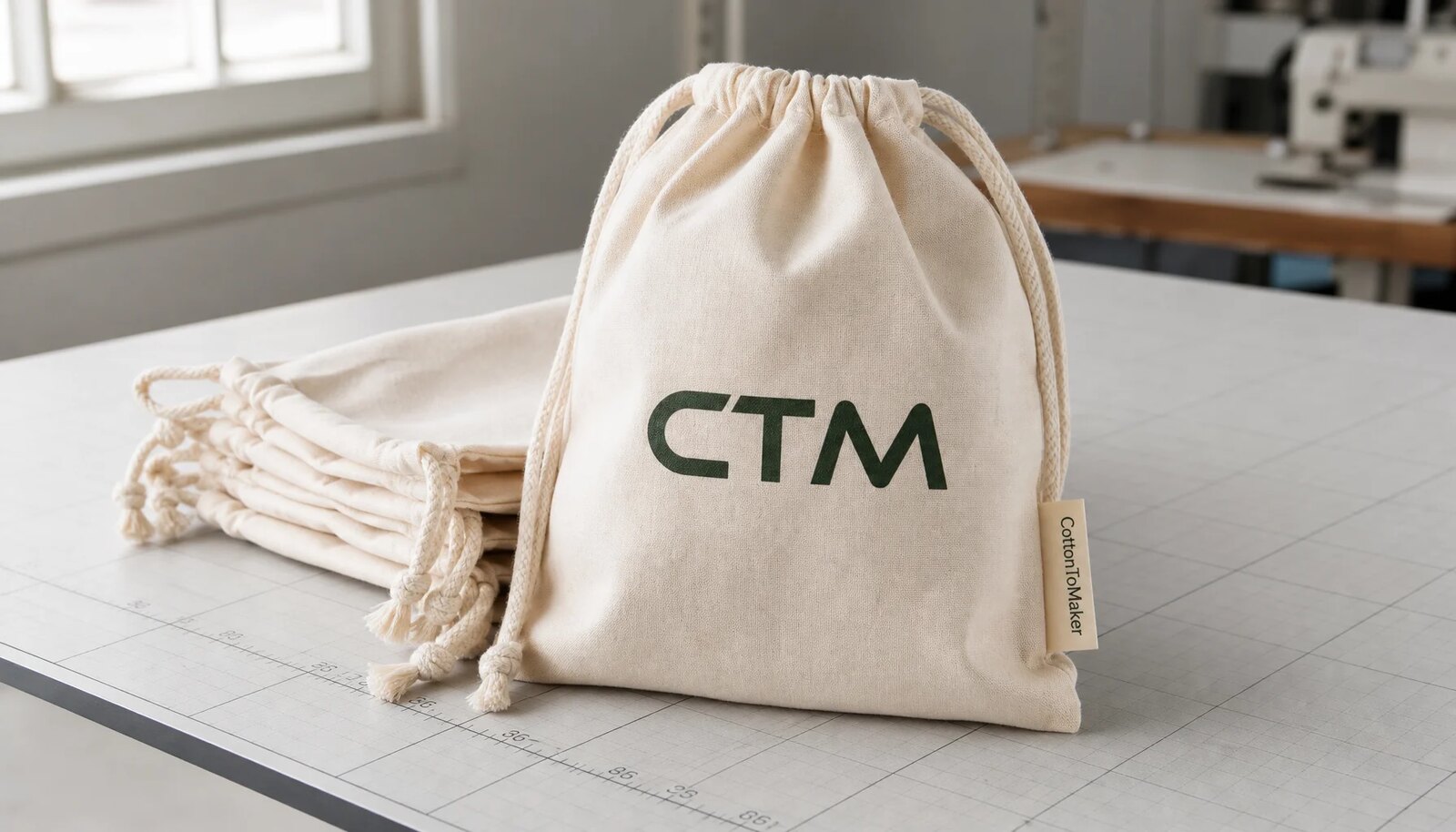
Start With the Selling Use Case
Most bad pouch quotes start with the wrong starting point. For farmers market vendors, a cotton drawstring pouch is usually not a fashion accessory. It is a working package for soap bars, tea sachets, spice blends, dried fruit, small gifts, seed packs, or sampler kits. That means the buying decision should start with fill weight, closing method, shelf presentation, and how many times the pouch will be reused after the first sale. If the pouch is meant to be handed out at a booth and then discarded, you can keep the spec light. If the pouch becomes part of a retail gift set, the finish has to look consistent in a customer photo and still hold up after repeated opening.
A useful RFQ begins with the use case, not just the logo. State whether the pouch needs to stand upright, whether it will carry food contact items, whether the customer will keep it as packaging or reuse it as storage, and whether the vendor wants a natural rustic look or a cleaner retail finish. Those details influence GSM, seam finish, cord type, and print method more than many buyers expect. If the supplier does not understand the application, they will default to a generic pouch and the quote will look good only until the first production sample arrives.
- Define the product load first: light samples, mixed craft goods, or heavier retail kits.
- Choose the pouch as packaging or as a reusable retail item, because the spec changes.
- State the market use case in the RFQ so the factory does not overbuild or underbuild the pouch.
Choose Fabric Weight Before Price
For custom cotton drawstring pouches, fabric weight is one of the few specs that directly changes the buying experience. A 120 to 140 GSM cotton is usually enough for lightweight giveaway pouches, dry goods, and simple market sampler packs. A 150 to 180 GSM cloth gives a better hand feel, less transparency, and better seam stability for retail sets. Once you move into 180 to 200 GSM, the pouch starts to feel more premium and can better support repeated use, but it also raises fabric cost and may change the way the drawcord channel folds. If the vendor wants the bag to feel substantial in hand, the extra weight is usually visible to the end buyer.
Buyers should not choose GSM in isolation. The weave density, yarn quality, shrinkage behavior, and seam allowance all affect how the pouch behaves after cutting and sewing. A heavy but loose weave can look rough and distort in print. A lighter but tighter weave can print cleanly and still hold a reasonable load. For market vendors, the safest approach is to choose a modestly heavier fabric that still prints cleanly, then lock the size around the contents instead of guessing from the outside dimension alone.
- 120 to 140 GSM: best for light giveaway use and low-cost sampling.
- 150 to 180 GSM: good balance for retail resale and repeat use.
- 180 to 200 GSM: better for premium presentation, heavier contents, or stronger reuse value.
- Ask for finished size after shrinkage, not only the cut size before sewing.
Print Method Changes the Quote
Printing is where many buyers accidentally compare two very different products as if they were the same. A one-color screen print is usually the most practical option for a cotton drawstring pouch in bulk because it scales well, looks clean on natural fabric, and keeps setup manageable. If the artwork is simple and the brand color is a solid spot color, screen print normally gives the best balance of cost and durability. If the design is detailed, shaded, or photo-based, you may need digital or transfer work, but that often raises the unit price and can introduce a different feel on the cloth surface.
The print spec should be written down in a way the factory can quote without interpretation. State the number of colors, the print area in centimeters or inches, the position on the pouch, and whether the art must stay clear of the drawcord channel and side seams. For a market vendor program, the most common mistake is asking for a large print area on a small pouch, which forces the factory to fight seam distortion and slows production. If the logo is only meant to identify the brand, a smaller centered mark or a neat side label often gives a better result than trying to fill the full front panel.
- Use one-color screen print unless the artwork really needs more.
- Keep the print away from seams and the drawcord channel unless the factory has approved placement.
- Ask whether the quote includes screen setup, color matching, and print re-run allowance.
- If brand identity matters more than print size, consider a woven side label or sewn tag.
MOQ and Price Breaks Need a Real Plan
MOQ is not just a factory rule; it is part of the pricing model. In custom cotton drawstring pouches, the main cost drivers are cutting efficiency, printing setup, sewing labor, label application, and packing. That means the unit price usually falls sharply once the run is large enough to absorb the setup costs. A buyer asking for 300 pcs, three sizes, two print colors, and individual retail packing is not buying the same product as a buyer ordering 5,000 pcs of one standard size with flat bulk packing. The quote should reflect that difference clearly.
For a market vendor program, the best volume logic is usually simple. Keep one pouch body size, one fabric color, and one print placement for the base program, then use a second spec only if the sales channel proves it needs more value. If you need multiple sizes, let one size dominate the order and keep the other sizes to a smaller allocation. That keeps the cutting yield stable and avoids turning the pouch into a custom production puzzle. Buyers who want low MOQ should protect the spec from unnecessary variation, because every added variable raises the cost of setup, approval, and rework.
- At low volume, setup cost can matter more than fabric cost.
- One size and one print placement usually beat a multi-SKU start.
- If the supplier offers a price ladder, compare the jump from 1,000 to 3,000 and 3,000 to 5,000 pcs, not just the headline unit price.
- Ask for the same quote with bulk pack and retail pack so the packing premium is visible.
Compare Supplier Routes Before You Compare Prices
The table above is useful because it separates sourcing routes that look similar on paper but behave very differently in production. A direct factory is usually the right route when the spec is stable and the buyer wants the lowest repeat cost. A trading company can help when the order includes multiple product types or when you need a single contact to manage more than one factory. A domestic decorator can be useful for a first market test or for urgent replenishment, but the quote usually climbs quickly when the order grows. A stock blank plus local print route can be fast, but it is often the least controlled on shade, cord quality, and final finishing.
The most important thing is to match the route to the business problem. If the program is a seasonal farmers market line with uncertain demand, a stock blank or low-MOQ custom route may be the safest. If the product will be part of ongoing retail packaging, direct factory sourcing gives you more control over the repeat spec and the landed cost. Buyers should not treat all suppliers as interchangeable. The same pouch can come from a factory, a trader, or a decorator, but the commercial risk, lead time, and QC burden are not the same.
- Use direct factory sourcing when the spec is repeatable and volume is stable.
- Use a trading company when you need consolidation or broader product support.
- Use local printing only when speed matters more than unit cost.
- Use stock blanks only as a test route, not as the final long-term model.
Sample Approval and QC Thresholds
A sample is not just a preview; it is the contract in physical form. The buyer should approve size, stitch quality, drawcord function, print placement, label position, and carton packing on the sample before bulk starts. If the supplier sends a beautiful pre-production piece and then runs bulk to a looser standard, the entire quote comparison becomes useless. Set the allowed tolerance in writing. For a small pouch, a tight size tolerance matters because a few millimeters can change whether the market vendor can fit the intended product or whether the pouch looks stretched after filling.
QC should focus on failure points that matter in the field. The drawcord channel must run smoothly and not jam when pulled. The side seams should be straight, with no open stitches at the top corners where tension concentrates. Print adhesion should survive a basic rub test and not flake off when the pouch is packed and unpacked. If the product will sit near food, bath items, or cosmetics, the bag also needs to pass a smell and residue check so the customer does not notice finish odor or dusty residue. For retail buyers, the first rejected carton is often caused by inconsistent sample sign-off, not by a catastrophic defect.
- Keep one golden sample signed and dated by both sides.
- Set size and stitch tolerances before bulk starts.
- Require a basic rub test on the print and a pull test on the drawcord.
- Inspect the first run off the line before the factory completes the full lot.
Packing, Cartons, and Retail Readiness
Packing choices change both cost and damage rate. Flat bulk packing in outer cartons is usually the cheapest and fastest for custom cotton drawstring pouches, especially when the buyer plans to distribute them as inserts, retail packaging, or market supply. Individual polybags make sense when the pouch will sit on a shelf, but they add labor, plastic cost, and more carton volume. If the pouch is part of a retail set, it may be better to pack it with the rest of the kit in counted inner packs rather than over-pack the pouch by itself. The right answer depends on whether the product is sold empty, filled, or bundled.
Carton planning is not an afterthought. Buyers should know how many pouches fit in each carton, the target gross weight, and whether the carton can survive palletization or long transit without crushing the product. A pouch can look cheap simply because it arrives creased, unevenly counted, or packed too tightly. Good factories will tell you the carton dimensions early, not after the goods are ready to ship. That lets procurement compare freight cost and storage efficiency, which often matters as much as the factory price when the order is moving through a distributor or retail warehouse.
- Use flat bulk pack if the pouches are not being sold as individual shelf units.
- Use inner packs when count accuracy or kit assembly matters.
- Ask for carton dimensions and gross weight before final approval.
- If the shipment will sit in warehouse storage, avoid over-compressed packing that leaves permanent creases.
Lead Time and Schedule Risk
A workable lead time starts with sample approval, not with the purchase order date. For custom cotton drawstring pouches, the schedule usually includes artwork confirmation, sample making, sample revision if needed, bulk fabric reservation, production, packing, and shipment booking. A simple repeat order with no artwork changes can move fairly quickly. A first order with a new size, new label, or new print method should be treated as a longer project because the first sample rarely gets every detail right on the first pass. Buyers who promise a booth launch or seasonal sell-in without buffer usually end up paying for rush fees or accepting a compromised spec.
The main schedule risks are predictable. Fabric shade can shift if the supplier changes dye lots. Screen print can slip if the art is approved too late or if the placement is too close to the seam. Label approval can delay production if the buyer changes the brand name or label size after sample sign-off. Carton art can also slow shipment if the marks do not match the buyer's warehouse system. The best way to protect the schedule is to lock the spec early, approve the sample decisively, and leave room for one correction cycle before bulk starts.
- Treat sample approval as a gate, not a courtesy step.
- Build buffer time for label changes and print revisions.
- Reserve extra time if the order uses a new fabric shade or new packing format.
- Do not schedule marketing or booth launch dates off the factory's best-case date.
Read the Quote Like a Buyer, Not a Shopper
A good factory quote should show the parts of the cost that actually move. Buyers need to see the fabric type and GSM, pouch size, print method, label work, packing method, carton data, and the assumed shipping term. When the supplier gives one all-in number with no details, it becomes impossible to tell whether the quote is competitive or simply stripped of the items that will later reappear as extras. For custom cotton drawstring pouches, the biggest comparison mistake is to focus only on the unit price and ignore the packing, setup, or rework exposure. That is how a low quote turns expensive during the first production cycle.
The cleanest way to compare landed cost is to ask for three options on the same sheet. Option one should be the base spec you actually want. Option two should show one controlled upgrade, such as a heavier GSM or a woven label. Option three should show the same pouch with different packing, such as bulk pack versus individual polybag. That gives procurement a realistic view of where the cost moves and which tradeoffs the market can accept. A quote that exposes these differences is more useful than a quote that hides them inside one number. For a vendor-facing product, transparency is the cheapest risk control you can buy.
- Compare ex-factory price and landed cost separately.
- Require the quote to split fabric, sewing, print, label, packing, and carton charges.
- Use three quote options to expose cost drivers instead of arguing over one number.
- Keep the quote tied to the approved sample so the next reorder stays consistent.
Specification comparison for buyers
| Spec decision | Recommended option | When it fits | Buyer risk to check |
|---|---|---|---|
| Direct factory order with standard spec | Best unit cost and repeatability for a single pouch style | You have stable artwork, a clear size, and 5,000 pcs or more | Confirm actual GSM, seam allowance, and print area before PO |
| Trading company with factory network | Useful when you need mixed items or consolidated sourcing | You are building a broader market booth or gift program | Verify which factory makes each item and who owns QC responsibility |
| Stock blank pouch plus local print | Lowest setup cost for a trial run or seasonal test | You need speed and do not want a full custom production cycle | Fabric shade, drawcord quality, and print adhesion can vary by batch |
| Domestic decorator near your market | Fastest turnaround and easiest artwork revisions | You need small replenishment or last-minute event orders | Unit cost usually rises fast once volume grows |
| Low-MOQ custom factory | Good for 500 to 2,000 pcs with a simple logo | You need custom size or label work but cannot commit to a large run | Check screen setup fees, minimum fabric width, and carton fill |
| Premium factory with tighter sewing control | Best for retail-ready pouches where finish matters | The pouch is part of a branded set or resale item | Ask for seam control, edge finishing, and defect replacement policy |
| Mixed-size order from one supplier | Efficient when one body size can serve samples, bundles, and gift sets | You want fewer SKUs and a more manageable inventory plan | Smaller sizes may lose price advantage if cutting yield drops |
| Private-label route with woven side label | Good when brand identity matters as much as the pouch itself | Retail packs, subscription inserts, or resale programs | Confirm label size, stitch position, and whether it is sewn before or after washing |
Buyer checklist before sampling
- Final pouch size with usable internal dimensions, not only the flat cut size
- Fabric weight in GSM, fabric color, and whether the cloth is natural, bleached, or dyed
- Drawcord type, cord diameter, and whether the ends are knotted, heat-cut, or folded
- Print method, print placement, ink color, and artwork file format
- Label type, label position, and whether the label is woven, printed, or sewn-in
- Packing format, carton quantity, and target carton weight
- Approved sample reference and allowed defect level
- Shipping term, sample charge, lead time, and reprint policy
Factory quote questions to send
- What is your unit price at 500, 1,000, 3,000, and 5,000 pcs for the same spec?
- Does the quote include screen setup, label stitching, carton packing, and master carton marks?
- What GSM are you using, and what shrinkage allowance do you build into the finished size?
- Which print method are you pricing, and how many colors are included without extra setup?
- What is the lead time from artwork approval and from pre-production sample approval?
- What defect rate do you accept, and what is your replacement policy for misprints or seam failure?
- What are the carton size, carton count, gross weight, and pallet or container loading assumption?
- Can you quote a second option with slightly heavier fabric or better packing so I can compare landed cost?
Quality-control points to confirm
- Finished size matches the approved sample and stays within the agreed tolerance
- Fabric GSM matches the quote and the cloth is even, without thin panels or weak spots
- Seams are straight, secure, and free of skipped stitches, loose thread tails, or needle damage
- Drawcord pulls smoothly through the channel and does not fray at the exit points
- Print is centered or placed as approved, with clean edges and no cracking, smudging, or ghosting
- Label is stitched in the correct position and does not distort the pouch body
- Bulk packed quantity per carton is accurate, carton marks are readable, and cartons hold shape
- Sample approval is signed off before mass production and the golden sample is kept on file