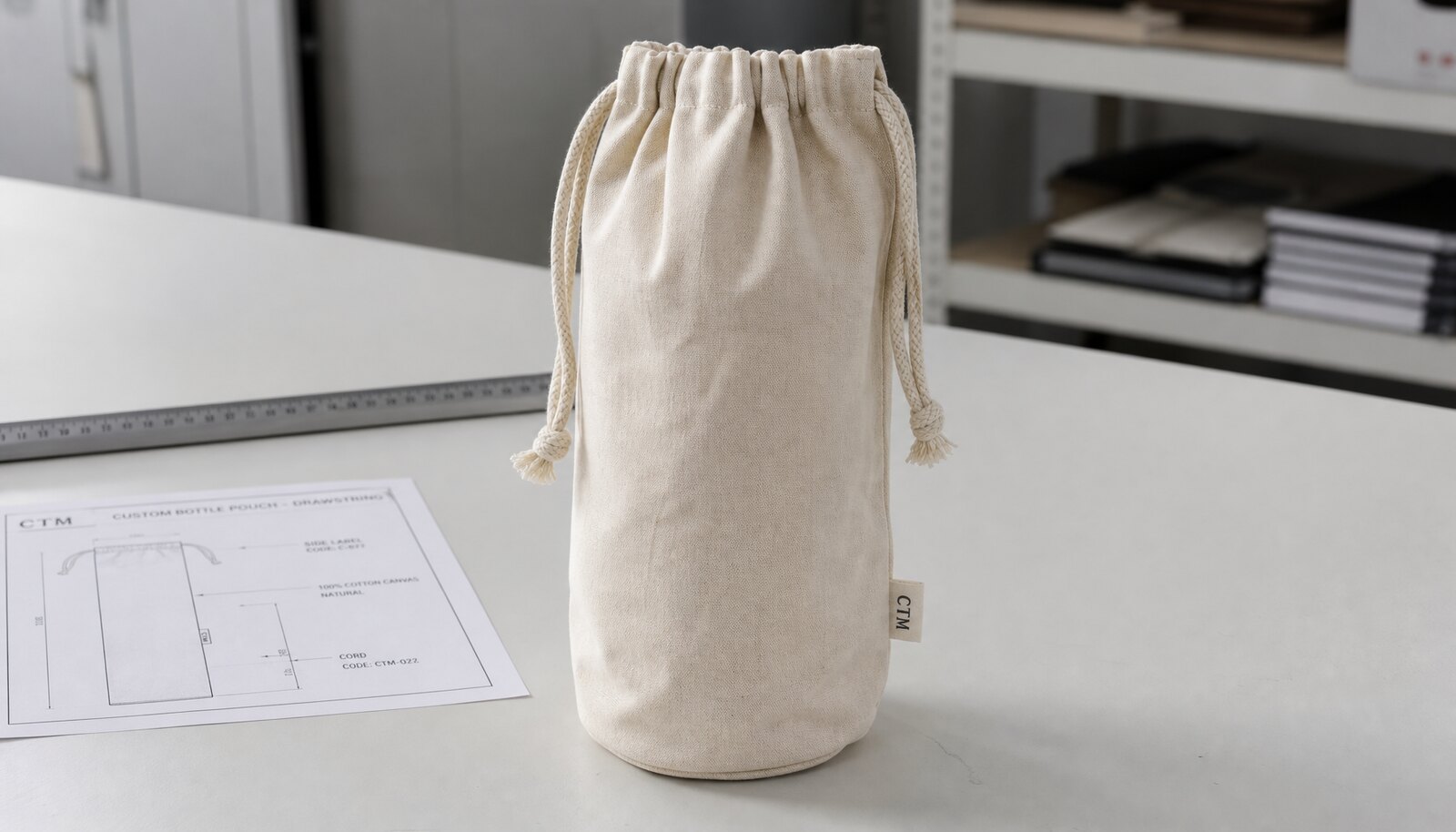
Why boutique wineries buy cotton drawstring pouches differently
For a boutique winery, a cotton drawstring pouch is rarely a generic bag purchase. It is part of a bottle presentation, a tasting-room upsell, a wine-club gift, a holiday hamper, or a retail bundle that needs to feel considered without destroying margin. The commercial question is not simply whether the pouch looks attractive. It is whether the pouch fits the bottle cleanly, supports the story of the wine, packs efficiently, and still leaves room for the winery, distributor, or retailer to make money.
That is why buyers should think about use case before they think about decoration. A pouch for a one-bottle tasting-room takeaway may only need enough structure to look tidy and protect the bottle from minor scuffing. A pouch for a direct-to-consumer holiday set may need heavier cloth, stronger seams, and more careful folding because the presentation has to survive shipping. A retail gift pouch may need a cleaner face, better opacity, and a more consistent finish across cartons because buyers see the packaging as part of the product.
The channel matters as much as the pouch itself. Tasting-room stock tends to move in smaller batches and may be replenished throughout the year. Club shipments and holiday promotions are usually seasonal and demand firmer planning windows. Distributor programs often need simpler packing and clearer carton counts so warehouse teams can receive and split the goods quickly. If the buyer does not define the channel first, the supplier is left guessing at the right compromise between cloth weight, decoration, and pack method.
Boutique-winery sourcing also tends to involve a tradeoff between presentation and logistics. A more premium 180-220 GSM fabric can improve the perceived value of the bottle, but it also increases cloth consumption and may reduce carton efficiency. A lighter 120-140 GSM option can be economical, but if it feels flimsy or becomes semi-transparent over a dark bottle, the pouch may undermine the premium message. For procurement teams, that tradeoff should be visible in the quote, not discovered after the goods arrive.
A practical way to approach the purchase is to define the pouch as a packaging component with a sales role. Once that is clear, the sourcing decision becomes easier to manage: size, GSM, closure, print, packing, and landed cost should all align with the channel and the bottle program. That is the standard that separates a low-friction bulk order from a pile of packaging exceptions.
If the winery uses several bottle formats, the pouch decision gets even more commercial. A standard 750 ml Bordeaux-style bottle may fit very differently from a Burgundy bottle with broader shoulders, and sparkling wine bottles can require more height and a broader opening. A pouch that is technically the right length but too tight at the shoulders can cause friction at packing time and a poor opening experience later. Procurement should therefore treat the pouch as a bottle-fit spec, not only a logo item.
- Treat the pouch as packaging plus presentation, not as a generic promo item.
- Match the pouch purpose to the bottle type, channel, and expected handling cycle.
- Build the quote around the final use case: tasting room, club shipment, retail set, or distributor gift.
- Use the actual bottle family in sizing decisions, especially when the winery sells more than one shape.
Start with bottle fit, finished size, GSM, closure, and print area
Many weak quotes begin with the artwork. That is backwards. The starting point should be the physical bottle or gift set, because the pouch has to close cleanly around the product before anyone can worry about branding. Measure the bottle height, shoulder width, and the diameter at the widest point. If the pouch is meant to hold a bottle plus an insert card, hangtag, or tissue, include those dimensions too. Then convert that into a finished pouch spec that describes usable internal space, not only the fabric blank before sewing.
This distinction matters because finished size and cut size are not the same thing. A supplier can quote a larger cut size, but if the seam allowances and channel construction are not controlled, the actual internal space may shrink more than expected. Buyers should ask for the supplier’s measurement method: is the size taken before sewing, after sewing, or with the pouch laid flat? If the answer is unclear, the quote is not yet procurement-ready. The specification should include both nominal size and acceptable tolerance.
Fabric weight is another decision that should be tied to use case, not taste alone. At 120-140 GSM, a pouch can be light, economical, and suitable for simple bottle sleeves or event giveaways. At 150-170 GSM, it usually lands in a more balanced zone for mixed winery use, especially if the customer sees the pouch as part of a gift. At 180-220 GSM, the hand feel becomes more substantial, and the pouch often performs better in retail presentation or repeat handling. Heavier cloth also tends to reduce the visual weakness that can appear when a dark bottle shows through a thin natural cotton shell.
For decoration, simple usually wins at bulk scale. One-color screen print is often the most efficient option when the logo is clean and the artwork area is modest. If the winery wants a quieter finish, a woven label or sewn patch may be better than large print coverage. Embroidery can look premium, but it should be treated as a separate cost and quality question because stitch density, backing, and registration all affect both price and appearance. The key procurement rule is to avoid mixing methods in the initial RFQ unless the buyer is willing to pay for and inspect the added complexity.
Closure details deserve more attention than they usually get. A cotton cord should glide through the channel without snagging, and the channel itself should resist puckering when the bag is cinched. A pouch for bottle gifting is opened and closed more than a promo bag, so the cord hole and bartack become real wear points. If the bag is meant to be reused by the recipient, then those structural details matter to the brand impression as much as the logo does.
Color and opacity also affect pricing logic. Natural cotton is the easiest starting point, but if the winery needs a dyed shade or a more controlled cream tone, the buyer should ask whether the fabric lot is dyed before cutting or whether the supplier is trying to match a target shade in-house. Shade matching introduces variation risk and should be checked against carton samples. For premium packs, opacity should be verified by placing the intended bottle inside the pouch under normal indoor light.
Finally, do not ignore the print area. The logo may look fine on a mockup, but if the pouch narrows too much near the opening, the art can disappear into folds or sit too close to the seam. Buyers should define the printable zone in relation to the finished construction, not only the flat artwork file. That avoids the common problem where the design is technically printed correctly but visually lost once the pouch is filled and tied.
A solid spec sheet should therefore lock the use case, bottle dimensions, finished size, GSM, closure, color, and printable area before the supplier quotes. Once those elements are fixed, pricing becomes a manufacturing question instead of a guessing exercise.
- Define finished size using bottle dimensions and usable opening, not only flat fabric measurements.
- Specify GSM with a tolerance range and ask whether the fabric is pre-shrunk or allowance-based.
- Keep artwork simple unless the order can absorb higher setup and rejection risk.
- Ask for a printable area diagram that reflects the sewn pouch, not just the flat template.
What actually drives bulk pricing and why one quote can look cheaper than another
Bulk pricing for custom cotton drawstring pouches is driven by a combination of material use and labor steps. The factory is calculating cloth consumption, cutting efficiency, sewing minutes, channel construction, cord insertion, decoration setup, packing labor, and scrap allowance. If the pouch grows even slightly in width or height, the fabric usage can rise in a non-linear way because the cutting layout becomes less efficient. That is why a small-looking spec change can move the unit price enough to matter across a seasonal winery program.
Decoration costs are often underexplained in early quotes. A single-color screen print may be efficient because the setup is predictable and the print can be run quickly. Add a second color, a large filled logo, or a second print location and the supplier may need new screens, more alignment checks, or additional drying time. Embroidery adds thread, digitizing, stitch density, and a different inspection burden. A woven label adds sourcing and attachment steps. If these items are bundled into one vague unit price, the buyer cannot tell what is actually driving the cost.
Packing also affects the economics more than many buyers expect. Bulk-packed pouches may be cheapest per unit at the factory, but if the winery or its fulfillment partner then needs to sort, fold, and relabel them later, the apparent savings can evaporate. Retail-ready packs with individual polybags and barcode labels cost more up front, yet they can reduce labor at receiving and make the cartons easier to deploy. The right choice depends on where the work happens after arrival, not only on the purchase order line item.
Another reason quotes diverge is the supplier’s assumption about wastage and rejection. A factory that expects tighter QC or a lower reject rate may quote differently from one that pads the price to cover unplanned rework. Buyers should ask whether the price includes an allowance for overrun or underrun and how the supplier handles faulty units. A low quote with loose control assumptions is not necessarily cheaper once defect sorting and missing-carton recovery are included.
For wineries, price should also be viewed through the lens of brand economics. A pouch attached to a premium bottle gift can justify a higher unit cost if it improves the perceived value of the pack. A pouch used for recurring tasting-room sales may need a tighter ceiling because the bag is part of a price-sensitive display. That is why procurement teams should ask the marketing or sales team how the pouch contributes to margin before they negotiate purely on cost.
The cleanest comparison method is to build a line-item matrix for each supplier. Require the same size, the same GSM, the same number of print colors, the same finishing, the same inner and outer packing rules, and the same delivery term. Then compare not just unit price but the hidden cost elements: setup fees, sample fees, carton configuration, overrun allowance, and freight basis. This is especially important when one supplier appears cheap because they omitted packing or quoted from a different size basis.
If a supplier offers a much lower price, the next question should be which assumption is different. Is the cloth thinner? Is the cord simpler? Is the print smaller? Is the carton count different? Is the quote based on a stock bag rather than a custom-made size? Procurement buyers should not accept a low price without understanding the source of the gap, because the cheapest headline number is often the one with the most missing information.
In short, bulk pricing is not one number. It is a bundle of decisions, and those decisions need to be visible before the buyer can compare two factories responsibly.
- A larger pouch can cost disproportionately more if the cutting layout wastes fabric width or height.
- Multi-location print, embroidery, and retail-ready packaging all add setup work that should be visible in the quote.
- The quote should separate production cost from packing and freight assumptions.
- Ask each supplier to identify the top three cost drivers in their own pricing logic.
Compare sourcing routes before you compare price per pouch
The sourcing route affects both control and cost, especially for custom cotton drawstring pouches bulk pricing plan decisions in boutique wineries. A direct factory cut-and-sew supplier is usually the strongest option when the buyer needs stable repeat production, exact dimensions, custom GSM, and clearer control over print and sewing details. This route is usually better when the winery expects annual reorders or wants the same pouch across several seasonal campaigns.
A trading company can be useful when the buyer needs a wider basket of packaging items or lacks an internal sourcing function that can manage multiple factories. The value is coordination, not always lower manufacturing cost. The risk is that the true production source is less visible and specs can be translated loosely if the intermediary is not disciplined. Buyers should ask the trading company to identify the actual factory, the fabric source, and the exact finish standard that will be used in production.
Stock-pouch resellers are the fastest route when the goal is to test demand, support a short promotional window, or bridge a timing gap before a fully custom program is ready. The tradeoff is clear: you usually get less control over fabric weight, size, cord style, and labeling. That can be acceptable for an early-stage tasting-room run, but it may not be acceptable for a retail or club pack that needs a consistent presentation across multiple cartons.
For procurement, the practical question is not which route sounds cheaper. It is which route gives enough control to avoid waste and rework. A direct factory is better when the winery cares about fit, cloth quality, and repeatability. A trading company can make sense when the buyer values coordination and bundle sourcing more than granular control. A stock route can be right for a test order, but it should not be mistaken for the baseline standard of a mature program.
Each route also changes how you should inspect the goods. If you buy direct from the factory, you can push harder on spec compliance and sample matching because the production path is more visible. If you buy through an intermediary, your RFQ has to be more explicit about the acceptance criteria so the message is not diluted before it reaches the shop floor. For stock-based programs, the buyer should focus on color consistency, size range, and print placement because these are the variables most likely to drift.
For boutique wineries, the ideal route often depends on the channel mix. A winery selling direct-to-consumer gifts may benefit from a more custom, controlled pouch because presentation and repeat orders matter. A tasting room that needs quick seasonal replenishment may prioritize speed and a lower minimum. A distributor or regional chain may prioritize pack consistency and carton efficiency. The route should follow that commercial structure, not the other way around.
One useful rule: if you cannot explain why a supplier is cheaper in terms of fabric, labor, decoration, packing, or chain markup, you do not yet have a procurement comparison. You have only a list of prices from different sourcing models.
- Use direct factory sourcing when repeat orders and spec control matter more than convenience.
- Use a trading company only when they can show the production source and quote line items clearly.
- Use stock-based sourcing only for a trial or a short seasonal need.
- Match the sourcing route to the winery’s channel mix and reorder pattern.
Write an RFQ that gets a usable quote instead of a vague estimate
A weak RFQ produces a weak price. If the supplier has to guess the bottle size, artwork placement, cord choice, finishing method, and pack format, the quote will be padded with assumptions that protect the factory and make comparison harder for the buyer. A usable RFQ should state the finished size, fabric GSM, fabric color, print method, number of print locations, artwork size, cord material, stitching reinforcement expectations, and the required packing format. The supplier should not have to infer the basics.
The RFQ should also define the commercial terms. Ask for the pricing basis, whether the quote is ex-works, FOB, or delivered, and identify what is excluded. A quote that looks attractive may omit inland transport, export documentation, port handling, carton labeling, or freight. If these are not explicit, landed cost will be distorted. Procurement buyers should require the supplier to list the pack count per carton, carton size, gross weight, and estimated loading efficiency so that shipping math can be checked, not guessed.
To make quotes truly comparable, ask every supplier to respond to the same questions and the same format. That means a dimension drawing, artwork file, the intended bottle reference, the desired label format, and the approval sequence for samples. When one supplier answers in one paragraph and another provides a structured line-item breakdown, the difference is not just style. It is a sign of how easy it will be to manage the order later. The structured supplier usually gives the buyer more control.
The RFQ should also force clarity on MOQ. Ask for MOQ by size, by color, and by artwork version. Mixed artwork can change cutting and print efficiency, so it should not be treated as free flexibility. If the winery plans to split the order across multiple labels or seasonal messages, the supplier needs to say how that changes price and lead time. This is especially relevant in holiday programs, where one pouch body may carry different gift occasions across a short production window.
A good RFQ avoids vague language such as “premium quality” or “nice finish” unless those terms are backed by measurable criteria. In procurement terms, “premium” should mean something concrete: heavier GSM, more even stitching, better fold consistency, or a specific print standard. If the buyer cannot measure it, the supplier may interpret it creatively, which creates quality disputes later.
For wineries, the smartest RFQ usually includes a reference use case: bottle gift, tasting-room sale, club pack, or retail bundle. That small note helps the supplier judge how much structure, print clarity, and pack discipline the program really needs. It also keeps the quote from drifting into a generic promotional bag format that is cheaper on paper but wrong in practice.
If you want a quote that can be used in an internal approval chain, the RFQ should be short, specific, and structured. It should include the technical spec, the pack spec, the term of sale, the sample approval process, and the final destination. Anything less invites hidden assumptions.
The best RFQs reduce future change orders. They should tell the supplier exactly what matters and exactly what is still open. In a bulk pouch program, that is usually enough to unlock a more reliable price and a cleaner sample path.
- Attach a dimension sketch with finished size, seam allowance, and artwork area.
- State whether the logo is for screen print, woven label, embroidery, or sewn patch.
- Ask for the production timing to start from PO, fabric approval, or sample sign-off, and make the basis explicit.
- Request a line-item quote that separates unit cost, setup, packing, and freight assumptions.
Sample approval should test fit, finish, and repeatability
A sample should be treated as a production control point, not as a courtesy sample. For winery pouches, the sample must be checked with the actual bottle or product insert inside the bag. A pouch that looks correct when empty can behave very differently when loaded. The bottle may drag on the opening, sit too deep, force the cord into the seam, or wrinkle the print in a way that changes the presentation. That is why fit testing matters as much as visual approval.
Sample approval should include the way the pouch closes and reopens. Pull the cord several times. Check whether the channel twists, whether the draw is smooth on both sides, and whether the closure sits evenly. If the top edge puckers or the bottle leans after closure, that problem will not disappear in bulk production. It needs to be corrected before cutting mass fabric. For a winery gift, small asymmetries are visible immediately, especially when several pouches are displayed side by side.
Buyers should also ask for a pre-production sample from the intended fabric lot, not a showroom sample made from a different roll or a more controlled material. The purpose of the pre-production sample is to prove that the actual production fabric, cord, print, and sewing setup can meet the agreed spec. If the sample is made from a special lot and production is made from another lot, the approval loses value. The same logic applies to printing: the approved print method, ink, and placement should match the bulk order.
A useful sample checklist should define measurable thresholds. For example, set the acceptable tolerance for finished size, seam straightness, print placement, and shade variation. The exact numbers can vary by buyer, but the principle should not: approval needs to be objective enough for a factory to follow. If the winery wants a cleaner retail appearance, add fold consistency and label placement to the sample gate. If the pouch will ship in a gift set, confirm that the folded bag fits the outer carton and does not deform other items in the pack.
The sample review should also look for details that seem minor but often cause complaints later. Loose threads at the cord exit, visible dust, poor end finishing on the cord, uneven top hems, and weak corners all affect how premium the pouch feels in hand. If the product is going into a bottle program, the recipient may notice those flaws at the moment the wine is gifted. In that context, a cheap-looking bag can weaken the perceived value of the bottle inside.
Keep one approved master sample on record. Mark it clearly and store it with the specification sheet, artwork proof, and purchase order. If there is a dispute later, that master sample becomes the reference for deciding whether the bulk run is acceptable. Without it, buyers often end up arguing over subjective terms rather than comparing against a physical standard.
It is also worth reviewing the sample under the same conditions it will face in use. Place the bottle inside, tie the bag, set it on a table, move it into the gift box, and check the look from a customer angle. Some pouches are technically correct but visually awkward when loaded. That is exactly the sort of issue sample approval is meant to catch.
The best sample workflow is simple: request prototype, review fit, approve pre-production sample, lock the master, then release bulk fabric. Once the buyer treats the sample as a production gate rather than a design curiosity, defect risk drops sharply.
- Use the intended bottle or insert during sample review.
- Mark the approved sample and keep it as the master reference in procurement records.
- Reject or revise any sample with loose threads, uneven channels, or low-contrast print that disappears after folding.
- Set measurable tolerances for size, print placement, and shade variation before bulk release.
Use QC points that reflect how wineries actually use the pouch
Quality control for cotton drawstring pouches should be built around stress points and presentation points. The stress points are the cord channel, the top seam, the side seams, and the bartacks where the cord exits. The presentation points are the print, the shade of the fabric, the fold, and the overall symmetry. If the stress points are weak, the pouch may fail in transit or during repeated handling. If the presentation points are weak, the bag may still function but it will not support a premium wine gift.
An effective QC plan starts before full production. The factory should run a pre-production check against the approved sample and confirm that the fabric lot, cord lot, print setup, and stitching method match the order. Once production starts, an inline inspection should catch problems such as skipped stitches, print drift, wrong size, or uneven top hems before the entire run is finished. Final inspection should then check pack count, carton integrity, label accuracy, and overall appearance. This three-step flow is more useful than waiting until the goods are fully packed and then discovering that an issue has affected every carton.
Defect thresholds should be explicit. For a boutique winery program, the buyer should state which issues are critical, major, or minor. A broken cord, wrong size, or mixed SKU is a critical issue. A loose thread, slightly off-center label, or small fold mark may be a minor issue if it does not affect function or retail appearance. If the buyer does not define the threshold, the factory will apply its own judgment, which can lead to very different interpretations of acceptability.
Sampling cadence also matters. For a first order, sample more cartons from the start, middle, and end of the run to check whether quality drifts during production. If the order is large or the program is seasonal, check the first finished cartons before the factory closes the run. In other words, do not wait until the container is ready before looking at quality. That timing is too late to correct a real problem without delay.
Buyers should also inspect packing discipline. Count whether the actual quantity per carton matches the declared count. Check whether inner packs are consistent, whether labels are readable, and whether any mixed-size or mixed-color cartons slipped through. For winery buyers, carton consistency matters because downstream teams often use the bags in timed promotional windows. If receiving teams have to sort mixed cartons, the labor cost can outweigh the savings from the purchase price.
Another point that often gets missed is odor and contamination. Cotton pouches can pick up dust, oil marks, machine residue, or storage smells if the factory or warehouse is not disciplined. That is especially important for a product that will sit near wine and food gifts. Buyers should include smell, cleanliness, and visual contamination in the QC checklist so these issues are not treated as subjective afterthoughts.
If the pouch uses embroidery, woven labels, or a sewn patch, the QC list should include the back side of the decoration, not only the visible front. Rough back stitching, poor backing, or weak attachment can affect comfort, packaging integrity, and perceived quality. A winery gift is often opened in front of guests, so even invisible construction details can influence the brand experience when the pouch is handled.
The most useful QC standard is one the supplier can actually execute. That means measurable tolerances, sample-based approval, an inline check, and a final inspection requirement all written into the PO or quality appendix. This is not extra bureaucracy; it is the difference between a repeatable packaging program and an order that depends on luck.
- Check seam strength at the cord exit and at the lower corners where load concentrates.
- Measure a random carton sample for finished size and print location before release.
- Verify that carton labels, SKU marks, and packing counts match the approved PO exactly.
- Sample cartons from the start, middle, and end of the run to detect drift.
Packing choices can change the economics more than the pouch itself
Many buyers treat packing as a back-end detail, but for a winery program it can change the economics in a meaningful way. Bulk-packed pouches usually give the lowest factory labor cost and are efficient for importers, distributors, and warehouse teams that will repack later. Retail-ready packing costs more but can reduce receiving labor and speed up deployment if the winery or retailer wants to put the product on display immediately. The best choice depends on who handles the goods after arrival.
If the winery’s warehouse will assemble the final gift set, bulk packing is often the cleanest option. In that case, the buyer should specify flat folding, carton count, size stickers, and SKU marks so the warehouse can receive and sort efficiently. If the pouches ship directly into retail or club fulfillment, then a more presentation-ready format may be justified. The extra labor at origin may be less expensive than repacking at destination, especially when receiving labor is expensive or time-sensitive.
Packing also affects damage and accuracy risk. If pouches are packed too loosely, they can arrive crushed or wrinkled, which hurts the presentation. If they are packed too tightly or mixed across SKUs, receiving teams may waste time verifying counts and sorting cartons. The buyer should therefore define not just the packing format but the folding method, the inner-pack count, the master carton count, and whether mixed SKUs are allowed in the same carton.
For winery use, barcode labels and carton marks can matter more than they do in generic promo bags. A warehouse may need a quick scan-to-receive process, or a retail partner may need specific carton text to route inventory correctly. Those details should be confirmed before sample approval. If the supplier adds labels after packing or uses a format the buyer cannot scan, the “cheap” pack plan becomes expensive to fix. This is why packing needs to sit inside the RFQ and the PO, not in a side email.
Carton size and weight are part of the procurement decision, especially for export programs. Better carton efficiency can lower freight cost or improve load utilization. A heavier cloth or a more rigid fold may reduce the number of units per carton, which changes the shipment economics even if the unit price seems stable. Buyers should ask the supplier to quote carton dimensions and gross weight so they can estimate the impact on freight and warehouse handling.
For a seasonal winery launch, a retailer-ready pouch might be worth the added cost because it reduces repacking steps during the tight sell-in window. For a tasting-room stock item, the simpler bulk route may be enough because the team can store and dispense it internally. The point is to tie the packing choice to the operating model, not to let the supplier default to its normal style.
The best packing rule is the one the warehouse can receive without interpretation. If the receiving team can open a carton and know exactly what it contains, how many units should be there, and where to route it, then the pack plan is working. If not, the buyer has paid for a pack format that shifted complexity downstream.
In procurement terms, packing is not just protection. It is labor, speed, and traceability. Those costs belong in the landed-cost comparison just as much as the pouch price itself.
- Specify whether the pouch should be folded flat, rolled, or inserted with tissue.
- State the inner-pack count and whether mixed SKUs are allowed inside a master carton.
- Require carton marks that match the destination warehouse’s receiving process.
- Ask for carton size and gross weight to estimate freight and handling cost.
Lead time risk usually comes from fabric, print, and correction cycles
Lead time for custom cotton drawstring pouches is rarely just sewing time. The schedule depends on fabric availability, color confirmation, screen preparation, sample approval, sewing capacity, and packing labor. If any one of those steps is vague, the lead time is only a rough estimate. Buyers should ask what the quoted timeline starts from: purchase order, fabric booking, sample sign-off, or artwork approval. That answer matters because a supplier who starts counting earlier may look faster than one who starts only after approval is complete.
The biggest schedule risk is change. If the winery changes artwork after sample approval, the supplier may need new screens, new print alignment checks, or revised labels and carton text. If the size changes, the cutting plan changes too. That can push the order back and create waste. For seasonal releases, where the bag may be tied to a holiday or harvest promotion, buyers should freeze the critical variables early: size, color, print count, pack format, and carton labeling. Leaving these open too long is a common source of missed windows.
Fabric booking is also a real issue. A factory may have sewing capacity available but still be waiting on the correct cotton lot or shade. That is why procurement should ask whether the fabric is already in stock, whether it needs to be dyed or reserved, and whether the quoted lead time includes waiting for material. If the supplier is relying on a standard stock fabric, the timing may be shorter but the buyer should confirm that the exact GSM and color can be held consistently across the order.
Correction cycles can also create delay. A sample that returns with poor print alignment or a weak cord channel may need one or more rounds of revision before bulk approval. That is not necessarily a problem, but it should be recognized as part of the schedule. Buyers who want a reliable launch should add a buffer for sample review and any label or carton proofing. A small correction in the factory can consume a lot of calendar time if the order is already close to the season boundary.
For wineries, lead time planning should also account for the commercial calendar. Harvest season, holiday gifting, and spring club shipments are not flexible. The bag may be a small component, but if it arrives late, the whole gift set can be delayed. Procurement teams should therefore back-plan from the actual release date and not from the factory’s ideal production slot. That usually means allowing time for sample approval, packing confirmation, shipping, customs clearance, and receiving.
A good supplier will help the buyer identify the steps with the highest risk, but the buyer still needs to build the buffer. If the pouch is for a promo window or trade event, the safest move is to freeze art early, approve a pre-production sample quickly, and keep the packing instruction simple. The more complex the pack, the more time should be added. It is almost always cheaper to spend a little extra time in pre-production than to pay for an expediting charge later.
If the winery’s buying team works with multiple SKUs, lead time should be tracked by SKU family, not just by order number. That helps the team see whether one pouch is likely to become the schedule bottleneck for the whole gift program. In a seasonal environment, that kind of visibility can save the launch.
Lead time is therefore a planning issue, not just a factory promise. The buyer who treats it as a controlled sequence will have a much higher chance of receiving the right pouch on time.
- Reserve extra time if the design needs custom dye matching, embroidery digitizing, or multi-step print approval.
- Avoid changing pouch size after sample approval unless you are prepared to rework the quote and schedule.
- Build a buffer for late artwork changes, carton text revisions, and label reprints.
- Ask the supplier to name the longest-lead item in the order so you know where the bottleneck sits.
Compare landed cost, not just ex-works price
A strong procurement decision compares the full landed path. The pouch price is only one part of the job; freight, cartons, packing labor, customs handling, inspection costs, and local receiving work can all affect the final economics. A supplier with a slightly higher ex-works price may still be cheaper overall if their carton efficiency is better, their defect rate is lower, or their packing is cleaner. The reverse is also true: a low quote can become expensive if it forces repacking, sorting, or freight inefficiency later.
For boutique wineries, landed cost should be judged against sales use. If the pouch is attached to a premium gift set, presentation consistency and damage reduction may matter more than shaving a few cents off the unit cost. If the pouch is a tasting-room stock item, cost per unit and replenishment speed may matter more because the product is sold in smaller quantities and the margin is more sensitive. The right landed-cost view should reflect how the channel earns money, not just what the factory charges.
A useful landed-cost worksheet should separate the elements the buyer can control from the elements they cannot. At a minimum, compare unit price, setup costs, packing costs, sample costs, freight basis, carton efficiency, and expected defect allowance. Then add the local cost of receiving and any repacking labor required to make the goods usable in the winery’s operation. Once those pieces are visible, the decision often looks different from the headline quote.
It is also wise to compare suppliers by supplier behavior, not only by numbers. One supplier may produce a very competitive quote but provide vague answers, inconsistent sample feedback, or poor line-item transparency. Another may appear slightly more expensive but offer cleaner spec control, faster clarification, and better packing discipline. For a buyer managing seasonal releases, that second supplier can create a better landed result because fewer hours are spent correcting avoidable problems.
Landed-cost thinking should also include the cost of uncertainty. If a quote hides the fabric source, the sample process, or the pack method, the buyer may spend extra time reconciling assumptions. That overhead is real even if it does not appear on the invoice. Procurement teams should therefore favor suppliers who can explain their pricing logic clearly, because clarity reduces both operational risk and internal approval time.
A simple comparison model can be very effective: normalize every supplier to the same size, GSM, decoration method, pack count, carton size, and delivery term. Then add a note on sample reliability and QC confidence. The supplier with the best total value is not always the cheapest line item. It is the one that delivers the required result at the lowest true cost to the winery.
If the buyer needs a quick internal answer, the safest summary is this: compare what arrives, not what is quoted. A low factory number means little if the goods arrive with poor finishing, mixed cartons, or a pack format that forces extra labor. For packaging buyers, landed cost is the real cost.
That approach is especially important in boutique wine programs where the pouch is part of the perceived value of the bottle. The pouch may be a small component, but it can influence the customer’s view of the entire product. A wiser procurement choice often pays for itself in smoother fulfillment and less rework.
- Compare quotes on the same terms: size, GSM, print, packing, carton spec, and delivery basis.
- Include repacking labor and QC sorting when evaluating a very low offer.
- Favor the supplier that gives clear quote structure over the one that gives the lowest headline number.
- Build a landed-cost sheet before supplier selection so internal approvals are faster and cleaner.
Specification comparison for buyers
| Spec decision | Recommended option | When it fits | Buyer risk to check |
|---|---|---|---|
| Sourcing route | Direct factory cut-and-sew with in-house print | Best for repeat orders, custom sizes, tighter control over GSM, and better visibility into sewing and print quality | Lead time can stretch if the factory is waiting on fabric booking, screen setup, or sample approval |
| Sourcing route | Trading company that bundles bags and packaging | Useful when the buyer needs several gift items in one program or lacks an internal packaging team | Markup can hide the true production cost and the translation of specs may be too loose for procurement |
| Sourcing route | Stock pouch with custom decoration added | Useful for short seasonal runs, rapid tasting-room programs, or a first test order before scaling | Limited control over size, fabric weight, cord style, and carton pack; can force compromises in presentation |
| Fabric weight | 120-140 GSM for light promo use | Fits low-cost inserts, tasting-room giveaways, and soft bottle sleeves | Fabric may show more show-through, feel thin in hand, and look underpowered in premium gift sets |
| Fabric weight | 150-170 GSM for balanced cost and presentation | Good middle ground for one-bottle retail packs, club gifts, and mixed-channel winery use | Needs clear shrinkage and opacity targets so the final hand feel does not drift from sample to bulk |
| Fabric weight | 180-220 GSM for premium gifting and repeated handling | Works well for retail sets, direct-to-consumer gifts, and higher perceived value | Heavier cloth changes unit cost, carton loading, and fold bulk; verify your landed-cost assumptions |
| Decoration method | One-color screen print or small woven label | Best when the logo is simple and the order quantity supports setup cost | Fine lines, tonal art, and large filled areas can lose clarity if screen count and ink coverage are not controlled |
| Decoration method | Two-color print or embroidery accent | Fits premium launches or collection packs where visual hierarchy matters | Decoration cost rises quickly; artwork changes can trigger new screens, stitch files, or higher rejection risk |
| Closure detail | Cotton cord with reinforced channel and bartack at stress points | Good for bottle pouches that will be opened and closed multiple times | Weak cord-hole finishing can fail in transit or feel cheap at unboxing |
Buyer checklist before sampling
- Confirm finished pouch size against the actual bottle, gift set, or insert card, not only the flat fabric cut size.
- Lock the fabric weight in GSM and state the acceptable tolerance range in the RFQ.
- Specify one decoration method unless you truly need two processes, then price them separately.
- Set a carton pack count, inner-pack rule, and label format before sample approval.
- Request a pre-production sample made from the intended fabric lot, not a showroom sample.
- Define seam strength, print placement tolerance, shade tolerance, and cord length before bulk production starts.
- Ask for a quote that separates fabric, cutting, sewing, printing, packing, and freight assumptions.
- Approve a lead-time plan that includes fabric reservation, sample sign-off, inspection, and packing time.
- Ask how the supplier handles overrun, underrun, and rework if the run falls outside the agreed tolerance.
- Require a clear defect threshold for stitching, print registration, and carton count before release.
Factory quote questions to send
- What fabric GSM, weave, shrinkage allowance, and opacity level are you quoting, and what tolerance will you hold in production?
- Is your price based on finished size or cut size, and what exact measurement method do you use for each?
- How many print colors, print locations, and setup fees are included in the unit price?
- What is the MOQ by size, by color, and by artwork version, and does mixed artwork change the MOQ?
- What is included in packing: folding method, polybag, barcode label, carton mark, and inner pack count?
- Can you share carton size, gross weight, and estimated loading efficiency for the quoted pack plan?
- What sample stages do you provide before mass production, and what is the approval gate before cutting bulk fabric?
- How do you handle overrun, underrun, and rework if stitching, shade, or print registration falls outside the agreed tolerance?
- Do you quote ex-works, FOB, or delivered terms, and which freight, duty, or port handling charges are excluded?
- Can you identify the main cost drivers in your quote so we can compare supplier pricing logic apples-to-apples?
Quality-control points to confirm
- Finished size matches the approved spec sheet within the agreed tolerance window, including usable opening width after stitching.
- Fabric GSM and hand feel match the approved sample lot, with no obvious shade variation between cartons.
- Seam stitches stay even, locked at stress points, and the cord channel does not pucker, fray, or twist.
- Print placement stays inside the defined artwork margin and does not crack, bleed, or ghost when folded.
- Drawcord pulls smoothly, closes evenly, and does not snag at the channel opening or cut into the fabric.
- Carton counts are exact, with packing labels and SKU marks matching the PO and shipping docs.
- Pre-production sample, inline check, and final inspection all reference the same approved master sample.
- No smell, oil marks, loose threads, dust contamination, mixed-size packing, or wet cartons appear in the finished lot.
- For retail or club programs, sampled cartons should confirm fold consistency and label placement before release.
- If using embroidery or woven labels, confirm back-side cleanliness and attachment strength, not only front-side appearance.