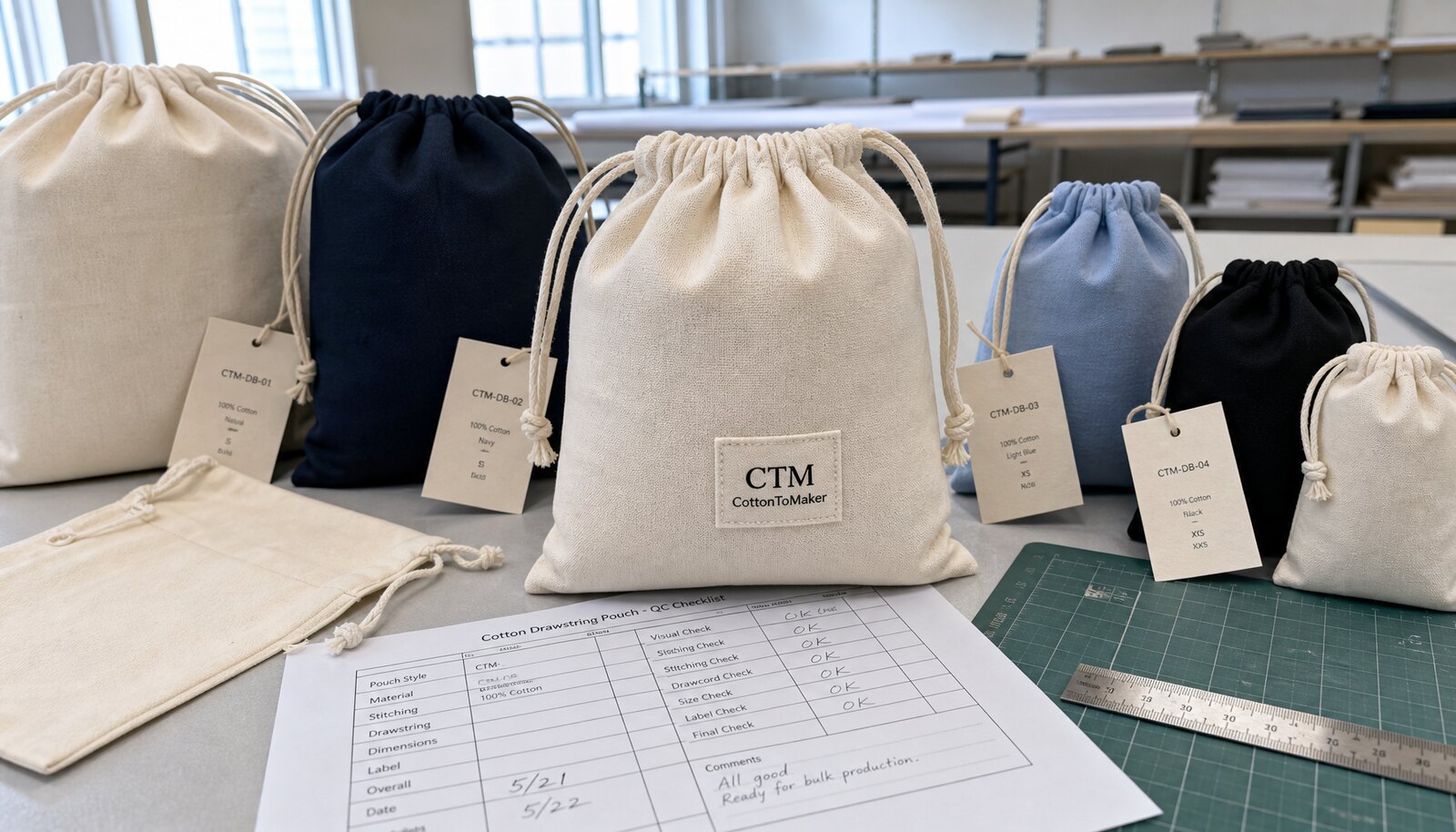
Start with the retail job the pouch has to do
Gift shops buy cotton drawstring pouches for different jobs, and the quality bar should follow the use case rather than the decoration. A pouch that wraps a candle sample, a soap set, or a small jewelry item does not need the same construction as a reusable retail bag that will be handled, gifted, reopened, and possibly washed. If the buyer starts with artwork and color first, the order can drift away from the real risk: thin fabric that shows contents through, seams that open at the corners, cords that snag in the channel, or print that looks fine until customers rub it in normal use.
Before sourcing, write down the product the pouch will hold, the maximum filled size, whether it is part of the gift itself or only packaging, and whether it must survive repeated opening and closing. That information drives fabric weight, closure structure, print method, and inspection depth. It also tells the supplier whether the pouch needs to be shelf-ready, warehouse-friendly, or both. Those are different requirements. A pouch that looks premium in a store display can still be a problem in distribution if the packing format is loose, mixed, or hard to count.
- Define the primary contents: jewelry, soap, tea, cosmetics, candles, souvenirs, or mixed gift sets.
- State the pouch role: packaging only, reusable retail bag, or premium presentation item.
- Write the maximum item dimensions and weight the pouch must accept without stressing the seam or drawcord channel.
Freeze the spec that actually changes cost and quality
A procurement spec for custom cotton drawstring pouches should be short, measurable, and hard to misunderstand. Finished size should be written as usable inside dimensions, not only flat lay measurements, because the pouch can lose usable space once the seams and channel are added. The same is true for fabric weight, cord length, and label placement: each detail seems small, but each one affects use, appearance, and the chance of a rework claim. If the spec is vague, the factory will fill in the blanks with its own assumptions, and those assumptions are rarely aligned with the buyer's retail plan.
The best spec sheet separates non-negotiables from flexible items. Non-negotiables are size, gsm, artwork placement, and packing format. Flexible items are weave style, cord color, and whether the pouch gets a woven label or a printed mark. When the supplier sees that difference clearly, the quote becomes easier to compare and the first production run is less likely to drift away from the approved sample. It also helps the buyer avoid overpaying for a cosmetic detail that does not matter to the retail customer.
- Specify finished dimensions, seam allowance, and allowable size tolerance in the RFQ.
- State fabric weight in gsm and whether the cotton is natural, bleached, dyed, pre-shrunk, or wash-tested.
- Lock artwork version, print area, and label location before the factory starts sampling.
Choose the fabric around opacity, feel, and load
Cotton fabric behaves differently depending on weave, finishing, and batch variation. Two pouches with the same gsm can feel different if one uses a loose weave and the other a tighter cloth, and that difference shows up immediately in a gift shop setting where touch and appearance matter. If the fabric is too thin, the contents can show through, the pouch can wrinkle heavily, and the branded item may feel less valuable than the product inside. If it is too heavy, the pouch may hold shape well but become stiff, bulky, or overpriced for a low-value giveaway.
A practical sourcing rule is to tie fabric choice to the retail expectation and the actual contents. Lightweight pouches can work in roughly the 120 to 150 gsm range when the job is low-load packaging for small items. Premium or reusable gift programs usually need heavier cloth, often in the 180 to 240 gsm range, to reduce show-through and keep the pouch from collapsing. Those are not universal laws. They are buying thresholds that help a team ask the right questions. The more useful question is whether the supplier can show the actual lot data, the finishing method, and the approved sample that proves the fabric performs as intended.
- Use lighter fabric for small, low-load gift packaging and heavier fabric for premium or reusable presentation.
- Ask for lot-based gsm data instead of a generic range on a quote sheet.
- If the pouch is supposed to stay dimensionally stable, require pre-shrunk or wash-tested fabric and confirm the result in writing.
Control the seam, cord, and closure as working parts
The drawstring closure is not decorative. It is the part the customer touches first, and it usually reveals whether the factory cut corners. The cord needs enough stiffness to move through the channel without snagging, but not so much bulk that the opening feels jammed. The seams need to hold under repeated opening, closing, and light loading. A pouch can look clean in a photo and still fail if the cord exits are uneven, the top corners are not reinforced, or the channel has inconsistent tension from one lot to the next.
Use a construction check that goes beyond appearance. Confirm seam allowance on the sample, count the stitches per inch, and inspect the top corners for skipped stitches, loose thread clusters, and channel distortion. If the pouch is meant to hold heavier contents, ask the factory how it reinforces the stress points and how it tests them before packing. Buyers should treat the cord channel and the top seam as the first two wear points, because that is where customer complaints usually start. If those points are weak, the rest of the pouch does not matter much.
- Match stitch density and seam finish to the approved sample, then verify the same detail on the first bulk run.
- Inspect the cord exit points for fraying, sharp edges, and uneven channel tension.
- If the pouch will carry heavier items, require corner reinforcement and a documented load test.
Treat decoration as an engineered process
Print quality is one of the most common reasons a small pouch order turns into a quality dispute. The artwork may look fine on a screen or even on an approval mockup, but cotton is an uneven substrate and the print method determines what the customer actually sees and feels. Screen printing is usually the simplest route for a one- or two-color logo because the result is consistent and easier to inspect. Transfer and digital methods can handle more detail, but they add risk in hand feel, edge sharpness, and abrasion resistance.
The right method depends on the design and the retail use. If the pouch will be handled repeatedly, the print should be checked for durability as well as alignment. If the art is small, thin, or highly detailed, ask the supplier how it controls ink deposit and whether the print will still pass a rub test after packing and shipping. For a branded gift shop item, the buyer should approve the physical print on the actual fabric, not just a digital proof on white paper. One good proof on the correct cloth is more useful than several clean mockups on a screen.
- Use screen printing for simple logos and stable repeat orders.
- Use transfer or digital print only when the design complexity justifies the added rub and hand-feel risk.
- Require a physical print proof on the exact cotton substrate before bulk production.
Set the inspection plan before the factory starts cutting
A useful quality inspection checklist for custom cotton drawstring pouches starts with a sampling plan. For many buyer programs, ISO 2859-1 General Inspection Level II is a practical baseline, with AQL 0 for critical defects, 2.5 for major defects, and 4.0 for minor defects unless the brand standard is stricter. That structure tells the factory which problems are unacceptable, which need sorting, and which can be tolerated in small numbers. Without that split, every defect becomes a subjective argument at shipment time.
Critical, major, and minor defects should be defined before the first order moves into production. Critical defects include wrong SKU, wrong artwork, open seam, hole, contamination, or broken cord. Major defects include size out of tolerance, print placement beyond the agreed limit, seam opening, or a failed rub test. Minor defects are cosmetic issues that do not affect function, such as short loose threads or slight wrinkling inside the carton. Buyers who define those lines early reduce claims because the supplier can inspect against the same rule set the customer will use. This is especially important on gift shop programs where the pouch is part of the presentation, not a generic commodity.
- Use ISO 2859-1 Level II with AQL 0 critical, 2.5 major, and 4.0 minor as a starting point.
- Write defect definitions for size, print, seam, cord, labeling, and packing before production starts.
- Ask the factory to report defects by class so you can see whether the risk is in sewing, printing, or packing.
Use test methods that a buyer can repeat
Inspection becomes more useful when it includes simple tests that the supplier and the buyer can repeat. For seam strength, a practical buyer spec is that the pouch should survive a static load equal to at least 2 times the intended filled weight, with 5 kg as a sensible minimum for small gift pouches and a higher threshold for heavier retail sets. That is a buyer threshold, not a universal standard, and it should be adjusted to the contents. The point is to test the actual failure mode rather than guess at it from appearance alone.
The drawcord also needs a defined test. Open and close the pouch 10 consecutive times and check that the cord moves smoothly, does not snag, and does not slip more than 10 mm when the pouch is filled to its intended retail load. Print durability needs more than a visual glance too. A dry-rub test of 50 passes and a wet-rub test of 10 passes with a white cotton cloth gives a fast read on whether the ink is curing properly or whether a transfer print is likely to smudge in handling. If the product is marketed as washable or pre-shrunk, run one cold wash and air dry cycle and compare the finished dimensions to the approved sample. A reasonable buyer threshold is plus or minus 3 percent on length and width for a product sold that way; if the claim is weaker, the accepted range should still be written down before cutting starts.
- Test seam strength with a static load equal to at least 2 times the intended filled weight.
- Run 10 open-close cycles on the drawcord and reject snagging, fraying longer than 5 mm, or slip over 10 mm under load.
- Use 50 dry rubs and 10 wet rubs on the print, then reject visible transfer, smearing, or cracking that hurts legibility.
Compare suppliers by process control, not only by price
A quote is only useful when it reflects the same scope across suppliers. The lowest number is not the safest choice if one factory owns the sewing and printing line, another outsources decoration, and a third only handles packing. For repeat gift shop programs, the strongest option is usually the supplier that can show how it controls the whole chain, from fabric lot to carton label, and can explain what happens when a sample fails. That process matters more than a small unit-price difference if you are planning replenishment, reorders, or seasonal drops.
Trading companies can still be valid when they consolidate several categories, but buyers should not compare them to direct factories without adjusting for traceability. If the supplier cannot name the actual plant, the QC owner, and the inspection standard in writing, then the buyer is not comparing the same product risk. Stock blanks plus local decoration can be the fastest route for a launch, but it is a different procurement model. The blank base may vary from batch to batch, and the local printer may introduce a new set of quality variables. In practice, the buyer should compare routes by lot stability, process traceability, packing control, and how quickly defects can be sorted if the first run goes wrong.
- Prefer a direct factory when you need repeatable construction and a clear corrective-action path.
- Use a trading company only when it can disclose the real factory and the same QC standard that will govern the order.
- Treat stock-and-print as a speed option, not as a substitute for a controlled custom program.
Ask quote questions that expose hidden cost and hidden risk
A procurement conversation becomes more useful when the supplier has to answer questions about process, not only price. Ask what fabric lot is being quoted, whether the cotton is pre-shrunk, which print method is used, and how the quote changes if you add a second color or a woven label. Those questions matter because the answer shows whether the supplier understands the real cost drivers or is only quoting a generic pouch. If the supplier cannot separate fabric, sewing, printing, packing, and freight assumptions, the quote is too opaque to manage.
The same applies to failure handling. Ask how sample approval works, what the rework process is if the print is off by 5 mm, what happens if the pre-shipment inspection fails, and who pays if the fault is in the factory lot. Those questions are not aggressive. They are the fastest way to learn whether the supplier has a system or only a sales response. For buyer teams comparing multiple sources, this is where the real pricing gap appears. A supplier with disciplined answer quality usually has disciplined order control; a supplier that answers loosely often handles the order loosely too.
- Ask for separate line items for fabric, sewing, print, packing, and shipping assumptions.
- Request the exact approval workflow, including who signs the pre-production sample and who owns the sealed reference sample.
- Require the supplier to explain how a failed inspection is corrected, sorted, or remade before shipment.
Plan packing and receiving for the warehouse, not only for transit
Packaging is part of quality because most buyers receive pouches by carton, not one by one. A pouch that is technically correct but packed loosely, counted incorrectly, or mixed across sizes creates extra work at the distribution center and increases the chance of store-level shortages. That matters in gift shops because orders often feed several locations, and one mixed carton can delay a launch or force a partial shipment. The buyer should specify the inner pack count, carton count, and carton marking format before the first production run starts.
Packing should also protect the product itself. Cotton pouches can pick up dust, and drawcords can tangle if they are dumped into the carton without a controlled pack format. Ask for clean inner packaging, fixed counts, and barcode labels that match the SKU structure in your system. If the order includes multiple sizes or print versions, keep them separated unless you have explicitly approved mixed cartons. A controlled carton is faster to receive, easier to stock, and easier to audit if something goes wrong later. It also makes chargebacks less likely because the receiving team can match what arrived to what was ordered without sorting through mixed content.
- Fix inner pack and carton counts, then reject mixed-SKU cartons unless they were approved in writing.
- Match carton labels, barcode format, and SKU naming to the buyer's receiving system.
- Ask for shipping samples or carton photos before the bulk run if the order will be routed through a distribution center.
Specification comparison for buyers
| Procurement variable | Lower-risk choice | Tradeoff | Buyer check |
|---|---|---|---|
| Supplier model | Direct factory with sewing, printing, and final packing under one named QC owner | Best traceability and the fastest corrective action when a defect appears, especially on repeat gift shop programs | Ask for the factory name, the actual production address, the responsible QC contact, and a simple process map that shows sewing, decoration, inspection, and packing |
| Supplier model | Trading company only when the real factory is named and the inspection standard is documented | Useful when you are consolidating several categories, but quality accountability is weaker if the factory stays hidden | Require the production factory ID, a sample report from that line, and written confirmation that the approval sample and bulk run come from the same source |
| Supplier model | Stock blank pouch plus local decoration | Fast for launch tests or seasonal demand, but the blank base can vary from batch to batch | Verify the blank lot, ask whether the base pouch can be reordered later, and confirm who owns print registration if the decoration is done elsewhere |
| Fabric control | Single mill lot, pre-shrunk or wash-tested cotton with a stated gsm tolerance | More stable hand feel, opacity, and finished size, usually at a higher unit price | Request mill data, lot traceability, and a written gsm tolerance such as plus or minus 5 percent or the supplier's own documented limit |
| Fabric control | Natural cotton with one approved shade band and a physical swatch reference | Avoids overpromising a perfect color match on an absorbent fiber that can vary by dye lot | Approve against a physical sample, not only a screen image, and ask whether slight shade drift is acceptable across replenishment orders |
| Decoration method | Screen print for one- or two-color branding on repeat orders | Most predictable visually and easiest to inspect, but less flexible for complex art | Ask for cure method, rub performance, and opacity on the exact fabric you plan to buy |
| Decoration method | Transfer or digital print for small runs or detailed artwork | Good for gradients and short tests, but hand feel, edge sharpness, and abrasion resistance are more variable | Request dry-rub, wet-rub, and fold testing on the actual pouch, not only a fresh proof |
| QC structure | Inline inspection plus pre-shipment inspection with photo evidence and defect counts by class | Catches issues before cartons are sealed and makes disputes easier to resolve | Require defect photos by type, a sample report, and separate counts for critical, major, and minor defects |
| Packing control | Fixed inner pack counts, single-SKU cartons, and clear carton marks | Speeds warehouse receiving and reduces mixed-item errors | Confirm pack count, carton label format, barcode requirements, and whether sizes or print versions may ever be mixed |
Buyer checklist before sampling
- Lock the finished size using usable inside dimensions, not only flat measurements, because seams and drawcord channels reduce usable space.
- Specify fabric weight in gsm and state whether the cotton is natural, bleached, dyed, pre-shrunk, or wash-tested.
- Define the weave, seam allowance, stitch density, cord type, cord length, and any label or hangtag requirement.
- Set the print area, print method, ink type, artwork version, and acceptable placement tolerance before quoting.
- Require an inspection standard such as ISO 2859-1 General Inspection Level II with AQL 0 critical, 2.5 major, and 4.0 minor unless your internal standard is tighter.
- Ask for numeric test methods for seam strength, cord performance, rub resistance, and shrinkage, not only a visual sign-off.
- Request a pre-production sample, an inline sample if the order is large, and a sealed reference sample kept by the supplier.
- Confirm packing counts, carton dimensions, carton marks, barcode format, and whether mixed sizes are allowed.
- Separate the quote into fabric, sewing, print, packing, and freight assumptions so price comparisons are clean.
- Require the supplier to identify the factory, lot codes, and revision numbers for fabric, artwork, and packing spec.
Factory quote questions to send
- What exact cotton fabric, weave, gsm, and pre-shrink treatment are included in the quote, and what tolerance do you hold on the finished fabric weight?
- Which factory will sew and print this order, and can you name the production line that will handle the bulk run?
- What is the minimum order quantity by size, color, and print version, and do you charge separate setup fees for each variant?
- Which print method are you quoting, and what changes in cost, lead time, or rub performance if we move from one color to two colors or from screen print to digital print?
- What finished-size tolerance do you guarantee, and how do you measure it on the final pouch rather than on cut fabric?
- What seam standard do you use, including stitch density, top-corner reinforcement, and allowed defect count for loose threads or skipped stitches?
- What test method do you use for the drawcord, and what is your pass/fail threshold for closure smoothness, fraying, and cord slip under load?
- What inspection level and AQL do you run before shipment, and can you share a recent sample report with critical, major, and minor defect counts?
- How do you handle shrinkage claims if the pouch is marketed as pre-shrunk or washable, and what is the maximum acceptable dimensional change after testing?
- What packing format is included in the quote, including inner pack count, carton count, carton marks, barcode labels, and pallet or no-pallet shipping?
Quality-control points to confirm
- Use ISO 2859-1 General Inspection Level II with AQL 0 for critical defects, 2.5 for major defects, and 4.0 for minor defects unless the buyer's own brand standard is stricter.
- Treat wrong size, wrong artwork, broken cord, open seam, hole, contamination, or SKU mix-up as critical defects with zero tolerance.
- Hold finished size to plus or minus 5 mm for pouches up to 200 mm in finished dimension and plus or minus 7 mm above 200 mm unless the approved sample states otherwise.
- Keep fabric gsm within plus or minus 5 percent of the approved spec or plus or minus 10 gsm, whichever is greater, and confirm the lot matches the approved swatch.
- Require seam lines to be straight and secure, with no seam opening under a static load equal to at least 2 times the intended filled weight, and not less than 5 kg for small gift pouches unless your product requires a higher threshold.
- Set stitch quality to match the approved sample, with no skipped stitches, no needle damage, and loose thread tails trimmed to 10 mm or less.
- Test the drawcord with 10 consecutive open-close cycles; the cord should move smoothly, not snag, and not slip more than 10 mm when the pouch is filled to its intended retail load.
- For cord fraying, reject any strand damage longer than 5 mm at the pull zone or channel exit, because it usually worsens quickly in use.
- Check print placement against the approved art box and keep visible shift within 5 mm of centerline or the agreed placement target.
- Use a dry-rub test of 50 passes and a wet-rub test of 10 passes with a white cotton cloth; reject if the print transfers visibly, smears, or cracks enough to hurt legibility.