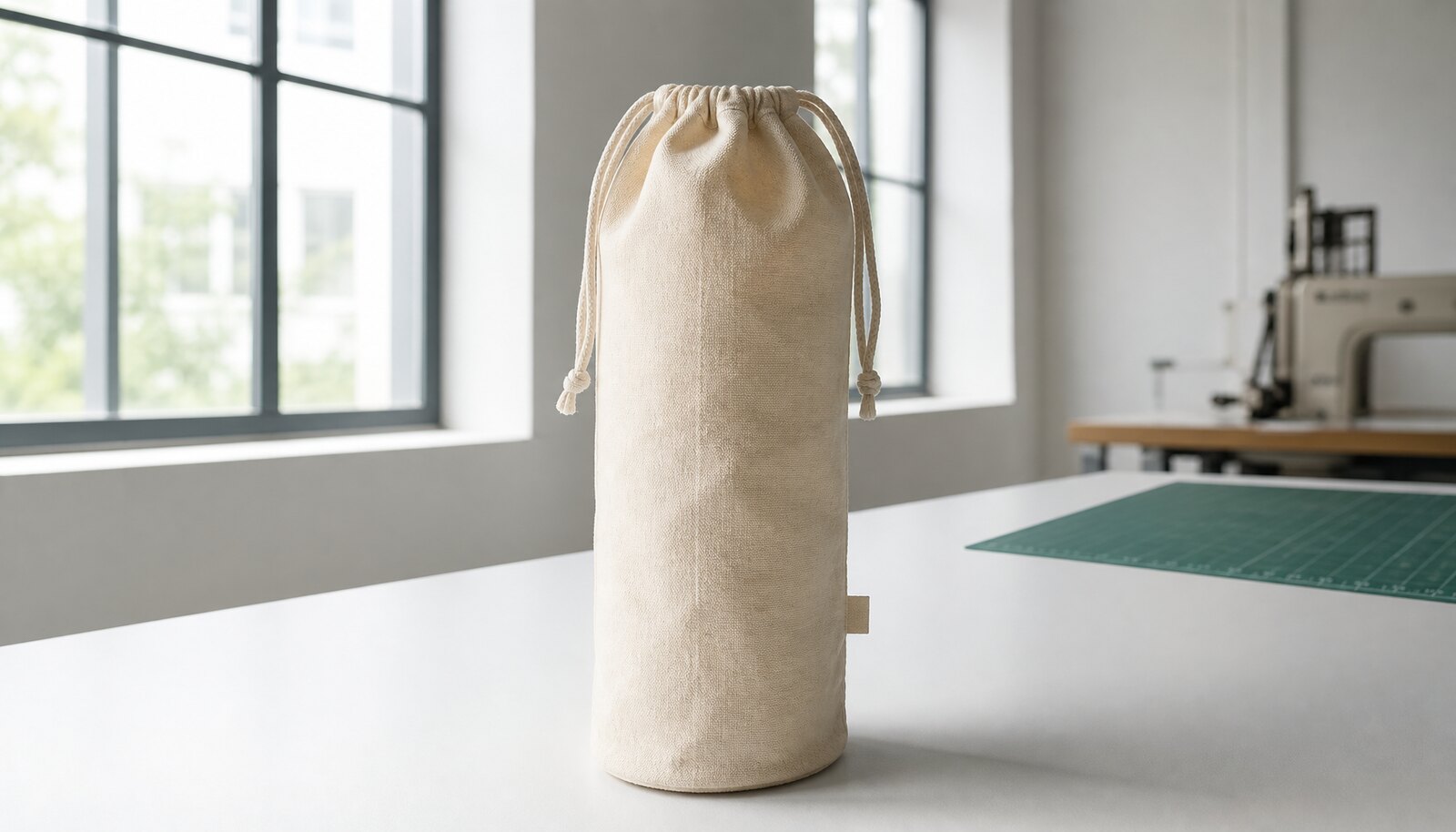
Why Boutique Wineries Need a Different Pouch Spec
A cotton drawstring pouch for a boutique winery is not generic accessory packaging. It influences shelf presentation, tasting-room perception, and the handoff moment when a bottle leaves the cellar or shop counter. If the pouch feels too thin, too glossy, or too decorative, it can work against the brand language that most wineries spend years building.
The procurement brief needs to reflect the role of the pouch in the commercial flow. A pouch used for a gift bottle has different requirements from one used for a retail accessory, a club shipment insert, or a seasonal event giveaway. The more clearly that role is stated, the easier it is to compare suppliers on the same basis and avoid sample churn.
Start with the use case, then the bottle or product, then the visual direction. That order usually produces cleaner quotes than opening with fabric names or a supplier catalog. It also reduces the risk of over-specifying decorative details that do not matter to the customer experience.
Useful briefing questions for wineries:
- Is the pouch for a bottle, a bottle plus insert, or a multi-item gift set?
- Will customers see it on a retail shelf, in a tasting room, or only after the purchase is packed?
- Does the pouch need to feel rustic, premium, minimal, or utility-first?
Start With Bottle Geometry and Pack Workflow
The best pouch size is based on the actual item going inside, not a nominal pouch category. A standard 750ml bottle, a magnum, a corkscrew set, or a mixed gift bundle all create different demands on opening size, body width, and seam placement. A pouch that is tight around the shoulder looks strained and slows packing. One that is too loose looks generic and lets the product shift.
Bottle geometry matters more than many buyers expect. The shoulder shape, capsule height, hang tag, and label width can all change how the pouch loads and how much ease the operator needs. For a winery program, the widest point is usually the key measurement, but the loading path matters too. If staff have to rotate the bottle awkwardly, the spec is probably too tight even if the dimensions look correct on paper.
For accessory bundles, the workflow can matter more than the finished size. If the pouch is loaded by hand, the opening should be forgiving and the closure simple. If the pouch is inserted into a shipping box, it should fold predictably and avoid excess bulk. That is why procurement should ask the line team or packer how the pouch will actually be used before locking the spec.
Information to collect before quoting:
- Product dimensions, including the widest point and any protruding parts.
- Whether the pouch must stand upright, fold flat, or fit inside another package.
- Who loads the pouch: winery staff, a co-packer, or the factory itself.
Fabric Choices That Actually Matter
For custom cotton drawstring pouches, the useful distinction is not simply cotton versus another material. It is how the weave, surface, and weight behave during sewing, packing, and customer handling. Light plain-weave muslin is efficient and easy to source, but it can look thin around a bottle and wrinkle more in transit. Heavier cotton sheeting or duck-style weave gives more body and can make the pouch feel more deliberate and retail-ready.
A boutique winery usually wants one of two outcomes: soft and natural, or clean and structured. Soft and natural points toward lighter to medium-weight cotton with a relaxed drape. Clean and structured points toward tighter weave, more opacity, and a fabric that resists collapsing when it is filled. The wrong choice is often obvious only after the first sample, which is why a physical swatch review is worth the time.
The headline price is not the only tradeoff. Heavier fabric changes cutting efficiency, seam bulk, and sewing speed. It can also improve the way a logo sits on the pouch because the surface is more stable. On the other hand, if the brand story depends on a relaxed, low-intervention feel, a heavy canvas-like pouch may look too rigid.
A practical way to think about fabric selection:
- 140-160 GSM is usually a lower-cost, lighter-duty range suitable for giveaways or accessory pouches.
- 180-220 GSM is often the best balance for bottle gifts and retail-facing winery packaging.
- 220+ GSM works when structure matters more than softness and the buyer accepts a higher unit cost.
Finish, Color, and Shrinkage Need Hard Controls
Natural unbleached cotton is popular with wineries because it supports an earthy, restrained brand story. The issue is that 'natural' is not a single color. Two production lots can differ enough to be visible beside a label, carton, or bottle capsule, especially under retail lighting. Bleached cotton gives a cleaner background for logos and small type, but it sacrifices some of the soft, organic tone that many boutique wineries want.
Finish is just as important as color. A soft-washed or pre-shrunk pouch can reduce size surprises and improve the hand feel, but it also changes the surface and may affect how ink or a woven label sits. The buyer should approve the finished state, not just the greige fabric. If the sample looks right before finishing but changes after the production process, the approval is not actually meaningful.
Shrinkage should be handled as an agreed tolerance, not a vague expectation. A common buyer starting point is around 3 percent for programs that are pre-shrunk or softly finished, with 5 percent as an outer limit only if the size change does not affect loading or retail appearance. If the pouch must hold a bottle snugly, even a small shift can matter, so the tolerance should be tied to the actual use case.
What to lock down in the spec:
- One physical color reference or swatch card, not just a verbal description like natural or ivory.
- The exact finishing route used for the sample and for bulk production.
- The acceptable size change after the agreed finishing process.
Decoration Should Match the Artwork, Not Force It
Simple screen print is still the most practical decoration method for many winery pouches. It is cost-effective on repeat runs, durable enough for normal handling, and a good fit for restrained logos or one-color marks. That matters because boutique winery branding usually benefits more from clarity than from complexity. A clean mark on cotton often feels more considered than an artwork treatment that fights the weave.
When the artwork is more detailed, the decoration choice should follow the art, not the other way around. A woven label or small patch can be a better premium cue than a complex multicolor print. Embroidery can work for a small emblem, but it adds bulk and is easy to overuse on a compact pouch. Digital or transfer methods may hold detail, but they should be approved on the actual fabric because they can change hand feel and visual consistency.
Ask for a production-fabric strike-off or sample, not just a paper proof. Cotton behaves differently than coated stock, and the weave affects line weight, edge clarity, and perceived color density. If the winery uses a subtle logo or fine typography, the buyer should specifically test whether the design still reads cleanly once it is sewn into the pouch.
Decoration decisions that are usually easier to defend in procurement:
- Screen print for one-color logos and stable reorders.
- Woven label or small patch for premium, textile-forward branding.
- Embroidery only for a small mark where a thicker finish is acceptable.
Construction Details That Decide Whether the Pouch Feels Premium
A drawstring pouch lives or dies on its construction. The front logo draws attention, but the cord channel, side seams, and bottom seam carry the actual stress. If the pouch is intended for a bottle gift, the buyer should specify how the top opening is built, what cord material is used, and how the bottom corners are reinforced. Those details determine whether the pouch feels sturdy or disposable.
Cord choice affects both usability and presentation. A cord that is too thin looks weak and can be uncomfortable in the hand. One that is too thick can make the channel bulky and reduce the clean fold of the pouch. The best option is usually a soft cotton cord that runs smoothly, knots cleanly, and does not snag the channel during repeated use.
Seam allowance and opening width should be set around the loading workflow, not just the finished look. If the opening is too narrow, packers will force the bottle and stress the top hem. If it is too wide, the pouch loses the tailored profile that helps it look like part of the product rather than a generic bag. This is one of the main reasons to approve the pouch with the actual bottle inside before bulk.
Construction details to confirm early:
- Bottom corners should be reinforced enough to handle normal handling and a bottle's weight.
- Cord entry points should be neat and free of rough edges that could fray the cord.
- The opening should close smoothly without distorting the top edge or logo placement.
How to Compare Quotes Without Losing the Real Cost
A clean quote comparison starts with one spec sheet and one approved sample target. If one supplier quotes lighter fabric, another includes a woven label, and a third assumes individual polybags, the numbers are not comparable. That is where many buyers get misled by the lowest unit price. The cheaper quote often hides a weaker fabric, a different finishing route, or packing assumptions that do not fit the launch plan.
The better comparison is total landed cost plus execution risk. Unit price matters, but so do setup charges, packing, inspection, and freight assumptions. For a winery program, the question is whether the pouch supports the bottle and the brand at the point of use. A slightly higher unit price can still be the better choice if it reduces defects, improves shelf presence, or avoids repacking work at the warehouse.
Buyers should ask each supplier to quote the same spec line by line and to state what is excluded. That includes fabric source, decoration setup, carton count, and any optional packing method. If the supplier cannot explain those items clearly, they are not ready for a reliable procurement comparison.
The most useful comparison dimensions are:
- Fabric source and finished GSM.
- Decoration process and setup charges.
- Packing format and carton count.
- Lead time from sample approval to shipment.
- Freight basis and destination terms.
Supplier Vetting: Provenance, Compliance, and Lead-Time Drivers
For boutique wineries, supplier vetting should go beyond price and photos. Ask where the cotton is sourced, where it is woven, where it is finished, and where the pouch is sewn. If the factory cannot explain its supply route in a straight line, treat the program as commodity sourcing with limited accountability. That may be acceptable for a one-off giveaway, but it is a problem for repeat retail use.
Provenance matters because it affects both consistency and documentation. If the supplier can show a stable fabric source and recurring finishing route, the buyer is more likely to get matching bulk orders. If the supplier claims special sustainability or chemical compliance, ask for the supporting documents before you award the job. Do not let marketing language substitute for a test report or traceable production path.
Compliance requirements depend on where the pouches will be sold, but wineries that sell into multiple markets often need a more disciplined document set. Ask whether the supplier can provide relevant fabric and ink testing, and whether any market-specific requirements are already built into their standard process. If you need a specific certification, make sure it covers the actual product and not just the mill or the trading company.
Lead time is usually driven by a small set of steps: fabric availability, finishing queue, decoration setup, sample revisions, packing, and export booking. The slowest step is often not sewing. It is usually a custom fabric, a new print screen, or a second sample round. A buyer who wants a seasonal launch should ask the vendor to name the bottleneck before the order is placed.
What to ask during vetting:
- Where does the cotton come from, and can the factory describe the supply chain without hand-waving?
- What compliance or test documents are available for the exact product, not a different item?
- Which step is most likely to extend lead time if we change color, decoration, or pack format?
Sampling and QC Need Concrete Acceptance Criteria
A pre-production sample should prove the exact fabric, finish, decoration, cord, and packing plan that will be used in bulk. It is not enough for the sample to look close. If any major component changes after approval, the sample becomes a reference image rather than a production standard. That is how a good-looking sample turns into a disappointing shipment.
The sample review should be practical. Put the actual bottle or accessory into the pouch. Pull the cord. Check whether the opening is wide enough for the packer to work quickly and narrow enough to keep the pouch looking tailored. Look at the logo in the same light the buyer or customer will actually see it, not just under a desk lamp. If the pouch will be sold at retail, inspect it next to the bottle label and carton so the full presentation can be judged together.
Quality control should use thresholds that are measurable and defensible. For premium retail programs, a functional standard usually means zero tolerance for major defects and a clearly defined allowance for cosmetic issues if the buyer accepts any at all. If the buyer wants loose-thread trimming, lint removal, or a tighter placement standard, that should be stated upfront because it affects labor and rework cost.
A practical inspection approach is to combine a full check for visible major defects with a sample-based measurement check for size, print placement, cord operation, and pack consistency. For boutique winery use, the key question is not whether the pouch is perfect in theory. It is whether the run looks intentional, consistent, and aligned with the approved sample across the whole carton pack.
Packing, Lead Time, and Reorder Planning
Packing can protect the pouch or quietly add unnecessary cost. Bulk fold works well when pouches go straight into gift sets or are handled again in a winery warehouse. Individual polybags or tissue wrap make more sense when the pouch itself is part of the retail presentation or when a printed surface needs protection in transit. The right choice depends on where the pouch lives after it leaves the carton.
Lead time should be read as a sequence, not a single number. Fabric readiness, finishing, sampling, decoration setup, packing, and dispatch all have their own timing. If the supplier says a date but cannot explain which step is on the critical path, the schedule is not really controlled. That matters for wineries, because packaging often follows seasonal releases, membership shipments, or event dates that do not move.
Reorders are easier when the first order is documented well. Save the approved swatch, the production sample, the carton spec, and the packing photos. On the next order, compare the new quote and sample against that record instead of recreating the spec from memory. This is the simplest way to protect consistency without overcomplicating procurement.
Before releasing an order:
- Confirm whether the packing format should be bulk, individually wrapped, or retail-ready.
- Check whether the schedule includes one sample round or room for a revision.
- Verify the carton marks, pallet pattern, and destination labeling before the job starts.
Specification comparison for buyers
| Decision area | Preferred option | Best when | What to verify in the quote |
|---|---|---|---|
| Fabric weight | 140-160 GSM plain-weave muslin | Light accessory pouches, low-cost giveaways, and programs where the pouch is secondary to the bottle | Ask for finished GSM, opacity, and whether the bottle outline shows through |
| Fabric weight | 180-220 GSM pre-shrunk cotton sheeting or tight muslin | Bottle gifts, tasting-room retail, and programs that need a fuller hand and better drape | Verify shrinkage after finishing, surface lint, and whether the fabric stays flat after folding |
| Fabric weight | 220+ GSM cotton duck or canvas-style weave | Premium presentation, heavier contents, or a more structured shelf look | Check seam bulk, stiffness, and whether the pouch still closes cleanly |
| Finish | Natural unbleached cotton, soft-washed | Rustic, organic, or minimal winery branding | Approve a physical swatch, not a verbal color name, because shade varies by lot |
| Finish | Bleached or pressed cotton | Sharper logo contrast and finer linework | Verify lint, whitening consistency, and whether the surface takes ink evenly |
| Decoration | 1-color screen print | Simple logos, repeat orders, and unit-cost control | Confirm ink hand-feel, rub resistance, and placement on the actual fabric |
| Decoration | Woven label or small woven patch | Premium retail packaging and longer-life branding | Check label size, stitch edge quality, and whether the label sits flat after packing |
| Decoration | Embroidery | Small emblem only, with a premium textile look | Verify backside backing, bulk at the stitch area, and impact on closure area |
| Closure | Soft cotton cord | Reusable pouch programs and natural-brand positioning | Confirm cord diameter, color, knotting, and whether the cord runs smoothly through the channel |
Buyer checklist before sampling
- Define the pouch's job first: bottle gift, retail accessory, tasting-room giveaway, mailer insert, or seasonal bundle component.
- Measure the actual item that goes inside, including capsule, tag, corkscrew handle, or any insert that changes the widest point.
- Approve one reference swatch for fabric color and finish before asking for price.
- Choose one decoration method that fits the artwork and the order quantity, then keep it consistent across quotes.
- State the finished size, seam allowance, cord type, and opening behavior in the brief, not just the nominal pouch size.
- Specify whether the pouch must sit upright, fold flat, or survive repeated reopening by customers.
- Ask the supplier to confirm fabric origin, finishing route, and any available compliance documents before sample approval.
- Decide on packing format early, because bulk fold, individual polybag, and retail tissue create different costs and lead times.
- Separate unit price from setup, packing, inspection, and freight so the quote comparison stays clean.
- Assign one internal approver for sample sign-off so artwork, finish, and size do not drift across revisions.
Factory quote questions to send
- What is the finished GSM after weaving, finishing, and any washing or pressing, and what tolerance do you hold on bulk lots?
- What is the exact fabric source, and can you state whether it is stock-held, greige-booked, custom woven, or custom dyed?
- Which finishing steps are included in the price, and which ones are extra if we want soft-wash, pre-shrink, or pressing?
- Can you make the pre-production sample from the same fabric route, decoration process, and cord spec planned for bulk?
- What is your documented shrinkage method, and what size change should we expect after the agreed finishing cycle?
- Which decoration method is included in the quoted price, and what setup charges apply for screens, labels, patches, or embroidery?
- What is the finished size tolerance for width, height, and opening, and how do you measure it on the production line?
- How are pouches packed in the carton, and what is the exact carton count, inner pack, and outer carton specification?
- What defect standard do you inspect to, and how do you classify seam failures, mixed styles, print defects, and loose threads?
- What compliance or traceability documents can you provide for fiber origin, inks, and any market-specific requirements?
Quality-control points to confirm
- Approve the same fabric route used for bulk, not a substitute sample made from a different lot or a different finishing process.
- Check finished dimensions on the actual production sample with a ruler or caliper and compare them to the approved spec sheet, not to a catalog name.
- Agree a shrinkage test method with the supplier before ordering; if the pouch will not be washed by the end user, test the finishing route that actually affects bulk size instead of a retail laundry cycle.
- Treat holes, broken seams, missing cords, wrong artwork, and mixed SKUs in one carton as zero-tolerance major defects.
- Inspect print placement against the approved art board and the actual sewn pouch, because fabric movement during sewing can shift the visible mark.
- Check the print for ink bleed, cracking, smearing, or heavy strike-through on the weave under normal light and after light handling.
- Define a practical cord-run check with the supplier and run it on a sample from the production lot; the point is to confirm smooth closure and no channel damage, not to chase a universal cycle number.
- Confirm seam strength at the bottom corners and cord entry points by loading the pouch with the actual product or a representative weight during sample approval.
- If you allow cosmetic variation, define it explicitly; for hand-sewn cotton, a small allowance for loose thread tails or minor lint is reasonable, but it should not include seam or artwork defects.
- Inspect the last cartons against the approved sample for fabric tone, print feel, cord length, and pack method so the run does not drift at the end of production.