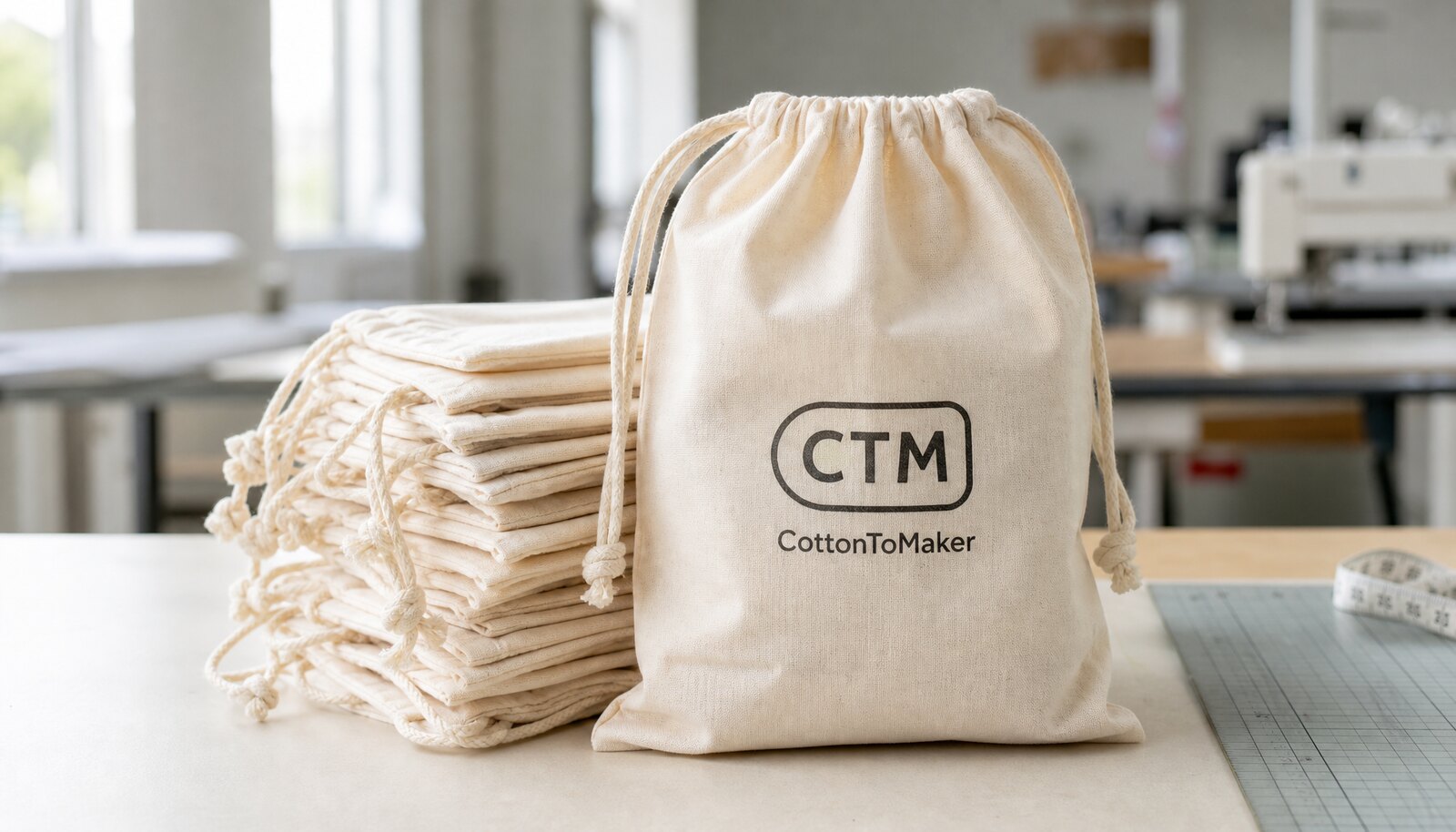
Start with the end use, not the logo
A custom cotton drawstring pouch is usually bought for one of three jobs: retail packaging, product bundling, or reusable brand presentation. Those jobs look similar in a quote, but they have different commercial requirements. A pouch that only needs to protect a sample in transit can be light, simple, and tightly packed. A pouch that will sit in a consumer's hand, appear in a gift set, or be opened repeatedly needs better fabric density, cleaner stitching, and a more durable brand application.
The most useful brief for a supplier is not just the logo artwork. It is the item the pouch must hold, the way the pouch will be handled, the acceptable price range, and the shelf or warehouse environment it will face. A jewelry pouch, a cosmetic pouch, and a pouch used inside a subscription box will not use the same spec even if the size is similar. Defining use case first cuts back on quote noise and helps the factory choose the right fabric weight, cord, and packing method.
- State the exact item to be packed, including dimensions and any sharp edges or fragile surfaces.
- Define whether the pouch is part of the product presentation or only a protective insert.
- Confirm whether the pouch must be reused by the end customer, since that changes seam and cord requirements.
- Write the use case into the RFQ so suppliers are quoting the same commercial target.
Fabric weight, weave, and finish drive both cost and perceived quality
For a cotton pouch, fabric weight is one of the fastest ways to move unit cost up or down. A 4 oz to 5 oz cotton pouch is usually enough for light promotional use, samples, and small accessories. It folds flat, keeps freight efficient, and works when the item inside is not heavy or sharp. The tradeoff is that thin fabric can show the outline of the contents, wrinkle more visibly, and feel less premium in hand.
Once the pouch is part of a retail program or a gift set, 6 oz cotton is often the safer default because it balances opacity, structure, and cost. For a more premium feel, or if the pouch will carry heavier contents, 8 oz cotton gives more body and a cleaner drape. Ask whether the quoted weight refers to greige fabric or finished fabric after wash and cutting loss, because two suppliers can both claim the same oz weight and still deliver very different handfeel and opacity.
- Use 4 oz to 5 oz for light accessories, promos, and cost-sensitive programs.
- Use 6 oz as the balanced default when the pouch is part of a retail or gift experience.
- Use 8 oz when the pouch must feel substantial or carry heavier contents without show-through.
- If opacity matters, ask for a filled sample or a backlight check, not only a flat swatch.
Construction details matter more than many RFQs admit
Most pouch failures do not come from the logo. They come from the opening, seam, and cord system. The drawcord channel needs enough room for the cord to move freely without binding, but not so much room that the top edge looks loose or uneven. A narrow or poorly stitched channel creates friction, uneven pull, and early wear. If the cord is too thin for the tunnel, it can slip or bunch. If it is too rough, it will abrade the fabric and shorten product life.
Stitching should be specified in practical terms. Buyers should define seam allowance, whether the top edge needs double stitching, and whether bartacks are required where the cord meets the channel. If the pouch will carry anything with weight or sharp corners, a weak top seam becomes a reject risk even when the fabric itself is fine. It is also worth confirming thread type and trim control, because loose threads, frayed ends, and uneven top stitching are common quality complaints that are visible immediately to the end user.
- Confirm channel width against the actual cord diameter before approving the sample.
- Specify whether double stitching or bartacks are required at the opening and stress points.
- Ask the factory how they prevent fraying, skipped stitches, and uneven draw length.
- If the pouch is for repeated reuse, prioritize seam construction over the lowest fabric price.
Printing, labels, and artwork need different risk controls
Screen print remains the most economical option for simple logos and medium to larger runs. It typically gives the cleanest brand look for one- or two-color artwork on cotton because the ink sits well on the fabric and the result feels integrated rather than superficial. The downside is that fine text, small lines, or gradients can lose clarity, especially on textured fabric. If your logo depends on detail, ask the supplier to show the smallest line width and smallest text size they can hold consistently.
Heat transfer and digital print help when the artwork is detailed, the order is small, or the brand changes designs frequently. Those methods can be the right commercial choice, but they need a durability check if the pouch will be folded, rubbed, or packed tightly. Woven labels, sewn patches, and embroidery are usually better when the pouch needs a premium identity and longer visual life. They cost more and may add lead time, but they reduce the risk of the graphic cracking, fading, or looking worn before the pouch reaches the customer.
- Screen print is best for simple logos and clear unit economics at scale.
- Digital or transfer print is better for small runs, complex graphics, or short artwork cycles.
- Woven labels and sewn patches are stronger when durability matters more than full-surface coverage.
- Ask for placement dimensions in millimeters so the logo is not only centered visually but also positioned consistently against the seam.
Comparison table: choose the spec that fits the commercial job
This table is meant to help a buyer compare practical tradeoffs, not just supplier types. The cheapest quote is not always the best landed cost if the fabric is too light, the packing wastes space, or the print fails at receiving. The right decision depends on how the pouch will be sold, how often it will be handled, and how much control your team needs over color, finish, and replenishment.
When comparing offers, make sure the suppliers are quoting the same size, the same fabric source if possible, the same print method, and the same packing count. A lower unit price can hide more freight, more rework, or a spec that does not actually meet the intended use.
- Compare full landed cost, not only factory price.
- Keep the same quote assumptions across every supplier before you rank the offers.
- Treat fabric weight, packing method, and print method as cost drivers, not afterthoughts.
A usable factory quote should read like a production plan
A serious quote for a custom cotton drawstring pouch should tell you exactly what the factory believes it is pricing. That means finished size, fabric weight, fabric finish, cord type, print method, print area, carton pack count, and any setup charges. If the quote only says "cotton pouch" and gives one unit price, you do not yet have a comparable offer. You have a starting point that still needs technical clarification.
The assumption line is where procurement teams save time. If one supplier is quoting natural 5 oz cotton with one-color screen print and bulk carton packing, and another is quoting 6 oz bleached cotton with two-color print and individual polybags, the prices are not directly comparable. Normalize the assumptions first, then compare unit price, sample lead time, and the supplier's ability to repeat the same spec on a reorder.
- Ask for price breaks by quantity tier and by spec variant.
- Separate the product price from setup charges, sample charges, and carton charges.
- Request the exact print placement and maximum print area in writing.
- Ask whether the quote assumes any overrun allowance or whether the shipment must match the PO exactly.
Sampling should prove fit, appearance, and handling together
For this category, a logo strike-off alone is not enough. The sample needs to show the real fabric, the finished size, the drawcord action, and the print in final position. If the pouch is intended to hold a cosmetic jar, a necklace box, or a folded accessory, place the actual item inside the sample and test closure, show-through, and how the top edge behaves when the cord is pulled tight. Problems that do not show up in a flat image often appear immediately in a physical sample.
A practical approval sequence is artwork confirmation, material reference approval, pre-production sample, then mass production. The pre-production sample should be made from the same fabric lot if the factory can support it, or from an equivalent approved lot with the same spec. If your team can tolerate a small shade variation on natural cotton or a slight seam variation, document that tolerance in writing before production starts. That note becomes the reference point if a later dispute arises.
- Test the sample with the real product inside, not empty only.
- Check logo placement against the seam and top edge, not only the centerline.
- Approve the cord pull, opening shape, and handfeel before mass production.
- If the order is for retail, approve carton marks and pack counts at the sample stage as well.
QC should use measurable acceptance criteria, not general language
QC guidance is most useful when it can be measured. Buyers should not stop at "good sewing" or "nice print." Set the acceptance criteria before production starts and attach them to the PO or quality agreement. A common starting point for many import programs is AQL 2.5 for major defects and 4.0 for minor defects, but the right standard depends on your channel, product value, and tolerance for rework. If the pouch will go into a premium gift set, the acceptable defect level is usually lower than for a low-cost promo run.
The same logic applies to shrinkage, print durability, and seam strength. If the pouch will be washed, specify the maximum shrinkage after wash and the wash condition used to test it. If the print must survive repeated handling, define the minimum rub performance your team will accept. If the pouch carries weight, set a seam-strength or pull-test threshold based on the actual filled load, not a generic factory promise. The goal is to make the defect line objective enough that the factory can inspect to it and your team can receive to it.
- Use a written AQL target and define which defects are major versus minor.
- Set maximum allowed shrinkage if washability matters to your product line.
- Define a minimum seam-strength or pull-test threshold tied to the filled weight.
- Write a print tolerance in millimeters for placement and a clear standard for color matching.
- Require checks for odor, dye migration, loose threads, and contamination before shipment.
- Confirm that carton labels, quantities, and pack counts match the PO exactly.
Packing, freight, and storage can change the landed cost more than expected
Packing is not a small detail in this category. Bulk carton packing is usually the most cost-efficient choice for wholesalers, distributors, and warehouse fulfillment because it reduces material use and keeps the shipping cube low. Individual polybag packing adds cost, but it can be worth it if the pouch is going straight to retail, needs dust protection, or must arrive shelf-ready with a barcode or hangtag. The right answer depends on how the pouch will move after it lands, not only how it looks when packed.
The carton spec matters too. If cartons are overfilled, pouches can crease, crush, or deform, especially when the fabric is heavier or the pouch includes a sewn label at the opening. If cartons are underfilled, freight efficiency drops and landed cost rises. Ask for carton dimensions, gross weight, net weight, and pack count before production. If the goods may sit in transit or in a warehouse environment, request moisture protection and clear carton marking so the receiving team does not have to sort by guesswork.
- Use bulk carton packing when the buyer controls downstream packing or distribution.
- Use individual polybags when shelf presentation, dust control, or e-commerce handling matters.
- Ask for carton dimensions early so you can estimate cube and freight cost realistically.
- Confirm moisture protection and carton labeling if the shipment may be stored before release.
Common sourcing mistakes that create avoidable cost
The most common mistake is treating every pouch quote as interchangeable. They are not. A lower price can come from lighter fabric, a simpler cord, less print coverage, or a packing format that works for the factory but not for your distribution model. Another common mistake is approving a sample without testing the actual item inside. A pouch can look fine when empty and fail once it is filled, closed, and handled the way the customer will use it.
Another source of trouble is allowing undocumented changes between sample and production. If the factory changes fabric source, print method, cord diameter, or carton pack count after approval, the buyer should require a written revision before production continues. The procurement file should stay tight enough that a future reorder can follow the same spec without reconstruction. That discipline matters more than most buyers expect because this category is often reordered on a seasonal or promotional cycle where time is limited.
- Do not compare quotes until size, fabric, print, and packing assumptions are aligned.
- Do not approve a pouch without a real fill test if the contents are part of the product brief.
- Do not accept undocumented production changes, even if they look minor.
- Keep the approved sample, the quote, and the PO tied to the same revision number.
Specification comparison for buyers
| Spec choice | Cost and freight effect | Best fit | Buyer risk to confirm |
|---|---|---|---|
| 4 oz to 5 oz natural cotton with one-color screen print | Lowest unit cost and best carton efficiency, but lighter fabric can reduce perceived value | Promotional packaging, light accessories, samples, and short-life gift use | Check show-through, wrinkling, and whether the pouch still feels acceptable when filled |
| 6 oz natural or bleached cotton with one-color screen print | Moderate unit cost with a better balance of appearance and durability | Retail sets, cosmetics, jewelry, and general-purpose branded packaging | Confirm pre-shrink status, weave tightness, and whether the print sits cleanly on the fabric |
| 8 oz cotton with woven label or sewn patch | Higher unit price and more freight weight, but a stronger premium presentation | Gift sets, repeat-use pouches, and programs where brand presentation matters more than lowest price | Verify seam strength, channel width, and whether the label adds bulk at the opening |
| Custom dyed cotton with multi-color branding | Highest setup burden and the most color-control work, often with longer lead time | Brand-controlled packaging where color consistency is a priority across a product line | Require lab dips, shade tolerance, and fabric lot confirmation before mass production |
| Bulk carton packing only | Lowest packing cost and best shipping density | Wholesale, distribution, and warehouse fulfillment | Confirm carton marks, moisture protection, and whether the goods can still be received cleanly at your DC |
| Individual polybag plus carton | Adds material and labor cost, increases cube slightly, but protects finish | Shelf-ready retail and e-commerce programs | Check whether the pouch needs ventilation, anti-dust protection, or barcode-ready labeling |
Buyer checklist before sampling
- Finished size with tolerance, not just nominal size, and an internal fit check against the item it must hold
- Declared fabric weight in GSM or oz, plus whether the cotton is natural, bleached, pre-shrunk, or dyed
- Weave type, opacity expectation, and whether the pouch must hide the contents when filled
- Cord material, cord diameter, cord length, and whether the channel construction supports smooth closure without twisting
- Seam allowance, top-stitch style, reinforcement points, and whether bartacks or double stitching are required
- Print method, artwork file type, color count, Pantone reference if needed, and exact print placement in millimeters
- MOQ by size, color, and print version, not only total order quantity
- Sample approval target: strike-off, pre-production sample, and whether a full production lot reference is required
- Packing method, inner polybag requirement, carton count, carton dimensions, and shipping marks
- Target lead time from artwork approval and deposit, not from first inquiry
Factory quote questions to send
- What fabric weight, weave, finish, and shrinkage allowance are included in the quote?
- Is the price based on stock natural cotton, custom dyed cotton, or a custom woven fabric specification?
- Which print method is included, how many colors are covered, and what setup charges apply by side or by color?
- What exact pouch size is quoted, and what tolerance do you guarantee on finished dimensions?
- What cord type, cord diameter, and channel construction are included in the price?
- What is the MOQ per size, per print design, and per colorway?
- What sample stage will you provide before mass production, and what is the sample cost and lead time?
- What packing is included per pouch and per carton, and can you quote alternate pack counts to compare freight impact?
- What inspection standard do you use before shipment, and can you share a pre-shipment report format?
- What overrun or underrun policy applies, and how do you handle rejected units if a defect is found?
Quality-control points to confirm
- Set an inspection standard before production, commonly AQL 2.5 for major defects and 4.0 for minor defects unless your internal standard is stricter
- Finished size stays within the agreed tolerance, with tighter control if the pouch must fit a fixed insert or box
- Fabric weight matches the approved sample within the agreed tolerance, with no obvious thin spots, slubs, oil marks, or uneven weave
- If the pouch is intended to be washable, define a shrinkage limit in the spec and require verification against that limit before shipment
- Seams are straight, secure, and reinforced at stress points, with no skipped stitches, needle damage, or edge fraying at the channel
- Set a minimum seam-strength or pull-test requirement based on the filled weight and use case, and require the factory to test against that threshold
- Cord runs smoothly through the channel without snagging, twisting, slipping, or uneven draw length on either side
- Print placement, color, opacity, and edge sharpness match the approved sample within the written tolerance, with no misregistration beyond the allowed mm variance
- If the print is expected to last through repeated handling, request a dry-rub and, if relevant, wet-rub check against your internal standard
- No loose threads, contamination, odor, dye migration, or visible lint that would create a customer-facing quality issue