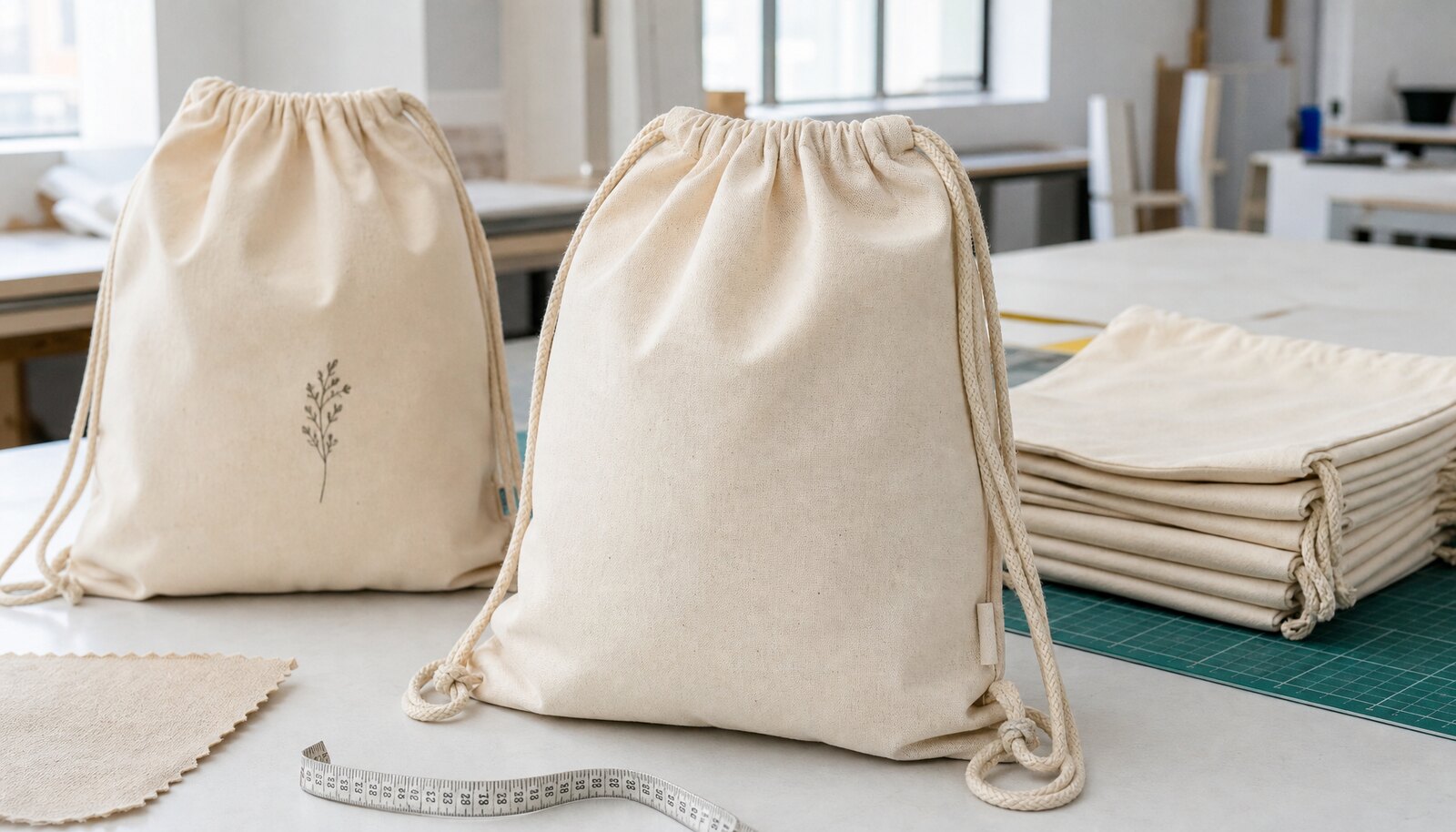
Start with the gifting brief, not the product name
A custom cotton drawstring backpack can be a budget conference giveaway, a container for an employee welcome kit, a client appreciation item, or part of a distributor merchandise program. Those buying situations create different specifications. A one-day event handout may prioritize delivery speed and unit cost. An employee onboarding kit may require better fabric, cleaner logo execution, controlled packing, and more predictable warehouse labeling because the bag represents the employer brand before the recipient even sees the gifts inside.
For procurement teams, the first mistake is asking several suppliers to quote “custom cotton drawstring backpacks” without a controlled specification. One factory may price 120 GSM natural cotton with simple cord and bulk packing. Another may price 160 GSM cotton, reinforced corners, a decorated sample, and export cartons. The lower price may not be better; it may simply be a different product. A B2B RFQ should define the commercial use, load, artwork, packing, inspection, and delivery assumptions before suppliers calculate cost.
Write the brief in operational language. For example: “Natural cotton drawstring backpack for 3,000 employee welcome kits, carrying one A5 notebook, one T-shirt, one 500 ml bottle, and printed inserts, packed 100 pcs per export carton for delivery to a kitting warehouse.” That sentence helps a factory judge fabric weight, bag size, cord strength, carton cube, and production timeline. It also helps buyers compare quotes on a like-for-like basis.
- Define the recipient: employees, clients, conference attendees, students, franchise partners, channel partners, or internal teams.
- List the actual gift contents, including the largest item dimensions and estimated loaded weight per bag.
- State whether the bag is a reusable gift, secondary kit packaging, event merchandise, or low-cost promotional carrier.
- Confirm the distribution model: bulk delivery to a warehouse, handout at an event, individual mailing, or multi-location drop shipment.
- Identify brand priorities early: lowest cost, natural look, premium presentation, sustainability documentation, fast delivery, or repeatable reorder quality.
Specify fabric by GSM, composition, shade, and finished bag weight
Fabric is the largest driver of perceived quality in cotton drawstring backpacks. For corporate gifting, 140–180 GSM cotton is usually the practical range to evaluate. Around 140–160 GSM often balances hand-feel, sewing efficiency, and cost for event and employee programs. Around 170–180 GSM can feel more substantial and less disposable, but it increases material cost, finished weight, and freight impact. A 120–130 GSM fabric may be acceptable for short-term campaigns, but buyers should inspect opacity, wrinkling, print strike-through, and seam strength carefully.
GSM should not be the only control point. Ask for the target finished bag weight in grams for the approved size and construction. A flat 34 x 42 cm bag in 140 GSM fabric will not weigh the same as a gusseted bag with thicker cord, labels, reinforcement, and heavier thread. Recording both fabric GSM and finished product weight makes it harder for bulk production to drift lighter than the approved sample. If your company uses incoming inspection, include a simple weighing check for random units.
Composition needs to be stated clearly. “Cotton bag” can refer to natural cotton, dyed cotton, recycled cotton blend, or a cotton-poly blend. If the gifting program references sustainability or recycled content, ask what documentation the supplier can support and whether it satisfies your company’s claims policy. Do not build marketing copy around recycled or organic claims unless documentation is reviewed by the responsible team. For natural cotton, approve whether flecks, seed specks, slubs, and shade variation are acceptable. For dyed cotton, confirm whether a lab dip or approved color swatch is required and whether exact Pantone matching is realistic on textile fabric.
- Budget promotional range: 120–130 GSM, suitable only when light hand-feel and shorter use are acceptable.
- General corporate gifting range: 140–160 GSM, often a balanced starting point for reusable event, HR, and client programs.
- More substantial range: 170–180 GSM, useful when the bag must feel closer to a durable gift item, with higher material and freight cost.
- Ask for fabric GSM tolerance, commonly expressed as a percentage such as ±5%, and confirm how it will be checked.
- Record target finished bag weight, fabric composition percentage, shade reference, and acceptable natural cotton irregularities in the final spec.
Build the bag around the load: size, gusset, cord, and reinforcement
Drawstring backpacks are simple products, but they fail when size, fabric, cord, and load are not designed together. A common flat size around 34 x 42 cm works for many notebooks, catalogs, folded shirts, and flat event items. It may not work for boxed accessories, water bottles, bulky apparel, or multi-item welcome kits. When contents are dimensional, a side or bottom gusset can improve capacity and presentation, but it also changes cutting, sewing, print placement, carton volume, and cost.
The stress points are predictable: top drawcord channel, side seams, bottom corners, and cord exits. When the recipient pulls the cords, wears the bag on shoulders, or carries a loaded kit, force concentrates at the lower corners and where the cord travels through the channel. A price-focused bag may omit reinforcement or use narrow seam allowances. For B2B gifting, define the reinforcement method before sampling. Options can include reinforced lower corners, bartacks, additional stitching, or folded fabric reinforcement depending on construction.
Cord specification should be measurable. Cotton rope or braided cotton cord supports a natural presentation, but the buyer still needs to approve diameter, finished length, color, knot style, and pull smoothness. Very thin cord may feel uncomfortable and can cut into fabric under load. Very thick cord may not move smoothly through a narrow channel. The sample review should include repeated opening and closing, wearing the bag briefly if the use case requires it, and loading it with actual gift contents.
- Measure the largest gift item and add practical clearance so the bag does not bulge or distort the logo.
- Set finished size tolerance in the purchase specification, such as ±1 cm for width and height unless your supplier proposes another agreed standard.
- Quote flat and gusseted versions separately when the gift kit includes bottles, boxes, headphones, apparel bundles, or wellness items.
- Specify cord material, diameter, finished length, knot or tipped ends, color, and whether both sides must pull evenly.
- Inspect bottom corners, cord exits, and drawcord channel with the expected loaded weight, not only with an empty flat sample.
Choose decoration by artwork risk, not only by color count
For many wholesale corporate gifting orders, one- or two-color screen printing is the strongest starting point. It is efficient at volume, works well for bold corporate marks, and usually keeps unit cost predictable. However, cotton texture affects print clarity. Fine legal text, thin lines, small icons, gradients, and photographic artwork can lose sharpness. Before approving artwork, ask the supplier to state minimum line width, minimum readable text height, maximum print area, and placement tolerance for the selected fabric.
Heat transfer and DTF can handle multi-color graphics and small details better than standard screen print in some situations, but they create different acceptance criteria. The transfer hand-feel may be heavier than ink, and adhesion depends on heat, pressure, dwell time, and fabric surface. A transfer that looks good on a digital mockup may not feel acceptable on natural cotton. If the bag will be folded, compressed, or packed tightly, check whether decorated surfaces block, scuff, or crease during packing.
Embroidery can look premium for a small chest-like mark or side mark, but it is not automatically better. Large embroidery areas on light cotton may pucker or make the bag hang poorly. Embroidery also adds stitch-count cost and can affect the inside face of the bag. If embroidery is requested, approve an actual sample and confirm backing, thread color, stitch density, and acceptable puckering. For most large front logos, screen print or a suitable transfer is more practical.
- Use screen print for bold logos, simple event marks, one- or two-color artwork, and higher quantity corporate orders.
- Use heat transfer or DTF when artwork needs gradients, multiple colors, or small details, but approve hand-feel and adhesion on the actual fabric.
- Use embroidery selectively for small premium marks after checking puckering and internal backing.
- Provide vector artwork, exact print size, print position from top and side references, and Pantone or approved visual color target.
- Define logo placement tolerance, such as an agreed maximum deviation from the approved position, before bulk production starts.
Compare wholesale quotes using one controlled specification
The same project can be quoted by a specialist bag factory, trading company, promotional distributor, local decorator, or full-service gifting supplier. Each route can be appropriate, but the buyer needs to understand what is controlled and what is outsourced. A bag factory may offer stronger construction control at larger quantities. A trading company may help consolidate multiple gift items. A distributor may provide easier account service. A local decorator may solve urgent decoration needs. None of these routes should be evaluated by unit price alone.
A fair comparison requires one RFQ package. Include finished size, fabric composition and GSM, target finished weight, cord specification, construction details, artwork, decoration method, packing format, carton marks, inspection requirement, delivery terms, and in-hand date. If one supplier includes a pre-production sample and export cartons while another excludes them, separate those costs before deciding. A low unit price can become expensive if sampling, rework, labels, repacking, or air freight are added later.
Ask who owns quality accountability. If cutting and sewing are done in one workshop and printing is subcontracted elsewhere, the supplier should still explain how print placement, color, inspection, and claims are managed. Subcontracting is common in textile supply chains, but hidden subcontracting creates risk. Procurement buyers should document which party is responsible for defects, replacement goods, credit notes, and expedited freight if the production batch does not match the approved sample.
- Require every supplier to quote against the same written spec, not a photo or short product name.
- Request itemized pricing for bag, decoration, setup, sample, labels, packing, cartons, documentation, and freight estimate.
- Ask which processes are in-house: fabric sourcing, cutting, sewing, printing, labeling, packing, and final inspection.
- Confirm whether inspection will be internal, buyer-arranged, or third-party, and when it can occur before shipment.
- Compare total landed and operational cost, not only FOB or ex-works unit price.
Use MOQ and price breaks to expose the real cost drivers
MOQ reflects production economics: fabric purchasing, cutting efficiency, sewing line setup, decoration setup, packing labor, and scheduling. For factory-direct custom cotton drawstring backpacks, MOQs often fall around 1,000–3,000 pieces per fabric color or artwork version, depending on material availability and customization. Lower quantities may be possible from stock fabric or through a distributor, but buyers should expect higher unit cost, fewer fabric options, or less color control.
Ask for price breaks at realistic levels, such as 1,000, 3,000, 5,000, and 10,000 pieces. These breaks show how much of the cost is fixed setup versus material and labor. If the price drops sharply after one threshold, that may reflect better fabric utilization or decoration setup amortization. If there is little difference, ask whether setup charges are included in the unit price or billed separately. Keep commercial terms visible so finance and procurement can compare suppliers accurately.
Clarify how splits affect MOQ. A 5,000-piece order divided into five fabric colors and five different logos may not behave like a single 5,000-piece run. Each color can require separate fabric procurement, cutting, and shade control. Each logo can require separate screens, transfers, artwork checking, or embroidery digitizing. If regional teams, departments, or event versions need different branding, list the exact quantities by version in the first RFQ.
- Ask whether MOQ applies per fabric color, artwork version, size, cord color, label, packing format, or delivery destination.
- Request price breaks by quantity and by version split, not only one blended project price.
- Separate recurring unit cost from one-time costs such as screens, sample fees, digitizing, artwork adjustment, or label setup.
- Confirm whether repeat orders can use existing screens, artwork files, labels, and approved samples to reduce future setup cost.
- If piloting a program, ask how a small first run affects later scale-up pricing and material consistency.
Make the pre-production sample the master control document
A pre-production sample should be treated as a control document, not a marketing preview. For a meaningful approval, it should use the final fabric weight, final composition or closest approved lot, final cord, final thread color, final construction, final decoration method, and intended packing format. If the sample is made from substitute fabric or a different decoration process, label it as a reference sample and do not use it as proof that bulk production will match.
Review the sample like an inspector. Measure the width, height, channel depth, gusset depth if applicable, cord length, logo position, and print size. Check stitching at the top channel, side seams, bottom seam, and reinforcement points. Pull the cords several times. Load the bag with the actual gift items and photograph the filled presentation. If the logo shifts, wrinkles, or becomes hidden when the bag is closed, adjust the print position before bulk production.
After approval, freeze the standard. Record sample version, date, fabric GSM, target finished weight, artwork file name, print dimensions, thread color, cord specification, label details, and packing method. Keep at least one signed or sealed sample for inspection comparison. If changes are approved later by email, consolidate them into a revised specification sheet. Production teams need one current standard, not multiple scattered comments.
- Approve sample details one by one: fabric, color, size, stitching, reinforcement, cord, logo, labels, packing, and carton mark.
- Use actual gift contents to test capacity, closure, shoulder wear, and visual presentation.
- Photograph approved close-ups of fabric texture, print, seam construction, cord exit, label placement, and packing method.
- Reject or revise the sample if the bulk production team could misunderstand any key detail.
- Keep the approved sample available for pre-shipment inspection, warehouse receiving, claims review, and repeat orders.
Define packing, labeling, cartons, and freight assumptions early
Packing choices affect both unit cost and operational performance. Bulk packing is usually economical when the bags will be repacked into gift kits at a warehouse. It reduces individual packaging material and labor, but it can increase wrinkling or print scuff risk if bags are compressed or if ink is not fully cured. Individual polybags protect the surface and simplify single-unit distribution, but they add material, labor, carton cube, and potential sustainability review. Belly bands, hangtags, inserts, and barcode labels improve presentation and warehouse control but must be quoted before production.
Corporate gifting often involves kitting centers, event venues, regional offices, or third-party logistics providers. Those destinations need correct carton labels and receiving information. If warehouse staff must identify color, SKU, PO number, event name, or destination without opening cartons, the carton mark must be approved in advance. If the buyer needs barcode labels, suffocation warnings, recycling marks, country-of-origin labels, or customer-specific routing labels, these requirements should appear in the purchase order.
Ask for a carton plan before final freight booking. The plan should include pieces per inner pack if any, pieces per master carton, carton dimensions, net weight, gross weight, and total carton count. Carton cube can affect sea freight, air freight, pallet configuration, storage cost, and warehouse handling. Also confirm carton strength and sealing method for export handling. A good product packed in weak cartons can arrive crushed, stained, or difficult to count.
- Use bulk packing when bags will be handled again by a kitting warehouse and cost control is the priority.
- Use individual polybags when surface protection, single-unit handling, or presentation outweighs added packing cost.
- Confirm whether polybags need suffocation warnings, recycling marks, SKU labels, or other customer-required markings.
- Approve carton marks showing PO number, SKU, color, quantity, net weight, gross weight, destination, and carton sequence if needed.
- Request carton dimensions and weights before freight quote finalization, not after production is packed.
Plan lead time around approvals, inspection, and logistics
Supplier lead times are often quoted as production days, but procurement schedules need calendar days from brief to in-hand delivery. A statement such as “30–45 days production” usually starts after artwork approval, sample approval, material confirmation, deposit or purchase order release, and production scheduling. The full timeline should include artwork review, sample making, sample shipment, buyer comments, revised sample if needed, bulk production, inspection, final payment, freight booking, export, customs clearance, domestic transport, and warehouse receiving.
Artwork and material approvals are common schedule risks. Missing vector files, unresolved Pantone references, multiple logo versions, or late legal text can delay printing. Dyed cotton can add time for lab dips or shade approval. Custom labels and hangtags can add their own MOQ and production window. If the event date is fixed, identify which specifications create risk and which can be simplified: use natural cotton instead of dyed fabric, reduce artwork colors, choose standard cord, remove nonessential labels, or use bulk packing.
Do not skip inspection to recover a late schedule unless the commercial risk is understood. If defects are discovered after goods arrive at multiple event sites, corrective action is more expensive and may be impossible before the gift date. Build inspection time into the plan, including a small window for sorting, rework, or replacement if defects exceed the agreed level. For high-visibility corporate gifting, a few days of inspection buffer is often cheaper than emergency freight or unusable inventory.
- Build the schedule from artwork preparation, sample production, sample transit, buyer approval, bulk production, inspection, freight, customs, and final delivery.
- Ask whether fabric, cord, thread, ink, labels, hangtags, and cartons are in stock or must be procured.
- Add buffer around holidays, year-end gifting season, back-to-school demand, and local factory peak periods.
- Set a latest sample approval date and a latest ship date based on the required in-hand date.
- Discuss backup specifications early if the delivery date cannot move.
Set QC tolerances and defect rules before production starts
Quality control should be part of the purchase specification, not a negotiation after defects appear. A cotton drawstring backpack has several inspection categories: fabric, dimensions, sewing, reinforcement, cord function, logo decoration, cleanliness, labeling, packing, and carton condition. The approved sample provides the visual standard, but written tolerances make inspection more objective. Common controls include GSM tolerance, finished dimension tolerance, print placement tolerance, cord length tolerance, and carton quantity accuracy.
Defect classification helps suppliers and inspectors make consistent decisions. A critical defect may include safety concerns such as sharp metal contamination or broken needle fragments. A major defect may include wrong logo, wrong fabric color, open seam, broken cord, severe stain, missing label, incorrect quantity, or decoration failure. A minor defect may include a small loose thread or slight cosmetic variation that does not affect function, depending on the buyer’s brand standard. The exact acceptance plan should match your company policy or third-party inspection provider’s system.
Pre-shipment inspection should compare random finished goods against the approved sample and written specification before the shipment leaves the factory. Include measurements, close-up photos, loaded or pull checks where practical, print rub or adhesion checks appropriate to the decoration method, and carton count verification. If the supplier proposes corrective action, require photos and, when needed, a re-inspection. Once goods are containerized or dispersed to multiple locations, sorting and replacement become slower and more expensive.
- Define tolerances for size, GSM, print placement, print color, cord length, shade, and packing count before issuing the purchase order.
- Check sewing for skipped stitches, open seams, poor reinforcement, loose thread, puckering, uneven channel depth, and broken needles.
- Inspect decoration for opacity, registration, edge sharpness, adhesion, scuffing, cracking, peeling, and incorrect position.
- Verify labels, hangtags, barcodes, inserts, carton marks, quantity per carton, and total carton count against the purchase order.
- Require inspection photos of the overall bag, measurements, stress points, logo close-ups, packed cartons, and shipping marks.
Specification comparison for buyers
| Spec decision | Recommended option | When it fits | Buyer risk to check |
|---|---|---|---|
| Fabric weight | 140–180 GSM cotton for most corporate gifts; confirm by fabric report and finished bag weight | Reusable employee kits, client gifts, conference welcome bags, and distributor merchandise | A supplier may quote a lighter cloth under the same description. Ask for GSM tolerance, commonly ±5%, and target finished bag weight in grams. |
| Fabric composition | Declare natural cotton, dyed cotton, recycled cotton blend, or cotton-poly blend by percentage | Programs with brand, sustainability, or compliance requirements | Avoid unsupported fiber claims. Ask what documentation is available and whether composition will appear on labels or packing documents. |
| Finished size | Common flat size around 34 x 42 cm, adjusted to actual gift contents; tolerance normally agreed in cm | Notebooks, shirts, catalogs, small wellness kits, and flat event materials | A bag can look correct when empty but fail when loaded. Test sample with the real contents and set finished size tolerance, such as ±1 cm for width and height unless otherwise agreed. |
| Gusset decision | Flat bag for economical paper/apparel loads; side or bottom gusset for boxed or bulky items | Water bottles, boxed tech accessories, folded apparel bundles, or dimensional gift kits | Flat bags distort when overfilled. Quote gusset depth separately and check how it changes cutting, printing position, carton cube, and unit cost. |
| Construction | Lock stitch seams, reinforced lower corners or cord exits, clean drawcord channel, and trimmed threads | Corporate gifts expected to be reused, carried, or worn on shoulders | Stress points fail first. Define seam allowance, stitches per inch or centimeter, reinforcement type, and acceptable open-seam defects before production. |
| Cord specification | Cotton rope or braided cotton cord matched to fabric weight; specify diameter, color, length, and end treatment | Natural-look brand programs and premium internal merchandise | Thin or uneven cords can fray, slip, or feel uncomfortable. Check cord diameter tolerance, knot security, symmetry, and smooth pull through the channel. |
| Logo method | 1–2 color screen print for bold corporate logos and higher volume orders | Clean marks, simple text, event logos, and cost-controlled wholesale runs | Fine lines and small type can fill in on textured cotton. Confirm minimum line width, minimum text height, print area, ink type, and placement tolerance. |
| Decoration upgrade | Heat transfer or DTF only when artwork detail or color count requires it; embroidery for small premium marks | Multi-color campaign graphics, gradients, short runs, or small detailed logos | Transfers can feel heavier and depend on correct heat settings. Embroidery can pucker light cotton. Require decorated sample, adhesion/rub checks, and approval of hand-feel. |
| Branding add-ons | Woven side label, printed care label, hangtag, kraft belly band, barcode label, or insert card | Client gifting, employee onboarding, retail-adjacent presentation, or warehouse-controlled programs | Add-ons affect MOQ, packing labor, lead time, carton labeling, and compliance review. Include them in the first RFQ, not after price approval. |
Buyer checklist before sampling
- Define the use case: employee welcome kit, client gift, event giveaway, distributor merchandise, internal swag store, or retail-adjacent packaging.
- List the exact contents going inside the bag, with approximate dimensions and total loaded weight, before confirming size or fabric weight.
- Specify finished bag size, whether flat or gusseted, channel depth, seam allowance, expected dimensional tolerance, and any maximum carton or pallet constraints.
- State fabric composition, GSM, color, shade tolerance, shrinkage expectation if relevant, acceptable natural cotton flecks/slubs, and target finished bag weight.
- Define construction: stitch type, stitches per inch or centimeter, lower-corner reinforcement, cord exit treatment, thread color, and loose-thread trimming standard.
- Specify cord material, diameter, color, finished length, knot or tip method, and whether both cord sides must pull evenly when closed.
- Send vector artwork and confirm decoration method, print size, print position from top/side references, Pantone or visual color target, minimum line width, and minimum readable text size.
- Ask for itemized pricing that separates unit price, screen/setup charges, sample fees, labels, hangtags, packing materials, export cartons, documentation, and freight estimate.
- Request a pre-production sample using final fabric, cord, stitching, decoration method, labels, packing format, and carton marking standard whenever feasible.
- Test the sample with actual gift contents, photograph approved details, record measurements, and keep a signed or sealed approval sample for inspection comparison.
Factory quote questions to send
- What fabric composition, weave, and GSM are you quoting, and what finished bag weight in grams should we expect for the proposed size?
- What tolerances will you apply for fabric GSM, finished width/height, cord length, print placement, and fabric shade? Please state numbers, not only “normal tolerance.”
- Is the quote based on natural cotton, dyed cotton, recycled cotton blend, or a cotton-poly blend, and what documentation can you provide for the composition?
- For the expected gift load, do you recommend a flat bag or gusseted bag, and what reinforcement will you use at the lower corners or cord exits?
- What cord material, diameter, color, finished length, and knot or end treatment are included in the price?
- Is decoration quoted as screen print, heat transfer, DTF, embroidery, woven label, or another method, and what setup, screen, film, or digitizing charges apply?
- What maximum print area do you recommend on this fabric, and what minimum line width and minimum text height should our artwork follow?
- Can you quote price breaks at 1,000, 3,000, 5,000, and 10,000 pieces, separated by bag color and artwork version?
- Does MOQ apply per fabric color, per artwork, per bag size, per packing format, or per destination label?
- Will the pre-production sample use the same fabric lot, cord, thread, decoration process, labels, and packing material as bulk production? If not, what is different?
Quality-control points to confirm
- Fabric composition, GSM, shade, texture, hand-feel, odor, and visible natural cotton slubs match the approved sample and written specification.
- Fabric GSM is checked against the agreed tolerance, commonly expressed as a percentage such as ±5% if accepted by both buyer and supplier.
- Finished dimensions are measured after sewing, including width, height, channel depth, and gusset if applicable, against the agreed tolerance such as ±1 cm unless another standard is approved.
- Cutting is square and consistent, with no obvious twisting, uneven panels, distorted grain, or asymmetrical bag body.
- Stitching is straight and secure, with no skipped stitches, open seams, broken thread, excessive puckering, needle damage, or untrimmed long thread tails.
- Stitch density and seam allowance match the approved sample, especially along side seams, bottom seam, and drawcord channel.
- Lower corners, cord exits, bartacks, or reinforcement patches match the approved construction and show no tearing when the bag is lightly loaded and pulled closed.
- Cord material, color, diameter, finished length, knot security, and left/right symmetry match the sample; cords pull smoothly without jamming in the channel.
- Logo placement is measured from defined reference points, such as top edge and side seam, and remains within the agreed placement tolerance.
- Print color, opacity, edge sharpness, registration, ink coverage, transfer adhesion, and hand-feel match the approved sample within the agreed visual standard.