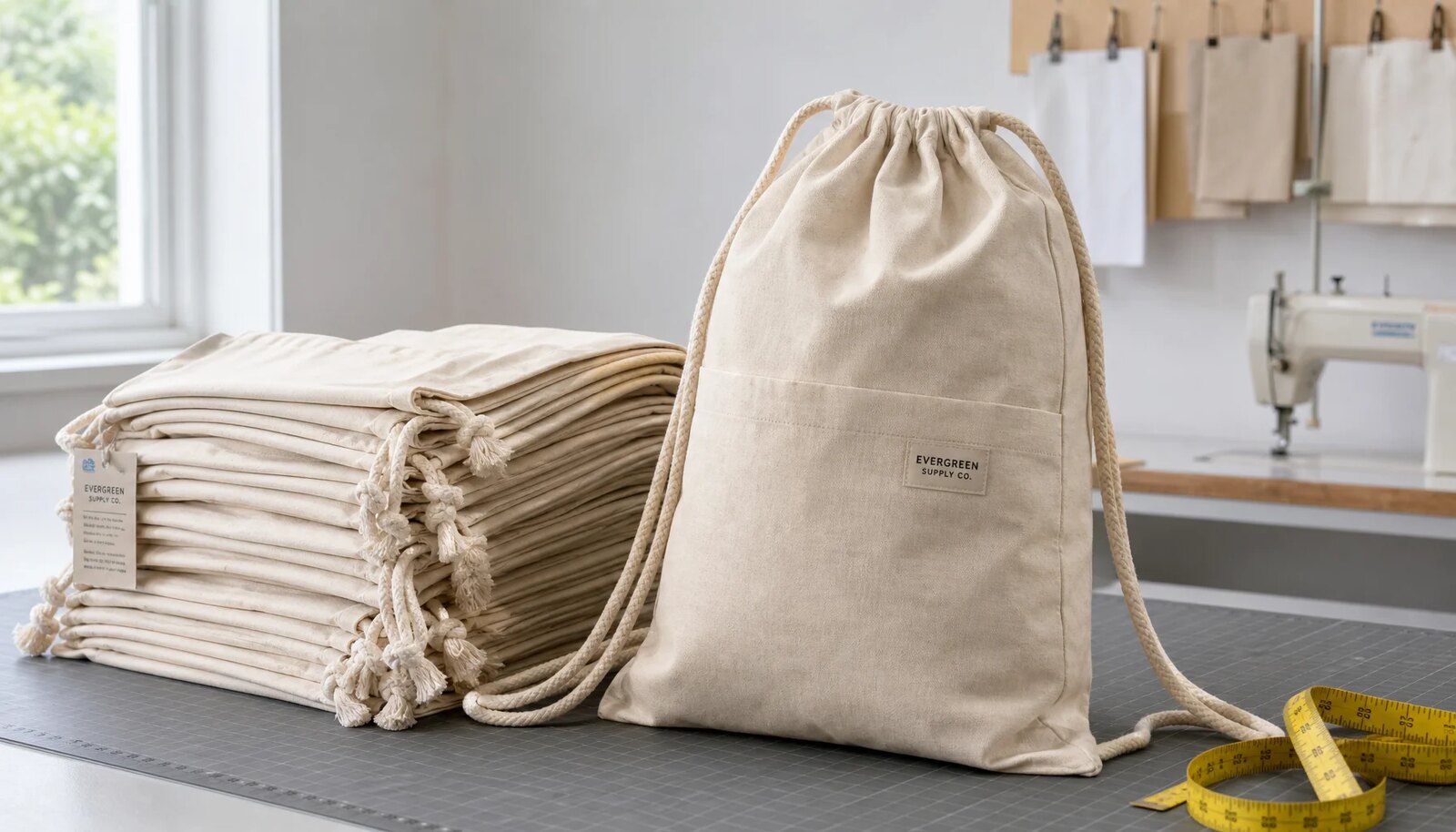
Why this bag is not a simple low-cost commodity
Custom cotton drawstring backpacks look basic, but the buying issues are not basic. The bag can fail on fabric weight, cord durability, print clarity, or packing method long before the buyer notices the unit price. For eco apparel brands, that matters because the bag often sits beside clothing and becomes part of the brand experience, not just a carry item.
The most common sourcing mistake is comparing quotes as if every supplier is selling the same product. One factory may be quoting soft 4 oz cotton for a giveaway, while another is quoting 8 oz canvas with reinforced corners and retail-ready packing. Those two bags can be priced close enough to cause confusion, but they will perform very differently in the market.
- Treat the bag as a branded accessory, not a generic tote substitute.
- Keep the RFQ focused on the end use: retail resale, event kit, or reusable packaging.
- Compare finished quality, not only fabric description or printed artwork.
Start with the use case and the weight of the load
The right fabric weight depends on what the bag will carry and how the buyer wants it to feel. For light promo use, 6 oz cotton is usually enough. For a retail program or a more premium eco apparel bundle, 8 oz or even 10 oz canvas gives better body, better print appearance, and less distortion when packed. If the bag will carry folded garments, hangtags, or small boxed goods, the bottom seam and cord channel matter as much as the fabric itself.
A common mistake is requesting a heavy-looking bag but asking for the lowest possible price. Heavy fabric increases raw material cost, but it also affects needle wear, sewing speed, and final carton weight. If the supplier does not adjust thread strength, seam allowance, and carton pack count, the product may look strong on the quote and weak in use.
- 6 oz to 7 oz: lower-cost giveaway or event use.
- 8 oz: balanced option for most eco apparel retail programs.
- 10 oz+: better structure, but verify sewing quality and freight cost.
Use a spec sheet that separates fabric from construction
Many RFQs fail because they list only size and logo. A better spec sheet splits the bag into fabric, construction, print, closure, and packing. For cotton drawstring backpacks, the fabric line should state cotton type, weave, and GSM or ounce weight. Construction should cover seam type, reinforcement points, cord channel method, and whether the bottom corners are boxed or flat. This gives the factory fewer chances to fill gaps with assumptions.
If you want the supplier to quote comparable numbers, standardize the dimensions. A typical buyer should specify finished width, finished height, gusset if any, and drawcord length. Include tolerance, such as plus or minus 0.5 cm on body size and plus or minus 2 cm on cord length. Without that, one supplier may quote a loose casual bag while another quotes a tighter retail fit and both will claim to meet the brief.
- State whether the bag is flat or gusseted.
- State whether the drawcord is cotton rope, braided cord, or blend cord.
- State whether the logo is on one side, both sides, or repeated in a pattern.
Compare suppliers on quote logic, not just the number
The best quote is the one that explains what is included. Two suppliers can show the same unit price, but one may include final sample approval, carton labels, and standard AQL inspection while the other charges those items later. Ask for the quote basis to be broken into fabric cost, print cost, sewing cost, accessories, packing, and testing if any. That is the only way to compare real value.
Direct factory sourcing is usually better for repeat programs, stable color control, and clearer accountability. A trading company can still be useful if you need mixed product sourcing, but the buyer should expect a layer of margin and a weaker view of actual production controls. If the supplier cannot say where the fabric comes from, how the print is applied, or how cartons are packed, the quote is not ready for procurement.
- Ask for the exact included items line by line.
- Compare price at the same order quantity and artwork complexity.
- Reject vague terms like 'standard packing' or 'good quality' without definition.
Print method choices that protect logo clarity
For cotton drawstring backpacks, screen print is usually the best value when the logo is one or two solid colors and the order quantity is large enough to justify the setup. It gives strong opacity and a clean brand feel on medium-weight cotton. Heat transfer can work for more complex art, but it must be tested on the actual fabric because textured canvas and soft weave can affect adhesion and edge sharpness. Digital print is useful for artwork with many colors, but buyers should confirm wash resistance and print hand feel before approving it.
The decision is not only about image quality. On dark cotton, the supplier may need underbase printing or a different ink system. On natural cotton, the weave can absorb ink and soften fine details. If the logo has thin lines, small type, or a subtle tone-on-tone effect, the buyer should ask for a proof on the same fabric color and weight, not on plain art paper. A woven label or small side label is sometimes a better brand solution than forcing a delicate print to do too much.
- Use screen print for simple logos and repeatable production.
- Use digital or transfer print only after sample testing on final fabric.
- Use woven or sewn labels when the logo must stay crisp and minimal.
MOQ logic: where the breakpoints usually sit
MOQ is not a single number; it changes with fabric, print, and color. If the factory is using stock natural cotton and one-color print, the MOQ may be manageable. If the buyer wants custom dyed fabric, special cord color, or a multi-color print, the MOQ usually rises because the factory must reserve materials and stop-start more production steps. For procurement planning, the real question is how the quote changes as each variable is added.
A clean MOQ conversation should expose the breakpoints. For example, a factory may hold one price at 1,000 pieces for stock natural fabric, a higher price at 3,000 pieces for custom logo print, and another step up if the buyer wants inside labeling or special packaging. This helps the buyer decide whether to simplify the spec or increase volume. The cheapest route is often to keep the base bag standard and customize only the elements that matter to the brand.
- Ask for price breaks at 500, 1,000, 3,000, and 5,000 pcs if relevant.
- Separate MOQ by fabric, print colors, and packaging requirements.
- If the MOQ is too high, simplify the artwork or keep the fabric stock.
Sample approval should verify more than appearance
The sample must be a production-relevant sample, not a showroom approximation. It should use the final fabric weight, final cord, final print method, and final label or side tag. If the sample arrives with a different weave or a cleaner print than the real order will get, the buyer is approving the wrong standard. The sample should also be checked for the feel of the drawcord, the stitch density at the channel, and how easily the bag opens and closes when loaded.
A practical sample checklist should include dimensions, print registration, color shade, seam strength, odor, loose threads, and fold memory. If the bag will be shipped retail-ready, the sample also needs the actual inner pack and carton format. That lets the buyer test whether the package protects the print, whether the bag creases too much, and whether the final presentation matches the brand position.
- Approve the sample only after measuring it, not just inspecting it visually.
- Compare the sample to the RFQ and artwork file line by line.
- Keep one signed sample with the production reference and one with the buyer team.
Packing and carton planning affect the landed cost more than buyers expect
Cotton drawstring backpacks are soft goods, so packing can quietly change the economics. Bulk packing usually lowers carton cost and speeds loading, but it can increase surface marks if the fabric is light or the print is large. Individual polybags help if the bags are going direct to retail or to a fulfillment center, but they add material cost and carton volume. The buyer should decide packing based on the destination, not habit.
For imported wholesale orders, always compare carton size, gross weight, and pieces per carton. A quote that looks cheaper per piece can become more expensive once freight is added if the supplier packs too loosely or uses oversized cartons. If the bags are going into a warehouse that relabels products later, simple bulk packing with size stickers may be the best balance. If the bags go straight to store shelves, ask for retail-friendly fold direction and clean unpacking.
- Request carton dimensions and gross weight on the quote.
- Choose bulk pack only if the warehouse can handle relabeling or repacking.
- Use polybags only when retail channel or moisture protection requires them.
Lead time risk comes from materials, not sewing alone
A realistic lead time for a standard custom cotton drawstring backpack is often 30 to 45 days after sample approval, but that only applies when the fabric is available and the print is straightforward. If the order needs custom dyed cotton, special labels, or a busy peak-season slot, the schedule can move to 45 to 60 days or longer. The buyer should separate sample timing, material booking, production, and inspection rather than accepting a single headline date.
Schedule risk increases when the supplier starts production before final approval or when the buyer delays art confirmation. Both problems create rework. The best practice is to freeze the artwork, approve the sample, and then release the order in one written step. For seasonal retail programs, build in one buffer week for corrections and one buffer week for freight booking. That is still cheaper than airfreighting an avoidable mistake.
- Confirm whether lead time starts from deposit, sample approval, or artwork approval.
- Ask whether fabric is stock or must be woven/dyed after PO.
- Plan buffer time if the bags must arrive before a launch date or event.
A practical landed-cost view for procurement teams
The final buying decision should be based on landed cost and sell-through value, not on unit price alone. A stronger 8 oz bag with cleaner print and better packing may cost more at origin, but it can reduce returns, improve retail presentation, and lower repack labor. On the other hand, if the bag is only a promo insert, over-specifying fabric weight and print complexity may waste margin. The buyer needs to align the spec with the channel.
When comparing suppliers, put every quote into the same worksheet: ex-factory price, sample fees, print setup, packing charges, cartonization, inland freight if any, ocean or air freight estimate, duty, and local handling. This reveals hidden differences quickly. If one supplier's lower unit price is offset by heavier cartons, higher MOQ, or slower production, the apparent savings can disappear before the goods reach your warehouse.
- Use the same quantity and same packing spec for every quote comparison.
- Include freight-ready carton data before approving the supplier shortlist.
- Consider retail presentation and labor savings as part of landed value.
Specification comparison for buyers
| Spec decision | Recommended option | When it fits | Buyer risk to check |
|---|---|---|---|
| Fabric base | 6 oz to 8 oz cotton canvas for most retail programs; use 10 oz if the bag must feel structured | Eco apparel brands needing a reusable bag that looks premium enough for store sales or event kits | Light fabric can wrinkle, crease, and show print bleed; heavy fabric raises cost and slows sewing |
| Fabric GSM | 200 to 280 GSM for standard use; 300+ GSM for higher perceived value | When the bag must hold brochures, lightweight apparel, or small retail items without sagging | Suppliers sometimes quote GSM and oz together without clarifying weave; request a swatch with measured weight |
| Closure style | Cotton rope drawcord with reinforced eyelets or stitched channel | Best for classic drawstring backpacks used in eco merchandising and brand promotions | Weak cord channels tear first; unreinforced eyelets can cut into the fabric after repeated use |
| Print method | Screen print for one to two spot colors; heat transfer or digital print for complex art; woven label for minimal branding | When logo clarity matters more than all-over decoration and the order quantity is moderate | Fine detail may blur on textured canvas; test logo size and color on a pre-production sample |
| Supplier route | Direct factory sourcing for repeat programs; trading company only if you need consolidated SKUs or mixed product sourcing | Brands buying ongoing replenishment, custom colors, or controlled QC | Middleman quotes may hide fabric substitution, extra handling fees, or slower issue resolution |
| MOQ strategy | 1,000 to 3,000 pcs per design for custom printing; higher if fabric dyeing or custom trim is required | When you need factory pricing without overcommitting inventory | Low MOQ may mean stock fabric only, limited print placement, or higher per-unit cost |
| Packing format | Bulk pack by 25/50 pcs with carton inner protection; retail polybag only if required by channel | Wholesale distribution, warehouse relabeling, or e-commerce fulfillment | Overpacked cartons raise freight cost; underpacked goods show scuffs and dirt on arrival |
| Lead time | 30 to 45 days after sample approval for standard materials; 45 to 60 days for custom dyed fabric or seasonal rush | When the artwork is final and the buyer can approve quickly | Quoted lead time may exclude fabric booking, test sampling, or peak-season capacity limits |
| Sampling route | Pre-production sample with final fabric, cord, print, and label | Any order where logo placement, hand feel, or packaging matters to the buyer | A paper proof is not enough; approve a sewn sample before mass production |
Buyer checklist before sampling
- Define the use case: retail resale, trade show giveaway, employee kit, or bundled apparel packaging.
- Lock the fabric spec in writing: cotton type, weave, GSM or oz, and whether the bag should feel soft or structured.
- Confirm exact size tolerance for body width, body height, cord length, and usable capacity.
- Choose one print method and one backup method if the artwork has fine lines or small type.
- Specify reinforcement points: bottom seam, cord channel, stress points, and optional eyelets or metal tips.
- Request a pre-production sample with the final fabric color, final logo placement, and final packing method.
- Ask for carton pack count, carton size, gross weight, and whether cartons are export-tested or single-wall.
- Compare landed cost, not unit price only: add freight, duties, carton charges, sample charges, and local fulfillment costs.
- Set acceptance criteria for shade, print registration, seam quality, measurement tolerance, and odor.
- Reserve time for correction: build one approval round into the schedule before mass production starts.
Factory quote questions to send
- What exact cotton fabric are you quoting: fiber type, weave, GSM or oz, and whether it is stock fabric or custom woven?
- Is the quoted price based on one-side print, two-side print, or no print, and how many colors are included?
- What is the MOQ by fabric type, print method, and color? If the MOQ changes with artwork complexity, show the breakpoints.
- Will you provide a pre-production sample made with the final fabric and final accessories, and what is the sample fee?
- What are the exact finished dimensions, cord length, and tolerance you will hold in production?
- What packaging is included in the quote: bulk packed, polybagged, barcode label, master carton count, and carton dimensions?
- What is the production lead time after sample approval, and what part of that time is fabric booking, printing, and sewing?
- Which quality checks are included before shipment, and can you share the inspection standard or AQL level used?
- If the print or fabric shade is not matched, what is your rework or replacement process before shipment?
- What are the freight-ready carton details so we can compare landed cost across suppliers on the same basis?
Quality-control points to confirm
- Fabric weight matches the approved spec within the agreed tolerance; do not accept a lighter substitute without written approval.
- Finished size is measured flat and keeps usable capacity; strap length and drawcord function are verified on both sides.
- Print placement is centered or aligned to the approved artwork template with no visible smearing, pinholes, or registration drift.
- Stitching is straight and dense enough at the bottom seam, side seams, and cord channel to pass normal retail handling.
- Cord ends are finished cleanly, with no fraying and no sharp metal tips unless those tips were approved in the sample.
- Color shade is checked against the approved reference under daylight or a neutral light source, not just factory warm light.
- Cartons are packed to protect the bag shape and print surface; no crush marks, wet cartons, or mixed SKUs in unmarked boxes.
- Odor, lint, and loose threads are reviewed before carton sealing, especially if the bags will be used for fashion or gift packaging.
- Barcode labels, size stickers, and inner pack counts match the buyer packing list exactly before loading.