Start With the Bookstore Use Case
A university bookstore cotton drawstring backpack is not the same product as a cheap event pouch with shoulder cords added. The buyer must first separate three use cases: retail merchandise sold on shelf, orientation giveaway packed with inserts, and licensed campus promotion distributed through departments. Each use case changes fabric weight, print durability, packing, and QC tolerance.
For retail sale, the bag needs a better handfeel, straighter stitching, cleaner print, and barcode-ready packaging. For giveaways, the priority is stable cost, consistent logo position, and cartons that can be opened quickly by campus staff. For licensed university marks, the artwork approval path may take longer than sewing, so the supplier compliance checklist should protect both logo accuracy and delivery schedule.
- Retail shelf target: usually 180-220 GSM cotton or light canvas, cleaner finishing, individual pack or paper band, barcode label.
- Orientation giveaway target: often 120-150 GSM cotton, simple one-color print, bulk pack by department or event carton.
- Licensed brand target: supplier must follow Pantone, clear space, print size, and trademark approval records.
- Distributor target: carton marks, SKU separation, packing list accuracy, and re-order consistency matter as much as unit price.
Write the Fabric Specification Clearly
Cotton fabric weight is one of the easiest places for quotes to become misleading. A supplier quoting 120 GSM natural cotton and another quoting 220 GSM cotton canvas are not competing on the same product. The RFQ should state fabric composition, GSM, color, finishing, shrinkage expectation, and whether the buyer accepts recycled cotton blend or only virgin cotton.
For most bookstore drawstring backpacks, 140-150 GSM is the low-cost starting point, 180 GSM gives a better retail feel, and 220 GSM moves toward a stronger canvas-style backpack. Natural cotton is usually faster and cheaper than dyed cotton because it avoids custom dye MOQ and shade approval. If the university requires a school color body fabric, build in extra approval time for lab dip, bulk shade variation, and possible higher MOQ.
- Specify fabric as cotton, cotton canvas, recycled cotton blend, or cotton-poly blend; do not write only eco fabric.
- State target GSM and tolerance, such as 180 GSM with acceptable factory tolerance confirmed before production.
- Confirm natural, bleached, dyed, or custom PMS fabric because each route changes MOQ and lead time.
- Require fabric handfeel approval because two fabrics with the same GSM can feel different after finishing.
- Include shrinkage expectation if the bag may be washed or if local decoration will happen after import.
Choose Construction for the Real Load
Drawstring backpacks fail most often at the cord channel, bottom corners, and eyelet or grommet area. A bookstore buyer should not approve a sample only by looking at the front print. The sample must be loaded with the expected contents and pulled open and closed repeatedly. A bag meant to carry a hoodie and notebook needs stronger stitching than a bag carrying a flyer and pen.
The RFQ should define finished size, drawcord material, cord diameter, channel width, and reinforcement method. Cotton rope has a natural look but can cost more and fray if the end is not controlled. Polyester cord slides smoothly and offers strength, but may feel less natural beside a cotton body. Metal eyelets look tidy, while sewn corner loops can reduce metal compliance concerns and avoid cracking on thin fabric.
- Common retail size range: about 34 x 42 cm or similar, adjusted for apparel and campus merchandise.
- Use reinforced bottom corners for retail bags and any order expected to carry notebooks or drink bottles.
- Require bar tack or dense stitching at stress points instead of relying only on a single seam pass.
- Match cord thickness to the channel; a cord that is too thick makes closing difficult and stresses seams.
- Review whether metal eyelets create extra testing or documentation requirements for the destination market.
Match Print Method to Artwork Risk
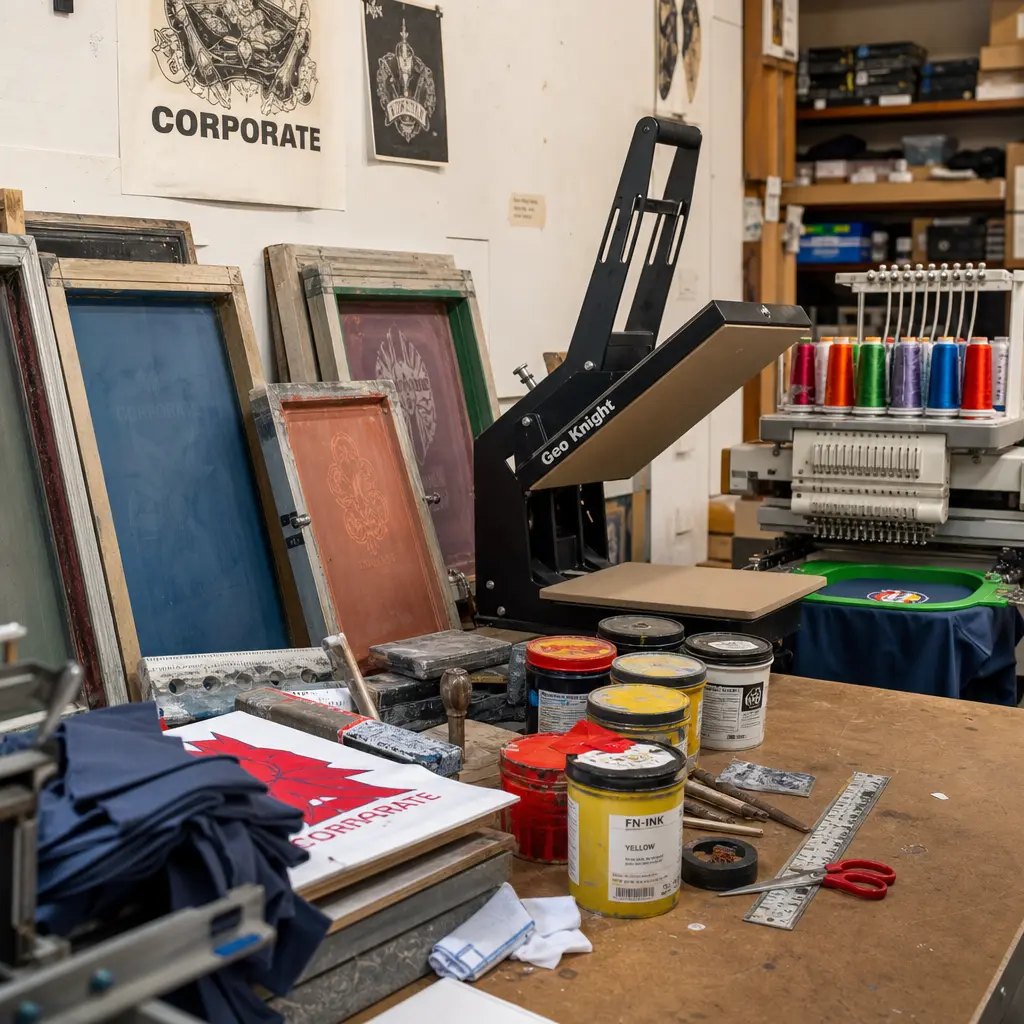
University bookstore artwork often includes licensed marks, small type, mascot details, and strict school colors. Screen print is usually the most reliable and cost-effective method for one to four spot colors on cotton. It gives good opacity, predictable color, and stable bulk production when the artwork is not too detailed.
Digital print or heat transfer can help with gradients, photos, or low-volume multi-color art, but buyers must test handfeel, folding durability, and edge cracking. Embroidery may look premium, but on lighter cotton drawstring backpacks it can pull the fabric or distort the panel unless backing and stitch density are controlled. The safest approval path is a strike-off on the actual bulk fabric, followed by a complete pre-production sample.
- For bold bookstore logos: screen print with Pantone reference and print size in centimeters.
- For many colors or gradients: digital print or transfer, with fold and rub checks before approval.
- For premium patches or labels: woven label or sewn patch may control detail better than direct print.
- For dark fabric: test ink opacity because school colors may shift on navy, black, maroon, or forest green cotton.
- For licensed marks: keep the approved artwork file, print proof, and sample photo in the order record.
Understand MOQ Logic Before Comparing Quotes
MOQ is not one number. A supplier may offer a low MOQ for natural cotton with one-color screen print, then require a higher MOQ for dyed fabric, custom woven labels, retail barcode stickers, or multi-SKU packing. Procurement teams should ask for the MOQ drivers separately so the buyer can decide which custom features are worth keeping.
For example, a bookstore may not need custom-dyed fabric if a natural cotton body with strong school color print delivers the same retail story. On the other hand, a woven side label may be worth the MOQ if the backpack becomes a repeat private label item. The goal is to separate product value from hidden setup cost.
- Fabric MOQ depends on stock fabric availability, dye lot size, and whether the color is natural, black, or custom PMS.
- Print MOQ depends on screen setup, color count, machine time, and whether artwork changes by department.
- Label MOQ depends on woven label minimums, cutting method, and label color count.
- Packing MOQ depends on printed polybags, barcode label setup, hangtag printing, and carton mark changes.
- SKU MOQ increases when the buyer splits one order across several bookstore designs or campus departments.
Build a Quote Sheet That Exposes Cost Drivers
A clean quote should show more than FOB unit price. For custom cotton drawstring backpacks, the buyer needs to see fabric cost, decoration setup, sample cost, packing cost, and export carton data. This prevents a cheap headline price from becoming expensive after artwork, label, barcode, and packing requirements are added.
Use a quote comparison sheet with the same assumptions for all suppliers: quantity, size, GSM, print method, number of print colors, packing method, carton quantity, Incoterm, and validity date. If one supplier quotes 100 pieces per carton and another quotes 200 pieces per carton, the freight comparison will be distorted unless carton CBM and gross weight are included.
- Request FOB unit price and separate setup charges, not a single blended line that hides screen or label cost.
- List sample fee, sample lead time, and whether the fee is refundable after bulk order.
- Require carton dimensions, pieces per carton, net weight, gross weight, and estimated CBM.
- Confirm Incoterm, loading port, quote validity, payment terms, and balance payment trigger.
- Ask whether price includes needle detection, final inspection support, export carton marks, and document preparation.
Approve Samples With Measurable Criteria
A sample approval email that says looks good is not enough for a bookstore order. The approval should name the fabric, size, print color, print position, cord, label, stitching, and packing status. If the sample is made from substitute fabric or temporary cord, the supplier should mark those differences clearly and submit a corrected pre-production sample before bulk cutting.
The pre-production sample should be treated as the contract reference. Procurement, merchandising, licensing, and warehouse receiving teams may each care about different details, so the sample record should include photos, measurements, material notes, and packing photos. This reduces disputes when bulk goods arrive and someone compares them against a vague approval image.
- Measure width, height, cord length, print size, print placement, and corner reinforcement position.
- Compare print color to Pantone or approved color target under stable lighting.
- Load-test the sample with expected contents and pull the drawcord repeatedly.
- Inspect inside seams, loose threads, stains, needle holes, and print curing.
- Approve final retail packing, barcode placement, hangtag, and carton mark before mass packing.
Set QC Thresholds Before Production Starts
Quality control works best when the factory knows the acceptance criteria before sewing. For cotton drawstring backpacks, buyers should define critical, major, and minor defects. Critical issues include wrong logo, unsafe metal parts, wrong fabric composition, or mixed SKUs. Major issues include weak seams, severe stains, wrong size, poor print adhesion, and unreadable barcode labels. Minor issues may include small thread ends or slight natural cotton slub within the approved range.
The inspection plan should include raw material check, inline sewing review, print inspection, and final packed goods inspection. AQL levels can be used if the buyer already works with that system, but even without formal AQL, the purchase order should state measurable tolerances. The supplier should not be left to decide whether a 2 cm logo shift is acceptable.
- Size tolerance: define allowable variation for width, height, and print position.
- Seam strength: test stress points by pulling drawcord and loading expected contents.
- Print durability: rub, scratch, fold, and inspect after curing time recommended by the ink supplier.
- Fabric appearance: define acceptable slubs, shade variation, stains, and oil marks for natural cotton.
- Packing accuracy: verify SKU, barcode, carton quantity, carton mark, and packing list before shipment.
Control Packing and Bookstore Receiving Risk
Packing is a compliance issue for university bookstores because receiving teams often handle many seasonal goods at once. If cartons are mixed, barcode labels are wrong, or carton marks do not match the purchase order, a low-cost bag can create warehouse delays. Buyers should define whether goods are bulk packed, individually packed, paper banded, or retail packed with barcode.
For sustainability-focused campus stores, the buyer may prefer paper bands or recyclable polybags, but the choice must still protect the cotton bag from moisture and dirt during ocean or air shipment. Natural cotton absorbs marks easily, so carton lining, dry storage, and clean packing tables matter. A packed sample or packing photo set should be approved before the factory seals export cartons.
- Bulk pack works for campus events but should still separate SKUs and artwork versions clearly.
- Individual pack protects retail goods but adds labor, material cost, and plastic-reduction questions.
- Paper band can reduce plastic but may not protect the bag from moisture or warehouse handling.
- Barcode labels must scan through the final package and match the bookstore receiving file.
- Carton marks should include PO number, SKU, quantity, color, destination, carton number, and country of origin if required.
Plan Lead Time Around Approval Bottlenecks
The production clock should not start from the first inquiry. For custom cotton drawstring backpacks, lead time normally depends on artwork approval, fabric booking, sample approval, print screen preparation, sewing capacity, packing, inspection, and freight. University licensing review can add uncertainty, especially if the logo size, color, or trademark clearance changes after the first proof.
A practical schedule separates buyer-controlled time from factory-controlled time. The buyer controls artwork file quality, internal approval speed, purchase order release, and deposit payment. The factory controls material sourcing, sample making, production, QC, and export handover. When these are mixed together, both sides underestimate the real delivery date.
- Allow time for artwork cleanup if the bookstore only has low-resolution logo files.
- Do not authorize bulk fabric cutting until the final print size and logo placement are approved.
- Book dyed fabric earlier than natural cotton because shade approval and dye lot control add risk.
- Schedule inline inspection before the full order is printed or packed, not only at final shipment.
- Reserve time for carton label correction if the distributor or bookstore changes receiving instructions.
Specification comparison for buyers
| Supplier option | What to verify | Commercial advantage | Buyer risk to control |
|---|---|---|---|
| Direct sewing factory | cord material proof, reinforcement close-ups, load-test photos, approved sample tag, and bulk-line first-piece record | Better sample-to-bulk control and faster production feedback | May be weaker on export paperwork or branded packing unless checked early |
| Trading company | Factory name, production photos, trim-source proof, and who owns QC decisions | Can coordinate small mixed orders and extra services | Markup can hide real factory capability and slow defect decisions |
| Specialized bag workshop | cord diameter, eyelet or reinforced channel, bottom corner reinforcement, seam allowance, bar-tack position, and load target | More practical for detailed construction, trims, and repeat programs | Capacity may be limited during peak seasons |
| Low-price general supplier | 6-10 oz cotton canvas, 210D polyester, rPET, or blended cotton with shrinkage and colorfastness expectations set before sampling | Useful for simple promotional runs with loose specs | Material downgrades, weak packing, and vague inspection scope can erase savings |
| Retail-ready supplier | fold direction, cord protection, bundle count, carton compression, moisture bag, and retail label position | Can handle labels, SKU separation, carton marks, and receiving rules | Higher unit cost must be compared against reduced warehouse work |
| Compliance-focused supplier | Fabric records, labeling review, test plan, and production traceability | Safer for retail programs and repeat brand orders | Documentation claims need evidence, not only sales language |
| Local sample room plus bulk factory | Signed sample, bulk factory handoff, first-piece photos, and deviation owner | Good for complex branding before large production | Sample room quality may not match bulk line unless handoff is controlled |
Buyer checklist before sampling
- Define bag size, cotton GSM, fabric color, drawcord material, corner reinforcement, and whether the backpack is for retail sale or giveaway use.
- State the expected load, such as textbooks, apparel, water bottle, or event inserts, so the supplier can quote suitable seam and eyelet construction.
- Require artwork files in vector format with Pantone colors, print size, print position, and logo clearance rules from the university licensing guide.
- Ask for fabric composition, GSM tolerance, shrinkage expectation, colorfastness method, and whether the fabric is pre-shrunk or untreated greige cotton.
- Request a pre-production sample using bulk fabric, bulk drawcord, bulk ink, and final packing before authorizing cutting.
- Set measurable QC limits for size tolerance, print registration, seam strength, stain allowance, needle holes, and carton quantity accuracy.
- Confirm MOQ by fabric color, print color count, label type, packing method, and carton mark requirement rather than accepting one generic MOQ.
- Compare quotes by FOB unit cost, sample fee, screen charge, label mold or woven label cost, packing cost, inland freight, and estimated carton CBM.
- Reserve approval time for university trademark review, bookstore buyer sign-off, and import document review before counting production lead time.
- Require final photos of packed goods, carton marks, random weight check, and inspection report before balance payment or shipment release.
Factory quote questions to send
- Are you the cut-and-sew factory, the printer, or a trading company coordinating outside workshops?
- What cotton GSM options do you normally keep in stock for drawstring backpacks, and what is the GSM tolerance after dyeing or finishing?
- What is your MOQ for natural cotton, dyed cotton, custom PMS fabric, one-color print, multi-color print, woven label, and individual retail packing?
- Can the sample be made with bulk fabric and the same print method planned for production?
- What seam construction and reinforcement do you recommend if the bookstore expects students to carry apparel, notebooks, or one light textbook?
- Which print method gives the best result for our artwork on cotton: screen print, digital print, heat transfer, or embroidery?
- What are the separate charges for screens, artwork setup, sample making, woven label, hangtag, barcode label, and custom carton mark?
- What is the production lead time after sample approval, and which materials must be booked before the university license approval is finished?
- How many pieces per export carton, what is the estimated gross weight, and what carton size should we use for freight calculation?
- What inline and final QC records can you provide before shipment, including size checks, print checks, seam checks, and packing checks?
Quality-control points to confirm
- Finished size tolerance should normally be controlled within about plus or minus 1 cm for width and height unless the buyer approves a wider tolerance.
- Fabric GSM should be checked against the approved sample and purchase order, with any downgrade documented before bulk cutting.
- Drawcord length, cord diameter, knot security, and channel stitching must be consistent enough that the bag closes smoothly without twisting.
- Corner reinforcement should be inspected for skipped stitches, weak bar tacks, metal eyelet cracking, or fraying around punched holes.
- Print color should be compared against Pantone target under consistent lighting, with registration and print position measured from bag edges.
- Ink adhesion should be checked by rubbing, folding, and light scratch testing on cured production pieces, not only on the strike-off panel.
- Stains, oil marks, yarn slubs, shade variation, and loose threads need an agreed acceptable level because natural cotton shows defects clearly.
- Retail packaging must match barcode, SKU, carton quantity, carton mark, and country-of-origin requirements before goods enter the export carton.