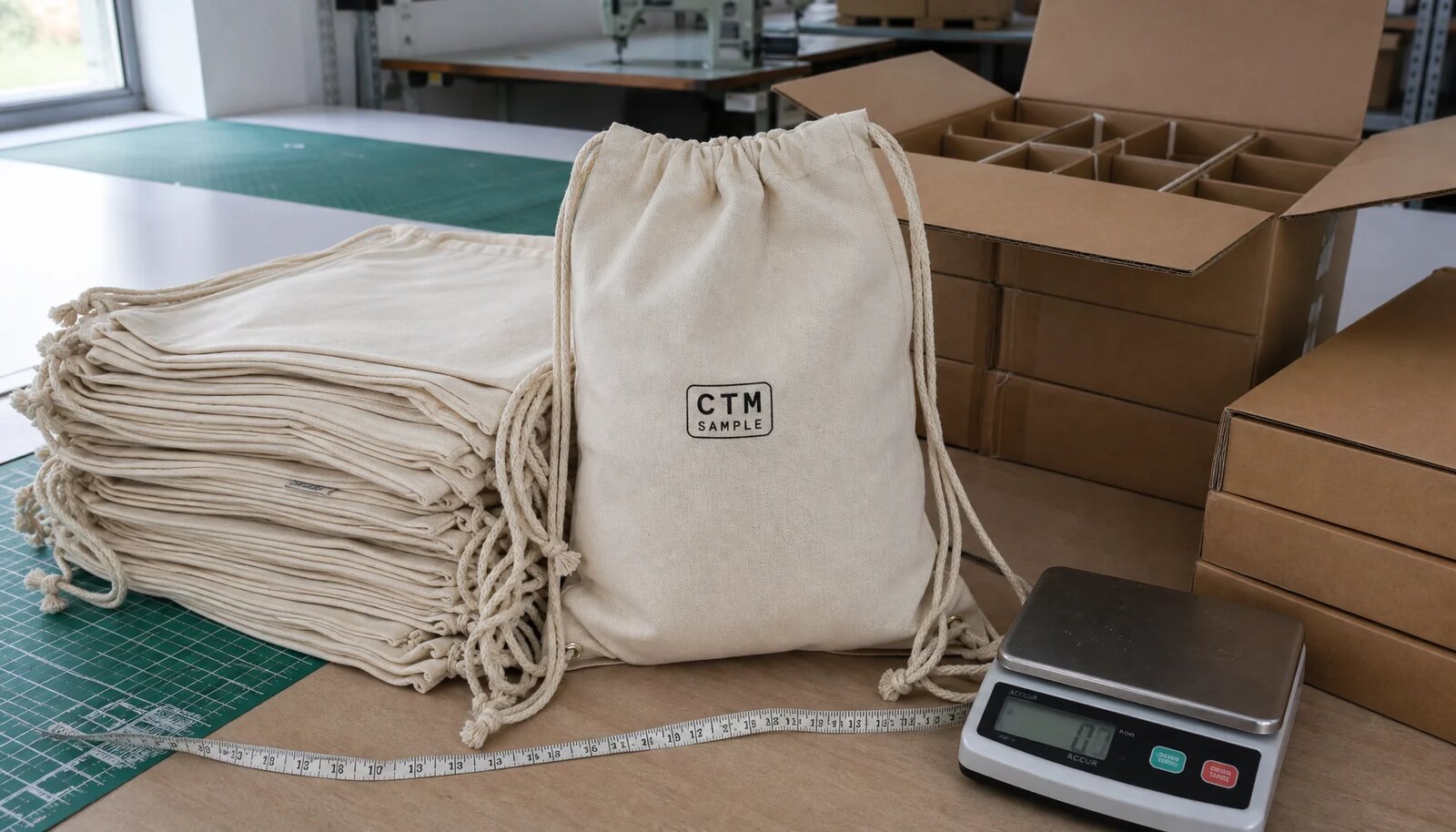
Why carton planning matters for craft fair backpack orders
For custom cotton drawstring backpacks, carton planning is not just a warehouse detail. Craft fair inventory often moves through several hands: factory, forwarder, importer warehouse, distributor, event team, booth staff, and sometimes a regional parcel carrier. Each handover creates opportunities for crushed cartons, mixed SKUs, print scuffing, short counts, or delayed booth replenishment.
The buying problem is simple: the backpack may be well made, but the order can still fail commercially if cartons are too heavy, too weak, poorly marked, or packed in a way that does not match fair operations. A booth team may need to carry cartons across a venue, open only one color at a time, or replenish from a van during peak traffic. Those needs should be built into the RFQ before the factory calculates price.
- A good carton plan reduces freight surprises by giving real carton size, weight, and CBM before booking.
- It protects printed panels from abrasion, blocking, and pressure marks during stacking.
- It helps distributors split inventory by fair date, color, design, or retail kit.
- It avoids over-heavy cartons that look efficient in a quote but slow down event handling.
- It gives QC inspectors measurable carton acceptance criteria instead of subjective packing comments.
Start with the selling format before deciding carton quantity
A craft fair order can be a low-cost giveaway, a paid souvenir, a maker kit bag, or a retail accessory sold through a booth. These uses look similar in a product photo, but the carton plan should differ. A giveaway order may prioritize high pieces per carton and low cube. A paid retail bag needs cleaner folding, better bundle protection, and fewer visible creases on the printed face.
Procurement teams should define how the backpacks will be opened and sold. If each fair receives 300 pieces in three designs, the carton split should support that allocation. If a distributor sells mixed assortments to small craft vendors, inner bundles by color and design become more important than maximum carton density. The factory cannot optimize this unless the RFQ explains the downstream handling.
- For giveaways: pack densely, but still protect the print from transfer and fabric dust.
- For paid retail: use neat folding, consistent front-facing orientation, and cleaner inner bags or paper bands.
- For event kits: pack by kit version or event location, not only by product color.
- For distributor resale: use scannable item codes or clear carton marks so warehouse staff can pick by SKU.
- For venue hand-carrying: target lighter cartons even if total carton count increases.
Fabric GSM changes carton weight, cube, and handling cost
Cotton drawstring backpacks for craft fairs are commonly made from 4 oz, 6 oz, 8 oz, or sometimes 10 oz cotton canvas. In GSM terms, that roughly ranges from about 140 GSM to 340 GSM depending on construction and finishing. For most craft fair merchandise, 6 oz to 8 oz, about 200-270 GSM, gives a practical balance between hand feel, print surface, and carton efficiency.
A heavier fabric can improve perceived value, but it quickly changes packing math. A 10 oz canvas backpack may reduce the quantity per carton from 100 pieces to 50 pieces, double the carton count, or push gross weight above comfortable event handling limits. A lighter 4 oz cotton bag may ship efficiently, but it can wrinkle more, show contents more clearly, and feel too promotional for paid retail.
- 4 oz cotton: low cost and low carton weight, but weaker hand feel and more transparency.
- 6 oz cotton: common for event merchandise where price and quality must both work.
- 8 oz cotton canvas: stronger retail feel and better print surface, but more carton weight.
- 10 oz canvas: premium feel, often better for durable resale, but less efficient for craft fair logistics.
- Dyed cotton can add finishing variation; natural cotton may show cotton seed specks but is widely accepted for craft markets.
Print method affects how the bags can be stacked and packed
For custom cotton drawstring backpacks, screen printing remains the most practical method for many craft fair programs. It works well for simple logos, event graphics, maker-brand artwork, and one to three color designs. Water-based ink is often preferred on natural cotton because it has a softer feel and lower risk of a thick plastic surface. However, the ink still needs proper curing and drying before packing.
Packing problems often start when print requirements are discussed separately from carton planning. Thick ink, under-cured ink, metallic ink, puff print, or heavy white underbase can stick to the next bag when pieces are stacked tightly. If the bag is folded with the printed face under pressure, the print may pick up lint, ghost onto another panel, or develop shine marks. The RFQ should state both the print method and the intended packing structure.
- Use water-based screen print for soft-hand natural cotton designs when artwork allows.
- Use plastisol or higher-opacity ink when printing bright colors on dark cotton, but control curing and blocking risk.
- Specify print size and location using measurements from the top edge and side seam.
- Avoid approving only a digital print mockup; require a physical strike-off or production sample.
- For large solid print areas, consider tissue interleaving or lower carton pressure if rub or blocking risk appears during sampling.
Set inner packing so event teams can replenish without creating damage
The cheapest packing method is usually loose bulk packing into the export carton. It may be acceptable for simple promotional giveaways, but it is rarely the best choice for craft fair retail inventory. Loose bags shift during transport, cords tangle, printed faces rub against each other, and booth staff must sort products while customers are waiting.
A practical approach is to pack 10 pieces per inner polybag, 10 pieces per kraft paper band, or another fixed bundle size that matches selling rhythm. Inner polybags protect against moisture and dust, while kraft bands reduce plastic and keep bundles tidy. The right answer depends on brand packaging policy, local retail expectations, and how often cartons will be opened before the fair.
- 10 pieces per inner bundle is easy for booth staff to count and replenish.
- 25 pieces per inner bag may reduce packing cost but is less convenient for small fair allocations.
- Individual polybags add cost and labor and may not match sustainable craft fair positioning.
- Kraft paper bands look cleaner for natural cotton products but offer less moisture protection.
- Cords should be tucked inward or aligned so they do not snag when the bundle is removed.
Choose export carton size by real handling limits, not only lowest freight cube
Factories often try to maximize the number of pieces per carton because fewer cartons appear cheaper. For craft fair programs, that can create operational problems. A carton that holds 150 lightweight backpacks may look efficient, but it may be bulky, hard to stack in a van, and awkward for a booth team to carry through a venue service entrance.
A more workable target is often 50 to 100 pieces per carton, depending on fabric weight, backpack size, and inner packing. Gross weight around 12-18 kg is usually easier to handle than cartons above 20 kg. Buyers shipping by parcel carrier should also watch dimensional weight and maximum carton size rules, because a large but light carton can still be charged at a high billable weight.
- Use 5-ply cartons for sea freight, pallet stacking, or multiple warehouse transfers.
- Use 3-ply cartons only for lighter domestic moves where stacking pressure is limited.
- Avoid bulging cartons; they stack poorly and can fail at seams or corners.
- Record actual packed carton dimensions after the pilot packing test.
- If cartons go to different fair locations, smaller cartons may reduce repacking labor even if freight count rises.
Build carton marks for receiving, allocation, and booth control
Carton marks are easy to overlook because they feel administrative, but they prevent expensive confusion. Craft fair orders often include several artwork versions, colorways, sizes, or event-specific allocations. A generic mark such as 'cotton backpack' does not help a distributor identify which carton belongs to which fair or which print version is inside.
A good carton mark should connect the factory packing list to the buyer's warehouse system and the event team's allocation plan. It does not need to be decorative. It needs to be readable, durable, and consistent. If the buyer uses barcodes or SKU labels, the factory should apply them in a fixed location so receivers are not searching every carton face.
- Include buyer PO number, item code, design name, color, and quantity per carton.
- Add carton sequence such as 1 of 48, 2 of 48, and so on.
- Show gross weight, net weight, and carton dimensions if required by the forwarder.
- Use event or warehouse destination codes for split shipments.
- Keep marks on at least two carton sides so they remain visible when palletized.
Use MOQ logic that matches colors, prints, and carton versions
MOQ is not only a total order quantity. For cotton drawstring backpacks, MOQ can be affected by fabric color, fabric purchase minimum, dye lot, print design, cord color, label type, inner packing, and carton marking version. A buyer may request 2,000 pieces total, but if that quantity is split across four colors and five event designs, the factory is managing many small production batches.
Small splits create setup waste and quality risk. Printing screens must be prepared, sewing lines must separate colors, packing staff must avoid mixed cartons, and carton marks must be controlled. If the program needs many designs, the buyer can often reduce cost and mistakes by standardizing the base backpack and changing only the front print or hangtag.
- State total quantity and quantity by color, print version, and destination.
- Ask where price breaks occur, for example at 500, 1,000, 3,000, or 5,000 pieces per design.
- Keep cord and fabric colors consistent when many artwork versions are needed.
- Avoid too many carton mark versions unless allocation truly requires it.
- For small craft fair runs, consider natural cotton stock fabric to avoid custom dye MOQ.
Sample approval should include a packed-carton review
Many buyers approve a backpack sample but never review how the finished goods will be folded, bundled, and cartoned. That leaves one of the highest-risk steps untested. A production-style sample should use the final cotton GSM, final cord, final print method, final stitch construction, and the same folding method planned for bulk production.
For larger orders or orders split across multiple craft fair destinations, a packed-carton sample or pilot carton is worth the extra time. It shows whether the carton is too tight, whether the print scuffs, whether cords tangle, whether the inner bundle count is practical, and whether carton marks are readable. This review should happen before mass packing, not after all goods are sealed.
- Approve fabric hand feel, GSM, color shade, and shrinkage expectation before bulk cutting.
- Approve print color, size, placement, opacity, and curing quality from a physical sample.
- Approve folding direction so print is not placed under unnecessary pressure.
- Open a packed test carton after 24-48 hours to look for print transfer or hard creases.
- Photograph the approved packing method and attach it to the purchase order or inspection file.
Plan lead time around artwork, fabric, printing, packing, and inspection
Craft fair sales are date-sensitive. A late shipment may miss the fair season, not just a warehouse appointment. Lead time should be broken down by stage: artwork review, sample making, sample approval shipping, fabric purchase or dyeing, cutting, printing, sewing, trimming, packing, inspection, and export handover. A single total lead time in the quote hides too many assumptions.
Buyers should also protect time for carton testing and correction. If the first carton plan is too heavy or the print blocks after stacking, the factory may need to adjust quantity per carton, add interleaving, or change drying time. Those changes are easier before production is packed. Rushing packing at the end of the schedule is a common cause of dirty fabric, count errors, and weak carton sealing.
- Allow extra time for custom-dyed cotton or special cord colors.
- Do not start bulk printing until artwork, Pantone references, and print placement are approved.
- Reserve inspection time after goods are fully packed but before final payment or loading.
- Build in buffer for event-date shipments that move through parcel forwarding or regional warehouses.
- For split deliveries, require a packing list showing carton numbers assigned to each destination.
Specification comparison for buyers
| Spec decision | Recommended option | When it fits | Buyer risk to check |
|---|---|---|---|
| Fabric weight for craft fair retail | 6 oz to 8 oz cotton canvas, about 200-270 GSM, pre-shrunk if washing is expected | Useful for mid-price craft fair merchandise where the backpack must feel stronger than a promo giveaway but still fold efficiently into cartons | Very light 4 oz cotton can look weak at the booth; heavy 10 oz canvas increases carton weight and may push freight class or parcel surcharges |
| Backpack size and carton cube | Common adult event size around 34 x 42 cm or 35 x 45 cm, packed flat with cords tucked inward | Fits most print artwork, small purchases, catalogs, or event items without creating an oversized carton | Oversized bags may need longer cartons; loosely packed cords can increase cube and create snagging during retail replenishment |
| Print method for repeated handling | Water-based screen print for natural cotton; plastisol or high-opacity ink only when stronger coverage is needed | Best for simple craft fair logos, one to three colors, and artwork that must survive handling in boxes and at booth tables | Thick ink can block, crack, or transfer if packed before curing; dark fabric with weak ink opacity leads to rejected retail appearance |
| Packing ratio per inner bundle | 10 pieces per polybag or kraft paper band, 50 to 100 pieces per export carton depending on GSM and size | Allows fair staff to open one bundle at a time instead of exposing the whole carton to dust and moisture | Random loose packing saves labor but slows booth replenishment and increases risk of mixed colors or dirty items at unpacking |
| Export carton strength | 5-ply corrugated carton for sea freight or mixed pallet shipping; 3-ply only for light domestic courier cartons | Recommended when cartons will be stacked in a warehouse, forwarded to regional craft fair locations, or handled by small parcel networks | Weak cartons collapse at pallet corners; overfilled cartons bulge and may be refused by forwarders or look unprofessional to distributors |
| Carton gross weight target | Keep most cartons around 12-18 kg gross weight; split to smaller cartons if retail teams must hand-carry to booths | Good balance between freight efficiency and practical craft fair unloading by two-person or single-person teams | Cartons over 20 kg may reduce handling efficiency, increase injury risk, and cause crushed lower cartons during storage |
| Carton marks and inventory control | Print item code, color, print version, quantity, carton number, gross weight, net weight, and destination event or warehouse code | Necessary when one order supports several craft fair dates, booth locations, or distributor allocations | Generic carton marks cause mis-picks; missing print-version marks can send the wrong logo batch to the wrong event |
| Sample approval before bulk packing | Approve one production-style sample and one packed carton test using final fabric, cords, print, folding, bagging, and carton size | Best before approving mass production for seasonal craft fair inventory or distributor launches | A perfect backpack sample does not prove carton performance; print scuffing and carton compression problems often appear only after packing simulation |
Buyer checklist before sampling
- Define the selling use: giveaway, paid merchandise, kit bag, or distributor resale, because this changes GSM, print durability, and packing quality.
- Lock the finished backpack size with tolerance, not only the flat fabric panel size; drawstring channel and seam allowance affect usable capacity.
- Specify fabric weight in oz and GSM, color, shrinkage expectation, and whether the cotton is natural, bleached, dyed, or custom dyed.
- Confirm cord material, cord diameter, cord color, and whether the cord ends are knotted, heat sealed, tipped, or left raw.
- Provide final artwork files with Pantone references, print size, print location, and required print method or performance expectation.
- Set packing method by piece, inner bundle, and export carton quantity; do not leave carton quantity for the factory to decide after production.
- Require carton dimensions, gross weight, net weight, and cubic meters in the quotation so freight can be estimated before order approval.
- Use carton marks that match your receiving plan: item code, color, event location, order number, carton sequence, and quantity per carton.
- Approve a packed sample carton or carton mock-up when the order is large, split by event, or shipped through parcel networks.
- Include AQL or inspection thresholds for dimensions, print defects, broken cords, dirty fabric, odor, carton strength, and carton marking accuracy.
Factory quote questions to send
- What fabric options can you quote for this backpack in GSM and oz, and what shrinkage range should we expect after normal finishing?
- What is your recommended carton quantity per color and per print version for the proposed fabric weight and finished size?
- Please quote FOB unit price plus export carton dimensions, gross weight, net weight, quantity per carton, and total CBM for the full order.
- Can you pack 10 pieces per inner polybag or kraft band, and what is the price impact compared with loose packing?
- Which print method do you recommend for our artwork and fabric color, and what curing or drying process prevents print transfer inside cartons?
- What is the MOQ per fabric color, per print design, and per carton marking version, and where do surcharge levels begin?
- Can you make one pre-production sample packed exactly as bulk goods will be packed, including inner bundle and carton mark?
- What carton grade will be used, and is it suitable for pallet stacking, sea freight, or small parcel forwarding?
- What lead time applies for fabric purchase, sample approval, printing, sewing, packing, and final inspection after deposit and artwork approval?
- What inspection photos or reports can be provided for carton drop condition, print rub resistance, carton marks, piece count, and packed carton weights?
Quality-control points to confirm
- Finished size tolerance should usually be controlled within about plus or minus 1 cm for width and height unless the design is oversized or garment-washed.
- Fabric GSM should be verified against the approved sample; large deviation changes hand feel, carton weight, and perceived retail value.
- Drawstring channel stitching must be even and secure, with no skipped stitches, open seams, or cords stitched into the channel.
- Cord length should match the approved sample, and both sides should pull evenly without jamming or twisting at the corners.
- Print placement should be measured from top edge and side seam reference points, not judged visually from a folded bag.
- Print curing should be checked for tackiness, blocking, rub-off, cracking, and visible ghost marks after stacking.
- Dirty fabric, oil marks, loose threads, needle holes, and color shading should be sorted before packing, because craft fair retail tables expose every defect.
- Piece count per inner bundle and per export carton must match the carton mark; random shortages create distributor claims that are expensive to investigate.
- Carton dimensions and gross weight should be measured from actual packed cartons, not estimated from a spreadsheet.
- Carton sealing, strapping if used, and corner condition should be inspected before loading, especially when cartons will be forwarded to multiple event sites.