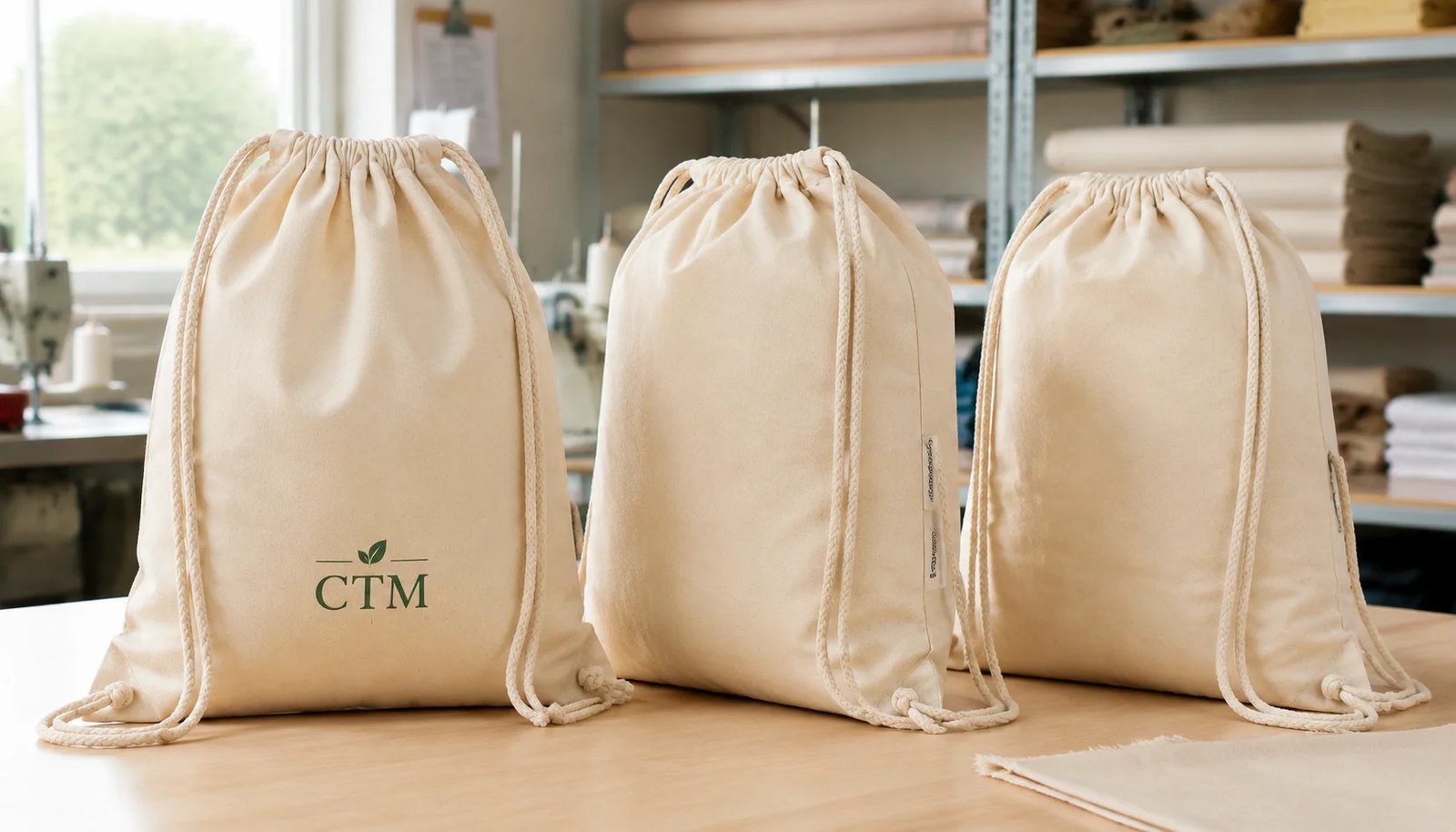
Why natural grocer programs need a tighter drawstring backpack RFQ
Custom cotton drawstring backpacks for natural grocers sit in a demanding middle ground. They are often priced like promotional goods, but judged like reusable retail products. A shopper who receives one at a produce event, wellness promotion, refill campaign, school partnership, or loyalty drive will immediately notice whether the bag feels substantial, whether the print looks clean on natural cotton, and whether the cords are comfortable enough to reuse. That means procurement cannot rely on a loose request such as "cotton drawstring bag with logo" and still expect comparable supplier quotes.
The main job of a strong RFQ is quote alignment. If one supplier prices 280 GSM natural canvas with thick cotton rope and reinforced exits, while another prices thin cotton sheeting with narrow cord and no reinforcement, those are not interchangeable offers. The apparent savings may only reflect a hidden downgrade in material, labor, or pack-out. For natural grocers, this problem is even sharper because the natural fabric look is part of the brand message. Variations in shade, nep, print absorption, and handfeel affect whether the finished bag feels authentic or cheap.
A better RFQ reduces ambiguity before sampling starts. It tells suppliers exactly what finished dimensions to price, what GSM range is acceptable, what print method is expected, what reinforcement points matter, how goods should be packed, and what approvals are required before bulk production. That gives buyers cleaner quote comparisons, more useful samples, and fewer disputes at final inspection or after store rollout.
- Common use cases: membership drives, Earth Day campaigns, produce and wellness events, eco-brand collaborations, gift-with-purchase, and low-SKU retail resale
- Most common RFQ failure: quoting from a reference image without stating GSM, rope diameter, print size, seam construction, or packing assumptions
- Most common downstream dispute: bulk bags feel thinner, print darker or duller, or finished smaller than the approved concept expected by the buyer
Build the RFQ around end use, not just a reference photo
Natural grocer buyers usually start with a visual concept, but suppliers need a production spec. The intended use should drive the bag construction. A bag meant for a one-day in-store giveaway may tolerate a lighter fabric and simpler finish. A bag intended for repeat customer use, boxed wellness kits, or paid retail sale should usually move toward heavier cotton canvas, more stable stitching, and better rope comfort. If the RFQ does not distinguish these use cases, factories will fill in the gaps differently based on their own assumptions or lowest-cost standard.
Start with a short product definition in the RFQ: finished size, fabric type, target GSM, print colors, drawstring style, and target use. For many natural grocer programs, a finished size around 35 x 45 cm in 270-340 GSM natural cotton canvas is a practical baseline. It is large enough for a produce bundle, light grocery run, or wellness event kit, but still compact enough to ship and store efficiently. If the bag is expected to hold heavier boxed items, add a gusset option as a separate quoted line item rather than letting factories guess.
It also helps to state what the product is not. If no laminated lining, zipper, inner pocket, or heavy backpack load rating is required, say so. B2B buyers save time when the RFQ limits feature creep while still locking the variables that matter commercially. A good RFQ produces quotes on the same bag, not on several loosely similar products.
For procurement teams managing approvals across merchandising, brand, and sourcing, include a one-page summary table at the top of the RFQ. That lets internal reviewers confirm whether they are buying an event giveaway, a reusable promotional item, or a retail accessory. Internal clarity improves supplier clarity.
- Define the intended channel: free giveaway, loyalty redemption, seasonal campaign, or retail resale
- State whether the bag is expected to carry light groceries, event materials, or mainly serve as brand merchandise
- Quote optional features separately: bottom gusset, woven label, hangtag, barcode sticker, or individual retail pack
- Use one approved spec sheet internally before requesting quotations from multiple factories
Core product specifications buyers should lock before requesting quotes
The strongest RFQs specify measurable details, not general impressions. For custom cotton drawstring backpacks, that starts with finished dimensions. Write the width and height in centimeters and state clearly that tolerance applies to finished sewn size. Without that note, one supplier may quote from panel cut size while another quotes actual finished dimensions after sewing and hemming. The difference can be enough to affect fit, fabric use, and customer perception.
Fabric should be defined in both commercial and technical terms. Instead of only saying "8 oz cotton," specify natural cotton canvas with a target range such as 270-340 GSM. Including both systems reduces conversion confusion across suppliers and buying teams. If natural appearance matters, note whether slubs, neps, and minor fiber flecks are acceptable within reason. Also state whether optical brighteners are prohibited, since some suppliers may offer a brighter base that no longer matches the intended natural grocer look.
Drawstring construction deserves equal clarity. Buyers should note rope material, diameter, color, threading method, and whether a self-fabric channel or folded top hem is required. Rope thickness is not a cosmetic detail; it affects comfort, ease of opening, stress on the channel, and overall perception of quality. The same is true for reinforcement. If bartacks or backstitching at cord exits are required, list them as a mandatory part of the quote, not a later upgrade.
Print specifications should cover color count, approximate print area, placement reference points, and acceptable tolerance. A one-color logo placed 8 cm from the bottom hem and centered from side seams is much easier to quote and inspect than "logo on front." If multiple art versions may be used later, ask for quote alternatives now so future replenishment does not require restarting the cost discussion.
Finally, define packing in the initial RFQ. Procurement teams often leave packing until after price review, but cartons, inner pack counts, and labeling can materially affect freight and DC handling. The earlier these details are fixed, the more reliable the quoted landed cost becomes.
- Must-lock RFQ fields: finished size, GSM, fabric type, rope spec, print area, seam reinforcement, and packing count
- Specify tolerance language for size and print placement so sample and bulk can be checked consistently
- If retail resale is possible, request alternate pricing for barcode label, hangtag, or individual packaging now rather than later
- Include a reference drawing if available, but make the written spec the controlling document
Fabric selection for natural grocers: balancing eco appearance, durability, and cost
Natural grocer programs often prefer unbleached or natural-color cotton because it visually supports organic, refill, and low-waste messaging. That preference is commercially useful, but it should be handled with realistic expectations. Natural cotton is not a bright white printable sheet. Shade can vary from lot to lot, and subtle flecks or yarn irregularities are normal. Buyers who expect a uniform paper-white base without stating that requirement may end up disappointed by a technically acceptable but visually different bulk result.
For most reusable drawstring backpack programs, 270-340 GSM natural cotton canvas is a strong operating range. It gives enough body for a quality handfeel, better opacity, and more stable logo presentation than very light promo fabrics. Lower-weight materials can still be appropriate for budget-driven giveaway programs, but they should be chosen intentionally, with acceptance that the final bag may wrinkle more easily, feel less substantial, and show more stress around the drawstring area.
Fabric construction matters too. Two fabrics with similar GSM may still behave differently in sewing and print due to yarn count, weave tightness, and finishing. That is why a printed swatch on the actual proposed fabric is more useful than a generic stock photo or color card. If the supplier offers a substitute base fabric during sampling, ask whether the bulk order will use that same construction or only a visual equivalent.
Natural grocer buyers should also think ahead about replenishment. If the bag may be reordered within a season or across campaign cycles, ask how the supplier controls lot-to-lot fabric shade and whether fabric can be reserved. Full lot continuity is not always practical, but an early conversation can prevent surprises when repeat orders do not perfectly match the first production run.
For teams with sustainability or compliance review, request the supplier to state clearly what the fabric is: conventional cotton, organic cotton, recycled blend, or other. Do not assume from the color or finish. If a sustainability claim matters to the purchase decision, it needs to appear in the RFQ and supporting documentation list.
- Natural cotton supports brand positioning, but buyers should approve acceptable shade range on real fabric, not only on screen
- Heavier canvas generally improves handfeel, opacity, and perceived value, especially for repeat-use programs
- Ask whether the quoted fabric is stock greige, made-to-order, or substituted from an equivalent mill source
- If sustainability claims matter, require documentation as part of quotation review rather than after PO placement
Print decisions on natural cotton: what buyers should specify upfront
Print performance on natural cotton is one of the most frequent causes of mismatch between expectation and delivered goods. The same dark green or black logo can look slightly different on unbleached canvas than it does on white paper, a digital mockup, or a bright sample fabric. Natural cotton absorbs ink differently, and the base shade shifts how color is perceived. That does not make natural fabric a poor print surface; it simply means print approval should happen on the real base material.
For many natural grocer programs, one-color or two-color screen printing with water-based ink is the most practical choice. It generally provides a soft handfeel, stable repeatability at volume, and a look that fits natural-fiber products. Buyers should still ask how the factory controls print density, registration, curing, and rub resistance. A clean screen print is not just about logo shape; it should also resist dry rub and avoid obvious pinholes, smudging, or ghosting.
Placement details belong in the RFQ. Suppliers should know whether the art is centered from finished side seams, positioned from the bottom seam, or aligned relative to the top channel. This matters because bags are sewn products, not flat paper pieces. If the print is applied before sewing, seam allowances can alter visual centering. If applied after sewing, the bag may distort slightly depending on fixture and fabric body. Placement tolerance gives both sides a realistic inspection rule.
If exact brand color is critical, say so and request a printed strike-off for approval. If approximate visual harmony is acceptable because the base is natural and artisanal in look, say that instead. Procurement teams save time when they separate true must-match branding from flexible event-use graphics.
Also consider print scale relative to use. Large flood areas can increase defect exposure, cracking risk, and setup complexity. For many natural grocers, a restrained front logo or message is both on-brand and easier to execute consistently.
- Request a printed swatch or strike-off on the actual fabric before approving bulk print color
- Define print location from finished seams or hems, not from rough visual estimates
- Ask whether printing occurs before or after sewing if placement consistency matters
- Keep large-area print decisions intentional because they affect cost, defect risk, and handfeel
Rope, channel, and seam construction: the practical durability details
Many bags that look fine in an initial sample fail in use because their stress points were never specified. For cotton drawstring backpacks, the cord system is the first area to review. Thin rope may reduce cost, but it often feels harsh on the shoulders, slips poorly through the channel, and puts more concentrated stress on the exit points. An 8-10 mm rope is usually a better choice for natural grocer programs where users may carry produce, jars, shoes, or event materials rather than just flyers.
Rope composition should also be stated. Braided cotton rope often fits the natural look and handfeel buyers want, while cotton-poly blends may provide a smoother slide or cost advantage. The RFQ should not assume these are interchangeable. If the visual and tactile experience matters, ask suppliers to send actual rope options with the sample. Even small differences in braid density or softness affect perceived quality.
The top channel needs enough room for the rope to move without bunching the fabric excessively. A narrow or poorly folded channel can cause snagging and increase the force users apply when opening and closing the bag. That in turn increases the chance of seam damage at the exits. Reinforcement at those exits is one of the highest-value specifications buyers can add. A simple bartack or strong backstitch can materially improve durability at minimal cost compared with the reputational cost of early failures.
Seam quality should be described in concrete language. If buyers can specify stitch density, seam type, and reinforcement points, they should. If not, they should at least require even stitching, no skipped stitches, no seam grin under light pull, and reinforcement at load-bearing points. These details matter more for repeat-use programs than for one-time giveaway bags, but they are worth quoting up front in either case so cost and durability can be weighed accurately.
If a gusset is included, note that seam load changes. Corner construction, gusset joins, and pack shape all need to be reviewed during the sample stage.
- Preferred baseline: 8-10 mm rope, smooth channel movement, reinforced cord exits, and clean bottom seams
- Ask for actual rope samples when evaluating suppliers, not just written diameter claims
- Specify whether knots, hidden ends, or heat-sealed rope ends are acceptable
- Check the channel opening in the PPS by repeated pull testing, not only by visual review
MOQ, price breaks, and quote comparison logic for B2B buyers
MOQ decisions should be tied to program economics, not only to the smallest quantity a supplier is willing to accept. Custom cotton drawstring backpacks look simple, but screen setup, cutting efficiency, packing labor, and material purchasing all become more economical once volumes reach practical production levels. For many custom programs, 1,000 to 3,000 pieces per size or colorway is where pricing starts to stabilize. Below that, suppliers may rely on stock fabric, absorb setup inconsistently, or quote substitutes that are harder to repeat later.
Natural grocers often run programs across multiple stores, regions, or event waves. That makes price-break visibility important. Ask for structured quote tiers such as 1,000, 3,000, 5,000, and 10,000 pieces, with any changes in print setup, packaging, or sampling charges stated clearly. If multiple logo versions are possible, request separate lines showing what can be pooled for fabric and what still carries separate screen cost. This helps procurement model rollout scenarios without returning to factories for every variation.
The safest way to compare supplier offers is to normalize them against one master spec. Any deviation should be marked in the comparison file rather than hidden inside the quoted number. If one supplier uses 220 GSM fabric instead of 280 GSM, or polyester rope instead of cotton rope, note that as a spec difference first and a cost difference second. This prevents teams from awarding business on a misleading like-for-unlike comparison.
Incoterms should also be lined up before any final price decision. An EXW quote can appear lower while excluding export handling, local transport, and documentation that another supplier includes in FOB. Procurement should compare equivalent commercial terms, or at least calculate the adjustment needed to reach parity.
For replenishment programs, ask one more question: what assumptions support repeat pricing? A first order may be competitive because screens are new, fabric is available, or the factory is filling line capacity. Buyers should understand which cost elements are likely to move on the second order.
- Useful quote tiers: 1,000 / 3,000 / 5,000 / 10,000 pcs with the same base specification
- Mark every deviation from the requested spec so the lowest price is not mistaken for the best value
- Compare all offers on the same Incoterm or create a normalized landed-cost sheet
- Ask whether print screens, artwork setup, or rope color references can be reused for repeat orders
Sampling and approval workflow that actually protects bulk production
A common sourcing mistake is approving whichever sample arrives first, regardless of what it proves. Different sample stages answer different questions. A digital proof confirms artwork layout and spelling. A material swatch confirms base fabric look. A printed strike-off checks color behavior on natural cotton. A sewn pre-production sample, or PPS, tests the combined reality of fabric, rope, stitching, finished dimensions, and print placement. Procurement teams should define the required sequence in the RFQ so both buyer and factory know what counts as an approval gate.
For this product, the PPS is usually the most important checkpoint before mass production. It should be made from bulk-like fabric and construction, not just whatever material is easiest for the sample room to use. The buyer should measure it flat from finished seams, confirm the channel construction, inspect the rope handfeel, and verify print placement using the same references that will later be used in final inspection. If the program is sensitive to color on natural fabric, attach approved strike-off photos or physical swatches to the file.
Internal approval discipline matters too. If brand, sourcing, and operations each review the sample, consolidate their comments into one controlled revision list. Mixed feedback sent in separate emails is a common source of production delay or accidental changes. Once the PPS is approved, freeze the spec unless there is a formal change request.
For larger programs or first-time suppliers, some buyers add a top-of-production sample or early production photo confirmation. This is useful when timing permits and when the order has a high visibility launch. It is less about adding bureaucracy and more about catching drift before all units are packed.
Keep the approval record organized. Store the approved sample details, spec sheet, and photos in a way that can be reused for replenishment. Repeat business often goes wrong because the original approval basis cannot be easily recovered.
- Best sample path: artwork proof, fabric swatch, printed swatch, PPS, optional top-of-production confirmation
- Require PPS to use bulk-like material and real rope construction whenever possible
- Measure the sample against the written spec and record the result before approval
- Centralize revision comments so the supplier receives one final approved instruction set
Quality control plan: measurable checks that reduce disputes on natural cotton bags
Quality control for natural cotton drawstring backpacks should be practical, written, and tied to the approved sample. Because natural cotton is inherently less uniform than bleached synthetic material, buyers need to distinguish acceptable natural character from unacceptable damage or inconsistency. Small fiber flecks or mild shade variation may be acceptable if approved in advance. Oil marks, mildew, severe weaving faults, obvious panel mismatch within one bag, and damaged print should not be.
A useful QC plan covers incoming material review, in-line sewing checks, print checks, and final random inspection. Incoming review should confirm fabric appearance and GSM within the agreed tolerance range. In-line checks should verify seam consistency, rope insertion, reinforcement, and print placement before too much quantity is completed. Final inspection should confirm finished measurements, print quality, count accuracy, cleanliness, and packaging conformity. This sequence reduces the chance that problems are found only when cartons are already sealed.
Procurement teams should define the key measurements in advance: finished width, finished height, top channel depth, rope length, and print location from agreed seam references. If there is a pull or functional test requirement, keep it simple and relevant. The goal is not to engineer a technical hiking bag, but to confirm that seams and exits hold under expected promotional or grocery-related use.
If the buyer uses AQL final inspection, align defect examples early. Natural-fabric irregularity can be interpreted differently by different inspectors, so photo examples or defect descriptions are valuable. For example, buyers can classify major print smudge, missing bartack where specified, or severe seam skipping as clear reject conditions. This reduces subjective argument at shipment stage.
Carton-level checks should not be ignored. Count accuracy, carton markings, gross weight, and moisture condition matter operationally, especially if goods will move through a DC or sit in storage before event deployment.
- Write defect examples specific to natural cotton so inspectors do not confuse acceptable specks with real damage
- Check measurement, print placement, and seam reinforcement together because these are the main dispute points
- Use in-line controls for cord exits and printing before the entire order is packed
- Inspect random packed units for odor, stains, mildew risk, and carton-label accuracy before shipment release
Packing, logistics, and lead-time planning for smoother program execution
Packing decisions affect more than freight cost. They influence how quickly a warehouse can count goods, whether prints arrive creased, how easily stores can allocate inventory, and how much handling labor the buyer absorbs after import. For most natural grocer programs, 25 or 50 pieces per inner pack is a workable default. It supports easy counting and reduces the need to open many small bags. If bags are intended for direct retail sale, individual packaging or labeling may be required, but that should be requested deliberately because it changes both cost and waste profile.
Carton planning should be reviewed early. Cotton drawstring backpacks are light but can become bulky if oversized cartons are used, while overpacked cartons can create excessive compression, distorted cords, and print creasing. Ask for carton dimensions, gross weight, net weight, and estimated container loading quantity. These details matter for ocean freight planning and for warehouse manual-handling limits. A slightly lower unit price can be offset by poorer carton efficiency or labor-intensive receiving.
Moisture risk is worth discussing for natural cotton goods, especially during humid-season transit or longer shipping lanes. Buyers do not need elaborate solutions in every case, but they should confirm dry cartons, clean storage conditions, and any agreed moisture-control measures. Natural cotton that arrives with odor, mildew spotting, or damp cartons becomes both a quality and inventory problem.
Lead time should be counted from a defined trigger point. Many disputes happen because the buyer assumes lead time starts at PO issue while the factory starts counting after artwork or PPS approval. Clarify the trigger in the quote sheet. Then map the full timeline backward from the campaign date, including proofing, sample review, revision buffer, production, inspection, booking, and transit. Simple products still suffer delays if approvals drift or shipping windows tighten.
For event-driven natural grocer calendars such as Earth Day, back-to-school wellness, or seasonal loyalty campaigns, backward planning is safer than relying on a broad promise like "about 30 days." Procurement teams should build in contingency for artwork approval loops and transit variability, particularly on first orders.
- Default bulk packing often works best: 25 or 50 pcs per inner pack with export cartons sized for manual handling
- Request carton dimensions and weights before final supplier selection because logistics can change the true best option
- Clarify lead time start point in writing: PO, deposit, artwork approval, or PPS approval
- Build a calendar that includes sample review, production, final inspection, and shipping buffer before the store launch date
Specification comparison for buyers
| Spec decision | Recommended option | When it fits | Buyer risk to check |
|---|---|---|---|
| Fabric weight | 8 oz to 10 oz cotton canvas, about 270-340 GSM | Best for reusable grocery promotion, loyalty programs, wellness events, and retail programs where the bag should feel durable but still fold flat | Quotes using lighter 140-180 GSM cotton may look cheaper but often fail on opacity, rope pull stress, body feel, and perceived retail quality |
| Fabric type | Natural cotton canvas with low nep level and pre-cut fabric inspection | Fits natural grocer branding where unbleached appearance supports eco positioning and simple one-color graphics | Natural fabric shade can vary by lot; define acceptable color range and request shade photo under daylight before bulk cutting |
| Bag size | Approx. 35 x 45 cm finished size with 5-8 mm size tolerance | Works for produce, light groceries, wellness kits, and in-store branded programs without becoming overstuffed | If size tolerance is not written into the RFQ, suppliers may quote on cut size instead of finished size and delivered bags can run short |
| Cord material | 8-10 mm braided cotton rope or cotton-poly core rope with soft handfeel | Suitable when comfort on shoulders matters more than the absolute lowest unit cost | Thin cords save cost but cut into shoulders and can tear channels; ask for rope diameter and pull test method in the quote |
| Print method | 1-color or 2-color screen print with water-based ink | Best for natural grocer logos, store campaigns, and larger production runs where artwork is simple and repeatable | Digital print on natural cotton can shift in color and wash/rub resistance; define print location tolerance and rub resistance standard |
| Seam construction | Side seams and bottom seam with 10-12 stitches per inch and bartack or backstitch at cord exit points | Needed for repeated open-close use and light grocery loads | Many quotes omit reinforcement details; without them, failures show up first at cord channel openings and bottom corners |
| MOQ structure | 1,000-3,000 pcs per size/colorway for efficient screen printing and fabric cutting | Makes sense for chain-wide promotions, seasonal retail programs, and distributor stock orders | Low-MOQ offers can hide higher setup allocation, mixed fabric sourcing, or unstable shade consistency between replenishment lots |
| Packing format | 25 or 50 pcs per polybag, then export carton with moisture control if ocean shipping | Works for importer receiving, DC counting, and store allocation with limited repacking labor | Over-compressed packing can crease prints and distort cords; request carton dimensions, net/gross weight, and pack orientation |
| Sample approval path | Digital artwork proof, then pre-production sewn sample from bulk-like fabric before mass production | Best when logo placement, rope feel, seam quality, and handfeel affect store presentation | Skipping the sewn PPS often leads to disputes on GSM feel, print tone on natural cloth, and true finished size after sewing |
Buyer checklist before sampling
- State finished bag size in centimeters and note whether tolerance applies to finished sewn size or cut panel size
- Specify fabric as cotton canvas with target GSM range, not only ounces, because suppliers quote in different systems
- Define whether natural cotton shade variation is acceptable and whether optical brightener is allowed or not
- List print colors by Pantone reference and note whether color match is critical on natural unbleached fabric
- Write the exact print area, print position tolerance, and whether artwork must be centered from finished seams
- Specify rope material, rope diameter, rope color, knot style, and whether heat-sealed ends are allowed
- Require reinforcement details at drawstring channel exits and any bartack or backstitch requirements
- Include packing method by units per inner pack and carton, plus carton weight limit for warehouse handling
- State sample stages required: artwork proof, material swatch, pre-production sample, and shipping sample if needed
- Request quote breakpoints by MOQ tier, shipping term, sample cost, tooling charge, and lead time from approval
Factory quote questions to send
- What exact fabric construction are you quoting: plain weave cotton, canvas, recycled blend, and what is the tested GSM tolerance?
- Is your price based on natural raw cotton fabric, dyed fabric, or stock greige fabric, and how much shade variation should we expect between lots?
- What rope specification is included in the quote in millimeters, material composition, and colorfastness?
- Which print method are you quoting and what is the expected color appearance on natural cotton versus a lab-dipped or bleached base?
- Are setup, screen, and sampling charges separated from unit price, or absorbed at the quoted MOQ?
- What seam reinforcement is standard on your quoted construction, especially at the lower corners and cord channel exits?
- Can you provide carton dimensions, pieces per carton, gross weight, and loading quantity by 20GP and 40HQ as part of the quote pack?
- What is your production lead time counted from: deposit, artwork approval, or pre-production sample approval?
- What in-line and final inspection standard do you normally apply for this bag type, and how do you record measurements and print defects?
- If we repeat the order in 60-90 days, what price elements are likely to move: cotton fabric, printing, packaging, or freight-related charges?
Quality-control points to confirm
- Finished size must stay within agreed tolerance after sewing, measured flat from seam to seam
- Fabric GSM should be tested from bulk lot and remain within the approved tolerance range
- Print position should stay within agreed tolerance from top seam and side seam references
- Print coverage must show no pinholes, ghosting, major shade variation, or rub-off under dry rub test
- Cord diameter, color, and handfeel should match approved sample and run smoothly through channel without snagging
- Bartack or backstitch reinforcement at cord exits must be present if specified in RFQ
- Side and bottom seams should show even stitch density with no skipped stitches or seam grin under light pull
- Raw edge management inside the bag should be consistent with approved construction, especially if overlock or folded seam was quoted
- Cartons must match agreed pack count, labeling format, and weight limits for warehouse handling
- Random packed bags should be checked for odor, mildew marks, oil stains, and needle damage before shipment release