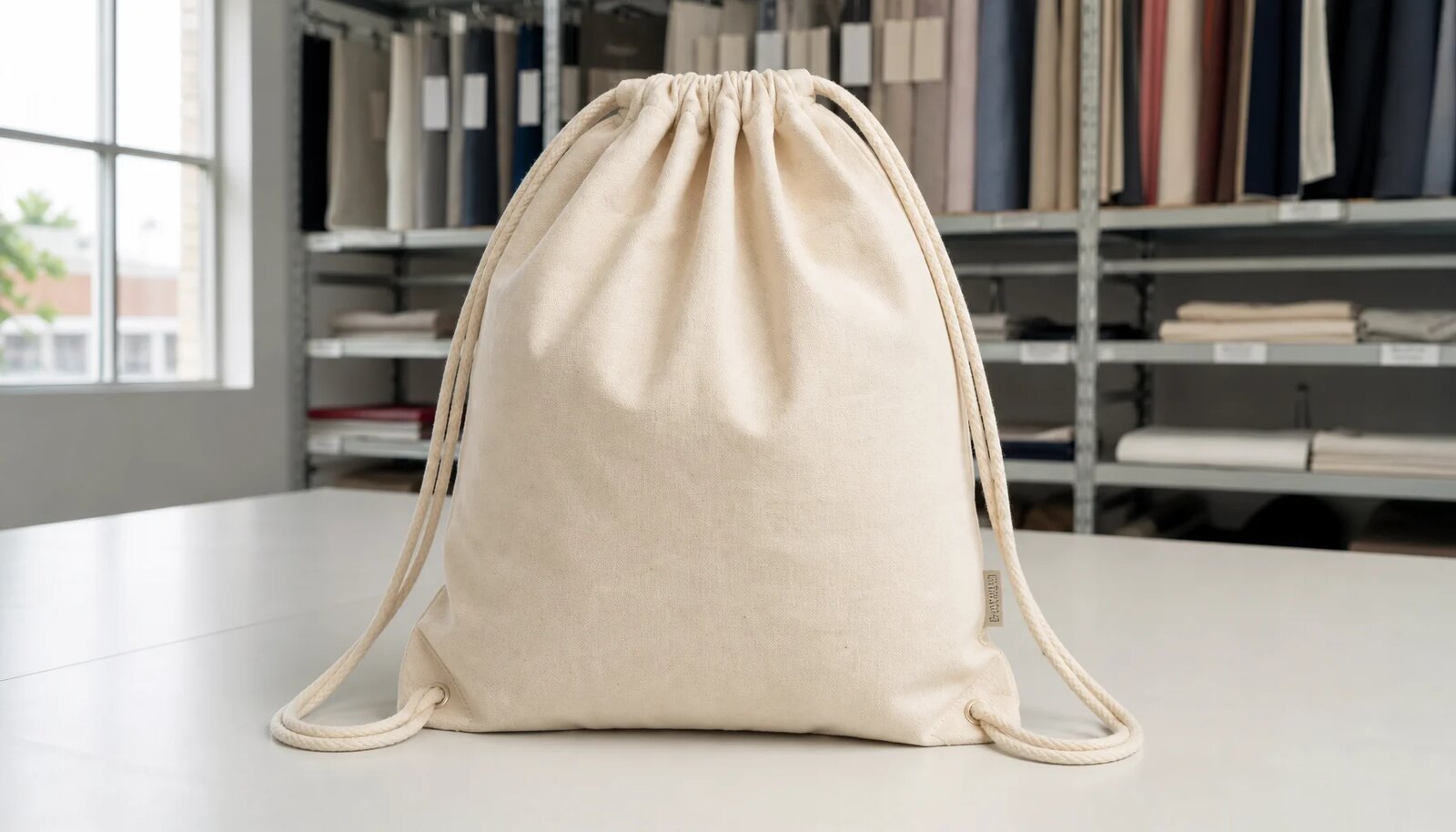
Start the RFQ With the Real Event Use Case
Many weak sourcing exercises begin with artwork and quantity, then ask the factory to "quote a cotton drawstring bag." That shortcut is exactly why quotes come back inconsistent. In a custom cotton drawstring backpacks RFQ template guide for event planners, the first requirement is not the logo file. It is the use case. A registration giveaway that carries a brochure, badge lanyard, and small water bottle is not the same product as a sponsor gift bag carrying apparel, a notebook, and multiple inserts. The event function determines the bag size, the cotton weight, the need for a gusset, the appropriate cord, and the acceptable print method. If you do not define those things up front, each supplier fills the gaps differently and the quote comparison becomes cosmetic rather than commercial.
Event planners should write the RFQ around what the bag must do on the day it is used. Note the intended contents, the approximate total load, whether the bag needs to look clean in event photography, whether attendees are expected to reuse it, and whether the item is purely promotional or closer to a retail-quality keepsake. That simple framing prevents under-specification. A bag for a one-day expo can tolerate a lighter construction and simpler print. A conference bag that must survive travel home, repeated carrying, and sponsor visibility after the event generally cannot. Procurement teams make better decisions when they describe performance expectations in plain operational language rather than using vague terms like premium, eco, or standard.
Another practical detail is the distribution environment. If bags will be pre-filled in a warehouse, the opening width and ease of loading matter. If staff will fill them at registration desks, the bag should open smoothly and close without the cord snagging. If the bag is handed to VIP guests, small cosmetic issues that would be acceptable in a mass giveaway may become rejection points. A strong RFQ uses these realities to set the technical baseline before any supplier sees the inquiry.
- State the intended contents and approximate carry weight, not just the event name.
- Define whether the bag is disposable promo, reusable event gear, or a retail-adjacent merchandise item.
- Describe how the bag will be filled and distributed so the supplier understands usability requirements.
Lock the Construction Spec Before You Ask for Price
The most effective way to improve quote quality is to freeze the physical specification before requesting pricing. For cotton drawstring backpacks, that means finished width and height, gusset requirement, cotton weight in GSM, cotton finish, cord type, and seam construction. A supplier cannot produce a truly comparable quote from the phrase "custom cotton drawstring backpack" because there are too many legitimate interpretations. Two factories may both quote the same nominal size, but one may price a flat bag with lighter fabric and narrow cords while the other assumes a sturdier body with reinforcement and a different cotton surface. Those are different products with different cost structures.
For event programs, many buyers start with a flat bag around 34 x 42 cm, but that is only a starting point. If the bag must carry folded apparel, thick catalogs, or boxed kits, a bottom gusset or larger format may be needed. Write size in finished dimensions, not just an approximate style label. Tolerances matter too. A practical RFQ usually includes a size tolerance such as plus or minus 1 cm and a GSM tolerance such as plus or minus 5 percent, because cotton can vary if the buyer never defines the standard. Also specify whether the cotton should be natural unbleached, bleached, dyed, or pre-shrunk. Those choices affect opacity, hand feel, print behavior, cost, and schedule.
Do not overlook the cord. Buyers often focus on fabric and print while treating the drawstring as a generic trim. In reality, cord thickness, fiber feel, and knot finishing affect how the bag opens, closes, and wears in use. Ask the supplier to declare cord material, approximate diameter, and whether the channel entry points are reinforced. For higher-use event bags, reinforcement at the top corners and clean back-tacking at stress points can matter more than a slight difference in print cost. A detailed specification sheet reduces negotiation noise later because the supplier is quoting a product, not guessing a concept.
- Use finished dimensions, not vague labels such as small, medium, or standard.
- Write cotton finish, GSM, and tolerances into the RFQ so factories cannot substitute assumptions.
- Specify cord construction and seam reinforcement because these directly affect field performance.
Match Fabric Weight and Cotton Finish to the Job
Fabric selection deserves its own section in any serious custom cotton drawstring backpacks RFQ template guide for event planners because GSM is one of the easiest places for a supplier to quietly lower cost. Lightweight cotton can be perfectly acceptable for simple event giveaways, but it should be chosen deliberately. As a rule of thumb, 120 to 140 GSM is often suitable when the bag holds light materials and the priority is budget and volume. Once the bag needs better opacity, a cleaner drape in photography, or repeated use after the event, buyers should usually test 160 GSM or higher. The point is not to chase the heaviest fabric by default. It is to buy the right construction for the actual use.
The cotton finish also changes how the product behaves. Natural unbleached cotton can support an earthy visual story, but it may show more natural variation in shade and small specks than a bleached base. Bleached fabric often gives a cleaner background for print contrast. Dyed fabric introduces additional lead time, minimums, and potential shade approval work. Pre-shrunk cotton can reduce dimensional change risk, but it needs to be specified and confirmed because many factories will otherwise quote standard cotton and leave shrinkage undefined. For procurement, these are not minor style choices. They influence print readability, consistency across lots, and the likelihood of post-production complaints.
A disciplined RFQ should ask for cotton composition, weave type if relevant, GSM, shade description, and expected shrinkage. It should also ask whether the quoted fabric is stock or made against the order. Stock fabric can improve speed and reduce minimums, which matters when event dates are fixed. Custom fabric may be justified for strict brand matching or a more premium hand feel, but buyers should recognize the schedule and cost tradeoff before locking it in. When fabric is treated as a precise input rather than a broad category, the quote becomes a procurement document instead of a rough estimate.
- Use 120-140 GSM mainly for light giveaway programs, and move higher when reusability or opacity matters.
- Decide early whether natural, bleached, dyed, or pre-shrunk cotton best fits the event objective.
- Ask whether the fabric is stock-supported or made to order because that changes both MOQ and lead time.
Choose Decoration by Artwork, Quantity, and Wear Conditions
Decoration decisions are where many RFQs become misleading. A buyer may think they requested the same logo application from all suppliers, but unless the RFQ names the method, size, color count, and placement, every quote can represent a different production path. For many event orders, one-color screen print remains the most practical baseline. It is repeatable, generally cost-effective at scale, and works well on flat cotton surfaces. That makes it a strong default when the logo is simple and the order volume is meaningful. If the artwork is highly detailed, photographic, or very small, another method may be technically possible, but the buyer should not assume equal durability, hand feel, or crease resistance.
Placement is as important as method. A large front print that creeps too close to the top channel can distort during sewing or when the cords are pulled tight. Artwork near side seams can warp or look off-center once the bag is loaded. To avoid that, the RFQ should specify print dimensions, placement from top and side edges, number of print colors, and whether branding is required on one side or both. If the event includes multiple sponsors, the supplier should know whether artwork versions change by panel, by side, or by quantity split. Those details drive setup planning and sometimes MOQ.
A woven label or woven patch can be a better commercial answer than a large print for some buyers. It does not replace the need for a clear RFQ, but it can give a cleaner premium presentation, especially if the bag must look polished without a heavy ink layer. Whatever method is selected, the approval sample should be checked for opacity, edge sharpness, registration, and behavior after folding. Event bags are often stacked, compressed, and handled quickly. Decoration that looks fine on a flat sample table can fail once it is packed, rubbed, or repeatedly opened.
- Specify print method, print size, color count, and exact placement rather than leaving decoration open to interpretation.
- Keep logos clear of the top channel and seam lines unless the artwork has been tested there.
- Consider a woven label or patch when the brand wants a neater premium finish with less risk of print distortion.
Break MOQ and Cost Drivers Into Visible Components
MOQ is rarely a single clean number, even when suppliers present it that way. In practice, a custom cotton drawstring backpack order may have one minimum for the bag body, another for print setup, another for woven labels, and a separate threshold for custom packaging. Procurement teams should ask for that breakdown because it changes the real economics of the order. A supplier may advertise a low MOQ using stock fabric, but once the buyer adds a woven label, barcode sticker, or custom insert card, the commercial reality shifts. Without a component-level view, the RFQ comparison can look simpler than it actually is.
The same principle applies to quantity breaks. Do not ask only for a single price at the ideal quantity. Ask for the quantities procurement may realistically approve, such as 500, 1,000, 2,500, and 5,000 units, plus any split by artwork version if different sponsors or event dates are involved. This reveals whether the supplier has meaningful economies of scale or whether the low headline price depends on a volume the buyer will never place. It also highlights fixed charges that should be shown separately rather than blended into unit price in a way that obscures comparison.
A strong RFQ sheet separates one-time charges from recurring unit cost. Tooling, screens, sampling, label setup, and special packaging should each have visible lines. This protects the buyer during negotiation because price movement can then be discussed on actual cost drivers instead of vague claims about total cost. It also helps event planners decide where simplification creates savings. Sometimes reducing label complexity or eliminating unnecessary individual packing is worth more than pushing for an unrealistic unit-price concession.
- Request MOQ by bag body, print, label, and special packaging component rather than one blended number.
- Ask for pricing at the volumes you may actually order, including artwork splits if relevant.
- Separate one-time setup charges from recurring unit price so negotiations stay factual.
Use a Sample Approval Process That Mirrors Production Reality
Samples are often treated as a formality, but for event procurement they should function as a risk filter. A useful pre-production sample must be made with the same bulk fabric type, the same cord construction, and the same decoration method intended for the final order. If the supplier sends a sample made from substitute stock or with a different print process, it may still be helpful for general style review, but it is not a reliable approval standard. Buyers should document that difference clearly and avoid approving it as if it represented production. The closer the sample is to bulk reality, the fewer surprises appear after cutting and printing begin.
The sample review should be operational, not purely visual. Measure the finished bag. Load it with the actual event contents or a realistic equivalent. Open and close it multiple times to see whether the cords move smoothly or catch in the channel. Review the print under neutral daylight if possible, not only under warm office lighting. Fold the bag as it would be packed and check whether the print cracks, marks, or transfers. If the bag will be inserted into kits, test how quickly warehouse staff can load it. These are simple checks, but they reveal whether the design works in the real event flow.
For larger or more time-sensitive programs, it can be useful to define the approval hierarchy in advance. For example, marketing may approve artwork appearance, procurement may approve specification compliance, and operations may approve pack-out and usability. That separation avoids the common failure mode where a bag is visually approved but later causes packing delays or freight issues. In RFQ terms, the sample is not just a branding checkpoint. It is the last low-cost opportunity to validate the product before bulk commitments are locked.
- Approve only samples that clearly declare whether they use bulk-equivalent fabric, cord, and print process.
- Test the bag with real or simulated event contents to verify loading, closing, and carrying performance.
- Separate visual approval from operational approval so logistics issues are caught before mass production.
Specify Packing for Receiving, Kitting, and Freight Efficiency
Packing instructions should be written as part of the RFQ, not exchanged casually after price approval. This is where many event teams lose margin and time. A bag intended for bulk handout may be best packed in export cartons without individual polybags, while a retail-adjacent merchandise program may require each unit to be folded, bagged, barcoded, and inserted with a paper card. These pack-out decisions change labor content, carton density, shipping cube, and receiving speed. If buyers leave packing undefined, suppliers will usually choose a default method that protects their quoting speed, not the buyer's downstream workflow.
Event planners should think about where the goods go immediately after import or delivery. If a third-party warehouse receives the bags and builds event kits, the carton markings and unit count per carton matter. If the bags move directly to a venue, manageable carton weight may matter more than absolute density. If sponsor kits need item-level barcode scanning, that should be written into the RFQ from the start so label placement and inspection can be planned correctly. The bag itself may be inexpensive, but poor pack-out can create rework that costs more than the product delta between suppliers.
Ask every supplier to provide units per carton, carton dimensions, gross weight, and any assumptions behind folding or compression. Compare those details alongside price. An order with a marginally higher unit cost can still be the better commercial choice if it ships more efficiently or eliminates relabeling on arrival. In B2B procurement, packing is part of product design because it affects landed cost, warehouse labor, and event execution reliability all at once.
- Define pack-out at RFQ stage: bulk, individually bagged, barcoded, inserted, or retail folded.
- Require carton dimensions and gross weight because these drive freight cube and handling cost.
- Write carton marks and labeling requirements clearly so receiving teams do not need to rework deliveries.
Build the Timeline Around Approval Gates and Supply Dependencies
Lead time should be treated as a schedule with dependencies, not as a single marketing promise. In a well-run custom cotton drawstring backpacks RFQ template guide for event planners, suppliers should quote timing from specific milestones: artwork receipt, sample making, sample approval, bulk production, final inspection, and dispatch. Those steps matter because event dates are usually fixed. A supplier can honestly say the sewing window is short while still underestimating how long fabric replenishment, custom dyeing, or artwork revision will take. Procurement needs the path, not just the endpoint.
Stock natural cotton with one-color screen print is often the safest route when time is tight, but even a simple product can slip if the buyer delays approvals or changes branding late. That is why RFQs should ask which inputs are stock-supported and which require fresh procurement. The answer tells you where the schedule risk sits. If the cord, label, or packaging insert has a longer lead time than the bag body, that component may become the real critical path. The best suppliers will explain this directly instead of hiding it inside a broad production estimate.
Work backward from the in-warehouse or at-venue date, not from the desired ship date. Leave room for sample review, final QC evidence, freight booking, customs handling where applicable, and local delivery. When the event cannot move, buyers should ask whether the supplier can reserve fabric, simplify decoration, or split deliveries to reduce risk. Those are better conversations to have during RFQ review than after approvals are already late. Schedule transparency is part of quality because an on-spec bag that arrives after the event has no commercial value.
- Ask for milestone-based timing rather than a single production-day estimate.
- Identify which materials are stock-supported and which require separate sourcing or dyeing.
- Back-plan from the event delivery date and keep buffer time for approvals, freight, and local handling.
Compare Landed Cost Instead of Chasing the Lowest Unit Price
Procurement buyers know that ex-works unit price alone is not a decision tool, yet event teams still fall into this trap when deadlines are tight. Two suppliers can quote the same bag size and artwork but produce very different landed outcomes once packing, cube, setup charges, inspection effort, and local rework are considered. A slightly cheaper unit price may exclude individual packing, use weaker cartons, or rely on a print method that creates more rejection risk. Once freight and labor are added, that quote may no longer be cheaper. A disciplined comparison normalizes every offer to the same assumptions before ranking suppliers.
Start by forcing apples-to-apples inputs: same fabric weight, same cotton finish, same decoration method, same print size, same quantity break, same packing method, and same incoterm. Then add the non-unit elements that affect the order value: sample charges, screen or setup fees, woven label costs, barcode application, carton count, estimated freight cube, and any import-related handling assumptions. If one supplier requires repacking on arrival because carton labeling is poor or unit presentation is inconsistent, that cost belongs in the decision model even if it sits outside the factory invoice.
The final comparison should include service risk as well as cost. Did the supplier answer technical questions clearly? Did they provide evidence for their assumptions? Can they describe their sample route and QC checkpoints in a way that suggests real ownership? For event programs, reliability has financial value. A cleaner quote, stronger documentation, and a more credible schedule often justify a modest unit-price premium because they reduce the probability of costly surprises close to the event date.
- Normalize all quotes to the same spec, quantity break, pack-out, and incoterm before comparing price.
- Add setup fees, sample charges, freight cube, and local handling to see the true landed cost.
- Include service quality and schedule credibility in the decision, not just unit economics.
Use a Structured RFQ Template That Forces Comparable Answers
A strong RFQ template is short enough for suppliers to respond to quickly but detailed enough to prevent guessing. For custom cotton drawstring backpacks, the template should cover product name, end use, finished size, gusset if any, cotton finish, GSM, cord specification, decoration method, print area, quantity breaks, sample requirement, packing requirement, delivery destination, and target timeline. That core structure gives factories enough information to quote accurately while giving procurement a standard grid for comparison. The goal is not to create paperwork for its own sake. It is to remove hidden assumptions from the buying process.
It helps to separate mandatory fields from optional alternatives. For example, the RFQ may define a required standard option, then invite suppliers to quote an alternate premium option such as heavier cotton or a woven label. This keeps the baseline consistent while still allowing practical sourcing ideas. If the event has multiple variants, put each version on a separate line with its own quantity and artwork note. Mixing several scenarios into one line item usually creates quoting errors and follow-up rounds that waste time. Clean structure at RFQ stage produces cleaner commercial discussions later.
For teams that buy repeatedly, the template becomes an internal control tool as much as a supplier communication tool. It makes it easier to compare current orders with past orders, identify where costs moved, and see whether a price difference comes from material, printing, packaging, or schedule pressure. That historical consistency is especially valuable for recurring conferences, roadshows, and sponsor programs where procurement wants fewer surprises year over year. A disciplined template is one of the simplest ways to upgrade sourcing quality without adding complexity to the final event workflow.
- Include only finalized mandatory specifications in the baseline quote request.
- Allow separate alternate options for premium upgrades instead of mixing them into the core line.
- Split event variants into separate line items so quantity, artwork, and packing assumptions stay visible.
Specification comparison for buyers
| RFQ element | Recommended baseline | When to upgrade or change it | Procurement risk if left vague |
|---|---|---|---|
| Finished size | 34 x 42 cm flat bag as a common event starting point | Increase height or add a bottom gusset when the bag must hold apparel, catalogs, or kit boxes | Suppliers will quote different usable capacities even when the style name sounds identical |
| Fabric weight / GSM | 120-140 GSM natural cotton for short-life giveaways | Move to 160-180 GSM for repeat use, heavier contents, better opacity, or a more premium hand feel | A quote that says only 'cotton' hides durability, shrinkage, print holdout, and cost differences |
| Cotton finish | Natural unbleached or bleached plain weave with declared shrinkage | Use dyed fabric only when brand color matching matters more than speed and cost | Color, opacity, and lead time change materially depending on whether fabric is natural, bleached, dyed, or pre-shrunk |
| Cord construction | Cotton cord sized to the bag scale, with reinforced channel entry points | Use thicker cord or knotted ends for heavier loads and more frequent reuse | Thin or loosely twisted cords can fray, bind in the channel, or pull out during use |
| Decoration method | One-color screen print for volume event orders | Use woven label, woven patch, or transfer only when artwork or positioning requires it | Unspecified print method leads to quotes that cannot be compared for feel, durability, or setup cost |
| MOQ structure | Break out MOQ by bag body, print setup, label, and packing component | Request mixed-artwork or split-delivery options when multiple event variants are planned | A single headline MOQ often hides setup fees or component minimums that appear later |
| Sample route | Pre-production sample using bulk fabric, final print method, and final cord | Request a sealed approval standard if multiple production batches or ship dates are planned | A sample from substitute stock material is not reliable for color, shrinkage, or print accuracy |
| Packing method | Bulk packed in export cartons with carton marks and piece count | Add individual polybag, barcode, insert card, or retail fold only if downstream handling requires it | Packing changes labor, carton density, cube, and receiving cost more than many buyers expect |
| Timeline basis | Lead time counted from artwork approval and sample signoff | Reserve fabric or book production earlier when the event date is fixed and non-negotiable | A vague '25-30 days' promise without milestones is not a schedule |
Buyer checklist before sampling
- Define the end use in operational terms: registration giveaway, sponsor handout, staff pack, VIP merch, or resale item.
- List the exact contents the bag must carry, including approximate weight and any rigid box, bottle, or apparel volume.
- Set finished size, gusset requirement, cord style, and target fabric weight in GSM before sending the RFQ.
- State whether the cotton should be natural, bleached, dyed, or pre-shrunk, and write an acceptable shrinkage expectation.
- Specify decoration method, print size, artwork colors, placement, and whether branding appears on one side or both.
- Request pricing at real quantity breaks such as 500, 1,000, 2,500, 5,000, and any split by artwork version.
- Define packing in detail: units per carton, individual polybag yes or no, barcode label, insert card, and carton marks.
- Require a pre-production sample made from bulk fabric with the final cord, print method, and finishing.
- Ask for carton dimensions, gross weight, and estimated total shipping volume so landed cost can be modeled early.
- Confirm lead time from artwork approval and sample signoff, not from the inquiry date or verbal discussion.
Factory quote questions to send
- What exact finished size, GSM, cotton finish, and weave construction are you quoting, and what tolerances apply?
- Is the fabric stock natural cotton, bleached cotton, dyed cotton, or pre-shrunk cotton, and how does that affect price and lead time?
- Which print method is included in the quoted price, and does it cover one side only or both sides of the bag?
- What are the maximum print area, artwork limitations, and likely quality issues for the method you are proposing?
- What is the MOQ by bag body, by print screen or transfer setup, by woven label, and by special packing component?
- Will the pre-production sample be made from the same bulk fabric lot, cord quality, and decoration process planned for production?
- What reinforcement is included at the cord channel, side seams, and bottom corners, and can you share close-up photos?
- What are the units per carton, carton dimensions, gross weight, and total estimated volume for each quoted quantity break?
- What quality documents can you provide before shipment, such as inline inspection photos, final inspection photos, carton loading photos, and packing lists?
- What is the production timeline by milestone: sample making, sample approval, bulk cutting, printing, sewing, final inspection, and dispatch?
Quality-control points to confirm
- Verify fabric weight against the approved GSM target and agreed tolerance using a consistent test method.
- Measure finished width, height, gusset depth if applicable, and cord length from production samples and final goods.
- Check that the cotton surface is clean, free from oil marks, major slubs, holes, or obvious shade inconsistency.
- Inspect side seams, bottom seams, and cord-channel stitching for skipped stitches, uneven seam allowance, and weak back-tacking.
- Confirm the cord runs smoothly through the channel, knots are secure, and the opening closes evenly from both sides.
- Review print color, opacity, registration, edge sharpness, and placement against the approved artwork and sample.
- Check that logos do not run too close to the top channel, seam line, or fold area where distortion is likely.
- Verify label position, barcode application, insert card orientation, and any retail fold standard against the approved pack-out.
- Count pieces per carton, confirm carton marks, and compare carton size and gross weight with the approved packing plan.
- Run a practical load test using the intended event contents or an equivalent weight to confirm seam and cord performance.