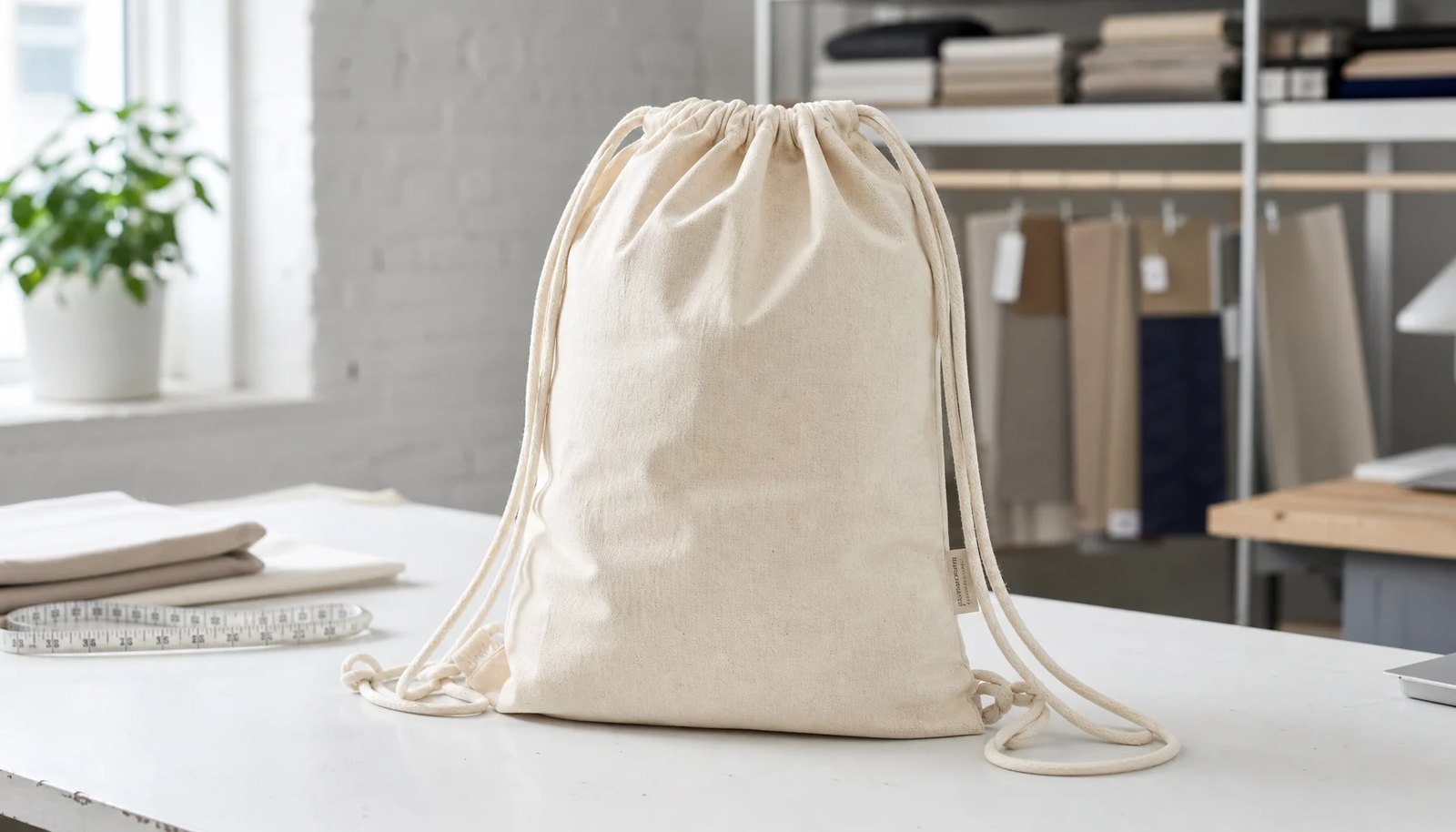
Start With The Box Use Case
A custom cotton drawstring backpack for a subscription box is not a generic promo item. It has to fit the contents, survive fulfillment, and still look deliberate when the customer opens the carton. The first decision is not decoration. It is the role the bag plays in the box: insert, gift-with-purchase, retail add-on, or a reusable carry item.
That role changes the spec. A flat insert that holds a light sample kit can use a lighter build and simpler packing. A bag that needs to carry apparel, heavier samples, or a reuse-focused gift needs more body, stronger seams, and a drawcord channel that will not deform when the bag is loaded and folded.
If the buyer does not define the use case, the factory will fill in the blanks with its own assumptions. That is how quotes become incomparable. One supplier prices a thin insert. Another prices a more durable carry bag. Both may be reasonable products, but they are not the same commercial item.
- State the item role before asking for a price.
- Name the expected contents and fill weight.
- Say whether the bag must ship flat, folded, or already packed.
- Note whether this is a launch test or a repeat program.
- Describe the customer moment the bag has to support: unboxing, gift use, or reuse.
Write An RFQ The Factory Can Price
The RFQ should read like a production brief, not a brand story. The supplier needs enough information to price fabric, labor, decoration, packing, and freight assumptions without choosing them for you. At minimum, include finished dimensions, fabric type and nominal GSM, color reference, logo method, cord specification, packing method, quantity tiers, destination, and the required ship date.
Tolerances matter as much as target dimensions. A quote for a 38 by 46 cm bag is not useful if one supplier allows broad cut variation and another holds tight to spec. Put the acceptable width, height, and cord-length range in writing. If the artwork is sensitive to placement, define the print location in millimeters from the seam or fold line.
Separate non-negotiables from acceptable alternates. If the preferred fabric is unavailable, what is the approved fallback? If the decoration must shift from screen print to woven label because of lead time, do you want that alternate quoted now or excluded? Clear fallback rules keep the factory from making its own substitutions later.
- Define finished size, flat size, and whether any gusset or bottom panel is required.
- State nominal GSM, weave type, and whether the bag should be raw, washed, or pre-shrunk.
- Set tolerances for dimensions, cord length, and print placement.
- Attach the artwork file version and a photo or reference sample of the desired look.
- List any approved fallback material, color, or decoration method up front.
Choose Fabric And Construction By Use, Not Habit
Cotton weight is where quotes drift fastest. For many subscription box uses, a midweight cotton canvas in the 140 to 180 GSM range is enough to create a clean printed surface and a bag that does not feel flimsy. If the bag has to read as more premium, or it will carry heavier contents, moving toward 180 to 220 GSM usually gives more body and a better handfeel. That is a starting point, not a rule.
Construction controls the real-world result. A reinforced bottom seam, a stable top hem, and a properly anchored cord channel can make a midrange fabric perform well. A weak seam build can make even a decent cloth look cheap once the bag is loaded, folded, and stacked in cartons. Ask how the cords are secured, whether bartacks are used at the stress points, and how the factory prevents seam distortion during sewing.
Do not allow an unapproved material swap. A factory may propose a cotton-poly blend, a thinner weave, or a different raw cotton shade if that is what it has in stock. That can be acceptable only if the buyer has already approved the alternate. For a curated box, the visual difference between cotton lots can matter more than the nominal GSM number.
- Use a lighter build for flat inserts and a heavier build for reusable or premium-use bags.
- Ask for a reinforced base and stable cord channel, not just standard stitching.
- Confirm whether the fabric is raw or prewashed so shrinkage does not move the spec.
- Request an alternate quote for a different GSM or seam build so you can compare the cost delta.
- Require written approval for any material substitution before bulk production starts.
Match Decoration To The Handling Cycle
Decoration should be chosen for how the bag will move through production, packing, and end use. Screen print is usually the most efficient choice for a simple logo because the setup can be spread across quantity and the result is straightforward to inspect. It is also a good fit when the art is one to three colors and the bag will be folded in a carton.
Embroidery can raise perceived value, but it adds thickness and another failure point near the top edge or cord channel. Woven labels are often a cleaner option when the buyer wants a more finished look without the bulk of embroidery. Heat transfer can work for detailed art or shorter runs, but it should be tested for folding, abrasion, and repeat handling before the buyer treats it as a production default.
Placement is part of the spec. Do not let the logo sit too close to the hem, the cord exit, or the center fold if the bag will ship compressed. Approve the proof on the actual fabric color whenever possible, because natural cotton rarely behaves the same way on screen as it does in daylight.
- Use screen print for simple logos, repeat orders, and controlled setup cost.
- Use embroidery or woven labels when the brand can justify the extra labor and possible MOQ impact.
- Keep artwork clear of seams, fold points, and the drawcord channel.
- Approve the proof on the actual fabric color when you can.
- Ask how the factory cures ink or secures embroidery backing before approving bulk production.
Compare Quotes On A Real Commercial Basis
A low unit price is not a low program cost if every supplier is quoting a different scope. The same bag can be priced as EXW, FOB, CIF, or delivered, with different assumptions for cartons, labels, packing, and export handling. The buyer needs one comparison worksheet with one assumption set. If one quote includes polybags, carton labels, and pallet wrap while another excludes them, the line items are not comparable.
Break the quote into one-time costs and recurring costs. Screens, digitizing, sample fees, and artwork setup belong in the first bucket. Fabric, sewing, decoration, packing, export handling, and freight belong in the second. For a repeat subscription program, you also want to know whether setup charges can be amortized across future orders. That is where the cheapest quote on paper often stops being the cheapest quote in practice.
If you are comparing a direct factory, a trader, and a domestic decorator, do not score them only on unit price. Score them on control, revision flexibility, lead-time reliability, and how much of the production flow they actually own. A quote that looks simple may hide a weak point in the supply chain. A quote that looks expensive may be easier to manage and cheaper after rework is avoided.
- Request unit pricing by quantity tier instead of one flat number.
- Separate sample fees, setup fees, and production unit price.
- Require the supplier to state packaging assumptions and incoterm.
- Ask for an overrun and underrun policy in writing.
- Capture what is included and excluded so you can compare quotes on the same basis.
Use Samples As Production Gates
Sampling should answer production questions, not just aesthetic ones. Start with a proto sample if the buyer is still deciding on fabric weight or decoration method. Then move to a pre-production sample that reflects the final spec. If the pack-out matters, ask for a sealed carton sample too. Each step should remove uncertainty before the factory cuts bulk fabric.
The most useful sample is the one handled like a real production unit. Load it with the intended contents or a realistic weight, fold it the way the fulfillment team will fold it, and inspect whether the logo lands where it should once the bag is packed. A bag that looks fine on a table may behave differently when it is stuffed, closed, stacked, and shipped.
Keep one approved golden sample and tie it to the purchase order. If the fabric, decoration method, cord type, or pack-out changes, resample the changed element before bulk production begins. If the supplier says the first sample is close enough but the build or pack method still differs, that is not approval. It is an open issue.
- Approve one physical golden sample before bulk cutting begins.
- Test the bag with the intended fill weight, not just as an empty shell.
- Review one packed carton if packing quality matters to the program.
- Ask for front, back, seam close-up, and carton photos from the factory.
- Record every approved change against the RFQ so the production version is unambiguous.
Put QC In The PO, Not Just In Email
Quality control has to be measurable if you want it to hold up in production. For custom cotton drawstring backpacks, the critical checks are finished size, print location, seam strength, cord function, color consistency, and pack accuracy. A minor wrinkle may be acceptable if it clears in packing. A wrong logo position, wrong color, or open seam should stop the batch. The inspector should not have to guess which defects matter most.
Use a two-step workflow. First, inspect the initial run after the first 10 to 15 percent of units are sewn so the factory can correct problems while there is still time. Second, do the final lot inspection after packing. Use an AQL plan if that is how your team manages sampling. AQL 0 for critical defects, 2.5 for major defects, and 4.0 for minor defects is a practical baseline for this kind of item.
Make the acceptance criteria specific. If the bag must be 38 by 46 cm, say what the acceptable range is and whether the measurement is taken before or after wash or heat setting. If the logo sits near the center line, say how much drift is acceptable before it becomes a reject. If brand color is sensitive, use a master sample and, when needed, set a Delta E limit so color drift is not left to subjective judgment.
- Treat wrong color, wrong logo, missing cord, missing label, or seam failure as major defects.
- Reject any unit that falls outside the agreed size or print-placement tolerance.
- Use pull tests on the cord and base seam during in-process and final inspection.
- Review at least one sealed carton per batch before release.
- Ask for an inspection report and photo evidence of any repaired or reworked units.
Make Packing Part Of The Spec
Packing is part of the product because it affects labor, presentation, and transit damage. For subscription box programs, the bag may need to arrive in an exact inner quantity, with the correct SKU label, barcode, and batch mark on the carton. Loose packing makes the fulfillment team spend time sorting. Overpacked cartons can crease the cotton, distort the print, and make the bag look worse before the customer ever opens the box.
Put the pack-out in the RFQ. State whether each bag ships flat or folded, whether polybags are required, how many units go in an inner pack, how many inners go in the master carton, and what the carton weight limit should be. If the destination is a fulfillment center, ask for its receiving constraints before you finalize the carton size. Many receiving docks care about carton weight and barcode placement as much as they care about the product itself.
If the route is humid or long, ask how the factory protects the goods. A simple polybag and carton liner may be enough for many programs. For a longer ocean route or a humid lane, moisture control may matter more. You do not need fancy packaging by default. You do need the packaging to fit the route and the destination.
- State the exact units per inner pack and master carton.
- Require carton marks, SKU labels, and barcode placement before shipment.
- Specify whether cartons must be palletized or can ship loose.
- Ask whether the factory can add moisture protection if the route needs it.
- Confirm label and documentation requirements for the destination market before award.
Calculate Landed Cost Before Award
The buyer should compare total landed cost per finished unit, not just the factory quote. That means unit price, setup fees, sample amortization, carton and label cost, export handling, freight, duty, brokerage, inland delivery, and any receiving or repack labor at the destination. A quote that looks lower at the factory gate can still end up higher once the shipment lands in the warehouse.
The easiest way to keep this straight is to ask every supplier for the same commercial basis and then build the landed-cost worksheet yourself. If all quotes are EXW, you can add freight, export handling, and duty in one internal model. If some quotes are FOB and others are delivered, normalize them before comparing. If a supplier insists on DDP, ask what duty, tax, and brokerage assumptions were used so you can see whether the number is real or padded.
For repeat programs, amortize one-time costs over the expected order volume. That makes a higher setup fee easier to judge if the per-unit price is lower on a reorder. It also prevents the team from selecting a cheap pilot quote that becomes expensive once the program scales. Procurement should know the cost of the first order and the cost of the second order, because they are rarely the same.
- Include freight, duty, brokerage, inland trucking, and receiving labor in the landed cost.
- Add sample and setup fees to the model if this is a launch order.
- Normalize EXW, FOB, CIF, and delivered quotes before you compare them.
- Amortize one-time costs over the expected reorder volume.
- Score the supplier on cost, lead time, quality risk, and communication, not price alone.
Lock The Purchase Order Against Drift
Most production problems on custom cotton drawstring backpacks are preventable if the purchase order is specific enough. The common failures are material substitution, unquoted packing changes, print placement drift, lead time that starts at the wrong milestone, and approval records that live only in email. The PO should close those gaps before bulk production starts.
Use plain, enforceable language. If the fabric, decoration method, and pack-out were approved in the sample, say that the bulk order must match the approved sample unless the buyer signs off on a change. If the supplier is not allowed to substitute material or labels, say that substitution requires written approval. If lead time starts only after deposit and approved pre-production sample, put that in the order. These details are not paperwork noise; they are the boundaries of the job.
The award package should be complete enough that another buyer could step in and understand what was bought. Attach the spec sheet, approved artwork, golden sample reference, packing spec, QC limit, and delivery term. If any of those are missing, the quote was not ready for award yet.
- No material substitution without written buyer approval.
- Lead time starts after deposit and approved sample, if that is the agreed trigger.
- Bulk packing must match the approved carton and inner-pack spec.
- All artwork and dimensions must reference the locked spec version.
- Do not award until the quote assumptions, packing spec, and QC standard are fixed.
Specification comparison for buyers
| Sourcing route | What you control | Commercial tradeoff | Best fit | Main watch-out |
|---|---|---|---|---|
| Direct factory | Best control over fabric, sewing, decoration, packing, and final inspection if the plant truly owns the full workflow | Usually the cleanest all-in unit cost because there are fewer handoffs, but the buyer needs a tighter spec and more discipline | Repeat subscription programs, launch programs with stable artwork, and orders where lead time is long enough for samples | Confirm that printing, packing, or carton prep are not quietly subcontracted after the quote is signed |
| Trading company or sourcing agent | Control depends on whether the agent has real factory access and a documented QC process | The quote can look simple, but margin, service fees, or transfer costs may be embedded in the number | Buyers without an in-country sourcing team or programs that need multi-supplier coordination | Insist on the actual factory name, in-house vs outsourced steps, and a breakdown of what is included |
| Domestic decorator using imported blanks | Strong control over final print or label step, weaker control over the base bag spec | Higher unit cost, but lower shipping complexity and faster finishing for small or urgent runs | Rush launches, regional fulfillment, and small tests where speed matters more than lowest cost | Verify that the blank bag stock really matches the intended fabric weight, dimensions, and seam quality |
| Stock blank with minimal custom branding | Fastest pilot route, but the least control over fabric tone, cut size, and long-term consistency | Lowest setup burden and often the cheapest way to test demand | Pilot subscription boxes, short campaigns, and orders where the bag is not a core brand asset | Stock can change between reorders, so lock the supplier and recheck samples before scaling |
| Material | 6-10 oz cotton canvas, 210D polyester, rPET, or blended cotton with shrinkage and colorfastness expectations set before sampling | Before price comparison | Different cloth weights, backing, or certification claims make quotes hard to compare | |
| Construction | cord diameter, eyelet or reinforced channel, bottom corner reinforcement, seam allowance, bar-tack position, and load target | Before sampling | Weak stress points create returns and failed inspections | |
| Decoration | screen print, transfer, embroidery, woven label, or drawstring tag tested against folding and abrasion | Before artwork approval | The wrong method can crack, bleed, pucker, or fail on the chosen fabric | |
| MOQ | Base MOQ plus change drivers | During quote review | Custom colors, trims, and packing can change minimums |
Buyer checklist before sampling
- Finished dimensions, how the bag is measured, and whether the dimension is before or after any wash, heat-set, or pre-shrink step.
- Fabric composition, weave type, nominal GSM, acceptable lot variance, color reference, and whether raw natural cotton, washed cotton, or pre-shrunk fabric is required.
- Cord specification: material, diameter, finished length, end finish, stopper if any, and whether the drawstring must glide smoothly under load without snagging.
- Construction details: seam allowance, top hem width, bartack or reinforcement requirement, bottom seam style, side seam style, and whether a gusset or bottom panel is required.
- Artwork file version, print area size, placement coordinates, number of colors, and the approved decoration method or methods.
- Packing spec: folded or flat, inner count, master carton count, carton dimensions target, maximum carton weight, barcode placement, and palletization requirement.
- Quantity tiers, expected reorder volume, acceptable overrun or underrun range, and whether the first order is a one-time campaign or a recurring subscription item.
- Target incoterm, destination port or warehouse, required in-yard date, and whether freight must be quoted separately or delivered.
- Sample plan: proto sample, pre-production sample, sealed carton sample if needed, and the person who has final approval authority.
- Compliance needs: fiber content label, country-of-origin label, retailer vendor guide, restricted-substance expectations, and whether the item is for adults or children.
Factory quote questions to send
- What exact fabric construction and nominal GSM are you pricing, and what lot-to-lot tolerance do you hold on fabric weight?
- Are the finished dimensions measured before or after any wash, heat-set, or pre-shrink step, and what tolerance are you quoting on width, height, and cord length?
- Which decoration method are you pricing, and what is included in that price: screens, digitizing, artwork setup, curing, label application, packing, and carton marks?
- Which steps are done in-house, and which steps are outsourced to another shop, print house, or packer?
- What one-time charges apply to this style: sample fee, screen fee, digitizing fee, plate fee, artwork revision fee, or carton setup fee?
- Can you quote the same spec at multiple quantity tiers, and can you show the unit price delta clearly by tier?
- What pack method, inner count, and master carton count did you use to calculate the quote, and can you also quote packing as a separate line item?
- What overrun or underrun policy do you use, and how is it handled if the batch lands outside the requested tolerance?
- What is your standard production lead time after sample approval, and what portion of that time is material booking, sewing, decoration, and packing?
- What inspection standard do you use for this item, and can you share a sample inspection report, defect log, or carton photo set from a recent run?
Quality-control points to confirm
- Use a written inspection standard such as ANSI/ASQ Z1.4 or ISO 2859-1 single sampling. Set critical defects at AQL 0, major defects at AQL 2.5, and minor defects at AQL 4.0. If the defect exceeds the accept number, hold the lot.
- For pilot lots under 500 units, inspect a minimum of 32 to 50 pieces plus at least one packed carton per SKU. For standard launch lots of roughly 500 to 3,000 units, use a final audit sample of about 80 to 125 pieces. For larger lots, increase the sample per your AQL table and inspect more than one carton pattern.
- Define major defects clearly: wrong size outside tolerance, wrong logo, missing cord, broken eyelet, open seam, missing label, wrong color against the approved master, or barcode that cannot scan.
- Define minor defects clearly: loose thread under about 25 mm, slight wrinkling that clears in handling, tiny print specks not visible at arm's length, or light carton scuffing that does not affect use or receiving.
- Measure finished width, height, and cord length on a random sample from each lot. If the bag is measured flat, say so in the spec. If the approved sample was measured after pre-shrink, keep the same method for production checks.
- Check seam quality at the top hem, side seams, bottom seam, and cord channel. Reject skipped stitches, open seams, weak bartacks, frayed raw edges, or exposed thread bundles that can snag in use.
- Run a simple functional load test on sampled units using the intended fill weight plus a safety margin. Look for cord slip, seam pop, eyelet pull-through, or opening distortion at the top channel.
- Verify print placement against the approved golden sample. The logo should stay clear of fold lines, seams, and the drawcord channel, and the location tolerance should be tight enough that the mark still looks centered when the bag is packed.
- If color matters, compare production units against the approved master under the same light source. For brand-critical colors, require the factory to report the measurement method if it claims a Delta E limit.
- Review at least one sealed carton from each lot before release. Confirm carton count, SKU labels, barcode readability, polybag count if used, and any moisture protection required for the shipping lane.