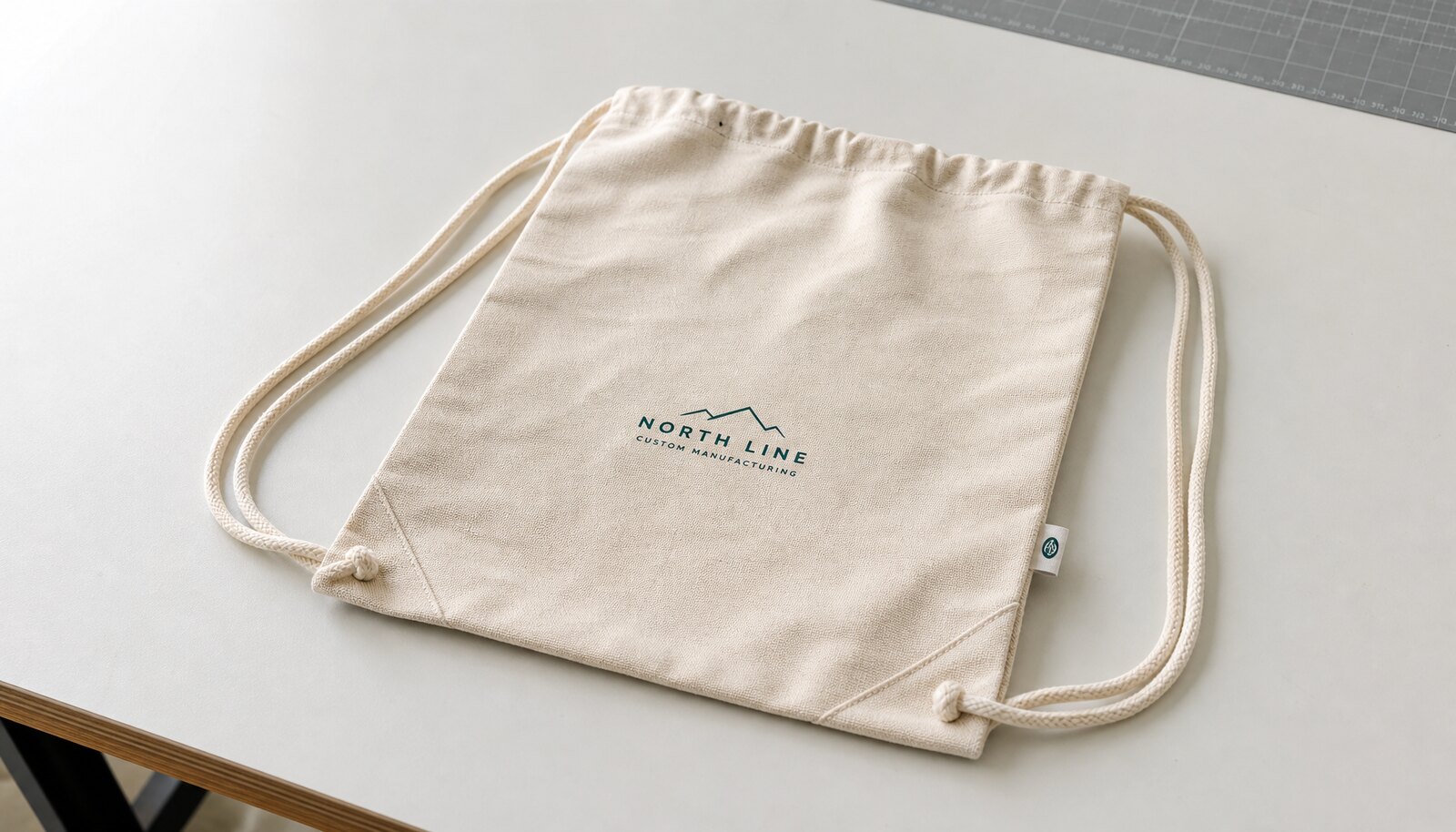
Start with the gifting program, not the bag
A custom cotton drawstring backpack is easy to describe in one sentence. That is exactly why many RFQs become too thin. For corporate gifting, the bag is not only a carrier with a logo. It may be the outer presentation for an onboarding kit, the handout at a sales meeting, the container for trade show collateral, or the item that keeps a product launch gift together until it reaches the recipient.
The first page of the RFQ should explain the job the bag has to do. A lightweight event handout for a brochure and pen has different needs from an employee kit holding a hoodie, notebook, tumbler, charger, and welcome card. The second version needs a more serious review of fabric weight, seam strength, cord comfort, packing accuracy, and carton labeling. Without that context, suppliers will quote what is convenient or familiar to them.
Give suppliers the operational facts early: event date, destination, recipient group, distribution method, expected contents, and whether the bag is handed out empty, filled at origin, packed by a kitting partner, or mailed individually. Also say whether the gift is meant to be a low-cost campaign item or something recipients may keep and reuse. That single distinction helps suppliers choose a realistic cotton GSM, cord, decoration method, and inspection scope.
Internal approvals matter too. Brand review, sustainability documentation, legal wording, warehouse receiving rules, barcodes, and regional allocation files can all slow a program after the price is approved. A strong custom cotton drawstring backpacks RFQ template guide for corporate gifting turns these internal requirements into supplier-facing instructions before sampling begins.
- State the program type: trade show, employee onboarding, sales meeting, campus recruiting, customer loyalty, product launch, store insert, or direct-mail campaign.
- List expected contents with approximate loaded weight and largest item dimensions, especially for notebooks, bottles, apparel, boxed accessories, or printed catalogs.
- Confirm whether the bag must arrive ready to hand out, ready for regional allocation, ready for warehouse receiving, or ready for a separate kitting line.
- Provide the in-hand date, event date, delivery destination, preferred shipping mode, and the buffer needed before distribution begins.
- Identify who owns inserts, hangtags, barcodes, gift components, carton labels, and final distribution so each supplier quotes the right scope.
Lock the physical specification
Cotton drawstring backpack quotes can look similar while describing very different products. One supplier may assume 140 GSM natural cotton, bulk packed. Another may price 220 GSM dyed cotton with reinforced corners and individual packing. A third may quote an available blank and add decoration locally. None of those choices is automatically wrong, but they are not the same item.
Fabric weight is an important control point. For light event use, 140 to 160 GSM cotton may be enough when the bag holds paper, badges, or small booth items for a short period. For corporate gifting with a cleaner feel and better presentation, 180 to 220 GSM is often a stronger evaluation range. Still, GSM does not carry the bag by itself. Cord exits, top channel construction, lower-corner reinforcement, seam allowance, and stitch quality decide how the bag behaves when it is filled.
Use finished flat dimensions, not casual labels such as standard, medium, or large. State width by height after sewing, and define where the measurement is taken. A supplier quoting cut-panel dimensions can deliver a bag that is smaller than expected once seam allowance and the folded top channel are included. That becomes a real problem when the bag must fit folders, apparel, gift boxes, or printed kits.
Be precise about the cotton itself. Natural unbleached cotton, bleached cotton, dyed cotton, washed cotton, recycled-content cotton, organic-certified cotton, and cotton-poly blends may all be described as cotton bags in emails. If a sustainability claim will appear in the campaign, ask what documentation can be supplied for the exact material being used. Keep marketing language behind verifiable material records.
- Quote finished flat dimensions, such as width by height after sewing, and state whether tolerance is measured at the opening, body, or bottom.
- Specify fabric composition, cotton finish, target GSM, and acceptable GSM tolerance instead of using only words like heavy, sturdy, eco, or premium.
- Define cord material, color, diameter, length, knotting method, and whether it exits through eyelets, sewn tabs, fabric loops, or a folded channel.
- State seam finish, approximate stitch density requirement, top hem style, bottom construction, and lower-corner reinforcement method.
- Ask the supplier to confirm whether the quoted bag can carry the expected contents without tearing, top-channel stress, or cord discomfort.
- Request documentation for recycled, organic, or other material claims before those claims appear in buyer-facing or recipient-facing copy.
Choose decoration for the real brand result
Decoration should follow the brand result, not the supplier's default quote sheet. Screen printing is usually practical for one- or two-color artwork on a flat cotton panel. It can be fast, clean, and cost-effective, provided the RFQ controls ink opacity, curing, placement, and color tolerance. On natural cotton, fine details may interact with the weave. On dark dyed cotton, opacity and print hand feel need closer review.
Multi-color screen print, heat transfer, digital transfer, embroidery, woven labels, patches, and hangtags each solve a different problem. Heat transfer can reproduce gradients or fine artwork, but buyers should check adhesion, edge lifting, stiffness, scorch marks, and residue. Embroidery can feel premium, yet dense stitching may pucker lighter cotton or make small text unreadable. A woven side label or cotton patch can create a quieter retail-like finish, but it adds label MOQ, placement tolerance, sewing quality, and color approval steps.
A placement diagram is worth more than a vague instruction to center the logo. Give measurements from the top and side edges, and ask the factory to confirm the safe decoration area. Drawstring backpacks gather at the top when closed and change shape when filled. A logo that looks perfect on a flat digital proof can sit too high, too low, or too close to folds once the bag is used.
When stakeholders are undecided, keep the base bag the same and ask for decoration options as separate price lines. One-color screen print, woven side label, and small embroidery can be compared fairly only if they are priced against the same fabric, size, cord, reinforcement, and packing plan.
- Provide editable vector artwork, Pantone or brand color references, approved logo size, and a placement diagram with measurements from the top and side edges.
- Define a safe decoration area that avoids seams, cord channels, lower-corner reinforcement, and heavy fold lines.
- For screen print, ask for ink type, opacity approach, curing method, color tolerance, placement tolerance, and whether screen charges are included.
- For heat transfer, request adhesion, edge-lift, hand-feel, wash or rub guidance, and a sample on the selected cotton rather than a generic transfer sample.
- For embroidery, confirm stitch count, minimum text height, thread colors, backing method, puckering risk, and whether artwork must be simplified.
- For woven labels, patches, or hangtags, specify size, fold type, edge finish, sewing position, attachment method, and placement tolerance.
Make quote tables expose assumptions
A useful RFQ forces the quote to show what is included. Cotton drawstring backpack pricing often hides meaningful differences inside one unit price. One quote may include the blank bag and one-color print only. Another may include custom cord, reinforced corners, individual packing, carton labels, and a pre-production sample. A third may exclude setup and add it later.
Ask suppliers to separate the commercial building blocks. The base bag, decoration running cost, setup fees, labels, inserts, packing, kitting labor, samples, testing, inspection support, and freight-related charges should not be blended unless the buyer has also received the detail behind the blend. This makes stakeholder tradeoffs clearer and reduces surprise charges after the supplier is selected.
MOQ also needs to be broken down. There may be one MOQ for the bag body, another for custom dyed fabric, another for cord color, another for woven labels, and another for each print version. A 3,000-unit order split across three fabric colors and two artwork versions is not the same job as one 3,000-unit SKU. The RFQ should ask whether MOQ applies per order, per fabric color, per cord color, per artwork, per label, or per packing configuration.
Overrun and underrun terms deserve a line of their own. Small quantity variations may be acceptable for general promotional inventory, but they can disrupt recipient-specific kits, regional allocations, or employee onboarding counts. Put the acceptable tolerance and invoicing method into the RFQ and purchase order before production starts.
- Request separate cost lines for base bag, decoration running cost, setup fees, labels, inserts, individual packing, kitting labor, export cartons, samples, testing, and document preparation.
- Ask suppliers to identify the assumptions behind the price, such as stock fabric, natural cotton, bulk packing, no third-party inspection, no custom dye, or no physical sample.
- Require MOQ by fabric color, cord color, logo version, label version, insert version, and packing version.
- Request price breaks using the same technical specification at each quantity so procurement can compare scale effects accurately.
- Ask whether setup fees are charged once per artwork, once per print color, once per screen size, once per label, or once per run.
- Define overrun and underrun tolerance, replacement process, shortage handling, and whether exact quantity control is available at added cost.
Compare sourcing routes with a scorecard
The lowest unit price is not always the best sourcing route. Factory cut-and-sew gives the buyer the most control over size, cotton GSM, cord, reinforcement, decoration placement, and packing. It is often the right path when the bag must feel like a considered corporate gift. The buyer also needs to manage approval gates, material booking, sample review, inspection timing, and international freight.
Trading companies and bundled sourcing partners can be useful when the program includes several items, such as a bag, notebook, pen, card, sticker, and box. One commercial contact may simplify coordination, but the bag specification still needs to be visible. Ask which factory makes the bag, who approves quality, who holds the sealed sample, whether inspection can occur at the packing site, and how substitutions are documented.
Domestic decoration on imported blanks can be a better choice when the schedule is tight or artwork may change late. It can also help with local language inserts, market-specific barcodes, or destination-country receiving requirements. The tradeoff is narrower blank selection, less construction control, and often higher handling cost. Compare total landed cost and schedule confidence, not only ex-factory price.
A scorecard keeps the discussion from collapsing into unit cost. Weight the factors that matter for the program: specification match, sample evidence, lead-time reliability, communication clarity, packing capability, inspection access, documentation support, and landed cost. For a fixed-date campaign, a slightly higher unit price can be easier to defend when it removes material uncertainty or reduces the chance of rework.
- Use factory-direct production when custom size, fabric, reinforcement, dye color, or controlled brand finish is central to the program.
- Use a trading company or program manager when multi-item coordination, consolidation, and one commercial owner are more valuable than factory-level control.
- Use domestic decoration when approved blanks are acceptable and local speed, late artwork control, or regional variation matters most.
- Ask every route for the same finished specification, sample standard, inspection plan, packing instructions, and quote format.
- Score quotes on specification compliance, total landed cost, sample evidence, schedule risk, packing capability, communication quality, and QC visibility.
- Require suppliers to list exceptions in writing so a lower price is not created by silently changing fabric, dimensions, packing, or logo method.
Build the RFQ so suppliers can answer cleanly
A supplier-ready RFQ does not need to be long, but it must be complete enough that each bidder prices the same product. Include buyer contact, project name, destination, required in-hand date, target quantities, bag specification, decoration details, packing instructions, document requirements, sample expectations, QC expectations, quote format, Incoterms, and quote validity period.
Use options when the team has not made every decision. Option A might be 180 GSM natural cotton with one-color screen print and bulk packing. Option B might be 220 GSM dyed cotton with a woven side label, insert card, and individual paper band. Option C might use the same bag with embroidery. This keeps undecided features visible instead of letting suppliers choose the cheapest interpretation on your behalf.
Add a supplier exception field. If the supplier cannot meet the requested GSM, substitutes a different cord diameter, changes the finished size, excludes carton labels, or quotes bulk packing instead of individual packing, the exception should appear beside the relevant line. Exceptions are not automatically a problem. Hidden exceptions are.
The purchase order should match the approved quote and sample. Many sourcing issues begin when the PO captures only quantity and unit price while the technical details remain scattered across emails. Attach the final specification, artwork proof, sample notes, packing instruction, and inspection requirements to the PO or supplier confirmation so the commercial and technical records tell the same story.
- Start the RFQ with program summary, quantities by version, delivery destination, required in-hand date, and decision deadline.
- Include a technical spec table covering finished size, GSM, material, cord, seam finish, reinforcement, decoration, labels, packing, carton count, and document needs.
- Ask for quote lines separating bag, decoration, setup, labels, inserts, packing, kitting, samples, testing, inspection support, and freight-related charges.
- Add fields for MOQ, quantity breaks, lead time by approval gate, sample timing, payment terms, Incoterms, quote validity, and excluded costs.
- Require a supplier exception column for every line where the quote differs from the RFQ.
- Carry the approved specification, proof, sample notes, and packing plan into the PO so there is one controlled reference for production.
Treat samples as approval evidence
Samples are not just a courtesy. They are evidence that the supplier can make the item being purchased. A photo proof can help with early logo placement, but it cannot confirm fabric hand feel, GSM, cord action, print curing, embroidery puckering, or final packing presentation. For meaningful approval, request a physical pre-production sample made with final fabric, final cord, final decoration method, final label, and final packing materials whenever the schedule allows.
If final materials are not available at sample stage, document what is representative and what remains open. The sample may confirm construction and size while the production fabric color waits for a lab dip. It may show print placement while the final woven label is still in production. Those notes matter because a partial sample should not become accidental approval of every detail.
Review the sample the way an inspector would. Measure width and height. Check seam straightness, top hem, lower-corner reinforcement, cord length, and cord movement. Fill the bag with expected contents, close it, and look at the front panel again. Drawstring backpacks change shape when gathered, so flat approval is not the whole story.
Approval language should be specific. Instead of writing only approved, list the approved elements and any required changes. Keep one sealed or signed reference sample for production comparison. If timing is too tight for a revised physical sample, ask for production start photos, print strike-off photos, or a short packing video before the full run moves too far.
- Request a pre-production sample using final fabric, cord, decoration, label, insert, and packing whenever time allows.
- Measure the sample against written specs for finished size, cord length, logo placement, label position, and visible construction quality.
- Fill the sample with expected contents to check shape, logo visibility, seam stress, cord comfort, and corner reinforcement.
- Review print opacity, color, placement, curing, rub resistance, edge sharpness, and hand feel before approving mass production.
- For embroidery, inspect puckering, backing, thread density, loose threads, small text legibility, and panel distortion.
- Keep a sealed approved sample, signed sample, or documented reference set available for inspection and dispute resolution.
Control packing before it controls the project
Packing is often where a simple bag becomes a complicated corporate gifting order. The pack-out may include insert cards, hangtags, barcodes, office allocations, language versions, region labels, gift components, or direct-mail preparation. If the RFQ does not specify packing, many suppliers will quote bulk cartons by default. That can work for event staff who will unpack manually, but it can create labor, errors, and rework for warehouses or recipient-specific programs.
State how each bag is folded, whether cords are tucked or tied, whether units are individually wrapped, whether plastic-free packing is preferred, how insert cards are positioned, and how many units go into an inner pack and master carton. If the program has multiple colors or logo versions, define whether mixed cartons are allowed. If mixed cartons are allowed, require a clear label and packing list. If they are not allowed, say that plainly.
Carton details affect receiving and freight. Ask for estimated carton dimensions, gross weight, carton strength, carton marks, barcode labels, palletization if required, and any distributor or warehouse label rules. For ocean freight or long storage, ask how the supplier controls moisture and odor. Cotton can absorb dampness and smells when packed in poor conditions.
For kitted programs, inspection must cover pack-out accuracy. Missing inserts, wrong language cards, incorrect barcodes, and mixed SKUs can be more disruptive than a small cosmetic defect. Ask for a first-article pack approval, packing photos, or a short pack-out video before all cartons are sealed.
- Specify fold method, cord position, unit wrapping, inner quantity, master carton quantity, carton dimensions, gross weight, and carton marks.
- Define insert cards, hangtags, barcode labels, warning labels, distributor labels, and recipient or region labels with exact placement instructions.
- State whether mixed SKUs are allowed and require carton labels and packing lists that make mixed contents easy to verify.
- Ask for first-article packing approval, packing photos, or a short pack-out video before bulk cartons are sealed.
- Make carton count, SKU separation, insert accuracy, barcode readability, and carton condition part of the inspection scope.
- Confirm moisture control, odor prevention, and carton strength when the shipment involves long transit, humid conditions, or extended storage.
Write QC standards that can be inspected
Quality control for custom cotton drawstring backpacks should focus on defects recipients will notice and errors that disrupt distribution. The inspection plan does not need to over-engineer a simple bag, but it should define what will be checked and what counts as a defect. Otherwise, the buyer and supplier may disagree after production, when fixes are expensive or impossible.
Start with tolerances. Finished dimensions can be controlled within an agreed range, such as a small centimeter tolerance depending on size and construction. Logo placement should have a tolerance from the approved reference point. GSM should have an agreed range or percentage tolerance. Label placement, cord length, print registration, and carton count also need written standards. Set these before the PO is placed, because overly tight tolerances may affect cost or rejection risk.
Classify defects before inspection. Critical defects may include wrong logo, wrong brand color, contamination, mold, unsafe foreign matter, or unusable construction. Major defects may include open seams, torn corners, severe misprints, missing inserts, wrong barcodes, incorrect SKU mixing, or unacceptable shade mismatch. Minor defects may include small loose threads, slight wrinkles, or tiny natural cotton marks within the approved sample standard.
Ask whether the supplier supports third-party inspection and where inspection can occur: sewing line, decoration area, packing area, or finished-goods warehouse. For higher-risk orders, a formal sampling plan such as an agreed AQL may be appropriate. For smaller orders, a defined checklist with photo evidence may be enough. Either way, inspection should happen before shipment, not after cartons arrive at the event warehouse.
- Set written tolerances for finished dimensions, GSM, logo placement, print registration, label position, cord length, and carton quantity.
- Inspect fabric for stains, oil, odor, dye streaks, holes, panel shade mismatch, unacceptable slubs, and contamination.
- Inspect construction for skipped stitches, open seams, loose threads, uneven top hems, weak reinforcement, cord fraying, and poor cord movement.
- Inspect decoration for color match, opacity, curing, adhesion, cracking, smudging, misregistration, embroidery puckering, and unreadable small details.
- Inspect packing for unit count, SKU separation, insert accuracy, barcode readability, carton labels, carton damage, and mixed-carton documentation.
- Request inspection photos showing front, back, inside seams, cord exits, reinforcement, logo close-up, packed units, carton marks, and any defects found.
Plan the schedule by approval gate
Lead time should not be treated as one number. A supplier may say production takes three weeks, but that may exclude artwork cleanup, material booking, lab dips, sample making, courier transit, buyer review, packing material procurement, inspection, export handling, customs clearance, and final domestic delivery. Corporate gifting usually has a fixed date, so the RFQ should map the whole schedule.
Work backwards from the required in-hand date. Include quote review, internal approval, artwork approval, material confirmation, lab dip or swatch approval, sample production, sample shipping, sample review, bulk production, decoration, packing, inspection, shipment booking, customs clearance, and destination delivery. Custom dyed fabric, custom cord, woven labels, printed inserts, or multiple pack versions can become the critical path.
Ask suppliers which dates depend on buyer approvals and which materials are already available. A stock natural cotton bag with one-color print can move much faster than a custom dyed cotton program with matched cord and woven labels. A late change to carton labels or insert artwork can delay shipment even if the bags are already sewn.
For fixed-date campaigns, keep a fallback specification visible. That might mean natural cotton instead of dyed fabric, fewer print colors, screen print instead of embroidery, bulk packing instead of individual packing, or domestic decoration on approved blanks. The fallback is not the preferred version. It is the version that protects the event date if an approval gate slips.
- Request a timeline with dates for artwork approval, material approval, sample completion, sample approval, production start, decoration, packing, inspection, ship date, and estimated arrival.
- Freeze artwork, print placement, insert files, carton labels, barcodes, and SKU splits before production materials are booked.
- Ask which components are stock and which require custom procurement, dyeing, label production, or outside decoration.
- Confirm whether production can proceed from photo approval for low-risk details or whether physical sample approval is mandatory.
- Build a buffer before the event date for customs, local delivery, warehouse receiving, allocation, and last-mile distribution.
- Keep a fallback specification ready when the campaign date cannot move and custom materials or decoration approvals may run late.
Specification comparison for buyers
| Spec decision | Recommended option | When it fits | Buyer risk to check |
|---|---|---|---|
| Blank stock bag + local decoration | Use an available cotton drawstring backpack and decorate it near the destination market | Small urgent runs, pilot gifts, or programs where speed and local artwork control matter more than custom construction | Confirm finished size, fabric GSM, blank inventory depth, shade consistency across lots, print adhesion on finished fabric, and whether replacement stock is available |
| Factory cut-and-sew + one-color screen print | Produce made-to-spec bags and print a simple logo on the front panel | Mid-volume corporate gifting where cost control, clean branding, and repeatable specs are priorities | Check screen setup fees, ink opacity on the selected cotton color, curing, placement tolerance, print cracking, and whether the approved sample uses production fabric |
| Factory cut-and-sew + multi-color print | Use screen print or transfer depending on artwork detail and color count | Campaigns with brand marks, campaign graphics, or event artwork that need stronger visual impact | Confirm color registration tolerance, Pantone matching method, maximum print area, hand feel, curing or bonding tests, and added lead time for artwork approval |
| Factory cut-and-sew + woven label or patch | Add a sewn side label, front woven label, cotton patch, or branded hangtag | Executive gifts, onboarding kits, or retail-adjacent programs where subtle branding is preferred | Control label size, fold type, edge finish, sewing position, placement tolerance, stitch neatness, label color approval, and minimum order for custom labels |
| Factory cut-and-sew + embroidery | Embroider a small simple logo on heavier cotton or a reinforced decoration area | Premium-feel gifting with limited artwork detail and smaller logo size | Review stitch count, minimum text height, backing, puckering, thread color match, needle holes, and whether the fabric GSM can support the embroidery |
| Custom dyed fabric + matched cord | Specify fabric color, cord color, logo color, and label color as one coordinated package | Brand campaigns where color consistency is important and timeline allows lab dips or strike-offs | Expect higher MOQ, longer approval path, shade variation between fabric and cord, lab dip rejection risk, and possible color fastness testing |
| Factory direct with kitting | Produce the bag and pack it with inserts, cards, or other gift components at origin | Programs needing ready-to-handout cartons, employee kits, sales kits, or pre-sorted regional allocations | Inspect insertion accuracy, SKU separation, carton count, barcode labels, mixed-carton rules, damage during pack-out, and missing component controls |
| Trading company or bundled sourcing partner | Use one supplier to coordinate bag production, decoration, packing, and related gift items | Multi-item programs where procurement wants one commercial owner for coordination and shipment | Ask which factory makes the bag, who controls QC, whether third-party inspection is allowed, and how specification exceptions are disclosed |
| Domestic decoration on imported blanks | Import or buy blank cotton drawstring bags and finish logo work locally | Tight schedules, last-minute artwork changes, language-specific inserts, or destination-market compliance handling | Compare higher handling cost, narrower blank choices, extra domestic freight, inconsistent blank sourcing, and limited control over fabric or construction |
Buyer checklist before sampling
- Define the exact gifting use case: trade show handout, employee onboarding kit, sales meeting pack, campus recruiting item, customer loyalty gift, product launch, retail insert, or direct-mail program.
- Confirm target quantity by fabric color, cord color, logo version, label version, insert version, and packing version instead of giving only one total order quantity.
- State finished flat bag dimensions, measurement points, fabric composition, target GSM, GSM tolerance, cord material, cord diameter, seam finish, top channel construction, and lower-corner reinforcement.
- List expected contents with approximate loaded weight and dimensions so the supplier can quote construction that matches the real carrying requirement.
- Provide vector artwork, Pantone or brand color references, logo size, placement measurements from edges, and any brand restrictions on scaling or clear space.
- Choose decoration priorities in writing: lowest cost, softest hand feel, sharpest small detail, wash or rub resistance, premium appearance, or fastest production.
- Ask whether the quote includes screen charges, digitizing, sample charges, lab dips, carton labels, inserts, barcodes, export packing, document preparation, and inland freight to port if applicable.
- Request tiered pricing at realistic quantities and require separate lines for base bag, decoration, labels, packing, kitting, setup, samples, inspection support, and freight-related charges.
- Define sample requirements: material swatch, artwork proof, lab dip, strike-off, pre-production sample, approval photos, physical sealed sample, and final packed unit sample.
- Set written tolerances for finished size, GSM, logo placement, color match, print registration, label position, cord length, carton count, and acceptable overrun or underrun quantity.
Factory quote questions to send
- What finished flat bag width and height, fabric composition, target GSM, and GSM tolerance are included in the quoted unit price?
- Are the dimensions quoted as finished measurements after sewing, or are they cut-panel dimensions before seam allowance and top-channel construction?
- Is the cotton natural, bleached, dyed, recycled-content, organic-certified, or blended, and what documentation can be supplied for any material claim?
- What cord material, cord diameter, cord color, channel construction, eyelet or tab method, and lower-corner reinforcement are included?
- What seam allowance, stitch type, stitch density range, and seam finish are planned for side seams, bottom seams, top hem, and reinforcement areas?
- Which decoration method is included, what is the maximum recommended decoration size, and what setup, screen, digitizing, film, or artwork fees are separate?
- What print color tolerance, placement tolerance, registration tolerance, curing or bonding check, and rub or adhesion check will be used for production?
- What is the MOQ per fabric color, cord color, print version, label version, packaging configuration, and shipment split?
- Can you quote the same construction as blank, one-color screen print, multi-color print or transfer, woven label, and embroidery so procurement can compare options clearly?
- Will the pre-production sample use mass-production fabric, final cord, final logo method, final label, final insert, and final packing materials?
Quality-control points to confirm
- Fabric GSM is checked from production fabric and remains within the agreed tolerance, commonly specified as a small percentage or fixed GSM range rather than judged by hand feel only.
- Finished bag width, height, top opening, usable depth, and cord length are measured flat at defined points and remain within the approved measurement tolerance.
- Fabric is free from unacceptable stains, oil marks, dye streaks, holes, weaving defects, mildew odor, strong chemical odor, panel shade mismatch, and visible contamination.
- Natural cotton slubs and seed flecks are reviewed against the approved sample so normal fabric character is not confused with defects and unacceptable dark marks are still rejected.
- Stitching is even at side seams, bottom seam, top hem, and corner reinforcements, with no open seams, skipped stitches, broken threads, loose thread nests, fraying seam allowance, or crooked reinforcement panels.
- Lower-corner reinforcement and cord exits withstand the agreed handling check, such as repeated cord pulls and a filled-bag review using the buyer's expected loaded weight.
- Drawcord slides smoothly through the channel, exits evenly, has consistent length on both sides, does not fray, and does not tear the top hem after repeated opening and closing.
- Screen print is centered, sharp, opaque enough for the selected fabric color, properly cured, and free from bleeding, cracking, pinholes, smudges, misregistration, or shade shift against the approved reference.
- Heat transfer is bonded evenly with no lifting edges, bubbles, scorch marks, ghosting, excessive stiffness, or adhesive residue beyond the approved sample standard.
- Embroidery is stable and clean, with acceptable backing, no fabric puckering, no loose jump threads, no thread breaks, no unreadable small text, and no distortion of the bag panel.