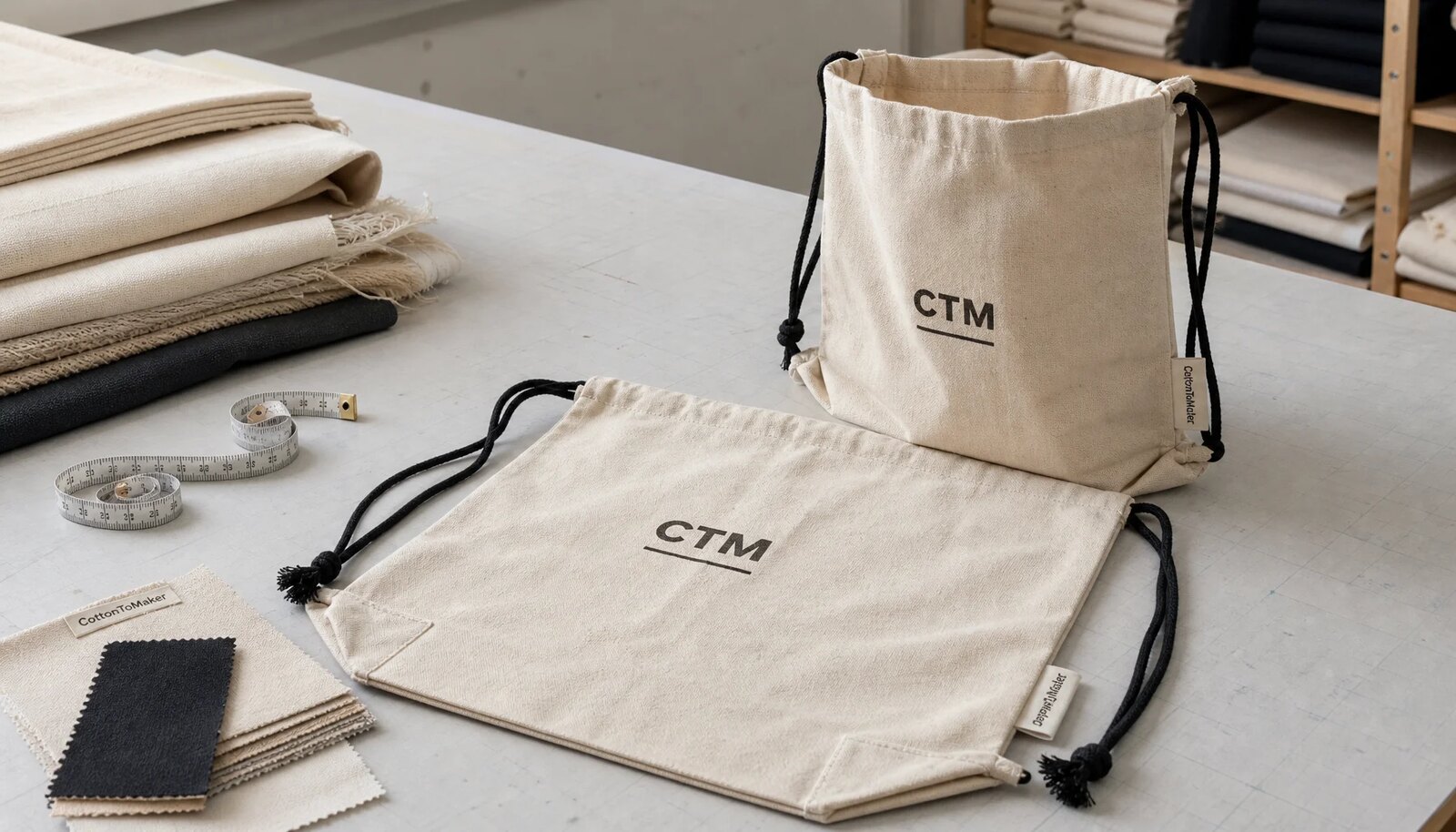
Start With the Event Job, Not the Product Name
A useful custom cotton drawstring backpacks RFQ template guide for craft fairs does not begin with “please quote cotton bag.” It begins with the job the bag has to do. The same drawstring shape can be a low-cost registration handout, a reusable attendee bag, a paid merchandise item, a workshop kit carrier, an exhibitor gift, or a sponsor pack. Those roles need different fabric weights, cords, reinforcements, decoration methods, packing formats, and inspection standards.
Craft fair bags also carry a wider mix of items than a simple conference tote. One buyer may need space for paper programs and postcards. Another may be packing yarn kits, notebooks, small tools, candles, glass jars, ceramics, folded apparel, or sponsor samples. Dense contents put pressure on the lower cord exits and side seams. Bulky contents affect the opening width and usable height. Sponsor artwork changes print setup, color control, and carton sorting.
When an RFQ only says “cotton drawstring backpack,” suppliers have to guess. Some will quote the cheapest standard bag to stay competitive. Others will assume heavier canvas, cotton rope, reinforced tabs, and more careful packing. Both quotes may look similar on the surface, but they are not pricing the same product. Give the supplier the use case, target load, distribution method, in-hand date, and branding role before asking for the unit price.
- Attendee giveaway: prioritize controlled cost, clean logo reproduction, fast counting, and bulk or bundled packing.
- Retail resale: prioritize heavier handfeel, tidy finishing, barcode or hangtag control, and consistent presentation.
- Workshop kit bag: prioritize size accuracy, load strength, easy pre-filling, and sorting by class or session.
- Exhibitor or VIP gift: prioritize stronger fabric, reinforced stress points, premium decoration, and tighter cosmetic limits.
- Sponsor pack: prioritize logo accuracy, artwork version control, print placement, and clear carton marks by sponsor or destination.
Build a Quote-Ready Specification Sheet
The best RFQ turns a product idea into a specification sheet that can be costed, sampled, inspected, and repeated. Keep it practical. Include finished size, fabric construction, fabric weight, fabric color, drawcord material, cord size, reinforcement method, decoration method, print area, artwork version count, packing method, carton requirements, sample process, inspection standard, shipment term, and required delivery date.
Avoid phrases that sound helpful but leave too much room for interpretation. “Standard size,” “good quality,” “eco style,” and “strong cord” do not give a factory enough detail to quote consistently. Finished dimensions should be written as width x height after sewing and pressing, measured flat without stretching. Common craft fair sizes include 35 x 42 cm and 38 x 45 cm, but the correct size depends on what the bag must hold.
Fabric should be stated in oz and approximate GSM when possible because buyers and suppliers often use different units. Decoration needs the same discipline. “One front logo” is not enough if the supplier must price screens, ink coverage, curing time, placement risk, and artwork changes. Ask suppliers to list assumptions clearly: stock fabric or custom dyeing, cotton rope or polyester cord, reinforced tabs or unreinforced exits, setup charges included or separate, and bulk packing or individual packaging.
- State finished size and tolerance, such as 38 x 45 cm with plus or minus 1 cm tolerance.
- State fabric as cotton canvas or cotton twill, with oz weight, approximate GSM, color, and swatch approval requirement.
- State drawcord as 6 mm cotton rope, 8 mm cotton rope, 15 mm cotton tape, or another exact trim.
- State reinforcement details, including top channel, lower tabs, loops, bar tacks, eyelets, or backing fabric.
- State decoration details, including method, print size, color count, placement from edges, and artwork version quantity.
- State packing details, including bundle count, individual packaging, hangtag, barcode, carton mark, pieces per carton, and carton dimensions.
- State commercial terms, including MOQ, price breaks, sample timing, setup fees, lead time, inspection access, and shipment term.
Specify Cotton Fabric in Buyer-Friendly Terms
Fabric is one of the biggest cost and performance drivers. For many custom cotton drawstring backpacks for craft fairs, 7 oz to 10 oz cotton canvas is a practical starting range. In approximate terms, 7 oz is about 237 GSM, 8 oz is about 271 GSM, and 10 oz is about 339 GSM, although the exact GSM can vary with weave, yarn, and finishing. Lighter 5 oz to 6 oz cotton may work for simple paper handouts, but it can feel limp as a backpack and may show more stress at the seams.
Heavier fabric is not automatically better. A 10 oz canvas gives more body and a stronger retail feel, but it increases material cost, carton weight, and freight impact. A 12 oz canvas can look premium, yet it may make the top channel bulkier and the bag harder to close unless the cord and sewing construction are adjusted. The RFQ should match fabric weight to contents, decoration, budget, and handling needs.
Natural cotton is popular for craft fairs because it supports a reusable, handmade, maker-market look. It also comes with natural characteristics that should be approved up front. Seed flecks, small slubs, neps, shade variation, and a slightly uneven print surface may be normal. If the buyer expects a cleaner white surface or tighter brand-color control, bleached or dyed cotton should be specified, sampled, and priced. For custom colors, allow time for lab dips and clarify whether thread, cord, labels, and print colors must coordinate.
- 5 oz to 6 oz cotton: suitable for budget handouts with light paper contents, but lower structure and perceived value.
- 7 oz to 8 oz cotton canvas: balanced choice for many event giveaways, reusable craft fair bags, and sponsor packs.
- 10 oz cotton canvas: stronger retail feel and better body, with higher unit cost and carton weight.
- 12 oz cotton and above: premium feel, but requires closure, sewing, and freight review before approval.
- Natural cotton: accepts normal flecks and shade variation; approve the actual swatch and print appearance.
- Bleached or dyed cotton: cleaner or more brand-specific, but requires color approval, shade control, and schedule allowance.
Control Size, Shape, and Carry Load
Finished size should come from the contents, not from a reference photo. A 35 x 42 cm bag may be enough for programs, postcards, and small purchases. A 38 x 45 cm bag gives more room for notebooks, folded apparel, yarn kits, or workshop materials. Oversizing adds cotton consumption, print area, carton cube, and handling weight. Undersizing causes a different problem: the event team discovers too late that the bag cannot hold what it was meant to carry.
The RFQ should also state the target load in plain language. A light handout may only need to carry paper inserts. A workshop kit may need to carry 3 kg of supplies. Bags used for candles, jars, small tools, or ceramics need more attention at the lower cord exits and side seams. Do not ask for an impressive load claim without explaining the contents. Ask the supplier whether the quoted construction is suitable for the real load and request a simple loaded hang, wear, or pull check on the sample.
Measurement rules belong in the RFQ, not in the inspection dispute. Bags should be measured flat, seam to seam, after sewing and pressing, without stretching. A tolerance of plus or minus 1 cm on width and height is often practical for sewn cotton event bags. If the bag must fit a fixed kit, a tighter tolerance can be requested, but it may raise cost or rejection risk. Cord length should be measured too because strap comfort depends on symmetry and usable length, not only body size.
- List the largest item that must fit through the opening and the densest item the bag must carry.
- Use finished measurements, not cut-panel size or photo reference proportions.
- Set size tolerance, commonly plus or minus 1 cm unless the bag must fit a fixed kit.
- Define target load such as 2 kg, 3 kg, or 5 kg based on actual fair contents.
- Ask the supplier to recommend reinforcement if contents are dense or hard-edged.
- Test the approved sample loaded, worn over the shoulder, opened, closed, and inspected at stress points.
Define Drawcord, Channel, and Reinforcement
On a drawstring backpack, the cord is not a small trim decision. It closes the bag, forms the shoulder straps, and carries the load through the lower exits. Cotton rope gives a natural craft-market look and pairs well with canvas. A 6 mm to 8 mm cotton rope is a common RFQ range for event bags. Too thin, and it can feel low value or dig into shoulders. Too thick, and the top channel may become bulky and harder to close.
Flat cotton tape is worth considering when comfort matters. A 15 mm to 20 mm tape spreads pressure across the shoulder and may suit workshop kits or heavier merchandise. Polyester cord can offer lower cost, stronger color consistency, or faster availability, but it may not match an all-cotton positioning. The RFQ should specify cord material, diameter or tape width, color, usable length, end finish, knots or tips, and whether cord color must match the fabric, print, or brand palette.
The lower cord exit deserves special attention because it is a common failure point. Low-cost bags may catch the cord into the side seam or pass it through a simple hole. Stronger constructions use triangular fabric tabs, reinforced loops, bar tacks, or metal eyelets with backing. Eyelets can look tidy, but they need correct setting and may create tearing or rust risk if poorly specified. Fabric tabs and bar tacks often fit cotton craft fair bags well because they add strength without losing the soft textile look.
- Specify rope diameter or tape width instead of writing only “drawstring cord.”
- Confirm top-channel width is compatible with the selected cord and allows smooth closure.
- Check strap length on different wearer heights and over light jackets or sweaters.
- Require clean cord ends, secure knots or tips, and no fraying that affects appearance or use.
- Add bar tacks or reinforced tabs when the bag will carry dense contents.
- If using eyelets, specify backing, finish, setting quality, and corrosion expectations.
- Include a loaded hang or pull check aligned with the stated target load.
Match Decoration to Artwork Risk
Screen printing is usually the first method to quote for cotton drawstring backpacks with simple craft fair graphics. It works well for one-color or limited-color logos, event marks, sponsor graphics, and bold illustrations. It can also be cost-efficient at bulk quantity when screens, ink curing, and packing are controlled. On textured cotton canvas, however, very fine lines, small text, halftones, and large solid ink areas need review. Ask the supplier to confirm minimum line thickness and any limits created by the fabric surface.
Heat transfer can solve full-color artwork, gradients, photographs, or short runs with many colors. It should not be treated as a direct substitute for screen print without sampling. A large transfer may feel different on cotton, show an edge, behave differently when folded, or create a less natural hand. For craft fairs, where a handmade or reusable look may matter, the transfer edge and surface feel can affect brand perception.
Embroidery and woven labels create a more retail-style finish, but they bring their own controls. Embroidery works best for smaller marks because high stitch density on lighter cotton can pucker the fabric. Woven side labels or front labels add brand presence without covering the full panel. For sponsor-heavy programs, every artwork version should be listed with quantity and color count. Screens, digitizing, label setup, and carton sorting can change cost and lead time quickly.
- Use screen print for one to three solid colors, simple event logos, and sponsor graphics.
- Use heat transfer for full-color designs only after approving handfeel, edge adhesion, and fold behavior.
- Use embroidery for smaller premium marks and test puckering on the actual fabric weight.
- Use woven labels for subtle reusable branding or retail-style finishing.
- Define artwork size, color count, placement from edges, print side, and version quantity.
- Set print placement tolerance, such as plus or minus 5 mm for simple front-panel artwork.
- Ask whether large ink coverage requires longer curing, interleaving, or special packing to avoid transfer marks.
Price MOQ Around Real Production Constraints
MOQ is not just a sewing-line number. It can be driven by fabric availability, dyeing minimums, cord sourcing, label production, screen setup, packing materials, and production efficiency. A stock natural cotton bag with one screen print is usually easier to quote flexibly than a custom-dyed bag with special cotton tape, woven labels, individual barcode labels, and several artwork versions.
Craft fair orders often include multiple designs: main event logo, sponsor bags, workshop graphics, city names, or exhibitor gifts. A supplier may accept the total order quantity but still need a minimum per version to justify setup and changeovers. If a buyer asks for 5,000 units and later reveals that the order is split across ten designs, the first quote is not reliable. Quantity by design should be a required RFQ field.
For fair comparison, separate unit price from conditional charges. Screen setup, artwork cleanup, sample fee, revised sample fee, courier freight, dyeing surcharge, label setup, hangtag printing, barcode application, carton marks, and local trucking can materially affect the final cost. Ask for price breaks only at realistic quantities, such as 500, 1,000, 2,500, and 5,000 pieces if those are possible buying scenarios. Then compare suppliers on the same specification, lead time, inspection access, payment terms, and shipping basis.
- Ask for MOQ per artwork, fabric color, cord color, label, packing method, and shipment.
- Request price breaks only for quantities the buyer could realistically place.
- Separate FOB unit price from setup, sample, revision, courier, dyeing, labeling, and packing charges.
- Confirm what specification assumptions change at each price break.
- Check whether multiple designs can share fabric, cord, print schedule, and packing materials.
- Ask whether custom dyeing, labels, or hangtags carry higher minimums than the bag itself.
- Compare payment terms, sample policy, inspection access, and lead time along with price.
Use Samples as Production Controls
Samples are not just for appearance approval. They are production controls. A rough shape sample can help early development, but it should not release bulk production if it uses substitute fabric, temporary cord, different reinforcement, missing labels, or another print method. The final pre-production sample should show the actual fabric weight, approved fabric color, real drawcord, final lower-exit reinforcement, final decoration method, labels or hangtags if used, and intended fold or packing presentation.
Sample comments should be measurable. Instead of “logo too low,” write the target distance from the top edge or bottom seam. Instead of “cord feels weak,” specify cord diameter, material, end finish, or pull requirement. Instead of “make it stronger,” identify bar tack length, tab size, stitch density, seam allowance, or load check. Measurable comments become part of the production file and give the inspector something objective to verify.
Keep one sealed approval sample with the buyer and ask the supplier to keep an identical reference. If third-party inspection is planned, the inspector should receive the approved sample or a clear spec pack with photos and measurements. Cotton bags can vary through fabric lots, cutting, sewing, pressing, and packing. The sample sets the target, but the written tolerances decide whether bulk goods pass.
- Approve fabric swatch for weight, color, surface texture, shade range, and handfeel.
- Approve a print strike-off or pre-production sample for color, placement, curing, and surface feel.
- Measure finished width, height, channel width, cord length, print size, and print placement.
- Load the sample with realistic contents and check bottom exits, seams, and top channel.
- Review label, hangtag, barcode, paper band, fold, and carton mark if used.
- Keep sealed approval samples with the buyer, supplier, and inspector when possible.
- Do not release bulk production from a substitute-material sample unless a final confirmation sample is scheduled.
Set QC Standards Before the PO
Quality control should be agreed before the purchase order. Event deadlines leave little room for late arguments about what counts as acceptable. The RFQ should identify critical, major, and minor defects. Critical defects may include unsafe contamination, mold, sharp metal, or severe foreign odor. Major defects may include open seams, wrong artwork, weak cord exits, incorrect size beyond tolerance, severe print defects, wrong quantity, or mixed designs. Minor defects may include small loose threads, light cosmetic variation, or minor fold marks within the approved standard.
For bulk inspection, many buyers use ANSI/ASQ Z1.4 or ISO 2859-1 sampling plans with AQL levels such as critical 0, major 2.5, and minor 4.0. The exact standard should be agreed by the buyer and supplier rather than assumed. If the buyer has an internal inspection manual, that document should control. For lower-risk giveaway orders, an internal final inspection may be enough. For event-critical or retail resale orders, third-party inspection after final packing is often worth planning.
QC should cover measurements, workmanship, decoration, load-related checks, and packing. Inspectors need the approved sample, spec sheet, measurement tolerance, artwork file, carton mark instructions, and defect classifications. Goods should be in final packed cartons, not in partially finished stacks. If a lot fails, the RFQ or PO should state whether the supplier may rework, whether reinspection is required, and who pays for reinspection when the failure is supplier-caused.
- Define critical, major, and minor defects before production starts.
- State the sampling plan and AQL level if using formal inspection.
- Inspect after final packing but before shipment release.
- Check measurements, fabric, seams, cord exits, print, labels, carton marks, and quantities.
- Use the approved sample and spec sheet as inspection references.
- Require rework and reinspection rules for failed lots.
- Hold shipment until the buyer releases the inspection disposition.
Plan Packing for Receiving and Freight
Packing affects cost, freight, setup labor, sustainability goals, and event-day speed. For registration handouts, bulk packing or paper-banded bundles may be better than individual polybags because staff can count and distribute bags quickly. For retail resale, pre-kitting, barcode control, or fulfillment-center handling, individual packaging may be necessary. The RFQ should describe the receiving environment instead of accepting “standard export packing” without detail.
Request carton configuration during quoting. Ask for pieces per carton, bundle count, carton dimensions, net weight, gross weight, and estimated total CBM. A 100-piece carton may work for lighter bags. Heavier canvas, thicker rope, or individual packaging may require 50 pieces per carton to keep handling practical. Overpacked cartons can crease printed panels, deform rope, or create cartons that are too heavy for venue staff.
Craft fair orders may ship to a venue, show contractor, 3PL, sponsor office, or several booth locations. Carton marks should identify event name, item code, artwork version, color, quantity, carton number, and destination. If several artwork versions arrive without clear marks, receiving teams lose time sorting inventory. Printed panels may also need enough curing time, interleaving, or a defined fold direction to avoid ink transfer.
- Use bulk packing for simple handouts where speed and low packaging waste matter.
- Use paper-banded bundles when staff need fast counting without individual bags.
- Use individual packaging for retail, barcode control, pre-kitting, or fulfillment handling.
- Specify pieces per carton, bundle count, carton dimensions, net weight, gross weight, and total CBM.
- Mark cartons by event, item code, artwork version, color, quantity, carton number, and destination.
- Ask whether print panels need interleaving, extra curing time, or special fold direction.
- Confirm carton strength and maximum carton weight for venue or warehouse handling.
Specification comparison for buyers
| RFQ line item | Procurement-ready specification | Why it matters for craft fairs | Verification before PO |
|---|---|---|---|
| Commercial use | Classify the order as an attendee giveaway, retail resale item, workshop kit bag, exhibitor gift, sponsor pack, merchandise insert, or reusable event bag. State the expected contents and target load, such as 2 kg, 3 kg, or 5 kg. | The use case changes fabric weight, reinforcement, decoration durability, packing labor, acceptable cosmetic standard, and realistic price level. | Ask the supplier to confirm in writing that the quoted construction is suitable for the listed contents, distribution method, and target load. |
| Body fabric | State cotton canvas or cotton twill, finished fabric weight in oz and approximate GSM. A common RFQ range is 7 oz to 10 oz, roughly 237 to 339 GSM depending on weave and finishing. | Fabric drives handfeel, print surface, strength perception, carton weight, freight cost, and the way the bag presents at a craft fair table or registration desk. | Request swatch approval, fabric weight confirmation, fabric lot control, shrinkage expectation if washing matters, and shade tolerance before issuing the PO. |
| Finished size | Quote finished width x height, commonly 35 x 42 cm or 38 x 45 cm. Specify measurement method and tolerance. Do not rely on cut-panel dimensions or reference photos. | Size must fit catalogs, notebooks, yarn kits, folded apparel, sponsor samples, workshop supplies, or small purchases without wasting cotton or creating poor usability. | Measure the approved sample flat, seam to seam, without stretching. Set a bulk tolerance such as plus or minus 1 cm unless the bag must fit a fixed kit. |
| Drawcord or tape | Specify 6 to 8 mm cotton rope, or 15 to 20 mm flat cotton tape. Include material, color, usable length, end finish, knots or tips, and channel width. | The cord is both closure and shoulder strap, so comfort, symmetry, abrasion, and closure movement affect the attendee experience. | Check closure movement, strap length, fraying, knot security, wearer comfort, and cord-to-channel compatibility on the pre-production sample. |
| Lower cord exit | Specify sewn fabric tabs, reinforced loops, bar tacks, or metal eyelets with backing. Avoid unreinforced holes for load-bearing craft fair bags. | The bottom cord exit is the highest-stress point when the bag carries books, jars, tools, candles, ceramics, or other dense merchandise. | Require a loaded hang or pull check using the stated target load. Inspect bar tacks, seam capture, eyelet setting, and any fabric tearing risk. |
| Decoration method | Specify screen print, heat transfer, embroidery, woven label, or a combination. Include artwork size, colors, placement, print side, and version count. | Craft fair orders often include event logos, sponsor marks, city versions, or workshop graphics that affect setup cost, print sequencing, and sorting. | Approve vector artwork, ink or thread reference, print strike-off, placement tolerance, curing quality, rub resistance, and packing protection. |
| Artwork versions | List quantity per design, print color count, print position, and whether sponsor logos vary by booth, city, workshop, or batch. | Multiple versions can create separate screens, setup fees, minimums, inspection samples, carton sorting, and receiving complexity. | Ask for MOQ and setup charge per version, plus a packing matrix showing how each design will be bundled, labeled, and shipped. |
| MOQ structure | Quote MOQ per fabric color, artwork version, print method, label, packing method, and shipment. Identify any higher minimum for dyeing, labels, cords, hangtags, or special cartons. | A low total MOQ can hide trim, dyeing, labeling, or decoration minimums that change the final cost and schedule. | Require written assumptions and compare price breaks only after specifications are normalized across suppliers. |
| Packing and cartons | Define bulk packs, paper-banded bundles, individual bags, hangtags, barcode labels, carton marks, pieces per carton, carton dimensions, and gross weight. | Packing affects receiving speed, event labor, sustainability targets, freight cube, carton handling, and damage risk to printed panels. | Confirm carton count, bundle count, carton size, net and gross weight, total CBM, carton numbering, and print-panel fold direction. |
Buyer checklist before sampling
- Define the commercial role of the bag: free attendee handout, paid retail item, workshop kit carrier, exhibitor gift, sponsor pack, reusable merchandise bag, or pre-packed merchandise insert.
- List the actual contents and target load, including dense items such as catalogs, glass jars, candles, small tools, ceramics, notebooks, yarn, folded apparel, boxed kits, or sponsor samples.
- State finished bag size, measurement method, tolerance, fabric construction, fabric weight in oz and GSM, color, drawcord type, cord color, reinforcement method, print position, print size, and packing method.
- Attach vector artwork, logo usage rules, Pantone or brand color references, print-size limits, and the number of artwork versions instead of sending only low-resolution images.
- Break down quantity by artwork version, fabric color, delivery location, packing type, and required in-hand date so the supplier can quote actual production complexity.
- Ask suppliers to separate unit price from screen setup, artwork adjustment, sample fee, revised sample fee, label setup, dyeing surcharge, special packing, carton marking, courier freight, and domestic delivery.
- Request a pre-production sample using the same fabric lot or approved swatch, cord, reinforcement, print method, label, fold, and packing style intended for bulk production.
- Set measurable tolerances for finished size, print placement, print color, stitch density, cord length, carton quantity, carton marks, and acceptable shade variation before comparing quotes.
- Define defect classes for dirty marks, loose threads, skipped stitches, open seams, fabric holes, mildew odor, poor print registration, ink cracking, ink transfer, weak cord exits, and incorrect packing.
- Confirm whether third-party inspection is allowed, which sampling standard will be used, and whether goods can be held after final packing until inspection results are approved.
Factory quote questions to send
- What exact cotton fabric are you quoting: canvas, twill, muslin, or another weave; what are the oz weight and approximate GSM; and is it stock natural, bleached, dyed-to-order, or certified material?
- Can you provide available swatches and describe normal shade variation, seed flecks, slubs, neps, surface hairiness, and print-surface limitations for the quoted cotton?
- What finished size tolerance do you support after cutting, sewing, pressing, and packing, and how will width, height, and drawcord length be measured during inspection?
- Which drawcord material, rope diameter or tape width, cord length, color, channel width, and end finish are included in the quote?
- How is the lower cord exit reinforced: sewn-in side seam, fabric tab, loop, bar tack, metal eyelet with backing, or another construction?
- What load or pull check do you recommend for the quoted construction, and can you document the test method before shipment?
- Which print method are you quoting, what print area is included, how many colors are included, and what line thickness, small text, or ink-coverage limits should we avoid?
- Are screen setup, digitizing, artwork cleanup, sample making, revised samples, sample freight, woven label setup, hangtags, carton marks, and local transport listed separately or included?
- What is the MOQ per artwork, per fabric color, per fabric type, per cord color, per label, per packing method, and per shipment if several craft fair designs are combined?
- What are the price breaks at realistic quantities, and what specification assumptions change at each price level?
Quality-control points to confirm
- Finished bag width and height checked flat, seam to seam, without stretching, against the approved tolerance; plus or minus 1 cm is common for event bags unless a tighter kit-fitting tolerance is agreed.
- Fabric weight verified against approved swatch, fabric specification, or lab result, with no unapproved downgrade from quoted oz or GSM.
- Fabric appearance checked for unacceptable holes, heavy slubs, oil marks, rust stains, mildew odor, dye streaks, excessive shade variation, dirty handling marks, or visible weaving defects.
- Print size, position, and alignment checked against the approved sample or artwork file; plus or minus 5 mm placement tolerance is often practical for simple front-panel prints.
- Print color compared under consistent lighting against approved sample, Pantone reference, ink drawdown, or other written color standard, allowing for cotton surface texture when approved.
- Ink curing and adhesion checked for tackiness, cracking, peeling, odor, transfer marks, blocking after folding, and excessive stiffness on large print areas.
- Drawcord length checked for left-right symmetry, smooth closure, comfortable wear, clean cut ends, secure knots or tips, and no fraying that affects appearance or use.
- Bottom cord exits checked for reinforcement quality, secure bar tacks, clean stitching, correct eyelet setting if used, and no fabric tearing or seam pullout around stress points.
- Seam quality checked for skipped stitches, broken stitches, open seams, needle damage, uneven stitch density, loose thread clusters, and seam allowance capture.
- Top channel checked for smooth drawcord movement, consistent fold width, no trapped cord, no missed stitches, and no stitching that blocks closure.