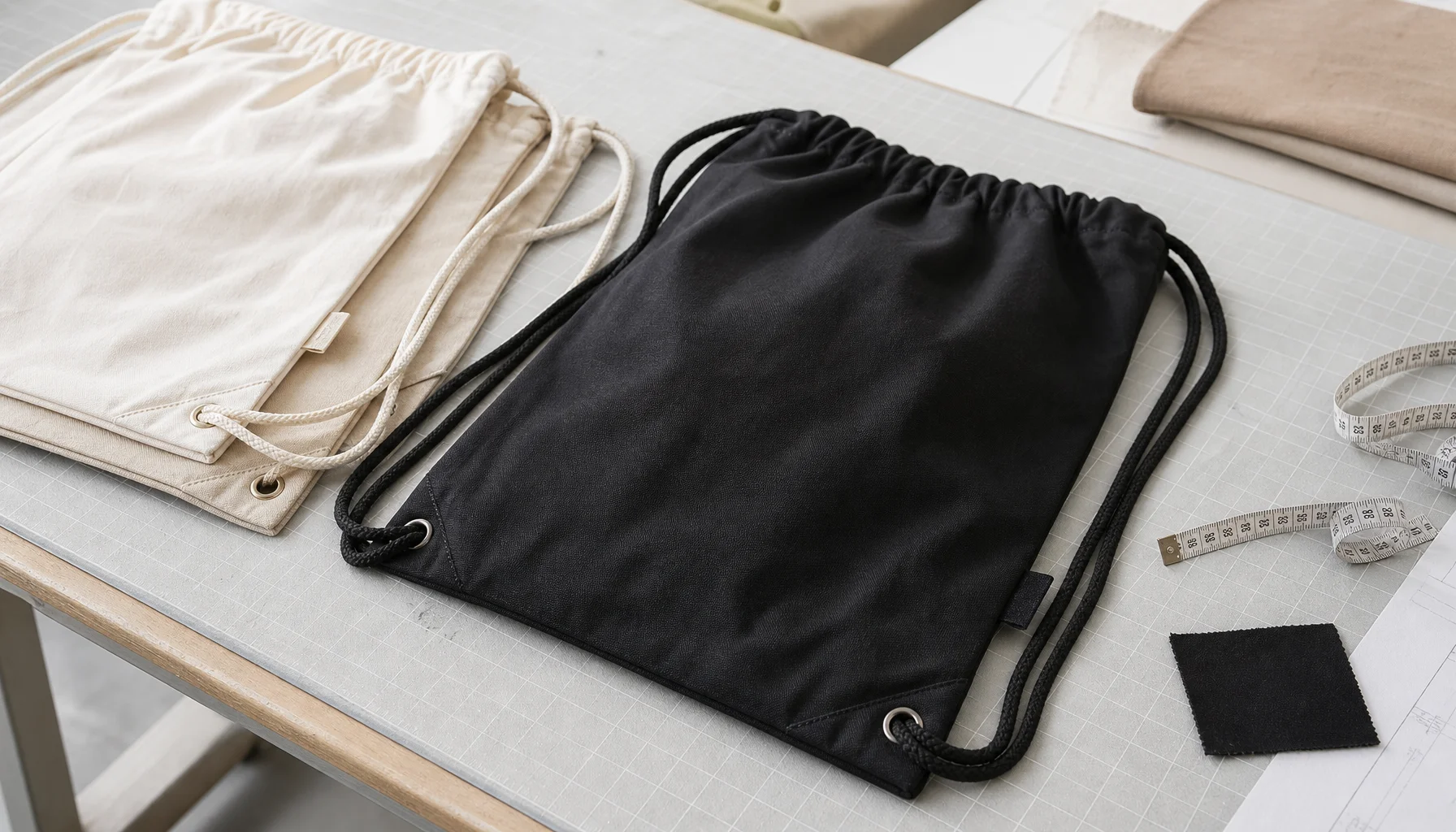
Start with the use case, not the unit price
Custom cotton drawstring backpacks can look simple on a quote sheet, but procurement risk starts when the bag is treated as a generic commodity. A cotton backpack used as a one-day event giveaway does not need the same fabric, cord, reinforcement, or print durability as a retail accessory packed with a hoodie or a shoe launch kit. Before comparing suppliers, define what the bag must carry, how long it should last, and how visible the branding will be when the customer receives it.
For eco apparel brands, the bag often does two jobs at once. It protects or presents the product, and it communicates a lower-impact brand direction through material choice, packaging format, and visual restraint. That means a slightly cheaper spec can create an expensive brand problem if the cotton feels too thin, the print cracks, the drawcord frays, or the carton arrives with inconsistent folding. A strong RFQ makes those expectations measurable so every supplier is quoting the same product.
A good procurement brief should say whether the order is for retail sale, packaging, events, subscription boxes, wholesale distribution, or internal brand merch. It should also state the intended contents: one T-shirt is different from denim, shoes, catalogs, bottles, or a multi-item kit. Once the use case is clear, the fabric weight, reinforcement, print method, packing, and inspection level become easier to choose.
- For a light apparel insert, prioritize clean appearance, consistent print, and efficient packing.
- For retail or resale, prioritize heavier fabric, better folding, accurate barcode or hangtag handling, and lower visible defect tolerance.
- For shoes, denim, catalogs, or event kits, prioritize seam strength, cord durability, and bottom-corner reinforcement.
- For an eco apparel program, define which packaging materials are allowed before the supplier quotes polybags by default.
Specify cotton fabric in language a factory can price
The phrase cotton drawstring backpack is not enough for a reliable quote. Cotton fabric can vary by GSM, weave, yarn quality, color treatment, finishing, and shrinkage behavior. A 120 GSM plain cotton bag may be appropriate for a light promotional program, while a 180 GSM cotton canvas-like fabric gives a firmer structure and better perceived value. The buyer should decide this before collecting final pricing, because fabric weight affects material cost, sewing behavior, print stability, carton weight, and freight cost.
GSM should be written as a target with an allowable tolerance, not as a loose descriptor. If you request 160 GSM cotton, ask whether the number refers to finished fabric and whether the supplier can verify it from the material roll used for the order. Some suppliers use terms like canvas, premium cotton, or heavy cotton without a consistent measurement. Those words are useful for marketing, but procurement needs numbers.
Color is also part of the fabric specification. Natural cotton may show seed flecks, small slubs, and warmer shade variation. That can be desirable for an eco apparel brand, but it should be described clearly so inspectors do not reject normal natural texture while accepting true defects such as oil stains, holes, dirt, or weaving contamination. Bleached white cotton gives cleaner logo contrast but may feel less natural. Dyed cotton can match a collection palette, but it introduces lab dip approval, bulk shade tolerance, and possible dye lot variation.
- 120-140 GSM: suitable for light giveaways, low-fill apparel packing, and cost-sensitive event orders.
- 150-160 GSM: useful middle range when the bag needs better body without moving into heavy canvas pricing.
- 170-200 GSM: stronger option for retail programs, footwear, denim, catalogs, and repeated customer use.
- Natural cotton: approve a shade range and texture expectation, especially if multiple production lots are possible.
- Dyed cotton: request lab dip approval, bulk shade approval, and carton-level shade checks during inspection.
Build the construction spec around stress points
Most failures on cotton drawstring backpacks happen at predictable stress points: the top cord channel, side seams, bottom corners, and any place where cord tension concentrates. A bag can look clean in a flat product photo but fail when it is filled, pulled closed, and carried repeatedly. That is why construction details belong in the RFQ, not only in the inspection report after goods are finished.
The top channel should be folded cleanly and wide enough for the selected cord to move without snagging. If the fold is too narrow, the cord drags and the customer has to pull harder, which stresses the stitches. If the seam tension is uneven, the top edge can twist or pucker. Side seams should be straight and secure, with enough seam allowance to prevent fraying from working out of the stitch line. Bottom corners need special attention when the bag will carry shoes, denim, or heavier merchandise because the load settles there during use.
Cord choice should match both brand feel and performance. Cotton rope cord supports a natural look and softer handfeel, but buyers should check fraying, stretching, and knot security. Braided polyester cord may not feel as natural, but it often performs better in repeated pulling or abrasive use. If metal eyelets are used, inspect finish and burrs; if the cord runs through a sewn channel only, inspect the channel strength and opening quality. The construction spec should leave no doubt about how the bag is meant to close and carry.
- Check that the cord channel has enough width for smooth movement after washing, folding, and packing compression.
- Require reinforcement or bar-tacks where the cord load concentrates, especially on heavier-use bags.
- Set a minimum stitch density expectation and reject skipped stitches, broken stitches, loose seams, and open corners.
- Confirm whether loose thread trimming is included before packing, because thread ends can make an otherwise acceptable bag look unfinished.
- Pull both cords together several times during sample review and bulk inspection to reveal twisting, snagging, and weak channel stitching.
Choose a branding method that matches the artwork and cotton surface
Print defects are one of the most visible problems on custom cotton drawstring backpacks. The buyer may approve perfect vector artwork, but the final result still depends on cotton texture, ink choice, fabric color, registration, curing, and folding after print. For simple one- to three-color logos, screen printing is usually the practical route because it is repeatable and cost-effective at bulk quantities. For detailed artwork, gradients, small runs, or photo-like graphics, heat transfer or digital print may be more suitable, but those methods need stronger durability checks.
Eco apparel brands often prefer a restrained logo, such as a small front print, side label, woven label, or cotton patch. That can reduce the visual risk of a large print defect, but it does not remove the need for placement control. A side label sewn crookedly or a patch with uneven stitching can look just as careless as a misprinted logo. The RFQ should include logo dimensions, position from top and side edges, Pantone or brand color references, and allowable placement tolerance.
Always request a print sample or strike-off on the actual fabric color when brand color matters. Natural cotton can mute ink; dyed cotton can shift perceived color; heavier weave can create uneven edges if the ink deposit is not controlled. Inspect print under normal daylight and indoor light, then rub the surface with a clean cloth to check transfer risk. If the bag will be folded with the print touching another surface, confirm the ink is fully cured before packing to reduce blocking or ink transfer.
- Screen print: best for simple spot-color logos, repeat programs, and larger orders with stable artwork.
- Heat transfer: useful for detailed artwork or smaller runs, but inspect cracking, edge lifting, handfeel, and heat marks.
- Digital print: useful for complex graphics, but check color density and fabric show-through on cotton texture.
- Woven label or side label: premium and subtle, but inspect stitching, placement, label fray, and color consistency.
- Patch branding: strong visual presence, but confirm patch edge finish, stitch quality, and added weight on lighter fabrics.
Compare quotes by total production reality
A low unit price can be misleading when quote details are incomplete. One supplier may include screen setup, sample cost, packing, and carton marks, while another lists only the sewn bag and adds charges later. For B2B buyers, the goal is not to find the shortest quote; it is to identify the most complete and comparable quote. Every quote should separate the recurring unit cost from one-time charges and should clarify which costs change if the order repeats.
MOQ also needs careful reading. A supplier may offer a low MOQ for stock natural cotton and one-color screen print, but require a higher MOQ for custom dye, woven labels, special cord, heavy GSM, or retail packaging. If the order has three bag colors or several logo versions, ask whether the MOQ applies to the whole order or to each color and artwork. This is especially important for eco apparel brands running capsule collections, regional activations, or multi-SKU retail programs.
Freight planning is part of quote comparison too. Heavier GSM, individual packing, insert cards, and looser folding can increase carton volume and shipping cost. A quote that looks cheaper at the factory gate may not be cheaper landed if carton count, gross weight, or packing method changes. Ask for estimated carton dimensions and weight before final supplier selection so procurement, logistics, and finance are working from the same numbers.
- Compare fabric, GSM, size, cord, print method, label method, packing, and inspection scope line by line.
- Ask which charges are one-time setup costs and which will repeat on reorder.
- Confirm whether sample cost is refundable, credited, or separate from production pricing.
- Check whether the quoted MOQ is per order, per color, per print design, per fabric type, or per packing style.
- Request carton dimensions, pieces per carton, gross weight, and net weight before approving the final landed-cost estimate.
Make sample approval a functional test
A pre-production sample should not be approved only because the logo looks attractive in a photo. It should prove that the final materials, construction, print, and packing can be produced consistently. Ask the supplier to make the sample with the same fabric GSM, color, cord, stitch method, label, print process, and folding method planned for bulk. If substitutions are unavoidable at sample stage, record them clearly and require approval of the final item before mass production starts.
Sample review should include measurement, visual inspection, handfeel review, and a simple functional test. Measure width, height, gusset if any, cord length, print size, print position, and label position. Fill the bag with a realistic load based on the use case, close and open it several times, then inspect the cord channel, side seams, bottom corners, and print surface. If the bag twists, puckers, snags, or distorts under expected use, the construction should be corrected before bulk cutting.
The approved sample should become the control sample. Sign and date it, photograph it from multiple angles, and record the version of artwork and packing instructions attached to it. Keep one control sample with the buyer and one with the supplier if possible. This shared reference reduces arguments later because inspection can compare bulk goods to a documented standard instead of relying on memory or email descriptions.
- Approve physical samples, not only renderings or factory photos, when the order is brand-sensitive or retail-facing.
- Use final fabric and final print method for the sample whenever color, texture, or ink behavior matters.
- Test closure movement by opening and closing the bag repeatedly before approving bulk production.
- Check whether the printed panel creases, rubs, or transfers after the proposed fold method.
- Do not approve bulk cutting until sample differences, artwork version, tolerances, and packing rules are documented.
Use a bulk inspection checklist with defect levels
A practical quality inspection checklist for custom cotton drawstring backpacks should separate critical, major, and minor issues. Critical defects are problems that make the product unsafe, unusable, or legally risky, such as sharp metal burrs, mold, severe contamination, or incorrect required labeling. Major defects affect function or brand presentation, such as broken seams, crooked logos, wrong fabric, poor print adhesion, wrong SKU labels, or off-size bags beyond tolerance. Minor defects may include trim-level loose threads or small natural texture variation that does not affect function or appearance beyond the agreed standard.
Inspection should start with carton selection across the shipment, not just the easiest cartons near the door. Pull samples from different cartons, colorways, and production lots if possible. First confirm quantity, SKU, carton marks, and packing method, then move to product-level checks: size, fabric, sewing, cord function, print, label, odor, stains, and folding. If defects cluster in one carton or one color, expand the inspection for that batch instead of treating the whole order as uniform.
For measurement, define tolerances before the order is made. Cotton sewing can have reasonable variation, but procurement teams should agree what is acceptable. For example, a small size variance may be acceptable on a promotional bag, while print placement drift on a retail-facing product may not be. The inspection report should include photos, defect counts, carton numbers, and pass or fail recommendations tied to the original specification.
- Critical defects: sharp edges, mold, severe contamination, prohibited materials, or required compliance label errors.
- Major defects: broken seams, wrong GSM, wrong color outside tolerance, incorrect logo, print cracking, missing labels, failed cord function, or wrong carton count.
- Minor defects: small loose threads, slight natural cotton slubs, minor shade texture within the approved range, or trim issues that can be corrected quickly.
- Measurement checks: width, height, gusset, cord length, print size, print position, label placement, and carton quantity.
- Function checks: repeated open-close test, light load test, knot security, channel movement, and bottom-corner stress review.
Inspect fabric, stitching, print, and packing in the right order
The order of inspection matters because it helps the buyer find root causes faster. Start with cartons and packing because wrong carton labels, mixed SKUs, moisture exposure, or poor folding can affect the whole shipment. Then inspect fabric panels before focusing on sewing, because stains, shade variation, holes, or weaving defects may appear across many units from the same fabric lot. After that, review stitching, cord movement, print quality, labels, and final presentation.
For fabric inspection, distinguish natural characteristics from defects. Seed flecks and mild slub variation can be normal on natural cotton, especially for eco-positioned products. Oil marks, dirt, mold, foreign fibers, strong odor, holes, and thin areas are not acceptable unless the buyer has explicitly allowed a rustic look with a defined tolerance. For dyed cotton, check shade consistency between front and back panels and between units from different cartons.
For stitching, look beyond one seam. Inspect the top channel, side seams, bottom seam, reinforcement, stitch tension, and thread trimming. For print, check opacity, edge sharpness, color consistency, placement, curing, cracking, peeling, and ink transfer. For packing, confirm fold direction, inner quantity, carton count, barcode or hangtag accuracy, carton marks, and moisture protection. The best inspections are specific enough that rework instructions are obvious.
- Carton first: carton marks, SKU mix, moisture, odor, compression, carton count, and inner packing quantity.
- Fabric second: GSM, shade, weave, stains, holes, contamination, slubs, and panel matching.
- Construction third: side seams, bottom corners, top channel, stitch density, skipped stitches, bar-tacks, and thread trimming.
- Branding fourth: print color, position, registration, opacity, adhesion, rub resistance, label placement, and spelling.
- Presentation last: folding, hangtags, barcodes, inserts, polybag or paper wrap, and export carton condition.
Control packaging before it becomes a shipment problem
Packing is often treated as the final step, but it should be part of the RFQ because it affects cost, sustainability goals, freight, and customer presentation. Cotton drawstring backpacks can crease, absorb moisture, pick up odor, and show ink transfer if packed carelessly. A bulk-packed order for warehouse distribution may need only neat folding, inner bundling, carton liners, and accurate carton marks. A retail order may require individual packaging, hangtags, barcode labels, size or color stickers, and cleaner folding rules.
Eco apparel brands should decide early whether individual polybags are allowed. Some distribution channels require them for barcode scanning or product protection, while some brands prefer bulk packing, paper bands, glassine-style alternatives, or no individual packaging. The supplier should price the selected method clearly. Leaving packaging undecided until after sample approval often creates late charges, carton changes, and schedule pressure.
Carton specs should be practical rather than theoretical. Ask for carton dimensions, pieces per carton, gross weight, net weight, and the proposed fold method. Overpacked cartons can create permanent print creases and compression marks, especially on larger front logos. Underfilled cartons can collapse during transit. Moisture protection matters because cotton can hold odor or develop mildew risk if stored or shipped in damp conditions. The packing approval should cover both product presentation and export durability.
- Specify fold direction so printed panels are not sharply creased through the main logo area.
- State whether individual polybags are required, prohibited, or replaced with paper-based packaging.
- Confirm barcode content, hangtag position, insert card placement, and carton marks before production packing begins.
- Request photos of packed inner bundles and closed cartons before final inspection when the order is time-sensitive.
- Check carton compression, moisture protection, odor, and ink transfer during inspection, not after the shipment arrives.
Plan lead time around approvals and material decisions
Lead time depends less on the bag shape and more on the number of decisions that must be approved before production can move. Stock natural cotton, standard cord, and a one-color screen print can usually move faster than custom-dyed fabric, special cord, woven labels, complex artwork, or retail-ready packing. Buyers should ask suppliers to separate the schedule into artwork review, sampling, material preparation, printing, sewing, packing, inspection, and shipment readiness.
The most common schedule slips happen at artwork approval, sample corrections, and print setup. If the logo file is low resolution, the Pantone reference is missing, or the buyer changes print size after the sample, production can pause. If the sample uses substitute fabric or substitute cord, another approval step may be required before bulk. If the supplier outsources printing or labeling, the schedule should include transfer time and queue time, not only sewing time.
MOQ and lead time are linked. Low MOQ is easier when all materials are in stock, but custom fabric colors, special GSM, or bespoke labels may require fabric mill minimums or label production minimums. A supplier who says every MOQ is flexible may still be making substitutions behind the scenes. Procurement teams should ask what changes if the order quantity increases, repeats, or splits across multiple colors.
- Fastest path: stock fabric, standard cord, simple logo, standard folding, and bulk packing.
- Slower path: custom dye, special GSM, woven labels, complex print, retail packing, and multiple SKU versions.
- Freeze artwork before sample approval so print screens, transfers, or digital files do not change midstream.
- Ask when bulk cutting begins, because changes after cutting can create waste, rework, or schedule conflict.
- Build inspection and rework time into the delivery plan instead of assuming goods can ship the same day they are packed.
Specification comparison for buyers
| Spec decision | Recommended option | When it fits | Buyer risk to check |
|---|---|---|---|
| Fabric weight | 120-140 GSM cotton for light promotional use; 160-200 GSM cotton or cotton canvas for retail, shoes, kits, and repeated use | Use lighter cloth for giveaways, apparel packaging, or low-fill event programs; use heavier cloth when the bag must carry garments, footwear, notebooks, catalogs, or daily items | Thin fabric can look acceptable in one sample but collapse, pucker, or tear in bulk. Confirm actual GSM, finished weight tolerance, shrinkage expectation, and whether the supplier is quoting greige, washed, or finished fabric |
| Fabric color | Natural cotton for an undyed eco look; bleached white for cleaner print contrast; dyed cotton only with color tolerance agreed in advance | Natural and white suit many eco apparel brands; dyed colors fit retail collections or brand campaigns that need closer color matching | Natural cotton can vary from lot to lot, while dyed cotton can shift between lab dip and bulk. Approve a shade band and inspect panels from multiple cartons |
| Print method | Screen print for 1-3 spot colors; heat transfer or digital print for complex artwork; woven label, side label, or patch for premium minimal branding | Screen print works well for simple logos and repeat orders. Transfer or digital suits short runs and detailed graphics. Labels work when the bag should feel less promotional | Artwork can pass on a PDF but fail on textured cotton. Inspect ink opacity, registration, cracking, edge sharpness, rub resistance, and placement on the actual fabric color |
| Drawcord style | Cotton rope cord for a natural handfeel; braided polyester cord where abrasion resistance or stronger repeated pulling matters | Eco apparel brands often prefer cotton cord for consistency with the product story; sports, travel, or campus programs may need a stronger synthetic cord | Soft cords can fray, stretch, twist, or cut into the channel. Pull-test both cords together, check knot security, and inspect the cord channel after repeated opening and closing |
| Construction reinforcement | Double-fold top channel, clean side seams, reinforced bottom corners, and bar-tacks where the cord load concentrates | Useful for bags expected to carry shoes, denim, hoodies, product kits, catalogs, or retail merchandise | Weak channel stitching causes puckering, uneven closure, and early failure. Inspect stitch density, seam allowance, skipped stitches, loose threads, and corner reinforcement |
| Supplier route | Factory or trading partner that can document fabric sourcing, printing, sewing, packing, and QC photos for the actual order | Best for procurement teams that need repeatability, audit trails, and predictable quality across reorders | Lead times slip when printing or packing is subcontracted without clear ownership. Confirm who handles each production stage and who signs off final inspection |
| MOQ logic | Low MOQ for stock natural fabric and simple one-color print; higher MOQ for custom dye, special GSM, custom cord, woven labels, or retail-ready packaging | Works for test orders, capsule drops, regional events, and phased buying when the spec uses available materials | A low MOQ quote may hide setup fees, limited fabric choices, or expensive packing. Compare total landed cost, not only unit price |
| Packing method | Bulk pack with fixed fold method and carton count; individual polybag, paper band, hangtag, barcode, or insert only when the sales channel requires it | Bulk packing suits apparel fulfillment, distributors, and promotional channels; retail needs cleaner presentation, scanning accuracy, and carton labeling | Loose folding can crease printed panels, while over-compression can mark ink. Polybags add cost and may conflict with eco packaging standards |
| Inspection plan | AQL-style visual and functional inspection covering size, fabric, print, seams, cords, labels, packing, and carton count | Best for branded programs, first orders, repeat orders after a supplier change, or shipments with multiple colors or SKUs | A sample approval alone does not protect bulk quality. Define major and minor defects, measurement tolerances, shade limits, and rework rules before production |
Buyer checklist before sampling
- Define the use case first: giveaway, apparel packaging, retail accessory, footwear bag, event kit, or daily carry item.
- Confirm finished bag size, usable loading weight, gusset requirements, drawcord length, and whether the bag must fit boxed or folded products.
- Specify fabric composition, GSM, weave, color, finishing treatment, shrinkage expectation, and acceptable shade variation.
- State whether natural cotton slubs are acceptable and separate normal texture variation from rejectable holes, stains, contamination, or thin spots.
- Send vector artwork with logo size, print position, Pantone or brand color references, and a note on whether slight fabric-show-through is acceptable.
- Choose the print method before pricing: screen print, transfer, digital print, woven label, patch, or side label.
- Ask for a physical pre-production sample made with final fabric, final cord, final print method, and final packing method where possible.
- Set measurement tolerances for width, height, cord length, print placement, label placement, and carton quantity before issuing the purchase order.
- Agree inner packing, fold direction, carton marks, barcode rules, moisture protection, and whether plastic packaging is allowed.
- Record bulk inspection checkpoints for fabric defects, stitching, print adhesion, cord function, stains, odor, quantity count, and carton labeling.
Factory quote questions to send
- What is the exact fabric composition, GSM, weave, and finish, and is the GSM measured before or after finishing?
- Is the cotton natural, bleached, dyed, recycled, organic, or conventional, and what documentation can be provided if a sustainability claim is required?
- What finished size tolerance do you quote for width, height, gusset, cord length, and print placement?
- Which print method will be used, and what are the setup fees, screen charges, transfer charges, plate charges, or minimum artwork fees?
- Can you print on the exact fabric color requested, and will you provide a strike-off or pre-production print sample before bulk printing?
- What is the MOQ by fabric color, print design, cord type, label type, and packaging method?
- Where will fabric cutting, sewing, printing, labeling, packing, and final inspection be done, and which steps are outsourced?
- What is your standard sample approval sequence, and at what point does bulk cutting or bulk printing begin?
- What inspection standard do you use for visual defects, measurement tolerance, print defects, and carton count?
- What carton dimensions, pieces per carton, gross weight, net weight, and shipment marks should we use for freight planning?
Quality-control points to confirm
- Measure finished bag width, height, gusset depth, cord length, and print placement against the approved specification and tolerance band.
- Verify fabric GSM, handfeel, weave consistency, panel shade, shrinkage expectation, and any visible slubs, holes, thin spots, stains, or foreign fibers.
- Inspect side seams, bottom seams, top channel folding, stitch density, seam allowance, skipped stitches, broken stitches, loose thread trimming, and reinforcement at stress points.
- Check drawcord material, cord diameter, cord length balance, knot security, channel movement, eyelet or channel finish, and smooth opening and closing after repeated pulls.
- Review print color, opacity, registration, edge sharpness, position, scale, ink coverage, fabric show-through, cracking, peeling, and dry or wet rub resistance when applicable.
- Confirm woven labels, side labels, patches, hangtags, care labels, and barcode labels match the approved artwork, placement, spelling, and SKU information.
- Check odor, moisture, mold risk, oil marks, chalk marks, machine dirt, needle damage, and ink transfer between stacked or folded bags.
- Verify inner pack quantity, folding method, polybag or paper packaging requirements, carton count, carton marks, gross weight, net weight, and barcode accuracy.
- Separate critical, major, and minor defects so the supplier knows which issues require rejection, rework, discount discussion, or simple trimming before shipment.
- Photograph defects by carton, SKU, and production lot so any corrective action can be traced to the affected batch.