Why Proofing Matters for University Bookstores
Custom cotton drawstring backpacks look simple at first glance. They are soft, lightweight, and easy to decorate. For a university bookstore buyer, however, they carry more risk than a generic giveaway bag. The backpack may display an official university wordmark, athletics logo, mascot, bookstore private-label mark, orientation campaign, alumni event message, or department name. If the logo color is off, the trademark detail is blurred, the barcode does not scan, or the carton sort is wrong, the issue can quickly move from a small product defect to rejected inventory, delayed receiving, or a missed campus event date.
A proofing checklist turns a visual idea into factory instructions. It should not stop at artwork approval. It should define finished size, cotton weight, fabric finish, Pantone target, print size, print placement, cord construction, reinforcement, folding, retail packing, carton marks, lead time, and final inspection criteria. Those details make supplier quotes easier to compare and give the inspector a clear basis for acceptance. Without them, the buyer is left debating opinions such as "the fabric feels thin" or "the logo looks too high."
University bookstore orders also involve several internal stakeholders. Merchandising wants a bag that looks credible on a shelf or peg. Procurement needs comparable pricing and predictable lead time. Licensing or brand teams need the approved mark used correctly. Receiving teams need carton marks, SKU separation, and barcode scanability. Sustainability teams may question polybags, recycled-content statements, or packing waste. A proof that only confirms a flat digital layout does not protect the order through retail handling, scan-in, campus distribution, and final sale.
- Use one proof package covering fabric, artwork, cord, construction, folding, retail packing, and carton marks.
- Treat licensed university marks as controlled retail decoration, not casual promotional printing.
- Write measurable tolerances for size, GSM, color, print placement, registration, and carton quantity before bulk production.
- Keep one approved sample, strike-off, or dated photo set for supplier, buyer, inspector, and receiving team alignment.
- Require written supplier acknowledgment for every approval comment, especially logo movement, Pantone changes, cord substitutions, and barcode placement.
Define the Bag Before Artwork Approval
Start the RFQ with the finished backpack, not the mockup. Common finished sizes for university bookstore cotton drawstring backpacks include about 34 x 42 cm, 36 x 43 cm, and 38 x 45 cm. A smaller size can work for admissions handouts, campus maps, coupons, and light literature. A larger size is better when the bookstore expects students to carry sweatshirts, notebooks, bottles, or bundled orientation items. The specification should say whether dimensions are measured flat after sewing, after washing, or after final pressing.
For most sewn cotton drawstring backpacks, +/- 10 mm is a practical finished-size tolerance. Tighter control can be requested for retail display, online photography, or uniform folding, but it should be discussed before quoting. Cotton panels can shift during cutting, sewing, drawcord-channel forming, washing, and pressing. If the bag must fit a specific kit insert, folded garment, or mailer, provide the item dimensions and target packing method so the supplier is not guessing at usable capacity.
The print area needs the same attention. A 24 cm wide logo on a 34 cm wide bag may leave less side clearance than the mockup suggests once seam allowance, panel curve, and fabric movement are considered. A logo placed near the drawcord channel may crease when the top is pulled closed. A logo placed too low can disappear when the bag is folded for a shelf bin. Review the bag flat, folded, hung, and lightly filled if those presentations matter to the bookstore.
- State finished width x height after sewing, with measurement tolerance and measurement location.
- Match the size to the real load: literature pack, apparel bundle, water bottle, notebook, or retail display item.
- Confirm usable print area after seam allowance, channel height, and bottom corner reinforcement are considered.
- Review the bag flat, folded, hung, and lightly filled when the bookstore will merchandise it in more than one format.
- Do not approve an artwork mockup until the finished bag size and print area are locked.
Specify Cotton Weight and Finish
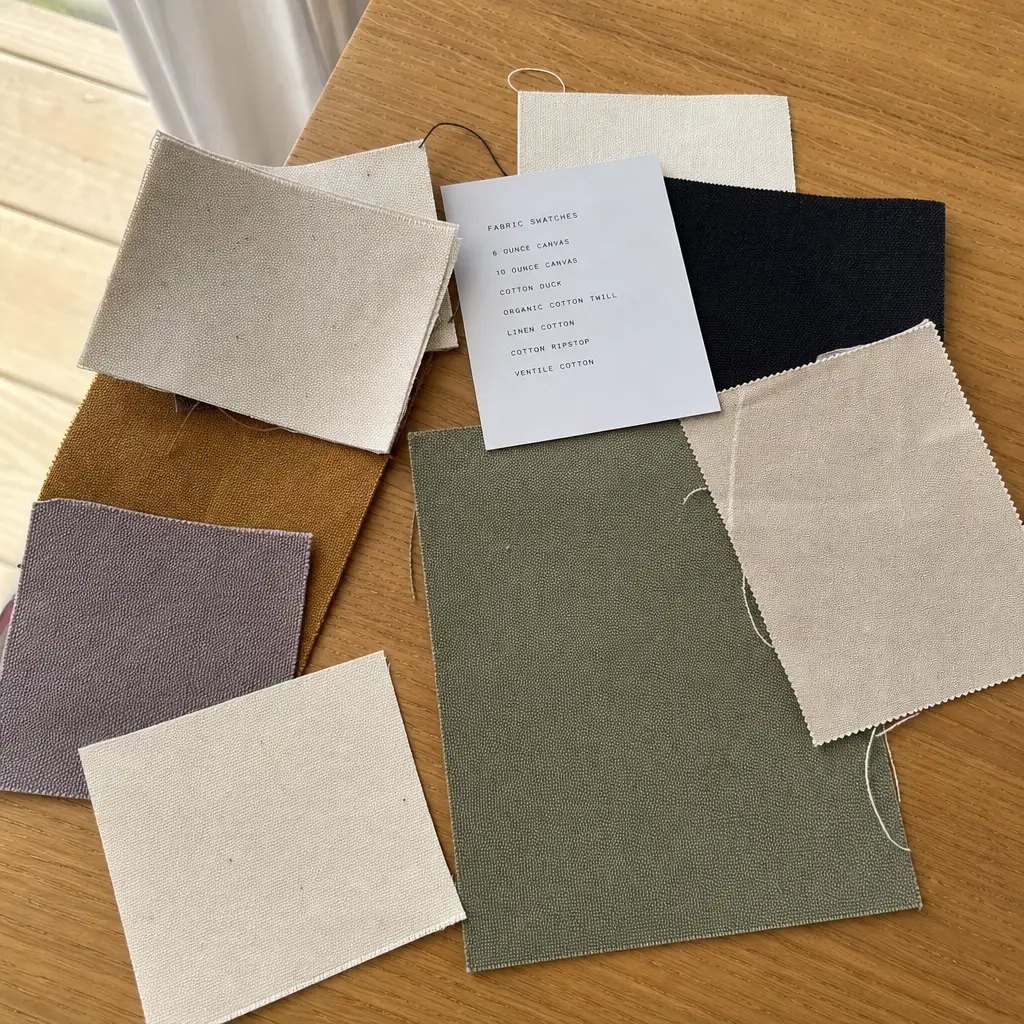
Fabric weight is one of the biggest cost and quality variables in custom cotton drawstring backpacks. Lightweight 5 oz to 6 oz cotton may be acceptable for a one-day giveaway where the expected load is low and resale presentation is not the priority. For university bookstore resale, welcome kits, and repeated student use, 8 oz to 10 oz cotton canvas is usually a stronger starting point. As a practical reference, 8 oz cotton canvas is often around 270 GSM and 10 oz is often around 340 GSM, although the exact number depends on weave, finishing, and the supplier's measurement method.
The purchase order should include both the commercial weight and a measurable GSM tolerance. A useful format is: 100% cotton canvas, 10 oz, approximately 340 GSM, +/- 5%, natural color, same as approved swatch. That is much clearer than "heavy cotton" or "premium canvas." If recycled cotton, organic cotton, or a blended yarn is requested, ask what documentation is available and avoid unsupported marketing language unless the certification scope and transaction documents match the order.
Natural cotton is not perfectly blank. Seed flecks, small slubs, and off-white shade differences are normal unless the buyer requests bleached or dyed cotton. Bleached cotton gives a cleaner logo background but may show dirt more easily. Dyed cotton supports school-color assortments, but it adds lab dips, dye-lot control, shade bands, and colorfastness checks. Washed cotton can feel softer and more casual, but it may shrink or twist. These choices affect print color, finished size, odor, lead time, and inspection standards, so they should be settled before cutting.
- Use oz and GSM together; include a tolerance such as +/- 5% for inspection.
- Approve natural cotton characteristics in advance: seed flecks, slubs, shade variation, and minor weave irregularity.
- Request lab dip or swatch approval for dyed cotton and define acceptable shade variation against the approved standard.
- Confirm shrinkage expectations when washed cotton or garment-washed finishing is requested.
- Avoid vague specs such as "premium cotton" unless fabric weight, weave, finish, and testable tolerance are included.
Choose the Print Method by Risk
Screen printing is often the most predictable decoration method for one-color to four-color university logos on cotton canvas. It works well for vector wordmarks, department names, bookstore logos, and solid athletics marks. With the right ink system, mesh count, squeegee pressure, and curing conditions, screen print can give strong opacity and good durability on cotton. Still, textured canvas can soften fine details, so minimum line width and small text should be reviewed at actual production size.
A practical minimum line-width target for screen printing on cotton canvas is often around 0.3 mm, but the right standard depends on fabric texture, print size, ink type, and factory capability. Trademark symbols, legal lines, mascot details, shield outlines, and thin serif type need extra scrutiny. Multi-color screen printing also needs a registration tolerance. For many soft-goods orders, +/- 1 mm registration is a reasonable discussion point, but the supplier must confirm what it can hold on the selected fabric and artwork.
Heat transfer is useful for gradients, full-color art, photographic graphics, and many small logo versions where screen setup would be inefficient. The tradeoff is different risk. Transfer film can feel heavier, show an edge, crack over folds, or lift at corners if film quality, press temperature, pressure, and dwell time are not controlled. Digital printing may also be an option for complex art, but the buyer should verify pretreatment, opacity on natural cotton, hand feel, rub resistance, and production consistency. The approved proof must use the same print process planned for bulk.
- Use screen print for solid spot-color logos, larger runs, and artwork requiring stable Pantone control.
- Use heat transfer for gradients, full-color graphics, many small SKUs, or low quantities where screen charges are inefficient.
- Set minimum line width, minimum text height, registration tolerance, and opacity expectations before screens or transfers are made.
- Ask whether Pantone matching is based on coated Pantone, uncoated Pantone, or an approved fabric strike-off.
- Reject process substitutions unless the supplier submits a new strike-off using the changed ink, film, or curing method.
Make Artwork and Placement Measurable
Good artwork saves time on both sides of the order. For screen printing, provide vector files such as AI, EPS, SVG, or editable PDF. Fonts should be outlined, strokes expanded, linked images embedded, and spot colors separated. A low-resolution JPG or PNG may look fine in email, then fall apart when enlarged to a 20-25 cm print on textured cotton. For official marks, the supplier should not redraw the logo unless the university brand office approves the redrawn file.
Placement should be written as measurements, not only shown in a digital mockup. A strong specification states the print size, such as 22 cm wide x proportional height, and the placement, such as centered left to right with the top of print 11 cm below the seam under the drawcord channel. The reference point should be a fixed seam or panel edge, not the loose drawcord. For retail-grade orders, +/- 5 mm logo-position tolerance is a practical target to request. For lower-cost giveaways, +/- 8 mm may be acceptable if the buyer agrees before production.
Tilt tolerance is easy to overlook until finished goods arrive. Soft cotton panels can shift during loading on the print table, and a block university wordmark makes even a small tilt noticeable. Define whether measurement is taken from the top of the print, the baseline of the text, or the artwork bounding box. For multi-color marks, include registration tolerance and identify the visual priority color, especially when the artwork includes a mascot outline, seal, or shield.
- Provide vector artwork with fonts outlined, strokes expanded, and spot colors separated.
- Name files with logo version and approval date to avoid outdated campus marks entering production.
- Define print size in centimeters or inches, not only as a percentage of the front panel.
- Measure placement from fixed seams or panel edges; avoid drawcord-based reference points.
- Set tolerance for position, tilt, registration, opacity, and readable small text before output approval.
Use Samples to Prove Bulk Conditions
A digital proof has a place. It confirms layout, spelling, logo scale, and approval routing. It does not prove cotton absorption, ink opacity, hand feel, transfer edge, fabric slubs, drawcord thickness, seam strength, fold creasing, barcode scan position, or carton presentation. For university bookstore procurement, the sample level should match the order risk. A low-cost internal giveaway may not need the same control as a licensed resale item shipping to several campus locations.
A printed strike-off on the actual fabric is the minimum control when logo color and print quality matter. It shows whether the selected Pantone shifts on natural or dyed cotton, whether fine details hold, and whether the ink deposit is acceptable. A full pre-production sample goes further. It proves the complete product: final fabric, final size, final cord, final stitch construction, final logo placement, final folding, final hang tag or barcode, and final packing method.
Approval comments should read like instructions. "Move logo 10 mm lower," "increase print width from 20 cm to 22 cm," "use Pantone 289 C for navy," and "place barcode on paper belly band back panel" are production-ready notes. "Looks better" is not. If a revision changes fabric, ink, screens, transfer film, packing material, or carton marks, the supplier should confirm whether price, sampling time, or bulk lead time changes.
- Use digital proof for layout and spelling only; do not rely on it for color or production quality.
- Use strike-off approval for Pantone match, opacity, line quality, rub performance, and hand feel.
- Use full pre-production samples for licensed marks, new suppliers, retail packing, barcode labels, or multi-SKU sorting.
- Retain one approved sample or dated photo set as the inspection standard.
- Release bulk only after every sample comment is acknowledged and closed in writing.
Compare Quotes With SKU-Level Detail
Quote gaps often come from hidden spec differences. One supplier may price 6 oz natural cotton, one-color screen print, thin cord, and bulk packing. Another may price 10 oz dyed cotton, two-color print, reinforced corners, barcode labels, and inner cartons. The cheaper quote may simply exclude the requirements the bookstore assumed were included. A complete RFQ forces each supplier to price the same construction, print, proofing, packing, and logistics assumptions.
Ask suppliers to separate unit price from setup costs. Screen charges, film output, color separation, ink mixing, transfer setup, pre-production samples, courier fees, barcode labels, hang tags, and packing labor should not disappear into vague totals. This is especially important for campus programs with multiple departments. A 5,000-piece order can behave like ten 500-piece SKUs if each department has a different logo, barcode, carton mark, or delivery location.
Landed cost needs early carton data. Cotton backpacks can pack tightly in bulk, but individual polybags, paper bands, hang tags, and inner cartons increase carton volume, material cost, and inspection time. A useful quote includes pieces per carton, carton dimensions, gross weight, net weight, total carton count, total CBM, trade term, and freight assumptions. Without that information, procurement cannot responsibly compare EXW, FOB, FCA, CIF, DDP, courier, or domestic delivery offers.
- Require suppliers to list deviations from the RFQ instead of silently substituting lighter fabric, thinner cord, or simpler packing.
- Separate unit price from screens, setup, samples, courier, labels, hang tags, and packing labor.
- Break pricing by SKU, logo, fabric color, print colorway, barcode, packing method, and destination sort.
- Request carton dimensions, weight, count, and CBM with the first formal quote.
- Compare trade terms carefully; EXW, FOB, FCA, CIF, DDP, and courier quotes are not equivalent.
Control MOQ Across Campus Programs
A supplier's advertised MOQ is rarely the only minimum that matters. Practical MOQ may be driven by fabric availability, dye-lot minimum, cord color, screen setup, print colorway, label printing, packing method, carton sorting, and sewing-line efficiency. Natural cotton in a standard weight may be available at lower quantities. Custom dyed cotton or school-color cord can require higher minimums and more approval time.
University bookstore programs often combine demand from bookstore retail, first-year orientation, admissions tours, athletics promotions, alumni weekend, colleges, departments, and staff events. Combining volume can improve price and production efficiency, but only when the buyer standardizes what can be standardized. The same bag body, same fabric, same cord, same print size, and same packing method can reduce complexity even when the front logo changes.
Repeat orders deserve planning before the first PO closes. Ask whether screens are stored, how long artwork files remain active, whether repeat screen charges apply, and whether a new strike-off is required. If the repeat order uses natural cotton and the same ink, approval may be straightforward. If it uses dyed cotton, the bookstore may need a new shade approval because new fabric lots can differ from previous inventory.
- Request MOQ by fabric color, logo, print colorway, packing SKU, barcode, carton mark, and destination.
- Standardize bag body, cord, print size, and packing where campus departments can accept a common base specification.
- Treat custom dyed fabric and custom cord color as separate MOQ and lead-time drivers.
- Ask about screen storage, repeat setup fees, and repeat strike-off requirements before the first order is closed.
- Avoid too many fabric colors unless the bookstore can manage MOQ, shade approval, and inventory risk for each color.
Pack for Receiving and Retail Handling
Packing should be decided during sourcing, not after production. A drawstring backpack for orientation distribution may be bulk packed in clean export cartons. A resale item may need a hang tag, barcode sticker, paper belly band, individual polybag, inner carton, or store-level sort. Each option affects unit cost, labor, carton volume, inspection time, and receiving speed. If packing is added after sample approval, it can change both price and schedule.
Test barcode placement on the actual packaging. A barcode on a wrinkled polybag may scan poorly. A sticker placed directly on cotton may not adhere well or may leave residue. A paper belly band can support plastic-reduction goals, but the fold line must avoid creasing the printed logo. Hang tags need an approved attachment method, such as cord attachment, seam loop, or tag pin, and the buyer should confirm that the method is acceptable for retail handling.
Carton marks are a receiving control, not an afterthought. A useful carton mark includes PO number, SKU, product description, fabric color, logo version, quantity, carton number, destination, gross weight, net weight, and routing code if required. For split campus delivery, cartons should be sorted at origin by department, store, or program. Mixed cartons create receiving labor and increase the chance that the wrong location gets the wrong logo.
- Use bulk pack for internal distribution, kitting, and event handouts where individual retail handling is unnecessary.
- Use individual polybags only when protection, online fulfillment, or store procedure justifies added plastic, CBM, and labor.
- Use paper belly bands only after testing fold position, barcode readability, and logo-crease risk.
- Approve barcode format, label content, label location, hang tag attachment, and SKU sort before bulk packing.
- Require carton marks with PO, SKU, logo version, color, quantity, destination, carton count, and weight data.
Set Lead Time From Approval Milestones
The safest lead-time discussion starts with approval milestones, not a generic production promise. Factories usually count bulk production after artwork, fabric, deposit or payment terms, proof approval, packing approval, and production slot confirmation are complete. For university bookstores, a missed date can affect semester opening, orientation week, homecoming, alumni weekend, graduation, or a planned merchandise reset.
A realistic calendar separates artwork review, digital proof, strike-off, full sample, courier transit, internal brand approval, bulk fabric preparation, cutting, printing, curing, sewing, trimming, packing, inspection, export documentation, and freight. Dyed fabric adds lab dip review and bulk shade approval. Multi-SKU programs add barcode, carton mark, and sorting checks. Even a small Pantone or logo-size change can require new screens, ink mixing, transfer output, or sample confirmation.
Procurement should ask the supplier for two dates: the latest approval date required to meet the desired ship date, and the latest ship date required to meet the campus delivery date. If the deadline is fixed, decide early whether air freight is allowed, whether partial shipment is acceptable, and which SKUs have priority. Those decisions are much harder after final inspection, when the schedule buffer is already gone.
- Ask for artwork review time, strike-off time, sample time, bulk time after approval, inspection date, and ship date.
- Build internal approval time for bookstore, licensing, athletics, receiving, and sustainability stakeholders where relevant.
- Treat logo, Pantone, fabric, cord, barcode, and packing changes after proof approval as schedule-impacting revisions.
- Schedule final inspection before shipment release, especially for retail, licensed marks, and direct-campus delivery.
- Confirm partial shipment rules and freight upgrade authority before the event deadline becomes urgent.
Specification comparison for buyers
| Spec decision | Recommended option | When it fits | Buyer risk to check |
|---|---|---|---|
| Finished size and usable capacity | Specify finished width x height after sewing; a common university bookstore range is 34 x 42 cm to 38 x 45 cm, with +/- 10 mm size tolerance unless the PO calls for tighter control | Orientation kits, bookstore resale, admissions tours, alumni events, light apparel bundles, and notebook carry | A quote based only on a photo can hide undersized panels, narrow drawcord channels, weak corner stress points, or a bag that will not fold neatly for retail display |
| Fabric weight and construction | Use 8 oz to 10 oz cotton canvas, approximately 270-340 GSM depending on weave and finishing; specify composition, weave, finish, and GSM tolerance such as +/- 5% | Bookstore resale, welcome kits, repeated student use, and programs where print coverage and shelf presentation matter | 5 oz or 6 oz cotton may reduce unit cost but can feel promotional, show ink bleed-through, distort under cord tension, and provide a weaker retail hand feel |
| Fabric color and finish | Choose natural cotton for lower complexity; choose bleached, dyed, washed, or custom school color only with swatch or lab-dip approval and shade tolerance | Natural campus merchandise, private-label bookstore programs, school-color assortments, and branded event bags | Natural cotton includes seed flecks and slubs; dyed cotton adds dye-lot risk, crocking checks, shade bands, and possible longer MOQ and lead time |
| Print method for university logos | Screen print for 1-4 spot colors on vector artwork; heat transfer for gradients, photographic art, many small logo versions, or lower quantities | Solid wordmarks, department names, bookstore logos, athletics marks, full-color campaign art, and multi-SKU programs | Screen print can lose fine lines on coarse canvas; transfers can crack, lift, or feel heavy if film, pressure, temperature, or dwell time are not controlled |
| Proofing standard before bulk | Approve at least a printed strike-off on actual fabric; require a full pre-production sample for licensed marks, retail packing, new suppliers, or multi-color registration | Official university marks, bookstore resale, barcode packaging, direct-to-campus shipments, and repeat replenishment programs | Digital proofs do not verify ink absorption, opacity, hand feel, cord diameter, seam reinforcement, folding marks, barcode scan position, or carton-ready packing |
| Logo placement tolerance | State print size and placement from fixed seams; use +/- 5 mm for retail-grade logo placement and +/- 8 mm for lower-cost giveaway programs where acceptable | Folded retail presentation, peg display, online product photos, SKU sorting, and licensed logo approvals | Without a written tolerance, slightly shifted or tilted logos become subjective disputes even when the goods are commercially usable |
| Drawcord and reinforcement | Specify 6-8 mm cord, channel width, cord color, knot or tip finish, reinforced channel exits, and bar-tack or X-stitch reinforcement at lower corners | Bags expected to carry apparel, notebooks, water bottles, event kits, or repeat-use campus items | Thin cord lowers price but can cut into shoulders, abrade fabric exits, slip knots, or cause seam failure when students load the bag |
| MOQ and SKU logic | Request MOQ by fabric color, logo version, print colorway, packing style, barcode, carton mark, and destination sort instead of total quantity only | Programs combining bookstore, admissions, athletics, alumni, departments, and orientation offices | A headline MOQ can be misleading if each college logo needs separate screens, strike-offs, labels, packing, and carton segregation |
| Packing and receiving | Use bulk pack for internal distribution; use retail-ready pack with barcode, hang tag, paper band, or polybag only when receiving, scanning, or merchandising requires it | Bookstore POS receiving, online fulfillment, campus kits, department drops, and plastic-reduction initiatives | Individual packing increases labor, CBM, inspection time, and material cost; incorrect barcode placement or carton marks can delay receiving |
Buyer checklist before sampling
- Define the buying channel: bookstore resale, online fulfillment, orientation kit, admissions giveaway, alumni event, athletics promotion, department program, or mixed SKU order.
- State finished bag dimensions in width x height after sewing, measurement method, and tolerance; note whether dimensions are measured before or after washing for washed cotton styles.
- Specify fabric composition, weave, finish, color, weight in oz and approximate GSM, and GSM tolerance; require proof samples to use the same fabric class as bulk production.
- Clarify natural cotton acceptance criteria, including seed flecks, slubs, shade variation, odor, fabric holes, heavy creases, and whether bleached or dyed cotton is required for a cleaner retail look.
- Provide vector artwork in AI, EPS, SVG, or editable PDF; outline fonts, expand strokes, separate spot colors, and include the approved university logo revision date.
- List Pantone references, print method, print size, placement from seams, position tolerance, registration tolerance, opacity expectation, minimum line width, and minimum readable text size.
- Require a printed strike-off or full pre-production sample for licensed marks, mascot detail, fine text, multi-color registration, new fabric weights, barcode packing, or new suppliers.
- Break quantities by SKU, fabric color, cord color, logo version, print colorway, packing style, barcode, carton mark, and destination so suppliers quote the actual operating complexity.
- Specify drawcord material, diameter, color, knot or aglet/tip requirement, channel width, stitch density, and reinforcement at drawcord exits and bottom stress points.
- Confirm packing format: bulk pack, individual polybag, paper belly band, hang tag, barcode sticker, inner carton, assortment carton, department sort, store sort, or direct-to-campus carton mark.
Factory quote questions to send
- What finished size, size tolerance, fabric composition, weave, fabric finish, cotton weight in oz, approximate GSM, and GSM tolerance are included in the quoted unit price?
- Is the price based on natural greige-look cotton, bleached cotton, dyed cotton, washed cotton, stock fabric, or custom fabric, and will bulk fabric match the approved swatch lot?
- What shrinkage range should be expected for washed or dyed cotton, and are dimensions quoted before washing, after washing, or after final finishing?
- Which print method is included, how many print colors are priced, and are screen charges, film output, artwork separation, ink mixing, or transfer setup fees shown separately?
- What minimum line width, minimum text height, registration tolerance, print opacity standard, and Pantone tolerance can you hold on this fabric in mass production?
- What MOQ applies per fabric color, per logo, per print colorway, per packing style, per barcode SKU, per carton mark, and per destination sort?
- Will the pre-production sample use final fabric, final drawcord, final print method, final print size, final fold, final barcode label, and final carton packing method?
- What logo placement tolerance, tilt tolerance, multi-color registration tolerance, and print color tolerance are included as normal production standards?
- What are the artwork review lead time, strike-off lead time, full sample lead time, bulk lead time after approval, inspection date, and latest approval date for the required ship date?
- What drawcord diameter, material, colorfastness standard, knot/tip method, channel width, stitch density, and corner reinforcement are included?
Quality-control points to confirm
- Check fabric GSM with a GSM cutter and scale or approved fabric weight method against the purchase order tolerance, not only against a supplier description such as 8 oz or 10 oz.
- Compare fabric color, shade bands, seed flecks, slubs, stains, odor, and surface cleanliness against the approved swatch before printing starts; quarantine off-shade rolls before cutting.
- Measure finished bag width and height flat after sewing and finishing, with the drawcord relaxed; do not use cut panel measurements as final bag dimensions.
- Verify print color under consistent lighting against Pantone reference or approved strike-off, considering natural cotton background color and ink absorption.
- Measure logo position from fixed seams or panel edges, such as side seam, bottom edge, or seam below drawcord channel; do not judge only by visual center on a soft bag.
- For multi-color artwork, check registration drift, haloing, filled-in small text, blurred mascot detail, pinholes, sawtooth edges, ink smearing, and inconsistent ink deposit.
- Test print adhesion using tape pull, dry rub, light wet rub where relevant, and flexing over a fold; transfers should also be checked for edge lift and cracking.
- Pull drawcords repeatedly through both channels to check smooth movement, twisting, snagging, slipping knots, color transfer, and tearing at channel exits.
- Inspect bottom corners, side seams, and drawcord channel exits for reinforcement such as bar tacks, backstitching, or X-stitching where specified.
- Check stitch quality for skipped stitches, broken thread, loose thread ends, needle holes, seam puckering, incorrect stitch density, and weak backtacks.