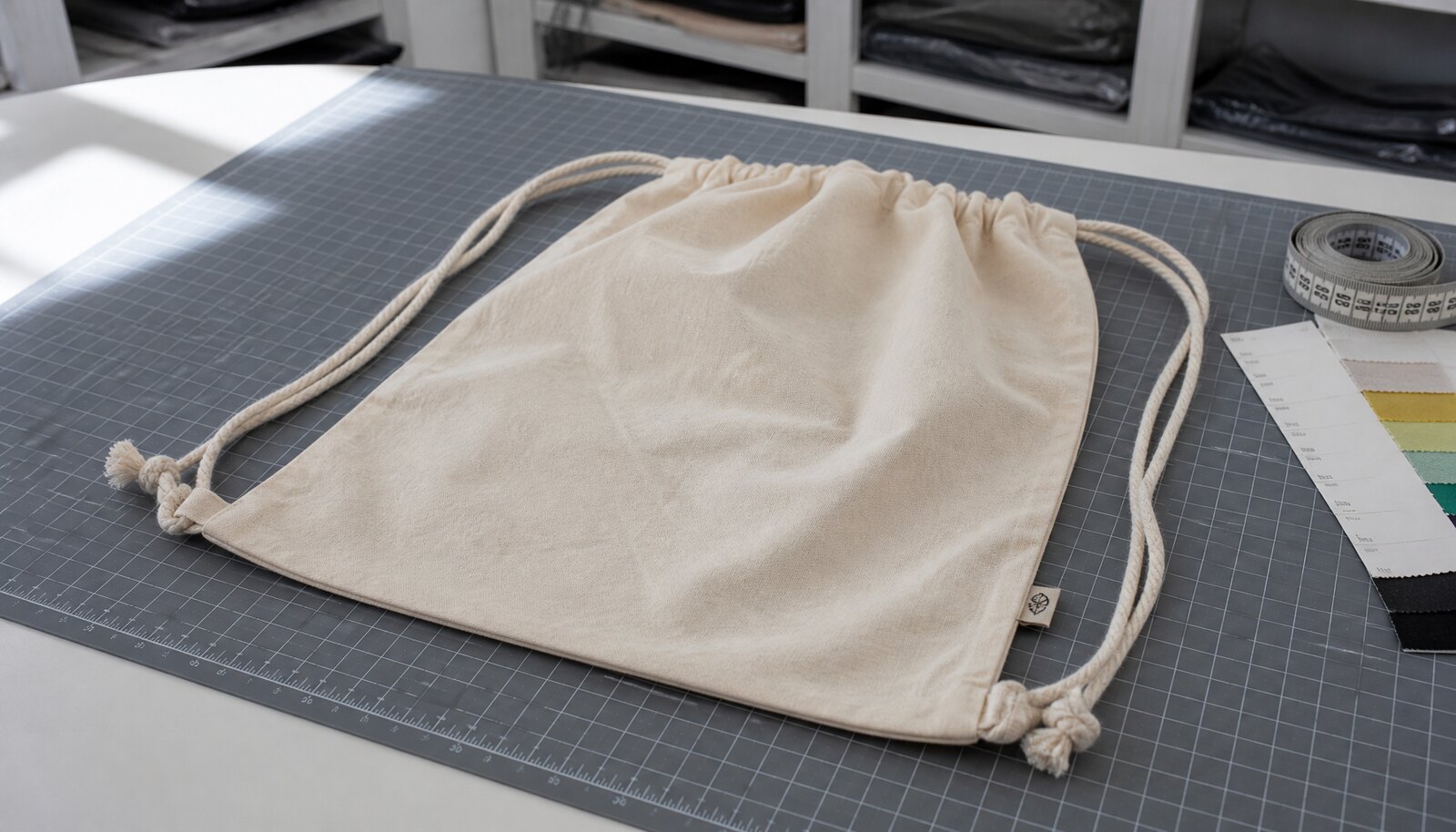
Start with the retail job, not the artwork
A custom cotton drawstring backpack for a gift shop is not just a blank with a logo. It has to survive shelf display, casual handling, folding, stuffing into a shopping bag, and transport to the customer’s home. That is why proofing should start with the retail job. Is the bag meant to be a low-cost souvenir, a premium gift item, or a practical reusable carrier? The answer changes the fabric, the decoration method, and even the way the bag should be folded and packed.
Buyers sometimes treat the logo proof as the main decision and everything else as secondary. That is how orders drift. A logo can look correct on screen while the bag feels too thin, the cord looks cheap, or the print sits too close to the seam and distorts once the bag is closed. The proof package should help the supplier make the same bag every time, not just a visually similar one.
For gift shops, repeatability matters as much as visual appeal. Reorders are common, and the selling window can be short. If the first order is approved on a vague sample and the reorder is based on memory, the second run may land with a different handfeel, a different natural cotton shade, or a logo that sits a few millimeters lower than the first. Buyers reduce that risk by defining the bag as a production item, not a creative concept.
- Use the proof to answer: will this bag sell and arrive in the same condition as the approved sample?
- Define the retail purpose first so fabric, print, and packing choices stay aligned.
- Keep the approved sample, final art file, and packing spec together in one order record.
Set the base spec before any artwork approval
Most print disputes begin with a weak base specification. If one supplier quotes 100 GSM cotton and another quotes 140 GSM, the same logo can look different even with identical artwork. Cotton weave, yarn density, pre-shrink treatment, and cord thickness all affect how the bag lays flat and how the print sits on the surface. For many gift-shop programs, 120-140 GSM is a workable starting range because it is usually firm enough for print stability without turning the bag into an expensive heavy-duty item.
That range is not a universal rule. A lighter body can be fine for low-cost souvenir packaging or seasonal promotional use, while a heavier body may be justified when the bag needs a more structured look on display or a stronger feel in the hand. The right choice depends on how the item is sold and what margin the buyer needs to preserve after freight, duty, and receiving costs are added. Ask the supplier to explain why a specific GSM was chosen rather than letting the quote default to whatever fabric they happen to stock.
It also helps to ask about the shrinkage allowance and whether the cotton is pre-shrunk or washed before cutting. A bag that looks right at sample stage can tighten after the first wash or even after humid transit if the fabric was cut too aggressively. If the supplier cannot state the cut-size allowance and the shrinkage assumption in writing, the buyer has not really locked the base spec yet.
- Confirm final GSM, weave, cord diameter, and seam reinforcement before artwork signoff.
- Ask whether the cotton is pre-shrunk and what shrinkage allowance is built into the cut size.
- Require written approval for any substitute fabric or colorway before bulk production.
Choose the decoration method for the art, volume, and use case
The decoration method should be selected for production behavior, not only for appearance. Single-color screen print is often the most dependable choice for simple logos and repeat orders because it gives clear edges and a stable cost structure. It is usually best when the brand mark is bold, the type is uncomplicated, and the buyer wants the same result across multiple replenishment cycles. Even then, the supplier should show how the ink behaves on the actual cotton base, because a white paper proof can hide opacity problems that appear once the ink is laid on a textured weave.
Transfer print has a different use case. It tends to make more sense when the logo includes fine lines, gradients, multiple colors, or small text that would be difficult to hold cleanly in a screen setup. It can be a useful proofing route for complex artwork because it reduces the risk of broken details at the proof stage. But the buyer still needs to check whether the transfer can survive the way the bag will be folded, packed, and handled in retail. A decorative image that looks sharp on a flat sheet can still fail when the fabric creases across it.
Embroidery and woven patches can lift the perceived value of the item, especially for souvenir or premium gift-shop placement. The tradeoff is mechanical. Stitch density, backing, patch size, and placement all matter, because a thick embellishment on a soft cotton body can cause puckering or make the panel sit unevenly. If the supplier recommends a premium decoration method, ask them to explain why the bag body can support it and what quality check they will use to prevent distortion.
- Use screen print for simple, repeatable logos and tighter unit-cost control.
- Use transfer print for fine detail, gradients, or short-run artwork complexity.
- Use embroidery or a woven patch only when the bag body and logo size can support the added texture.
Measure the print area on the sewn bag, not on the mockup
A frequent proofing mistake is approving artwork based on a digital mockup rather than on the sewn geometry of the bag. A logo may look centered on a flat design file and still sit too close to the cord tunnel once the bag is sewn and folded. On a drawstring backpack, the top area moves every time the bag is opened or tightened, so print placement has to account for usable surface area, seam allowance, and the way the fabric gathers under the cord.
The cleanest way to control this is to define the print area in millimeters and to map it to the actual bag dimensions. Specify the distance from the top seam, side seam, and bottom seam, and ask the supplier to mark that area on the production pattern or first article. This is especially important if the logo is large or if the bag is a narrow format. Buyers should not accept a design that only works when the supplier silently widens the panel or changes the pocket of usable print space.
For gift-shop merchandise, visual balance matters as much as technical fit. A tall logo can crowd the panel; a wide logo can look forced once the drawstring is pulled. The approved sample should be judged from the normal customer viewpoint, not just from a ruler. Still, the ruler is what prevents arguments later. A good proof has both: visual acceptance and measured placement.
- State logo width and height in millimeters, not only in pixels or percentages.
- Require the supplier to show the print position relative to seams and the cord tunnel.
- Reject artwork that only fits after the factory changes the bag proportions without approval.
Ask for a sample that behaves like production
A digital proof is only the first gate. The sample that matters is a pre-production sample made from the final fabric, final cord, final decoration method, and final packing specification. That is the version that reveals whether the print sits cleanly across the weave, whether the seam line distorts the logo, and whether the fold creates a crease across the artwork. If the factory sends a sample made from a different fabric lot or a different print setup, the buyer is not reviewing the real production outcome.
The sample should also be tested in the way the item will actually be sold. Look at it empty, lightly filled, and folded the way it will be packed for shipment or display. A gift-shop buyer may also want to see a hanging sample if the product will be merchandised on hooks or display rods. The point is not to create extra work. It is to see whether the backpack keeps its shape and whether the print still reads clearly once the bag is under basic handling stress.
Keep the approval record clean. Save the sample image, the final art version, the fabric description, the date, and any notes on print or packing changes. If the supplier later claims the bulk order matches the approved sample, the buyer needs the exact sample record to compare against. Missing paperwork is one of the easiest ways for production standards to drift.
- Approve one physical master sample before bulk production starts.
- Review the sample empty, lightly filled, folded, and, if relevant, hung for display.
- Save the approved sample photo, date, and art version with the PO record.
Use measurable QC limits so inspection is not subjective
Buyer-side quality control is strongest when it uses measurable limits. For most cotton drawstring backpack programs, a practical starting point is to hold fabric weight within the supplier’s stated tolerance, with a buyer target of plus or minus 5 percent unless the internal spec is tighter. Bag dimensions can be kept within plus or minus 5 mm for smaller bodies up to 40 cm and plus or minus 10 mm for larger bodies after sewing and light pressing. Print placement should stay within plus or minus 5 mm of the approved position.
These numbers are not meant to replace product judgment. They are meant to make the pass/fail decision consistent between the sample room and the incoming goods inspector. The same logic applies to durability. A dry rub test should show no visible transfer after 20 firm passes with a white cotton cloth. If the bag will be handled a lot, a light damp rub is worth checking as well. If the print smears before the goods leave the factory, it will not improve in a warehouse.
Sewing quality matters just as much as the print. Inspect for skipped stitches, open holes, loose thread tails longer than 5 mm, and uneven topstitching on visible panels. Test the cord and channel by opening and closing the bag several times. If the cord snags, slips, or cuts into the channel, that problem may only get worse with use. For buyers using AQL or an internal incoming inspection system, these checks should be mapped into the same workflow so the sample approval and the bulk inspection are not using different standards.
- Hold fabric weight within the agreed tolerance and verify the lot against the approved sample.
- Keep dimensions and print position within the buyer’s written millimeter limits.
- Run dry rub and, if needed, light damp rub checks on the actual print area.
- Reject skipped stitches, open holes, loose thread tails longer than 5 mm, or cord-channel problems.
Read the quote the way a procurement team should
A useful quote breaks the order into cost drivers instead of hiding everything in one unit price. For custom cotton drawstring backpacks, the buyer should see the fabric weight, print method, number of colors, setup charges, sample cost, packing format, carton count, inland freight assumption, and shipping term. If the supplier only gives one number, the missing items are likely to reappear later as change charges. The quote should also state whether MOQ is calculated per artwork, per colorway, or by total order quantity.
Supplier type affects how much confidence you can place in that quote. A direct factory with in-house sewing and printing usually gives better control over artwork approval, proof corrections, and repeatability because fewer handoffs are involved. A trading company can still be appropriate when it names the actual factory and explains who controls the sample, but the buyer should not assume accountability is clear until that relationship is written down. If the factory uses subcontracting, ask where the subcontracted work happens, how the artwork is transferred, and who inspects the final cartons.
The lowest unit price is not always the lowest-risk quote. If one supplier includes screens, cartons, and packing while another excludes them, the comparison is not real yet. Ask for a line-by-line quotation and normalize all offers to the same GSM, the same print area, the same carton count, and the same freight assumption before comparing suppliers.
- Ask for a quote broken into bag body, decoration, setup, packing, freight assumption, and lead time.
- Confirm who owns screens or plates and whether they are reusable on reorder.
- Treat a quote without a named production site as incomplete.
Verify supplier credibility before you send artwork
A buyer should verify more than a business card and a price list. Ask the supplier to identify the actual production site, the decoration line, and any outsourced partners. Then ask for recent audit or compliance documents if they are available, such as a factory audit report, a social compliance certificate, or a buyer-facing quality document. Not every supplier will have the same paperwork, but a legitimate factory should be able to show something consistent with how it claims to operate.
If the order is going through a trading company, subcontracting risk deserves extra attention. Who approves the artwork? Who owns the screens or plates? Who checks the first carton? If the answer is vague, the chain of responsibility is vague. That becomes a problem when the print shifts, a carton count is short, or the shade changes between sample and bulk. The buyer does not need a perfect system, but the responsibilities must be visible enough that a defect can be traced back to the right step.
For higher-value gift-shop programs, ask how the factory handles document control. You want to know whether the approved sample photo, final artwork file, inspection notes, and carton labels are all stored against the same order number. Good document control does not guarantee a perfect run, but it makes correction faster and limits arguments about which version was approved.
- Ask which site actually sews, prints, packs, and inspects the order.
- Request audit or compliance documents when available, especially for larger or recurring programs.
- If subcontracting exists, ask who owns artwork approval, screens or plates, and final carton inspection.
- Make sure the approval record ties the final sample, final file, and packing spec to one order number.
Compare landed cost, not just factory price
Factory price alone can mislead a buying decision. The real number is landed cost per sellable unit, which includes setup, packing, inland freight, duty, brokerage, freight, and any receiving or repacking cost on the buyer side. A quote that looks cheap at the factory can become expensive once cartons are adjusted for shipping, or once the buyer has to pay extra to relabel or rework the goods in the warehouse. If two suppliers quote different carton sizes or different pack counts, compare them only after normalizing the total cost to the same finished unit.
Regional sourcing tradeoffs should be viewed through the same lens. Nearshore or regional supply can reduce transit time and simplify replenishment, which is valuable when the gift-shop launch date is fixed or when you need small repeat orders. Offshore supply can lower the base unit cost and may offer broader decoration capacity, but it also adds exposure to port delay, holiday shutdowns, and slower correction cycles. The right choice depends on how sensitive the program is to timing and how much inventory the buyer can safely hold.
A simple example shows why the calculation matters. If a quote is 0.82 per bag at the factory, but setup, cartons, inland freight, export handling, duty, and receiving together add several hundred dollars, the real cost per bag can be far above the headline price. That does not automatically make the quote bad. It just means the buyer should compare suppliers using the same landed-cost assumptions instead of reacting to the lowest unit price first.
- Normalize every quote to the same GSM, print area, carton count, and shipping term.
- Include setup, freight, duty, and receiving costs before comparing suppliers.
- Choose nearshore supply when speed and replenishment matter more than the lowest factory price.
Protect the print with the right packing spec
Packing can damage a good print if it is treated as an afterthought. Fresh ink can mark or transfer if the bag is folded too tightly before it cures fully, and a bad fold can create a crease right across the logo. For gift-shop orders, the packing spec should define whether the item ships loose, in a polybag, with tissue, or with a hang tag and barcode already attached. Each choice changes retail readiness, carton count, and the amount of handling required when the goods arrive.
The carton spec matters for the same reason. Ask for carton dimensions, carton count, label placement, and the expected stacking strength. Long-distance freight can crush a lightweight carton or scuff the printed surface if the bags are packed too tightly. Moisture protection may also matter if the route includes humidity, sea transit, or long storage time. Packing is not separate from quality; it is one of the quality controls that protects the approved sample from the factory floor to the retail shelf.
For buyers managing multiple SKUs, consistent pack-out also speeds receiving. A clearly labeled carton with the correct barcode and count reduces manual sorting and the chance of a stocktake error. If the supplier changes the fold style or inserts a tissue sheet, ask whether that changes the carton size or the print contact surface. Small packing changes can create big freight and handling consequences.
- Confirm fold style and any tissue insert before bulk starts.
- Set polybag, hang tag, barcode, and carton label placement in the proof package.
- Ask for carton dimensions because packing changes can affect freight cost and damage risk.
- Request a first-carton photo before the run is sealed.
Specification comparison for buyers
| Sourcing or decoration choice | Best use case | Operational upside | Buyer risk to verify |
|---|---|---|---|
| Direct factory, in-house sewing and printing | When you want fewer handoffs and tighter sample control | Cleaner accountability for artwork approval, corrections, and bulk consistency | Confirm the print line is actually in-house and not quietly subcontracted |
| Trading company coordinating production | When you need sourcing help across several SKUs or factories | Can simplify communication and consolidate orders | Ask which factory sews the bag, which partner prints it, and who owns screens, plates, and reprint cost |
| Nearshore or regional factory | When speed, replenishment, and lower transit risk matter | Shorter lead time and easier reorder cycles | Check whether decoration capacity is limited and whether unit cost rises enough to offset faster transit |
| Imported blank bag + domestic decoration | When you need urgent delivery or very low MOQ on decorated goods | Useful for domestic shipping speed and local final-mile control | Watch blank shade drift, shrinkage mismatch, and higher landed cost after domestic decoration |
| Single-color screen print | When the logo is simple and volumes repeat | Best control for bold retail logos on cotton | Verify opacity and edge sharpness on the actual fabric, not on a paper proof |
| Transfer print | When art has detail, gradients, or multiple colors | Handles fine type and complex artwork more reliably than a rushed screen setup | Check cracking, edge lift, and fold marks after handling and packing |
| Embroidery or woven patch | When the gift shop wants a more premium feel | Adds texture and a higher perceived value | Confirm stitch density, puckering, and whether the bag body can support the extra weight |
| 120-140 GSM cotton body | When you need a balanced retail bag for everyday merchandising | Usually the most practical range for print stability and cost control | Make sure the bag is not so light that it feels thin once filled |
Buyer checklist before sampling
- Lock the base spec first: bag size, cotton GSM, weave, cord diameter, seam reinforcement, and whether the fabric is pre-shrunk.
- Approve the logo size in millimeters and require the supplier to show exact distances from the top seam, side seam, bottom seam, and cord tunnel.
- Define the acceptable fabric shade by master sample or approved reference, not by a vague description such as natural or beige.
- Request a pre-production sample built from the final fabric, final cord, final print method, and final pack-out spec.
- Ask the supplier to identify the actual production site and all outsourced steps before you compare quotes.
- Require a line-by-line quote that separates bag body, print setup, sample cost, packing, cartons, inland freight assumption, and shipping term.
- State the acceptable tolerances in writing for dimensions, print position, color shift, and overrun or underrun handling.
- Request a first-piece or first-carton photo set before the full packing run is sealed.
- Lock the packaging spec: fold style, tissue insert if used, polybag, barcode or hang tag placement, and master carton count.
- Compare every supplier quote on the same basis: fabric weight, print area, carton count, freight assumption, and MOQ per artwork or colorway.
Factory quote questions to send
- Which factory will sew, print, and pack this order, and can you name the actual site that will run production?
- What exact cotton GSM, weave, and shrinkage allowance will you use for the bag body?
- Is the print method in-house? If not, which steps are outsourced, and to whom?
- How many colors are included in the quote, and what are the extra charges for a second print location or additional color?
- What is the MOQ per artwork, per colorway, and per size?
- Do your prices include screens or plates, sampling, one proof correction, and export cartons?
- What is the final approved print area in millimeters, and where is the logo positioned relative to the top seam and cord tunnel?
- What packaging is included in the quoted unit price, and what is charged separately?
- What overrun or underrun range should we expect on bulk production, and how is it handled in invoicing?
- How long do you need for sample approval, bulk production, packing, and dispatch after artwork signoff?
Quality-control points to confirm
- Fabric weight should match the agreed GSM within the supplier's stated tolerance, with a buyer target of plus or minus 5 percent unless your internal spec is tighter.
- Bag dimensions should stay within plus or minus 5 mm for smaller bodies up to 40 cm and plus or minus 10 mm for larger bodies, measured after sewing and light pressing.
- Print location should stay within plus or minus 5 mm of the approved position, and the logo must remain clear of seams, cord tunnels, and stitch lines.
- Color should be checked against the approved physical sample under daylight-equivalent light, with no obvious hue shift, washout, or patchy ink coverage.
- Dry rub testing should show no visible transfer after 20 firm passes with a white cotton cloth on the approved print area.
- If the use case involves handling or merchandising, a light damp rub should also show no major transfer, smear, or tacky residue after curing.
- Seams should have no skipped stitches, open holes, loose thread tails longer than 5 mm, or visibly uneven topstitching on the retail-facing panels.
- Drawcord and channel construction should survive repeated opening and closing, with no tearing, snagging, cord slip, or blocked channel movement during inspection.
- A simple load check should confirm that the bag can be filled to the expected retail use level without seam failure, distortion, or print cracking.
- Carton labels, barcodes, and pack counts should match the approved packing spec, and the first carton should scan correctly before the bulk run is closed.