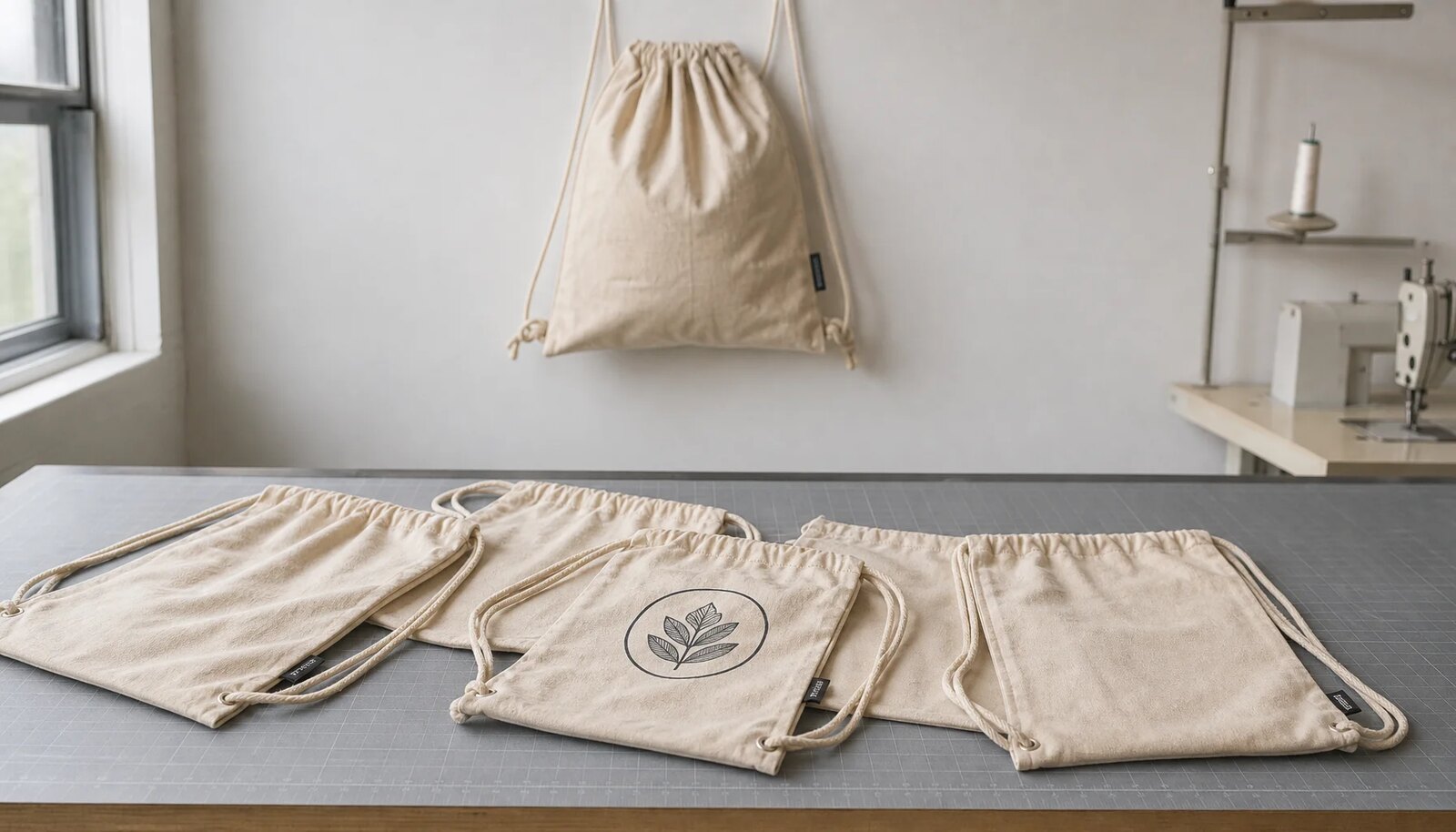
Proofing turns a simple bag into a controlled purchase
Custom cotton drawstring backpacks look easy to buy. They are small, familiar, and often treated like basic promotional merchandise. In practice, a B2B order is still a cut-and-sew product, a decorated product, and a logistics unit. Fabric weight, fabric shade, cutting accuracy, print behavior, cord quality, stitching, packing, and carton labeling all affect whether the order can be received and used without extra work.
For eco apparel brands, the stakes are higher than the unit cost suggests. The backpack may carry a product launch kit, staff uniform item, retail gift-with-purchase, wholesale showroom sample, subscription bundle, or event handout. It often sits next to apparel and quietly reinforces the brand story. If the cotton feels too thin, the natural shade varies from carton to carton, the logo looks soft, or the bag cannot hold the intended contents, customers notice.
A good custom cotton drawstring backpacks print proofing checklist for eco apparel brands should connect artwork approval to the real production route. It is not enough to approve a clean digital mockup. Procurement needs to confirm the fabric, print method, print placement, sewing construction, label, packing, and inspection criteria that will be repeated in bulk. The earlier these details are written down, the fewer arguments happen after cartons are sealed.
- Treat the backpack as a controlled SKU, not a generic blank with a logo added later.
- Approve print on the actual cotton base because weave, shade, and absorbency change the result.
- Link each approval to the PO: size, GSM, print method, placement, label, packing, and carton marks.
- Define defect handling before bulk production, so rework, discount, or remake decisions use written standards.
Specify fabric before you judge the print
Fabric is the starting point. It controls print clarity, hand feel, opacity, carrying strength, and freight weight. For many cotton drawstring backpacks, 140-160 GSM works for lighter promotional programs, 180 GSM is a practical midpoint for apparel-brand merchandise, and 200-240 GSM gives a sturdier retail feel. Those ranges are useful, but they are not a substitute for sampling. A tight weave at one GSM can print cleaner than a looser weave at a heavier weight.
Natural unbleached cotton is popular with eco-positioned brands because it has a low-processed look. Still, natural does not mean identical. The base shade may be warm, cream, beige, or slightly gray depending on the lot. That base color changes how PMS inks are perceived, especially blues, greens, grays, pale colors, and white. If the program includes repeat orders or multiple shipment waves, ask how the supplier will control shade continuity.
If the bag will be described as organic, recycled, undyed, low-impact, or made with recycled content, separate the claim from the fabric description. Ask what certificate, transaction document, test report, or supplier declaration is available and what it actually covers. Some paperwork may apply to yarn or fabric only; some may apply to the finished bag; some may be a supplier declaration rather than a certification. Procurement should not let a loose eco phrase become a consumer-facing claim unless it matches the brand’s compliance rules.
- Use 140-160 GSM only after checking show-through, print opacity, and strength for the intended contents.
- Start around 180 GSM when the bag needs to sit comfortably beside apparel without excessive freight weight.
- Consider 200-240 GSM for retail, premium gifting, or heavier fill, while checking drawcord comfort and carton weight.
- Approve natural, bleached, dyed, recycled, organic, and blended cotton as distinct specifications.
- Ask whether all panels will be cut from one fabric lot and how shade variation will be handled for reorders.
Match the print method to the artwork and sales channel
Screen printing is usually the efficient route for volume orders with solid artwork, one or two colors, and clear brand marks. It can produce a clean result on cotton, but the outcome depends on mesh selection, ink type, squeegee pressure, curing, fabric absorbency, and operator control. A digital proof can confirm position and scale. It cannot prove that a thin line will hold on a textured cotton weave.
Heat transfer can be the better option for detailed artwork, gradients, lower quantities, or many-color graphics. The buyer should ask what type of transfer will be used, how the edge looks, whether the surface feels glossy or plastic, and how it behaves when folded or rubbed. This matters for eco apparel brands because the decoration should not fight the natural material story of the bag.
Embroidery, woven labels, and patches can make a simple backpack feel more premium, but sizing matters. Large embroidery on lightweight cotton can pucker the panel and distort the artwork. A small embroidered mark, side woven label, or cotton patch may give a cleaner result. If a trim is part of the brand presentation, include it in proofing instead of treating it as a late production add-on.
- Use screen print for simple solid logos, repeat programs, and cost-efficient volume decoration.
- Use heat transfer for complex graphics or short runs, but test adhesion, folding, rubbing, and hand feel.
- Use embroidery or woven labels for small premium branding rather than large dense artwork on light cotton.
- Ask the factory to flag risky artwork before screens, transfers, or embroidery files are made.
- Confirm whether inks, transfers, labels, and packaging materials align with your internal material restrictions.
Prepare production artwork, not presentation artwork
Many print issues start before the factory prints anything. A logo that looks polished in a presentation deck may not be production-ready. The supplier needs vector artwork, final print dimensions, PMS targets, orientation, and clear notes for any details that cannot be simplified. If the factory has to rebuild a mark, guess a color, convert a low-resolution file, or decide whether tiny copy matters, proofing slows down and risk goes up.
Review artwork at final print size, not at screen zoom. A circular icon, certification-style mark, QR-style detail, or sustainability tagline may look sharp on a monitor and become unreadable on cotton at 60-80 mm wide. Reverse-out text is especially vulnerable because ink gain can close small openings in the letters. For screen print, many suppliers prefer minimum line weights around 0.3-0.5 mm, though the real limit depends on the fabric, mesh, ink, and artwork.
Placement also needs numbers. 'Centered on front' is too vague for a procurement file. State logo width, logo height, distance from the top edge or cord channel, horizontal centerline, and acceptable tolerance. For two-sided print, clarify whether front and back must align. If the bag has a gusset, side label, eyelets, or reinforced corners, show how the artwork should relate to those construction features.
- Send AI, EPS, or editable PDF artwork plus a flattened reference image for visual comparison.
- State PMS color targets, print dimensions, print orientation, and placement from fixed measurement points.
- Avoid tiny reverse-out text, fine rings, small icons, and low-contrast pale ink on natural cotton unless tested.
- Approve every fabric color and ink combination separately when the order includes multiple SKUs.
- Keep artwork version names consistent across proof, PO, sample approval, and inspection report.
Control MOQ, price breaks, and quote scope
MOQ is rarely just a sewing quantity. It can be driven by fabric roll availability, cutting yield, dye-lot minimums, cord color, woven label production, screen setup, packing labor, and carton planning. A stock natural cotton bag with one-color print may be available at a lower MOQ than a custom dyed bag with a special label, custom cord, individual barcode, and retail packing.
A low MOQ can be useful for launch testing, limited campaigns, or first artwork approval. The tradeoff may be a higher unit price, setup fees, stock-only fabric, or fewer packing choices. For repeat programs, a higher MOQ may provide better unit cost, stronger shade control, and more predictable trims. Ask the supplier to separate one-time development charges from repeat-order pricing, otherwise annual cost comparisons become misleading.
Also define overrun and underrun rules. Cut-and-sew and printed goods may have quantity variation because of cutting loss, rejected panels, print spoilage, or QC removal. If the order must hit an exact count for event kits or subscription boxes, say so before production. If a small variance is acceptable, write the percentage and confirm whether invoicing is based on ordered quantity or shipped quantity.
- Confirm whether MOQ is per artwork, fabric color, cord color, label, packing style, or total order.
- Separate unit price from sample fees, screen charges, label development, barcode labor, and special carton marks.
- Ask for price breaks at practical quantities such as 500, 1,000, 3,000, and 5,000 pieces when relevant.
- Define acceptable overrun or underrun before production, especially for fixed kit quantities.
- Compare MOQ against inventory risk, launch timing, and repeat potential, not unit price alone.
Use a proof sequence that tests real production
A reliable approval route usually moves from digital artwork proof to fabric approval, print strike-off, pre-production sample, and top-of-production confirmation. Each step has a job. The digital proof checks layout, spelling, print size, color references, and orientation. The fabric swatch confirms GSM, shade, texture, and hand feel. The strike-off shows how the ink, transfer, embroidery, or label actually behaves on the chosen base.
The pre-production sample should bring all components together: production fabric, production drawcord, final label, intended print method, correct stitching, and representative packing. If any substitute is used, document it clearly. A good-looking sample made on non-production fabric does not protect the buyer from bulk variation. For color-sensitive orders, it is often better to approve the fabric strike-off before building the full pre-production sample.
Top-of-production approval is worth considering when the order is large, launch-driven, or color-sensitive. The supplier can send photos, video, measurements, or a physical TOP sample from the first bulk output before the full run is finished. This step does not replace final inspection, but it can catch early drift in placement, opacity, shade, or sewing while there is still time to correct it.
- Approve digital layout before screens, transfers, labels, or embroidery files are produced.
- Approve fabric swatch and print strike-off when shade, color, or fine detail matters.
- Approve a pre-production sample that includes final fabric, cord, label, print method, and construction.
- Request top-of-production confirmation for larger or higher-risk orders.
- Keep the approved physical sample for final inspection and receiving comparison.
Set tolerances and defect categories in writing
Cotton goods need realistic tolerances. Natural cotton may show small slubs and texture variation. Cut-and-sew dimensions can move slightly. Screen print placement may vary within a controlled range. The aim is not mathematical perfection; the aim is a standard that fits the channel. Retail programs, e-commerce orders, apparel launch kits, and premium gifting usually need tighter visual standards than basic event giveaways.
Useful tolerances are measurable. Finished width and height can be checked against an agreed millimeter range. Logo placement can be measured from the top edge, side seam, cord channel, or centerline. Print color should be compared with the approved physical strike-off under consistent lighting, not judged from a phone photo. Drawcord function can be tested by repeatedly opening and closing sampled bags. Seam quality can be checked for skipped stitches, broken threads, weak reinforcement, and loose ends.
Defect severity should be agreed before inspection. A trim-able loose thread may be minor. A stained front panel, wrong logo color, missing label, incorrect size, broken cord, or wrong carton mark is usually major because it affects saleability or receiving. Mold, sharp contamination, unsafe metal hardware, strong odor, or wet cartons may be critical. When categories are clear, rework and replacement decisions are faster.
- Set finished dimension tolerance for width, height, opening width, drawcord length, and gusset if used.
- Set logo placement tolerance, often in the range of +/- 5 mm to +/- 10 mm depending on construction and requirement.
- Reject visible stains, oil marks, holes, severe slubs, color contamination, strong odor, or wet packing on main panels.
- Classify defects as minor, major, or critical before final inspection.
- State whether inspection follows the supplier’s standard, your own checklist, or a named AQL sampling plan.
Inspect print durability and construction together
Print and sewing should not be inspected as separate worlds. A logo can be printed correctly on a flat panel and still look off-center after assembly if the panel shifts during cutting or stitching. A transfer may look clean before packing and then show cracking at fold lines. Heavy ink coverage can stiffen the fabric and create puckering near seams. Final inspection should review the finished backpack, not only the decorated panel.
Basic print checks include color, registration, opacity, edge sharpness, pinholes, ink coverage, curing, transfer adhesion, and cracking at folds. Simple rub testing is useful: check whether ink transfers under dry rubbing and, if relevant, damp rubbing. If consumers may wash the bag, state that expectation before production. Not every promotional cotton bag is designed for repeated laundering, so wash performance should not be assumed.
Construction checks should focus on the stress points. The top cord channel, side seams, bottom corners, eyelets, knots, and reinforcement areas take the most strain. Drawcords should pull evenly, open and close smoothly, and stay secured. If metal eyelets are used, inspect for sharp edges, poor setting, rust risk, and misalignment. If the backpack uses sewn corners instead of eyelets, check bartacks or reinforcement stitching closely.
- Inspect finished bags after sewing because print position can change visually after assembly.
- Check ink curing, cracking, transfer lifting, edge sharpness, and print opacity on folded and handled samples.
- Test drawcord pull, cord security, channel stitching, eyelet setting, and corner reinforcement.
- Watch for puckering around print, embroidery, woven labels, and patches.
- Confirm the inspection sample includes all colorways, artwork versions, labels, and packing styles.
Treat packing as a procurement specification
Packing affects cost, freight cube, warehouse receiving, and the brand’s sustainability goals. Bulk packing often works best for wholesale distribution, event use, or internal kitting because it reduces material and handling. But bulk packing still needs control. Cartons should have accurate counts, SKU labels, PO references, colorway information, and clear carton numbering so receiving teams can identify contents without opening every carton.
Individual polybags, barcode stickers, paper bands, or retail sleeves may be necessary for e-commerce, retail display, or direct-to-consumer fulfillment. They also add labor, material, and carton volume. Eco apparel brands should state packaging restrictions clearly: no individual plastic unless required, recycled-content polybag, paper band, FSC paper if required by the brand, suffocation warnings where applicable, and barcode placement for warehouse scanning. Do not assume the factory will choose the lowest-plastic option unless it is written into the spec.
Carton data belongs in the quote stage, not only after production. Pieces per carton, carton dimensions, gross weight, net weight, and CBM affect sea freight, air freight, pallet planning, and storage. Moisture control also matters for cotton, especially during humid production seasons or ocean shipments. If desiccants, inner liners, dry-carton storage, or moisture checks are required, add them to the packing instructions.
- Use bulk packing for warehouse, event, or kitting programs when individual unit protection is unnecessary.
- Use individual packing only when required for retail, e-commerce, barcode scanning, or dirt protection.
- Request carton dimensions, gross weight, net weight, pieces per carton, and estimated CBM with the quote.
- Define carton marks: PO, SKU, color, quantity, carton number, total cartons, destination, and barcode if needed.
- Include moisture-control requirements for ocean freight, long storage, or humid production environments.
Compare supplier routes by control and accountability
The production route changes the risk profile. A factory with in-house cutting, sewing, and printing may offer strong control if it has suitable equipment and a working QC system. A sewing factory that subcontracts printing can also be effective, but the buyer must know who owns color matching, rework, schedule impact, and approval if the print does not match the proof. A sourcing partner can coordinate the moving parts, but procurement should still ask where each step happens.
Stock-item suppliers and platform sellers may work for urgent, low-customization orders. The limitation is usually specification control. You may not be able to choose exact GSM, fabric lot, cord style, label type, print tolerance, carton packing, or repeat-order consistency. For eco apparel brands planning seasonal drops or repeat merchandise programs, inconsistent stock blanks can create visible differences between orders.
Ask the supplier to describe the full flow: fabric booking, cutting, decoration, sewing, trimming, inspection, packing, carton sealing, and shipment handover. If subcontractors are involved, the purchase order should still have one accountable supplier for corrective action. This matters when responsibility crosses process boundaries, such as a logo that was printed correctly on panels but appears crooked after sewing.
- Ask where fabric sourcing, cutting, printing, sewing, QC, and packing physically take place.
- Confirm whether printing is in-house or subcontracted and who approves color before bulk.
- For repeat orders, ask how fabric, cord, pattern, label, and print setup will be controlled over time.
- Do not compare a stock quote with a fully custom quote unless size, GSM, print, label, and packing match.
- Require one responsible supplier contact for corrective action even when subcontractors are used.
Specification comparison for buyers
| Spec decision | Recommended option | When it fits | Buyer risk to check |
|---|---|---|---|
| Finished size | Common adult range: 34 x 42 cm to 38 x 45 cm; confirm usable opening and print-safe area | Apparel kits, retail gift-with-purchase, event merchandise, and light carry use | Nominal size is not the same as usable capacity; sewing shrinkage and seam allowance can reduce internal space |
| Fabric weight | 140-160 GSM for light promotions; 180 GSM for balanced apparel-brand use; 200-240 GSM for sturdier retail feel | You need to balance hand feel, opacity, print clarity, carton weight, and cost | Lighter fabric may show contents and distort under heavy ink; heavier fabric increases material cost, sewing load, and freight weight |
| Fabric identity | Conventional cotton, recycled cotton, organic cotton, or blended recycled content with documentation requirements stated in the PO | Eco apparel brands need claims that match internal sourcing standards | Do not market recycled or organic content unless supplier documentation meets your compliance needs |
| Base color | Natural unbleached for low-processed look; bleached for cleaner print contrast; dyed for brand color programs | You need the fabric appearance to match product positioning and artwork contrast | Natural shade varies by lot; dyed fabric needs colorfastness and rubbing checks; pale inks may disappear on warm cotton |
| Print method | 1-2 color screen print for volume; heat transfer for detailed graphics or lower runs; embroidery or woven label for small premium marks | You need a repeatable decoration method matched to artwork and quantity | Fine screen lines can fill in; transfers can crack, peel, or feel plastic; embroidery can pucker light fabric |
| Artwork minimums | Screen print line weight typically 0.3-0.5 mm minimum; avoid tiny reverse text; keep important small copy at readable final size | Your artwork includes thin icons, certification-style marks, QR-style details, or taglines | Artwork that looks clean on a PDF may lose edges on cotton weave after ink gain |
| Placement tolerance | Set logo position tolerance such as +/- 5 mm to +/- 10 mm depending on size, fabric, and process | You need repeatable front-panel branding across bulk cartons | Vague 'centered' instructions create disputes when bags are sewn and folded slightly differently |
| Color approval | Approve PMS target against a physical strike-off on the actual fabric base; keep a signed reference sample | Brand color matters and fabric is natural, dyed, or dark | Phone photos and monitor proofs are unreliable; cotton shade and ink opacity shift perceived color |
| MOQ logic | 500-1,000 pcs may fit standard stock fabric plus simple print; 3,000+ pcs is common for custom dye, custom cord, special labels, or controlled fabric lots | You are comparing sampling, market test, and repeat program options | MOQ may be per design, per color, per cord, per label, or per packing style, not total order quantity |
Buyer checklist before sampling
- Define finished width, height, top opening, usable capacity, bottom construction, seam allowance, drawcord length, cord material, reinforcement points, and whether the bag is flat, gusseted, boxed-bottom, or corner-reinforced.
- Specify fabric GSM with an acceptable range, composition, weave, base color, shade tolerance, shrinkage expectation, and whether the cotton is conventional, recycled, organic, blended, natural, bleached, or dyed.
- Confirm documentation requirements before using eco claims, including any organic, recycled, or restricted-substance paperwork your brand requires for marketing, compliance, or retailer onboarding.
- State print location, print dimensions, safe print area, placement measurement points, number of colors, PMS targets, and whether branding appears on front, back, both sides, label, hangtag, or packing.
- Flag artwork risks in the RFQ: gradients, halftones, very fine lines, reverse-out text, small certification-style icons, QR-style details, heavy ink coverage, metallic inks, or multiple PMS colors.
- Define MOQ by artwork, fabric color, cord color, label style, packing format, and shipping destination; ask whether the MOQ is per SKU or can be combined across variants.
- Request a digital artwork proof, fabric swatch, print strike-off on actual fabric, and pre-production sample made with intended production fabric, drawcord, label, print process, and packing format.
- Set measurable tolerances for finished size, logo placement, color, print sharpness, print adhesion, seam quality, drawcord function, stains, odor, moisture, carton count, and barcode accuracy.
- Confirm packing method, units per inner bundle, units per carton, carton dimensions, gross weight, net weight, carton marks, SKU labels, barcode placement, and any plastic-reduction requirement.
- Ask for a production calendar covering artwork approval, fabric booking, strike-off, sample approval, bulk cutting, printing, sewing, inline inspection, final inspection, packing, and shipment handover.
Factory quote questions to send
- What is the exact fabric specification: GSM and tolerance, composition, weave, base color, shrinkage expectation, fabric lot control, and whether the material is stock, made-to-order, conventional, recycled, organic, or blended cotton?
- Can you quote the same construction in 160 GSM, 180 GSM, and 200 GSM with identical size, print, label, and packing so we can compare unit cost, carton weight, hand feel, and print performance?
- What finished size tolerance do you recommend for this bag construction, and will measurements be taken flat before or after final pressing and packing?
- Is the decoration completed in-house or subcontracted, and who is responsible for remake cost, schedule impact, and approval if bulk print does not match the approved proof?
- Which proof stages are included: digital layout proof, fabric swatch, lab dip for dyed fabric, print strike-off, pre-production sample, top-of-production photo, physical TOP sample, or final inspection report?
- Will the pre-production sample use production fabric, production cord, actual ink or transfer film, final label, final stitch method, and representative packing? If any substitute is used, what exactly differs?
- What is the MOQ by fabric color, print design, cord color, label type, packing format, and shipping destination? Does the MOQ apply per SKU, per artwork, or across the total order?
- What is included in the unit price: fabric, cutting, sewing, cord, metal eyelets if used, screen setup, print run, ink, woven label, care label, barcode sticker, individual packing, master carton, and carton marks?
- What are the one-time charges for sampling, screen setup, film, embroidery digitizing, label development, custom dyeing, courier samples, and repeat-order setup?
- What print tolerance do you recommend for PMS color variation, logo placement, registration movement, minimum line thickness, small text, ink coverage, curing, wash or rub resistance, and acceptable hand feel?
Quality-control points to confirm
- Check incoming fabric for GSM range, shade lot, weave density, hand feel, odor, moisture risk, stains, slubs, holes, oil marks, color contamination, and storage condition before cutting.
- Measure finished bag width, height, opening width, bottom gusset if any, drawcord length, seam allowance, cord channel height, eyelet position, and reinforcement placement against the approved spec sheet.
- Inspect logo placement from fixed reference points such as top edge, side seam, centerline, or cord channel; record variance instead of judging by eye only.
- Check print color against the approved physical strike-off under consistent lighting; inspect registration, opacity, edge sharpness, pinholes, ink coverage, curing, cracking at folds, and transfer edge lifting.
- Verify that small text, QR-style marks, certification-style icons, thin lines, and reverse-out details remain readable at the approved final size on the actual cotton base.
- Test drawcord function by opening and closing sampled bags repeatedly; confirm cords are even, not fraying, correctly knotted or secured, and do not pull out of the channel or eyelet.
- Inspect side seams, bottom seams, top hem, cord channel stitching, bartacks, reinforcement points, loose threads, skipped stitches, broken stitches, needle holes, puckering, and panel twisting.
- If embroidery, woven labels, or patches are used, check stitch density, backing, label alignment, label edge fraying, color, placement, panel puckering, and whether the trim matches the approved sample.
- Confirm item count, bundle quantity, inner packing, barcode accuracy, carton marks, carton strength, gross weight, carton sequence, moisture protection, and destination labels before release.
- Retain approved pre-production and top-of-production samples so final inspection and warehouse receiving can compare bulk output to the same physical reference.