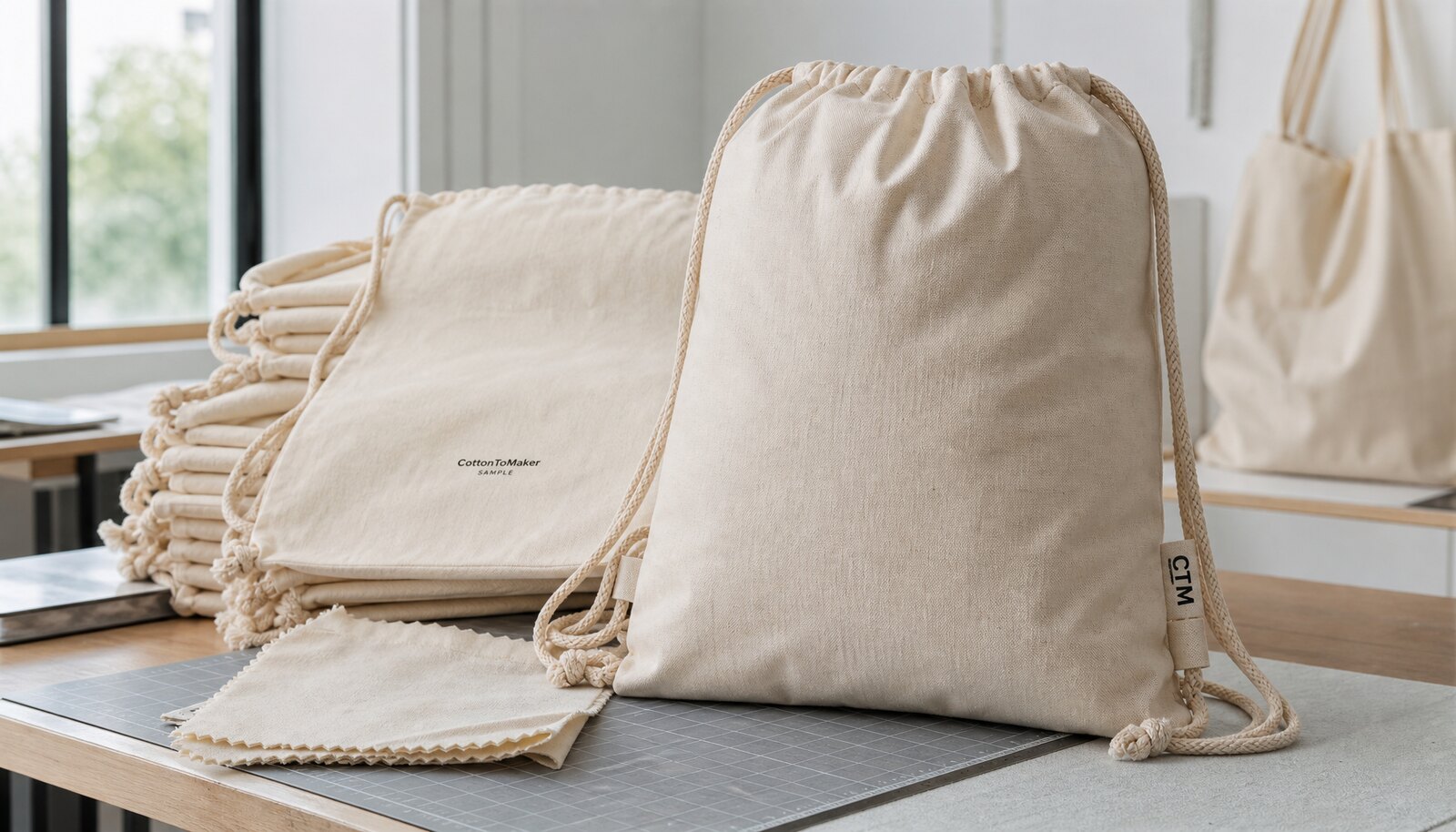
MOQ is a spec decision before it is a price discussion
For custom cotton drawstring backpacks, MOQ is not a single number waiting on a supplier price list. It is built from fabric purchasing, cutting setup, sewing-line planning, print setup, artwork versioning, packing labor, carton handling, and the factory's willingness to schedule a smaller batch. A buyer asking for 500 pieces is not giving enough information yet. The factory still needs to know whether those 500 pieces use one stock fabric, one logo, one print color, one packing method, and one ship-to plan, or whether the order is split across regions, departments, sponsors, and delivery dates.
That is why MOQ negotiation for corporate gifting works best when procurement treats the product specification as the first lever. The same supplier may reject 500 pieces of dyed cotton with four artwork versions but accept 500 pieces of stock natural cotton with one screen-printed logo. The difference is not mood or mystery. It is setup time, material availability, and production interruption.
The strongest buyer position is clear but flexible. Lock the recipient-visible quality points: fabric weight, finished size, clean print, reliable cords, neat stitching, and pack condition. Then look for concessions that make the order easier to run. Fewer artwork versions, standard carton labels, a stock cotton fabric, or a longer approval window can reduce the supplier's burden without making the gift feel cheaper.
For procurement, the goal is not simply to force the lowest possible minimum. The useful target is a quantity, price, lead time, and quality standard that survives internal approval and actual delivery. A late conference bag, a thin-feeling onboarding backpack, or cartons mixed by destination can create more internal cost than the unit-price saving was ever worth.
- Ask which input drives MOQ: fabric availability, dyeing, print setup, sewing batch, packing split, or schedule pressure.
- Negotiate order structure before pushing unit price; simplification can reduce the effective MOQ faster than a direct price challenge.
- Treat MOQ, lead time, sample approval, QC tolerance, and packing plan as one commercial package.
- Do not compare quotes until every supplier is pricing the same GSM, finished size, cord type, print method, and packing basis.
Build an RFQ that suppliers cannot interpret loosely
A vague RFQ creates quote drift. The phrase natural cotton drawstring backpack with logo may look harmless, but it lets each supplier choose its own assumptions. One may price 110 GSM cotton. Another may price 140 GSM. One may quote a 34 x 42 cm finished bag. Another may use a similar cutting size that becomes smaller after sewing and channel folding. The spreadsheet will show neat rows of prices, but the rows will not describe the same product.
Start with finished sewn dimensions. Finished size is the size after cutting, sewing, seam allowance, shrinkage, and drawcord-channel construction. If the backpack must hold A4 folders, notebooks, shirts, bottles, event badges, tech accessories, or sample boxes, say so in the RFQ. For kit programs, list the largest item and the approximate loaded weight. A simple sample-stage fit test can prevent a very expensive discovery after bulk production.
Next, define the fabric and the cord. For many corporate gifting programs, 120-140 GSM natural cotton is a practical baseline because it balances hand feel, cost, and carton weight. If the campaign needs a stronger presentation, request a 150 GSM or 160 GSM alternate. Cord should be equally specific: cotton rope, braided polyester cord, flat tape, self-fabric cord, approximate diameter or width, color, knot method, and any reinforcement details.
Finally, ask suppliers to identify assumptions and exclusions in writing. This one request often exposes hidden differences before negotiation begins. If a quote omits GSM, finished size, print method, cord construction, MOQ basis, packing count, or carton data, it is not ready for purchasing review.
- Use one spec revision number across the RFQ, quote, artwork proof, sample approval, purchase order, and inspection checklist.
- Specify finished bag size, fabric GSM, cotton finish, cord type, logo size, logo placement, print method, and packing method.
- State the use case: trade show giveaway, employee onboarding, customer gift kit, campus event, sales sample pack, or conference pack.
- Ask each supplier to list assumptions, exclusions, and optional upgrades instead of burying them inside a low unit price.
Control fabric weight, finish, and shrinkage early
Fabric weight is one of the biggest cost drivers in a cotton drawstring backpack. It is also one of the easiest places for quotes to become misleading. A 100-110 GSM cotton bag may look acceptable in a photo and still feel too thin when loaded with corporate gift items. A 150 GSM bag feels more substantial, but material cost, carton weight, and freight cost rise. Procurement should avoid undefined words such as standard cotton and request controlled GSM options instead.
Natural cotton, bleached cotton, dyed cotton, and washed cotton should be treated as separate specifications. Stock natural cotton is often the most MOQ-friendly route because suppliers may be able to buy or pull existing fabric. Bleached cotton can create a cleaner background for certain logos, but it needs whiteness approval and may show dirt more readily. Dyed cotton can support a brand color or campaign theme, but it can bring dye-lot minimums, shade approval, longer production time, and colorfastness checks.
Tolerance belongs in the RFQ, not in a later dispute. For GSM, buyers commonly agree to a percentage or a band, such as +/- 5% or +/- 5 to 10 GSM depending on fabric source and supplier capability. For finished dimensions, +/- 1 cm is common for promotional cotton bags, though a tighter range may be necessary when the backpack is part of a fitted kit. For dyed fabric, approve a lab dip, swatch, or physical sample and define the acceptable shade range under normal viewing conditions.
Fabric also changes print behavior. Open-weave or lightweight cotton can absorb ink unevenly, soften edges, and make small text less readable. Natural cotton has a warm base tone, so white, pale gray, metallic-effect, or low-contrast logo colors may not resemble the digital proof. If brand color is important, approve the print on the actual cotton fabric that will be used in production.
- 100-110 GSM: budget option for light giveaways; inspect opacity, seam strength, and wrinkle behavior carefully.
- 120-140 GSM: balanced option for most corporate gifting, event packs, onboarding kits, and repeat promotional orders.
- 140-160 GSM: stronger hand feel for premium programs or heavier contents, with higher material and freight cost.
- Dyed cotton: quote separately because dye-lot MOQ, shade approval, colorfastness, and lead time can change the order economics.
Print choices can quietly raise MOQ
Print method can move MOQ as much as fabric choice does. A one-color screen print on stock natural cotton is usually easier to schedule than a large full-color transfer across several bag colors. Screen printing is often cost-effective for solid artwork at larger quantities because the setup cost is spread across the run. It also has a familiar promotional-product finish when the logo is designed for fabric.
Screen printing is not automatically the right answer for every corporate gift. Logos with gradients, photographic elements, many colors, tight registration, or frequent version changes may be better suited to DTF, heat transfer, or another transfer process. These methods can handle detail and smaller version splits, but they introduce other approval points: edge visibility, plastic hand feel, adhesion to cotton texture, cracking risk, and whether the surface looks appropriate for the brand.
Artwork versioning is a common MOQ trap. A 2,000-piece order may become five smaller jobs if it includes five department logos, sponsor panels, regional languages, event names, or destination-specific marks. Each version may need its own proof, setup, sorting, inspection, carton label, and packing list. A supplier may accept the total quantity while adding setup fees or a higher unit price per split.
Before requesting quotes, create a version matrix. List bag color, quantity, artwork file name, logo size, print location, print color count, packing version, and destination. Ask the supplier to quote that matrix as submitted, then ask for a simplified option. Often the better MOQ result comes from one shared corporate mark, one print location, and fewer fabric colors.
- Send vector artwork or high-resolution production files at actual print size, not a small presentation image.
- Ask for maximum print area, minimum line weight, minimum readable text height, and registration tolerance before sampling.
- Quote setup fees per screen, print color, transfer, artwork version, and print location separately from the unit price.
- Approve bulk only after reviewing a physical sample when logo color, opacity, alignment, edge quality, or hand feel matters.
How to ask for a lower MOQ without downgrading the gift
Lower MOQ requests are easier to accept when the buyer offers production-friendly tradeoffs. The safest tradeoffs reduce setup burden without reducing recipient-visible quality. For a corporate gift, hand feel, logo clarity, seam strength, smooth cord function, clean folding, and accurate carton labels usually matter more than multiple minor fabric colors or department-specific artwork.
Start with standardization. Use stock natural cotton, one finished size, one cord option, one print location, and one packing method. If several internal teams want the backpack, consider one shared corporate logo instead of separate departmental marks. If multiple events can use the same approved bag, combine demand into one production run and split cartons after packing. The factory gets a cleaner batch, while the buyer still supports internal distribution.
Timing is another lever. A supplier may accept a smaller run if it can be placed around existing production or if the buyer allows a longer approval window. A rush, low-MOQ, multi-version order is difficult because it compresses every setup and inspection step. When the event date is fixed, simplify the product before asking the supplier to absorb both small quantity and speed.
Keep MOQ and price breaks separate. A factory may agree to produce 500 pieces but recover setup cost through screen fees, sample charges, packing charges, or a higher unit price. Ask for stepped pricing at 500, 1,000, 2,500, and 5,000 pieces on the same spec. This gives finance a clearer view of whether a small first order is worth it or whether a higher quantity supports a repeat corporate gifting program.
- Offer stock fabric, standard size, one logo position, one cord type, and standard bulk packing as MOQ-reduction levers.
- Reduce artwork versions before reducing GSM, seam quality, or print approval standards.
- Ask for stepped prices at defined quantities using the same spec, artwork basis, and packing method.
- Combine demand across departments, regions, or event dates when one approved backpack can serve more than one program.
Normalize quotes before you negotiate
The cheapest quote is often the least complete quote. One supplier may include 130 GSM cotton, screen setup, sample making, export cartons, carton labels, and a clear packing count. Another may quote 110 GSM cotton, a smaller finished size, loose packing, no revision allowance, and no carton data. Both prices may look comparable in a procurement sheet, but they are not pricing the same work.
Build a comparison sheet that forces every quote into the same fields. Include fabric GSM, finished size, cotton finish, cord material, print method, print size, print color count, artwork versions, sample charge, setup charge, unit price, packing method, carton dimensions, gross weight, lead time, payment terms, inspection support, and whether key processes are in-house or subcontracted. Negotiation becomes more productive when the discussion is about visible cost drivers rather than general pressure.
Supplier route matters too. A direct factory with in-house cutting, sewing, and printing may have stronger production control, but it may need clearer documentation from the buyer. A trading company or sourcing partner may manage communication, sampling, and version complexity, but procurement should still understand who controls fabric, printing, sewing, packing, and rework. The important question is accountability. Who can correct a failed print, wrong label, mixed carton, or seam issue before shipment?
For corporate gifting, quote reliability can matter more than a small unit-price gap. Late delivery, wrong logo placement, mixed cartons, or weak packing creates work for marketing, HR, events, distributors, and warehouses. Normalize quotes around total program readiness, not only ex-factory unit price.
- Reject or revise quotes that omit GSM, finished size, print method, cord type, MOQ basis, and packing count.
- Compare sample charges, setup fees, split fees, revision fees, carton costs, and packing fees separately from unit price.
- Ask which processes are in-house and which are subcontracted, especially printing, dyeing, and final packing.
- Use landed cost, approval risk, delivery confidence, and event-readiness as the final comparison basis.
Use sampling as a control tool, not a formality
A pre-production sample should be the control standard for bulk production. It is more than a visual preview for a stakeholder presentation. For custom cotton drawstring backpacks, the sample should verify fabric weight, hand feel, finished size, cord type, channel construction, seam quality, logo placement, print opacity, print hand feel, drawcord movement, fold method, and packing style.
Measure the sample before approval. If the logo should be 22 cm wide and centered 8 cm below the top seam, record those numbers. If the backpack must hold a notebook, T-shirt, bottle, box, or welcome kit, load the sample with the actual contents and close the cords. If the cord feels too short, rough, uneven, or hard to pull, correct it before bulk. If the logo looks dull on natural cotton, adjust ink, artwork, print method, or fabric before production begins.
Color approval needs practical language. Cotton is textured and absorbent, so brand colors can look softer than they do on coated paper, plastic, or a screen. If Pantone matching is required, define whether Pantone is a target reference or a strict approval standard on cotton fabric. For many gifting programs, a signed physical sample under normal lighting is more useful than chasing a digital color that cannot be reproduced exactly on natural fiber.
Once approved, seal the sample as a golden sample. Label it with supplier name, date, PO or quote number, spec revision, artwork file name, and approved packing method. When possible, the buyer and supplier should each keep one approved sample. Inspectors can then compare finished goods to a physical reference instead of interpreting old email attachments and mockups.
- Require the sample to use bulk-intended fabric, cord, stitching, print process, fold method, and packing whenever timing allows.
- Record finished size, print size, logo placement, cord length, channel width, and visual approval criteria.
- Test the sample with real kit contents if the backpack will carry more than flat documents.
- Tie the golden sample to the PO, artwork proof, inspection checklist, carton label, and packing plan.
Define QC criteria before production starts
Cotton drawstring backpacks look simple, which is exactly why QC can be underestimated. Defects can appear in fabric, cutting, printing, sewing, cord installation, trimming, folding, packing, and carton labeling. If quality standards are defined only after goods are finished, inspection becomes subjective and slow. Procurement should agree on measurable checks before production starts.
Fabric inspection should cover GSM, shade, odor, stains, holes, severe slubs, loose weave, oil marks, water marks, and mold. Natural cotton may have small texture variation, but visible contamination or strong odor is not acceptable for a corporate gift. Dyed cotton should be checked against the approved swatch or sample, and shade variation within the same version should be controlled.
Sewing inspection should focus on stress points: side seams, bottom corners, drawcord channel, eyelet area if used, and cord attachment or knotting. Skipped stitches, open seams, broken thread, uneven channel width, loose knots, and long untrimmed threads all reduce perceived quality. A simple load-and-pull check is useful. Fill the bag with expected contents, open and close the cords several times, and watch for tearing, distortion, or rough movement.
Print inspection should compare bulk goods to the approved sample. Check placement, skew, print size, opacity, pinholes, smudging, cracking, color shift, edge sharpness, and registration. For transfer processes, inspect film edges, adhesion, bubbling, stiffness, and cracking after handling. For screen printing, check curing and rub resistance so bags do not mark each other during packing or distribution.
- Set measurable tolerances for GSM, finished size, logo placement, print size, cord length, channel width, and carton count.
- Classify wrong artwork, wrong logo color, mold, severe odor, major seam failure, and mixed versions as critical or major defects.
- Inspect finished bags, not only printed panels, because sewing, cords, trimming, folding, and packing affect the final product.
- Keep defect photos and counts linked to carton numbers for faster rework, sorting, replacement, or shipment-release decisions.
Packing and cartons affect landed cost and event readiness
Packing is part of the deliverable. A well-printed backpack can arrive in poor condition if it is over-compressed, dusty, sharply creased through the logo, tangled by cords, or mixed across versions. For corporate gifting, packing affects warehouse receiving speed, event setup, distributor allocation, freight cost, and recipient presentation.
Start with fold method and inner count. Some programs can accept loose bulk packing to reduce material and labor. Others need bundles of 10, 25, or 50 pieces so field teams can distribute quickly. Individual polybags may improve presentation and protect the bag from moisture or handling, but they add cost, labor, and sustainability concerns. If polybags are not desired, state that clearly and require clean inner protection inside the master carton.
Master carton planning should be part of the quote, not a detail left until shipment. Ask for pieces per carton, carton dimensions, gross weight, net weight, carton material, and label format. Cotton bags are compressible, but too much compression can create stubborn creases and pressure marks on print areas. Under-filled cartons waste freight space and may collapse in transit. The right carton plan balances freight efficiency with product condition.
Multi-version programs need especially clear labels. Cartons should identify bag color, artwork version, quantity, destination, PO number, carton sequence, and any event or department code. Mixed cartons may look manageable at origin, but they can create serious problems when regional teams are building kits close to the event date.
- Confirm whether bags are loose packed, bundled, individually polybagged, packed by destination, or packed by artwork version.
- Request carton dimensions, gross weight, net weight, pieces per carton, and carton material before final landed-cost approval.
- Use carton labels that show artwork version, color, quantity, destination, PO number, carton sequence, and any required event code.
- Avoid excessive compression where fold lines cross the print area or distort the drawcord channel.
Lead time depends on approvals, not just production days
Lead time should be broken into stages. A supplier's 25 days may mean 25 days for bulk production after final sample approval. It may not include artwork checking, sample making, sample shipment, sample revision, material booking, dyeing, production queue, inspection, packing, export documents, freight booking, customs, or domestic delivery. Corporate gifting programs often have fixed event dates, so every stage needs an owner and a deadline.
The most common schedule risks are late artwork, sample revisions, fabric unavailability, dye-lot approval, print setup issues, multi-version sorting, destination-specific carton labels, and shipment booking. A change after approval is rarely just a quick email change. New artwork may require new screens or transfers. New packing may require new labels and carton allocation. A changed bag color may change fabric MOQ and schedule.
A disciplined purchase order should reference the approved spec revision, artwork file name, sample approval date, quantity by version, packing method, carton-label requirement, inspection requirement, delivery term, and agreed overage or shortage tolerance. It should also state whether production can begin only after written sample approval. Clear control documents protect both buyer and supplier.
If the delivery date cannot move, reduce complexity early. Use stock fabric, a standard size, one shared artwork, one print location, and standard packing. If the brand requirement is complex, build the timeline around that reality instead of forcing a short calendar and hoping the supplier can recover later.
- Separate artwork review, sampling, sample transit, revision, material booking, bulk production, inspection, packing, and shipment booking.
- Treat artwork changes, fabric changes, color changes, and packing changes after approval as schedule-impacting changes.
- Reference the exact approved spec, artwork file, sample, packing plan, carton label, and inspection requirement in the PO.
- For fixed events, simplify the backpack before compressing the production calendar.
Specification comparison for buyers
| Procurement decision | Recommended buyer position | When it fits | Buyer risk to check |
|---|---|---|---|
| Fabric weight | Use 120-140 GSM natural cotton as the main RFQ baseline, then ask for 110 GSM and 150 GSM alternates on the same finished size | Corporate gifting, onboarding kits, trade show packs, employee events, university programs, and repeat promotional orders | A low quote may quietly assume 90-110 GSM open-weave cotton unless GSM, weave, finished size, and tolerance are written into the quote |
| Finished bag size | Specify finished sewn size, such as 34 x 42 cm or 38 x 45 cm, with +/- 1 cm tolerance unless kit fit requires tighter control | Brochures, A4 documents, folded apparel, notebooks, welcome kits, samples, and conference materials | Cutting size is not finished size; seam allowance, shrinkage, and drawcord-channel folding reduce usable capacity |
| Cotton finish | Quote stock natural cotton first, then price bleached, dyed, washed, or Pantone-targeted fabric as separate options | Natural cotton is usually easier for low-to-mid MOQs; dyed cotton supports brand-color programs and campaign segmentation | Dyed or bleached cotton may require fabric lot minimums, shade approval, colorfastness checks, extra lead time, and tighter packing controls |
| Print method | Use 1-2 color screen print for solid logos; request DTF, heat transfer, or digital transfer pricing for gradients, many colors, or small version splits | Screen print suits repeat programs and larger runs; transfer methods can suit detailed artwork or version-heavy orders | Fine lines, small text, reverse areas, gradients, and low-contrast colors should be proofed on the actual cotton fabric |
| MOQ basis | Require MOQ to be stated by total order, fabric color, artwork, print color, print location, packing version, and production batch | Useful for campaigns split by department, region, event, sponsor, language, or recipient group | A supplier may accept total quantity but add setup charges, split surcharges, longer lead time, or separate inspection steps for each version |
| Drawcord construction | Specify cord material, diameter or tape width, channel construction, knot or attachment method, and reinforcement points | Improves comfort, closure function, perceived quality, and repeat-use value for corporate gifts | Weak channels, rough cords, short cords, loose knots, or unreinforced stress points can tear when recipients load and pull the bag |
| Sampling route | Approve a physical pre-production sample made with bulk-intended fabric, cord, print method, stitching, fold, and packing | Important when hand feel, logo position, odor, cord movement, print opacity, and kit fit affect buyer approval | Photo-only approval can miss thin fabric, crooked seams, rough cord, print stiffness, odor, shrinkage, and packing creases |
| Packing method | Define fold style, inner count, master carton count, carton label, destination split, moisture protection, and polybag policy | Helps distributors, importers, warehouses, event teams, and regional offices receive and allocate goods quickly | Loose, mixed, or over-compressed packing can cause count variance, wrinkles, print marks, cord tangles, and slow receiving |
| Carton plan | Request carton dimensions, gross weight, net weight, pieces per carton, carton material, and carton sequence before PO approval | Needed for freight quotes, warehouse limits, pallet plans, receiving labor, and landed-cost comparison | Under-filled cartons increase freight cost; over-filled cartons can crease cotton, deform cord channels, and damage print areas |
Buyer checklist before sampling
- Define the finished sewn bag size in centimeters, including width, height, drawcord-channel style, and acceptable dimensional tolerance.
- List the intended contents the backpack must hold, including largest item size and estimated loaded weight if the bag will be used as a kit container.
- State target cotton fabric GSM, weave expectation, cotton finish, and whether stock natural cotton, bleached cotton, dyed cotton, washed cotton, or custom color is acceptable.
- Separate required quantity by bag color, artwork version, print location, logo color count, packing version, destination, and delivery date before requesting MOQ.
- Ask suppliers to quote unit price, setup charge, screen or transfer setup, sample charge, sample revision charge, packing charge, carton cost, inspection support, and split-order surcharge as separate lines.
- Confirm whether MOQ is based on total pieces, per fabric color, per artwork, per print color, per print location, per packing version, or per production batch.
- Provide artwork at actual print size and ask the supplier to flag fine text, gradients, halftones, thin lines, reverse text, small registered colors, and low-contrast logo areas.
- Require a physical pre-production sample that matches bulk fabric, cord, stitching, print method, print size, logo placement, fold method, and packing style.
- Create a golden sample approval record with date, supplier name, spec revision, artwork file name, measurable pass criteria, and approved sample photos.
- Request carton dimensions, gross weight, net weight, pieces per inner pack, pieces per master carton, carton material, moisture-control method, and carton marking format before PO release.
Factory quote questions to send
- What exact cotton fabric weight, weave type, finish, coloration, and expected shrinkage range are included in this quotation?
- Is the quoted fabric stock material, or does it require weaving, bleaching, dyeing, washing, or a separate fabric lot purchase?
- Can you quote the same finished bag at 110 GSM, 130 GSM, and 150 GSM so we can compare unit cost, carton weight, and freight impact?
- What finished sewn size are you quoting, what is the dimensional tolerance, and what cutting size will you use before sewing and channel folding?
- Is the MOQ based on total quantity, per bag color, per artwork, per print color, per print location, per packing version, or per production batch?
- Which cord type, approximate cord diameter or tape width, knot method, eyelet or reinforcement detail, and drawcord-channel construction are included?
- Which print method is included, what artwork limitations apply, and what is the setup fee per screen, per color, per transfer, or per artwork version?
- Can you confirm the maximum recommended print area, minimum line weight, minimum readable text height, and registration tolerance for this cotton fabric?
- Will the pre-production sample use the same bulk fabric, cord, print method, ink or transfer material, stitching method, fold method, and packing style?
- What sample charge, sample lead time, sample shipment method, and sample revision policy should we expect before bulk approval?
Quality-control points to confirm
- Fabric GSM should be checked against the approved spec, commonly within +/- 5% or an agreed GSM band such as +/- 5 to 10 GSM depending on cotton supply and buyer tolerance.
- Finished width and height should be measured after sewing and normal pressing, with a typical promotional-bag tolerance around +/- 1 cm unless the bag must fit a specific kit or insert.
- Fabric should be free from oil stains, water marks, mold, objectionable odor, holes, needle damage, severe slubs, uneven dyeing, and obvious shade variation within the same version.
- Logo placement should match the approved proof and golden sample, with defined tolerance for distance from top edge, side centering, skew, and print size, commonly +/- 5 mm for placement when feasible.
- Print quality should be checked for pinholes, smudging, ink buildup, cracking, poor opacity, color shift, misregistration, blurred small text, and visible transfer film edges where relevant.
- Stitch density should be even at side seams, bottom seams, drawcord channel, and reinforcement points, with no skipped stitches, broken seams, unraveling, or long untrimmed threads.
- Drawcords should pull smoothly through the channel, hold evenly on both sides, and withstand repeated open-close checks without tearing the channel, eyelet area, side seam, or bottom corner.
- Cord length should be consistent across the order so the backpack sits correctly on the shoulder and does not look uneven when closed or worn.
- Packing should match the approved fold method, inner count, master carton count, carton label, moisture-control requirement, and destination split if applicable.
- Carton count, gross weight, net weight, product count per carton, and version labels should match the packing list, with discrepancies documented by carton number before shipment release.