Start MOQ Negotiation With the Real Cost Drivers
For an artisan bakery, a custom cotton drawstring backpack can play several roles at once. It may be retail merchandise, reusable gift packaging, a bread club welcome item, a farmers market bag, a staff launch kit, or a wholesale buyer leave-behind. Because the use is broader than simple packaging, MOQ negotiation needs more care than asking for the lowest possible quantity.
A factory is not only pricing sewing time. It is looking at fabric-roll usage, cutting efficiency, cord inventory, print setup, label sourcing, packing labor, inspection time, and carton handling. Screen printing may require artwork preparation, a screen, ink mixing, and a strike-off even if the order is only 300 pcs. A woven side label can have its own minimum that has nothing to do with the bag body. Custom dyed cotton may trigger a mill MOQ far above the sewing workshop’s practical minimum.
The cleanest negotiation separates fixed setup costs from variable production costs. Ask the supplier which parts of the order create minimums and which parts simply affect unit price. Stock natural cotton, one finished size, one print position, stocked cord, and bulk packing are usually easier to quote at a trial quantity than custom dyed fabric, multiple store logos, special labels, and individual retail packing. A better question than “Can you do 200 pcs?” is “If we keep the fabric, size, cord, construction, and packing standard, what is your lowest practical trial quantity, and which setup costs remain fixed?”
- Ask whether the minimum is driven by fabric, cutting, print setup, sewing line time, label MOQ, or packing labor.
- Request quantity tiers such as 300, 500, 1,000, and 2,000 pcs instead of accepting one MOQ price.
- Keep one body specification for the first order and negotiate artwork versions or packing as separate variables.
- Use repeat-order potential as useful context, but do not rely on unverifiable forecasts to force an unrealistic first MOQ.
- Require setup charges to be listed separately so procurement can compare suppliers on the same basis.
Define the Bag Before Asking for Price
A vague RFQ produces a protective quote. “Cotton drawstring backpack with logo” could mean a light promotional sack, a midweight reusable bag, or a retail-grade bakery merchandise item. Before asking for MOQ, define the finished size, fabric weight, fabric color, cord type, logo size, print method, seam construction, packing method, and intended contents. The more concrete the brief, the less the supplier has to guess.
A common bakery-friendly size is around 34 x 42 cm, but the right size depends on the actual items. A folded apron and loyalty card need less space than a coffee bag, jam jar, boxed pastry, cookie tin, or corporate gift bundle. If the backpack will replace disposable gift packaging, test the real contents before approving dimensions. Oversizing raises fabric consumption, carton volume, and freight cost. Undersizing creates a different problem: staff struggle to pack the bag, and the logo may distort once the contents go in.
Also define the likely load. Light inserts and a recipe card do not require the same reinforcement as jars, granola, coffee, tins, or market purchases. The buyer does not need to guarantee every consumer use case, but the RFQ should tell the factory whether the bag is mostly decorative, moderately functional, or expected to carry dense bakery goods.
- State finished width and height with measurement method and tolerance, not only a design sketch.
- List expected contents and maximum intended load category so construction advice is grounded in real use.
- Confirm whether boxed bakery items must fit without crushed corners or a distorted front print.
- Specify that dimensions are finished size after sewing, not cut panel size before seam allowance.
- Requote size changes because fabric consumption, carton data, and price may all move.
Choose Cotton Weight and Color Carefully
Fabric weight shapes cost, durability, hand-feel, print behavior, carton weight, and customer perception. For bakery-branded drawstring backpacks, 7 oz to 10 oz cotton canvas is a practical commercial range, often about 220-340 GSM depending on weave, humidity, and finishing. Lighter cotton can work for short promotional use, but it may feel less premium, wrinkle more easily, show transparency around the print, or stress faster at the drawcord channel.
If the budget is not fixed, ask the supplier to quote the same construction in two or three fabric weights. A 7 oz or 8 oz canvas may be the best balance for loyalty gifts, subscription packaging, and farmers market events. A 10 oz canvas can feel more retail-worthy for paid merchandise or premium gifting. A 12 oz fabric may be strong, but it can become bulky at the top channel and may not cinch smoothly unless the construction is adjusted.
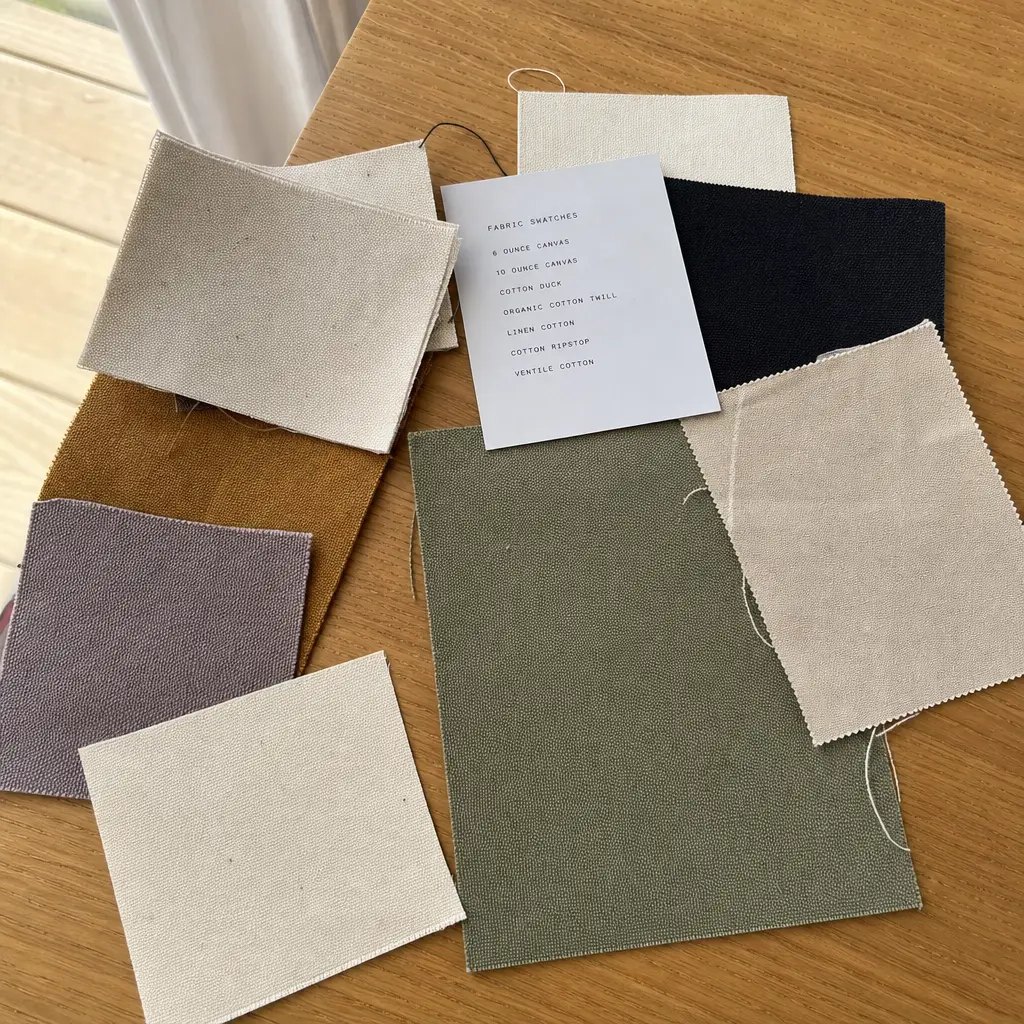
Natural cotton often suits artisan bakeries because it supports a handmade, local, or organic brand language. It also has natural character. Seed specks, slubs, creamy shade differences, and minor weave variation are normal unless the buyer asks for a cleaner grade, bleached cotton, or a dyed finish. The key is to approve the real look in advance, not from a polished digital mockup.
- Use 6 oz cotton only for very light promotional programs where low cost matters more than repeated use.
- Use 7-8 oz cotton canvas for balanced bakery merchandise, loyalty gifts, and reusable seasonal packaging.
- Use 10 oz canvas when stronger hand-feel is worth the higher fabric cost, sewing bulk, and freight weight.
- Ask for GSM or ounce tolerance because fabric weight can vary by batch, finish, and measurement method.
- Approve natural cotton shade and speck level from physical swatches before bulk cutting.
- Treat custom dyed cotton as a separate MOQ and lead-time discussion because lab dips and roll commitments may apply.
Keep Construction Simple, Not Weak
A drawstring backpack looks simple, but small construction choices can change MOQ and defect risk. A standard build usually uses two fabric panels, side seams, a bottom seam, top drawcord channels, and cord routing that also acts as shoulder straps. Add-ons such as metal eyelets, zipper pockets, lining, contrast panels, bottom gussets, custom cord tips, and multiple labels introduce more sourcing, sewing, and inspection steps.
For a low-risk first order, stay close to the supplier’s proven construction and spend the specification budget on fabric, print quality, and stress-point reliability. Many bakery programs do not need a complicated bag. A clean natural cotton backpack with a sharp logo and smooth cord function can do more for the brand than a feature-heavy design that raises MOQ and delays approval.
Do not remove reinforcement blindly to hit a price point. Bakery customers may place dense items in a compact bag: coffee, jam, granola, tins, boxed cookies, or farmers market purchases. The top channel, cord exits, side seams, bottom corners, and cord attachment points carry the stress. Ask how the supplier reinforces those points and whether the reinforcement changes price or MOQ.
- Keep one finished size and one panel construction across artwork versions to protect cutting efficiency.
- Use stocked cotton cord or flat cotton tape before requesting custom dyed cord or special cord tips.
- Specify cord diameter or tape width, cord color, cord length, and whether ends are knotted, sewn, or otherwise secured.
- Avoid metal eyelets unless they are necessary; they add sourcing steps and can create rust, noise, or inspection issues.
- Confirm woven side label MOQ, lead time, color approval, and placement tolerance before adding it to the spec.
- Prioritize reinforcement at cord stress points for bags expected to carry dense bakery goods.
Set Print Expectations Before the Strike-Off
Most bakery artwork is a strong match for screen printing: wordmarks, wheat illustrations, oven icons, pastry line drawings, anniversary marks, and bread club slogans. Water-based screen print often works well on cotton because it gives a softer, more natural hand-feel than heavy ink layers. On dark cotton, high-opacity screen print may be needed, but the buyer should approve opacity and hand-feel together because thicker ink can look less refined.
Digital pigment printing can be useful for seasonal artwork, gradients, many colors, or short artwork batches. It may reduce the need for multiple screens, but color result and cost depend on the fabric texture, pretreatment, artwork resolution, and the supplier’s equipment. There is no universal best method. Compare print methods using the actual artwork, actual fabric, order quantity, durability expectations, and repeat-order plan.
Artwork splits are a common hidden MOQ issue. A bakery group may request 500 bags across ten store logos, but the print room may treat that as ten setups of 50 pcs. Each version can require separate screens, strike-offs, registration, cleaning, carton separation, and carton marks. If local identity matters, compare printed logo splits with alternatives such as one shared main design plus store-specific hangtags, inserts, or destination labels.
- Use water-based screen print for 1-3 solid colors on natural or light cotton when soft hand-feel matters.
- Use high-opacity screen print on dark fabric, with strike-off approval for coverage, edge sharpness, and ink thickness.
- Use digital pigment print for detailed, multi-color, or short seasonal artwork after testing on actual cotton.
- Set print placement tolerance, commonly +/-5 mm for standard front logos, and define the measurement reference point.
- Review fine lines and small text at actual size because textured canvas can break lines or fill small gaps.
- Ask whether screen setup, PMS matching, strike-off, second-side print, artwork cleanup, and repeat screen storage are included.
Negotiate MOQ With Real Tradeoffs
A strong MOQ negotiation gives the supplier something operationally easier in exchange for a lower quantity or clearer price. For example, the buyer may accept stock natural cotton, black stocked cord, one finished size, one front print, and bulk packing while keeping logo color, print position, cord function, and seam strength non-negotiable. That protects the customer-facing details while reducing production complexity.
Request three scenarios. The first is a trial quantity, often 300-500 pcs when stock materials and simple printing are available and the supplier’s workflow supports it. The second is a commercial launch quantity such as 1,000 pcs, where cutting and setup costs spread more efficiently. The third is a repeat order using the same approved fabric, artwork, packing, and QC standard. These tiers show whether the buyer is paying a fair small-order premium or receiving a padded MOQ.
Do not make fabric downgrade the first lever. Cutting cotton weight, shortening cord length, loosening stitch density, or skipping samples may lower the visible unit price but damage the bakery’s customer experience. Better levers include stock materials, fewer artwork versions, bulk packing, one construction across locations, fewer accessories, and planned reorder timing.
- Ask for a low-MOQ trial price and a repeat-order price so fixed setup costs are visible.
- Negotiate total order quantity separately from artwork split because each print version may carry a minimum.
- Use shared bag artwork with location-specific hangtags or inserts when many store logos push MOQ up.
- Accept bulk packing when retail shelf handling, ecommerce picking, or barcode scanning does not require individual polybags.
- Do not approve a cheaper quote unless every spec change is listed in writing and sampled when performance may change.
- State in the PO that unapproved substitutions are not allowed, even if the supplier says the alternative is equivalent.
Compare Quotes by Landed Cost and Risk
Unit price is only one part of the decision. One supplier may quote a low EXW price and later add sample fees, screen charges, PMS matching, label costs, individual packing, carton marking, inland freight, and reinspection costs. Another may look higher at first but include strike-off support, packing clarity, and better inspection cooperation. Procurement should compare suppliers using the same specification, quantity tiers, Incoterm, and packing basis.
Carton data should be requested early. Cotton backpacks are soft goods, but fabric weight, fold method, individual polybags, hangtags, and carton quantity can change CBM and gross weight. A 10 oz individually packed bag can cost more to ship than an 8 oz bulk-packed bag even when the FOB difference looks small. Ask for carton dimensions, pieces per carton, net weight, gross weight, and estimated CBM at quote stage, then update the numbers after the packing sample is approved.
Risk terms have value too. If the strike-off is wrong, who pays for the remake? If a cord is substituted, does the buyer approve it before production continues? If carton marks are incorrect, who handles relabeling before handover? If mixed artwork appears in cartons that should be separated, what corrective action is included? These questions keep a cheap quote from becoming an expensive order.
- Compare 300, 500, 1,000, and 2,000 pcs using the same fabric, print, cord, packing, and delivery term.
- Separate sample fee, pre-production sample fee, screen setup, PMS matching, strike-off, label cost, packing cost, and inland freight.
- Request carton dimensions, pieces per carton, gross weight, net weight, and estimated CBM for each packing option.
- Include inspection and possible reinspection costs when suppliers offer different QC cooperation levels.
- Ask whether supplier-caused sample remakes, print corrections, packing rework, or carton relabeling are included.
- Use total landed cost and launch risk as the decision basis, not the lowest visible unit price.
Treat Samples as Production Agreements
A pre-production sample should act like a production agreement, not a decorative sales sample. It should use the actual bulk fabric quality, actual cord, actual print method, approved artwork size, approved print placement, final label or hangtag, and intended packing components where possible. If the sample uses substitute fabric or a different ink system, label it as a development sample and do not treat it as final bulk approval.
The approval record should mix measurements with visual standards. Measure finished width and height after sewing. Check cord length when the bag is fully open, cinched closed, and worn as backpack straps. Approve print color, opacity, hand-feel, edge sharpness, and position on the real cotton surface. Review natural cotton specks, slubs, and shade variation against what the bakery’s brand can accept. Put the result into the PO or specification sheet.
Change control matters even more on low-MOQ orders because there is less extra inventory to absorb problems. If the supplier changes fabric roll, cord supplier, ink type, label position, print size, carton quantity, or packing method after approval, the buyer should approve the change before bulk production continues. A small order can still damage a launch if it misses a holiday campaign, store opening, subscription release, or wholesale presentation.
- Approve fabric swatch, cord swatch, print strike-off, full pre-production sample, and packing sample as separate checkpoints.
- Keep one sealed approval sample with the buyer and one matching sealed sample with the supplier’s production team.
- Photograph approved print placement, label placement, cord routing, folded packing, and carton mark format.
- Do not release bulk cutting until fabric, size, cord, print, and required labels or hangtags are approved.
- Require written approval for any substitution after sample approval, including materials described as equivalent.
- Use the approved sample plus written tolerances as the final inspection reference.
Plan Packing, Receiving, and Timing Together
Packing is a procurement choice, not a warehouse afterthought. Bulk packing in bundles of 25, 50, or 100 pieces is efficient for bakery chain replenishment, staff assembly, distributor handling, farmers market events, and promotional handouts. Individual polybags may be necessary for retail shelves, ecommerce fulfillment, barcode scanning, or clean handling, but they add labor, material, plastic, carton volume, and inspection points.
Carton organization becomes critical when the order includes multiple artwork versions, destinations, stores, wholesale accounts, or campaign dates. Carton marks should identify PO number, SKU or artwork code, fabric color, quantity, destination, and carton count where applicable. Avoid mixed cartons unless the receiving team can count and allocate them accurately. Fixing carton errors after arrival is usually more expensive than defining carton rules before packing starts.
Lead time should be managed by decision gates. Sampling, artwork correction, print strike-off, material booking, label production, cutting, sewing, printing, inspection, packing, documents, and shipping handover can all affect the launch calendar. A supplier’s “25 days” may mean bulk production after deposit and all approvals, not the full project timeline. For seasonal bakery programs, build buffer for sample revisions, factory peak periods, local holidays, forwarder booking, and customs documentation.
- Use bulk packing unless retail, ecommerce, distributor cleanliness, or item-level barcode scanning requires individual packing.
- Specify bundle quantity, fold method, print-facing direction, polybag need, hangtag attachment, barcode placement, and carton marks.
- Avoid mixed cartons for multiple artwork versions unless each mix ratio and carton label is approved in writing.
- Ask which approval delays will move the ship date so internal bakery teams understand their own deadlines.
- Reserve final inspection before goods leave the factory, not after they reach a port warehouse or bakery distribution center.
- Update carton dimensions and CBM after packing approval so freight and landed-cost estimates remain accurate.
Write QC and Defect Rules Into the PO
Quality control should be agreed before production, not debated after cartons are packed. The main inspection areas for custom cotton drawstring backpacks are finished size, fabric weight, fabric shade, print placement, print color, print detail, seam strength, cord function, stains, loose threads, labels, packing accuracy, and carton marks. Without written standards, inspection becomes subjective.
Use measurable tolerances where possible. A practical finished-size tolerance is often +/-1 cm unless the buyer approves a wider range. A common print placement tolerance for a standard front logo is +/-5 mm. Fabric weight should be checked against the approved swatch or stated tolerance. Cord length should be consistent enough that the bag closes properly and can be worn as intended. Carton quantity must match the packing list and PO.
Defect classification protects both buyer and supplier. Critical defects include wrong artwork, unusable closure, broken cord, missing legally or commercially required label, or unsafe component. Major defects include open seams, severe stains, badly tilted logos, blocked channels, wrong packing, or wrong carton marks. Minor defects may include small loose threads, light removable creases, or natural cotton slubs within the approved standard. With this clarity, the supplier knows what to produce and the inspector knows how to judge it.
- Set tolerances for finished size, GSM, fabric shade, print placement, print color, stitch density, cord length, and carton quantity.
- Classify critical, major, and minor defects before inspection so accept/reject decisions are not improvised.
- Require random checks for measurement, print comparison, seam quality, cord function, stain review, label placement, and SKU separation.
- Check fine artwork details for pinholes, broken lines, filled letters, weak opacity, or blurred edges on textured canvas.
- Inspect presentation defects such as oil spots, needle dirt, water stains, heavy logo creases, and visible fabric damage.
- Keep inspection photos, defect counts, approved sample records, and packing lists for reorder comparison and supplier accountability.
Specification comparison for buyers
| Procurement decision | Practical specification target | MOQ impact | Quote or QC risk to control |
|---|---|---|---|
| Fabric weight | 7 oz to 10 oz cotton canvas, often about 220-340 GSM depending on weave, humidity, and finish | Stock canvas in this range is usually easier to source than custom-dyed or very heavy canvas | Ask for fabric weight tolerance, approved swatch, shrinkage expectation if washing is relevant, and whether GSM is measured before or after finishing |
| Fabric color | Stock natural, white, black, or supplier-held dyed cotton for first orders | Stock colors can reduce fabric-roll commitment and speed material booking | Natural cotton may show seed specks, slubs, and shade variation; define the acceptable visual standard before bulk cutting |
| Finished size | Common bakery-friendly size around 34 x 42 cm or 13.5 x 16.5 in, with +/-1 cm finished-size tolerance | One size improves cutting efficiency and avoids separate measurement standards | Confirm finished size after sewing, not flat pattern size; test with the actual apron, coffee bag, jar, boxed pastry, or gift insert |
| Drawcord | 5-7 mm cotton cord or flat cotton tape in stocked color, with consistent cord length per bag | Stock cord reduces custom material MOQ; contrast or dyed cord can add material minimums | Thin cord can twist, cut into shoulders, fray, or pull through weak attachment points; inspect cord function on bulk samples |
| Seam and stress points | Double-fold top channel, secure side seams, reinforced cord exits or bottom corners where load is expected | Simple construction supports lower MOQ, but reinforcement may be worth keeping | Specify stitch density, back-tacking, channel opening quality, and cord attachment strength before approving production |
| Print method | Water-based screen print for 1-3 solid colors; digital pigment for multi-color seasonal artwork or small runs | Each print artwork, color, and position may create separate setup even when bag construction is identical | Confirm screen charges, PMS matching, strike-off approval, print size, print placement tolerance, opacity, and rub resistance |
| Artwork versions | One shared main design, with store-specific identity handled by hangtag, insert, carton allocation, or small secondary label | Many bakery location logos can raise effective MOQ per artwork | Ask whether MOQ applies per total order, per print design, per colorway, per size, or per packing SKU |
| Packing format | Bulk pack in inner bundles of 25, 50, or 100 unless retail or ecommerce requires individual packing | Bulk packing reduces labor, plastic, carton volume, and inspection points | Individual polybags, barcodes, hangtags, and mixed-SKU cartons must be quoted and inspected as separate requirements |
| Lead time | Break out sampling, strike-off, material booking, cutting, sewing, printing, inspection, packing, and handover | Low MOQ does not guarantee short lead time if materials, labels, or print approvals are custom | A quoted 25 production days may exclude sample revisions, deposit date, artwork correction, label production, inspection booking, or vessel cutoff |
Buyer checklist before sampling
- Define the commercial use before sourcing: retail merchandise, bread club welcome item, loyalty gift, delivery packaging, farmers market promo, corporate gifting add-on, wholesale buyer kit, or staff launch kit.
- State finished bag size, fabric ounce weight or GSM range, fabric color, cord type, cord color, print method, logo size, print position, seam construction, packing method, and destination in the RFQ.
- Decide the expected load category: light inserts and apron, medium coffee or packaged snacks, or denser bakery goods such as jars, granola, tins, or boxed gift items.
- Ask whether the MOQ is per total order, per fabric color, per finished size, per artwork, per print color, per label version, or per packing SKU.
- Keep the first MOQ negotiation focused on one or two levers such as quantity tier, artwork split, stock material choice, or packing format instead of changing every component at once.
- Ask which materials are stocked and which require separate procurement: cotton canvas, drawcord, woven label, care label, hangtag, barcode sticker, polybag, carton, and carton label.
- Request fabric swatches with stated GSM or ounce weight, cord swatches, print strike-offs, and one full pre-production sample made with intended materials before bulk cutting.
- Set measurable tolerances in the purchase order: finished size, fabric weight, print placement, print color reference, stitch density, cord length, carton quantity, and acceptable natural cotton appearance.
- Compare quotes using total order value and estimated landed cost, not only FOB or EXW unit price; include sample fee, screen charge, PMS matching, label cost, packing cost, inland freight, inspection, and estimated CBM.
- Confirm packing rules before production: inner bundle quantity, individual polybag requirement, hangtag attachment, barcode placement, carton marks, mixed-carton rules, pallet preference, and store allocation.
Factory quote questions to send
- What is your practical MOQ if we use stocked natural cotton canvas, stocked cotton cord, one finished size, one front print, and bulk carton packing?
- Does your MOQ apply per total order, per fabric color, per finished size, per print artwork, per print color, per label version, or per packing SKU?
- Which cotton canvas weights do you regularly hold for drawstring backpacks, and what tolerance do you apply for GSM or ounce weight in bulk production?
- Can you quote the same bag in 7 oz, 8 oz, and 10 oz cotton canvas so we can compare unit price, hand-feel, carton weight, and freight impact?
- What is the minimum efficient cutting quantity per size and fabric color in your workshop, and at which quantity tiers does the unit price materially improve?
- How does MOQ and lead time change if we request custom dyed fabric, custom dyed cord, contrast cord, woven side labels, individual polybags, or multiple bakery location logos?
- Can you quote water-based screen print, high-opacity screen print, and digital pigment print separately for our artwork at 300, 500, 1,000, and 2,000 pcs?
- Are screen setup charges, PMS color matching, strike-off samples, artwork adjustment, second-side printing, and repeat-order screen storage included or charged separately?
- What print placement tolerance, print color tolerance, and line-detail limits do you recommend for this artwork on textured cotton canvas?
- Can you make a pre-production sample using actual bulk fabric, actual cord, actual print method, final label, final hangtag, and intended packing components?
Quality-control points to confirm
- Finished size should be measured after sewing with the bag laid flat and lightly smoothed; a common tolerance is +/-1 cm unless the purchase order states otherwise.
- Fabric weight should be checked against the approved swatch or lab-cut reference; bulk fabric should not be visibly thinner, looser, or more transparent than the approved sample.
- Natural cotton shade should be reviewed under consistent lighting, with accepted seed specks, slubs, and shade variation defined by the approved swatch or defect board.
- Print placement should normally stay within +/-5 mm for a standard front logo and must remain level when the bag is laid flat without excessive stretching.
- Print color should be compared with the approved strike-off or PMS target, allowing realistic variation caused by cotton texture and ink absorption.
- Fine lines, small text, wheat illustrations, oven icons, and pastry drawings should be checked at actual size for filling, broken edges, pinholes, and loss of detail.
- Drawcord should pull smoothly through both top channels without twisting, snagging, shedding lint, fraying, or cutting the fabric at cord exits.
- Cord length should be checked in open, cinched, and worn positions so the bag closes properly and straps are usable for the intended customer profile.
- Bottom corners, side seams, channel ends, and cord attachment points should be checked for back-tacking, skipped stitches, open seams, and reinforcement consistency.
- Screen print should pass the agreed dry rub check and a buyer-approved damp cloth or gentle hand-wash resistance check when washability is part of the claim.