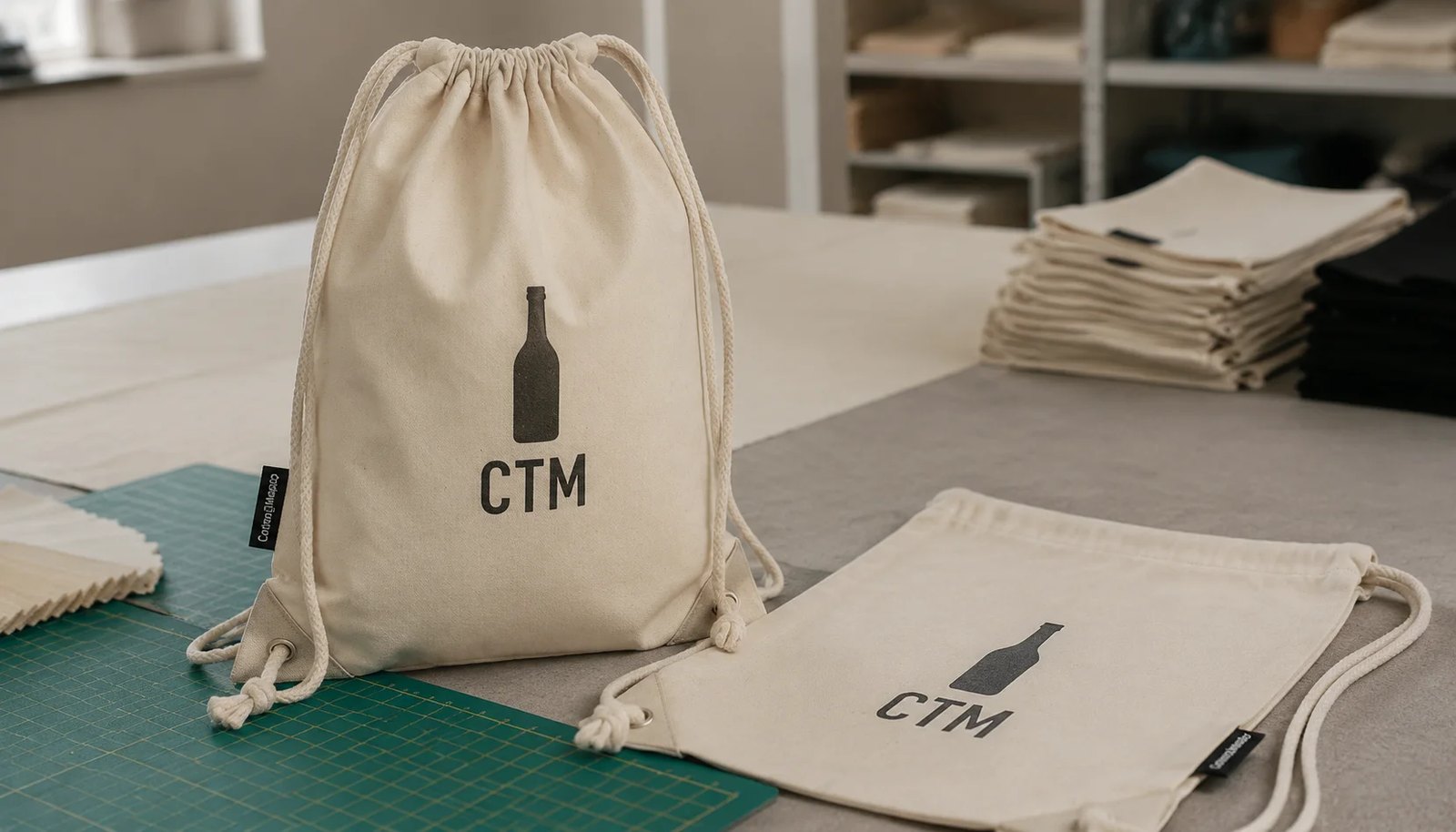
Where MOQ Pressure Really Comes From
For custom cotton drawstring backpacks, MOQ is rarely a single number. A factory may talk about 500 pieces, 1,000 pieces, or 3,000 pieces, but the real limit can come from fabric purchasing, dye lot, cord availability, print setup, cutting efficiency, carton packing, or the number of artwork versions. Liquor retailers often lose negotiating room because they request many variables at once: several brand logos, a special cotton shade, individual polybags, store-specific cartons, and a tight event date.
The cleanest negotiation starts by separating the body of the backpack from the decoration. If the same natural cotton backpack body can be used for several liquor brands or store campaigns, the supplier may be able to cut one efficient fabric lot and print smaller design batches afterward. That usually gives better leverage than asking for completely separate backpacks by brand, especially when each brand wants a small test quantity.
- Body MOQ: driven by fabric width, cutting table efficiency, sewing line setup, and cord supply.
- Print MOQ: driven by screen setup, ink color changes, artwork size, curing time, and print wastage allowance.
- Packing MOQ: driven by carton marks, inner packing method, store allocation, and warehouse receiving rules.
- Material MOQ: affected by cotton canvas color, GSM, yarn quality, cord color, labels, and any custom accessories.
Start With the Retail Use Case
A liquor retailer buying drawstring backpacks should define the load and handling path before negotiating quantity. A backpack handed out empty at a tasting event can use a lighter construction than a retail gift bag carrying glassware, cocktail kits, branded apparel, or boxed accessories. If the bag will be reused by customers, the buyer should treat it as a product with performance expectations, not as a disposable pouch with shoulder cords.
The use case also changes which MOQ arguments are credible. A factory can reduce MOQ more easily when the spec uses stock natural cotton, a standard body size, standard cord, and one-color print. A low MOQ becomes harder when the retailer needs dyed fabric to match a spirits brand, heavy canvas, custom woven labels, complex print coverage, and many separate carton allocations.
- Event handout: prioritize low unit cost, fast print approval, and carton handling speed.
- Gift-with-purchase: prioritize fabric feel, print accuracy, and strength at the cord corners.
- Premium retail program: prioritize 10 oz or heavier cotton canvas, neat stitching, and controlled logo position.
- Distributor campaign: prioritize repeatable specs, artwork version control, and consistent packing lists.
Fabric Weight and Construction Choices
Cotton drawstring backpacks for liquor retail programs usually sit between 6 oz and 12 oz cotton canvas. A 6 oz fabric can be acceptable for light promotional use, but it may look weak beside premium whisky, wine, tequila, or craft spirits branding. For most retail buyer programs, 8 oz to 10 oz gives a better balance of perceived value, sewing efficiency, and freight weight. In GSM terms, buyers commonly compare around 220 GSM, 270 GSM, 300 GSM, and 340 GSM options.
Heavier fabric does not automatically mean a better buy. A 12 oz canvas backpack may feel substantial, but it increases cutting resistance, sewing time, carton weight, and freight cost. It can also raise MOQ if the supplier does not keep that fabric in regular stock. For MOQ negotiation, the practical move is to request the supplier's regular cotton canvas weights first, then choose the lowest weight that still passes the retailer's handling and brand presentation requirements.
- 6 oz or around 200 GSM: light event use, lower perceived value, easier to compress in cartons.
- 8 oz or around 270 GSM: common balance for reusable promotions and liquor retail handouts.
- 10 oz or around 300-340 GSM: stronger brand feel and better for heavier contents.
- 12 oz and above: premium feel, but higher landed cost and more pressure on MOQ.
Print Method and Artwork Control
Screen printing is usually the best starting point for MOQ negotiation on cotton drawstring backpacks. It is stable, familiar to factories, cost-effective for solid liquor logos, and easier to inspect than many specialty effects. One-color and two-color prints are the simplest to quote. If the artwork uses gradients, photographic labels, metallic effects, very fine lines, or large ink coverage, the supplier may need heat transfer, digital print, or additional testing, which changes both cost and lead time.
Liquor brands often have strict color rules, but cotton is not a coated paper label. Natural cotton absorbs ink differently, and slubs or texture can affect the visual edge of small text. The RFQ should define Pantone targets, print size, print placement, and acceptable color tolerance. For large front panel logos, the buyer should also approve ink hand-feel, because a heavy ink layer can make the backpack front stiff and less premium.
- Use vector artwork for logos, seals, and campaign marks.
- State maximum print area in centimeters, not only as a visual mockup.
- Avoid tiny legal text on textured cotton unless the supplier confirms readable output.
- Approve print on the actual fabric weight, because ink behavior changes between 6 oz and 10 oz cotton.
How to Negotiate MOQ Without Weakening the Product
The strongest MOQ negotiation is not simply asking for a lower number. It gives the factory a production structure that still makes sense. A liquor retailer can often negotiate by committing to one standard backpack body and using that body across several campaigns. The supplier cuts and sews a practical total quantity, while the buyer splits decoration into brand or event versions. This works best when print size, print location, and print colors remain similar.
Another useful route is staged ordering. Instead of demanding a very low MOQ for a fully custom backpack, the buyer can approve a first production run using stock natural cotton and standard cord, then reserve the right to repeat with forecasted quantities. A credible forecast helps, especially for importers and distributors who can show seasonal demand around holidays, tasting events, or retail chain promotions. The forecast should be realistic; inflated volumes do not help once the supplier reviews repeat orders.
- Negotiate total body quantity and per-design print quantity separately.
- Keep fabric color standard for the first order if timing and MOQ matter.
- Use the same print placement across versions to reduce setup complexity.
- Offer repeat-order visibility only when the retailer can support it with a real campaign calendar.
- Avoid changing cord, label, size, and packing rules for every artwork version.
Quote Data That Makes Comparison Possible
A useful supplier quote should show more than a unit price. For custom cotton drawstring backpacks, buyers need enough data to compare production risk and landed cost. A cheap quote with no GSM, no carton data, and no print method is not comparable with a detailed quote from a factory that has priced the correct construction. Procurement teams should require the same data fields from every supplier before discussing final MOQ concessions.
The quote should also expose which parts are optional. Individual polybags, woven labels, reinforced corners, upgraded cotton cord, and special carton allocation can each add cost. If these items are bundled into one number, the buyer cannot decide what to keep and what to remove. A clear quote lets a liquor retailer reduce MOQ pressure by simplifying the right item instead of accidentally removing the feature that protects quality.
- Fabric: composition, weight in oz or GSM, color, shrinkage or finishing notes.
- Size: finished width, height, tolerance, and whether dimensions are before or after sewing.
- Cord: material, diameter, color, construction, and bottom reinforcement method.
- Print: method, number of colors, print size, setup cost, sample cost, and curing requirement.
- Packing: pieces per carton, carton size, gross weight, net weight, CBM, and carton mark rules.
- Commercial terms: MOQ, price breaks, sample lead time, bulk lead time, payment terms, and quote validity.
Sample Approval Should Test the Real Risks
A sample is not only for appearance. It is the buyer's chance to catch the production risks that become expensive after bulk sewing starts. For liquor retail programs, the sample should be made in the quoted fabric weight with the intended cord type and actual print method. A sample made from a random lighter fabric or a different print technique may look acceptable in a photo but fail as an approval reference.
The sample approval record should include photos, measurements, print position, fabric weight, cord details, and any comments on hand-feel. If the buyer approves a sample with vague notes such as 'looks good,' later disputes become difficult. A factory can only hold production to measurable points. The approval should state which differences are acceptable and which changes require written approval before bulk production.
- Measure finished width and height flat on a table.
- Pull cords firmly from both sides and inspect bottom corner reinforcement.
- Rub the print with a dry white cloth to look for visible transfer.
- Compare print color under neutral light, not only under warm office lighting.
- Pack sample contents similar to the retail program and carry it by the cords for a short practical test.
Packing and Allocation for Liquor Retail Chains
Packing is often treated as an afterthought, but it can create cost and schedule problems. Liquor retailers may need cartons separated by campaign, region, store group, distributor, or seasonal display program. If this is not stated in the RFQ, the factory may quote standard bulk packing, then add cost later for sorting, relabeling, or mixed artwork cartons. That late change can also slow shipment because packing instructions touch the final production stage.
For most cotton drawstring backpacks, flat packing is more efficient than individual folding into retail-style sleeves. A standard carton of 50 or 100 pieces is easier to count and reduces handling. Individual polybags may be required for cleanliness or store distribution, but they add labor, plastic, and carton volume. Buyers should decide whether polybags are necessary for the channel rather than copying packaging used for more fragile products.
- Use flat bulk packing when the backpacks will be unpacked at a distribution center.
- Use inner bundles by artwork or store group when allocation accuracy matters.
- Use individual polybags only when cleanliness, resale presentation, or store handling requires it.
- Require carton marks that match the purchase order, artwork version, quantity, and destination code.
- Request carton dimensions and CBM before approving the quote, not after goods are finished.
Lead Time Risks in Small MOQ Orders
Small orders are not always fast orders. A factory may fit a low MOQ backpack order between larger production runs, but that flexibility depends on fabric stock, print schedule, and sewing line availability. If the buyer requests a custom dyed cotton, unusual cord color, specialty print, or store allocation packing, the order may need the same preparation time as a larger shipment. The purchase quantity is only one part of the lead time.
The safest timeline separates sample, artwork approval, material preparation, bulk cutting, printing, sewing, inspection, packing, and export booking. For a liquor retailer working toward a tasting event or seasonal promotion, the critical date is not the factory completion date. The critical date is usable stock at the retailer's warehouse or store network. Any negotiation that reduces MOQ but removes schedule buffer may cost more than it saves.
- Sample making can take longer when the exact fabric or cord is not in stock.
- Artwork approval delays often stop production more than sewing capacity does.
- Print curing time and inspection should be built into the schedule.
- Mixed artwork packing can add time at the end of production.
- Ocean freight, customs, and inland distribution should be considered before committing to event dates.
Landed Cost and Quote Comparison
MOQ negotiation should be tied to landed cost per usable backpack. A lower MOQ may create a higher unit price, higher freight share per piece, and more inspection cost per unit. That can still be worthwhile for a test program, but the buyer should understand the tradeoff. For an importer or distributor, the best choice may be a moderate MOQ with repeatable specs rather than the lowest possible opening quantity.
When comparing quotes, normalize the specification first. A 6 oz backpack with thin polyester cord and one-color print is not the same product as a 10 oz cotton canvas backpack with reinforced corners, cotton cord, and woven side label. If the retailer is comparing suppliers, each quote should be evaluated against the same approved spec and the same packing requirement. Only then does price comparison show real supplier competitiveness.
- FOB unit price: useful, but incomplete without carton and CBM data.
- Freight cost per unit: affected by carton volume, packing method, and order quantity.
- Inspection cost per unit: higher on small orders but important for multi-store campaigns.
- Defect allowance: low-cost production is expensive if weak cords or bad prints create unusable stock.
- Repeat value: a stable body spec can reduce future sample cost and speed repeat orders.
Specification comparison for buyers
| Spec decision | Recommended option | When it fits | Buyer risk to check |
|---|---|---|---|
| Fabric weight for bottle-related promotions | 8 oz to 10 oz cotton canvas, roughly 270-340 GSM | Good for liquor gift-with-purchase programs, tasting kits, and reusable retail bags that may carry glass bottles or boxed accessories | Below 7 oz can feel too thin for premium spirits; above 12 oz may raise freight, sewing time, and MOQ pressure without adding retail value |
| Backpack size | Approx. 34 x 42 cm or 35 x 45 cm with tolerance stated at +/-1 cm | Fits standard promotional inserts, tasting booklets, small apparel items, or one protected bottle accessory set | Oversized panels increase fabric consumption and carton volume; undersized bags may fail store teams during packing |
| Cord construction | Cotton cord or polyester cord, 5-6 mm, with reinforced bottom corner stitching | Works for repeat opening and closing in retail handouts and event use | Thin cord cuts into shoulder area; weak corner bartacks can fail when the bag carries heavy promotional contents |
| Logo method | One or two color screen print for most MOQ negotiations | Best when liquor brand artwork uses solid marks, batch names, or tasting event graphics | Large ink coverage on natural cotton can stiffen the panel; metallic, puff, or gradient artwork changes setup cost and sample timing |
| Labeling | Small woven side label or inside care label separated from main print approval | Useful for house brand programs, distributor identity, or compliance information without changing the whole bag | Multiple label versions can split production into smaller lots and weaken MOQ leverage |
| MOQ structure | Negotiate one fabric and body size with multiple print designs only if print colors and placement stay similar | Suitable for liquor retailers running several store banners, seasonal campaigns, or regional beverage partners | Factories may accept lower MOQ per design but still require a total fabric cutting quantity; unclear design splits cause re-quotation |
| Packing format | Flat packed 50 or 100 pcs per export carton with inner polybag optional by retail requirement | Best for warehouse receiving, store allocation, and lower freight volume | Individual polybags add labor, plastic cost, carton volume, and possible sustainability objections |
| Inspection plan | AQL-based final inspection plus focused checks on print adhesion, cord pull strength, seam allowance, and carton count | Appropriate for importers, distributors, and liquor retail chains with multiple receiving locations | Visual inspection alone may miss weak drawcord channels, ink rubbing, or mixed artwork inside cartons |
Buyer checklist before sampling
- Define whether the backpack is a premium reusable item, event giveaway, gift-with-purchase bag, or store allocation pack before discussing MOQ.
- State fabric type, GSM or ounce weight, finished size, cord material, cord diameter, reinforcement method, and allowed size tolerance in the RFQ.
- Separate body MOQ, fabric MOQ, print MOQ, label MOQ, and packing MOQ so the supplier can show where the real constraint sits.
- Limit the first negotiation round to one body size and one fabric color if the goal is a lower opening MOQ.
- Provide artwork size, print position, number of colors, Pantone references, and whether ink hand-feel matters on the front panel.
- Request a pre-production sample made in the nominated fabric weight, not only a photo of an existing backpack in a similar style.
- Set acceptance criteria for print registration, color tolerance, seam strength, cord pull resistance, and carton quantity accuracy.
- Give the supplier a realistic annual or seasonal forecast if you need several smaller call-offs instead of one large shipment.
- Confirm whether packing must support liquor store allocation by SKU, campaign, state, province, or store group.
- Compare quotes on landed cost per usable backpack, not only FOB unit price.
Factory quote questions to send
- What is your minimum cutting quantity for this cotton canvas weight and color, separate from the finished backpack MOQ?
- Can you quote one body size with two or three logo designs, and what is the minimum quantity per print design?
- Which fabric weights do you keep regularly for drawstring backpacks: 6 oz, 8 oz, 10 oz, 12 oz, or GSM equivalents?
- What cord options are available from stock, and what is the MOQ impact if we require cotton cord instead of polyester cord?
- What is the quoted print method, setup charge, maximum print area, and expected color tolerance against Pantone references?
- Will the sample be made by the same sewing line and printing process intended for bulk production?
- What are the standard carton dimensions, gross weight, pieces per carton, and CBM per 1,000 units for the quoted specification?
- What lead time applies after artwork approval, deposit, and fabric confirmation, and which step controls the critical path?
- Can you support store allocation packing, mixed artwork cartons, or carton marks by campaign without changing the MOQ?
- What inspection standard do you use for fabric defects, print defects, broken stitches, loose threads, and cord pull strength?
Quality-control points to confirm
- Fabric weight should be verified against the approved sample using GSM or ounce weight tolerance agreed before production.
- Finished size should stay within the stated tolerance, commonly +/-1 cm for width and height unless the design requires tighter control.
- Print should pass dry rub and light scratch checks without obvious ink flaking, smearing, or transfer onto adjacent bags.
- Cord channel stitching should be straight, secure, and free from skipped stitches that can open under repeated pulling.
- Bottom corner reinforcement should withstand practical pull testing because this is where shoulder load concentrates.
- Logo placement should match approved artwork position within the agreed tolerance, especially on natural cotton where panel distortion is visible.
- Cartons should match the packing list by artwork, quantity, carton mark, and destination allocation.
- Needle holes, oil stains, fabric slubs, odor, and dirt marks should be controlled before packing, not corrected at the receiving warehouse.