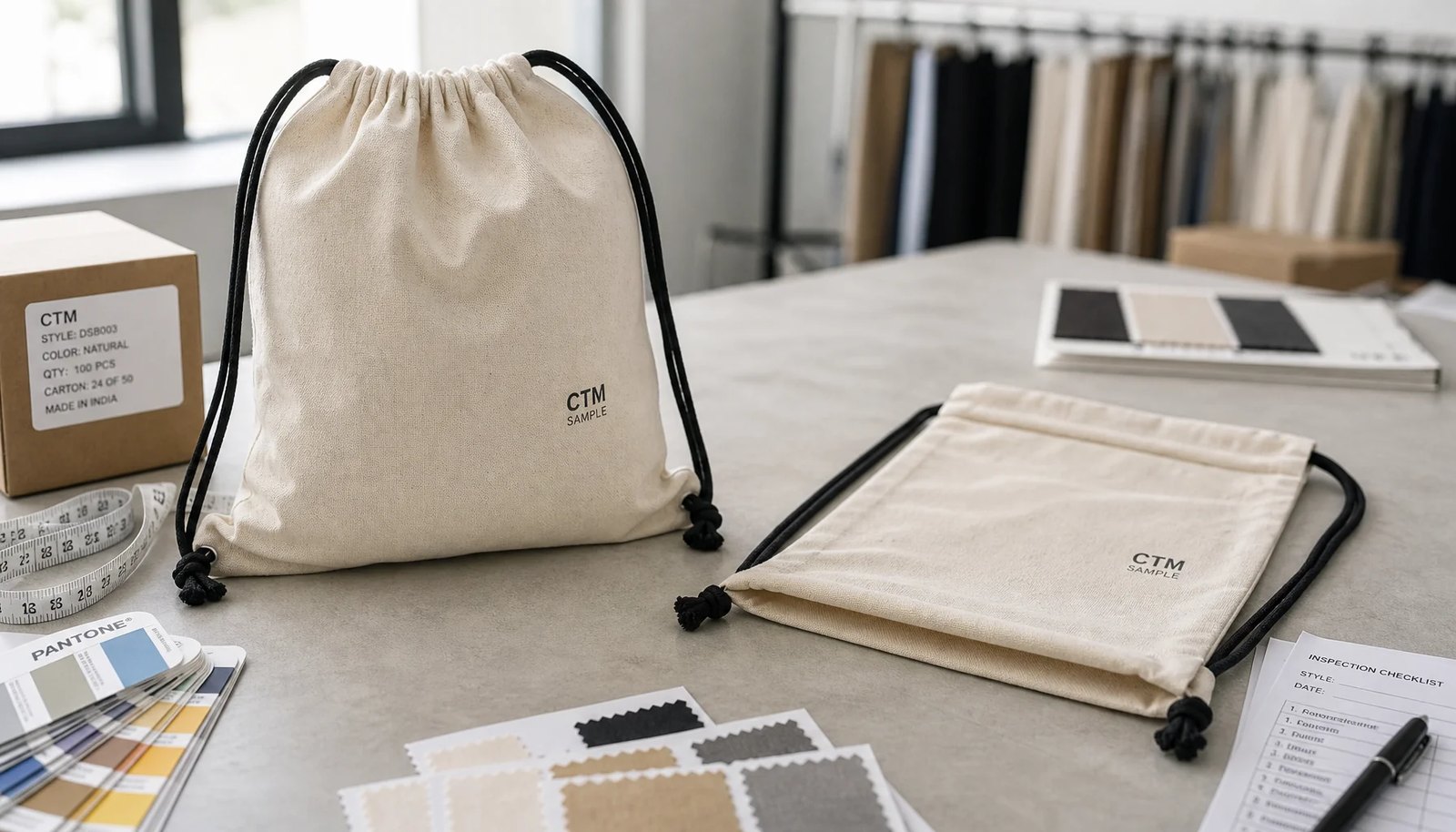
Start With Program Demand, Not a Target MOQ
University bookstore orders often look simple from the outside: one cotton drawstring backpack with a campus logo. In practice, demand may come from admissions, orientation, athletics, alumni relations, housing, academic departments, clubs, and retail merchandising. Each group can request a different artwork, date, delivery point, barcode, or packing style. MOQ negotiation is stronger when the buyer first maps the program instead of asking a supplier to quote one vague total quantity.
Factories usually calculate minimum order quantity around the least efficient part of the order. Fabric purchasing, dye lots, cutting setup, screen setup, print registration, sewing changeover, packing rules, and carton labeling can all create separate thresholds. A 1,000-piece order split across five fabrics and five artworks may be treated like several small jobs. The same 1,000 pieces using one body, one fabric, one cord, and several print versions gives the supplier more room to negotiate without quietly reducing quality.
- List quantities by department, artwork, bag color, delivery date, and sales channel before sending the RFQ.
- Treat MOQ as per artwork, fabric color, construction, and packing method until the supplier confirms otherwise.
- Combine approved department demand under one shared bag body when fabric, size, cord, and seams are identical.
- Share possible repeat demand as planning context, not as a promise unless the volume is funded and approved.
Define the Bag Body Before the Logo
The bag body drives most cost and minimums. A strong RFQ defines finished dimensions, fabric type, fabric weight, cord material, lower-corner construction, drawcord channel, seam allowance, print area, label requirement, and packing format. A common bookstore size may be around 35 x 45 cm or 14 x 18 in, but the right size depends on whether the bag carries a hoodie, notebooks, orientation packets, a water bottle, light books, or only event inserts.
Fabric is the first practical negotiation lever. Lightweight cotton around 140-160 GSM can work for simple giveaways but may feel weak for bookstore resale. Cotton around 180-200 GSM can suit budget campus events if expectations are clear. For reusable merchandise, 220-240 GSM cotton drill or about 8 oz cotton canvas is often a balanced starting point. Heavier 10 oz or 12 oz canvas can improve structure and perceived value, but it increases fabric cost, sewing time, carton weight, freight cost, and sometimes mill or cutting minimums.
- Provide finished width, height, cord length, cord channel height, and print area instead of only a photo reference.
- Name the intended load: apparel, notebooks, event packets, welcome kits, light books, or resale purchases.
- Ask for two fabric-weight quotes when handfeel and budget are still being evaluated.
- Avoid comparing a 160 GSM cotton quote with an 8 oz canvas quote as if they describe the same product.
Use Stock Inputs to Lower Minimums
MOQ pressure drops when the buyer chooses materials the factory already runs. Natural cotton, black cotton, regular stock-dyed colors, standard cord colors, and an existing pattern usually support lower minimums than custom dyeing, unusual cord colors, special linings, or new hardware. If school colors are important, many bookstores get better control by printing approved Pantone logo colors on a neutral bag instead of custom dyeing the entire fabric.
Custom dyeing is the common MOQ reset. The bookstore may want 500 pieces, but the fabric mill may require a larger dye lot. Even when custom dyeing is possible, shade approval, lab dips, bulk dye variation, and extra lead time add risk. A buyer should ask whether the supplier has regular cotton inventory, whether fabric is purchased per order, and whether the MOQ changes by fabric color.
- Choose natural, black, or regular stock colors when the objective is a lower first-run MOQ.
- Keep cord color standard unless the cord is a visible brand requirement.
- Confirm if MOQ is based on fabric purchase, dye lot, cut quantity, or finished bags.
- Use print color, hangtags, or packaging to carry brand detail when custom fabric color is not essential.
Separate MOQ From Setup Charges
A low MOQ is not automatically a better deal. Some suppliers build setup work into a higher unit price; others show separate charges for screens, sampling, artwork adjustment, cutting, or special packing. For procurement, the clearer quote is often the better quote because it shows what changes when volume increases or artwork is repeated.
Ask for price breaks that match realistic bookstore buying patterns, such as 300, 500, 1,000, and 3,000 pieces per shared construction or per artwork. The goal is to see where fabric cutting, print setup, sewing, and packing become more efficient. A small test run may need a higher unit price, but a repeat order using the same approved body and artwork should carry less sampling risk and may qualify for better pricing.
- Ask which cost blocks create the MOQ: fabric, cutting, print setup, sewing, packing, or export handling.
- Negotiate total cut quantity when fabric, size, cord, and construction are identical.
- Accept transparent setup charges when they prevent hidden cuts to fabric, curing time, or inspection.
- Request repeat-order pricing tied to the same approved sample and artwork files.
Control Artwork Splits and Licensing
Artwork is the hidden MOQ multiplier in university bookstore programs. One wordmark in one color is straightforward. Multiple mascot versions, school names, sponsor marks, event dates, department lockups, and bookstore-exclusive graphics create separate screens, approvals, sorting, inspection, and carton labeling. Even if the bag body is identical, each artwork version needs its own production control.
Before quoting, divide artwork into confirmed, pending, and speculative versions. Confirmed art can be sampled and priced accurately. Pending art should have a firm approval deadline. Speculative art should not hold the full production schedule. If university licensing review is required, build it into both the sample stage and any later artwork change. Natural cotton texture can mute ink compared with a screen proof, so licensed marks should be reviewed on a physical strike-off or pre-production sample.
- Group artwork by color count, print size, approval status, and required delivery date.
- Confirm whether MOQ and setup charges apply per artwork, per print color, or per total order.
- Provide vector files, Pantone references, placement measurements, and licensing rules at RFQ stage.
- Set a final art approval date before bulk printing, not after the PO is released.
Pick the Print Method for Use Case
Screen printing is usually the most practical method for cotton drawstring backpacks with one to three solid university colors. It gives predictable coverage and cost for wordmarks, mascot graphics, alumni slogans, and bookstore resale designs. The tradeoff is setup: each color needs a screen and registration. When many artwork versions have low quantities, setup can become a large share of total cost.
Heat transfer can help with gradients, full-color graphics, photographs, or small sponsor logos, but it must be tested on the exact cotton fabric. Buyers should check edge lift, gloss, handfeel, cracking after flexing, and adhesive marks. Digital printing may be available from some suppliers, but color brightness, pretreatment marks, wash behavior, and cotton texture still require sampling. A digital proof does not replace a physical print approval.
- Use screen print for repeat campus marks, solid colors, and larger program quantities.
- Consider heat transfer for complex full-color designs only after durability and handfeel testing.
- Avoid very fine text on textured cotton unless the supplier proves it with a strike-off.
- Require curing, rub, scratch, adhesion, and blocking checks before folded bulk packing.
Make the Sample the Contract Standard
The pre-production sample is the physical version of the commercial agreement. It should use actual fabric weight, actual drawcord, actual print method, final seam construction, final size, and intended packing presentation. A blank sample can confirm dimensions and sewing, but it cannot approve ink coverage, print position, logo scale, Pantone appearance, curing, or folding behavior.
Create a sample approval record instead of relying on a short email saying approved. Measure finished width and height, print size, distance from top seam, distance from side edges, cord channel height, cord length, and bundle or carton presentation if available. Photograph the sample under neutral light and keep the approved reference available to purchasing, licensing, receiving, and the supplier.
- Approve a physical sample or printed strike-off before bulk printing starts.
- Record measurements, print location, color references, seam details, cord type, and packing method.
- Use the approved sample as the inspection standard for size, handfeel, print, and construction.
- Restart approval when artwork, fabric, print method, cord, size, or packing changes.
Compare Quotes by Landed Usable Cost
A procurement quote should allow a fair comparison, not just display the lowest unit price. Request fabric type and weight, finished size, cord specification, reinforcement method, print method, print color count, setup charges, sample cost, MOQ rule, quantity price breaks, packing method, carton quantity, carton dimensions, gross weight, production lead time, inspection terms, trade term, and quote validity. Missing fields often become later cost surprises.
For cotton drawstring backpacks, freight and receiving matter because bags are bulky relative to unit value. Heavy canvas may be right for resale, but it can increase carton weight and shipping cost. Individual polybags, hangtags, barcode stickers, or retail folding can improve store handling but add labor and materials. The clean comparison metric is landed cost per approved usable bag, including product cost, setup, sample allocation, freight, duty if applicable, inspection, defect sorting, and internal receiving effort.
- Normalize quotes to the same fabric, size, print method, color count, cord, reinforcement, and packing.
- Separate unit cost from setup, sample, artwork, label, barcode, and special packing charges.
- Request carton CBM and gross weight before estimating freight or warehouse handling cost.
- Evaluate approved usable bags, not only the lowest quoted FOB or EXW unit price.
Set Packing Rules for Campus Operations
Packing should match how the backpacks will be received and used. Retail resale may require hangtags, barcode stickers, SKU separation, inner cartons, and carton marks that match receiving documents. Orientation or admissions distribution may be better with flat bulk bundles. Distributor shipments may require pallet rules, advance shipment notices, or maximum carton weights.
Packing affects quality as well as cost. Individual packaging adds labor and material and may conflict with campus plastic-reduction goals. Bulk packing reduces waste but requires accurate counts, clean bundling, and protection from print transfer. If screen-printed bags are folded too soon after curing or compressed too tightly, prints can block, crease, or transfer. The packing method should be approved before production, not improvised after sewing is complete.
- Choose retail-ready packing only when POS, ecommerce, or warehouse rules require it.
- Use counted bulk bundles for event distribution when individual packaging adds no value.
- Confirm pieces per carton, carton size, gross weight, CBM, inner bundle quantity, and carton marks.
- Set a maximum carton weight that works for bookstore receiving rooms and campus stockrooms.
Plan Lead Time Around Fixed Campus Dates
University bookstore deadlines are tied to academic calendars. Orientation, welcome week, move-in, family weekend, homecoming, graduation, and season openings do not move because sampling or licensing took longer than expected. Work backward from the required receiving date and include demand collection, artwork preparation, licensing review, quotation, sample production, sample transit, revisions, bulk production, inspection, export booking, freight, customs if applicable, and local delivery.
Lead-time ranges should be treated as planning assumptions, not promises. For a standard fabric, simple screen print, and available factory capacity, sampling may take roughly one to two weeks after production-ready artwork, while bulk production may take several additional weeks after final approval. Region, season, order quantity, artwork count, transport mode, holidays, supplier workload, and inspection timing can all change the schedule. The production clock should start from final sample or strike-off approval, not merely from PO date.
- Build the schedule backward from the bookstore receiving date, not the desired ship date.
- Ask the supplier for region-specific production, transit, customs, and delivery assumptions.
- Protect time for licensing review, sample transit, revision cycles, inspection, freight, and receiving.
- Identify the last safe approval date for artwork, fabric, packing, and shipping mode.
Specification comparison for buyers
| MOQ driver | Lower-MOQ choice | When it works for bookstores | Procurement risk to control |
|---|---|---|---|
| Fabric body | Natural, black, or stock-dyed 220-240 GSM cotton drill or 8 oz cotton canvas | Best for 300-1,000 pcs per artwork when the bookstore wants reusable merchandise without custom dyeing | Confirm whether MOQ is per fabric color, per dye lot, or total cut quantity; approve handfeel and finished weight before bulk |
| Bag size | One shared size such as 35 x 45 cm or 14 x 18 in with agreed tolerance | Works across admissions, bookstore retail, alumni events, orientation kits, and department giveaways | Oversized bags use more fabric, increase carton cube, and can change price; do not approve from reference photos only |
| Drawcord and reinforcement | Standard cotton or polyester-cotton cord with reinforced corners or bar-tacked lower loops | Suitable for carrying apparel, notebooks, event packets, light retail purchases, and welcome-week inserts | Thin cords, weak eyelets, or unreinforced exits can fail first; require pull checks on stress points |
| Artwork split | Same bag body with multiple screen-printed artwork versions | Useful when schools, departments, clubs, or event teams share one procurement program | Ask if MOQ and setup charges apply per artwork, print color, bag color, or total PO volume |
| Print method | Screen print for 1-3 solid colors; transfer for complex full-color art only after testing | Fits most university wordmarks, mascot art, alumni slogans, and bookstore resale graphics | Fine text can fill on cotton texture; approve a physical strike-off with Pantone tolerance |
| Labels and retail presentation | Standard hangtag, barcode sticker, or no individual packaging depending on sales channel | Controls cost when some units are retail-ready and others are event-ready | Mixed packing rules create receiving errors; define SKU, barcode, hangtag, bundle, and carton marks |
| Supplier model | Cut-and-sew cotton bag factory with controlled printing or accountable print subcontracting | Best for repeat programs, consistent construction, and clear remake responsibility | Trading-only quotes may hide print timing, inspection ownership, and defect-resolution terms |
| Sample approval | Pre-production sample using actual fabric, cord, print, seams, and intended packing | Needed before licensing approval, buyer sign-off, ecommerce photography, or large bulk release | A blank sample plus digital proof cannot validate ink coverage, placement, shade, folding, or curing |
| Packing and cartons | Flat bulk bundles, often 50 pcs per bundle and 100-200 pcs per carton depending on GSM | Works for bookstore receiving rooms, distributor warehouses, and campus event kit assembly | Overpacked cartons can crease prints, transfer ink, exceed safe handling weight, or conflict with plastic-reduction rules |
Buyer checklist before sampling
- Map total demand by department, artwork, fabric color, delivery date, sales channel, and shipping destination before asking for MOQ.
- Define finished backpack width, height, cord length, cord channel height, print area, and acceptable size tolerance in writing.
- Specify fabric construction and weight, such as plain cotton, cotton drill, or cotton canvas with GSM or oz target.
- Separate total program volume from per-artwork, per-fabric-color, per-size, and per-packing-method quantities.
- Provide vector artwork, Pantone colors, print dimensions, print placement, and university licensing requirements before sampling.
- Ask whether MOQ applies per artwork, per bag color, per fabric dye lot, per packing method, or per purchase order total.
- Request price breaks at realistic quantities, including test-run volume, reorder volume, and full program volume.
- Require a pre-production sample with actual fabric, actual drawcord, actual print method, final seams, and intended packing.
- Set acceptance standards for size tolerance, fabric shade, print color, print placement, seam strength, stains, odor, and loose threads.
- Confirm whether screen setup, sample cost, artwork adjustment, hangtag, barcode label, inner bundle, and carton marking are included.
Factory quote questions to send
- What is your lowest practical MOQ using regular cotton fabric, standard drawcord colors, one standard size pattern, and normal screen printing?
- Does your MOQ apply per artwork, per print color, per fabric color, per bag size, per packing method, or per purchase order total?
- At what quantities do fabric purchasing, cutting, printing, sewing, and packing become efficient enough to reduce unit price?
- Which cotton fabrics can you supply regularly, such as 180 GSM, 220 GSM, 240 GSM, 8 oz, 10 oz, or 12 oz canvas?
- Can you quote the same bag at two fabric weights so we can compare unit cost, handfeel, carton cube, and freight impact?
- Can you produce a pre-production sample with actual fabric, actual screen print or transfer, actual cord, final seams, and final packing?
- What print method do you recommend for our logo size, color count, fabric texture, expected use, and order split?
- What Pantone tolerance can you control for university colors, and how will you manage shade variation between sample and bulk?
- What are the sample lead time, sample transit time, bulk lead time, inspection window, shipping mode, and latest approval date for our receiving deadline?
- How many pieces fit per export carton, what are estimated carton dimensions and gross weight, and can you meet our maximum carton weight?
Quality-control points to confirm
- Measure finished size flat after normal fabric relaxation, with width and height typically held within about plus or minus 1 cm unless tighter tolerances are agreed.
- Check fabric weight against the approved sample by GSM test, cutting-weight comparison, or supplier production record before bulk cutting proceeds.
- Review fabric shade by batch under consistent light, especially for natural cotton variation or mixed production lots.
- Measure print placement from fixed reference points such as top seam, side edge, and cord channel, with written tolerance before production.
- Test screen print with dry rub, light scratch, adhesion, and blocking checks after curing, especially before folded packing.
- Check heat transfer for edge lift, gloss consistency, handfeel, cracking after flexing, and adhesive marks on textured cotton.
- Pull-test drawcord ends, lower corner loops, eyelets if used, and cord channels because these stress points often fail before the fabric panel.
- Inspect seams for consistent stitch density, skipped stitches, open seams, broken threads, and loose thread clusters around corners.
- Confirm packing prevents moisture, odor transfer, print transfer, excessive compression, and severe creasing during ocean, air, parcel, or warehouse movement.
- Classify final inspection defects as critical, major, and minor so buyers know which issues trigger sorting, repair, replacement, or rejection.