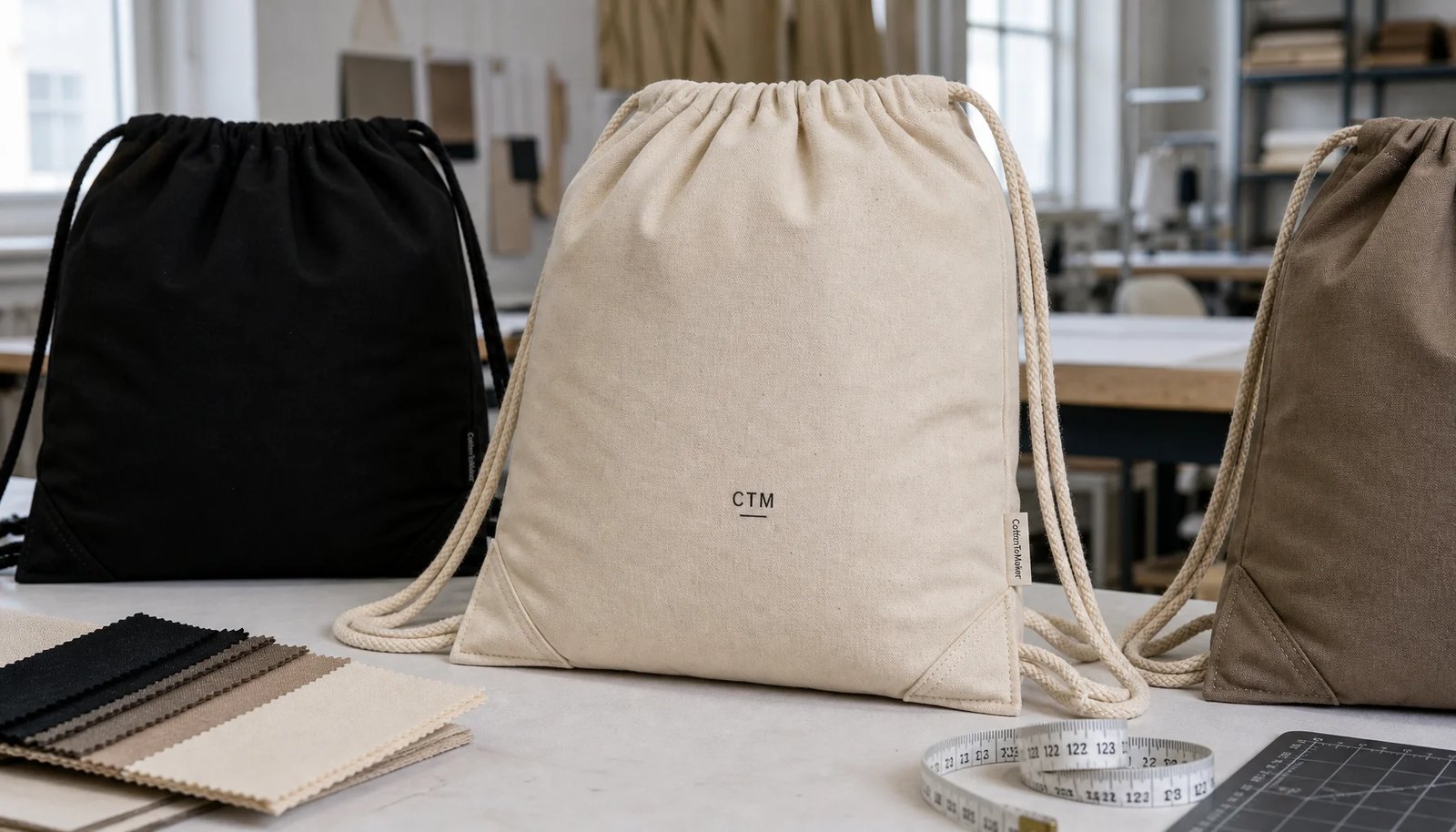
Start With The Actual Event Load
A cotton drawstring backpack for a trade show is not only a logo surface. It has to survive a long day of catalogues, sample packs, business cards, badge lanyards, water bottles, and sometimes a laptop charger that nobody planned for. Material selection should start with the expected load, not the lowest quoted unit price.
For light brochure use, a lighter cotton may be acceptable. For an exhibitor kit that includes product samples or heavier printed materials, the buyer should move toward canvas weight fabric and reinforced cord exits. This decision affects fabric cost, print quality, sewing speed, carton weight, and the way visitors judge the exhibitor brand.
- Brochure-only giveaway: 4 oz to 5 oz cotton can work if the design is simple and the event is short.
- Mixed show kit: 6 oz to 8 oz cotton canvas is the safer middle range for most exhibitors.
- VIP or retail-style gift: 10 oz canvas gives a stronger handfeel but raises freight and sewing cost.
- Heavy sample products: use reinforced bottom corners and avoid very thin plain weave cotton.
Choose GSM By Function, Not By Habit
Cotton bag quotes often list fabric as 4 oz, 6 oz, 8 oz, or 10 oz. Some factories quote in GSM, and some quote both. As a rough guide, 4 oz cotton is often around 140 GSM, 6 oz around 200 GSM, 8 oz around 270 GSM, and 10 oz around 320 to 340 GSM. The exact conversion varies by fabric construction and finishing, so the approved sample matters more than a number typed into a quote sheet.
A common buying mistake is asking several suppliers for a cotton drawstring backpack without defining GSM. One supplier may quote thin promotional cotton, another may quote canvas, and the buyer then compares prices that do not represent the same product. A clean RFQ should state the target GSM range, acceptable tolerance, fabric construction, and whether the final approval is based on a physical swatch.
- Use 140-170 GSM only when budget is the main driver and durability is secondary.
- Use 200-270 GSM when the backpack should feel useful after the event.
- Use 320 GSM and above when the bag is part of a premium booth kit or retail campaign.
- Avoid comparing quotes unless all suppliers confirm fabric weight and construction in writing.
Natural, Bleached, Dyed, Recycled, Or Organic Cotton
Natural unbleached cotton is popular for trade show drawstring backpacks because it gives a clear cotton look, supports a lower-processing story, and prints well with dark spot colors. It is not pure white, and the shade can vary slightly between fabric lots. If the booth design needs a clean white background, bleached cotton should be specified instead of assuming natural cotton will look bright.
Dyed cotton is useful when the backpack must match a brand color or stand out on a crowded show floor. The tradeoff is more control work: lab dips, colorfastness, shade tolerance, and sometimes longer lead time. Recycled or organic cotton can be commercially valuable for sustainability programs, but it must be quoted with documentation requirements stated early. Certifications, transaction documents, and hangtag claims can change MOQ and lead time.
- Natural cotton: good for dark logo prints, practical budgets, and simple sustainability messaging.
- Bleached cotton: better when artwork needs a cleaner white base, but it may look less natural.
- Dyed cotton: stronger brand impact, with added lab dip and shade approval steps.
- Recycled or organic cotton: specify documentation needs before price comparison.
Fabric Construction Changes The Print Result
Two backpacks can have the same GSM and still print differently. A tight canvas usually gives a flatter surface for screen printing than a loose plain weave. Coarser yarns create more texture, which can make fine lines, small text, and thin outlines look less sharp. For trade show bags viewed at arm's length, this may be acceptable, but logos with legal copy, QR codes, or detailed icons need extra attention.
If the artwork has fine detail, the factory should review the file before confirming the print method. Screen printing is still the most common choice for one to three solid colors. Heat transfer can handle gradients and small digital runs, but it changes the handfeel and may not match the natural cotton story. Embroidery is possible on heavier cotton canvas, although it can pucker lighter fabric and adds cost.
- For bold one-color logos, screen print on 6 oz or 8 oz cotton canvas is usually efficient.
- For gradients or photo-style artwork, consider heat transfer and approve the film edge carefully.
- For premium small logos, embroidery works better on heavier canvas than on thin cotton.
- For QR codes, test scanning from the printed sample before approving production.
Cord And Reinforcement Are Material Decisions Too
Buyers often spend time on the front fabric and logo, then leave cord material unspecified. That is risky because the cord is both the closure and the shoulder strap. Cotton cord gives a soft, natural appearance and matches the product story. Polyester cord can be more consistent in color, smoother through the channel, and more resistant to abrasion. Both can be correct, but they should be selected deliberately.
The weakest point on a drawstring backpack is usually where the cord exits near the bottom corner. For trade show use, especially with catalogues or sample products, reinforced triangle patches and bar tacks are worth specifying. A small saving from deleting reinforcement can become a visible failure at the booth, where visitors overload bags immediately.
- Specify cord diameter, material, color, and finished length.
- Use reinforced bottom corners when the event kit is more than paper inserts.
- Require bar tacks or secure stitching at cord stress points.
- Review whether the cord slides smoothly after the bag is printed, sewn, and packed.
Understand MOQ Logic Before Negotiating
MOQ is not only a factory rule. It is connected to fabric purchasing, dyeing minimums, print setup, cutting efficiency, and packing labor. A standard natural cotton fabric in a common weight may allow a lower MOQ because the supplier can source it from regular stock. A custom dyed 10 oz canvas with matched cotton cords may need a higher MOQ because fabric dyeing and cord dyeing both have minimum batch quantities.
For exhibitors, the best negotiation is usually not pushing every specification into a low MOQ. It is separating must-have features from nice-to-have features. If the event needs only 500 pieces, natural cotton with screen print may be more realistic than custom dyed fabric, special cord tips, individual bags, and multiple print locations. If the brand needs a strict color program, order volume and lead time should support that decision.
- Lower MOQ is easier with stock natural or black cotton fabric.
- Dyed fabric, custom cords, and multiple sizes usually increase MOQ.
- Large logo areas may increase print setup and reject risk even if fabric MOQ is unchanged.
- Split deliveries or multiple artwork versions should be discussed before sampling.
Build The RFQ Around Quote Data
A useful supplier quote should do more than state a unit price. Procurement teams need enough data to compare the real cost of each option. For cotton drawstring backpacks, quote data should include fabric GSM, finished size, print method, number of print colors, reinforcement style, packing method, pieces per carton, carton measurement, gross weight, sample charge, tooling or setup charge, and production lead time.
This information protects the buyer from false savings. A thin bag packed 200 pieces per carton may look cheap but arrive wrinkled and fail under load. A heavier canvas bag may have a higher unit price but better event value, lower complaint risk, and a more useful second life. Without carton CBM and gross weight, the landed cost comparison is incomplete.
- Compare unit price together with carton CBM and gross weight.
- Separate print setup charges from per-piece production cost.
- Request the cost impact for 4 oz, 6 oz, 8 oz, and 10 oz options when volume justifies comparison.
- Ask whether the quoted price is based on approved artwork size or only a rough logo estimate.
Sample Approval Should Be More Than Looking At The Logo
The pre-production sample should represent the actual production plan. A sample made from substitute fabric is useful only for shape review, not final approval. For trade show orders, the approved sample should include the real GSM, real fabric color, actual cord, reinforcement, print method, logo size, and packing method if packing affects wrinkles or presentation.
Sample review should include handling. Load the bag with the same materials planned for the booth and wear it for a few minutes. Pull the cords open and closed several times. Fold the printed area once and rub it with a dry white cloth after curing. These simple checks often reveal issues that a flat product photo cannot show.
- Measure finished width, height, channel depth, and cord length.
- Compare fabric handfeel against the approved swatch or previous sample.
- Check print edge sharpness, opacity, curing, and placement.
- Load test with realistic event contents before signing off.
Packing Choices Affect Presentation And Freight
Packing is part of material selection because cotton wrinkles, absorbs moisture, and changes carton volume depending on how it is folded. Bulk packing is efficient for booth handouts and reduces extra material. Individual polybags keep items cleaner during warehouse handling, but they add labor, plastic, carton volume, and unpacking time at the venue. Paper belly bands or recycled paper sleeves can look cleaner but need realistic testing so they do not tear during transport.
Carton planning matters when an exhibitor is shipping directly to a venue or a show service warehouse. Overpacked cartons can crush the bags and create deep fold lines across the logo. Underpacked cartons increase freight cost. The RFQ should state whether cartons need shipping marks, event name labels, SKU labels, barcode labels, or palletization instructions.
- Use bulk packing for simple booth distribution when the receiving team can manage loose units.
- Use individual packing for distributor resale, kitting, or multi-location shipments.
- Avoid fold lines directly through large screen-printed logos where possible.
- Confirm pieces per carton, carton size, gross weight, and shipping marks before final invoice.
Lead Time Risk Comes From Approvals, Not Only Sewing
Cotton drawstring backpacks are simple products, but trade show dates are fixed. The schedule risk usually comes from slow artwork approval, fabric color approval, material sourcing, print strike-off approval, and packing changes after the order is placed. Sewing time may be short, while waiting for dyed fabric or revised logo files can consume the buffer.
A practical timeline separates sample lead time, approval time, material purchasing, cutting, printing, sewing, inspection, packing, export handling, and shipping. If the event date is close, choose stock fabric colors and a proven print method. A buyer who needs custom dyed fabric, exact Pantone matching, and individual labeled packing should protect the schedule with earlier approval and a clearer decision path.
- Freeze artwork before sample production whenever possible.
- Approve lab dips before bulk dyed fabric is purchased.
- Reserve time for print strike-off review on dark fabrics or large logos.
- Keep a buffer for inspection, carton relabeling, and freight booking.
Specification comparison for buyers
| Spec decision | Recommended option | When it fits | Buyer risk to check |
|---|---|---|---|
| Main fabric weight | 6 oz to 8 oz cotton canvas, about 200-270 GSM | Most trade show giveaways where the bag must carry brochures, catalogues, samples, and a light bottle without looking too cheap | Very low GSM may reduce quote price but causes show-through, poor shape, and weaker cord exit points |
| Economy fabric route | 4 oz to 5 oz plain cotton, about 140-170 GSM | High-volume, short-use events where the backpack is mainly a handout bag and the logo is simple | Print may look less solid, dark objects can show through, and shrinkage after washing may be more visible |
| Premium fabric route | 10 oz cotton canvas, about 320-340 GSM | Retail-style exhibitor gifts, paid merchandise, VIP kits, and distributor programs needing stronger perceived value | Heavier fabric increases carton weight, freight cost, sewing time, and minimum order pressure |
| Natural versus dyed fabric | Natural unbleached cotton for lower dye risk; dyed cotton for brand color matching | Natural works well for sustainability messaging and simple dark prints; dyed fabric fits strict brand color programs | Dyed cotton requires colorfastness review, lab dip approval, and tolerance for shade variation between batches |
| Cord material | Cotton cord for a soft natural look; polyester cord when higher abrasion resistance or color consistency is needed | Cotton cord suits eco-positioned campaigns; polyester cord suits repeat handling, dark colors, or sharper matching | Cotton cords can fray or shrink; polyester cords may reduce the natural product story if not disclosed |
| Logo print method | Screen print for solid spot-color logos; heat transfer for gradients or small color runs | Screen print is the default for most exhibitor logos, especially one to three colors on flat panels | Fine lines can fill in on coarse cotton; large prints on dark fabric may need underbase and extra curing control |
| Reinforcement design | Bar-tacked cord exits with cotton or canvas triangle reinforcement | Recommended when bags will carry catalogues, giveaway products, drinkware, or tech accessories | Unreinforced corners save cost but are the first failure point when visitors overload the bag |
| Packing method | Individual polybag or paper belly band only when required; otherwise bulk pack with layer separation | Bulk pack fits low-waste event handouts; individual packing fits distributor resale or pre-kitted booth shipments | Individual packing adds labor, material cost, carton volume, and sometimes avoidable plastic waste |
Buyer checklist before sampling
- Define the expected load: brochures only, sample products, drink bottle, apparel, or mixed exhibitor kit.
- Choose cotton fabric by GSM and construction, not by the word cotton alone.
- State whether natural, bleached, dyed, recycled, or organic cotton is required before suppliers quote.
- Specify finished size, seam allowance expectation, cord length, cord diameter, and reinforcement style.
- Match print method to artwork: spot color screen print, CMYK transfer, embroidery, or woven label.
- Request a pre-production sample using the actual fabric weight, cord, print method, and packing method.
- Set measurable acceptance criteria for size tolerance, print position, shade variation, seam strength, and carton labeling.
- Ask suppliers to separate fabric cost, print setup, unit price, packing cost, inland freight, and export carton details.
- Calculate landed cost using carton CBM and gross weight, not only the factory unit price.
- Lock artwork, fabric color, and packing instructions before mass production to protect lead time.
Factory quote questions to send
- What cotton fabric construction and GSM are included in the quoted unit price?
- Is the fabric greige, bleached, dyed, recycled, organic, or conventional cotton?
- Can you provide a fabric swatch or previous sample close to the quoted material before sampling?
- What is the minimum order quantity for this exact fabric weight, color, and print method?
- Does the quote include screen setup, color matching, print curing, trimming, and packing labor?
- What print method do you recommend for our artwork and fabric color, and why?
- What size tolerance, print placement tolerance, and color tolerance do you use in production?
- How are cord exits reinforced, and are bar tacks included in the quote?
- What are the estimated carton quantity, carton size, gross weight, and CBM per carton?
- What is the sample lead time, mass production lead time, and latest artwork approval date to meet our event date?
Quality-control points to confirm
- Fabric GSM should be verified by swatch comparison or lab weight test against the approved sample.
- Finished width and height should normally stay within plus or minus 1 cm unless a tighter tolerance is agreed.
- Logo placement should normally stay within plus or minus 5 mm to 8 mm from the approved sample position.
- Print color should be compared under consistent light against Pantone target, artwork file, or approved strike-off.
- Screen prints should pass a basic rub test after curing and should not crack heavily when the fabric is folded once.
- Cord length should be consistent across production so the backpack hangs evenly on both shoulders.
- Cord exit points should include secure stitching or reinforcement with no loose threads cutting into the cord.
- Seams should show even stitch density, clean backstitching, and no skipped stitches on stress points.
- Cartons should match approved quantity, gross weight range, shipping marks, and packing method.
- Random finished goods should be loaded with a realistic event kit to confirm handle feel and corner strength.