Start with the craft fair use case, not the fabric swatch
Custom cotton drawstring backpacks for craft fairs can look almost identical in a product photo and still be very different products. A visitor giveaway, a paid market bag, a workshop kit carrier, and a sponsor-branded event backpack do not carry the same risk. They need different cotton weights, cord choices, reinforcement details, packing rules, and inspection standards.
That is why the sourcing brief should begin with the bag’s job. What will it hold? Who receives it? Will it be sold, given away, packed with materials, or kept as a repeatable stock SKU? If buyers skip these questions and ask only for “a cotton drawstring backpack,” one supplier may quote a thin promotional sack while another quotes a reinforced canvas item. The cheaper quote may not be wrong. It may simply be for a different product.
Procurement teams should also ask what failure would create cost. For a free event giveaway, late delivery and poor logo appearance may be the biggest problems. For paid merchandise, weak handfeel, crooked printing, or uncomfortable cords can hurt sell-through. For workshop kits, the bag has to fit the contents quickly at packing time and survive the weight of the kit. For distributor stock, repeatability matters: the next order should not arrive with a different GSM, shade, cord, or fit.
- Event giveaway: prioritize delivery date, acceptable print appearance, efficient carton packing, and lower unit weight.
- Paid merchandise: prioritize cotton handfeel, consistent stitching, print clarity, stronger cord, neat reinforcement, and retail presentation.
- Workshop kit bag: prioritize finished size, usable opening, load performance, smooth cinching, and stress-point reliability.
- Sponsor or artist edition: prioritize artwork version control, strike-off approval, sorted packing, and clear carton labeling by design.
- Distributor stock SKU: prioritize stable materials, repeatable dimensions, reorder documentation, barcode/carton control, and sealed reference samples.
Choose cotton weight by GSM, load, and landed cost
Fabric weight is the material decision that most strongly shapes cost, feel, durability, and freight. Suppliers may describe cotton by ounces, GSM, or trade terms such as calico, canvas, duck, or sheeting. Those words help, but they are not enough for a purchase order. The specification should state a target weight and a tolerance, commonly ±5% unless the buyer needs tighter control.
As a working reference, 6 oz cotton is often about 190-220 GSM, 8 oz cotton canvas is often about 260-280 GSM, and 10 oz cotton canvas is often about 320-360 GSM. Exact values vary by mill, weave, yarn, and finish, so the approved swatch and GSM requirement should sit together in the file. Do not rely on a photo or a supplier’s generic “canvas” label.
For many craft fair programs, 8 oz cotton canvas is the safe middle ground. It feels more substantial than a 6 oz promotional bag without the extra sewing bulk and freight weight of heavier canvas. A 6 oz cotton bag can work for flat paper inserts, light giveaways, soft yarn, fabric patches, or greeting cards. It should not be positioned as premium or heavy-duty. A 10 oz cotton canvas bag makes more sense for retail resale, museum shops, premium maker kits, and heavier contents.
The lowest unit price may not produce the lowest landed cost. Heavier cotton increases finished bag weight, carton gross weight, warehouse space, and sometimes freight. If a fixed craft fair date forces air shipment after a production delay, the material choice becomes a logistics choice. Ask for carton quantity, carton dimensions, net weight, gross weight, and total carton count for each fabric option before choosing.
- 6 oz / about 190-220 GSM: suitable for light giveaways, paper programs, flat instructions, greeting cards, soft craft goods, and cost-sensitive distribution.
- 8 oz / about 260-280 GSM: recommended default for mixed craft fair use, paid bags, workshop materials, sponsor merchandise, and light daily reuse.
- 10 oz / about 320-360 GSM: stronger handfeel for resale, premium maker kits, museum shops, and heavier insert programs.
- 12 oz and above: usually unnecessary for a simple drawstring backpack unless the brief calls for a rugged canvas look and the buyer accepts extra freight and sewing bulk.
- RFQ requirement: state target GSM, tolerance, weave description, fabric finish, finished bag weight if available, and logistics data.
Compare natural, bleached, dyed, washed, and pre-shrunk cotton with real approval samples
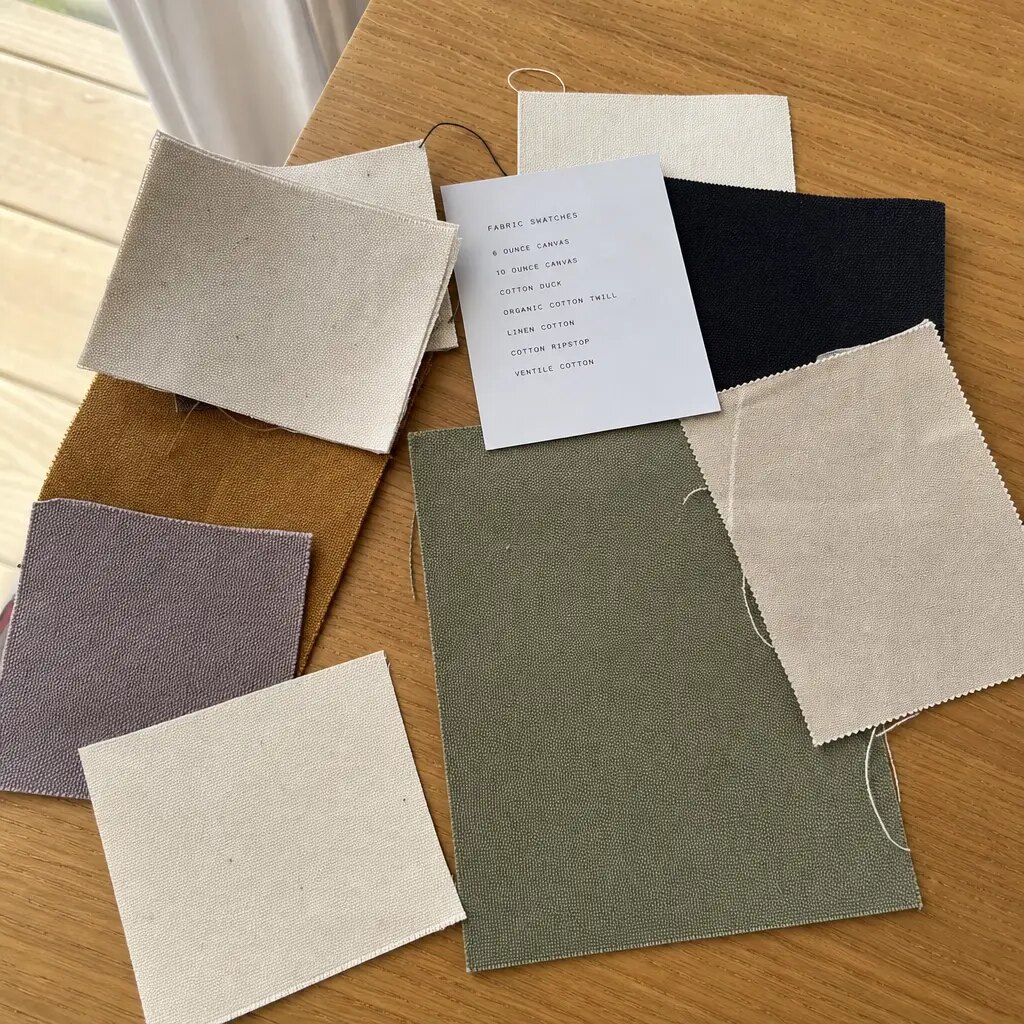
Natural cotton is popular at craft fairs because it fits a handmade, organic, and low-key brand language. It pairs well with black, brown, olive, navy, burgundy, terracotta, and other earthy print colors. But natural cotton is not a controlled white background. It can shift from cream to beige or slightly gray, and it may show small cotton flecks. If the backpack will sit beside hangtags, printed packaging, or branded displays, approve a physical swatch instead of judging shade from a screen.
Bleached cotton gives a cleaner base and stronger contrast for pale inks or detailed logos. It also shows stains, sewing dirt, yellowing, and handling marks more clearly. If the front panel is part of the retail presentation, define obvious marks in the logo area as major defects. Dyed cotton gives stronger visual impact, especially for seasonal or sponsor programs, but it adds sourcing steps. Stock dyed fabric is usually simpler than custom dye. Custom dye requires lab dips, approval rounds, dye-lot control, colorfastness review, and usually higher minimums.
Washed, pre-shrunk, and sanforized cotton should not be treated as vague comfort claims. They affect measurement, shade, shrinkage, and repeatability. Washing can soften the bag, but it may increase size variation and shade variation. Pre-shrunk or sanforized cotton is useful when the finished backpack must fit an A4 folder, box, notebook, or retail pack with less size movement. If consumers are likely to wash the bag, ask for shrinkage expectations after a defined wash method and decide whether the approved size is before or after washing.
- Natural cotton: best for handmade, organic, and minimal craft positioning; control lot shade with approved swatches.
- Bleached cotton: better for crisp artwork and lighter print colors; inspect carefully for stains, yellowing, and handling marks.
- Stock dyed cotton: good for visual impact and faster development than custom dye; request rubbing and shade-range checks.
- Custom dyed cotton: use when brand color matters enough to justify lab dips, higher MOQ, and additional lead time.
- Washed cotton: softer and more relaxed; approve final measurements after washing, not before.
- Pre-shrunk or sanforized cotton: useful for repeatable kit packing, retail boxes, and size-sensitive reorders.
Specify finished size, usable opening, and construction details
The word “standard” causes more problems than it solves. One factory may quote 34 x 42 cm, another 35 x 45 cm, and another may be referring to cutting dimensions before seams and top channel folding. For custom cotton drawstring backpacks, finished flat dimensions matter most. Buyers should specify finished width, finished height, usable opening, top channel height, and cord exit location.
Test the largest real item that will go into the bag. A4 programs need height and clean inner seams. A boxed craft kit needs clearance so staff can insert it without tearing paper bands or denting corners. Yarn and apparel need volume more than flat width. Candles, jars, notebooks, and small books create localized weight at the lower corners. If packing happens at a busy booth or workshop table, fast insertion is part of the product requirement, not an afterthought.
Construction should follow the expected load. A light giveaway may be fine with a simple folded channel and basic side seams. Reusable merchandise and workshop bags should have stronger lower corners, secure cord exits, and reliable stitching. Eyelets can look tidy, but they are not automatically stronger on cotton. On lighter fabric, a metal eyelet can pull out unless the area is backed or reinforced. Fabric corner triangles or sewn cord tabs often work better for cotton canvas drawstring backpacks.
- Common adult finished size: around 34 x 42 cm for programs, apparel, light merchandise, and general craft fair use.
- Kit size: measure the actual box, notebook, yarn bundle, candle carton, or retail insert and add practical clearance for fast packing.
- Opening width: confirm usable opening after side seams and the top channel are sewn.
- Channel height: leave enough room for the chosen cord or tape to slide without bunching.
- Construction drawing: include finished width, height, seam allowance, channel depth, cord exit position, reinforcement, print position, and label position.
- Tolerance example: ±1 cm for finished width and height, ±0.5 cm for channel height, and ±1 cm for print placement may be practical for many simple cotton styles if agreed before production.
Select cords and channels for comfort, smooth draw, and durability
Cord choice changes the way the backpack feels immediately. A thin cord may reduce cost and carton bulk, but it can dig into shoulders when the bag carries books, jars, candles, or workshop materials. A wider flat tape spreads pressure better and can make a simple cotton backpack feel suitable for resale. For many B2B craft fair projects, an 8 mm round cord or a 10-15 mm flat cotton tape is a sensible starting point.
Cord material should be chosen deliberately. Cotton cord supports a natural look and pairs well with cotton canvas, but it may fray, absorb moisture, or shrink differently from the main body. Polyester cord often slides more smoothly and offers better color stability, but it may not suit a strict natural-material story. A cotton-poly option can be useful when appearance and function both matter. Put the cord material, diameter or tape width, color, end treatment, knot style, and finished loop length in the RFQ.
The top channel has to match the cord. A thick round cord in a narrow channel creates friction and pushes users to pull harder. Flat tape needs enough width so it does not twist, fold, or jam at the seam. During sampling, open and close the bag repeatedly, then load it and hang it by the cords. This low-tech test often finds cord slippage, channel catching, uncomfortable wearing position, and weak lower corners before bulk production starts.
- 6 mm round cord: acceptable for very light giveaways where cost and compact packing matter most.
- 8 mm round cord: common general-purpose choice for cotton drawstring backpacks.
- 10-15 mm flat tape: better for shoulder comfort, paid merchandise, workshop kits, and repeat use.
- Cotton cord: natural appearance; check fraying, shrinkage, knot security, and color consistency.
- Polyester cord: smoother draw and stronger performance; confirm whether the material story allows it.
- Cord ends: specify knotted, sewn, capped, taped, tipped, or heat-sealed ends where applicable.
- QC check: measure loop length and verify that both sides cinch evenly when the bag is worn.
Plan screen printing and decoration around cotton’s texture
Screen printing is the practical decoration method for many custom cotton drawstring backpacks used at craft fairs. It works well for one to four spot colors, logos, event names, sponsor marks, artist signatures, and simple illustrations. It is also straightforward to quote and inspect. The limitation is the fabric itself: cotton canvas is woven, textured, and absorbent. Artwork that looks sharp on coated paper can soften on cloth.
Turn brand artwork into production rules. Specify print size in centimeters, placement from finished edges, number of colors, Pantone targets, and acceptable placement tolerance. Very fine lines, small reversed text, gradients, tight multi-color registration, and large solid ink areas should be tested on the actual production fabric. Natural cotton will warm and dull some colors because the base shade is not white. A digital proof is useful for layout, but it should not be the final color approval for cotton bags.
Other decoration methods may fit certain briefs. Digital printing can support complex artwork or many colors, but buyers should review handfeel, pretreatment, cost, and wash behavior. Heat transfer can produce sharp detail, yet it may feel plasticky or crack after folding if not specified properly. Woven side labels, hangtags, belly bands, barcode labels, and paper bands can add retail value without overcomplicating the front-panel print.
- Artwork files: provide AI, EPS, or production-ready PDF; avoid low-resolution web files.
- Placement: define print position from finished top, bottom, and side edges, not from the cutting panel.
- Color approval: approve ink on actual production cotton or approved swatch fabric.
- Fine detail: test small text, reversed text, and thin lines with a strike-off before bulk.
- Opacity: define whether slight fabric texture showing through ink is acceptable.
- Version control: name each design file clearly by event, sponsor, artist, colorway, and revision.
- Label spec: define woven label size, fold type, orientation, seam side, placement tolerance, and content approval.
Control MOQ, artwork versions, and assortment complexity early
MOQ is not only a factory sales policy. It is affected by fabric purchasing, dyeing minimums, cutting efficiency, screen setup, ink changes, sewing-line planning, label purchasing, packing material minimums, and carton sorting. A supplier may offer a low minimum for stock natural cotton with one print, then quote a much higher minimum for custom dyed cotton, multiple fabric colors, or many artist designs.
Craft fairs often create version complexity: sponsor editions, city themes, artist collaborations, workshop tracks, seasonal graphics, or booth-specific merchandise. A 1,000-piece order with one artwork is operationally simple compared with a 1,000-piece order split into ten 100-piece designs. Each design may require separate screens, strike-offs, approvals, production records, and carton labels. If MOQ is not defined per version, the quotation may look clean but break down once the assortment is finalized.
Build a version matrix before asking for final pricing. List quantity, fabric color, bag size, cord color, artwork file, print colors, label, hangtag, barcode, packing type, and destination for each line. Then ask the supplier what can be combined and what must be separated. This prevents hidden setup charges, protects artwork control, and lowers the risk of wrong logos in mixed cartons.
- Stock natural cotton usually supports lower MOQ than custom dyed cotton.
- Each print design can require separate screen setup, strike-off, ink preparation, and approval.
- Each fabric color may require separate cutting, shade control, and carton labeling.
- Labels, hangtags, barcode stickers, and paper bands may have independent supplier MOQs.
- Low MOQ often increases unit price because setup and sampling costs are spread over fewer pieces.
- Ask for two quote versions: ideal assortment and simplified assortment, so buyers can price the cost of complexity.
Use sampling to approve material, function, print, and packing
Sampling should answer the questions that a quote cannot. A photo mockup is not enough for a cotton drawstring backpack. Buyers need to feel the fabric, measure the finished size, pull the cords, inspect reinforcement, review the print, check label placement, and confirm packing. If an early sample uses substitute fabric or temporary cord, mark it clearly as a construction sample only. Do not let it become the approved bulk reference by accident.
For dyed cotton, start with lab dips or approved stock color swatches. For printed bags, request a strike-off on actual production fabric. This is the best way to judge ink color, opacity, line sharpness, registration, and handfeel. For construction approval, measure the sample after all finishing processes. Then load it with the expected contents or an agreed equivalent weight, hang it by the cords, and open and close it repeatedly. A flat sample review rarely catches every functional issue.
The pre-production sample should match the final bill of materials as closely as possible. If bulk production will use 10 oz dyed canvas, flat tape, a woven label, a hangtag, and a kraft paper band, the approved sample should show those elements. Keep one sealed reference sample with the supplier and one with the buyer or inspection team. This helps inspectors judge bulk goods against an agreed reference rather than memory or email photos.
- Approve fabric swatch for shade, GSM, weave, slub level, handfeel, and finish.
- Approve lab dip for custom dyed cotton and record the selected dip number.
- Approve print strike-off for color, opacity, edge quality, registration, placement, and handfeel.
- Measure finished width, height, opening, channel height, cord loop length, print placement, and label placement.
- Load with intended contents or agreed equivalent weight and check lower corners, cord exits, and seams.
- Open and close repeatedly to confirm smooth cord movement and no catching in the top channel.
- Fold as packed to check print cracking, blocking, ink transfer, and crease behavior.
- Approve retail packing, carton labels, barcode format, assortment ratio, and master carton marks before bulk packing.
Build an RFQ that exposes the real cost drivers
A procurement-ready quote should let buyers compare suppliers line by line. Unit price alone is not enough. The quote should state finished size, cotton GSM, fabric finish, fabric color, cord specification, reinforcement, decoration method, number of print colors, label details, packing method, carton data, sampling charges, setup charges, production lead time, and Incoterm with named place.
Cost often hides in versioning and packing. A natural 8 oz cotton backpack with one-color screen print and bulk packing is straightforward. Add three sponsor designs, two fabric colors, woven labels, hangtags, barcodes, individual paper bands, and sorted cartons, and the cost structure changes. That does not mean the added details are wrong. It means procurement needs to see them clearly before approving the final assortment.
For fixed craft fair deadlines, logistics data belongs in the quote. Ask for pieces per carton, carton dimensions, net weight, gross weight, and total carton count. Compare landed cost per usable bag, not only ex-factory price. A heavier fabric may be worth it for paid merchandise, but if production runs late and air freight becomes necessary, the difference in carton weight can matter quickly.
- Quote line must include finished size, GSM, fabric finish, color, cord material, cord size, reinforcement, and print method.
- Separate one-time costs: screens, samples, strike-offs, artwork adjustment, label setup, barcode setup, courier, and packing mockups.
- Request carton data: pieces per inner pack, pieces per master carton, carton size, net weight, gross weight, and total cartons.
- State packing rule: bulk, individual pack, paper band, barcode, hangtag, sorted by design, or mixed ratio carton.
- Confirm Incoterm: EXW, FOB, CIF, DAP, DDP, or other term with named port or place.
- Ask for lead time by stage: swatch, strike-off, pre-production sample, bulk fabric, production, packing, inspection, and shipment.
- Request optional savings: stock fabric color, fewer print versions, standard cord color, bulk packing, or no individual barcode.
Define QC standards that match cotton sewn-goods reality
Cotton drawstring backpacks are sewn textile products, so a small amount of variation is normal. The important step is to define acceptable variation before production. Natural cotton may have flecks or minor shade movement within an approved range. That is very different from a stained front panel, broken seam, wrong artwork, loose reinforcement, or a cord that does not slide. Written tolerances and defect categories keep final inspection from becoming a negotiation.
A practical QC plan should classify defects as critical, major, or minor. Critical defects may include contamination, sharp metal components, unsafe parts, or wrong product identity. Major defects may include broken seams, missing reinforcement, incorrect size outside tolerance, wrong print, unreadable barcode, severe stains, poor cord function, or mixed designs in the wrong carton. Minor defects may include small thread ends or cosmetic issues away from the logo area, depending on the sales channel.
Inspection should cover materials, measurements, sewing, print, function, packing, and documentation. Retail merchandise usually needs tighter appearance control than free handouts. Workshop kits may require stronger functional checks because the bag carries known contents. Repeat orders should be checked against the same sealed sample and written specification so fabric shade, GSM, cord type, and construction do not drift over time.
- Material checks: GSM, shade, fabric defects, holes, oil marks, stains, severe slubs, and weave faults.
- Measurement checks: finished width, height, opening width, channel height, cord length, print placement, and label placement.
- Sewing checks: stitch consistency, skipped stitches, broken threads, seam security, bar tacks, reinforcement, and trimming.
- Print checks: color, opacity, registration, edge sharpness, placement, skew, cracking, transfer, and contamination.
- Function checks: cord sliding, even cinching, reopening, loaded hanging, lower corner strength, and shoulder comfort.
- Packing checks: quantity, assortment ratio, barcode, hangtag, paper band, carton mark, destination label, and carton count.
- Documentation: record inspection photos, measurement data, defect list, sampled cartons, and approval or rejection decision.
Specification comparison for buyers
| Spec decision | Recommended option | When it fits | Buyer risk to check |
|---|---|---|---|
| Main fabric weight | 8 oz cotton canvas, typically about 260-280 GSM, with a purchase-order tolerance such as ±5% | Most craft fair backpacks for vendor merchandise, workshop kits, sponsor bags, paid event bags, and light daily carry | If the quote only says canvas or cotton, suppliers may substitute lighter fabric; require GSM test method, finished bag weight if available, and approved swatch |
| Budget fabric | 6 oz cotton, typically about 190-220 GSM, with simple one-color screen print | Large event giveaways carrying programs, brochures, flat craft instructions, yarn, greeting cards, fabric patches, or small soft goods | Less structure, more show-through, lower perceived value, and higher stress at cord exits; reinforcement and loading assumptions must be defined |
| Premium fabric | 10 oz cotton canvas, often about 320-360 GSM, with reinforced lower corners and adequate channel width | Retail craft brands, museum shops, maker kit packaging, subscription boxes, paid merchandise, and heavier insert programs | Higher GSM increases carton weight, sewing bulk, seam thickness, shrinkage variability, and channel friction; confirm cord slide test before bulk |
| Finished dimensions | Specify finished flat size, commonly 34 x 42 cm or buyer-defined, with tolerance such as ±1 cm for simple styles | Any order where the bag must fit A4 papers, boxed kits, notebooks, apparel, yarn bundles, candles, jars, or retail packaging | Cutting size is not usable size; top channel, seams, shrinkage, and pressing change final dimensions |
| Cotton finish | Pre-shrunk, sanforized, or washed only when size behavior is agreed and measured after finishing | Retail packs, subscription kits, repeat orders, or bags that must fit a defined box or folder | Unwashed cotton may shrink after consumer washing; washed cotton can vary more in size and shade; define shrinkage expectation and test conditions |
| Fabric color route | Stock natural or stock dyed cotton for faster sourcing; custom dye only when brand color control justifies MOQ and lead time | Short craft fair timelines, low-MOQ launches, market tests, artist collaborations, and reorderable stock items | Custom dyeing requires lab dips, dye-lot control, colorfastness review, and mill MOQ; natural cotton shade varies by lot |
| Drawstring cord | 8 mm round cotton or polyester cord, or 10-15 mm flat cotton tape when comfort matters | Round cord suits general bags; flat tape is better for resale, heavier contents, and shoulder comfort | Too-thin cord can cut into shoulders; too-thick cord can jam in the channel; specify cord diameter or tape width, loop length, and end treatment |
| Reinforcement | Fabric corner triangles plus bar tacks or dense lockstitch at cord exits for reusable bags | Workshop kits, paid resale bags, sponsor merchandise, bags carrying more than paper, and repeat-use programs | No reinforcement may pass visual inspection but fail under loaded hanging; eyelets can pull out on light cotton unless backed or reinforced |
| Print method | Screen print for 1-4 spot colors on actual production cotton, approved by strike-off | Most logos, craft fair graphics, sponsor marks, artist names, line illustrations, and simple retail branding | Fine lines may bleed on coarse weave; natural cotton shifts Pantone appearance; define placement tolerance, opacity standard, and registration expectation |
Buyer checklist before sampling
- Define commercial use: free giveaway, paid merchandise, workshop kit, subscription insert, sponsor bag, artist-edition item, or distributor stock SKU.
- Specify finished flat size in centimeters, not only cutting size; include width, height, usable opening, top channel height, and intended contents.
- State cotton weight in oz and GSM, with tolerance such as ±5%, plus weave or fabric type when known: sheeting, twill, plain canvas, or duck canvas.
- Clarify fabric finish: natural, bleached, stock dyed, custom dyed, washed, pre-shrunk, sanforized, organic-certified, or conventional cotton.
- Confirm whether consumer washing is expected; if yes, request shrinkage data after a stated wash method and approve post-wash dimensions where relevant.
- Define construction: seam type, stitch density target if needed, bottom seam, top hem/channel, cord exit location, side label position, and reinforcement method.
- Choose cord type: round cord diameter, flat tape width, material, color, end treatment, knot style, and finished loop length when worn.
- Decide reinforcement: fabric corner triangles, sewn cord tabs, bar tacks, double stitching, backed eyelets, or no reinforcement for very light promotional use.
- Provide vector artwork and specify Pantone targets, print size, print placement from finished edges, number of colors, print method, and artwork version codes.
- List printing restrictions: avoid seams, drawstring channels, folded areas, heavy slub zones, label seams, and reinforced corners unless tested.
Factory quote questions to send
- What exact cotton fabric are you quoting: oz, GSM, weave, yarn count if available, finish, color route, stock status, and expected GSM tolerance?
- Is the quoted measurement the cutting size or finished flat size after sewing, pressing, washing, and drawstring channel construction?
- What finished tolerances do you apply for width, height, opening width, channel height, cord length, print placement, and label placement?
- What seam construction is included: seam type, stitching line, stitch density, lockstitch or chainstitch, seam allowance, and thread specification if available?
- Which reinforcement is included in the base price: bottom corner triangles, bar tacks, double rows, sewn cord tabs, backed eyelets, or none?
- What cord or tape material, diameter or width, color matching method, loop length, knot style, and end treatment are included?
- What top channel width and channel height will you use, and have you tested the selected cord or tape for smooth sliding after bulk sewing?
- Which decoration method is included, how many colors are assumed, and are screen charges, ink mixing, strike-offs, artwork adjustment, and repeat setup included or separate?
- Can you print the approved artwork on actual production fabric for a strike-off before bulk printing, and what is your print placement tolerance?
- Can you provide fabric swatch, lab dip for dyed fabric, print strike-off, complete pre-production sample, and packing sample before bulk cutting?
Quality-control points to confirm
- Verify fabric GSM against the purchase-order target and tolerance, commonly ±5% unless another tolerance is agreed in writing.
- Measure finished flat size after sewing and any washing or pressing process; for simple cotton drawstring backpacks, ±1 cm is a practical starting tolerance for width and height if agreed before production.
- Check usable opening width and top channel height, because a correct flat size can still fail if the bag cannot be packed quickly with the intended contents.
- Inspect cord diameter or tape width, cord color, total cord length, finished loop length, knot security, end treatment, and symmetry when worn.
- Run a cord sliding test: the bag should open and close smoothly without catching at side seams, label seams, thick folds, bar tacks, or uneven topstitching.
- Check loaded hanging performance using the expected contents or agreed equivalent weight plus a practical margin; record load weight and duration in the QC report.
- Inspect bottom corners, cord exits, and reinforcement stitches for skipped stitches, broken threads, loose bar tacks, unraveling, or fabric tearing.
- Check print color, opacity, edge definition, registration, placement, skew, cracking after folding, ink transfer, contamination, and readability of small text.
- Classify visible fabric defects: holes, stains, oil marks, severe slubs in the logo area, weaving faults, broken yarns, and shade panels outside approved range.
- For dyed cotton, check dry and wet rubbing risk when the bag may contact light clothing, paper goods, handmade products, or retail packaging.