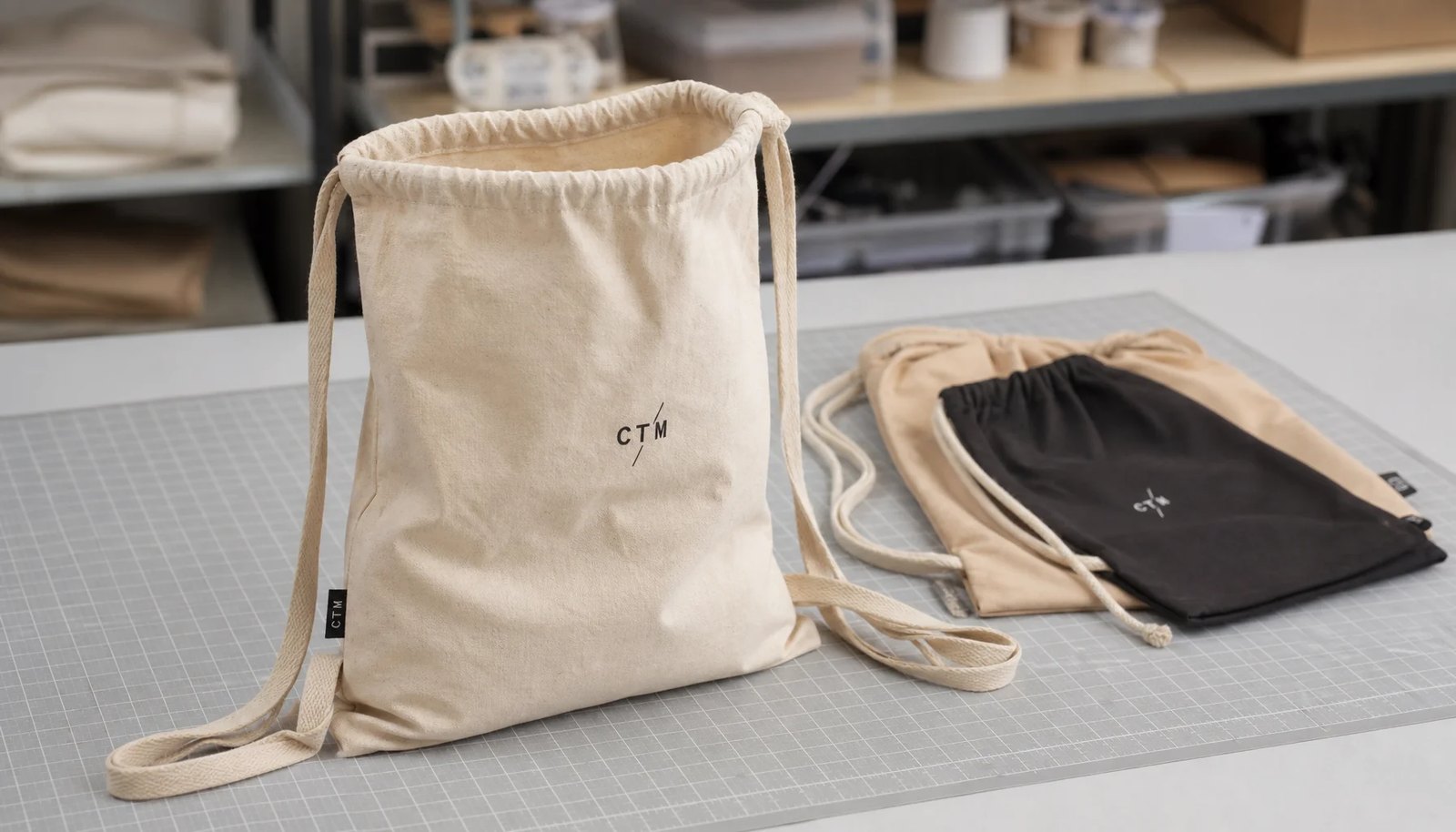
Start With the Bookstore Use Case
A custom cotton drawstring backpack for a university bookstore is not the same product as a cheap event giveaway bag. Bookstore buyers usually need a bag that can sit on a retail shelf, hold campus apparel or welcome kit items, and carry the university identity without looking disposable. The material choice has to match that use case before the buyer compares unit prices.
The first RFQ decision is whether the bag is for resale, orientation distribution, club merchandise, alumni events, or bundled packaging for apparel. A resale bag needs cleaner sewing, better fabric handfeel, and more controlled print placement. A one-day event bag can be lighter, but it still needs enough strength to avoid complaints when students load it with notebooks or bottles.
- For retail resale, prioritize 8 oz cotton canvas, neat stitching, stronger rope, and cleaner packing.
- For orientation kits, prioritize consistent size, cost control, fast packing, and carton labels by department or event.
- For apparel bundle packaging, prioritize a smooth print area and a bag size that fits folded hoodies or T-shirts.
- For club or department orders, prioritize flexible artwork handling and clear MOQ rules by logo.
Choose Fabric Weight Before Negotiating Price
Cotton drawstring backpack quotes can look similar while the fabric cost is very different. Many quote sheets say cotton or canvas but do not state ounces or GSM. That makes comparison unsafe. A 140 GSM cotton bag and a 270 GSM cotton canvas bag may both be called cotton drawstring backpacks, but they perform differently in strength, opacity, print result, and freight weight.
For university bookstore use, 6 oz to 8 oz cotton canvas is usually the practical range. It gives enough body for retail presentation without making the bag too stiff at the drawstring channel. A 10 oz canvas may be suitable for a premium bookstore line, but it increases material cost, makes closure less flexible, and adds carton weight.
- 120-160 GSM cotton: low-cost promotional use only, usually too thin for bookstore resale.
- 180-220 GSM cotton: workable for light orientation packs and short-term student events.
- 240-270 GSM cotton canvas: balanced option for bookstore-quality drawstring backpacks.
- 300 GSM and above: premium feel, but higher unit cost, higher freight, and tighter sewing control required.
Natural, Bleached, or Dyed Cotton
Fabric color affects cost, lead time, print method, and the final appearance of a campus logo. Natural cotton is often the easiest and most economical route because stock fabric may be available and small shade variation is usually acceptable. It also supports a simple campus sustainability story when the buyer does not want a bright synthetic-looking bag.
Bleached cotton gives a cleaner background for full-color or bright artwork, but it can show dirt more easily during handling and packing. Dyed cotton looks more branded, especially when matched to school colors, but the buyer needs to treat it as a different sourcing route. Custom dyeing may require higher MOQ, longer lead time, and lab dip approval before bulk fabric is cut.
- Natural cotton works well for black, dark green, navy, burgundy, or single-color campus logo printing.
- Bleached cotton gives a brighter base but needs cleaner production handling and better carton protection.
- Stock dyed cotton is useful when the buyer can accept available shades instead of exact Pantone fabric color.
- Custom dyed cotton should include lab dip approval, shade tolerance, and extra schedule allowance.
Rope, Corners, and Carry Comfort
A drawstring backpack fails quickly if the rope is too thin or the bottom corners are weak. Procurement teams often focus on fabric and logo first, then discover during sampling that the bag is uncomfortable when loaded. For campus use, the rope is both closure and shoulder strap, so it needs to be specified like a functional component rather than a trim detail.
Cotton rope gives a natural look and matches the fabric message, but it can be slightly bulkier than polyester cord. Flat cotton cord may feel softer on the shoulder. Metal eyelets give a familiar promotional-bag construction and can be efficient for bulk orders, but they must be set cleanly. Reinforced stitched corners avoid metal hardware and may suit bookstores that want a softer all-textile product.
- Use 6-8 mm cord for adult bags; very thin cord feels cheap and can dig into shoulders.
- Specify rope color, rope material, end finish, and knot style in the RFQ.
- For eyelets, require smooth edges and pull resistance after the bag is loaded.
- For stitched corners, require enough fabric reinforcement and bartack strength at the rope exit.
Print Method and Logo Risk
University artwork often includes official marks, mascot graphics, department names, and sponsor logos. The print method should be selected from the artwork file, not chosen only by price. Cotton canvas has texture, so fine lines and small text may fill in if the screen mesh, ink type, or print pressure is not suitable.
For most bookstore cotton drawstring backpacks, water-based screen printing is the cleanest choice for one to three spot colors. It gives a softer handfeel and works well on natural cotton. Heat transfer can handle full-color artwork and gradients, but the buyer should test adhesion and edge durability. Embroidery is possible but less common for drawstring backpacks because large embroidery can distort the front panel and increase cost.
- State artwork size in inches or centimeters and define the print area from the bottom of the drawcord channel.
- Use Pantone references for ink color, but allow practical tolerance on natural fabric because cotton absorbs ink differently.
- Avoid very small text below practical print limits unless the factory confirms the screen can hold detail.
- Require a folded print rub check for artwork placed near areas that crease during packing.
MOQ Logic for Bookstore Programs
MOQ is not only a total quantity number. For cotton drawstring backpacks, MOQ can be driven by fabric procurement, dyeing, cutting efficiency, print setup, trim purchasing, and packing style. A buyer asking for 2,000 pieces may still create five separate production lots if the order includes different school colors, different logos, and different packing instructions.
The cleanest RFQ separates quantity by fabric color, artwork, delivery destination, and required date. This allows the factory to quote the real setup structure. If the bookstore has several department logos, the buyer can reduce cost by using the same bag body, same fabric, same rope, and same print ink color, then changing only the screen artwork.
- One fabric color plus one print design usually gives the best unit cost.
- Multiple logos on the same bag spec may still add screen charges and production handling cost.
- Custom dyed fabric can create a separate MOQ from the sewing MOQ.
- Individual polybagging, barcode stickers, or assortment packing can raise the effective MOQ per SKU.
Sample Approval That Prevents Bulk Problems
The approval sample should represent the actual bulk product as closely as possible. A sample made from substitute fabric or a different rope can help confirm size, but it should not be treated as final approval for a bookstore retail order. The risk is that the buyer approves the shape, then receives bulk goods with a different handfeel, weaker cord, or changed print color.
For custom cotton drawstring backpacks, the buyer should review the sample with a loaded-use mindset. Put realistic items inside: a hoodie, notebook, small bottle, and bookstore receipt pack. Pull the cords several times, wear the bag briefly, fold it as it will be packed, and inspect the print after handling. This is more useful than approving the sample flat on a desk.
- Confirm fabric weight by swatch or supplier measurement and compare it with the quoted GSM.
- Measure finished width, height, drawcord channel, and rope length on the sample.
- Load-test the bag with a practical campus weight before approving corner construction.
- Review print color under normal store lighting, not only under bright photo lighting.
- Keep one signed or sealed approval sample for factory reference and one for buyer receiving inspection.
Quote Data Needed for Real Comparison
A low unit price is not useful if the quote hides setup charges, sample charges, carton volume, or packing labor. For importers and distributors, the better comparison is total landed cost and risk. Two suppliers may quote the same FOB unit price, but one may use lighter fabric, smaller cartons, or a slower sampling path that creates hidden cost later.
A proper quote should show the bag spec, material weight, print method, quantity breaks, sample fee, tooling or screen charges, packing method, carton data, lead time, payment terms, and validity period. If the supplier cannot state fabric weight and carton CBM, the buyer cannot forecast freight or compare quotes fairly.
- Request price breaks at realistic quantities such as 500, 1,000, 2,500, and 5,000 pcs if the program may reorder.
- Separate sample cost, screen setup, bulk unit price, packing upgrade, and freight estimate.
- Ask for carton dimensions, pieces per carton, gross weight, net weight, and CBM per carton.
- Clarify whether the quote includes hangtags, barcode labels, inner bundles, or individual polybags.
- Record quote validity because cotton fabric and freight costs can change between sampling and PO release.
Packing for Campus Store Receiving
Packing is often treated as an afterthought, but bookstore receiving teams feel the difference immediately. A bulk order for orientation may need cartons sorted by event, department, or campus location. A retail order may need cleaner folding, barcode labels, or smaller inner packs for shelf replenishment. The packing instruction should be part of the RFQ, not decided after production.
Flat packing is usually efficient for cotton drawstring backpacks. The factory can bundle 25 or 50 pieces, then pack into export cartons that stay within practical manual-handling weight. Over-compression should be avoided when the print is large or when bags are dyed dark colors, because pressure and moisture can create creases or transfer marks.
- Use inner bundles when the bookstore team will count and distribute bags to departments.
- Use individual polybags only when resale presentation or dust protection justifies the added cost and labor.
- Keep carton labels clear: SKU, design name, fabric color, quantity, carton number, gross weight, and destination.
- Avoid mixed artwork cartons unless the buyer has approved a clear assortment plan.
- Request carton photos before shipment when several designs or destinations are involved.
Lead Time and Schedule Risk
The schedule should be built backward from the in-store date, not from the factory's fastest possible sewing time. Custom cotton drawstring backpacks need artwork confirmation, material sourcing, sample making, sample shipping, approval, bulk fabric preparation, cutting, printing, sewing, inspection, packing, and export booking. Any unclear spec at the beginning can restart part of that chain.
Stock natural cotton with one-color screen print is usually the fastest route. Custom dyed fabric, multi-color printing, special labels, barcode packing, or multiple delivery splits add time. A buyer preparing for orientation or back-to-school season should avoid approving production based only on a digital proof; physical sample approval is the safer path when the order is retail-facing.
- Allow extra time for university brand approval before the factory starts screen making.
- Treat lab dips, custom dyed fabric, and special rope colors as schedule risks.
- Build in time for sample shipping and buyer-side review, not only factory sample production.
- Confirm production lead time after sample approval and deposit, not from the first RFQ date.
- Reserve time for final inspection and carton correction if labels or assortment packing are wrong.
Specification comparison for buyers
| Spec decision | Recommended option | When it fits | Buyer risk to check |
|---|---|---|---|
| Main cotton fabric weight | 6 oz to 8 oz cotton canvas, roughly 200-270 GSM | Campus bookstore giveaways, orientation kits, apparel add-ons, and lightweight daily carry | Below 180 GSM can look transparent and wrinkle heavily; above 300 GSM raises freight and may feel too bulky for drawstring closure |
| Fabric weave and handfeel | Plain weave cotton canvas with pre-shrunk or stabilized finish when available | Bookstores needing a clean print surface and predictable panel size after sewing | Loose weave causes print edge bleed, seam puckering, and inconsistent color absorption on natural cotton |
| Drawcord material | Cotton rope or flat cotton cord, 6-8 mm diameter for adult bookstore bags | Merchandise bags expected to carry notebooks, apparel, water bottles, or small campus supplies | Thin cord cuts into shoulders; synthetic cord may not match a cotton sustainability message |
| Bottom corner reinforcement | Metal eyelets or reinforced stitched corners depending on brand position | Eyelets suit higher-volume promotional orders; stitched reinforcement suits softer all-cotton positioning | Poor eyelet setting can tear fabric; stitched corners need enough seam allowance and bartack strength |
| Print method | Water-based screen print for 1-3 spot colors; heat transfer only for small full-color artwork | University logos, department marks, mascot graphics, and bookstore private-label designs | Heavy plastisol-like ink can crack on cotton folds; transfers may peel if heat and pressure are not controlled |
| Size and capacity | Around 14 x 18 inches for adult campus use, with tolerance stated in the PO | Fits folded apparel, notebooks, small binders, and welcome kit items without oversized freight volume | Oversized bags need stronger rope and larger carton space; undersized bags disappoint retail buyers |
| MOQ structure | MOQ by fabric color and print setup, not only by total quantity | Buyers ordering multiple campus colors, department logos, or bookstore seasonal drops | Splitting 1,000 pcs across five designs can trigger five print setups and higher unit cost |
| Packing method | Flat packed, 25-50 pcs per inner bundle, export carton weight kept manageable | Bulk bookstore receiving, repacking for orientation, or shelf replenishment | Over-compressed packing can crease print areas; cartons over 15-18 kg are harder for store teams to handle |
Buyer checklist before sampling
- Define the exact use case: retail resale, orientation giveaway, welcome kit, club order, or bookstore private-label stock.
- State fabric weight in ounces and GSM range, not only the word cotton.
- Specify natural, bleached, dyed, or custom Pantone fabric color before requesting pricing.
- Provide bag size, seam construction, drawcord type, cord diameter, and corner reinforcement method.
- Send vector artwork with print size, print position, color references, and any university brand restrictions.
- Separate quantities by artwork, fabric color, and delivery date so the factory can calculate MOQ correctly.
- Request pre-production sample approval for fabric handfeel, print color, rope comfort, and closure function.
- Define acceptable size tolerance, print placement tolerance, loose thread standard, and carton label format.
- Confirm whether bags must arrive flat for shelf display, bulk packed for kit assembly, or individually polybagged.
- Compare quotes using landed cost, sample cost, setup cost, carton CBM, and payment terms, not unit price alone.
Factory quote questions to send
- What cotton fabric weights can you supply for this drawstring backpack, and can you quote 6 oz, 8 oz, and 10 oz options separately?
- Is the quoted fabric greige, natural, bleached, dyed stock fabric, or custom dyed fabric, and what is the MOQ for each route?
- What is the estimated shrinkage or size tolerance after cutting, sewing, and finishing?
- Which print method do you recommend for our artwork, and what is the maximum print area on the front panel before distortion becomes a risk?
- How many print setup charges apply if we use the same bag but different department logos or different ink colors?
- What drawcord material, diameter, and reinforcement method are included in the base price?
- Can you provide a pre-production sample using actual bulk fabric, actual rope, and actual print method before mass production?
- What packing method, carton dimensions, carton weight, and CBM per 1,000 pcs are included in the quote?
- What inspection standard do you use for fabric stains, print defects, seam failures, and eyelet pull strength?
- What is the realistic production lead time after sample approval and deposit, and which steps could extend the schedule?
Quality-control points to confirm
- Fabric weight should be verified from a cut swatch or lab-style GSM check, not only from the supplier's item description.
- Finished bag size should be measured on multiple pieces, with practical tolerance such as plus or minus 0.5 inch unless tighter retail requirements are agreed.
- Print position should stay centered and within agreed tolerance, especially when the drawcord channel changes the usable front panel area.
- Ink adhesion should pass a basic rub test and fold test before bulk packing, particularly on dark dyed cotton.
- Rope ends should be knotted or finished consistently and should pull smoothly through the top channel without fabric tearing.
- Eyelets, if used, should be set flat without sharp edges and should resist normal pulling from a loaded bag.
- Seams should have no skipped stitches, open seams, or loose thread clusters visible on the retail-facing side.
- Natural cotton shade variation, slubs, and small seed flecks should be defined as acceptable or unacceptable before production.
- Cartons should be clean, dry, export-strength, and labeled by SKU, artwork, quantity, gross weight, net weight, and carton number.