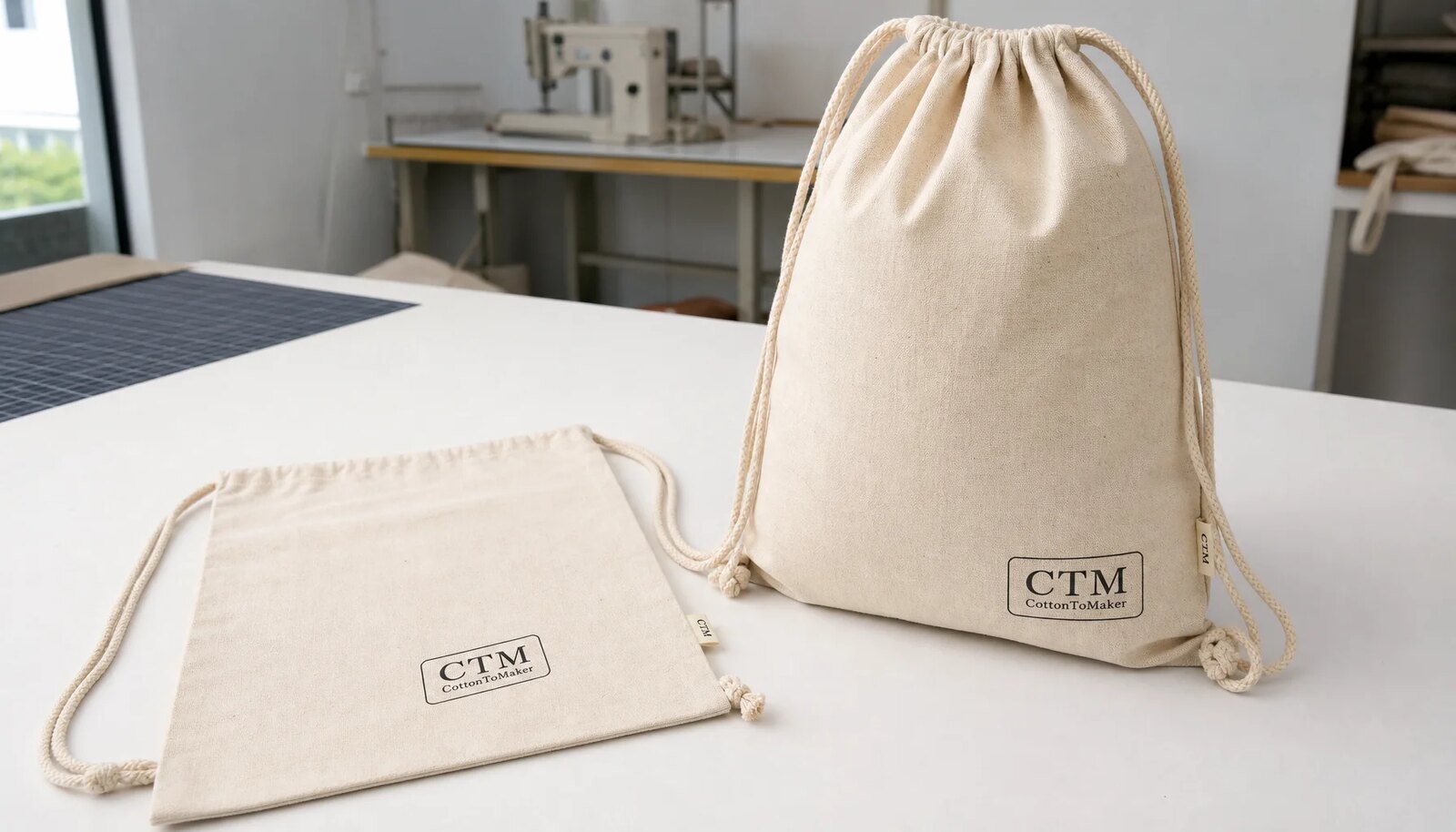
Why Logo Placement Decides the Whole Bag
For custom cotton drawstring backpacks, logo placement is not a design detail. It changes the cost, the print method, the usable fabric area, and the chance of a production mistake. Event buyers often start with a mockup and only later discover that the logo sits too close to the cord tunnel, overlaps a seam, or becomes unreadable when the bag is filled. If the placement is not defined early, every supplier will quote a slightly different interpretation, and the comparison becomes noisy fast.
The practical goal is simple: make the logo visible when the bag is worn, keep it away from structural parts of the bag, and choose a location that matches the event use case. A sponsor logo for a conference welcome kit needs different placement than a retail-style merch bag or a school giveaway. The first decision is not artwork size. It is which surface area actually gives you a clean, repeatable print zone on the final bag.
- Front panel placement is usually the safest choice for one main logo.
- Lower-center placement can improve visibility when the cords are tight.
- Side or back branding works when the front must stay clear for sponsor marks or event graphics.
- Small woven side labels can support a retail look when the main print area is limited.
Start With the Usable Print Zone
A cotton drawstring backpack may look like a simple flat panel, but the usable print zone is smaller than it appears. You need to leave clearance above the bottom seam, away from the drawstring tunnel, and clear of any side shaping or reinforcement. On a typical event bag, a practical front print area might be roughly 18 to 25 cm wide and 15 to 22 cm high, but the real number depends on the cut, the stitching allowance, and whether the bag has a lined top channel or added gussets. If you want a larger logo, the factory should confirm the actual panel measurement on the production pattern, not a catalog sketch.
For planning, the safest placement is usually centered on the front panel with enough white space around the mark so the bag does not look crowded when folded or filled. If the logo is too high, it disappears under the cords. If it is too low, it can sit on the seam or distort when the bag carries weight. That is why a millimeter-based placement map matters more than a clean visual mockup. Ask for the usable zone in writing, with a simple drawing that shows centerline, top clearance, bottom clearance, and any no-print areas.
- Use a measurement from the finished bag, not from the fabric blank.
- Leave visible clearance from the drawstring tunnel so the logo does not disappear when the cords are tightened.
- Avoid printing across side seams unless the factory has already proven that construction style.
- If the bag will be folded for event kits, keep the logo above the main fold line or the crease will weaken the visual impact.
Match the Print Method to the Artwork
The right print method depends on the number of colors, the size of the logo, and how the bag will be handled. Screen printing is usually the best value for simple logos on cotton because it gives strong opacity and holds up well on larger front panels. It is especially practical when the artwork is one or two colors and the event quantity is high enough to spread setup cost. Heat transfer is more flexible for gradient art, small text, or multicolor logos, but the finish and durability can vary by transfer film quality and application control.
Embroidery and woven patches belong in a different category. They can look sharper and more premium, but they are not always the right fit for thin cotton or low-cost giveaway bags. Heavy embroidery can pull the fabric, and woven patches add steps and labor. If the buyer wants a sponsor logo that must stay crisp after repeated use, a woven side label or a stitched patch can be a better route than a large direct print. The key is to compare decoration method against the actual use, not against a vendor's default preference.
- Screen print: best for flat, simple logos and cost control at scale.
- Heat transfer: best for detailed art, smaller runs, and multi-color branding.
- Embroidery: best for premium perception on heavier cotton or canvas blends.
- Woven label or sewn patch: best when the brand wants a durable mark without covering the full panel.
Compare Supplier Routes Before You Compare Unit Price
A lot of buyers compare only the quoted unit price and ignore the sourcing route behind it. That is a mistake on logo placement jobs because the route changes who controls the bag, who controls the print, and who owns the final approval. A direct factory with in-house printing usually gives the cleanest chain of responsibility. A trading company may be easier to coordinate, but it can hide the real factory capabilities. Imported blanks plus local decoration can be fast, but then the blank bag spec becomes a separate risk. Those differences matter more than a small price gap.
For event planners, the right route depends on how much risk you can carry. If the logo is simple and the deadline is fixed, a direct factory with screen printing is usually the most defensible option. If the branding is premium, a factory that can source the fabric, sew the bag, and finish the label in one line can reduce mismatch between sample and bulk. For urgent orders, a local decorator may win on speed, but only if the blank bag truly matches the approved construction. The table below is the simplest way to judge the route before you ask for a revised quote.
- Do not compare suppliers until you know whether they are the maker, a decorator, or a coordinator.
- Ask who approves the final artwork position and who pays for a misplaced print.
- Treat blank-bag sourcing and logo application as two separate risk points unless one factory controls both.
- If the supplier cannot show a recent bulk sample in the same construction, their quote is incomplete.
Write the Quote So It Can Be Compared
A useful quote for custom cotton drawstring backpacks should read like a production spec, not a sales message. It needs the finished size, fabric weight, color, cord type, print method, logo size, placement position, packing method, and lead time after approval. Without those fields, two quotes may look similar while actually describing very different products. That is how buyers end up comparing a 140 gsm bag with a 240 gsm bag or a one-color screen print with a heat transfer that costs more to rework later.
The most important quote data for logo placement is not just the logo width. It is the maximum printable area, the number of colors, whether a second-side print is included, and whether each additional placement changes setup cost. If the buyer needs 5,000 bags for an event, a quote that hides plate charges or assumes the artwork can move after approval will not survive a real comparison. A clean quote should make revision cost visible before the PO goes out.
- Include fabric GSM, bag size, and cord spec in every quote request.
- State the exact placement: center front, lower front, back panel, or side label.
- Separate the cost of the bag body from the cost of each decoration step.
- Request lead time from artwork approval, not from first inquiry.
Use GSM and Fabric Type to Protect the Logo
Fabric weight changes how the logo sits on the bag. For low-cost event giveaways, 140 to 180 gsm cotton is often enough if the bag only carries light items and the print is simple. For a bag that needs a more substantial hand feel or better drape, 200 to 240 gsm cotton is usually a safer zone. Once you move into heavier canvas-like cotton, the print area tends to stay flatter, which helps screen print registration and keeps embroidery from pulling the panel as much. If the bag is too thin, large logos can show distortion when the bag is filled.
Fabric finish matters too. Unbleached cotton can show print colors differently from bright white cotton, and a brushed or washed finish can soften the edges of a design. If the bag is intended for a branded event kit, send the supplier the target use and not just the artwork. A conference bag that carries brochures and a bottle has different panel stress than a light promo bag. The right GSM is the one that holds the logo flat enough, survives the packing method, and still hits the budget target.
- 140-180 gsm works for lightweight giveaways and simple front prints.
- 200-240 gsm fits most branded event bags where durability and print stability matter.
- Heavier cotton or cotton-canvas blends suit embroidery, woven patches, and premium sponsorship packs.
- Prewashed or enzyme-washed fabric should be approved separately because shrinkage can shift placement.
Approve the Sample the Way Production Will Be Run
A flat artwork proof is not enough for this product. The approval sample should show the real logo location on the actual bag construction, including the final cord, seam layout, and print method. If the supplier sends a paper proof only, you still do not know whether the logo collides with the tunnel stitch, whether the print stretches after sewing, or whether the bag hangs properly when worn. Ask for a pre-production sample that reflects the production setup, not a generic test bag.
The sample should be judged against simple acceptance criteria. Measure the logo position from the approved centerline, verify the size of the print, compare the color against the reference file or Pantone target, and test the bag under normal load. If the artwork includes small text, confirm that the smallest line still reads cleanly at arm's length. Once the sample is approved, freeze the placement map. Moving the logo after sample signoff is one of the fastest ways to create delays and disputes.
- Approve the sample only after it matches the final fabric, cord, and print method.
- Measure the logo with a ruler or template, not just by eye.
- Load the bag with realistic contents to see whether the print distorts.
- Keep one signed sample for the factory and one for the buyer file.
Set QC Thresholds That Catch Real Problems
Quality control should focus on the failures that hurt event delivery, not on cosmetic details that nobody will see. For drawstring backpacks, the first failure is misplaced branding. A logo that shifts too high, too low, or too close to a seam can make the whole order look careless. The second failure is print quality: ghosting, weak coverage, color drift, or uneven edges. The third failure is bag function. If the cords knot badly, the top channel twists, or the seams open under normal use, the bag will reflect badly on the event even if the logo looks fine.
Write the acceptance standard before production starts. Define the allowed position tolerance, the acceptable color range, and the level of print variation allowed across the order. For larger programs, inspect a few cartons from the top, middle, and bottom of the shipment so you do not only see the first packed pieces. On a busy event program, a bag that passes a quick visual glance can still fail once it is filled, folded, and handed out. QC should simulate that final use case.
- Check logo position, not just logo appearance.
- Inspect print on loaded bags, not only flat bags.
- Open random cartons from multiple pallet layers.
- Record any placement drift with photos and measurements so the factory can correct the line quickly.
Packing Can Save or Ruin the Artwork
Packing is part of the branding system because the bag will arrive folded, stacked, and sometimes compressed. If the logo sits on the main fold line, it can arrive with a crease that is hard to remove before the event. If the print is still curing or the ink is soft, the packing method can mark the surface. The simplest way to protect the artwork is to specify fold direction, tissue or paper insert if needed, and a carton count that does not crush the panel. Those details are cheap to define and expensive to ignore.
For event buyers, the packing standard should match the distribution model. If bags will be handed out directly from cartons, you may need a neat retail fold and a clean outer polybag. If they will be repacked into kits, a flatter pack with less volume may work better. The supplier should tell you whether the cartons are optimized for sea freight, air freight, or direct event handling. A good packing spec protects the logo and keeps the bags organized by color or destination without adding unnecessary cost.
- State the fold orientation so the logo does not land on the crease.
- Use an inner bag or tissue only if it protects the print without adding excessive labor.
- Confirm carton dimensions and gross weight before freight booking.
- Label cartons by PO, color, and quantity so event teams can distribute them quickly.
Plan the Schedule Around Artwork Approval
Lead time is often lost before production starts. The common delay is not sewing; it is waiting for artwork changes, placement revisions, or sample signoff. A realistic schedule should include time for quote comparison, sampling, sample correction, and final approval before bulk production. If the event date is fixed, the buyer should work backward from the distribution date and leave a buffer for transit, customs, and one production issue. When the logo placement is still uncertain, every day spent revising the proof is a day stolen from the factory line.
The fastest way to miss an event is to treat the first sample as a formality. The faster and better approach is to lock the placement map before the sample is made. If the supplier has to move the logo after the sample, the order will usually lose time and sometimes cost more in setup. For urgent campaigns, it is often better to simplify the art, reduce the number of colors, and stay inside the factory's proven print zone than to chase a larger graphic that needs extra revisions.
- Work backward from the event date and include transit and customs buffer.
- Freeze artwork and placement before the factory starts the sample.
- Use a simpler print spec if the schedule is already tight.
- Do not assume a sample can be revised and still keep the original ship date.
Specification comparison for buyers
| Spec decision | Recommended option | When it fits | Buyer risk to check |
|---|---|---|---|
| Direct factory with in-house screen print | Best control for one- or two-color logos on 140-240 gsm cotton | Standard event backpacks with repeat orders and stable artwork | Confirm setup charge, registration tolerance, and whether the print is on prewashed or raw fabric |
| Direct factory with embroidery or woven patch | Best for premium branding on thicker cotton or cotton-canvas blends | Retail-facing kits, VIP bags, and programs that need a more durable brand mark | Check puckering on thin fabric, patch edge finish, and minimum size for legible text |
| Trading company managing multiple decorators | Useful when one supplier must coordinate bag making, printing, and packing | Multi-SKU event programs or buyers who need one contact for several regions | Verify who owns artwork approval, who pays for mistakes, and which factory actually makes bulk goods |
| Imported blank bags plus local decorator | Good when the event date is tight and domestic print time matters more than unit cost | Rush campaigns or campaigns with small quantities and limited freight tolerance | Make sure the blank bag spec, color, and GSM match the final approved sample |
| Sample-first low-MOQ supplier | Best for first-time buyers testing logo placement before a full PO | New brands, sponsor events, and uncertain artwork layouts | Confirm the sample comes from the same pattern, fabric weight, and print process as bulk |
| Full-package supplier with fabric sourcing | Best when GSM, cord, label, and print all need to be controlled together | Brand programs with strict packaging and consistent reorders | Audit fabric source, shrinkage behavior, and carton pack count before approval |
| Dual-source primary and backup factory | Best for high-stakes events or seasonal volume spikes | Large programs with fixed dates and limited tolerance for delay | Keep artwork files, placement map, and color standards identical across both factories |
| Nearshore converter for quick ship | Useful when transit time is the real bottleneck and quantities are moderate | Short lead-time programs where air freight or domestic trucking is acceptable | Compare landed cost, not unit price, because faster production can still be more expensive overall |
Buyer checklist before sampling
- Define the exact bag size, fabric weight, and color before discussing logo placement.
- Mark the usable print area in millimeters and keep clear of the drawstring channel, side seams, and bar tacks.
- Decide whether the logo must read from one side only or both sides, because that changes print cost and layout.
- Specify the print method you want to compare, not just the artwork file.
- Request a pre-production sample with actual placement, not a flat artwork proof only.
- Confirm whether the quote includes setup, plates, embroidery digitizing, or woven label tooling.
- State the carton pack, polybag requirement, and any folding standard for event distribution.
- Set an approval deadline that still leaves room for one correction round before production starts.
Factory quote questions to send
- What is the exact bag spec being quoted, including finished size, fabric GSM, and cord type?
- What is the usable print area after seam, tunnel, and fold allowances are removed?
- Which print method is included in the unit price, and what are the setup or tooling charges?
- Will the pre-production sample be made on the same fabric and production line as bulk goods?
- What is the minimum order quantity for the bag itself and for each logo location or color change?
- What tolerances do you use for print placement, color match, and finished dimensions?
- How are the bags packed for shipment, including folding method, inner bag, and carton count?
- What is the production lead time after artwork approval, and what can delay the order?
- What defect remedies are offered if the print is off-center, blurry, or damaged in transit?
- Can you share a carton spec sheet and a packing list format before we issue the PO?
Quality-control points to confirm
- Logo centerline should match the approved sample within the agreed placement tolerance, typically tighter on front-panel branding than on side labels.
- Print edges should be clean with no visible smearing, pinholes, or broken solids in the logo fill.
- Ink should not bleed through the fabric enough to distort the back panel or leave a greasy hand feel.
- Stitching around seams, cord channels, and bar tacks should be even, with no skipped stitches or loose ends.
- Fabric weight and feel should match the approved swatch closely enough that the bag hangs and folds the same way in production.
- Cord length, knotting, and left-right symmetry should be consistent so the bag does not twist when carried.
- Finished dimensions should stay within the agreed tolerance after printing and packing, especially if the bag is heat-set or washed.
- Cartons should carry the right PO, color, quantity, and carton count, with no crushed print area or wet damage on arrival.