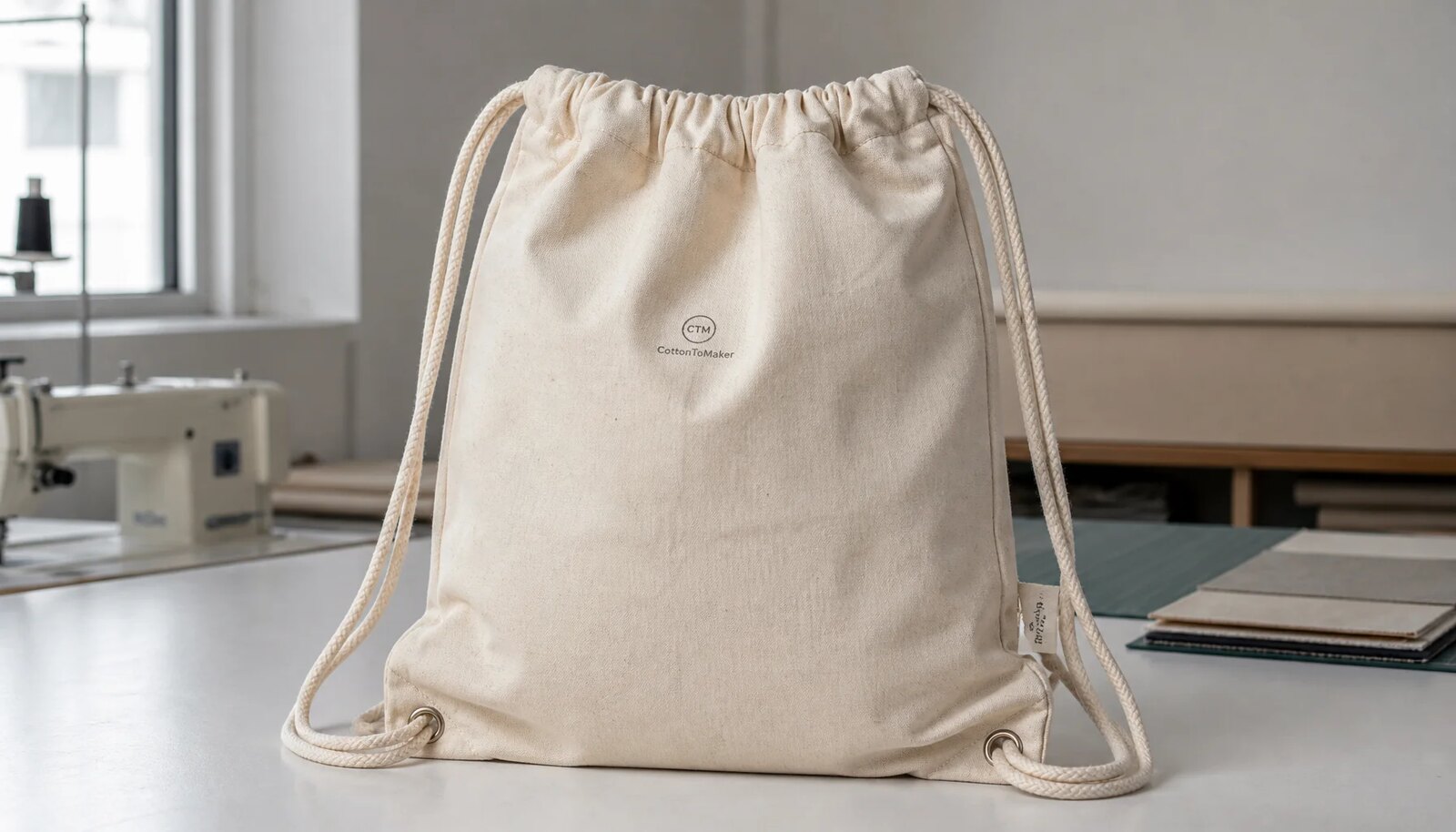
Start With The Wine Program, Not The Mockup
Boutique winery buyers get better results when they start with the actual program use, not the artwork mockup. A cotton drawstring backpack used as a tasting-room retail item has different needs from one used for a club gift, bottle carrier, trade-show handout, or distributor insert. The logo placement should follow that use case. If the bag needs to sell from a retail hook, the mark has to read cleanly from a few feet away. If it will be bundled with a bottle, it has to remain visible after the bag is cinched and loaded. If it is a premium gift, the finish matters as much as the logo itself.
The bag is not a flat canvas. Once sewn, loaded, and closed, the visible area changes. The drawstring channel eats into the top zone, side seams interrupt the panel, and the cotton body can wrinkle or tilt under weight. A placement that looks balanced on a proof can disappear under a fold or sit too high once the bag is cinched. That is why the first buyer decision is the use case, not the decoration detail. If the bag will carry a 750 ml bottle, test the layout with the actual bottle shape before approving the sample.
For winery buyers, the question is not only where the logo looks best. It is where it still reads correctly after display, sale, handling, shipping, and reuse. A placement that works on a shelf, in a shipping carton, and in a customer's hand is worth more than one that only looks good in a mockup. If the bag needs to carry sub-brand, reserve-tier, or vintage messaging, define that hierarchy up front so the factory does not guess at size or emphasis. Procurement gets easier when the brief says what the bag must do, not just what the brand wants it to feel like.
- For retail shelf appeal, prioritize a centered mark that stays visible when the bag is lightly cinched.
- For bottle carry, test the logo against the loaded shape, not only the empty bag.
- For club gifts, choose a finish that still looks intentional after repeated handling and shipment.
- For giveaway programs, simplify the mark so the brand reads instantly at a glance.
- If the bag will be reused, specify a decoration method that can survive friction and folding.
Lock The Base Spec Before You Debate Placement
Logo placement only becomes meaningful after the bag spec is fixed. Fabric weight, finished size, cord gauge, seam allowance, and top channel height all change the printable area. For planning purposes, light promotional bags often sit around 180 to 220 GSM, standard retail bags around 260 to 320 GSM, and heavier-use or premium bags around 340 to 400 GSM. Those are not universal rules. They are useful starting ranges for RFQ discussion. If the bag must carry a bottle, 260 GSM is often a reasonable floor; if it must carry two bottles or a heavier gift set, a thicker body and reinforced stress points are safer.
Ask for the finished size, not just the cut size. The usable print panel should be measured after seams, the drawstring tunnel, and reinforcements are accounted for. If the fabric is pre-washed, dyed, or otherwise pretreated, the supplier should disclose the shrinkage assumption before placement is approved. The same applies to channel height and seam geometry. A few millimeters matter here because they change how the logo sits once the bag is full. Without a locked spec, placement feedback becomes subjective and reorders become harder to match.
A solid RFQ should also include a drawing or annotated sample showing the reference points the supplier will use. The most useful points are the top edge, centerline, side seam, and the lower boundary of the print area. If the factory cannot state those dimensions in millimeters, it probably cannot repeat them reliably on the next run. For a winery program, repeatability matters because the backpack usually sits alongside bottles, labels, shipper inserts, or club materials and needs to look like part of the same system.
- 180 to 220 GSM: light promo feel, suited to inserts and low-stress giveaways.
- 260 to 320 GSM: the most balanced range for tasting-room retail and bottle carry.
- 340 to 400 GSM: better for premium presentation, repeated use, and secondary decoration.
- Approve the finished size, not the cut pattern, before you sign off on placement.
- Ask for the exact shrinkage assumption if the cloth is washed, dyed, or pretreated.
Translate The Logo Into Measurement Points
The most reliable default for winery programs is the front panel below the cinch line, centered between the side seams. That location keeps the mark visible when the bag is lightly loaded and avoids the distortion created by the drawstring channel. For a simple wordmark, this is usually the best balance of readability, production stability, and lower quote risk. It is also the easiest placement to repeat on reorder, because the factory can measure it from two fixed references: the top edge and the centerline. If there is no strong brand reason to move the logo, this should be the first layout to compare.
A useful placement instruction should read like a production note, not a mood statement. Example: logo top edge 35 to 45 mm below the finished top hem, centered on the front panel, with no artwork crossing a seam or entering the cord tunnel. That kind of callout gives the supplier something measurable. If the winery name is long, a two-line layout may work better than shrinking the font until it becomes fragile. If the logo includes a crest, give it enough clear space so it does not feel cramped when the bag is cinched. A mark can be technically centered and still look wrong if it is too wide for the panel.
Side placement is worth considering when the logo is long, the crest is detailed, or the front panel needs to stay cleaner for a premium look. A small woven label, compact side print, or edge patch can feel more deliberate than forcing a detailed logo into the front face. The tradeoff is control. Side placement is more sensitive to seam alignment and stitch density, so the buyer needs a drawing with exact distances from the side seam and top hem. If the logo will be seen mostly up close, the side can be the better choice. If it needs to sell the bag across a retail table, the front panel usually wins.
- Best general zone: front panel below the cinch line, centered and clear of seams.
- Best premium detail: small woven side label or woven patch on the edge.
- Best for long winery names: a simple two-line layout with generous spacing.
- Avoid artwork that crosses a seam, sits too close to grommets, or hides under the cord channel.
- State all placement references in millimeters, not vague terms like near the top or centered.
Match Decoration Method To Art Complexity And Wear
Screen print is still the default for most cotton drawstring backpacks because it handles flat logos, clean type, and one or two solid colors at a workable cost. It also gives buyers the easiest path to repeatability on reorders. The key control point is line weight. Thin strokes, tiny serifs, and tightly spaced text can fill in or break apart if the art is pushed too small. Ask the factory what minimum line thickness they can hold on the selected fabric, and request a proof at actual size rather than a scaled image. That matters for wineries because estate marks and crests often include detail that does not survive arbitrary reduction.
Woven labels and patches feel more premium, but they usually work best as a secondary brand element rather than the entire mark. They are useful for a side label, reserve-tier marker, or origin tag. Embroidery can look elevated on heavier cloth, but it may pucker thinner cotton and is not always the best fit for a large flat logo. Heat transfer can reproduce complex artwork and fine text, but it should be treated as a durability decision, not a default option. If the bag will be rubbed, packed, or carried often, require abrasion checks on the exact fabric before accepting transfer as the production method.
The practical rule is simple: choose the method that the artwork can survive, not the one that looks best in a sales sample photo. A simple winery wordmark usually belongs in screen print. A small premium detail may belong in a woven label. A complex crest may need simplification, or it may need to move to a different product if the decoration method cannot hold it cleanly. If a supplier suggests reducing the mark or removing detail, ask for the revised proof and the reason in writing. That gives you a defensible record when comparing suppliers or approving the final layout.
- Screen print: best for simple logos, repeat orders, and stable unit cost.
- Woven label: best for premium side branding and small, precise marks.
- Heat transfer: useful for complex art, but require abrasion and handling checks.
- Embroidery: reserve it for heavier canvas or patch-style application.
- If small text matters, ask for a legibility check at actual size before approval.
Separate Supplier Routes Before You Compare Price
A direct factory quote is usually the cleanest benchmark because the bag body, decoration, packing, and carton work sit under one chain of responsibility. That makes it easier to see whether the price includes the actual finishing steps or only the blank bag. It also makes placement control easier, because the same supplier owns the body dimensions and the print location. For a winery that repeats a program every season, that consistency often matters more than shaving a few cents off the first order. The lower-risk reorder is usually the better commercial outcome.
Domestic decoration on imported blanks can still be the right answer for a launch order or rush replenishment. It is often faster and can support lower quantities. The tradeoff is that the buyer now manages two vendors: one for the blank bag and one for decoration. That adds risk around color consistency, panel size, and packing. If the bag is a recurring SKU, the better long-term model is usually one factory controlling the body, logo, label, and carton spec. If the program is short-run or time-sensitive, split sourcing can work, but only if the buyer is ready to audit both sides and manage incoming QC.
Trading companies can help when the order includes multiple colors, mixed pack-outs, or different factories with different strengths. The buyer should still demand a line-by-line breakdown showing factory cost, service margin, and any subcontracted work. If the breakdown is vague, the unit price is not useful for procurement comparison. Ask directly whether the body, label, print, and packing all happen at the same site. If not, confirm who owns final inspection and who is accountable when placement drifts. That answer should be explicit, not implied.
- Ask whether the same plant makes the bag body and applies the decoration.
- Separate blank-bag and decoration quotes only when both vendors can be audited.
- Request photos of the actual sample room or production line, not only catalog images.
- Use one quote format for every supplier so costs are truly comparable.
- Confirm who owns the approved artwork file and who keeps the placement record for reorders.
Quote Landed Cost, Not Just Ex-Factory Price
A useful quote should show the cost of the bag as it will arrive and be received. That means the buyer needs the bag body price, decoration setup, sample cost, packing spec, and carton dimensions. If a quote omits a woven label, individual polybag, barcode sticker, or carton mark, the comparison is incomplete. The first problem is obvious: a low unit price is not a low landed cost. The second problem is more damaging: the missing item usually appears later as a change order after the sample is already approved. Procurement should not discover those gaps during production.
Landed cost should include inland freight to the port or domestic distribution point, export handling, ocean or air mode, duty if applicable, and final delivery to the winery, distributor, or fulfillment center. Small changes in fabric weight or carton volume can change freight enough to erase a lower decoration price. The cleanest practice is to compare cost per packed and delivered unit, not cost per unboxed bag. If the quote includes oversized cartons with extra headspace, the shipping penalty can matter on larger runs.
For annual programs, ask suppliers to quote both the first run and the reorder. Some factories reduce the repeat setup cost once the artwork and placement drawing are locked. If that saving is not shown, the buyer may assume a repeat price that will never exist. The best RFQ format asks for a first-run charge, a recurring unit price, and a reorder price if no design change is made. That gives the team a realistic planning number and avoids treating one-time setup as permanent cost.
- Compare quotes at the same MOQ tier and the same print area.
- Ask for packed carton dimensions and gross weight on every quote.
- Track setup costs separately from recurring unit cost.
- Use one comparison sheet so freight assumptions do not drift across suppliers.
- Request first-run pricing and reorder pricing if the program will repeat.
- Ask for a price delta if you remove retail polybags or inner labels.
Write The RFQ So The Factory Cannot Guess
A good RFQ for this product should read like a production brief, not a brand story. Include the finished size, fabric GSM, cord type, logo dimensions, placement distance from the top edge, print colors, and whether the mark is on one side or both. If the winery logo includes a crest or a sub-line such as reserve or estate, say whether every word must remain legible or whether the supplier may simplify the art for stability. That matters because vague artwork invites judgment calls. In procurement terms, ambiguity becomes paid revision time.
The RFQ should also define what is not allowed. State no bleed into seams, no logo crossing the drawstring channel, no substitute fabric weight without approval, and no unapproved placement shift. This is important for quote integrity: if the factory knows the tolerance and the non-negotiables up front, it can price the actual work rather than padding the quote with hidden risk. If you expect the logo to sit 40 mm below the top edge, that measurement should be written in the RFQ and repeated in the approved drawing. Precision up front prevents arguments later and improves the quality of the pre-production sample.
If the bag will move through multiple channels, include the packing and labeling requirements in the RFQ. A tasting-room retail bag may need no unit packaging, while a distributor pack-in may require barcode labels, inner packing, carton marks, or SKU labels tied to the PO. The supplier should know that before sampling starts, not after bulk production is underway. If the product needs country-of-origin marks, carton tick marks, or vintage codes, specify where those appear and whether they must be on the unit, the carton, or both. That avoids release problems later.
- Provide vector artwork, color references, and one photo showing intended placement.
- State the approved finished size and the measured printable panel.
- List every extra item: hangtag, insert card, barcode sticker, or retail label.
- Ask the factory to separate setup charges from unit pricing.
- Define the no-go items: seam bleed, channel overlap, fabric substitution, and placement drift.
- Specify whether labels, carton marks, and barcodes must match a current PO or a master SKU file.
Treat The Sample As The Production Standard
The sample stage is where placement issues become visible. Measure the logo from the top edge, centerline, and nearest seam, then compare those dimensions to the approved drawing. Do not rely on a straight-on photo if the bag is meant to be cinched or filled. A photo can hide shifts that become obvious once the bag is pulled closed. For a winery program, the sample should reflect how the product will actually be sold. If it is a bottle bag, place the real bottle inside. If it is a gift set, use the real insert weight and shape. Judge the bag in the same condition the customer will see.
Treat the pre-production sample as the production standard, not as a display piece. If the logo disappears under load or the side label curls when the bag is closed, that is a placement failure. If the print color looks correct only under one light source, ask for a daylight or light-box comparison against the approved reference. If the supplier changes the cord, label material, or print method after sample approval, require a fresh sign-off. That keeps the approved sample meaningful and prevents the common problem where the proof looks good but the bulk lot does not.
A clean approval process also protects the reorder. Keep the measured drawing, sample photo, and signed sample reference in one place. If the winery repeats the bag for a new vintage or club program, the factory should be able to reproduce the same positioning without reinterpreting the layout from memory. For repeat work, ask the supplier to note the screen count, ink color references, and placement origin points used on the approved sample. That makes the next run faster and lowers the chance of quiet variation.
- Approve a measured placement drawing, not only a sample photo.
- Test the sample with the actual bottle size or gift kit.
- Sign off only after the decoration and the pack-out both match the sellable unit.
- Keep the golden sample and the approved artwork file together for reorders.
- Record the sample date, supplier, and any deviations in writing.
Set QC Limits Before Bulk Production Starts
QC for these bags should focus on the defects winery buyers notice first. For the print, that means color consistency, clean edges, no ghosting, and no broken small text. For the bag construction, it means seam strength, bar-tack quality, cord symmetry, and whether the bag hangs straight enough to display well on a shelf hook or tasting-room rack. A bag that twists, skews, or looks crooked when cinched can undermine a premium brand even if the logo is printed correctly. The supplier should understand that both decoration and garment build are part of acceptance.
The factory should be willing to define acceptable tolerances in the purchase order. For soft cotton bodies, a placement window of plus or minus 5 mm is often realistic as a starting point, but the buyer can request tighter control if the structure is stable and the supplier has the tooling. If the artwork is especially sensitive, specify a tighter tolerance for the top edge and a broader tolerance for the side seam so the factory knows which dimension matters most. That creates a more useful QC target than a vague instruction to make it look centered. If the winery mark is heavily text-based, require a minimum x-height and test that size on the actual fabric.
Inspection should compare the bulk lot against one signed golden sample before release. If the run includes mixed colors or multiple SKUs, the first cartons and the final cartons should both be checked. That is where drift often appears, especially if the packing line changes operators mid-run or the supplier starts pulling from a different fabric lot. A practical acceptance plan includes visual inspection, measurement checks, pull tests on the cord anchors, and a review of carton labels against the PO. If the supplier cannot support that level of control, the buyer should expect more rework risk later.
- Reject bulk bags with print smearing, seam puckering, or loose threads in the logo zone.
- Require random pull testing on cords and stress points.
- Use the signed golden sample as the reference during inspection.
- Make sure carton labels match the SKU, quantity, and vintage or program name.
- Check the first cartons and the final cartons, not just the middle of the run.
- Ask the supplier to note any inspection method used on the production report.
Plan Packing And Lead Time Around Winery Seasonality
Wineries do not buy on a standard retail calendar. Demand often spikes around harvest events, club shipments, holiday gifting, and tourism peaks. That means the bag has to be packed for the selling channel, not just for shipment. If the bags go straight into tasting-room retail, individual polybags may be unnecessary and can add cost without benefit. If they go through a distributor, club fulfillment center, or warehouse, carton traceability, barcode labels, and consistent pack counts matter more. The right packing spec depends on where the buyer receives the shipment and who touches it next.
Lead time risk usually comes from artwork approval, print setup, and fabric availability. If the logo changes after sample approval, the schedule slips quickly. The safest move is to freeze the bag body and placement first, then allow only minor changes to text size or secondary label position before bulk production begins. For rush orders, simplify the decoration rather than compressing every requirement into a short window. A simpler mark on the right material is usually better than a complex logo on a rushed, poorly controlled run. If the supplier offers a shorter lead time by changing fabric weight or decoration method, ask whether the change affects the approved look and whether a new sample is required.
If the winery needs the same bag every season, build a reorder file that records the finished size, GSM, cord spec, print method, placement drawing, carton count, and packing style. That file keeps the next order from becoming a new project. Include the approved supplier contact, artwork version, and carton label format so your team does not have to reconstruct the spec from old email threads. The best repeat program is the one that can be reordered from a controlled document set with minimal interpretation.
- Build a buffer before harvest, club ship dates, or holiday retail windows.
- Confirm carton count, carton marks, and pallet plan before production starts.
- Keep the same placement code on every reorder so the factory does not reinterpret the layout.
- For tight schedules, choose a stocked fabric color and a simpler decoration method.
- Align packing with the channel: retail shelf, club shipment, or distributor pack-in.
- Document the reorder file so the next buyer can repeat the spec without guesswork.
Specification comparison for buyers
| Spec decision | Recommended option | When it fits | Buyer risk to check |
|---|---|---|---|
| Launch order under 300 pcs | Domestic decorator on stocked blanks | Fast tasting-room tests, seasonal retail, or a new winery sub-brand | Stock changes can force a new blank, and added label or hangtag steps often change the quote more than buyers expect |
| Routine wholesale run | Direct factory with in-house screen print | 300 to 2,000 pieces with a simple mark and stable reorders | Confirm the true printable area after the top channel, seams, and any reinforcement stitches are removed from the layout |
| Premium gift or club pack-in | Direct factory with screen print plus woven side label | Membership boxes, reserve-tier gifts, or retail sets where the bag should feel more finished | Check handfeel, stitch density, seam distortion, and whether the label crowds the seam or cord path |
| Detailed crest or small text | One controlled supplier using a method that matches the art | Multi-line seals, fine serif copy, or complex winery emblems that do not screen cleanly at small size | Require actual-size legibility approval and abrasion testing, not just a proof file |
| Repeat annual program | One direct factory owning body, decoration, and pack-out | When the bag is a seasonal SKU or part of a recurring wine club program | Make sure the factory keeps the artwork file, placement drawing, and approved sample record for reorders |
| Rush replenishment | Domestic printer on imported blanks | Short lead times before harvest, holiday retail, or a last-minute event order | A time save can disappear if fabric color, panel size, or print setup changes late |
| Mixed SKU program | Trading company coordinating multiple factories | When colors, bottle counts, or retail pack formats vary in one purchase order | Demand a split of factory cost, service margin, and any subcontracted work |
| Lowest apparent unit price | Separate blank supplier plus local decoration partner | Only when your team can manage two vendors and incoming inspection on both sides | Responsibility gaps show up at color match, carton packing, and placement drift |
Buyer checklist before sampling
- Define the use case first: tasting-room retail, bottle gift, club shipment, event giveaway, or distributor pack-in.
- Freeze the finished bag size, fabric GSM, cord type, and whether the bag must hold one bottle, two bottles, or a gift set.
- Measure the usable print panel after seams, the drawstring tunnel, and any reinforcement stitches are removed from the layout.
- Approve one logo version with exact dimensions, color references, and a placement callout measured from the top edge and centerline.
- Choose the decoration method based on artwork complexity, order quantity, and expected handling wear.
- Ask for a pre-production sample built from the same fabric, same print method, same label, and same packing as bulk.
- Compare quotes only when MOQ, packing, setup, and carton assumptions are identical.
- Set the delivery window with buffer time before harvest, club shipment, trade show, or holiday retail.
- Define acceptable tolerance for placement, color, and seam alignment before bulk production starts.
- Require a signed golden sample or measured reference drawing before authorizing mass production.
Factory quote questions to send
- What finished bag size, fabric GSM, and cord specification are you pricing?
- What is the exact printable area after seams and the drawstring channel are removed?
- Which decoration method is included, and what setup, screen, digitizing, or label fees apply?
- What placement tolerance do you guarantee on bulk production, measured from the approved sample?
- What is the MOQ, sample lead time, and production lead time for this exact spec?
- What packing is included per unit and per carton, and are barcode labels, hangtags, or insert cards extra?
- Which parts of the work are done in-house and which parts are subcontracted?
- What changes would trigger a re-quote after sample approval?
- Can you show the carton spec with dimensions, gross weight, and packing count for this style?
- Will you retain the approved artwork file and placement drawing for reorders?
Quality-control points to confirm
- Logo position should stay within the agreed tolerance from the top edge and centerline; as a starting point, plus or minus 5 mm is realistic on a soft cotton body if the supplier can hold it.
- Color should match the approved reference under daylight or a standard light box, with no unapproved shift between sample and bulk.
- Print edges should be clean, with no bleeding into seams, no pinholes, no ghosting, and no broken small text.
- Seams, bar-tacks, and cord anchors should hold under a realistic pull test, especially if the bag will carry a bottle or gift set.
- Cord length should be even on both sides, and the bag should cinch smoothly without twisting the print zone or hiding the logo unexpectedly.
- Finished bags should be free of stains, odor, excess lint, loose threads, and visible pilling around the logo area.
- Carton counts, carton marks, and SKU labels should match the purchase order exactly, including vintage, club tier, or program name if used.
- The bulk lot should be checked against one signed golden sample before shipment release.
- If the logo includes a crest or small text, check legibility at arm's length, not only on the proof file.
- Inspect the first cartons and the final cartons, since packing drift often appears late in the run.