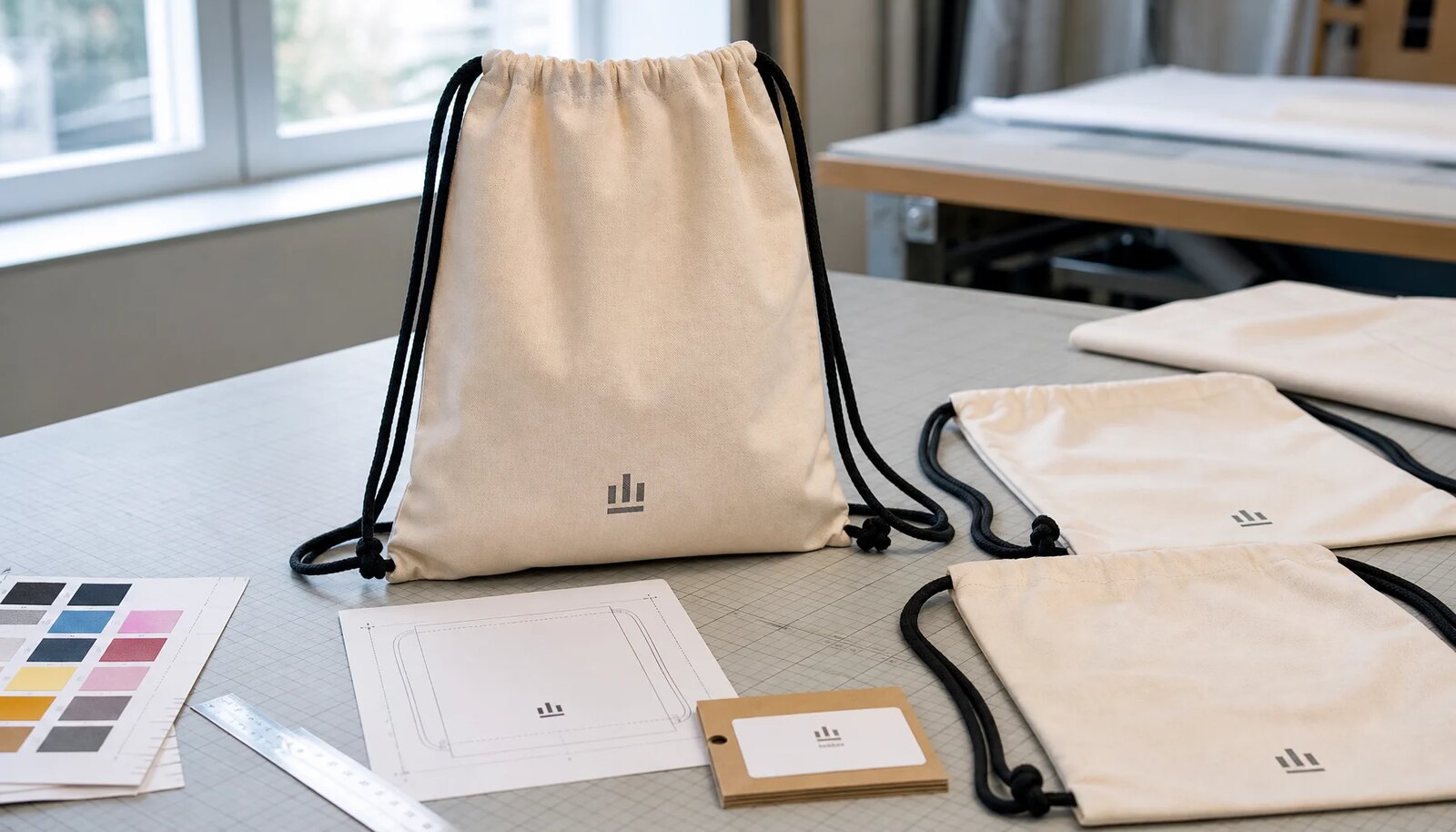
Start With the Craft Fair Use Case
Custom cotton drawstring backpacks for craft fairs should be specified by job, not by product name alone. A free entrance giveaway, sponsor attendee bag, VIP kit, workshop supply pack, and retail resale item can all look similar in a catalog, but they require different logo size, cotton weight, cord strength, packing, and inspection priorities.
For a giveaway, the buyer usually needs reliable distribution, clear sponsor visibility, and predictable landed cost. For a maker-branded resale bag, the same buyer may prefer a smaller logo, better handfeel, a woven side label, and cleaner retail packing. For workshop bags, the contents matter: notebooks, tools, catalogs, samples, or ceramics can stress bottom seams and cord exits more than a simple brochure pack.
Convert the use case into a placement brief before requesting quotes. Include expected contents, viewing condition, event date, destination, quantity by artwork, and whether the bag may be reordered. This lets suppliers recommend a safe logo zone from the real pattern instead of guessing from a flat digital mockup.
- State the role: giveaway, sponsor pack, VIP kit, workshop bag, merchandise item, or resale product.
- Identify how the bag will be seen: flat on a table, hanging at a booth, worn closed, filled, or retail displayed.
- Share expected contents so the factory can judge seam stress, cord exits, and lower-panel creasing.
- Use construction references such as channel stitch line, side seams, bottom seam, and cord-exit points.
- Do not scale final artwork until the actual pattern and printable area are confirmed.
Confirm Pattern and Printable Area
Logo placement starts with the sewn pattern. Many adult cotton drawstring backpacks fall around 330-380 mm wide by 420-460 mm high, but that range is only a sourcing reference. A shorter bag compresses vertical placement. A narrower bag reduces safe logo width. A deep drawstring channel, pocket, contrast base, boxed bottom, or unusual side cord exit can change the usable front panel.
The printable area is smaller than the visible front. Side seams distort fabric, the top channel gathers when cords are pulled, and the lower panel can crease when the backpack is filled or folded. On many standard adult-size cotton bags, a front logo around 180-220 mm wide is a workable starting range, but the final decision must follow the confirmed pattern, fabric behavior, and decoration method.
Measurement language should be exact. Specify whether finished dimensions are measured flat, empty, after pressing, after washing, or after packing. If the supplier measures cut panels and the buyer measures packed finished goods, both sides may believe they are correct while inspection still fails.
- Request a pattern drawing before approving logo size.
- Define finished dimensions and printable area as separate specifications.
- Measure top placement from the channel stitch line, not the soft top edge.
- Set separate tolerances for bag size, logo placement, and logo centering.
- Confirm whether printing happens before sewing or after sewing.
Compare Logo Placement Options
The default placement for craft fair backpacks is front center, below the drawstring channel and above the lower load crease. For many adult bags, buyers often sample the logo top edge around 60-80 mm below the channel stitch line, with enough side clearance to keep artwork away from seams. Treat this as a testing range, not a universal rule.
A high front-center logo is visible when the bag hangs flat, but it may wrinkle when cords are pulled. A lower logo avoids the channel, but it can disappear into the fold line when the bag is packed or filled. A smaller lower-corner mark can look more retail and less promotional, but it may not satisfy sponsors who expect crowd visibility. Large full-front art creates impact, but it requires tighter control over fabric flatness, registration, and folding.
Approve placement by both drawing and sample. The drawing should show logo width, logo height, distance from channel stitch line to logo top edge, left and right clearances, bottom clearance, and any label positions. The sample should be reviewed flat, hanging, closed, lightly filled, and folded as planned for packing.
- Use front-center placement for the strongest event visibility.
- Use lower-corner placement for subtle retail-style branding.
- Use woven side labels when a permanent but understated brand detail is preferred.
- Avoid placing detailed artwork close to the channel, side seams, or fold line.
- Sample alternate placement when artwork is large, tall, detailed, or sponsor-critical.
Choose Cotton Before Artwork Lock
Cotton weight, weave, and finish influence both perceived value and print clarity. A 4 oz to 5 oz cotton bag can work for short-life giveaways, but it may feel thin, show contents, and react poorly to heavy ink coverage. For reusable craft fair programs, 6 oz to 8 oz cotton canvas is often a stronger commercial range because it gives better handfeel and structure without moving into very heavy canvas costs.
Do not compare GSM numbers alone. Ounce weight and GSM are affected by weave, yarn count, fabric density, washing, and finishing. Two fabrics with similar quoted GSM can feel different if one is loosely woven and another is finished firm. As a rough reference, 6 oz to 8 oz cotton often falls around 200-270 GSM, but buyers should approve physical swatches and print response, not only a number in the quotation.
Natural cotton shade variation can support a handmade craft fair look, but it still needs boundaries. Warm natural cotton works well with black, navy, forest green, brown, and other earthy inks. Pale logos, QR codes, or detailed sponsor marks may need tighter shade control or a different base color. Dyed cotton adds lab dip approval, shade tolerance, and possibly underbase requirements for light decoration.
- Use 4 oz to 5 oz cotton only when low cost and short event life are acceptable.
- Use 6 oz cotton canvas for many reusable promotional backpacks.
- Use 8 oz cotton canvas for stronger structure, retail resale, or heavier kits.
- Approve swatches for handfeel, shade, surface texture, and print response.
- Request shrinkage notes for washed, dyed, or custom-finished cotton.
Match Decoration Method to Artwork
Screen printing is usually the practical B2B choice for one to three solid colors. It suits event logos, sponsor marks, simple illustrations, and repeat orders. On natural cotton canvas, a direct screen print often fits the craft fair aesthetic, provided the supplier controls screen setup, ink deposit, drying, curing, and placement jigs.
Heat transfer, digital transfer, and DTG can be useful for gradients, full-color graphics, versioned artwork, or complex illustrations. They are not automatically lower quality, but they bring different inspection risks. Transfers require full adhesion at corners and fine details. Rough canvas can reduce contact. DTG depends on fabric shade, pretreatment, curing, and artwork coverage.
Artwork detail should be tested on the quoted cotton. Fine sponsor lists, distressed maker logos, thin outlines, and QR codes can look sharp in a digital proof but fail on textured fabric. Ask the supplier for minimum line thickness, smallest readable text height, and recommended QR code size for the exact material and method.
- Choose screen print for solid logos, repeat programs, and cost-efficient bulk decoration.
- Choose transfer or digital methods only when artwork detail justifies the extra checks.
- Confirm ink cure, transfer pressure, temperature, peel timing, and cooling requirements where relevant.
- Set minimum text, line, and QR-code requirements before approving artwork.
- Scan QR codes on physical samples under typical indoor event lighting.
Evaluate Supplier Options, Not Just Price
A low unit price may hide a lighter fabric, smaller bag, weaker cord, different print method, looser tolerance, or simpler packing. Before comparing quotes, identify what type of supplier is responding and which steps they control in-house.
A cut-and-sew factory with in-house printing can coordinate pattern, logo jigs, and bulk inspection more directly. A sewing factory that outsources printing may still be suitable, but the handoff between print shop and sewing line must be documented. A trading company can help with small buyers, mixed products, or region-to-region coordination, but procurement should confirm who makes the goods and who owns quality responsibility.
Regional sourcing should be assessed by schedule and risk rather than stereotypes. Domestic or nearshore suppliers may offer faster sampling, easier communication, and shorter transit at a higher unit cost. Offshore suppliers may provide stronger cotton bag capacity and sharper volume pricing, but they require tighter specs, freight planning, and inspection discipline. The right choice depends on quantity, event date, artwork complexity, and tolerance for schedule risk.
- Identify the supplier type: factory, factory with in-house print, outsource print partner, or trading company.
- Ask who controls fabric buying, cutting, printing, sewing, packing, and final inspection.
- Request business registration, export capability, factory profile, and relevant cotton bag product photos.
- Confirm required compliance documents before PO approval, not after production.
- Compare control, communication, sampling speed, lead time, landed cost, and substitution risk.
Build an RFQ That Blocks Substitution
A strong RFQ prevents quiet changes. For cotton drawstring backpacks, common substitutions include fabric weight, weave, finished size, cord type, side-exit reinforcement, print method, packing style, and carton quantity. These changes may not be obvious in a short quote, but they affect the product the buyer receives.
Use structured RFQ fields instead of long narrative instructions. Ask for finished dimensions, cotton oz/GSM, weave, finish, color, shade control, print method, number of colors, print size, placement measurements, cord material and diameter or width, reinforcement, label requirements, packing style, carton quantity, carton dimensions, gross weight, sample cost, setup charges, lead time, MOQ, price breaks, Incoterms, and payment terms.
MOQ should be broken down by component. Fabric color, cord color, artwork version, woven label, hang tag, individual packing, and destination split can each create minimums. If the craft fair program has multiple sponsor versions, city versions, or retail SKUs, request SKU-level pricing rather than one blended quote that hides operational risk.
- Separate screen, film, sample, color matching, and setup charges from unit price.
- Ask for price breaks at 500, 1000, 3000, and 5000 pieces per artwork where relevant.
- Normalize Incoterms, carton data, packing method, and gross weight for landed-cost comparison.
- Require the supplier to state the maximum safe logo size for the quoted pattern.
- Treat unspecified fabric, cord, reinforcement, and packing details as substitution risks.
Use Sampling to Prove the Specification
A useful sample is not a sharp print on a random blank. It should use the quoted cotton, final backpack pattern, actual cord, selected print method, final logo size, and planned packing fold. A separate print swatch can help check color and ink behavior, but it cannot prove finished-bag placement by itself.
Sample approval should be measured and recorded. Note finished bag width and height, logo width and height, top distance from the channel stitch line, side clearances, bottom clearance, print color, print handfeel, cord specification, reinforcement, stitching, and packing fold. Keep one approved reference sample for inspection and reorders.
If placement is uncertain, sample two options before bulk production. A slightly smaller or lower logo may look less aggressive in a mockup but perform better when the bag is closed, worn, or packed. Moving artwork after screens, transfers, or placement jigs are made can add cost; moving it after bulk printing may be impossible before a fixed fair date.
- Require a pre-production sample using actual fabric, cord, pattern, print method, and packing.
- Measure placement from construction points instead of approving only a rendered mockup.
- Review the bag flat, hanging, closed, filled, and folded before bulk approval.
- Keep a sealed reference sample and written approval notes for inspection.
- Use alternate placement samples when the logo is high, wide, detailed, or close to seams.
Set QC Standards for Print and Sewing
Inspection should focus on what event users notice first: the front logo panel, visible stains, print clarity, cord function, side exits, channel stitching, bottom corners, carton quantity, and artwork version. Cotton is a natural material, so small flecks or slubs may be acceptable in low-visibility areas, but a dark slub through a sponsor logo should be graded more strictly.
Separate tolerances by defect type. Finished size, logo placement, logo centering, print registration, color variation, sewing strength, and carton shortage each need clear rules. A broad phrase such as “normal tolerance” gives little protection when logos drift toward one side or mixed artwork cartons arrive at the event warehouse.
Print checks depend on the decoration method. For screen print, inspect edge clarity, pinholes, smears, ghosting, ink buildup, cure, and rub resistance. For transfers, inspect corner adhesion, edge curl, cracking, scorching, glue halo, and gloss consistency after cooling. For QR codes, scan the physical bag while the panel is flat and slightly curved.
- Set separate tolerances for finished size, placement, registration, color, and quantity.
- Use stricter defect grading for the front logo zone than hidden or back-panel areas.
- Check screen print cure and rub resistance after proper drying or curing time.
- Check transfer adhesion, edge lift, cracking, scorch marks, and glue halo.
- Inspect cord exits, knots, channel stitching, bottom seams, and seam slippage before packing.
Plan Packing, Compliance, and Lead Time
Packing affects appearance, labor, and freight. Flat packing is efficient, but a hard fold through a large logo can leave a visible crease. Over-compressed cartons can press cords into printed panels, mark the ink, or make natural cotton bags look tired when opened. Approve the folding method, inner bundle count, carton quantity, carton dimensions, and carton marks before bulk packing starts.
Craft fair teams need fast receiving and replenishment. Inner bundles of 25 or 50 pieces are easier for booth staff, warehouse receivers, and volunteers than loose mixed cartons. If the order includes multiple artworks, colors, sponsor versions, or destinations, carton marks should show SKU, artwork, color, quantity, PO number, and destination. Avoid mixed-artwork cartons unless the receiving team has a sorting plan.
Build the schedule backward from the fair date. Include latest safe arrival, freight cutoff, inspection window, production completion, bulk start, sample approval, artwork freeze, lab dip if needed, and document review. Dyed fabric, woven labels, retail packing, and multi-artwork programs need more time than a stock natural cotton reorder.
- Approve fold method so the logo is not creased or marked unnecessarily.
- Use inner bundles of 25 or 50 pieces for counting and booth replenishment.
- Specify carton marks by SKU, artwork, color, quantity, PO, and destination.
- Request required compliance, material, labeling, and claim documents before production.
- Freeze artwork and placement before screens, transfers, or placement jigs are prepared.
Specification comparison for buyers
| Option | Best use at craft fairs | Buyer advantages | Procurement watchouts |
|---|---|---|---|
| Front-center logo below channel | General attendee giveaways, sponsor bags, workshop kits, and visitor packs | Most visible and easiest for event staff to recognize; works well with simple screen-printed artwork | Confirm distance from channel stitch line, side clearance, and lower fold risk on the actual pattern before bulk printing. |
| Smaller lower-corner logo | Retail-style maker merchandise, premium gift bags, and minimalist brand programs | Cleaner look, less ink coverage, lower distortion risk near channel gathering | May be less visible in crowd photos; specify exact corner, baseline, and clearance from bottom seam. |
| Large full-front artwork | Paid merchandise, event posters converted into bag graphics, or high-impact sponsor designs | Strong visual presence and better perceived value when artwork is attractive | Higher reject risk from seam drift, fabric texture, pinholes, creasing, and registration shift; sample both flat and filled. |
| Woven side label | Resale bags, maker-branded products, and subtle long-term branding | Durable, retail-friendly, and not affected by front-panel print wear | Must be approved before sewing; label MOQ, fold type, placement, and color can affect lead time. |
| Hang tag or paper band | Short craft fair campaigns, sponsor messaging, SKU labeling, and plastic-reduced packing | Low commitment, easy to localize by event, and avoids adding another sewn component | Not a substitute for permanent branding; confirm attachment method, barcode, claims, and carton sorting. |
| Screen print decoration | One to three solid colors, repeat orders, sponsor marks, and natural cotton aesthetics | Cost-effective at volume, matte handfeel, and repeatable when screens and jigs are controlled | Fine text, QR codes, and multicolor registration need physical sample approval and cure/rub checks. |
| Heat or digital transfer | Full-color art, gradients, short versioned runs, and detailed illustrations | Handles complex graphics without separate screens for each color | Check adhesion, edge curl, cracking, scorch marks, gloss, and texture compatibility on cotton canvas. |
| 6 oz cotton canvas | Reusable giveaways and standard craft fair attendee bags | Balanced cost, handfeel, printability, and carton weight for many B2B programs | Still confirm weave, finish, shrinkage, and shade; oz/GSM alone does not define quality. |
| 8 oz cotton canvas | Retail resale, heavier kits, premium sponsor packs, and repeated use | Better structure, stronger perceived value, and flatter print surface than thin calico | Higher unit cost, freight weight, and sewing demands; check cord exits and bottom seam strength. |
Buyer checklist before sampling
- Define the commercial use case: free visitor giveaway, sponsor attendee bag, VIP kit, workshop supply bag, paid merchandise, or retail resale item.
- Confirm finished size, flat measurement method, and tolerance before artwork scaling; do not approve logo size from a generic mockup.
- Specify cotton by oz/GSM, weave, finish, color, shade tolerance, shrinkage expectation, and handfeel target; request a physical swatch.
- Ask whether printing is done on cut panels or finished sewn bags, because placement control and maximum safe artwork size differ.
- Approve a measured placement drawing showing logo width/height, top distance from channel stitch line, side clearance, bottom clearance, and label positions.
- Choose the decoration method by artwork complexity: screen print for simple solid logos, transfer or digital only when detail justifies extra QC.
- Require a pre-production sample made with quoted fabric, final pattern, actual cord, final logo size, selected print method, and planned packing fold.
- Record sample measurements, print color, print handfeel, cord spec, stitching, fold line, and any approved deviations in writing.
- Break MOQ and pricing down by artwork, fabric color, cord color, label, packing style, and destination split.
- Compare landed cost using unit price, setup fees, sample charges, Incoterms, carton dimensions, gross weight, inspection cost, freight timing, and event delivery deadline.
Factory quote questions to send
- What cotton oz/GSM, weave, finish, color, shrinkage expectation, and shade tolerance are included in this quotation?
- Is the fabric stock natural, bleached, dyed, washed, or custom finished, and what approval step is required before bulk cutting?
- What finished dimensions, seam allowance, drawstring channel depth, cord-exit location, and measurement tolerance are quoted?
- Can you provide a front-panel pattern drawing with the recommended printable area for this exact backpack size?
- Will the logo be printed on cut panels or finished bags, and what jig, template, or measurement method controls placement in production?
- Which print method, ink or transfer type, number of colors, setup charges, and color-matching method are included?
- What is the maximum safe logo width and height after accounting for channel gathering, side seams, shrinkage, and packing folds?
- What minimum line thickness, smallest readable text height, and QR code size do you recommend on the quoted cotton surface?
- Can you make one pre-production sample with final placement and one alternate size or position if the artwork is close to the safe-zone limit?
- What MOQ applies separately to artwork version, fabric color, cord color, woven label, hang tag, individual packing, and destination split?
Quality-control points to confirm
- Finished size tolerance should be agreed before production; plus or minus 10 mm is often workable for standard cotton drawstring backpacks, but washed fabrics and relaxed giveaway specs may need different limits.
- Logo placement tolerance should be separate from bag size; plus or minus 5 mm may be practical for front-center panel printing with a stable jig, while post-sewing printing may require wider tolerance.
- Logo centering should be measured from front-panel edges or side seams, not judged only by eye on soft cotton.
- Top placement should be checked after the drawstring is pulled closed, because channel gathering can distort high artwork.
- Print registration tolerance should be agreed for multicolor artwork, sponsor text, outlines, and QR codes.
- Print color should be checked against an approved physical sample or Pantone target under consistent lighting, not only from phone photos.
- Screen prints should show readable edges with no unacceptable ink buildup, pinholes, smears, ghosting, under-curing, or visible registration shift.
- Transfers should be checked for corner adhesion, edge lift, cracking, scorching, glue halo, uneven gloss, and texture mismatch after cooling.
- The printed area should pass an agreed dry rub or handling check after curing, especially where dark ink contacts folds or other printed surfaces.
- Fabric slubs, stains, shade variation, and natural flecks should be graded more strictly inside the front logo zone than on hidden seams or back panels.