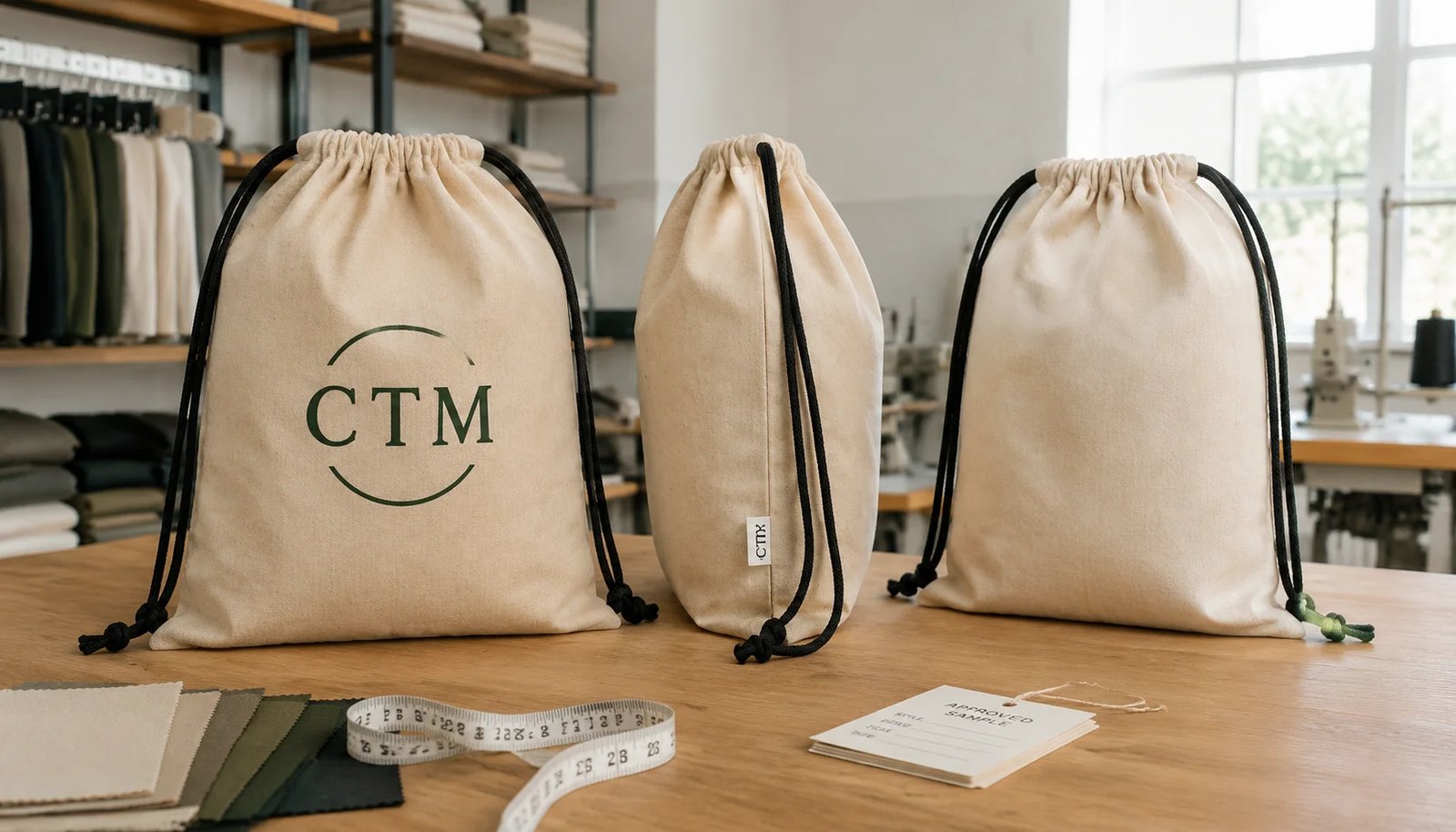
Why lead time slips on custom cotton drawstring backpacks
For liquor retailers, these backpacks are often tied to a fixed event calendar: holiday gifting, store openings, tasting programs, loyalty promotions, or bundled bottle offers. The problem is that buyers often treat them as a simple sewn item and assume the lead time is only sewing plus freight. In practice, the longer path is usually fabric choice, print approval, and packing detail alignment. A plain drawstring bag can move quickly if it uses stock canvas, standard cords, and single-color print. The same bag can slip two to four weeks if the order adds dyed fabric, exact Pantone matching, retail barcoding, or individually inserted promo cards.
The core planning mistake is starting from a generic supplier promise such as '30 days production' instead of building from the slowest component. A liquor retail program usually has at least six linked steps: artwork proof, material booking, sample approval, printing queue, sewing queue, and final packing. If one of those steps is undefined in the RFQ, the date risk sits with the buyer. Good lead time planning means identifying what can be standardized early and what must remain custom for the brand. That tradeoff matters more than chasing the lowest unit price.
- Fastest route: stock natural cotton + 1-color screen print + standard cord + flat bulk packing
- Common delay route: custom dyed fabric + revised artwork + custom labels + retail-ready individual packing
- Most missed date driver: sample approval cycles that are not assigned a deadline on the buyer side
- Second most missed driver: components quoted as standard but actually purchased from outside vendors
Start with the use case, not the logo
A liquor retailer should define what the backpack must carry before discussing artwork. If the bag is a promotional giveaway meant for brochures, small accessories, or general store use, 140-220 GSM cotton can work depending on bag size. If it may carry a wine bottle, tasting accessories, or mixed gift items, most buyers should step into 270-340 GSM canvas or use reinforced corners and stronger cord. Otherwise the bag may pass visual inspection but fail in actual store use, leading to claims that the supplier will argue are due to misuse.
The use case also changes the acceptable bag proportions. A wider bag may improve logo visibility, but a narrow bottle-oriented fill pattern creates point load at the corners and cord exits. That means the same cotton weight behaves differently depending on shape. Procurement teams that define loading intent in the RFQ usually get more useful factory feedback than teams that only provide a logo and target price.
- For lightweight promo use: around 140-220 GSM can be workable if cost is the main driver
- For resale or heavier contents: around 270-340 GSM is a safer starting range
- For bottle-related carry use: review bottom corner stress and cord channel reinforcement, not just body fabric
- Record intended load example in RFQ, such as one 750 ml bottle plus leaflet, or two small items under 2 kg total
Fabric choice is the first real lead time decision
Cotton drawstring backpacks are often quoted as if all canvas is interchangeable. It is not. Stock natural cotton canvas can usually move faster because the mill or factory already carries repeat material in a few standard weights. Once the buyer requires dyed black, forest green, deep burgundy, or a strict Pantone retail brand color, the schedule may need greige stock allocation, dyeing, drying, inspection, and possible shade correction. On smaller orders, custom color can be especially inefficient because the fabric dye MOQ may be higher than the sewing MOQ.
Fabric weight also affects timing because heavier canvas is not always held in every width and finish. A supplier may quote 10 oz canvas quickly, but if the actual available roll width changes marker efficiency or the cloth requires pre-shrink handling, production planning changes. For liquor retailers with hard launch dates, the practical rule is simple: if color is not critical, use stock natural or a regularly stocked black. If exact brand color is critical, build extra time before PP sample approval and request shade approval rules in writing.
- Approximate guide: 8 oz canvas is about 270 GSM, 10 oz about 340 GSM, though mill conversion can vary
- Natural cotton often shortens sourcing time versus custom dyed fabric
- Dyed fabric may require shrinkage and shade control before cutting
- If using recycled or organic cotton claims, include document timing in the schedule, not only material timing
Print method can save a week or cost a week
Most liquor retail backpack programs fit screen printing because the artwork is usually bold, event-driven, and logo-based. A one-color print on natural canvas is normally the most schedule-friendly route. Multi-color logos, large coverage areas, or dark bags with light ink increase setup, drying, and approval time. Water-based printing can look premium on cotton but may vary more on absorbent fabric and can require careful curing. Heat transfer or digital printing can be suitable for small runs or detailed artwork, but these methods may not be the fastest once scale increases.
The buyer should treat print approval as a real gate, not a casual email confirmation. A screen print strike-off or pre-production sample is where placement, color density, edge sharpness, and fabric show-through should be signed off. Retail buyers often spend extra time revising artwork after sampling because the logo that looked good on a white screen proof does not read well on natural canvas texture. That revision cost is not only about price; it can push the print booking slot and move the ship date.
- Fast route: 1-color or 2-color screen print on stock natural cotton
- Higher risk route: metallic ink, puff print, discharge effects, halftones, or oversized panels
- Define print area in RFQ, for example 20 x 24 cm centered on one side
- Request acceptable print tolerance for position, for example +/- 0.7 cm from approved centerline
MOQ logic: where small custom details become schedule problems
Buyers usually focus on the bag MOQ, but the real issue is component MOQ. A factory may accept 1,000 pieces for sewing, while the woven label vendor wants 3,000 labels, the custom dyed cord vendor wants a color lot minimum, and the printed hangtag supplier wants a plate setup that makes small runs uneconomical. When several small customizations are stacked onto a modest order, the factory either delays while consolidating sources or substitutes materials that were not fully discussed. Neither result helps a fixed retail launch.
For liquor retailers, a practical strategy is to choose one or two visible brand elements and standardize the rest. For example, use stock natural canvas, a black standard cord, and a one-color front print, then invest in a branded side label or retail swing tag only if the order quantity supports it. This keeps the product branded without turning every trim into a separate sourcing task.
- Sewing MOQ may differ from fabric dye MOQ, print MOQ, label MOQ, and packaging MOQ
- Custom cord colors often look minor but can become one of the slowest sourced parts
- Below efficient quantity, stock trims usually beat custom trims on both timing and landed cost
- Request a quote split showing standard trims versus custom trims so timing differences are visible
Sample approval should mirror production reality
A useful sample process for drawstring backpacks is not just one pretty prototype. Buyers should separate development sample, print strike-off, and pre-production sample. The development sample proves dimensions, fabric hand feel, cord path, and seam construction. The strike-off proves the print. The PP sample should use actual intended material and construction so the factory can treat it as the sealed standard. If these stages are merged too loosely, the supplier may move into bulk with assumptions on print color, cord thickness, or packaging details that were never finalized.
For liquor retail programs, sample checks should be use-based. Put actual weight inside the sample, pull the cords repeatedly, and inspect corner stress after a short carry test. This is especially important if the promotion may tempt store staff to place a bottle into the backpack even if it was not designed only for bottle carry. A sample that looks clean on the table may still distort at the bottom under a real retail load.
- Development sample: size, pattern, fabric weight, and cord function
- Strike-off: print color, coverage, and edge quality on actual fabric base
- PP sample: final sewing, label placement, and packaging method
- Sealed sample should include approved carton marks and barcode label position if retail compliance matters
Packing details often get pushed too late
Packing is one of the most underestimated sources of delay for promotional bags. A bulk export pack can be straightforward: flat fold, 25 or 50 pieces per polybag, then packed into outer cartons. But many liquor retailers need more than that. They may require suffocation warning rules, item stickers, inner assortment labels, carton weight limits for DC handling, or retailer-specific shipping marks. If those instructions arrive after production starts, finished goods may wait at the factory while new packaging materials are sourced or repacking labor is arranged.
Packing choices also affect freight economics. A simple cotton drawstring backpack compresses well, but folded inserts, cardboard headers, or each-in-poly retail presentation can sharply increase carton volume. That matters when a buyer is already close to a shipping cutoff. In some cases, reducing decorative packing saves enough cube to shift an order from overflow air freight back to sea freight or combined loading.
- Typical bulk pack: 25-50 pcs per polybag, export carton based on weight and cube target
- Good carton control range: keep gross weight suitable for manual handling based on destination rules
- If barcodes are needed, provide format, size, and placement before PP sample stage
- Carton dimensions should be confirmed before bulk packing so freight booking is accurate
Build the schedule backward from the in-store date
The most reliable way to plan custom backpack timing is backward scheduling. Start with the in-store date, then subtract destination receiving time, customs or domestic handling, international transit, ex-factory completion, production days, sample approval days, and artwork release. This immediately shows whether a custom-dyed, multi-trim program is realistic. It also helps procurement teams decide where to simplify. If the backward plan leaves only a narrow production window, use stock fabric and standard trims rather than hoping the factory can compress every stage.
For sea freight programs, buyers should also distinguish between ex-factory date and vessel-on-board date. A bag order completed on time can still miss the launch if carton details delay booking or if final carton weights are unavailable for freight planning. For urgent campaigns, split shipment planning can be worthwhile: reserve the option to air a small launch quantity and send the balance by sea. That choice should be discussed before the PO, not after delay occurs.
- Map milestones: artwork approval, material booking, sample sign-off, bulk cutting, printing, sewing, packing, inspection, dispatch
- Assign buyer response deadlines as well as factory deadlines
- Separate ex-factory date from port departure date and warehouse delivery date
- Keep a contingency buffer for fabric shade issues, print rework, or booking changes
What quote data buyers need to compare suppliers properly
A weak quote comparison focuses only on unit price and stated lead time. A useful quote comparison breaks out the assumptions. Two suppliers may both quote the same backpack, but one is pricing 180 GSM cotton with generic cord and one-side print, while the other is pricing 280 GSM canvas with reinforced corners, thicker cord, and individual barcodes. Procurement teams should force comparability by asking each supplier to state fabric GSM, fabric source status, print method, trim assumptions, sample timing, packing count, and carton data in the quotation itself.
This is especially important for liquor retail buyers because product use and channel requirements vary. A bag for a tasting event, a loyalty redemption item, and a retail shelf item should not be evaluated through the same costing lens. The cleanest method is to request both a base option and an upgraded option from each supplier. That exposes which supplier is competitive on standard work and which supplier is better at retail-ready finishing.
- Request price by quantity break, for example 1,000 / 3,000 / 5,000 / 10,000 pcs
- Request sample cost and whether it is refundable against bulk order
- Require lead time split: sample days, production days, packing days
- Require carton quantity, carton size, net weight, gross weight, and estimated CBM
QC thresholds that matter more than cosmetic perfection
For cotton drawstring backpacks, buyers should prioritize failures that affect retail usability and claims risk. A slightly irregular natural cotton slub may be acceptable if the brand approves that character, but weak back-tack at the cord exit, uneven cord length, or print misplacement on a logo-centric bag can trigger rejection or customer complaint. QC planning should therefore distinguish critical load-bearing points from normal fabric appearance. If natural cotton is used, define what visual variation is acceptable in advance so factory and inspector are not arguing during final inspection.
A workable QC approach is to create a short pass-fail list tied to the sealed sample and purchase order. For liquor retail channels, include carry function, print readability, size tolerance, pack count accuracy, and carton labeling accuracy. Overly broad quality language creates room for interpretation, while a narrow practical standard helps both supplier and buyer move quickly.
- Measure finished width and height on a flat bag with specified tolerance
- Test cord pull smoothness and verify equal extension left to right
- Inspect print placement and color strength against approved sample under consistent lighting
- Review seam security at upper channel, side seams, and lower cord anchor points
- Count pieces per carton and verify assortment or barcode labels before sealing cartons
Specification comparison for buyers
| Spec decision | Recommended option | When it fits | Buyer risk to check |
|---|---|---|---|
| Fabric weight | 8 oz to 10 oz cotton canvas, about 270-340 GSM | Best for liquor gift-with-purchase, bottle shop merchandise, and retail resale where bag needs structure but still folds flat | Too light under 180 GSM can distort under bottle weight; too heavy above 400 GSM can extend fabric sourcing and sewing time |
| Cotton type | Stock natural cotton canvas instead of dyed custom fabric | Best when launch date is fixed and color accuracy is not the main brand requirement | Natural shade varies slightly lot to lot; if exact white or dark brand shade is required, dyeing lead time and shrinkage control must be added |
| Print method | 1-color screen print on one panel | Best for seasonal promos, store events, holiday liquor packs, and mid-volume orders | Large solids can crack if ink cure is poor; dark bags with light ink may need underbase and extra drying time |
| Logo complexity | Simple artwork under 2 spot colors with no halftone | Best when approval speed matters more than decorative effect | Fine lines, metallic ink, or edge-to-edge artwork increase strike-off cycles and press setup delays |
| Cord construction | Cotton rope or braided polyester cord with knotted ends | Best for standard backpack use and easier replenishment | Special tipped cords, metal aglets, or exact custom dye lots often become small-component bottlenecks |
| Bag size | Standard adult retail size around 35 x 45 cm or 38 x 42 cm | Fits one bottle plus promotion materials, or general store merchandise | Non-standard dimensions affect marker efficiency, fabric yield, carton count, and sample revision timing |
| MOQ route | Use factory stock fabric and standard cord for 1,000 to 3,000 pcs | Best for pilot launches, regional chains, or event campaigns | Trying to force custom Pantone dyed fabric below efficient dye MOQ can raise price and add 7-14 days |
| Packing format | Flat packed 25 or 50 pcs per polybag, then export carton | Best for lower CBM and easier DC receiving | Individual retail inserts, hangtags, barcodes, or each-in-poly packing add labor and can slow final packing throughput |
| Shipping route | Split shipment planning: bulk by sea, urgent balance by air only if needed | Best for chain rollouts where launch date is fixed but total demand is high | Without early carton weight and cube estimates, air fallback can become too expensive or impossible for margin targets |
Buyer checklist before sampling
- Lock the target in-store date first, then back-calculate sample approval, production, and ex-factory milestones.
- State whether the backpack carries a bottle, accessories, or only promotional literature, because load requirement changes GSM and seam construction.
- Specify finished size with tolerance, for example 38 x 42 cm +/- 1 cm, and note whether dimensions are measured flat before packing.
- Choose stock natural cotton or custom dyed fabric early; this decision changes sourcing lead time more than most buyers expect.
- Define print method and color count in the RFQ, including print area size and whether both sides need artwork.
- Confirm cord material, diameter, color, and finishing method such as knots, heat cut, or aglets.
- Set sample approval stages: digital artwork, pre-production sample, print strike-off, and if needed a sealed sample.
- Declare packing format including pieces per inner pack, barcode label placement, carton size limit, and outer carton marks.
- Request estimated net weight, gross weight, and carton CBM before PO approval so freight planning is not delayed.
- Include AQL level or key visual and seam criteria so final inspection standards are aligned before production starts.
Factory quote questions to send
- What is the current lead time if we use stock 8 oz, 10 oz, or 12 oz cotton canvas instead of custom dyed fabric?
- Which fabric weights are kept in regular inventory, and which require weaving or outside sourcing?
- At our target quantity, what MOQ applies for natural fabric, dyed fabric, custom cord color, woven label, and hangtag separately?
- How many days are needed for artwork proof, print strike-off, pre-production sample, and mass production after approval?
- Does the quoted lead time include fabric testing, color approval, and booking time for screen printing, or only sewing days?
- What sewing construction is standard at the cord channel and bottom corners for a loaded drawstring backpack carrying a bottle-weight item?
- What print method are you quoting exactly: water-based screen print, plastisol, pigment print, heat transfer, or digital print?
- How many print stations and sewing lines will be allocated to this order size, and can production be split if we need partial shipment?
- What is the standard packing configuration, carton dimensions, carton gross weight, and pieces per carton for this bag size?
- Which components are the most likely delay points in your current schedule: fabric, cord, label, printing, packing materials, or export booking?
Quality-control points to confirm
- Fabric GSM within agreed tolerance and consistent shade across production lots, especially on natural cotton where lot variation is visible.
- Finished size measured flat within agreed tolerance, with channel opening and cord length matched on left and right sides.
- Screen print position centered to approved placement tolerance and color density matching sealed sample.
- No raw edge fray at inside seams beyond agreed standard; seam ends back-tacked at stress points.
- Cord pulls smoothly through channel without twisting, snagging, or uneven resistance.
- Bottom corner reinforcement and cord insertion points secure enough for intended retail load.
- Needle holes, oil marks, loose threads, and fabric slubs reviewed against approved sample standard, not judged after packing.
- Packing count per polybag and carton exactly matched to pack instruction to prevent DC receiving claims.