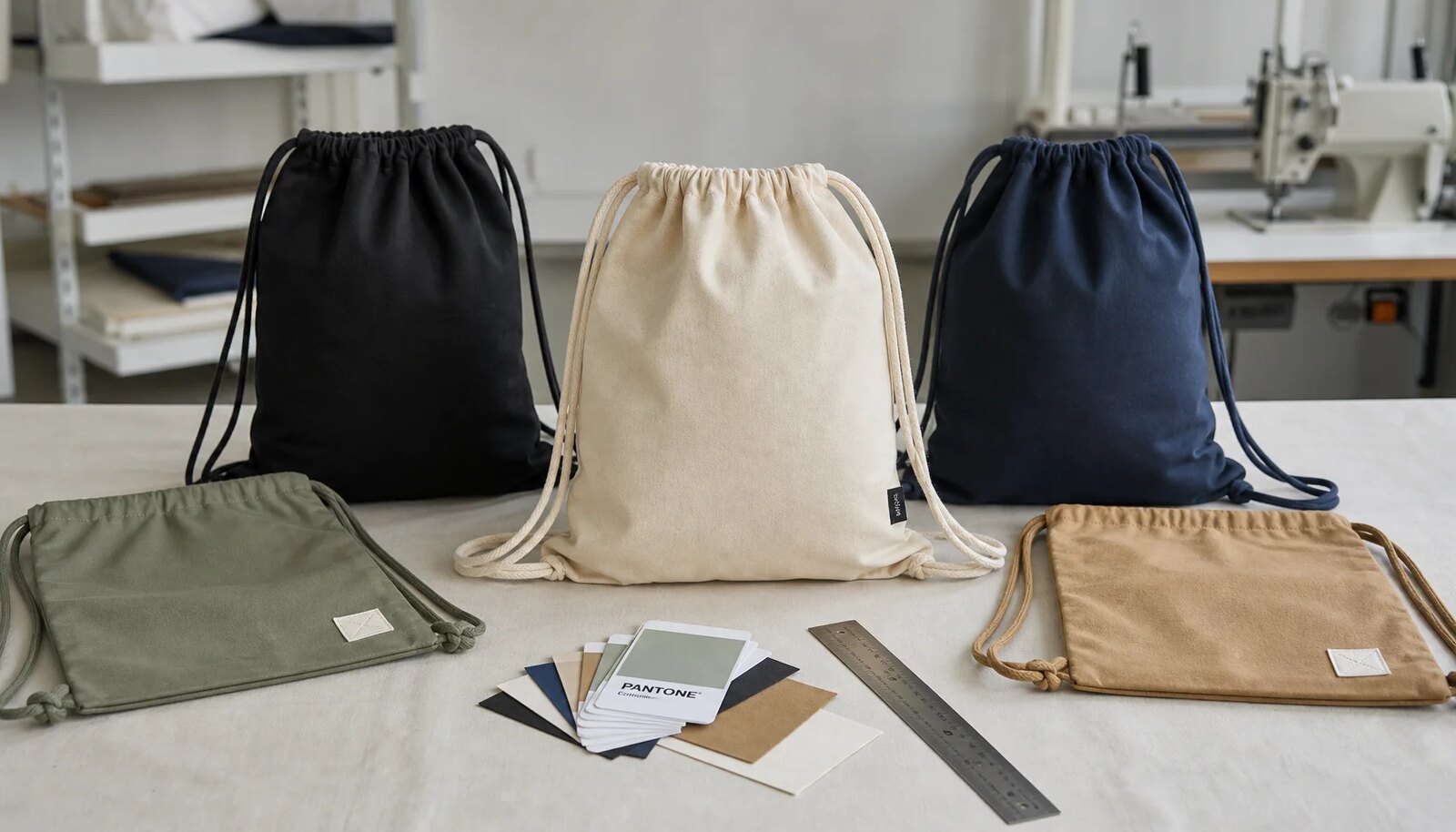
Start from the day the bags must be usable
For coffee roasters, custom cotton drawstring backpacks usually serve a commercial purpose, not a decorative one. They support a trade show, cafe opening, wholesale launch, subscription insert, staff kit, or retail shelf program. That means the real deadline is not the day the factory says the goods are ready. The real deadline is the day the bags must be counted, received, and usable in your warehouse or event kit.
A lead-time plan should therefore work backward from the date the bags are needed in hand. That calendar has several steps that buyers often collapse into one vague approval bucket: artwork signoff, sample review, production slotting, inspection, export paperwork, freight, customs, warehouse receiving, and internal pack-out. If any one of those steps slips, the whole program slips.
The fastest way to lose time is to ask for a quote before the timeline is fixed. A supplier can only give a useful schedule if the use date, the order version, and the decision owner are already clear. When those items are locked early, the factory can tell you what is already in stock, what needs to be made, and which step actually controls the schedule.
- Use date: when the bags must be on site or on the event floor.
- Receiving date: when the warehouse must physically have the cartons.
- Pack-out date: when the bags must be ready to fill with coffee or inserts.
- Decision freeze: the point after which changes reset the schedule.
- Buffer: time reserved for sample revisions, freight, customs, and warehouse receiving.
Write an RFQ the factory can price without guessing
Procurement teams usually get better timing when the brief is boringly specific. The bag size, intended contents, artwork version, decoration method, and packing format should all be named in the RFQ. If the bag is meant to hold coffee pouches and a mug, say that. A flat dimension on its own does not tell the factory how much structure the bag needs, how much fabric it will consume, or whether the finished shape will hold under load.
The same logic applies to the decoration callout. A logo on a flat sketch is not enough when the bag has seams, cord channels, and folds that affect print placement. If the artwork must sit a certain distance from the seam, say so. If the logo must look clean after the bag is folded for retail packing, say that too. Every missing detail becomes a hidden assumption in the quote.
A good RFQ also separates the product from the commercial extras. Fabric, printing, labels, packing, sample work, and freight are different cost buckets. If the supplier quotes only a single number, ask for the components separately. That makes later negotiations easier and keeps the buyer from comparing unlike proposals as if they were the same offer.
- Include dimensions, target contents, and finished bag use case.
- Send vector artwork, not a screenshot, and name the final print size.
- State the fabric weight target and whether the bag should feel premium or lightweight.
- Call out label, barcode, and retail packing requirements in the same brief.
- Ask the factory to quote product, sample, packing, and freight as separate lines.
Choose the spec that fits the sales channel, not just the logo
The best backpack specification is the one that fits the commercial job. A low-cost giveaway bag for a coffee tasting event does not need the same construction as a retail bag sold beside whole-bean coffee. The first question is what the bag must do in use: carry product once, survive repeated customer use, or present well on a shelf or in a fulfillment carton.
Fabric weight is usually the first commercial decision. A lighter cotton bag may lower cost, but it can wrinkle more easily, show the contents more clearly, and carry a less durable feel. A heavier canvas raises material cost and freight weight, but it can improve hand feel and print appearance. The right answer depends on how the bag is being sold or used, not on a generic preference for heavy or light canvas.
Decoration should be chosen with the same discipline. A simple one-color screen print is usually the cleanest path for speed and repeatability. Two-color printing can improve shelf appeal if the artwork is truly built for it, but it adds setup and registration checks. Embroidery or a patch can raise perceived value, but it also introduces extra setup cost and may create texture issues on lighter fabric. If the decoration does not help the buyer or the end customer make a better decision, it is probably not worth the added complexity.
- Giveaway or event bag: prioritize stable print, bulk packing, and a low landed cost.
- Subscription insert: prioritize clean folding, accurate pack counts, and warehouse-friendly cartons.
- Retail merch: prioritize presentation, label placement, and a decoration method that sells at a higher price point.
- Heavy content kit: test the bag filled with real pouches or objects before freezing the spec.
- Repeat program: choose the version that the factory can reproduce without special handling every time.
Treat MOQ as version control, not just a number
MOQ problems usually show up when the buyer turns one order into too many versions. A factory may be fine with a workable total quantity for one bag size, one fabric color, one print setup, and one packing method. The same order becomes harder to price and harder to schedule when it is split across several artwork versions, colorways, label sets, or retail pack formats.
Coffee roasters are especially exposed to this because the brand system often includes flagship coffee, seasonal releases, cafe merch, wholesale kits, and event collateral. Each variation can require its own setup, approval, and carton labeling. That affects both the quote and the lead time. If a launch date is fixed, simplification is usually the cheapest way to buy time.
The practical move is to ask the supplier to quote the clean version first and then price each added variable separately. That lets you see where the real cost and timing friction lives. In many cases, one larger run with fewer variations lands better than a smaller order split across several SKUs. If variation is unavoidable, keep the version count tight and make the pack plan obvious enough for the warehouse to receive it without confusion.
- Ask whether MOQ is per total order, per fabric color, per print version, or per packing version.
- Keep the first run to one size and one decoration position if the deadline is tight.
- Use inserts, stickers, or hangtags for campaign variation when changing the bag itself would slow production.
- Request separate pricing for every screen, embroidery file, patch, label, barcode, and carton mark.
- Put the version list in the PO so the factory and warehouse count the same SKU set.
Compare quotes on landed cost, not unit price alone
A quote that looks cheap at the unit level can become expensive once packing and freight are added. Cotton drawstring backpacks are bulky relative to their value, so carton size and freight mode matter more than they do for small flat goods. One supplier may look more expensive on the product line but actually win on landed cost because the carton packs more efficiently or the decoration method is simpler.
To compare suppliers fairly, force the quote into the same structure. Ask for the base product price, setup fees, sample cost, packing labor, carton dimensions, gross weight, and freight assumption if one is included. If a supplier is quoting dyed fabric while another is quoting natural cotton, or one includes polybags while another does not, the numbers are not directly comparable. The point is not to get the lowest sticker price. The point is to buy the lowest usable cost for the deadline you actually have.
This is also where supplier quality shows up. A strong quoting partner will tell you which assumptions are fixed and which ones are still open. A weak one will quote fast and vague, then add charges later when packing, shade control, or carton details become real. For procurement, the question is not just how low the quote is. It is how much of the final landed cost the supplier has already made visible.
- Compare product price, sample cost, setup fee, packing cost, carton spec, and freight together.
- Ask for chargeable-weight estimates before using air freight for bulky orders.
- Require carton dimensions early if the warehouse or 3PL has receiving rules.
- Check whether barcodes, hangtags, and carton marks are included or extra.
- Score suppliers on quote clarity and assumption control, not just speed.
Use sampling to remove risk, not just to approve artwork
A sample should prove the real bag, not only the logo. For a first order, ask for a pre-production sample that uses the final fabric, final cord, final decoration method, final label placement, and intended folding method. A digital proof may help with artwork alignment, but it cannot show hand feel, seam quality, closure behavior, or how the bag looks when the real contents are inside it.
That matters for coffee programs because the bag is often judged in context. Put the actual pouches, mug, cards, or inserts into the sample. Close it, reopen it, and fold it the way your warehouse or event team will handle it. Check whether the print creases, whether the cord cuts into the fabric, whether the label is visible in the intended position, and whether the packed bag still looks clean enough for retail or handoff.
Once the sample is approved, freeze the spec in writing. If the buyer later changes the logo size, fabric shade, cord color, label position, or packing format, the schedule should be rechecked immediately. Late changes are not just an art issue. They are a production issue, and sometimes a freight issue too. The best supplier will treat the sample as the reference standard for the whole run, not as a rough draft that can be improvised later.
- Require a physical sample for first orders, new fabrics, retail programs, and complex packing.
- Approve photos alone only when the order is a true repeat and the risk is low.
- Record the approval date, file name, spec version, and any accepted tolerance in writing.
- Test the bag filled, folded, and packed, not only flat on a table.
- Do not release mass production until sample comments are closed.
Write QC around the ways these bags actually fail
Quality control is more useful when it is written as a failure checklist instead of a general request for good workmanship. For cotton drawstring backpacks, the common failure modes are pretty concrete: wrong fabric weight, off-center print, poor opacity, weak seams, loose threads, uneven cord length, sloppy folding, carton mix-ups, and label errors. Those are the issues that buyers, warehouse teams, and end customers actually notice.
The inspection standard should be agreed before the order runs. If you want a tolerance on dimensions, say it. If you care about shade consistency across a dyed order, say that too. If barcode placement matters to your retail client or 3PL, include the required position and orientation. The more measurable the standard is, the less likely the factory and the buyer are to disagree after production is already finished.
Use the same logic for sample size and inspection method. A formal pre-shipment inspection, an AQL-based check, or a buyer-defined sampling plan all work if they are matched to the order risk. A simple event giveaway can tolerate a lighter check than a retail program with multiple SKUs and barcodes. The key is to inspect the points that would create a customer-facing problem or a receiving delay if they were wrong.
- Write tolerances for dimensions, placement, shade, and fabric weight into the approved spec.
- Check bottom corners, side seams, and cord channels as functional points, not cosmetic details.
- Require first-article approval when artwork placement or print opacity is critical.
- Inspect front, back, inside seams, cords, labels, fold, and carton marks with the same reference standard.
- Make carton-count accuracy part of QC when orders are split by cafe, campaign, or SKU.
Plan packing and freight before the goods are sewn
Packing affects both product quality and warehouse efficiency. Bulk packing is usually best for internal use, event giveaways, and low-cost programs where the bags will be handled again before they reach the customer. Individual polybags add cost and time, but they can protect print surfaces, keep bags clean in storage, and make retail or subscription fulfillment easier. The right choice depends on how the bag will move after it leaves the factory, not on habit.
The carton plan should be known before production starts, because it affects freight and receiving. Ask for carton dimensions, gross weight, net weight, units per carton, and carton marks. If your warehouse or 3PL needs a barcode sequence or a specific carton label format, that has to be built into the packing spec before the factory closes the order. Otherwise the goods may be correct as products and still be awkward or slow to receive.
Freight is the last step, but it should not be an afterthought. Air freight is useful when the order is urgent or only a portion of the goods must arrive early, but it can become expensive quickly because these bags are bulky. Ocean freight is usually the better landed-cost choice when the calendar allows it. A split shipment can be a practical compromise if the event quantity is urgent and the replenishment stock can wait for a lower-cost route.
- Use bulk packing for low-cost programs where warehouse handling is simple.
- Use individual polybags when retail presentation or storage cleanliness matters.
- Get carton dimensions and weights before you decide on freight mode.
- Ask whether cartons can be split by priority if only part of the order is urgent.
- Confirm export documents, carton marks, and packing-list format before the goods leave the factory.
Make the first order easy to repeat
The best first run is the one that turns into a repeat order with minimal rework. Coffee roasters often reorder merch for seasonal launches, annual events, and recurring cafe programs. If the first order is documented properly, the next one should not require the buyer to rebuild the spec from scratch. Keep the approved sample, the artwork files, the packing plan, and the carton details in one place.
Reorder control matters because small material changes can create visible variation. Natural cotton can vary from lot to lot. Dyed fabric can shift shade. Screens may need to be remade. Cord suppliers can change. If the bag is going to be sold again, the buyer should know what needs to match and what can flex. That is especially important when the first run performs well and the next order needs to be placed quickly.
The practical habit is to build a reorder packet at the same time as the first PO. Include the final spec, the approved sample reference, the carton and packing details, and any supplier setup notes the team will need later. That keeps the first order from becoming a one-off project and makes the next sourcing cycle shorter, cleaner, and easier to price.
- Keep one approved production sample as the reorder reference.
- Store final artwork, print size, placement notes, and label files in one spec record.
- Ask whether screens, patterns, or digitized files will be retained for future runs.
- Document fold method, carton count, and carton marks for the warehouse team.
- Review sales or usage data early enough to reorder by ocean instead of rushing to air freight.
Specification comparison for buyers
| Buying decision | Typical sourcing effect | Best fit for coffee roasters | What to ask the supplier |
|---|---|---|---|
| Natural 10 oz cotton canvas | Usually the lowest baseline cost and the easiest material to source when the factory stocks greige or natural fabric. It also keeps sampling and reorder risk lower because there is no dye lot to manage. | Event bags, subscription inserts, launch kits, and brand giveaways where the bag needs to look clean without pushing the budget. | Ask whether the fabric is stocked or made to order, what the real weight tolerance is, and whether the quote assumes one fabric lot or multiple lots across the run. |
| 12 oz cotton canvas | Adds fabric cost, sewing effort, and freight weight. It can lift the retail feel of the bag, but the landed cost can rise faster than the visual difference if the program is pure giveaway or event use. | Retail merch, premium coffee sets, staff kits, and heavier bundles that need a more durable hand feel. | Ask for the price delta versus 10 oz, the sample weight, whether the stitching spec changes, and how carton weight affects air freight or warehouse handling. |
| Dyed cotton fabric | Adds lab dip review or shade approval and usually increases both lead time and cost. It is the right choice when brand color on the bag is commercially important, not when color is just a nice-to-have. | Cafe-location merch, seasonal drops, and retail lines that must match a specific brand palette. | Ask whether dyeing is in-house or outsourced, what the shade approval step looks like, whether the dye lot can be repeated, and what the MOQ is for one color. |
| 1-color screen print | Usually the most efficient decoration path. Setup is simpler, sampling is cheaper, and the factory can keep the process stable for repeat orders if the screen is retained. | Roaster logos, event marks, wholesale starter kits, and programs that need speed and repeatability. | Ask for print size limits, minimum line thickness, ink opacity expectations, setup fee, and whether the screen will be stored for reorders. |
| 2-color screen print | Adds setup, alignment checks, and more proofing time. It can improve shelf appeal, but it increases the cost gap between a small and a larger run because the setup is spread across fewer units. | Premium merch where the second color materially improves the design, not just the artwork file. | Ask for registration tolerance, whether both colors are printed in one pass or two, and how many revision rounds are included before mass printing. |
| Embroidery or patch | Raises setup cost because of digitizing, patch production, or machine time. It can justify a higher retail price, but it is rarely the fastest route for a deadline-driven launch. | Higher-value retail bags, loyalty gifts, and limited drops where texture matters more than the lowest unit cost. | Ask for digitizing cost, thread color limits, stitch density, patch approval, puckering risk, and whether decoration happens before or after sewing. |
| Individual polybag with barcode or hangtag | Adds material, labor, artwork approvals, and carton handling. It can be worth it if the receiving warehouse or retail account expects clean presentation and simple scan flow. | Retail counters, subscription fulfillment, and wholesale accounts that need each unit ready to sell or store. | Ask for polybag size, barcode placement, warning-label requirements, pack count per carton, and whether the quote includes application labor. |
| Air freight | Moves the schedule fastest, but it can erase low product savings on bulky cotton bags because the chargeable weight rises quickly. Best used selectively, not as the default fix. | Urgent events, short-notice sales samples, or split shipments where only part of the order is time-sensitive. | Ask for packed carton dimensions, gross weight, chargeable-weight estimate, ready date, and whether the supplier can release priority cartons first. |
| Ocean freight | Usually the lowest freight cost per unit, but it needs more calendar buffer and better carton discipline. Delays in sample approval or export paperwork matter more when the transit window is long. | Planned seasonal buys, larger wholesale programs, and reorder stock that can wait for a more efficient landed cost. | Ask for carton count, pallet or floor-load assumptions, export documents, port handoff timing, and a receiving buffer before the warehouse needs the goods. |
Buyer checklist before sampling
- Event date, warehouse receiving date, and kit-assembly date written separately so the factory sees the real deadline, not just the target ship date.
- Quantity by SKU and by version, including fabric color, artwork file, print position, cord color, label version, and packing format.
- Finished bag dimensions, plus the actual items the bag must carry if it is meant to hold coffee pouches, mugs, apparel, or inserts.
- Fabric spec stated as natural, dyed, washed, pre-shrunk, or blend, with target ounce weight or GSM and any acceptable tolerance.
- Cord spec including material, diameter, color, finished length, knot style, and whether eyelets or sewn channels are required.
- Vector artwork with final print size, artwork placement from seams and fold lines, and named approval contact for any later changes.
- Decoration method, number of colors, print side, setup fee, and whether the supplier must provide a physical sample or strike-off.
- Labeling and retail requirements such as woven label, care tag, country-of-origin label, hangtag, barcode, warning label, or sticker placement.
- Packing plan with bulk pack or individual polybag, units per carton, carton marks, barcode sequence, SKU labels, and whether mixed cartons are allowed.
- Inspection criteria for fabric shade, stitch quality, print clarity, print placement, loose threads, cord pull, folding, carton count, and mix-up prevention.
Factory quote questions to send
- What date are you quoting from: artwork approval, sample approval, deposit receipt, or production slot confirmation?
- Is the fabric stocked, reserved, or dyed to order, and what is the actual lead-time impact of that choice on this quote?
- What is the MOQ per fabric color, artwork version, print position, cord color, label version, and packing version?
- Can you quote the base version separately from each add-on, including dyeing, extra print color, embroidery, patching, hangtags, barcodes, and polybags?
- What is the sample cost, and is that sample charge credited back if we place the bulk order?
- Can you provide a pre-production sample with final fabric, final cord, final decoration, final label placement, and the intended folding method?
- Which steps are in-house and which are outsourced, including dyeing, cutting, sewing, printing, embroidery, label application, packing, and export prep?
- What carton dimensions, gross weight, net weight, and units per carton should we use for freight planning and warehouse receiving?
- Can you split the shipment by priority if we need event quantities first and replenishment stock later?
- What tolerances will be written into the approved spec for finished dimensions, fabric weight, print placement, shade, and carton count?
Quality-control points to confirm
- Check fabric weight against the approved spec, and write the tolerance into the purchase order so the inspector is not guessing.
- Measure finished dimensions at the same points used on the approved sample, including width, height, and the cord-channel or top opening area.
- Verify print placement from the centerline and seam references, not by eye alone, because slight shifts are obvious on retail-facing panels.
- Review print clarity for opacity, pinholes, smears, ghosting, edge bleed, and color mismatch against the approved artwork or sample.
- Test the cord closure repeatedly to confirm smooth movement, consistent length, and secure knots that do not slip under normal use.
- Inspect stress points such as bottom corners, side seams, and cord channels for skipped stitches, open seams, puckering, or needle damage.
- Compare dyed fabric under consistent lighting with the approved swatch or sample so shade variation is not judged casually on the receiving dock.
- Confirm that labels, hangtags, barcodes, and care or origin labels appear in the correct position and match the approved files.
- Review fold quality and packing protection so the print is not creased, dirty, or abraded before the bags reach the warehouse or retail floor.
- Check carton counts by SKU, artwork version, and packing version, and make carton marks match the packing list before shipment leaves the factory.