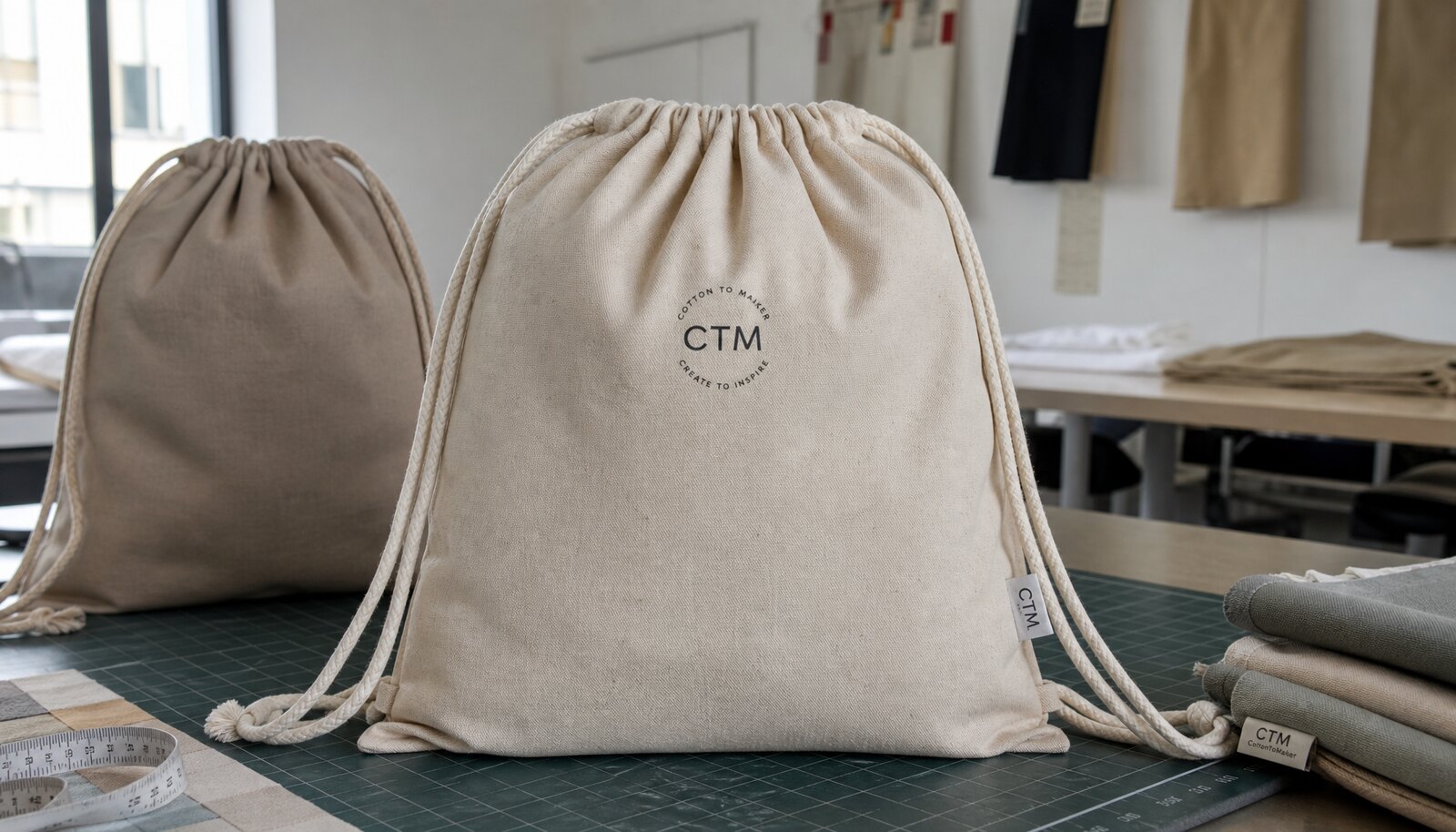
Start With the Delivery Date, Not the Bag Spec
For boutique wineries, a custom cotton drawstring backpack is rarely an open-ended accessory purchase. It usually supports a seasonal launch, a tasting-room retail reset, a harvest event, or a wine-club gift program. That makes the delivery date the real commercial requirement. If the bags are late by even one week, the buyer loses display time, event visibility, or bundled gift value. The first move is to back-plan from the dock date, not from the factory start date.
A usable schedule has four anchors: artwork freeze, sample approval, bulk production start, and ship date. If the supplier cannot commit to those points, the quote is not ready for comparison. Build a buffer before freight as well, especially if the bags need to cross borders or connect to a consolidation shipment. For a fixed event date, the safest planning method is to lock the target dock date, then hold a contingency window for sample correction and transit delay.
- Plan around the event or launch date that matters to the winery, not around a generic production estimate.
- Treat artwork approval as a hard gate, because late design changes reset print and packing timing.
- Keep separate buffers for production and freight so one delay does not consume the whole schedule.
Choose a Cotton Build That Fits the Schedule
Fabric choice changes both look and lead time. A lighter 8 oz cotton canvas, around 270 gsm, is usually easier to sew and can work for tasting-room giveaways or wine-club inserts. A 10 oz cotton canvas, around 340 gsm, gives a more substantial retail feel and usually remains manageable for standard sewing lines. Once you move into heavier cloth or more structured construction, the bag starts to behave more like a small tote than a quick-turn backpack, and the extra handling can slow output.
The simplest build is usually the safest for lead time: one body color, one print location, standard cotton cord, and no complex lining. If the winery wants a premium look, a woven side label or sewn patch is often easier to control than a multi-color print layout. Ask the supplier to quote the same spec in both a simple and upgraded version so the lead-time impact of each upgrade is visible. Buyers often discover that a small design change, such as a second print location, changes the whole schedule more than the unit price suggests.
- 8 oz to 10 oz cotton canvas is a practical range for most winery programs.
- Single-panel artwork is faster than multi-location branding.
- A sewn label can improve retail value, but only if the supplier has the label supply chain under control.
Pick the Right Sourcing Route Before You Compare Quotes
A quote from a direct factory is not the same as a quote from a trading company or a local decorator. The lead time, the hidden handling steps, and the accountability chain are different. A direct factory is usually the best fit when the bag spec is stable and the buyer wants one party responsible for fabric, sewing, printing, and packing. A trading company can help when the order is part of a wider sourcing program, but the buyer must still find out which operations are actually subcontracted. A local decorator can move quickly for small test runs, but the bag base may not match the final factory spec later.
The comparison table should be read as a sourcing decision, not just a material list. If the winery needs a fast pilot run, stock blanks plus local print can work. If the program is for retail shelves or repeat seasonal replenishment, a direct factory with in-house print and packing gives better repeatability. The wrong route usually shows up as schedule drift, not just a higher price. When the source is fragmented, the buyer spends time chasing the blank supplier, the printer, and the packer separately.
- Direct factory: best for repeat orders and controlled schedules.
- Trading company: useful only when it adds real coordination value.
- Stock blank route: useful for urgent pilots, but verify consistency before scaling.
Write the RFQ So the Supplier Can Quote One Schedule
Most lead-time problems start with incomplete RFQs. If the buyer only says custom cotton drawstring backpacks and a logo, the supplier has to guess fabric weight, print method, cord type, label method, and packing requirements. Each guess adds risk, and cautious suppliers protect themselves with longer lead times. A good RFQ should let the factory understand exactly how many operations are needed and which operations must happen before bulk starts. That is how the buyer gets a quote that can actually be compared across suppliers.
The quote should show the same basis across all suppliers: exact size, GSM or oz, logo colors, print location, packaging, carton marks, quantity ladder, and incoterm. Ask for a breakdown of what sits inside the quoted production days. If a supplier says 25 days, make sure that includes material reservation, cutting, printing, sewing, finishing, inspection, and packing. A faster-looking quote that excludes three of those steps is not a faster order. It is just an incomplete one.
- Send artwork in a clean vector format and include the print size in centimeters or inches.
- State whether the bag needs retail packing, barcode labels, or an insert card.
- Quote the same quantity ladder to every supplier so the lead-time and MOQ comparison is meaningful.
Treat Sampling as a Schedule Gate
Sampling is where many winery orders lose time. A digital mockup is useful for artwork approval, but it does not prove the hand feel, seam behavior, drawcord function, or print placement on real fabric. For a custom cotton drawstring backpack, the buyer should ask for a pre-production sample whenever the order includes a new fabric weight, a new label method, or a new packing requirement. If the sample needs a revision, that revision must be treated as a schedule reset, not a minor edit.
The sample review should cover practical points that matter in use. The bag should close smoothly, the cords should not snag, the logo should sit where the buyer approved it, and the stitching should not distort when the bag is filled. If the print is on natural cotton, the buyer should compare the color against the approved reference under normal light, not just on screen. A good sample approval note is written in measurements and tolerances, not in vague language. That prevents a later dispute when the bulk order arrives.
- Check logo placement, print color, cord movement, and seam quality on the physical sample.
- Approve the sample only after it passes a fill test and a close-open test.
- Treat any change to fabric, print, or label as a new approval point.
Plan Production Around the Slowest Step
A production schedule is only as fast as its slowest operation. Cotton bags can still be delayed by fabric sourcing, label sourcing, print drying time, or a packed-carton inspection queue. If the cloth is in stock and the artwork is simple, a supplier may quote a relatively short production window. But once the project needs custom dyeing, multiple print colors, or outsourced labels, the quoted days can stretch quickly. Buyers should read the schedule as a sequence: material reservation, cutting, print, sewing, finishing, inspection, packing, then handoff to freight.
The practical lesson is to simplify the first run. If the winery wants bags for a launch event, keep the first order to one body color and one artwork version. If the business later needs seasonal variants, those can be phased in after the base spec is stable. A small delay at the start can be more expensive than a small unit-cost saving, because it affects the event date and the sell-through window. For an order around a few thousand pieces, a simple spec can often move much faster than a more decorative one, but only when fabric, cord, and labels are already confirmed.
- Ask the supplier which parts are in stock and which parts must be reserved or made to order.
- Keep the first production run simple if the event date is fixed.
- Do not accept a lead-time quote without understanding the step that takes the longest.
Specify Packing for Tasting Rooms and Retail
Packing is not a cosmetic detail. It changes labor, carton size, carton loading efficiency, and the amount of inspection needed before shipment. For wholesale or distribution, bulk packing is usually the fastest and least expensive route. For retail or gift programs, individual polybags, barcode labels, and insert cards may be necessary. If the winery plans to sell the bags in-store, the buyer should define the exact retail presentation before production starts, because retrofitting packing after sewing is inefficient and often expensive.
The carton plan should match the channel. Tasting-room handouts can usually tolerate simple bulk cartons, while retail replenishment often needs clearer carton marks, carton counts, and SKU separation. If the shipment is going by sea, moisture protection matters as much as the outer look. Ask for clean, dry cartons, legible marks, and a packing list that matches the physical carton count. A well-packed order is easier to receive, count, and store, and it reduces the chance of damaged goods being blamed on the factory after transit.
- Bulk pack for wholesale, individual pack for retail, and define that choice before the quote is finalized.
- Use barcode labels, insert cards, and carton marks only if the receiving team actually needs them.
- For sea freight, ask for moisture protection and carton integrity, not just visual appearance.
Set QC Thresholds That Match the Price Point
Quality control should match how the bag will be used. A giveaway bag does not need the same finish level as a premium retail item, but it still needs basic consistency. The factory should agree to measurable thresholds for fabric weight, print registration, stitch quality, and cord function before bulk starts. If the buyer waits until inspection to define what is acceptable, the order becomes a dispute instead of a process. A simple checklist with tolerances is more useful than a long paragraph of subjective language.
The most useful checks are the ones that can be repeated quickly on the line and again during pre-shipment inspection. Inspect the logo placement, seam straightness, cord movement, loose threads, stains, and carton count. If the order uses dark ink on natural cotton, check for strike-through or uneven curing. If the bag includes a sewn label or woven patch, make sure it sits flat and does not pucker the fabric. The right QC standard does not eliminate all defects, but it does tell everyone which defects are serious enough to stop shipment.
- Agree on measurable tolerances for fabric, print placement, and stitch quality before production starts.
- Use pre-shipment inspection to catch loose threads, oil marks, and broken cords.
- Match the inspection standard to the channel: giveaway, retail, or gift set.
Compare Landed Cost, Not Just Ex Works Price
The cheapest factory quote is often not the cheapest order. A useful comparison includes sample fees, freight booking, export handling, carton upgrades, label insertion, inspection, and any rework risk created by a loose spec. For boutique wineries, the landed cost is usually more important than the unit price because the bag is tied to a campaign date. If a slightly higher factory price reduces the chance of air freight or a remake, it may be the better commercial choice.
Compare route by route. Direct factory, delivered on a planned sea schedule, may be best for repeat seasonal demand. A local print route may be cheaper on paper for a small test run, but the blank quality and future replenishment may drift. Air freight should be treated as a rescue option, not the default plan, because it can erase the margin on a small accessory order. The buyer should ask every supplier to quote the same incoterm and the same schedule basis, then compare the total cost to the dock date that actually matters.
- Include freight, carton spec, label work, inspection, and sample costs in the comparison sheet.
- Compare suppliers on the same incoterm and the same quantity ladder.
- Use air freight only when the event date is more valuable than the freight premium.
Specification comparison for buyers
| Spec decision | Recommended option | When it fits | Buyer risk to check |
|---|---|---|---|
| Base fabric weight | 8 oz to 10 oz cotton canvas, about 270 to 340 gsm | Tasting-room giveaways, wine club mailers, and retail bags that need a better hand feel without slowing sewing | Thin fabric can distort print and feel cheap; heavy fabric increases cutting and sewing time |
| Print method | Single-color screen print for the first run | Fastest option for launch bags with a clean winery logo or seasonal mark | Multi-color artwork may require extra screens, longer drying, and stricter registration control |
| Branding method | Print plus woven side label or sewn patch | Retail-oriented programs that need a more finished look than print alone | Extra label operations can add days if the supplier outsources labels or sewing |
| Supplier route | Direct factory with in-house cutting, sewing, and print | When you want one owner for schedule, sample control, and final packing | Verify whether print, labels, and packing are actually done in-house or subcontracted |
| Low-MOQ route | Stock blank bag plus local or regional print partner | Pilot orders, event programs, or fast replenishment under a small quantity | Blank size, shade, and cord details can change between replenishments |
| MOQ strategy | One body color, one artwork version, one packing spec | When the goal is to reduce setup changes and protect lead time | Too many colorways or packaging variants usually create avoidable delays and higher defect risk |
| Packing format | Bulk packed with carton marks, or retail polybag with barcode | Bulk for wholesale, polybag for retail shelves or winery gift sets | Retail packing adds labor and needs exact barcode, insert, and carton instructions |
| Freight route | Sea freight for planned replenishment, air freight only for urgent launches | Seasonal programs with a fixed dock date or a short event window | Air freight can rescue timing but may erase the unit-cost advantage of the bag order |
Buyer checklist before sampling
- Lock the delivery date first, then work backward from artwork freeze, sample approval, production start, and ship date.
- State the exact fabric weight in gsm or oz, not just cotton or canvas.
- Choose one print method and one artwork version for the first order if schedule is tight.
- Provide the final logo file, placement measurements, and Pantone references before requesting a quote.
- Specify whether the bag is for tasting-room giveaway, retail sale, wine-club gift, or shipping insert.
- Define packing: bulk carton, individual polybag, barcode label, hangtag, insert card, or retail shelf-ready pack.
- Ask the factory to confirm whether labels, printing, sewing, and packing are done in-house or outsourced.
- Build a time buffer for sample revisions, carton approval, and freight booking, not just production days.
Factory quote questions to send
- What fabric weight, weave, and shrinkage allowance are you quoting?
- Is printing done in-house, and how many print colors are included in the quoted lead time?
- What is the sample path: digital mockup, pre-production sample, or full shipment sample?
- Which operations are included in the production lead time: cutting, print, sewing, label attachment, inspection, and packing?
- What MOQ applies to the quoted spec, and does the MOQ change if we add a woven label or retail packaging?
- What packing method is included, and what carton size and carton quantity are planned?
- What incoterm is being quoted, and does the quoted transit estimate include booking time and export handling?
- What approval points will stop the line before bulk production starts?
Quality-control points to confirm
- Fabric weight should stay within the agreed tolerance band, and the fabric should not feel noticeably thinner than the approved sample.
- Logo placement should stay within the written measurement tolerance and remain centered after pressing and packing.
- Screen print should show even ink coverage, no pinholes, and no smear at the edges of the artwork.
- Stitching at the side seams, cord channels, and bottom corners should be straight, secure, and free from skipped stitches.
- Drawcords should move smoothly, knot cleanly, and keep the bag closed without slippage during a simple pull test.
- Labels, hangtags, barcodes, and country-of-origin marks should match the approved artwork and placement sheet.
- Cartons should be dry, correctly marked, and packed to the agreed quantity without crushing the bags.
- Pre-shipment inspection should catch loose threads, oil marks, broken cords, and color mismatch before balance payment.