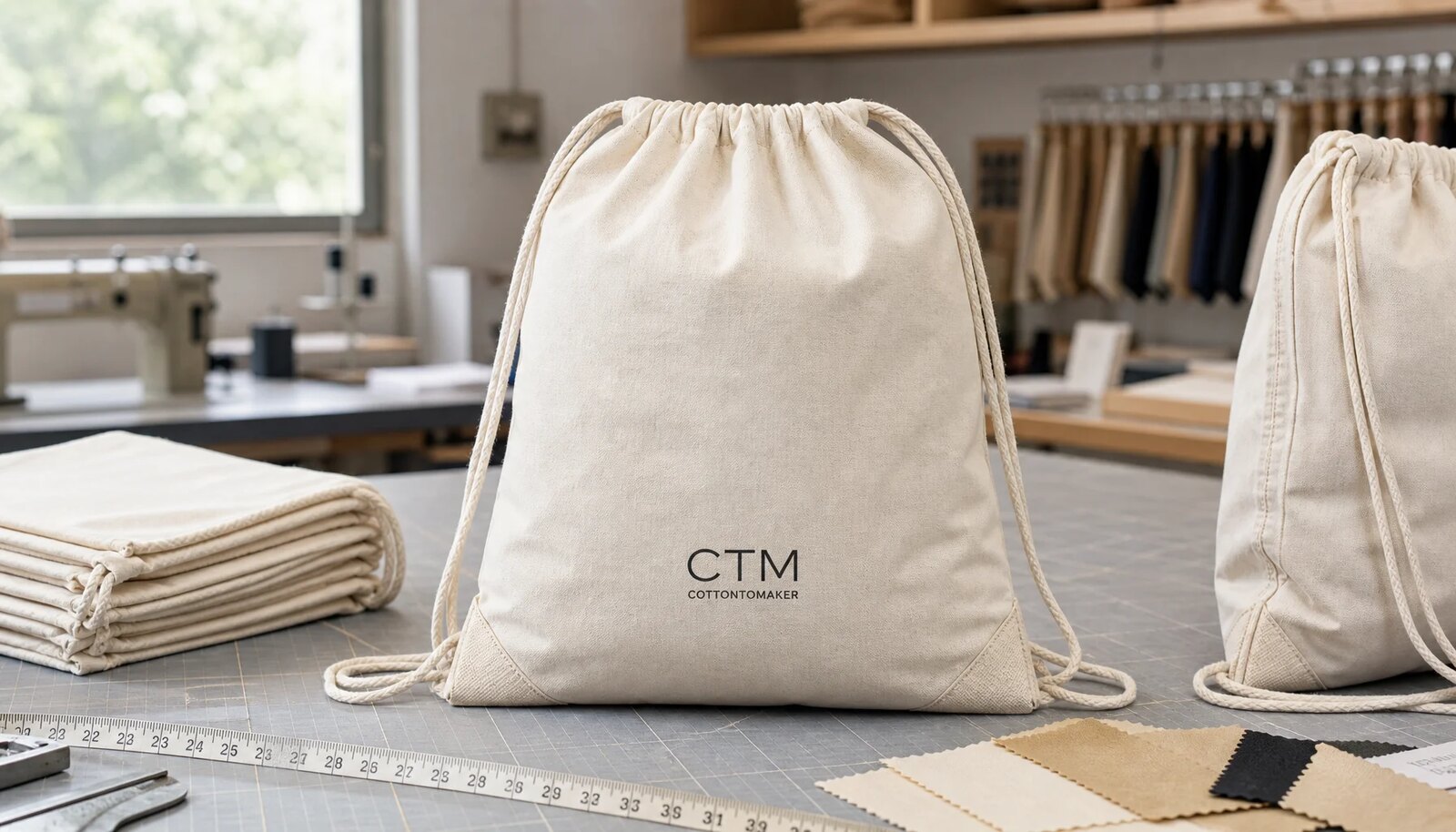
Start With the Real Production Trigger
For custom cotton drawstring backpacks in hotel retail, the sourcing clock rarely starts when the first inquiry is sent. At RFQ stage, the supplier is usually pricing from assumptions: natural cotton, average finished size, stock cord, simple logo, basic export packing, and no complicated destination split. That early estimate is useful for comparison, but it is not a controlled production schedule.
A workable lead time starts after the buyer has approved the commercial specification, confirmed the quantity split, released usable artwork, agreed payment terms, and chosen the sample route. If a pre-production sample is required, the safest bulk trigger is signed sample approval, not the day the logo file was emailed. Factories cannot responsibly book fabric, expose screens, reserve sewing capacity, order labels, approve cartons, or allocate packing labor while key details remain open.
Plan backward from the date the backpacks must be sellable or distributable at the property. Ex-factory readiness is only one milestone. The goods may still need inspection release, export handover, freight, customs, destination trucking, hotel receiving, SKU check, price labeling, allocation by property, and shelf setup. Hotel retail calendars are often tied to opening week, high season, spa launches, group events, cruise or tour departures, and shop resets. A missed approval can therefore create more than a small delay; it can push inventory past the selling window.
- Use RFQ date for supplier comparison, not committed delivery planning.
- Use final artwork and specification approval for proofing and sample scheduling.
- Use signed pre-production sample approval as the cleanest trigger for bulk cutting.
- Reserve buyer-side days for brand review, retail approval, procurement release, payment, and inspection decision.
- Add buffer for Chinese New Year, Golden Week, local holidays, peak export periods, and fixed hotel opening dates.
Define the Hotel Retail Use Case First
The phrase custom cotton drawstring backpack can describe anything from a low-cost promotional sack to a retail-ready resort accessory. Before choosing fabric or asking for a final price, define what the product needs to do for the hotel. A paid gift shop SKU needs better handfeel, cleaner printing, and more controlled packing than a one-time welcome amenity. A kids’ activity bag may need brighter artwork and careful cord decisions. A spa package may call for natural cotton, soft texture, and plastic-reduced presentation.
For many hotel retail uses, 6 oz to 8 oz cotton is the practical middle range. It has more body than lightweight promotional cotton while staying foldable and comfortable as a drawstring backpack. Lighter 4 oz to 5 oz cotton can work for cost-driven amenity or event programs, but it may not support a strong retail price. Heavier 10 oz canvas can suit premium merchandise, although it adds unit cost, carton volume, sewing load, and shoulder stiffness.
Finished size should be decided with actual contents, not only a catalog reference. A common adult size is about 35 x 45 cm, yet that may be too large for a spa kit and too small for a towel-and-sandal bundle. If bags are sold folded, shelf depth matters. If they hang on pegs, hangtag location and top-channel thickness matter. If staff will pre-fill them, lower-corner reinforcement and cord exit strength matter more than a clean front-view mockup.
- Define whether the product is resale merchandise, amenity packaging, event merchandise, or replenishment stock.
- Specify finished size after sewing, not only cut panel size or catalog size.
- Request reinforced lower cord exits when contents may include bottles, towels, sandals, or retail bundles.
- Confirm whether natural cotton slubs are part of the desired look or a rejectable variation.
- Test actual contents in the sample before approving bulk dimensions.
Write Fabric Specs Buyers Can Enforce
A strong RFQ does not say only cotton backpack. It identifies fabric weight, weave, color route, tolerance, and appearance standard. Cotton weight may be quoted in ounces per square yard or GSM. Because suppliers use different conventions, ask for both when possible and confirm whether the number is nominal, mill-stated, or tested. For simple cotton bags, a mill tolerance around +/-5% may be commercially realistic, but it should be written into the PO or sample approval record.
Natural cotton brings useful character, including mild shade variation, seed specks, and slubs. For resort and sustainability positioning, that look can be desirable. Still, it must be separated from defects such as stains, oil marks, mildew, odor, or dirty handling. Dyed cotton needs tighter control. Ask whether the fabric is stock dyed, piece-dyed before cutting, garment-dyed after sewing, or custom milled. Custom-dyed routes can add lab dip rounds, dye lot MOQ, and repeat shade risk on reorders.
Shrinkage matters if the hotel plans to describe the bag as washable or reusable. Cotton may shrink after washing, and printed artwork can change in appearance if washed or tumble dried. Do not make a care or durability promise unless the supplier supports it with data or the buyer runs its own wash evaluation. For procurement clarity, state whether approved dimensions are before washing, after washing, or not wash-tested.
- Ask for fabric weight in oz and GSM, plus the supplier’s acceptable tolerance.
- State the weave or handfeel target when comparing quotes from multiple factories.
- Approve dyed fabric against a lab dip or signed swatch, not only a digital image.
- Define acceptable natural cotton specks and slubs separately from stains or contamination.
- Document shrinkage expectations if the product will carry a care label or wash claim.
Control Drawcord and Construction Details
Drawcord details shape both guest comfort and defect risk. Cotton cord supports a natural look and is often preferred for plastic-reduction programs. Braided polyester cord can give stronger color consistency and may resist fraying better in repeated handling. A practical shoulder-carry diameter is often around 5 mm to 7 mm, depending on bag size and target cost. Very thin cord can cut into shoulders. Cord that is too thick may drag through the channel and make the closure feel rough.
The lower cord exit deserves special attention. On many drawstring backpacks, the cord exits at the lower corners and becomes the shoulder strap. If that point is weak, the seam can tear when guests carry heavier items than expected. Reinforcement can include extra stitching, fabric tabs, metal eyelets, bartacks, or folded corner construction. Each option changes cost, appearance, and production handling, so it should be specified rather than left to factory habit.
Top-channel width should match the chosen cord. A narrow channel slows closure and increases friction. An overly loose channel can make the top gather unevenly and look untidy on a retail shelf. Buyers should also confirm cord length, knot placement, end finishing, and whether loose cord ends are acceptable. Dark dyed cords touching natural cotton should be checked for rubbing and staining, especially when goods move through humid transit or warehouse conditions.
- Specify cord material, diameter, length, color, knot style, and end finish.
- Confirm top-channel width and closure smoothness on a physical sample.
- Require reinforced lower cord exits for retail use, not only promotional use.
- Check dark cord against light cotton for dry and wet rubbing risk where relevant.
- Measure cord length tolerance because uneven straps affect wear comfort and shelf appearance.
Match Decoration to Cotton Texture
Screen printing is usually the best starting point for hotel logos, resort names, destination icons, and one to three solid colors. It is efficient at bulk quantities and works well on cotton when artwork is clean. The RFQ should include vector artwork, Pantone references, number of colors, print size, and print placement measured from fixed seams. If the buyer wants a soft handfeel, say so early. A note that says front logo print is too loose for comparable supplier quotes.
Cotton is not a perfectly smooth print surface. Natural slubs, weave texture, and fabric movement can affect fine lines, small serif text, tight registration, and large solid ink areas. Big ink blocks can stiffen the front panel and may crack or crease if folded through the design. If the backpack will ship folded for hotel retail, approve the folded sample with the print in its final location, not only a flat strike-off.
Heat transfer, digital transfer, DTG, or other digital methods may be suitable for gradients, photographic artwork, or many colors. They should not be chosen only because the screen proof looks attractive. On cotton, buyers should review film edge visibility, handfeel, adhesion, opacity, cracking after flexing, and performance after packed storage. For retail merchandise, the print must look clean under shop lighting and feel acceptable when guests handle it.
- Use screen print for clean logos, simple icons, and repeat replenishment SKUs.
- Use transfer or DTG only when artwork complexity justifies extra sample review.
- Set print placement tolerance in writing, commonly +/-5 mm to +/-10 mm depending on design.
- Avoid placing heavy ink directly on a fold line unless the crease risk is accepted.
- Approve color against Pantone or a signed production sample under consistent lighting.
Plan MOQ by SKU, Not Total Units
MOQ for custom cotton drawstring backpacks is not only the total number of bags. It is shaped by fabric color, material availability, cutting efficiency, cord color, print screens, label type, hangtag, barcode, packing method, carton marking, and destination allocation. A factory may accept a lower MOQ for natural cotton, one standard size, stock cord, one-color screen print, and simple packing. The same factory may need a higher MOQ for custom-dyed fabric, multiple print positions, woven labels, paper bands, or several property logos.
Hotel groups often combine demand from multiple properties to reach a better quantity. That can work well when the base bag is identical and only the artwork changes. Even then, each hotel logo may require its own artwork proof, screen setup, approval, print batch, packing control, and carton label. If an RFQ says 3,000 pieces total but hides five designs of 600 pieces each, the supplier may quote incorrectly or add charges later.
The best MOQ negotiation is often simplification. Keep one fabric weight, one body color, one size, one cord, one construction method, and one packing format across all properties. Vary only the print or hangtag when necessary. This reduces material fragmentation, improves cutting efficiency, and makes QC cleaner. Splitting a small order into many colors and packing versions usually increases cost and calendar risk, even when the total volume looks attractive.
- Lower MOQ path: natural cotton, standard size, stock cord, one-color print, and simple export packing.
- Higher MOQ drivers: custom dye, custom cord, multiple logos, woven labels, hangtags, barcodes, and destination sorting.
- Quote quantity by fabric color, artwork, packing version, and destination, not total order quantity only.
- Ask whether overrun or underrun tolerance applies, such as +/-3% to +/-5% for bulk production.
- Check whether low-MOQ quotes exclude screens, samples, carton labels, or special packing labor.
Map Lead Time by Work Stage
A reliable lead time plan separates stages instead of relying on one broad production estimate. Artwork proofing may take two to five working days when files are clean. Missing Pantone references, low-resolution logos, unclear print placement, or unapproved brand marks can stop the clock. Sampling may take seven to fourteen working days for a basic physical sample, plus courier transit and buyer review. A pre-production sample using final material may take longer if fabric or cord must be produced first.
Bulk production becomes predictable only after materials are released. Stock natural cotton usually shortens preparation. Custom-dyed cotton, custom cords, woven labels, printed hangtags, paper bands, and barcodes add purchasing and approval steps. Printing time depends on number of colors, ink coverage, drying space, humidity, and workshop load. Sewing time depends on construction complexity, reinforcement method, inline defect rate, and whether the order is split into multiple artwork batches.
For many standard hotel retail cotton drawstring backpack orders, about 45 to 70 days from approved artwork, confirmed specification, and deposit to ex-factory readiness is a practical planning range. It is not a universal supplier promise; it is a working calendar for procurement planning. Add ocean, air, truck, customs, receiving, and internal distribution separately. Air freight can shorten transit, but it cannot recover time lost to late artwork, rejected lab dips, slow sample comments, unclear packing, or inspection rework.
- Artwork proofing: often 2 to 5 working days when files and placement are complete.
- Physical sampling: often 7 to 14 working days, plus courier and buyer review time.
- Lab dips or custom dye: add approval rounds and material booking time.
- Bulk production: depends on fabric route, print method, reinforcement, order size, and SKU split.
- Inspection and packing: reserve time for rework, carton marking, document checks, and forwarder handover.
Use Samples as the Production Standard
A digital mockup is helpful, but it does not prove retail quality. It cannot show cotton handfeel, fabric shade, print opacity, ink stiffness, seam finish, drawcord comfort, closure smoothness, folded presentation, or carton packing. For a hotel retail item, the sample is the bridge between the brand file and the product a guest will buy, receive, carry, and associate with the property.
Use the correct sample name. A blank stock sample can confirm approximate size and construction. A printed development sample can help review logo scale and print method, even if the fabric is not final. A lab dip confirms dyed fabric color direction. A pre-production sample should use approved bulk fabric, final cord, final print method, label, hangtag, and intended packing. In most first-order programs, that pre-production sample should become the signed production standard.
Sample approval should include real handling, not just a desk review. Load the bag with expected contents. Pull the cords repeatedly. Wear it over a shirt. Fold it as packed. Place it on a shelf or hook. Compare the print under retail lighting. Photograph and label the approved sample with version, date, fabric, color, print method, and packing. If any sample element is substituted, write the exception clearly so bulk production is not judged against the wrong material.
- Measure sample length and width flat after sewing and record the result.
- Check cord pull, channel friction, strap length, knot security, and lower-corner strength.
- Load the sample with realistic hotel contents before approving size and reinforcement.
- Fold the sample in final packing style to review crease, shelf size, and print position.
- Sign and version-control the approved pre-production sample before bulk cutting.
Control Packing Before Landed Cost
Packing is both a retail presentation decision and a freight-cost decision. Cotton drawstring backpacks can arrive dusty, creased, compressed, or humidity-marked if they are loosely packed in weak cartons. At the same time, excessive individual plastic may conflict with hotel sustainability policies. Decide early whether the priority is export protection, plastic reduction, shelf display, barcode handling, destination allocation, or a balanced mix of those needs.
Common options include individual polybag, recycled polybag, paper band, belly band, hangtag, bulk folded packing, or inner bundles by quantity. Individual polybag protects natural cotton during export, warehouse handling, and hotel receiving. Paper bands and belly bands can support plastic-reduction messaging, but they offer less protection from moisture and dust. Bulk packing reduces packaging material, yet it can create inconsistent folds and more handling marks at store level.
Packing affects both lead time and landed cost. Hangtags, barcodes, paper bands, carton labels, and destination marks require artwork approval and production. Folded size and pieces per carton determine CBM, which affects freight estimates. A unit price without carton dimensions is incomplete for procurement. Ask for carton length, width, height, gross weight, net weight, pieces per carton, inner packing ratio, and estimated CBM before PO release.
- Choose individual or recycled polybag when export protection is the priority.
- Choose paper band or belly band only with clear dust, moisture, and carton-strength controls.
- Confirm folded unit size before finalizing shelf plan, barcode label, or carton quantity.
- Require carton marks showing SKU, artwork version, color, quantity, gross weight, net weight, and destination.
- Ask the forwarder to review packed CBM before treating unit price as landed-cost competitive.
Compare Quotes on Equal Assumptions
Supplier prices can vary because the quoted products are not actually the same. One factory may include 8 oz cotton, reinforced corners, Pantone-matched screen print, individual recycled polybag, hangtag application, export carton, and carton label. Another may assume 5 oz cotton, no reinforcement, standard ink, bulk packing, and separate screen charges. Procurement should normalize the quote before ranking suppliers by unit price.
A complete B2B quote should show fabric specification, finished size, construction, cord details, print method, number of colors, print size, MOQ basis, sample route, packing method, carton data, setup charges, payment terms, Incoterm, lead time trigger, quote validity, and production tolerance. If the order covers multiple hotels, the quote should show quantity by artwork and destination. This prevents surprise costs for separate screens, packing labor, or carton sorting after internal budget approval.
Lead time language must be precise. Some suppliers quote from deposit receipt. Others quote from artwork approval, sample approval, fabric arrival, or receipt of all packing files. A quote stating 30 days from deposit is not equivalent to 45 days from signed pre-production sample. Ask suppliers to identify the exact start trigger and list buyer responsibilities that can pause the schedule.
- Compare fabric weight, construction, cord, and reinforcement before comparing unit price.
- Separate unit price from screens, samples, hangtags, packing labor, documents, and freight.
- Review MOQ by SKU, artwork, fabric color, cord color, packing version, and destination.
- Confirm Incoterm and whether quoted timing is ex-factory, FOB, CIF, DDP, or delivered warehouse.
- Reject vague lead time wording unless the start trigger and approval dependencies are clear.
Specification comparison for buyers
| Procurement decision | Practical planning range | Best fit for hotel retail | Quote or QC risk to lock |
|---|---|---|---|
| Fabric weight | 6 oz to 8 oz cotton canvas or plain weave cotton; ask for GSM, oz, and written tolerance, often around +/-5% when mill-approved | Gift shop resale, resort welcome retail, spa merchandise, children’s resort items, and reusable guest amenity programs | 4 oz to 5 oz can feel giveaway-grade; 10 oz canvas can lift perceived value but adds cost, carton CBM, shoulder stiffness, and sewing load |
| Finished size | Common adult range about 35 x 45 cm; specify finished size after sewing with tolerance such as +/-1 cm unless the design needs tighter control | General hotel shop resale, event welcome bags, light towel carry, amenity bundles, and property-branded merchandise | Catalog size may be cut size, not finished size; top channel and seam allowance reduce usable capacity |
| Fabric color | Natural cotton for the simplest schedule; stock dyed cotton when available; custom dyed only with lab dip and approved shade tolerance | Natural resort branding, eco-positioned retail, seasonal shop programs, and orders with limited approval time | Custom dye can add lab dip rounds, dye lot MOQ, shade variance, and colorfastness checks; approve against a swatch or signed sample, not phone photos |
| Drawcord | Cotton cord or braided polyester cord, commonly 5 mm to 7 mm for shoulder comfort; specify cord length, end finish, and knot method | Cotton cord suits natural positioning; polyester cord suits darker colors, repeat handling, and tighter color consistency | Thin cord can dig into shoulders; dark dyed cord can rub onto light cotton; the channel must be wide enough for smooth closure |
| Construction | Flat backpack with reinforced lower cord exits; boxed bottom or gusset only when actual contents need extra volume | Folded shelf display, poolside retail, kids’ programs, and light guest carry use | Unreinforced lower exits are a common tear point; gussets add sewing time, measurement points, and packing volume |
| Print method | Screen print for 1 to 3 solid colors; transfer, DTG, or digital methods only when artwork complexity requires them | Clean hotel logos, resort names, destination icons, and replenishment SKUs | Large ink coverage can stiffen cotton; small text can lose sharpness on slubbed fabric; agree print position tolerance, often +/-5 mm to +/-10 mm |
| MOQ structure | Plan 500 to 1,000 pcs per fabric color and artwork as a practical early range, then confirm actual MOQ by material, color, and decoration | Boutique hotel groups, resort launches, distributor stock programs, and first seasonal orders | Total quantity can hide separate MOQs for fabric color, cord color, print screen, hangtag, barcode, packing version, and destination sorting |
| Sampling route | Development sample if materials are not final; pre-production sample made with bulk fabric, final cord, print, label, and intended packing before bulk cutting | Retail-facing programs where handfeel, shelf presentation, function, and brand approval matter | Digital proof does not confirm fabric weight, shade, closure, shoulder comfort, print handfeel, folded size, or reinforcement quality |
| Packing method | Individual polybag or recycled polybag for protection; paper band or belly band for plastic-reduction messaging with stronger carton control | Export shipping, warehouse handling, hotel gift shop receiving, and retail shelf display | Unbagged cotton can pick up dust or humidity marks; paper bands can shift; carton data is required before landed-cost comparison |
Buyer checklist before sampling
- Define the commercial use: paid gift shop SKU, in-room amenity, resort welcome item, spa package, kids’ activity bag, conference merchandise, or distributor replenishment stock.
- Set the business constraint first: target retail price, target landed cost, opening date, brand approval deadline, plastic-reduction policy, and whether late goods still have value after the campaign.
- Specify fabric in measurable terms: cotton type if known, weave, weight in oz or GSM, allowed weight tolerance, color route, shade reference, shrinkage expectation, and whether natural slubs are acceptable.
- Confirm finished dimensions after sewing, usable capacity, bottom style, top-channel width, seam allowance, seam type, lower-corner reinforcement, cord exit construction, and whether inside seams need binding or overlock.
- State drawcord material, diameter, color, length, end finish, knot position, and colorfastness requirement when dark cord touches light cotton.
- Send vector artwork with Pantone references, print size in centimeters, placement measured from fixed seams, number of colors, print method preference, and any maximum handfeel or stiffness restriction.
- Break quantities by SKU: fabric color, print artwork, cord color, label, hangtag, barcode, packing method, carton label, and final shipment destination.
- Ask suppliers to separate lead time for artwork proofing, sample making, sample courier, buyer review, bulk fabric booking, printing, sewing, trimming, QC, packing, inspection, export handover, freight, customs, and hotel receiving.
- Request carton dimensions, gross weight, net weight, pieces per carton, folded product size, estimated CBM, inner packing ratio, moisture protection, and pallet limits if the hotel warehouse requires them.
- Confirm included and excluded costs: screens, PMS matching, sample charge, sample freight, hangtags, paper bands, barcodes, carton labels, export cartons, inspection support, bank fees, and documents.
Factory quote questions to send
- What exact fabric are you quoting: cotton canvas, plain weave cotton, recycled cotton blend, or another construction; what are the GSM or oz weight, mill tolerance, and shrinkage range?
- Is the fabric natural stock, stock dyed, piece-dyed to order, garment-dyed after sewing, or custom milled, and what approval steps and working days apply to each route?
- What colorfastness tests or internal standards can you support for dyed fabric and drawcords, especially rubbing on light natural cotton?
- Is the MOQ based on one fabric color, one print design, one cord color, one label, one packing version, one shipment destination, or combined order volume?
- What is included in the quoted unit price: reinforced lower cord exits, overlocked seams, screen setup, Pantone matching, hangtag application, individual packing, export carton, carton label, and trimming?
- What sample types can you provide: digital proof, blank stock sample, printed sample on available fabric, lab dip, development sample, or pre-production sample using bulk materials?
- How many working days are needed for artwork proofing, sample production, sample dispatch, buyer comments, lab dip approval, bulk fabric, cutting, printing, drying, sewing, inspection, packing, and forwarder handover?
- What print method do you recommend for this artwork, and what are the limits for print size, fine-line detail, ink coverage, opacity, registration, cracking risk, and handfeel on the selected cotton?
- What tolerances will you accept in writing for fabric weight, finished length and width, cord length, print placement, print color, shade variation, carton quantity, and total order quantity variance?
- Can you provide expected carton size, carton gross weight, carton net weight, pieces per carton, folded backpack size, estimated CBM, and loading assumptions before PO confirmation?
Quality-control points to confirm
- Fabric weight should be checked against the approved specification using the agreed unit of measure, with mill tolerance stated in advance and no substitution without written buyer approval.
- Finished size should be measured flat after sewing; a common commercial tolerance is about +/-1 cm for simple cotton drawstring backpacks, but tighter or looser tolerance must be agreed before cutting.
- Fabric shade should be compared with the approved swatch, lab dip, or signed sample under consistent lighting; dyed cotton and repeat hotel programs need written shade tolerance.
- Shrinkage expectations should be documented if the bag may be washed by guests; cotton can shrink, so any wash claim should be supported by supplier data or buyer testing.
- Drawcords should pull smoothly from both sides, close evenly, and show no obvious fraying, slipping, twisting, or tearing at the top channel or lower cord exits during functional checks.
- Lower cord exits and bottom corners should be pull-checked on sampled units because hotel guests may carry bottles, sandals, towels, sunscreen, or retail bundles beyond light promotional use.
- Print color should be compared with the approved Pantone reference or signed production sample under controlled light, not approved only from line photos or screen proofs.
- Print adhesion, opacity, edge sharpness, registration, cracking risk, and ink handfeel should be reviewed on the actual bulk cotton fabric and after folding if the bag will ship folded.
- Print placement should be measured from fixed edges such as side seam, bottom edge, and top channel; define tolerance such as +/-5 mm or +/-10 mm depending on artwork and construction.
- Cotton surface defects, stains, oil marks, mold, odor, humidity marks, needle holes, broken stitches, skipped stitches, loose threads, and dirty fold lines should be classified as critical, major, or minor defects.