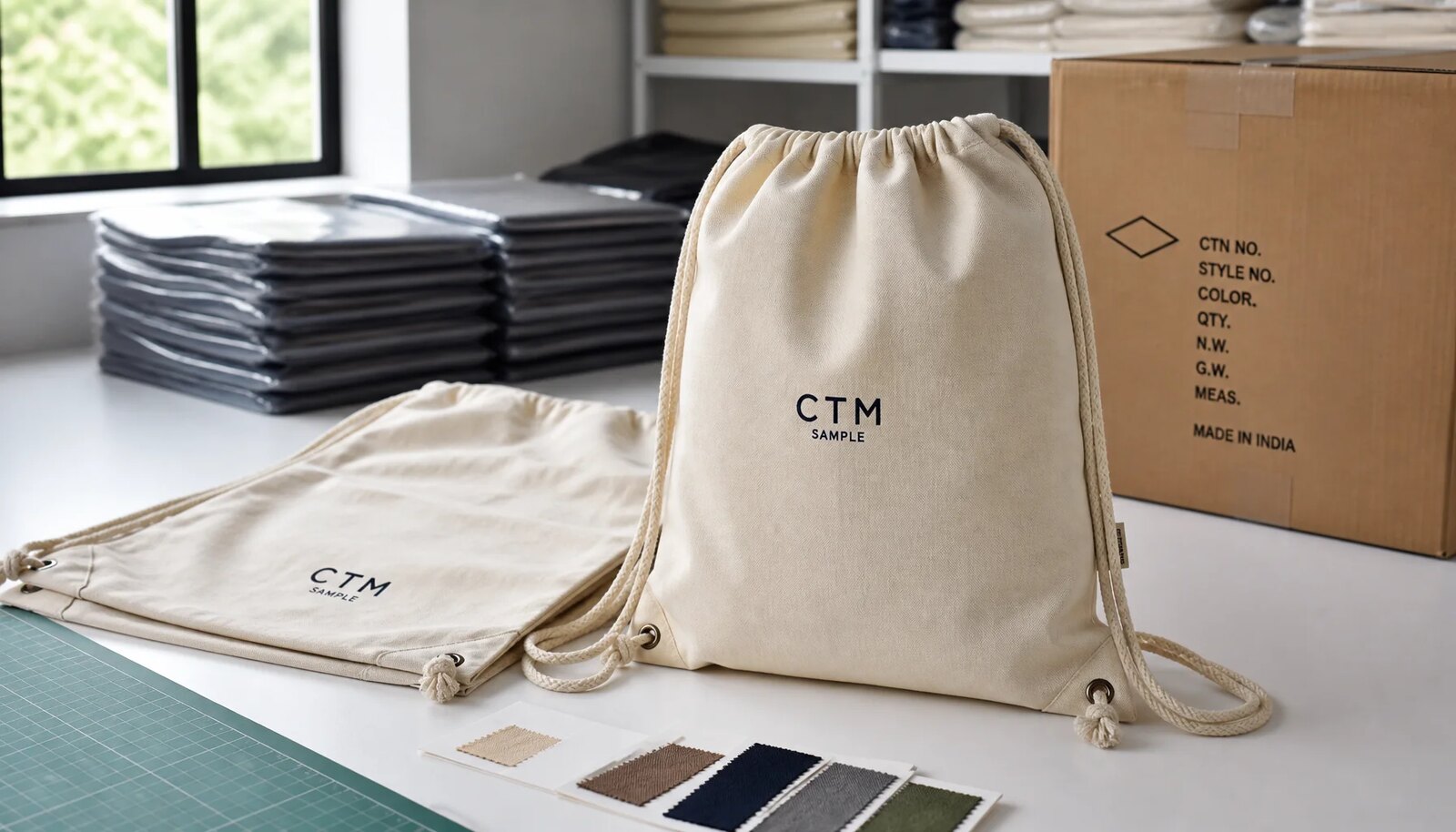
Define the Packing Problem Before the Bag Spec
For hotel retail, a custom cotton drawstring backpack is not only a promotional bag. It may sit in a boutique, spa reception area, resort gift shop, welcome kit, or destination retail display. The carton packing plan affects shelf condition, receiving speed, warehouse storage, barcode control, and landed cost. If the RFQ only says cotton drawstring backpack with logo, suppliers will quote different fabric weights, fold methods, carton quantities, and retail packing styles. Those differences make prices look comparable when they are not.
Start the project by deciding how the bag will be received and sold. A hotel group replenishing multiple properties needs clean SKU separation and readable carton labels. A resort shop selling bags individually may need a hangtag, belly band, or barcode sticker protected from abrasion. A distributor shipping mixed cartons to several boutique hotels needs inner bundles and accurate carton marks. The right carton packing plan prevents crushed bags, short packs, mixed designs, and unnecessary air freight volume.
- Use one packing plan per SKU unless all designs share the same size, fabric, and retail pack.
- Set a maximum carton gross weight that warehouse staff can lift safely, often around 15 kg to 18 kg for cotton bags.
- Require carton dimensions in the quote so freight forwarders can calculate CBM before production finishes.
- Treat retail packing as a cost item, not a free afterthought, because folding, labeling, and carton sorting add labor.
Choose Cotton Fabric Weight for Retail Handling
Most hotel retail cotton drawstring backpacks work well in the 6 oz to 8 oz range, roughly 200 to 270 GSM depending on fabric construction. A 5 oz cotton can be acceptable for amenity giveaways but often feels too light for a paid retail item. A 10 oz or 12 oz canvas gives better structure and premium hand feel, but it increases sewing time, carton weight, and sea freight volume. The best value is usually not the heaviest fabric; it is the fabric that meets shelf appearance and carry strength without pushing the carton over the weight limit.
Fabric finish also changes the packing result. Natural cotton has small specks and a warm hotel-retail look, but buyers must accept natural slubs and seed marks within agreed limits. Bleached cotton gives a cleaner print background but can show stains and handling marks more easily. Dyed cotton needs shade approval and may require a higher MOQ because dye lots must be controlled. If the bag is folded tightly into OPP or inner bundles, heavier canvas will hold fold lines more strongly than lighter cotton.
- Amenity or welcome-pack use: 5 oz to 6 oz cotton when low cost and light freight matter more than structure.
- Hotel retail shelf use: 6 oz to 8 oz cotton canvas for a better balance of feel, print result, and carton efficiency.
- Premium resort merchandise: 10 oz canvas when the buyer accepts higher CBM, higher sewing cost, and stronger fold memory.
- Dyed fabric: approve lab dip and bulk shade tolerance before cutting, especially for navy, black, forest green, and terracotta.
Build the Bag Construction Around Real Use
Drawstring backpacks fail first at the cord channel, lower corner tabs, or side seams. Hotel guests often carry water bottles, sandals, small towels, and souvenirs, so the bag must handle more than a brochure pack. For a retail cotton drawstring backpack, a finished size around 35 x 45 cm is common because it fits adult use without becoming a bulky sack. Smaller sizes such as 30 x 40 cm can work for kids, spa kits, or compact welcome bundles, but they should not be quoted as equivalent to a full-size retail backpack.
Construction details should be included in the RFQ because they affect price more than many buyers expect. Double-folded top channels reduce raw-edge fraying. Cotton rope between 5 mm and 7 mm usually feels better than very thin cord. Reinforced corner triangles or sewn tabs improve pull strength. A simple overlock seam may be enough for low-cost orders, while French seams or bound seams improve inside appearance but add labor. If the bag will be sold at a hotel shop, the inside finishing matters because buyers and guests inspect it more closely.
- Specify finished dimensions, not cut panel dimensions, because sewing shrinkage changes the final size.
- Add bartacks or reinforced stitching at the lower cord exits when the backpack is expected to carry weight.
- Avoid very thin drawcords on adult backpacks; they reduce comfort and create more customer complaints.
- Decide whether inside seams must look retail-clean or only functionally secure before comparing quotes.
Select Printing That Matches Cotton and Quantity
Screen printing is normally the most stable choice for cotton drawstring backpacks with one to three solid logo colors. It gives good opacity on natural or dyed cotton and works well for hotel names, resort icons, destination maps, and simple artwork. The factory needs vector artwork, Pantone references, print size, print location, and whether the ink should feel soft or have stronger coverage. Large ink blocks may stiffen the cotton and can slow drying, especially in humid production seasons.
Heat transfer or digital print can help when the artwork has gradients, photo detail, or many colors. The tradeoff is hand feel, wash durability, and sometimes a more promotional look. Embroidery is less common on drawstring backpacks because the fabric panel can pucker, and the cost rises quickly on large logos. For hotel retail, the most practical approach is often a clean one-color or two-color screen print plus a woven side label or hangtag for brand presentation.
- For natural cotton, approve one printed strike-off on the actual fabric, not on a substitute white cotton panel.
- For dyed fabric, test print opacity because light ink on dark cotton may need an underbase.
- For large front artwork, define the maximum print area after drawcord channel and seam allowance are removed.
- For multi-property programs, keep one standard print position to reduce setup errors across SKUs.
Use MOQ Logic Instead of Chasing One Lowest Price
MOQ for custom cotton drawstring backpacks is driven by fabric purchasing, cutting efficiency, print setup, packing labor, and SKU separation. A factory may accept 300 pcs for one simple design if fabric is in stock, but the unit price will carry more setup cost. At 500 to 1,000 pcs per design, screen setup and cutting become more efficient. At 3,000 pcs and above, the buyer can usually negotiate better fabric cost, more stable production scheduling, and more predictable carton planning.
The problem for hotel retail buyers is not only total quantity; it is the number of SKUs. One order of 2,000 pcs in one natural cotton color and one print is straightforward. The same total quantity split into four fabric colors, five print designs, and three barcode labels becomes a different production job. Each split increases counting, label control, carton marking, and inspection workload. The RFQ should show the factory the full SKU matrix, not just the grand total.
- Request price tiers at realistic quantities such as 500, 1,000, 3,000, and 5,000 pcs per design.
- List each fabric color, print design, barcode, hangtag, and ship-to destination as separate SKU data.
- Avoid very small color splits unless the buyer accepts higher unit cost and longer sorting time.
- Clarify whether overrun or underrun tolerance is acceptable, especially for printed retail inventory.
Design the Carton Packing Plan Around Receiving
A practical carton plan for cotton drawstring backpacks often uses flat folding, 10 pcs per inner bundle, and 100 to 150 pcs per export carton. The exact count depends on fabric weight, bag size, individual packing, and carton strength. A 6 oz bag without individual OPP may fit more pieces than an 8 oz bag with hangtag and barcode sticker. If the carton is packed too tightly, the bags arrive heavily creased and the retail presentation suffers. If the carton is too loose, cartons crush, shift, and count errors become harder to detect.
Carton marks should support hotel warehouse receiving. At minimum, the carton should show item name, SKU, color, print design, quantity, carton number, gross weight, net weight, and country of origin if required. If the goods ship to a third-party retail warehouse, add PO number, barcode information, and any routing label requirement. Buyers should approve a carton mark draft before mass packing. A packed carton photo is also useful because it shows fold direction, inner bundle method, and whether labels face consistently.
- Recommended inner bundle: 10 pcs per bundle for faster counting and cleaner carton organization.
- Recommended master carton: 100 pcs for heavier 8 oz to 10 oz bags, up to 150 pcs for lighter 5 oz to 6 oz bags.
- Carton strength: use export-grade corrugated carton with tape or strapping suitable for the gross weight.
- Pallet planning: provide carton dimensions early if the buyer needs warehouse slotting or container loading estimates.
Control Retail Presentation Without Overpacking
Hotel retail buyers often want the bag to look natural, but they also need barcodes, clean handling, and easy counting. Individual OPP bags protect the cotton from dust and barcode abrasion, but many hotel brands now try to reduce plastic. Kraft belly bands or paper hangtags can work if the receiving warehouse and store staff can keep the product clean. No individual packing is the lowest-cost option, but it increases the risk of stains, handling marks, and missing barcode data.
The packing choice should match the sales channel. A resort boutique may prefer a hangtag tied to the drawcord and no poly. A distributor shipping to multiple hotel stores may need individual barcode stickers to avoid relabeling labor. A spa amenity program may use simple bulk packing because the bags are unpacked behind the counter. Each method changes folding labor, carton count, and inspection criteria, so the quote should identify the selected presentation clearly.
- OPP packing fits barcode protection and dust control but may conflict with plastic-reduction policies.
- Kraft belly band fits natural hotel retail styling but needs secure sizing so it does not slide off in cartons.
- Hangtags add brand value but require clear placement rules to prevent cord tangling and bent tags.
- Bulk pack reduces cost but needs stronger stain control and cleaner carton lining.
Approve Samples With Packing, Not Only the Bag
A blank sample only confirms shape and sewing. A printed sample confirms artwork placement and color. A packed sample confirms whether the final product can survive folding, bundling, labeling, and carton handling. For hotel retail orders, the approval sample should include final fabric weight, final cord, final print method, label or tag, individual packing if used, and one sample fold method. If the buyer approves only the loose bag, carton packing disputes often appear after production is finished.
Sample review should be strict but practical. Cotton is a natural fabric, so tiny slubs and seed flecks may be normal on natural cotton. However, oil stains, mildew odor, large dark spots, broken yarns, severe skewing, or poor print registration should not pass. The buyer should sign off on acceptable print position tolerance, usually measured from the top edge or side seam. A physical approved sample is better than photo approval for color and hand feel, especially when the order will be sold at a hotel retail price point.
- Approve fabric hand feel, thickness, color tone, seam finish, drawcord comfort, and lower tab strength.
- Measure finished size after the bag is sewn and pressed, not while fabric panels are flat.
- Review print placement with a ruler and tolerance, such as plus or minus 5 mm for logo position.
- Request one folded and packed sample if carton appearance or retail packing is part of the order.
Set QC Thresholds Before Final Inspection
Quality control for cotton drawstring backpacks should focus on function, appearance, and packing accuracy. Major defects include broken seams, missing cords, wrong print, severe stains, wrong barcode, incorrect carton count, or mixed SKU cartons. Minor defects may include small loose threads, slight natural cotton flecks, or small fold marks within the approved standard. Without agreed thresholds, a buyer may reject natural fabric characteristics that were visible in the approved sample, or a factory may ship defects that damage retail presentation.
For most hotel retail orders, final inspection can use AQL 2.5 for major defects and AQL 4.0 for minor defects, with additional carton-specific checks. Inspectors should pull samples from multiple cartons and multiple points in the production lot, not only from top cartons prepared for inspection. Carton drop condition, tape strength, inner bundle count, label accuracy, and moisture risk should be part of the report. A correct bag packed in the wrong carton is still a commercial failure when retail warehouses receive by SKU.
- Functional checks: cord pull, seam strength, lower tab reinforcement, top channel stitching, and bag opening smoothness.
- Appearance checks: print color, print registration, stains, fabric holes, skewed panels, odor, and loose thread trimming.
- Packing checks: inner bundle count, carton quantity, carton mark, SKU separation, barcode scan, and carton gross weight.
- Shipment checks: dry cartons, no mildew odor, no crushed corners, and no mixed design cartons.
Compare Quotes With Landed-Cost Data
A cheaper unit price can become expensive when the carton plan is weak. If one supplier packs 200 lightweight bags per large carton and another packs 100 heavier retail-packed bags per smaller carton, the ex-factory price is not enough to compare. Buyers need carton dimensions, gross weight, CBM, packing method, and retail labor included in the quote. Freight cost, warehouse receiving labor, relabeling, and damage risk all affect the landed cost.
A useful quote should separate the cost drivers. Fabric weight, print colors, bag size, cord type, label method, individual packing, and carton quantity should be visible. If the factory cannot provide estimated carton measurements before order placement, it may not have enough experience with similar packing. For importers and distributors, the best supplier is often the one who gives clear packing data early, because that allows freight planning before the production clock starts.
- Compare unit price together with carton CBM per 1,000 pcs, not unit price alone.
- Identify whether screen charges, sample charges, hangtags, barcodes, and OPP bags are included or separate.
- Request estimated net weight and gross weight so the forwarder can check ocean and air freight options.
- For multi-destination hotel programs, ask whether the factory can sort cartons by property or PO line.
Specification comparison for buyers
| Spec decision | Recommended option | When it fits | Buyer risk to check |
|---|---|---|---|
| Fabric weight | 6 oz to 8 oz cotton canvas for most hotel retail drawstring backpacks | Gift shops, resort boutiques, guest amenity resale, and light day-use bags | Below 5 oz can feel thin on shelf; above 10 oz increases carton weight and freight cost |
| Bag size | About 35 x 45 cm for adult retail use; 30 x 40 cm for compact amenity kits | Fits sandals, towel, sunscreen, guide map, or small retail bundle | Oversized bags may exceed planned carton volume and reduce pieces per carton |
| Drawcord type | Cotton rope 5 mm to 7 mm with reinforced lower corner tabs | Natural look for hotel retail and comfortable shoulder carry | Thin cord cuts into shoulder and may fail pull tests at corner stitching |
| Printing method | Screen print for 1 to 3 solid colors; heat transfer only for detailed gradients | Hotel logos, destination artwork, simple line graphics, and retail slogans | Heavy ink coverage can stiffen the bag and slow production drying time |
| Carton packing | Flat folded 10 pcs per inner bundle, 100 to 150 pcs per export carton | Balances counting speed, carton strength, and warehouse handling | Loose packing causes creasing, count disputes, and unstable cartons during palletizing |
| Retail presentation | Individual OPP, kraft belly band, or no poly depending on hotel plastic policy | OPP for barcode protection; belly band for plastic-free retail display | Buyer must define barcode location before carton plan is finalized |
| MOQ logic | 500 to 1,000 pcs per print design for efficient screen setup and fabric usage | Seasonal hotel shop orders and multi-property group programs | Too many colorways below MOQ raise setup cost and increase shade-control risk |
| Inspection level | AQL 2.5 for major defects and AQL 4.0 for minor defects, with carton drop check | Retail orders where appearance, count accuracy, and barcode accuracy matter | Inspection without carton verification misses mixed SKU and short-pack problems |
Buyer checklist before sampling
- Define exact bag size, fabric GSM or ounce weight, cord diameter, reinforcement style, and seam allowance before requesting prices.
- Separate retail artwork requirements from carton packing requirements so the factory can quote printing and packing labor correctly.
- State whether each backpack needs OPP bag, kraft belly band, hangtag, barcode sticker, size label, or master carton label only.
- Confirm carton quantity per SKU, inner bundle quantity, carton dimensions, gross weight limit, and pallet pattern if the goods ship to a hotel retail warehouse.
- Approve a pre-production sample with the final fabric, cord, print color, label, and packing method, not only a blank bag sample.
- Set QC acceptance points for print placement, drawcord pull strength, seam strength, stain limits, odor, needle holes, and carton count accuracy.
- Request quote lines for sample fee, mold or screen charge, unit price by quantity tier, packing surcharge, carton dimensions, CBM, lead time, and payment terms.
- Align production timing with hotel opening dates, seasonal resort launches, cruise delivery windows, or retail replenishment calendars.
Factory quote questions to send
- What fabric weight and composition are included in the quoted unit price, and is the cotton greige, bleached, dyed, or recycled blend?
- What finished bag size tolerance can you hold after cutting, sewing, washing, and pressing?
- Which print method is quoted, how many colors are included, and what is the maximum printable area on the backpack front?
- What cord material, cord diameter, knot style, and lower corner reinforcement are included in the standard construction?
- What is the MOQ per design, per fabric color, and per print colorway, and how does the price change at 500, 1,000, 3,000, and 5,000 pcs?
- What is the proposed inner packing and master carton quantity, and what are the estimated carton size, gross weight, and CBM?
- Can you provide a packed carton photo, carton mark draft, and one fully packed approval sample before mass packing?
- What inline and final inspection steps do you run for seam strength, print color, odor, stains, broken cords, carton count, and barcode accuracy?
- What production lead time applies after sample approval and deposit, and how many days should be allowed for carton packing and final inspection?
Quality-control points to confirm
- Finished size tolerance should normally be controlled within plus or minus 1 cm unless the buyer approves a wider range for washed cotton.
- Fabric weight should be verified by GSM or ounce standard from the same production lot used for bulk cutting.
- Print color should be matched against Pantone, approved strike-off, or signed sample under consistent light, not by phone photo alone.
- Cord pull strength should be tested at the lower corner tabs because this is the highest-stress point during hotel guest use.
- Seams should be checked for skipped stitches, loose thread, needle holes, uneven top edge, and weak bartacks at stress points.
- Carton count should match packing list quantity by SKU, color, and print design, with random carton opening during final inspection.
- Retail labels, hangtags, barcodes, and carton marks should be verified against the buyer's shipment file before cartons are sealed.
- Odor, mildew, visible stains, insect contamination, and wet cartons should be treated as shipment-blocking risks for hotel retail goods.