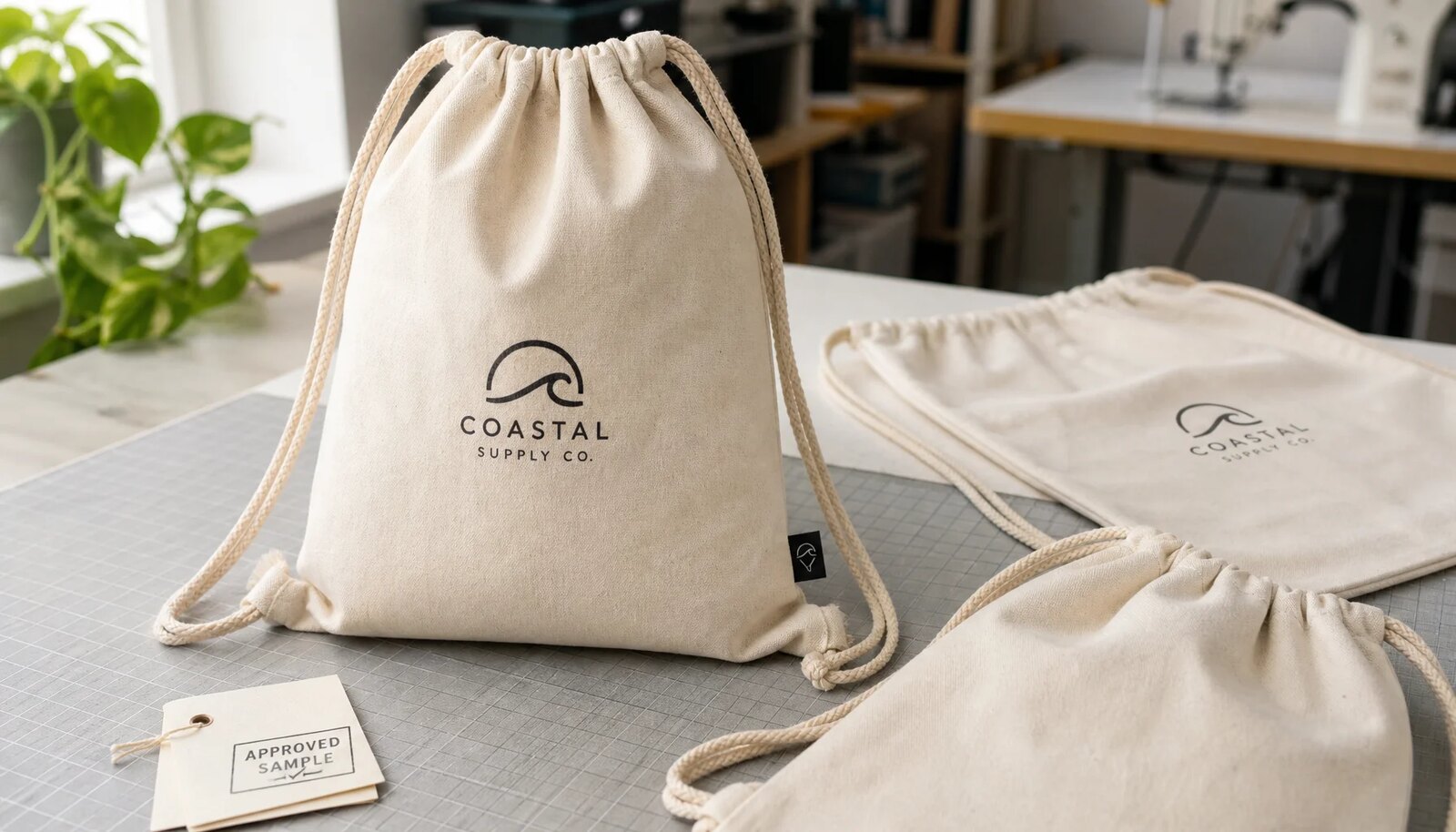
Start With the Hotel Retail Job, Not the Bag Name
A custom cotton drawstring backpack can do several jobs in a hotel program. It might sit in a resort boutique with a retail price tag. It might carry spa products after a purchase. It might be handed to children at a kids club, placed in guest rooms as an amenity, or used at a conference registration desk. Those products may share the same basic silhouette, but they should not share the same specification. A paid retail item needs better hand feel, cleaner finishing, and more reliable presentation. A short-use event bag may need speed, simple packing, and a tighter budget.
Begin the RFQ with the commercial role. Tell the supplier whether guests will buy the bag, receive it free, or use it as packaging for another product. Then describe the expected contents. Sandals, wet swimwear, folded apparel, brochures, boxed spa products, and bottled water all create different stress points. Once the factory understands the load, it can recommend fabric weight, cord diameter, top-channel width, reinforcement, and packing with fewer assumptions.
Think about the property-level workflow too. Will staff fold the backpacks into boutique baskets, hang them on pegs, place them on beds, or issue them from a beach desk? Display method affects fold lines, hangtags, barcode placement, carton marks, and the level of surface variation that guests will notice. These details may look operational rather than product related, but they influence unit cost, labor, freight volume, and receiving accuracy.
- Define the use: paid merchandise, GWP, spa amenity, kids club item, event bag, or room amenity.
- List likely contents and approximate load so the supplier can judge stress points.
- State where the bag will be displayed or handed out: boutique shelf, stockroom, room setup, beach desk, or registration table.
- Use 8 oz to 10 oz cotton canvas when the item must feel credible as hotel retail merchandise.
- Use lighter cotton only when the bag is clearly a short-use giveaway and the buyer accepts a softer, thinner structure.
- Decide early whether hangtags, barcodes, individual bags, paper bands, or property-level cartons are required.
Specify Fabric Weight, Finish, and Fiber Claims Precisely
Fabric drives both cost and perceived value. A 5 oz or 6 oz cotton bag can work for a low-cost amenity or one-time event, but it often feels too thin for paid hotel retail. It may collapse on shelf, show darker contents through the fabric, and wrinkle quickly after handling. An 8 oz cotton canvas, roughly 270 GSM depending on weave and finishing, is often a balanced choice for resort shops and branded guest merchandise. It has enough body for a clean front print while still folding and packing efficiently. A 10 oz canvas, roughly 340 GSM, gives a more substantial feel, but it adds material cost, carton weight, and sometimes production time.
Do not rely on an ounce or GSM number alone. Ask whether the value is measured before or after washing, dyeing, compacting, calendaring, or other finishing. Two fabrics with similar GSM can feel different because of weave tightness, yarn count, finishing, shrinkage control, and moisture content. If shade, hand feel, or opacity matters, approve a physical swatch before the supplier locks the quote.
The fabric story should be clear and supportable. Natural unbleached cotton fits coastal, wellness, and eco-style retail, but seed specks, slubs, and shade variation are normal. Bleached cotton creates a cleaner base for bright artwork. Dyed cotton helps match a brand palette, yet it needs lab dip approval, shade tolerance, and review of rubbing color transfer. If the backpack will be marketed as organic cotton or recycled cotton, define the documentation required before adding the claim to hangtags, websites, or shelf signs.
- 5 oz to 6 oz cotton: acceptable for low-cost amenity or one-time event use, not usually ideal for paid boutique retail.
- 8 oz cotton canvas: strong default for custom cotton drawstring backpacks in hotel retail wholesale programs.
- 10 oz cotton canvas: better structure and perceived value, with higher material and freight impact.
- Natural unbleached cotton: approve seed specks, slubs, and shade variation as part of the standard.
- Bleached cotton: useful when the buyer wants a cleaner white or off-white base for sharper branding.
- Dyed cotton: request lab dip, strike-off, or fabric swatch approval before bulk cutting.
- Organic or recycled claims: confirm documentation requirements before adding claims to hangtags or marketing copy.
Lock Finished Size, Tolerances, and Measurement Method
Finished size sounds simple until the first sample arrives too small for the intended contents. A backpack that looks fine in a catalogue may not fit sandals, a folded towel, retail boxes, or a conference folder. The opposite problem is also expensive. An oversized pattern can look generous, but it uses more fabric, needs longer cords, increases carton volume, and may hang poorly when lightly loaded.
A common hotel retail starting point is around 14 x 18 in or 35 x 45 cm. Treat that as a starting point, not a rule. If the bag will hold a towel, robe, slippers, or boxed spa set, put the real item into the sample. If it will carry rigid boxes, check corner stress and how the bag closes. A gusset is less common on simple drawstring backpacks, but it changes cutting, sewing, packing, and cost when added.
Write the measurement method into the specification. Confirm whether width and height are measured flat, empty, after pressing, after washing, or after packing. Cotton can shrink or distort slightly through dyeing, printing, sewing, and pressing, so a tolerance such as +/- 1 cm is practical for many standard drawstring backpacks. If the bag must fit a shelf fixture, inserted welcome kit, or retail display box, state that early because tighter control may require different cutting, pressing, inspection, or rejection rules.
- Specify finished width and height, not only approximate catalogue dimensions.
- Clarify whether measurements are taken flat, empty, after pressing, or after any washing or packing.
- Test the sample with real contents such as sandals, towels, spa products, retail boxes, or event materials.
- Define print area after confirming top channel depth and usable front panel size.
- Use a practical tolerance, commonly +/- 1 cm, unless the program needs tighter control.
- Avoid oversized patterns unless retail use justifies extra fabric, cord length, and carton volume.
Construction Details Decide Reuse and Return Risk
Most failures do not start in the middle of the cotton panel. They show up where guests pull: the top channel, cord exits, side seams, and lower cord anchors. A low quote may use a single-fold channel, narrow seam allowance, low stitch density, or minimal reinforcement. These shortcuts are difficult to see in a front-view mockup, but they become obvious when the bag carries shoes, towels, bottles, or retail purchases around a property.
For hotel retail, the top channel should be wide enough for smooth cord movement. A thick cord in a narrow channel bunches, twists, and makes the product feel cheap. Double-fold construction gives cleaner edges and helps prevent fraying. Reinforced seams and bartacks at stress points add cost, but they protect the exact areas that receive the most force. If guests are paying for the backpack, those details are usually worth specifying.
Inspection should cover stitching in measurable terms. Ask for consistent stitch density, secure backstitching, no skipped stitches at stress points, and trimmed threads. Review the lower cord anchor closely because it carries the backpack load when worn. A polished sample still needs a simple stress check: load it with realistic contents and pull the cords repeatedly. If the anchors distort on the sample, they are unlikely to improve in bulk production without a revised construction.
- Specify double-fold top channel construction for cleaner edges and better durability.
- Confirm channel width relative to cord diameter so the opening closes smoothly.
- Request reinforced side seams and bartacks at top cord exits for resale-grade programs.
- Review lower cord anchor construction because this area carries the highest load.
- Check stitch density, seam allowance, backstitching, and trimmed threads on the approved sample.
- Perform a simple load-and-pull check with realistic contents before approving bulk production.
Choose Drawcords for Comfort, Color, and Safety
Drawcords are not an afterthought. They determine how the backpack opens, how it feels on the shoulder, and how well the finished product supports the hotel’s brand story. Cotton cord pairs naturally with unbleached canvas and gives a softer hospitality look. Polyester cord is often smoother and more color consistent, especially for dyed shades, but it changes the material composition and may not suit a product described as all cotton. Flat tape can spread pressure across the shoulder, yet it changes the style and requires separate sample approval.
For most hotel retail drawstring backpacks, a 5 mm to 7 mm cord is more comfortable than a very thin cord. Cord under 4 mm may reduce cost, but it can cut into the shoulder when the bag is loaded. Length matters just as much as diameter. A cord length that looks tidy on a flat sample may sit poorly on a guest’s back. Uneven cord lengths across a production lot also make the product look unfinished.
Specify the cord end finish before sampling. Cotton cords may be knotted. Synthetic cords may be heat cut. Some designs use plastic tips or metal aglets, but those details can add inspection concerns if they are loose, sharp, or inconsistent. For kids club merchandise, review intended age range, cord length, loose parts, and applicable local safety expectations. If the order will ship to multiple countries, confirm labeling, care, and safety requirements early rather than after cartons are packed.
- Cotton cord: best match for natural canvas and a soft hospitality retail feel.
- Polyester cord: useful when color consistency, smooth pull, or stronger dyed shades matter.
- 5 mm to 7 mm diameter: common comfort range for backpack use.
- Avoid very thin cords for resale items because they feel cheap and uncomfortable under load.
- Approve cord length on a worn sample, not only by flat measurement.
- Define knotting, tip finishing, and loose-end appearance before sampling.
- Review cord length and small-part concerns for children’s programs or kids club merchandise.
Match Logo Method to Cotton Texture and Artwork
Screen printing is usually the most practical logo method for custom cotton drawstring backpacks with one to three solid colors. It works well for resort names, spa graphics, boutique line art, and simple brand marks. The final result still depends on fabric texture, ink selection, screen preparation, and curing. Coarse canvas can break fine lines. Heavy ink deposits can feel stiff or crack if poorly cured. A digital mockup cannot show those risks.
Heat transfer has a place when the artwork includes gradients, complex color blends, or photo-style detail that is not efficient to screen print. The trade-off is surface feel. Large transfers can feel plastic and may look less integrated with natural cotton. Embroidery can work for small premium marks, but it may pucker lighter fabric and usually costs more. Woven side labels or tabs add a retail finish, though they bring their own MOQ, placement approval, and stitching checks.
Give the supplier production-ready art. Vector files, Pantone references, exact print size, and measured placement reduce interpretation. Avoid vague instructions such as center front without defining distance from the top channel and side seams. For dark dyed cotton, ask whether an underbase is needed for opacity. For natural cotton, approve how the ink sits over seed specks and surface texture. The pre-production sample should prove color, alignment, edge sharpness, print hand, and adhesion before bulk production starts.
- Use screen print for solid logos, resort names, simple icons, line art, and 1 to 3 color retail graphics.
- Consider heat transfer only when artwork detail justifies the different surface feel.
- Avoid very small reversed text or hairline details on coarse cotton canvas.
- Define print size and placement by measured distance from seams and channel, not visual estimate.
- Ask about underbase requirements for dark dyed fabric.
- Run rub, scratch, or tape checks after curing to catch poor adhesion before shipment.
- Approve the physical print sample under consistent lighting with the hotel brand team.
Plan MOQ and SKU Splits Before Comparing Quotes
MOQ is one of the easiest places for quotes to become misleading. A supplier may say 1,000 pieces, but that can mean 1,000 per fabric color, per artwork, per size, per cord color, per label, or per packing style. A hotel group with four property names, three bag colors, two cord colors, and separate barcode labels can create a much larger production matrix than the first total quantity suggests.
Several components drive minimums. Dyed fabric may require a dye-lot quantity. Custom cord color may have its own minimum. Print screens, transfers, woven labels, hangtags, barcode stickers, and packing materials can create setup charges or handling fees. Buyers can often reduce cost by keeping one natural cotton body, one size, and one cord color across properties, then splitting only the print artwork. Another option is to use one shared retail SKU and manage property allocation through hangtags or carton labels.
Compare quotes only after every supplier prices the same matrix. Show total program quantity and per-SKU quantity in the RFQ. Ask whether the supplier allows overage or shortage and whether that tolerance applies to the total order or each SKU. If exact property-level quantities are needed, the factory may need tighter counting and packing controls. Document the rule before production so receiving teams are not surprised.
- Break MOQ down by fabric color, size, artwork, cord color, label, hangtag, barcode, and packing method.
- Show total program quantity and per-SKU quantity in the RFQ.
- Consolidate fabric, cord, and size when possible; split artwork only where necessary.
- Expect dyed fabric and custom cord colors to create more MOQ pressure than natural cotton.
- Ask whether artwork splits carry extra screen, transfer, setup, or handling charges.
- Confirm overage and shortage tolerance, especially for multi-property hotel allocations.
- Do not compare quotes until all suppliers price the same SKU matrix.
Sampling Should Prove the Production Route
A sample is not just a photo opportunity. It is the buyer’s proof that the supplier understands the full product. A sales sample or digital layout helps early discussion, but it should not approve bulk production. For hotel retail, the pre-production sample should use the actual fabric weight, actual color, actual cord, actual stitching, actual print method, actual label, and intended packing method. Substitute materials hide the risks that matter most.
Measure and handle the sample like an inspector would. Record finished width and height, channel width, cord length, print placement, seam appearance, label position, and fold style. Load it with realistic contents, then pull the cords repeatedly. Watch the top channel, side seams, and lower anchors. If the item will be individually packed, review how it looks after unpacking. A perfect folded unit can still show hard creases across the logo once opened on the retail floor.
Keep the approval disciplined. The buyer should retain one sealed approved sample for incoming inspection or third-party QC, and the factory should keep a matching sample on the production floor. Approval notes should also state accepted variations, such as natural cotton specks, slight shade movement, or a textured print edge caused by canvas weave. Without a physical standard, shade, hand feel, print placement, and fabric character become subjective after thousands of units are finished.
- Request a pre-production sample made with the same materials and processes planned for bulk production.
- Measure size, channel width, cord length, print position, label position, and fold appearance.
- Test the sample with realistic contents and repeated cord pulls.
- Approve print color against a physical standard, not only phone photos or screen images.
- Review the packed unit if barcode stickers, hangtags, paper bands, or polybags are required.
- Keep a sealed approved sample for QC and receiving reference.
- Document approved deviations so final inspection does not reject intentional details.
Write a QC Standard Before Production Starts
Quality control works best when the standard is written before cutting begins. The approved sample matters, but it should be supported by a defect list that a factory, distributor, or third-party inspector can apply consistently. Name the defects: open seams, broken stitches, stains, wrong fabric, wrong artwork, incorrect barcode, missing hangtag, severe shade mismatch, poor print adhesion, and carton count errors. Then classify them as critical, major, or minor for the program.
AQL inspection can be useful when the order size justifies formal sampling, but cotton drawstring backpacks still need product-specific checks. Finished size may be inspected against +/- 1 cm. Print placement should be measured from agreed reference points, not judged by eye. Cord length should match the approved worn sample. Units should be pulled from multiple cartons and, where possible, different points in the production run.
Do not ignore carton-level QC. For hotel groups, a product that is well made but shipped to the wrong property still creates operational problems. Check carton marks, SKU counts, inner bundle counts, barcode accuracy, and destination property labels. Add simple functional tests too: manual cord pulls with realistic contents, rub or tape checks after print curing, and an unpacking review for folded retail units. Natural cotton character should be judged against the approved swatch, not against an unrealistic expectation of perfect uniformity.
- Create a defect list before production: open seams, stains, wrong shade, wrong print, loose threads, barcode errors, and carton count errors.
- Define critical, major, and minor defects so inspection decisions are not subjective.
- Use the approved sample plus written tolerances for size, print placement, cord length, and packing.
- Check units from multiple cartons and production points, not only display samples.
- Include carton marks, SKU count, inner bundle count, and property destination in QC.
- Agree on rework, sorting, replacement, or discount process before shipment if defects exceed the limit.
Packing, Labels, and Cartons Affect Shelf Condition
Packing should match how the hotel will receive and use the backpacks. Bulk packing in counted inner bundles is efficient for stockrooms, welcome-kit preparation, and event distribution. Individual recycled polybags, paper bands, hangtags, barcode stickers, and retail folds may be necessary for boutique shelves and POS scanning, but they add cost, labor, waste, and carton volume. A bulk-pack quote and an individual retail-pack quote are not the same commercial offer.
Cotton can pick up dust, lint, moisture, and color transfer during storage and transport. Natural cotton shows marks more easily than dark dyed fabric. Dark dyed fabric may create transfer concerns when packed against light items without protection. The packing plan should protect the print and fabric surface without creating unnecessary waste. For humid routes or long storage periods, ask whether inner liners, desiccants, moisture control, or stronger cartons are appropriate.
Receiving clarity is part of the product specification. Carton marks should match the purchase order, SKU, color, artwork, quantity, and destination property. If the order is split across resorts, the packing list should be property-specific. Barcode labels, hangtags, and paper bands should be applied according to an approved layout before cartons are sealed. Collect carton dimensions, gross weight, net weight, and units per carton before shipment planning; do not wait until production is complete.
- Choose bulk inner bundles for stockroom handling, amenity kitting, and lower packing cost.
- Choose individual protection only when retail shelf condition, barcode scanning, or higher-value presentation requires it.
- Request units per inner bundle, units per carton, carton size, net weight, and gross weight for every SKU.
- Separate light natural cotton from dark dyed items if color transfer is a concern.
- Approve barcode, hangtag, paper band, or label placement before bulk packing.
- Use carton marks that match PO number, SKU, color, artwork, quantity, and destination property.
- Ask about moisture control, inner liners, or stronger cartons for humid routes and long storage.
Specification comparison for buyers
| Spec decision | Recommended option | When it fits | Buyer risk to check |
|---|---|---|---|
| Fabric weight | 8 oz to 10 oz cotton canvas, roughly 270 to 340 GSM depending on weave and finishing | Paid resort retail, spa shops, gift-with-purchase, conference welcome packs, and amenity retail where the bag should feel reusable | Very light 5 oz to 6 oz cotton can look thin, show contents, wrinkle heavily, and fail sooner at cord channels under repeated guest use |
| Finished size | Common retail range around 14 x 18 in or 35 x 45 cm, with final dimensions confirmed by actual contents | Beach accessories, folded apparel, kids club items, boxed spa products, and event materials | Catalogue dimensions may be cut size or flat finished size; confirm measurement method and tolerance, typically +/- 1 cm unless otherwise agreed |
| Fabric finish | Natural unbleached cotton for relaxed resort positioning; bleached or dyed cotton when cleaner shade or brand color control matters | Natural suits coastal, wellness, and eco-style retail; dyed cotton suits coordinated brand programs and premium boutiques | Natural cotton has seed specks, slubs, and shade variation; dyed cotton needs lab dip approval, crocking/colorfastness review, and dye-lot MOQ confirmation |
| Construction | Double-fold top channel, reinforced side seams, secure lower cord anchors, and bartacks at stress points | Paid retail, guest reuse, kids programs, and bags expected to carry sandals, towels, bottles, or merchandise | Single-fold channels, narrow seams, low stitch density, and missing reinforcement can tear or fray after normal guest use |
| Drawcord | 5 mm to 7 mm cotton cord for natural positioning; polyester cord when smoother pull and tighter color matching matter | Cotton cord supports a mostly cotton story; polyester cord improves shade consistency and often reduces fraying at ends | Uneven cord lengths, thin cord under 4 mm, weak knots, or sharp tips can create comfort, appearance, and safety concerns |
| Logo method | Screen print for 1 to 3 solid colors; heat transfer for gradients or complex multi-color art only when surface feel is acceptable | Resort logos, spa graphics, boutique line art, property names, and simple branded retail artwork | Fine lines can break on coarse canvas; heavy ink can crack if poorly cured; large transfers may feel plastic on a cotton product |
| MOQ structure | Confirm MOQ per fabric color, size, artwork, cord color, label, hangtag, barcode, and packing style | Hotel groups with multiple properties, seasonal designs, or several retail SKUs | A quoted 1,000 pieces may mean per SKU, not total program quantity; artwork splits and custom dye lots can raise true minimums |
| Packing style | Flat bulk pack in counted inner bundles, or individual paper band/recycled polybag only when shelf protection or barcode scanning requires it | Bulk pack for stockroom handling and amenity kitting; retail pack for boutique shelves and POS systems | Over-packing increases cost, waste, carton volume, and freight; under-packing causes dust marks, fold damage, barcode errors, and receiving confusion |
| Sample approval | Pre-production sample using actual fabric GSM, cord, stitching, print ink, label, and packing method | Retail launches, brand approval, multi-property distribution, and any order with exact presentation requirements | Digital mockups and substitute fabric samples do not prove shrinkage, print hand, ink adhesion, cord comfort, seam strength, or shelf presentation |
Buyer checklist before sampling
- Define the commercial use first: paid merchandise, gift-with-purchase, spa amenity, kids club item, conference welcome bag, room amenity, or event retail item.
- List likely contents and approximate load, such as sandals, towels, boxed spa products, water bottles, folded apparel, brochures, or children’s items.
- Specify finished size with tolerance; include width, height, channel depth if relevant, and whether dimensions are measured flat before packing.
- Select fabric weight by target retail position; use 8 oz to 10 oz cotton canvas when the backpack should feel retail-grade rather than disposable.
- State whether fabric is natural, bleached, dyed, organic cotton, recycled cotton blend, or conventional cotton, and request swatches before quotation if shade matters.
- Confirm whether fabric is pre-shrunk, washed, dyed, compacted, or otherwise finished because this affects size, shade, hand feel, and print behavior.
- Define construction details: top channel type, seam allowance, stitch density, lower cord anchor method, reinforcement, and bartacks at high-stress points.
- Require actual drawcord material, diameter, color, end finishing, knot method, and approved length when worn as a backpack.
- Provide artwork as vector files and define print size, placement, Pantone references, ink type, number of colors, and acceptable color tolerance.
- Confirm whether the logo method is screen print, heat transfer, embroidery, woven label, or a combination, and ask why the method fits the artwork and fabric.
Factory quote questions to send
- What cotton fabric weights are available for this drawstring backpack, and are GSM or ounce values measured before or after washing, dyeing, or finishing?
- Is the fabric natural, bleached, dyed, organic cotton, recycled cotton blend, or conventional cotton, and what documentation or swatches can support that claim?
- What is the finished size tolerance after sewing and pressing, and is +/- 1 cm realistic for this pattern and fabric?
- Is the MOQ based on total order quantity or per fabric color, print design, size, cord color, label, hangtag, barcode, and packing style?
- Can the pre-production sample be made with the same fabric lot, cord, ink, label, stitching method, and packing method planned for bulk production?
- What is the recommended print method for our artwork size, number of colors, line thickness, halftones, and fabric texture?
- What Pantone, lab dip, strike-off, or physical color standard will be used for approval, and what tolerance is realistic on natural or dyed cotton?
- Which seam areas are reinforced, and can bartacks be added at top cord exits, side seams, or lower cord anchor points?
- What cord material, diameter, color options, end finishing, knot method, and length are included in the base quote?
- What stitch density and seam allowance are standard for the quoted construction, and where are backstitches or lockstitches used?
Quality-control points to confirm
- Finished size should stay within the agreed tolerance, commonly +/- 1 cm for standard cotton drawstring backpacks unless a tighter range is approved and priced.
- Fabric weight should match the approved sample and quote; significant GSM variation changes opacity, drape, print result, carton weight, and perceived retail value.
- Fabric shade, seed specks, slubs, and surface marks should be judged against the approved swatch or sealed sample, not against an unrealistic expectation of perfectly uniform natural cotton.
- Cut panels should be aligned so the front print area is not visibly skewed, twisted, or distorted after sewing and pressing.
- Top channel stitching must be straight, fully caught, and wide enough for smooth cord movement without bunching, twisting, fraying, or skipped stitches.
- Cord exit points and lower anchors should show no tearing, popped stitches, or fabric distortion after repeated manual pull checks with realistic contents.
- Cord length should match the approved worn sample and remain consistent within the lot; uneven cords make the backpack look unfinished and affect comfort.
- Print placement should remain within the approved tolerance from top, side, and bottom reference points, with allowance for fabric and sewing variation.
- Print color should match the approved physical standard under consistent lighting, not only a digital mockup or phone image.
- Ink adhesion should pass practical rub, scratch, and tape checks after curing, especially on darker dyed cotton or heavier ink deposits.