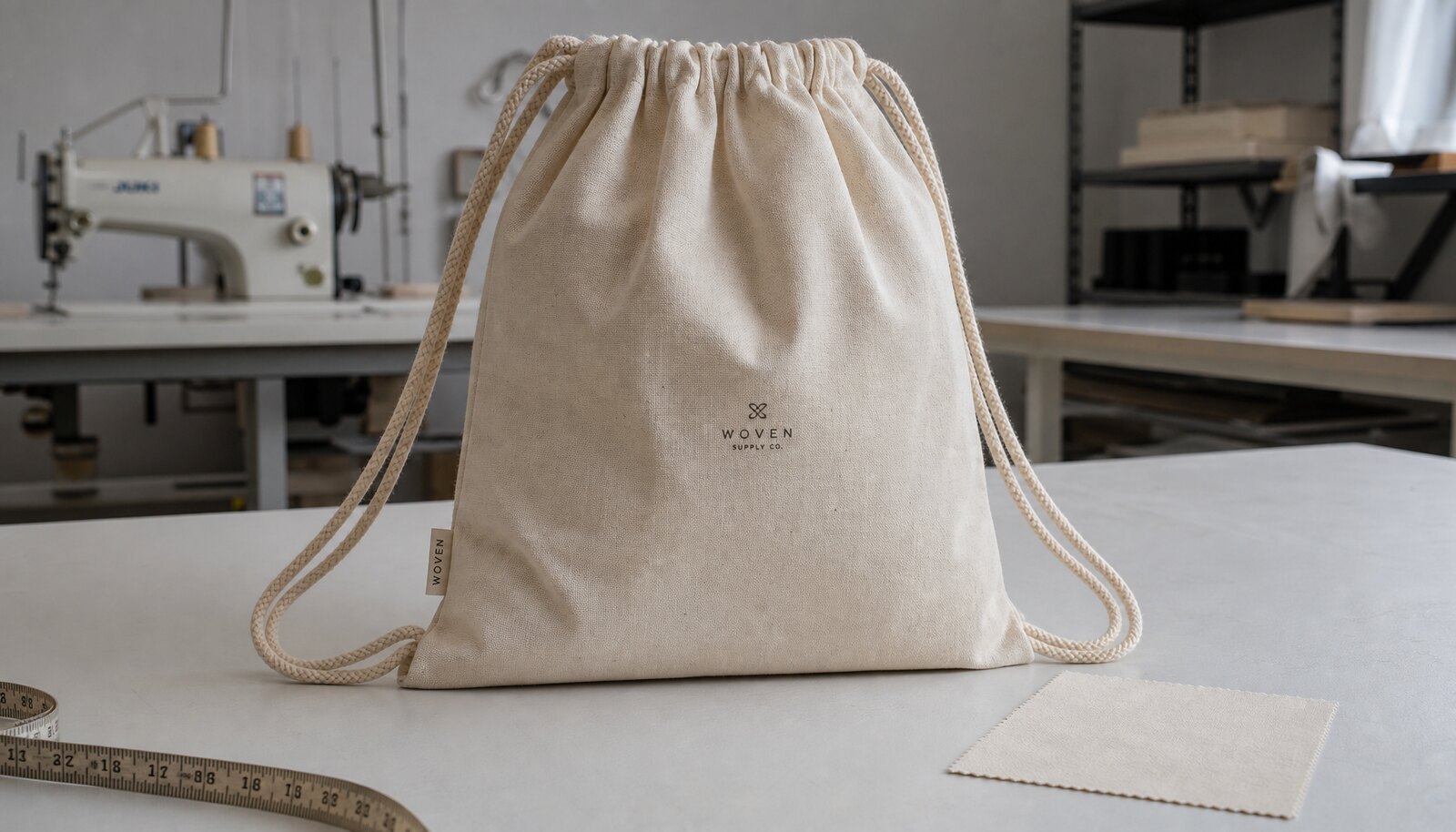
Why Fabric Weight Is the First Buying Decision
For gift shops, a custom cotton drawstring backpack is usually a low-ticket retail item, a souvenir add-on, or a packaging upgrade that has to justify itself quickly at point of sale. That means the bag needs to do three things at once: look tidy on the shelf, survive repeated handling by shoppers, and stay inside a cost target that preserves margin. Fabric weight drives all three because it affects opacity, drape, print clarity, seam strength, carton weight, and the first impression buyers get before they even open the bag.
The common sourcing mistake is to start with artwork and only later discover that the quote changes once the factory switches from a thin 120 GSM cloth to a denser 180 GSM cloth. By then, the buyer is comparing different products instead of different suppliers. For procurement, the cleaner approach is to lock the fabric spec first and hold everything else constant: GSM, yarn type, weave, finished size, drawcord, print method, packing format, and carton count. That is the only way to compare quotes on equal terms.
For this category, fabric weight is not just a technical note. It is a commercial decision that changes retail perception. A thinner bag may look acceptable in a sample room and still feel underbuilt when it is hung on a shop hook beside more substantial soft goods. A heavier bag may feel premium, but it can also push the unit cost, carton weight, and retail price beyond the target range. The right answer depends on what the gift shop is selling, how much the bag needs to carry, and how much perceived value the buyer expects to communicate in a small format.
- GSM changes cost, structure, opacity, and shelf presence at the same time.
- A sample that looks fine flat on a table may perform poorly once filled and hung.
- A locked spec sheet is more valuable than a loose logo file when comparing suppliers.
Which GSM Range Fits Gift-Shop Use
The most practical way to think about cotton drawstring backpack fabric weight is by use case rather than by abstract quality claims. A 120-140 GSM bag is usually the low-cost end of the market. It folds flat, prints easily, and keeps the first-order price down, but it can look soft, thin, or slightly transparent when the contents are visible. That can be acceptable for event handouts, lightweight souvenirs, or bags sold mainly as packaging, but it is a weak fit when the customer expects a reusable retail item.
The most balanced range for gift shops is typically 160-180 GSM. At that level, the bag usually keeps shape better, feels more substantial in the hand, and gives a cleaner retail impression without jumping too far in cost. For programs that need to carry multiple souvenirs, a bottle, or heavier merch, 200-240 GSM moves the product into a more premium tier. It gives stronger structure and a more substantial feel, but the buyer should expect higher material cost, heavier cartons, and sometimes more careful folding so the bag does not take up too much shelf or freight volume.
The important procurement point is that GSM alone does not define the bag. A 160 GSM loose weave can feel flimsier than a tighter 150 GSM fabric. A heavier cloth can still look cheap if the yarn is rough or the finish is inconsistent. So use GSM as the starting point, not the full decision. Ask the supplier to show the actual construction, not just the target weight, and request a reference sample when moving above or below the standard range.
- 120-140 GSM: lowest cost, lowest structure, best for giveaways and packaging use.
- 160-180 GSM: the default retail choice for most gift-shop programs.
- 200-240 GSM: premium feel, stronger shelf presence, and higher landed cost.
Fabric Construction, Yarn Type, and Finishing That Change the Quote
GSM is only one part of the fabric story. Yarn type, weave density, shrinkage control, and finishing all affect how a backpack looks, prints, and holds up in store. This is where many quotes become misleading. A supplier may quote two bags with the same nominal GSM, but one uses a tighter, cleaner yarn and the other uses a rougher, looser cloth. The retail result is not the same. The tighter cloth usually gives better print definition, better shape retention, and a more finished hand feel.
For gift-shop buyers, ring-spun cotton is often the cleaner retail option because the yarn is smoother and usually produces a more refined surface for printing. Open-end cotton can be cheaper, and for some programs that lower cost is enough. But open-end fabric often looks fuzzier and may not hold very fine logo detail as cleanly. That tradeoff matters more on a bag that sits on a display hook than it does on a bag that is given away and used casually.
Pre-shrunk or sanforized cloth can also matter when the finished size has to remain stable after pressing, steaming, or light washing. If the bag will be retail-ready or stored folded for long periods, ask whether the mill has already controlled shrinkage in the cloth stage. If not, ask the factory what dimension change they expect after handling. That answer should be measured or at least tied to a known process, not left as a vague promise. For some buyers, a half-inch shift is minor; for others, it changes how the bag hangs, folds, or fits with an insert card.
Finishing is also part of value perception. Natural, bleached, dyed, brushed, or washed surfaces do not cost the same, and they do not photograph the same. A buyer who wants a clean, natural retail look should ask for the exact finish in the RFQ rather than assuming the factory will understand the intended aesthetic. Small upgrades in finishing often influence the shelf result more than a small increase in GSM.
- Ring-spun cotton usually gives a smoother print surface and cleaner edges than rougher yarns.
- Open-end cotton can lower cost, but the cloth may look fuzzier and less refined.
- Pre-shrunk cloth helps when size stability matters after steaming, folding, or light washing.
- Always ask for weave type, yarn type, and finishing process in addition to GSM.
Size, Seam Design, and Load Expectations
Fabric weight only makes sense when it is tied to the actual bag size and intended use. A 35 x 40 cm souvenir bag does not behave like a larger promotional backpack with a deeper body and longer cords. The larger bag carries more stress at the bottom seam, on the cord channel, and at the top corners where the drawcord pulls together. That means a heavier fabric may be appropriate not because the buyer wants a more premium look, but because the loaded bag needs more structural support.
Procurement teams should ask for finished size, usable opening, seam allowance, and cord length before comparing price. Two bags can have the same stated size but feel very different because one uses a wide seam allowance and a tall cord channel while the other is cut more economically. If the bag is meant to hold brochures, folded apparel, or heavier souvenirs, the load test should be part of the approval process. It is better to learn that the bag twists or sags in sample review than after the first carton arrives at destination.
It also helps to define whether the customer will carry the bag by hand, over the shoulder, or mostly as a display item. A gift-shop program with light souvenirs can stay in the 160 GSM range. If the bag is expected to replace a paper shopping bag and carry multiple items, the buyer should specify that load expectation. That simple note can shift the recommended fabric weight, cord thickness, and even the stitch count around the seams.
- Match fabric weight to finished size and intended load, not to a generic category label.
- Ask for usable opening width, not just nominal dimensions.
- For heavier contents, confirm seam reinforcement and cord-channel construction in the sample.
Print Method, Logo Size, and Color Count
Most gift-shop backpacks should be designed around one or two spot colors. That keeps the decoration readable, gives the factory a more stable production setup, and avoids turning a simple retail item into an expensive decoration project. For straightforward logos, single-color screen print is usually the most practical option. It is easy to quote, easy to inspect, and usually easier to keep consistent across repeat orders than more complex decoration methods.
DTF and heat transfer make sense when the artwork includes gradients, very small text, multiple colors, or image detail that would be difficult to reproduce in screen print. The tradeoff is not just cost; it is also the surface feel and durability profile. Some gift-shop buyers are comfortable with a slightly film-like finish. Others want the bag to feel like cotton, not like a printed promotional item. That preference should be stated in the RFQ so the supplier knows whether print softness matters as much as color accuracy.
Embroidery can look premium, but it is not automatically the best answer for every cotton drawstring backpack. On lighter cloth, embroidery may pull the fabric, distort the panel, or raise the cost too much for the retail price point. If a buyer is considering embroidery, the sample should be checked for puckering around the stitch area and for how the design sits after the bag is folded. In many gift-shop programs, a clean screen print or a careful DTF application offers a better balance of cost, clarity, and shelf appeal.
Print placement deserves the same attention as print method. If the artwork sits too close to the top seam, under the cord channel, or across a curved panel, the logo can look crooked even when the artwork file is correct. For that reason, a buyer should ask for a placement mockup before production, especially when the logo has a border, small type, or strict brand rules. A small offset on paper can become obvious once sewn onto fabric.
- Screen print: best for flat logos, repeat SKUs, and cleaner long-run economics.
- DTF or heat transfer: best for detailed art, seasonal runs, or short pilot orders.
- Embroidery: premium-looking, but it can distort lighter fabric and raise cost quickly.
- Require a print-placement mockup before bulk if the art is close to seams or curves.
MOQ Logic, Short-Run Pricing, and How to Read a Quote
MOQ is usually driven by fabric sourcing, printing setup, and packing labor, not by sewing alone. A factory may quote one MOQ for blank bags, another for printed bags, and a third for retail-packed bags. That is normal. The buyer’s job is to separate true production constraints from convenience thresholds. If the answer is vague, the quote is harder to trust because the real limitation may show up later as a delay or surcharge.
Short-run pricing should be read as a blend of one-time costs and variable costs. One-time costs include screen setup, artwork prep, color matching, and possibly packaging setup. Variable costs include fabric, sewing, print labor, packing, and carton loading. If the supplier only gives one lump number, ask for a split. For procurement, that split is valuable because it shows whether the order becomes more efficient at higher quantities or whether the seller is simply padding the first quote to cover uncertainty.
A useful buying example: a 500-unit order with custom print and individual polybags may have a materially higher per-unit cost than a 2,000-unit order in bulk pack, even if the sewing cost difference is small. That does not automatically mean the 500-unit order is bad. It means the buyer must compare the full landed cost and the commercial purpose of the order. If the goal is a market test, a higher per-unit price can still be sensible. If the goal is a long-term retail program, the same structure might be too expensive once freight, duty, and store margin are added.
The quote should also reveal whether custom colors, woven labels, hangtags, or special drawcords change the MOQ. Those elements often move the minimum more than the bag body itself. Buyers who ignore that distinction end up with quotes that look affordable until the accessory and packing requirements are added later.
- Ask for MOQ by spec element: blank bag, printed bag, custom color, and retail packing.
- Request a cost split for fabric, sewing, printing, packing, and carton loading.
- Short runs often carry higher setup cost per unit, even when sewing is straightforward.
- A low headline price is less useful than a quote that shows where the real cost sits.
How to Write a Better RFQ for Cotton Drawstring Backpacks
A clean RFQ is the fastest way to reduce quote noise. The goal is not to write a long document; it is to write a controlled one. At minimum, the request should state fabric weight, fabric construction, finished size, drawcord type and length, print method, artwork dimensions, packing format, target quantity, destination, and the tolerance you can accept. That gives the factory a realistic basis for pricing and cuts down on assumptions that later turn into change orders.
The best RFQs also say what is not negotiable. For example, a gift-shop buyer may be flexible on the exact shade of natural cotton, but not on the placement of the logo, the barcode position, or the fold size for shelf display. That type of clarity helps the supplier decide whether they are quoting the right product. It also makes it easier for procurement to compare different sellers on equal terms, because every factory is answering the same question.
If you are working with multiple suppliers, send one reference pack or one approved sample image set. Then ask each supplier to confirm whether they are quoting against the same reference. If one seller is using a lighter cloth, a different cord, or a smaller print area, that difference should be visible before samples are made. A good RFQ reduces interpretation. It does not leave the supplier to guess what the gift shop wants.
For buyer teams that manage seasonal retail programs, the RFQ should also include the retail timing window. That matters because factories may accept an order at a price that is only realistic if production starts immediately. If your launch date is fixed, say so. A supplier can then tell you whether the schedule fits fabric booking, sample approval, and printing capacity before you issue the PO.
- State the spec that matters most: GSM, size, print, packing, and tolerance.
- Clarify what is flexible and what is not, especially for color, logo placement, and fold size.
- Use one reference sample or reference image set across all suppliers.
- Tell suppliers the delivery window up front if the order supports a launch or seasonal retail date.
Sample Approval and QC Thresholds That Prevent Rejections
A sample is not just a look-and-feel check. It is the production reference. Approve the fabric hand, seam finish, logo placement, and cord behavior before the factory cuts bulk cloth. If the sample comes from a different fabric lot than the bulk order, note that explicitly on the approval sheet so everyone knows which differences are acceptable and which are not. Without that note, a buyer may reject a shipment that technically matches the approved process but not the exact sample lot.
The strongest sample checks are measurable. For a gift-shop backpack, inspect stitch density, seam alignment, cord pull, and the way the bag opens and closes. If the bag will hang on a peg, test whether it hangs evenly and folds back into shape without twisting. A sample that looks good on a table can still be awkward in retail if the cord channel is too tight or the opening collapses when a shopper lifts it. For printed bags, also check edge sharpness, placement drift, and whether the ink remains stable after handling.
Set tolerances in writing. A buyer does not need laboratory language, but the approval should not rely on phrases like same as sample or good quality. Better wording includes acceptable GSM range, finished size tolerance, print position tolerance, and acceptable minor thread trimming. If you expect a normal retail bag, it is reasonable to reject obvious puckering, crooked seams, loose threads, damaged cords, odor, or print misalignment. The more specific the rejection list, the less room there is for conflict after bulk production.
For decoration durability, a simple dry rub and light wet rub test can be useful if the bag will be handled often in-store. DTF, heat transfer, and screen print all behave differently under wear, and the buyer should decide what level of edge lift, cracking, or color transfer is acceptable before production starts. The goal is not to over-engineer the test; it is to avoid discovering a weak finish only after retail handling has begun.
- Set a tolerance for GSM and finished size instead of using vague sample language.
- Define print position by distance from the top edge and side seam.
- Reject loose threads, skipped stitches, uneven cord lengths, and visible puckering.
- Use dry rub and light wet rub checks when the logo will be handled frequently.
Packing, Labeling, and Retail Readiness
Gift shops buy presentation as much as product. If the backpack goes straight to shelf, it needs a consistent fold, a clean front panel, and a barcode or label that does not cover the logo. If it ships in bulk for rework, that should be stated in the RFQ because the packing method changes both the labor load and the carton footprint. A bag that looks plain in bulk may look perfectly acceptable after in-store repacking, but that rework cost has to be counted somewhere.
Ask the supplier to quote both bulk packing and retail-ready packing whenever possible. Retail-ready usually means individual polybag, barcode, size sticker, and carton marks. For more premium gift shops, a simple insert card or hangtag can lift shelf appeal without changing the bag body. The buyer should, however, watch the hidden cost of added packing. Extra packaging increases material cost, slows packing, and can push carton dimensions higher than planned. That matters if the order moves by air or if shelf display depends on a clean fold.
Packing is also a QC issue. A badly folded backpack can crease the print area, kink the drawcords, or create the appearance of a defect even when the bag body is acceptable. Ask the supplier to confirm the fold method and whether the cords are tucked or secured during packing. If the bag will sit in a display tray or hang from a peg, the fold should support that use rather than fight it. Small presentation details often have more effect on sell-through perception than buyers expect.
If the bags will be barcoded, request the barcode location, barcode type, and scan standard in the quote. It is also worth confirming whether the factory can apply retailer-specific labels without covering up the branded print. Those details save time in warehouse receiving and reduce relabeling work after arrival.
- State carton pack count and target gross weight before production starts.
- Specify whether each unit needs a barcode, hangtag, insert card, or none of them.
- Require a fold method that protects the print area and keeps cords tidy.
- If the order will move by air, watch carton cubic size as closely as unit cost.
Lead Time, Schedule Risk, and Where Delays Usually Happen
Lead time on a custom cotton drawstring backpack is not just sewing time. The schedule normally includes fabric sourcing, sample approval, print setup, cutting, sewing, packing, and freight booking. A quote that ignores one of those steps can look faster than it really is. That becomes a problem when the order is tied to tourism season, holiday retail, or a store opening that cannot slip.
The most common delay points are fabric approval, art approval, and late packing changes. If the buyer changes print placement after the sample is approved, the factory may need to reset screens or adjust the file and recheck the first output. If the buyer switches from bulk pack to retail polybag after production has started, the packing line changes and the order can lose days. If the buyer adds a hangtag or barcode late, the supplier may need to source or reprint labels before packing can continue.
The practical fix is simple: lock the spec sheet early, name one internal approval owner, and build buffer into the purchase order. If a factory says the order can ship in a very short window, ask which part of that timeline is already covered by existing fabric stock, existing print setup, or pre-approved packing components. Those details matter more than the headline promise. Procurement teams are usually better served by a realistic schedule with clear checkpoints than by a fast quote that depends on no changes, no delays, and no rechecks.
For seasonal programs, ask for the production calendar in writing. Even a short list of checkpoints is useful: fabric booking date, sample approval date, print start date, packing date, and dispatch date. That makes it easier to spot slippage early and keeps the project from drifting while everyone assumes the other side is watching the schedule.
- Ask whether fabric booking happens before or after sample approval.
- Confirm whether rush service changes the print setup fee or packing fee.
- Keep one decision maker on the buyer side so revisions do not reset the schedule.
- Request written milestones for fabric, sample, production, packing, and dispatch.
Specification comparison for buyers
| Spec decision | Recommended option | When it fits | Buyer risk to check |
|---|---|---|---|
| Fabric weight | 120-140 GSM cotton | Low-cost giveaways, event handouts, lightweight souvenir packaging, or promotional bags that are not expected to hold shape | Can look thin or slightly transparent; verify opacity, seam stress, and whether the bag sags when partially filled |
| Fabric weight | 160-180 GSM cotton | Default retail choice for most gift-shop programs that need a balanced look, feel, and cost | Confirm the bulk lot matches the approved sample on hand feel, weave density, finished dimensions, and shrinkage behavior |
| Fabric weight | 200-240 GSM cotton | Premium shelf presence, higher perceived value, and bags that will carry heavier contents | Higher landed cost and carton weight; make sure the bag does not become stiff, bulky, or overpriced for the target retail tier |
| Fabric construction | Ring-spun cotton, tighter weave, pre-shrunk where possible | Programs where print clarity, hand feel, and repeatability matter | Request actual construction details, not just '100% cotton'; check whether the sample and bulk cloth share the same lot or finish |
| Fabric construction | Open-end cotton, standard weave | Budget-sensitive programs where texture is less important and the goal is a lower first price | The cloth may feel fuzzier and print less sharply; ask for a reference sample before approving bulk |
| Print method | Single-color screen print | Simple logos, repeat SKUs, cleaner cost curve for larger runs | Check registration, coverage, and whether the ink sits cleanly on the chosen weave |
| Print method | DTF or heat transfer | Short runs, detailed artwork, multicolor graphics, or seasonal test orders | Confirm hand feel, edge lifting risk, and whether the finish looks too plastic for a cotton retail item |
| Sourcing route | Direct factory | Repeat programs that need tighter control of GSM, dimensions, and packing | Watch MOQ, sample timing, and whether the factory truly owns sewing, printing, and packing steps |
| Sourcing route | Trading company or stock distributor | Pilot orders, fast tests, or programs that need speed more than customization depth | Check lot consistency, hidden markups, and whether the actual production is subcontracted |
Buyer checklist before sampling
- Finished size, usable opening, and drawcord length are written on the spec sheet
- Fabric GSM, weave type, yarn type, and any pre-shrink or finishing process are stated in the quote
- Sample approval covers fabric hand, print placement, stitch quality, cord function, and fold appearance
- Print method, color count, artwork dimensions, and print position are confirmed before sampling
- MOQ is split by blank bag, printed bag, custom color, and retail-ready packing if they differ
- Packing method, barcode status, carton pack count, and carton marks are specified in writing
- Lead time is broken into fabric booking, sample approval, print setup, sewing, packing, and shipment steps
- Inspection standard, defect list, and acceptance tolerance are agreed before bulk production starts
- Incoterms, freight basis, destination delivery responsibility, and any local handling charges are written clearly
- A backup internal approver is named so artwork or spec changes do not stall production
Factory quote questions to send
- What exact GSM, weave type, yarn type, and finishing process are you quoting, and what tolerance applies to the bulk lot?
- Is the fabric pre-shrunk, sanforized, or expected to shrink after washing, steaming, or warehouse handling?
- Which print method is included in the price, and what are the setup costs, color limits, and reprint risks?
- What are the finished dimensions, usable opening width, drawcord length, seam allowance, and stitch specification?
- What MOQ applies separately to blank bags, printed bags, custom colors, and retail-ready packing?
- What packing is included in the quote, and what items are extra, such as polybags, barcodes, inserts, hangtags, or master cartons?
- What is the sample lead time, and is there any sample fee or tooling fee for screens, plates, or artwork setup?
- What is the full production timeline from fabric booking to packed cartons, and which steps are the usual delay points?
- What inspection evidence can you provide before dispatch, such as in-line photos, carton count photos, or final QC notes?
- If there is a defect, what is your rework, replacement, or credit policy before shipment?
Quality-control points to confirm
- Fabric GSM matches the approved target within the agreed tolerance, and the same tolerance is stated on the spec sheet
- Finished bag dimensions are within tolerance after pressing, light steaming, or fold recovery testing
- Side seams, bottom seams, and cord channels are straight, secure, and free of skipped stitches or seam slippage
- Print position and size match the approved artwork placement and do not drift near seams, top edges, or eyelets
- Ink coverage is even, with no obvious strike-through, bleeding, blocking, or cracking under normal handling
- Drawcords pull smoothly, both sides are even, and knots, tips, or end finishes are secure
- No oil marks, heavy lint, broken yarns, loose threads, hard creases, or odor issues are present on packed goods
- Carton count, carton marks, packing list quantities, and barcode scans match the shipment documentation