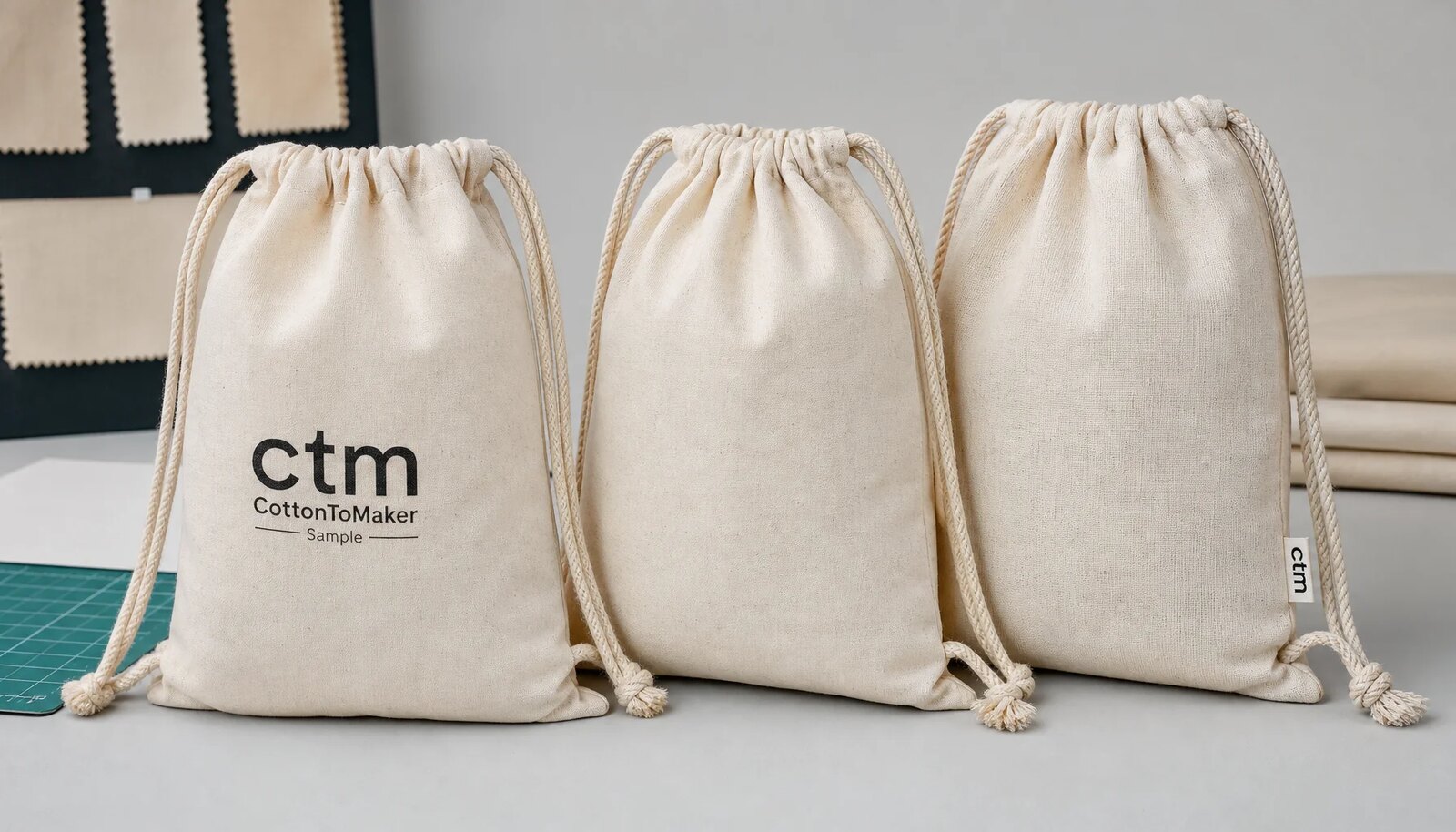
Buying Problem: Too Light Looks Cheap, Too Heavy Raises Landed Cost
For craft fairs, cotton drawstring backpacks sit between a giveaway bag and a small retail backpack. Buyers often lose money by treating fabric weight as a simple quality upgrade. A 120 GSM bag may be acceptable for sponsor inserts, but it can look weak beside handmade products on a booth table. A 240 GSM bag feels better, but carton weight, freight cost, cutting difficulty, and drawcord closing performance all change.
The practical target is not the highest GSM. The target is a fabric weight that matches the product load, selling price, branding method, and distribution plan. A procurement team should write the RFQ around use case first, then request supplier quotes for two or three controlled fabric options. Without that structure, every supplier quotes a different fabric and the cheapest offer is usually not comparable.
- Use 120-140 GSM only when the bag carries light literature, flat samples, or temporary event giveaways.
- Use 160-180 GSM for most craft fair branded backpacks where reuse and shelf presentation matter.
- Use 200-240 GSM when the bag is sold as merchandise or carries heavier craft kits.
- Avoid comparing prices unless fabric weight, construction, dimensions, print area, and packing are identical.
Fabric Weight Ranges That Actually Work
Cotton drawstring backpacks are commonly quoted in GSM, while some buyers and suppliers use ounces per square yard. The conversion is not the only issue. Two fabrics with the same GSM can feel different if one is a loose plain weave and the other is tighter canvas. For craft fair use, buyers should request the finished fabric weight after washing, dyeing, or finishing, because production finishing can change handfeel and shrinkage.
A light plain cotton bag folds small and keeps the unit price low, but the front panel may show contents through the fabric and the printed logo may look less solid. A mid-weight cotton canvas gives better opacity and a more stable print surface. Heavy canvas gives a premium handfeel, but it needs stronger stitching, cleaner drawcord channel sewing, and a packing plan that does not crush the shape.
- 120-140 GSM: budget event bag, light load, low freight weight, limited retail value.
- 150-160 GSM: useful entry point when the buyer needs a better feel but still controls cost.
- 170-180 GSM: strong general recommendation for craft fair resale, brand campaigns, and distributor stock.
- 200-240 GSM: premium option for heavier contents, higher price points, and long-term reuse.
- Above 240 GSM: only useful when the construction is redesigned; otherwise the mouth may close poorly.
Cotton Type, Weave, and Finish Affect More Than Price
Many RFQs say only cotton drawstring backpack, but that is not enough for a factory to quote correctly. Natural cotton, bleached cotton, reactive-dyed cotton, and pigment-dyed cotton all create different cost and risk. Natural cotton is popular for craft fairs because it matches handmade, organic, and local-market visual language, but it can vary from cream to beige between lots.
Weave also matters. A plain cotton fabric may be softer and cheaper, while canvas has a firmer structure and better durability. If the backpack must hold boxed candles, small ceramics, books, or craft tools, canvas is usually safer than a loose weave. If the bag is only used to hold leaflets and small purchases, a lighter plain weave can be commercially reasonable.
- Natural cotton: lower processing cost and craft-style appearance, but shade variation needs approval.
- Bleached cotton: cleaner white base for bright prints, but more processing and higher stain visibility.
- Dyed cotton: better brand color control, but MOQ and lab dip approval become important.
- Cotton canvas: better body and print stability, but higher material and freight cost.
- Cotton-poly blend: may improve strength or reduce shrinkage, but must be declared if the buyer markets the bag as cotton.
Print Method Choices for Craft Fair Branding
Most craft fair drawstring backpacks use screen printing because the artwork is often a solid logo, market name, sponsor mark, or simple illustration. Screen print is stable for bulk orders because the setup cost is spread across the production run. It also works well on 160-240 GSM cotton when the fabric surface is tight enough and the ink is cured properly.
Heat transfer can make sense for small multicolor artwork, short runs, or designs with gradients, but it changes the feel of the front panel. Digital print is possible for complex artwork, yet it may not suit every cotton surface and can raise sample time. Embroidery is less common on cotton drawstring backpacks because it adds cost and can pucker lighter fabric, but it can work for premium small logos on heavier canvas.
- Screen print: best for solid logos, one to four colors, stable bulk pricing, and strong visibility.
- Heat transfer: useful for complex small artwork, but test edge adhesion and handfeel.
- Digital print: useful for detailed designs, but confirm fabric pretreatment and color fastness.
- Embroidery: only practical on heavier canvas and smaller logo areas.
- Print position: keep artwork below the drawcord channel so the logo does not distort when cinched.
Construction Details That Change Durability
The fabric weight is only one part of durability. A 200 GSM bag with weak side seams may fail sooner than a 160 GSM bag with correct stitch density and reinforced stress points. Drawstring backpacks fail most often at the bottom corners, side seam near the cord exit, and drawcord channel. Those areas need more attention than a general claim of strong stitching.
For craft fair buyers, the construction should match the expected load. A simple flat bag is fine for light promotional use. A folded bottom or boxed bottom improves capacity and presentation, but it requires accurate sewing and changes the packed volume. If the backpack is sold to consumers rather than handed out free, buyers should also review the inside seam finishing because loose threads are visible when customers open the bag.
- Side seam allowance should be wide enough to prevent fraying after repeated use.
- Bottom corners should be cleanly closed with no open thread loops or weak backstitching.
- Drawcord channel should allow smooth pulling without catching at seam intersections.
- Cord exit points should not tear when the bag is loaded and worn over the shoulder.
- Stitch density should be consistent, not tightened so much that it cuts through light cotton.
MOQ Logic: What Really Sets the Minimum
The quoted MOQ is not always about sewing capacity. For cotton drawstring backpacks, MOQ can be driven by fabric sourcing, dyeing, printing setup, cord color, labels, packing inserts, or carton marks. Natural cotton in common weights may be available at a lower MOQ because factories can buy stock fabric. Custom dyed cotton usually requires a higher minimum because the dye house needs a batch quantity.
Buyers should separate product MOQ from customization MOQ. A factory may sew 500 pieces, but a custom woven label supplier may require 1,000 or 3,000 labels. A custom cord color may require its own minimum. If a quote looks high, the buyer can often reduce cost by using stock natural cotton, standard cord, standard carton, and a one-color screen print.
- Lowest MOQ route: stock natural cotton, stock cord, one-color screen print, bulk packing.
- Medium MOQ route: stock fabric plus custom print, hangtag, barcode, and standard retail packing.
- Higher MOQ route: custom dyed fabric, custom cord color, woven label, and printed export carton.
- Hidden MOQ risk: accessories may have higher minimums than the bag itself.
- Quote comparison tip: request MOQ by component, not only one final MOQ number.
Sample Approval Should Test the Real Production Setup
A photo sample is not enough for this product. Buyers need a physical sample because fabric weight, stiffness, opacity, cord feel, and print hand cannot be judged reliably from images. The pre-production sample should use the final fabric weight, final color, final cord, final print size, and final seam construction. If the sample is made from a substitute fabric, the buyer should treat it only as a shape sample.
The sample approval process should include practical load testing. Place the intended contents inside the backpack, cinch it closed, wear it by the cords, and check whether the mouth closes evenly. Review the front logo after filling the bag because artwork can shift visually when the fabric stretches. For craft fair sales, the bag must look good both flat on a display table and filled with products.
- Measure flat size, mouth opening, drawcord length, and bottom width against the tech pack.
- Weigh the sample fabric or request a measured GSM report from the production fabric.
- Rub the print with a dry white cloth after curing to check obvious ink transfer.
- Pull both cords several times to confirm smooth closure and no seam tearing.
- Place sample contents inside and photograph the filled shape for approval records.
Quote Data Buyers Need Before Comparing Suppliers
A useful quote should show more than unit price. Procurement teams need the specification basis behind the price: fabric type, GSM, dimensions, print method, number of print colors, accessory details, packing method, carton quantity, carton dimensions, gross weight, lead time, and Incoterm. Without these details, a lower price may simply mean lighter fabric, smaller bag size, weaker cord, or loose packing.
For importers and distributors, landed cost can change quickly when fabric weight increases. A heavier bag may look better at the fair, but the additional carton weight may affect sea freight, courier samples, warehousing, and local delivery. The safest comparison is to request at least two controlled versions from the same supplier and the same versions from competing suppliers.
- Version A: 140 GSM natural cotton, one-color screen print, standard cord, bulk packing.
- Version B: 180 GSM cotton canvas, one-color screen print, standard cord, bulk or individual packing.
- Version C: 220 GSM cotton canvas, upgraded cord, hangtag, barcode, and retail-ready packing.
- Require each quote to show carton quantity, carton size, and estimated gross weight.
- Compare the final landed cost per usable bag, not only the ex-factory unit price.
Packing Decisions for Event Distribution and Retail Channels
Packing is often decided late, but it affects labor cost, carton size, warehouse handling, and product cleanliness. For a craft fair organizer handing out bags at registration, bulk packing may be efficient. For a retail buyer selling the backpacks as merchandise, individual polybags, hangtags, barcodes, and inner carton separation may be needed.
Natural cotton can pick up moisture, dust, and odor if cartons are stored poorly. Export cartons should be dry, clean, and lined if needed. If the buyer wants to avoid individual polybags for sustainability reasons, the supplier still needs a clean folding and carton protection method. The goal is to reduce plastic without letting the bags arrive wrinkled, stained, or mixed incorrectly.
- Bulk packing: lowest cost and fastest handling, suitable for event giveaway distribution.
- Individual polybag: cleaner for retail or distributor stock, but adds material and labor cost.
- Paper band or belly wrap: useful retail alternative when plastic reduction is a priority.
- Inner cartons: helpful for mixed colors, store allocation, and fair booth inventory control.
- Carton marks: should show SKU, color, quantity, PO number, gross weight, and destination details.
Lead Time and Schedule Risks Around Craft Fair Seasons
Craft fair orders are often tied to fixed event dates, which makes schedule control more important than saving a few cents. Lead time should be counted from the final approval of artwork, sample, fabric color, label, packing, and payment terms. If the buyer approves the bag shape but delays print artwork, the factory cannot safely start printed production.
Seasonal congestion also matters. Before spring and holiday craft fair seasons, fabric mills, print rooms, and sewing lines may be booked. Dyed fabric and custom accessories add the most risk because they create dependencies outside the sewing line. Buyers can reduce schedule risk by locking the fabric weight and color early, then leaving only print artwork for final confirmation.
- Fastest route: stock natural cotton, existing cord color, standard carton, and one-color print.
- Moderate route: stock fabric with custom artwork, hangtag, barcode, and controlled carton allocation.
- Slowest route: custom dyed fabric, custom cord, woven label, printed retail sleeve, and mixed-SKU packing.
- Schedule risk point: sample approval delays usually push bulk production more than sewing time itself.
- Shipping risk point: heavier GSM increases carton weight, which can affect air freight backup plans.
Specification comparison for buyers
| Spec decision | Recommended option | When it fits | Buyer risk to check |
|---|---|---|---|
| Fabric weight for low-cost giveaways | 120-140 GSM plain cotton | Short craft fair promotions, lightweight brochures, small yarn kits, or one-day sponsor bags | May feel too thin for retail resale; require opacity check and seam pull test before approving bulk |
| Fabric weight for general craft fair retail | 160-180 GSM cotton canvas or heavier plain weave | Best balance for branded maker markets, reusable shopper-style backpacks, and mid-range retail packs | Supplier quotes may mix GSM and oz/yd²; request both GSM and finished fabric swatch weight |
| Fabric weight for premium maker merchandise | 200-240 GSM cotton canvas | Higher perceived value, better print coverage, and stronger feel for pottery tools, notebooks, or packaged craft kits | Higher carton weight and shipping cost; confirm drawcord channel can close cleanly with thicker fabric |
| Fabric finish | Scoured natural or reactive-dyed cotton | Natural cotton works for rustic craft fair positioning; dyed fabric fits retail color palettes | Natural shade varies by cotton lot; dyed colors need lab dip approval and colorfastness checks |
| Print method | Screen print for solid logos; heat transfer only for small multicolor artwork | Screen print keeps unit cost stable on bulk craft fair orders and handles simple brand marks well | Thick ink on heavy canvas can crack if not cured; test adhesion and wash/rub resistance |
| Drawcord type | Cotton cord for natural look; polyester cord for higher abrasion resistance | Cotton cord matches handmade and eco-style positioning; polyester suits frequent-use event bags | Cotton cord can fray if cut poorly; require sealed or knotted ends and cord pull strength check |
| Bottom reinforcement | Single panel for light loads; folded bottom or boxed corners for resale | Flat single-panel construction is economical; folded or boxed construction supports heavier craft items | Boxed bottoms change packing volume and price; confirm dimensions after filling, not only flat measurement |
| Packing method | Individual polybag optional; master carton with moisture control preferred | Bulk event distribution can use loose packing; retail channels may need barcode, hangtag, and inner carton | Loose natural cotton can absorb warehouse odor or moisture; require dry cartons and clean wrapping standard |
Buyer checklist before sampling
- Define the intended load: paper inserts only, small craft kits, retail merchandise, or repeated shopper use.
- State fabric weight in GSM and request a physical swatch from the same fabric lot planned for production.
- Specify flat dimensions, drawcord length, cord material, seam allowance, and whether the bottom is flat, folded, or boxed.
- Provide artwork size, Pantone color, print position, print method preference, and whether the logo must remain visible when the bag is cinched.
- Request one pre-production sample with final fabric, final cord, final print, final packing, and approved care label or side label if used.
- Set acceptance criteria for GSM tolerance, seam strength, print registration, drawcord pull, color shade, and carton moisture condition.
- Compare quotes using the same packing terms, carton quantity, export carton dimensions, lead time, and Incoterm.
- Confirm whether the MOQ is driven by greige fabric, dyed fabric, printing setup, label production, or carton customization.
Factory quote questions to send
- What exact fabric construction will you quote: plain cotton, cotton canvas, or cotton-poly blend, and what is the GSM tolerance after finishing?
- Can you provide a fabric swatch and a finished bag sample from the same weight category before bulk production?
- What is the minimum order quantity for natural cotton, dyed cotton, custom cord color, woven label, and printed carton separately?
- Which print method do you recommend for our artwork, and what is the maximum printable area before distortion near the drawcord channel?
- What are the setup charges for screen, film, color matching, sample making, label, packing insert, and carton mark?
- How many pieces are packed per inner bag and export carton, and what are the estimated carton dimensions and gross weight?
- What lead time applies after sample approval, deposit, fabric booking, artwork confirmation, and packing confirmation?
- What inspection standard do you use for GSM, stitching, print defects, shade variation, drawcord function, and final packing?
- Can you separate the quote into fabric cost, cutting and sewing, printing, accessories, packing, inland delivery, and export documentation?
- What changes would reduce cost without weakening the bag for craft fair use?
Quality-control points to confirm
- Fabric GSM should be checked by cutting a measured sample from production fabric, not estimated from supplier description alone.
- Finished bag dimensions should stay within the agreed tolerance after sewing and pressing, especially at the mouth opening and bottom width.
- Drawcords must slide smoothly through the channel and withstand repeated pulling without tearing the channel seam.
- Side seams, bottom seam, and corner stress points should show even stitch density with no skipped stitches, loose threads, or open seams.
- Printed logos should meet approved color, position, opacity, curing, and rub-resistance standards before packing starts.
- Natural cotton shade variation should be controlled within approved range and kept consistent within each carton when possible.
- Cartons should be dry, clean, correctly marked, and strong enough for export stacking without crushing the bags.
- Random packed pieces should be opened during inspection to verify actual folding method, barcode or hangtag placement, and mixed-size or mixed-color accuracy.