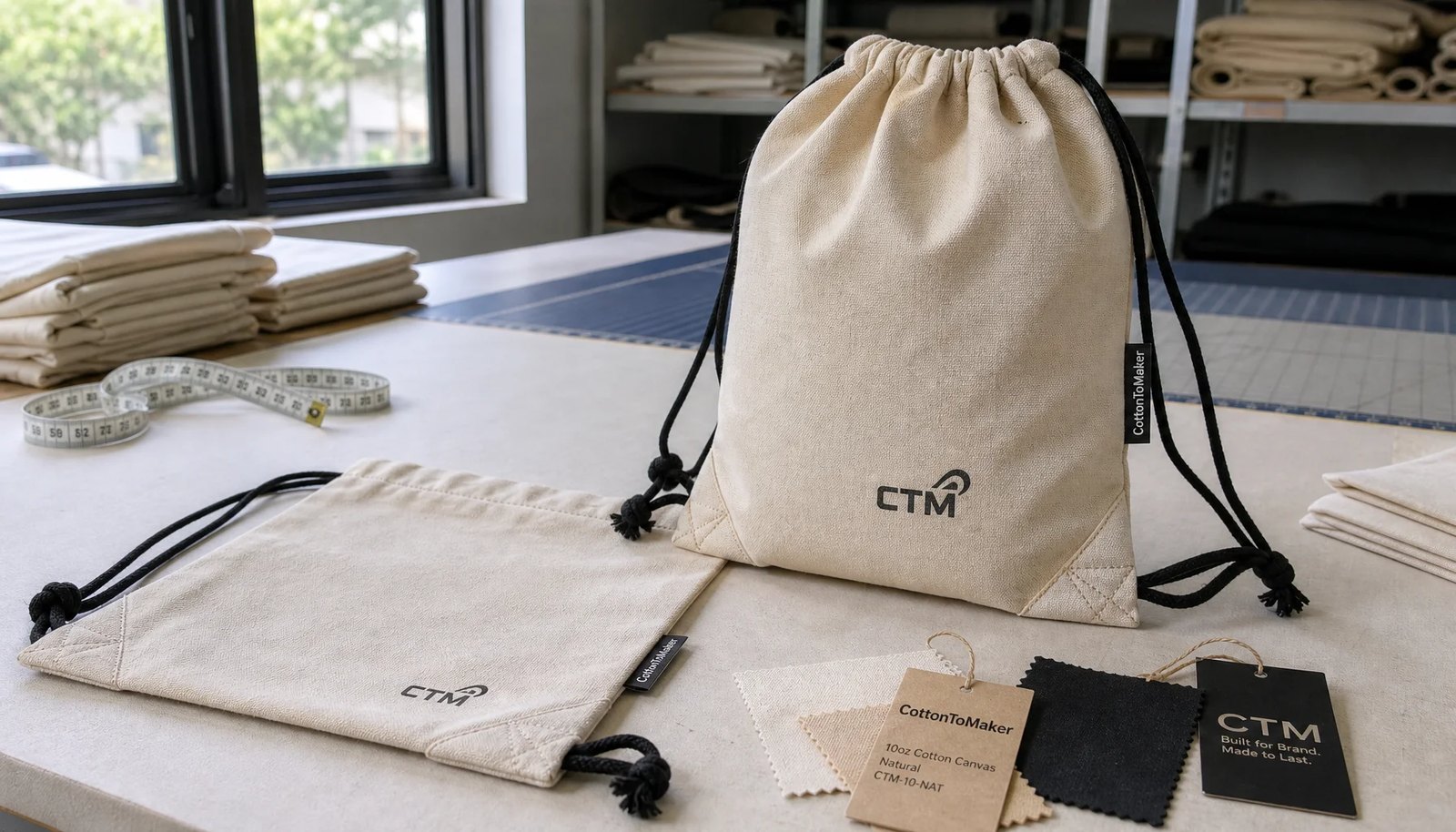
Why Trade Show Use Changes the Test
A custom cotton drawstring backpack for a trade show is not used like a fashion tote or a retail gym bag. It is picked up at a booth, filled immediately with brochures, sample packs, notebooks, power banks, water bottles, badge inserts, and sponsor collateral, then carried through a long event day. That use pattern creates a different failure profile: the cord exits carry the load, the top channel sees repeated pulling, the front panel gets folded and unfolded, and the print is exposed to friction when bags are stacked, shipped, or stuffed into a booth bin.
The buying mistake is common. Many RFQs describe only the logo size and the bag color, so the supplier quotes the cheapest construction that still resembles the reference image. A durability testing checklist changes the conversation. It gives the factory a performance target, gives procurement a fair basis for comparison, and gives the exhibitor a better chance of getting a bag that survives the full event program instead of only the sample review.
For this category, the useful question is not whether the bag looks good on a screen. It is whether it will still close cleanly, carry the expected load, and keep the logo readable after freight handling, booth use, and a full day on the show floor. That is why the durability plan needs to start before the first quote goes out, not after the first sample arrives.
- Set a working load target before requesting samples, such as 1.5-2 kg for light handouts or 3-4 kg for heavier literature kits.
- Treat cord exit points and bottom corners as structural parts, not decorative sewing details.
- Separate visual approval from performance approval; a neat sample can still fail under load, fold stress, or carton compression.
- Use the same checklist for quote comparison, pre-production sample approval, final inspection, and any reorder.
- Write the intended use into the RFQ so the factory does not guess at construction priority.
Fabric Weight, Weave, and Shrinkage Control
For exhibitor backpacks, cotton fabric weight is one of the first durability decisions. A 5 oz cotton bag may look acceptable in a photo, but it is usually better suited for very light giveaways. For a drawstring backpack that must carry catalogs and small branded items, 8-10 oz cotton canvas is a practical starting point. In metric terms, that is often around 270-340 GSM, depending on weave, yarn, and finishing.
Higher GSM is not automatically better. A 12 oz canvas can feel substantial and hold shape well, but it also costs more, weighs more in cartons, and may require stronger needles, slower sewing, and wider seam allowances. If the bag is a premium exhibitor kit or retail resale item, the upgrade can make sense. If it is a one-day giveaway, a well-stitched 8 oz or 10 oz bag is usually the better value.
Buyers should also ask how the fabric is finished. Pre-shrunk or sanforized fabric is easier to control after sewing and pressing. If the supplier is quoting untreated cotton, the buyer should ask for a shrinkage tolerance and confirm whether that tolerance applies to cut panels, finished bags, or both. Natural cotton deserves its own decision as well. Some programs want a raw, environmentally neutral look and accept seed flecks, minor slubs, and shade variation. Others need a cleaner panel for brand printing, which means lab dip approval or swatch approval before bulk cutting starts.
The practical point is simple: fabric should be specified in a way the factory can test, not just a way the marketing team can describe. A quote that says only 'cotton' is too broad to compare. A quote that says 10 oz cotton canvas, natural color, pre-shrunk, with a stated finished-size tolerance and acceptable fleck range is much easier to enforce when the order arrives.
- For light promotional use: consider 6-8 oz cotton only when the load is low and the budget is tight.
- For standard trade show carry: specify 8-10 oz cotton canvas with reinforced cord exits.
- For premium kits: consider 12 oz canvas and test comfort, carton weight, and sewing bulk before committing.
- For natural cotton: allow seed flecks and shade variation unless you specify bleached or dyed fabric.
- Ask whether the supplier will quote fabric by oz only, by GSM only, or by both; buyers should normalize the quote before comparing suppliers.
- If the bag must hold its shape in booth photography, request a fabric handfeel sample and a sewn sample, not just a swatch.
Cord, Channel, and Stress Points
Drawstring backpacks fail differently from tote bags because the cord does double duty. It closes the bag and carries the load on the shoulder. When the wearer pulls the cords tight, force concentrates at the lower corner and the top channel. If those areas are only folded and single stitched, the bag may pass packing inspection but fail during the first event or after a few uses.
Cord material should match the intended use. Cotton cord looks consistent with a natural cotton bag, but it can absorb moisture and show dirt faster. Polyester cord is usually more abrasion resistant and can be heat sealed, but it may look less natural. Diameter matters too: a 6-8 mm cord usually feels better on the shoulder than a very thin cord, while oversized cord may drag in the channel and slow production. Buyers should ask for the exact diameter, not just a generic material description.
The channel itself needs attention. If the opening is too narrow, the cord can bind after the fabric is sewn and pressed. If the channel is too loose, the upper edge can look sloppy and the opening can distort under load. Buyers should ask how the channel is formed, whether the cord passes through a folded hem or a sewn tunnel, and how the factory prevents abrasion where the cord rubs against the fabric.
At the lowest stress points, the buyer should specify the reinforcement method instead of assuming the factory will add it. Bar tacks, box stitches, or reinforced patches at the cord exits are more meaningful than a general statement like 'strong sewing.' For heavier literature kits, ask the supplier to show exactly where the extra stitching lands and whether the same stitch count is used on both sides of the bag. If the bag is meant to be carried by attendees all day, the shoulder comfort and load path matter as much as the print.
- Use bar tacks, box stitches, or reinforced patches at bottom cord exits for heavier loads.
- Confirm the channel opening is wide enough for smooth cord movement after sewing shrinkage.
- Specify cord length and shoulder drop; do not leave it to factory habit.
- Test cord ends for fraying, knot security, or heat-seal quality.
- Ask whether the cord is inserted before or after the side seam is closed, because that affects both quality and repairability.
- If the bag will be used by attendees with heavier literature kits, request a cord pull test on finished samples.
Print Method and Artwork Durability
For trade show exhibitors, logo visibility matters, but print durability matters just as much. Screen printing is usually the most practical choice for simple solid-color logos on cotton backpacks. It gives good opacity and a clean commercial finish when the ink is cured correctly. Large ink coverage on lightweight cotton can stiffen the front panel, so the print area should be considered together with fabric weight and fold line position.
Heat transfer can work for gradients, small details, or short production runs, but buyers should test edge lifting, cracking, and blocking after folding. Embroidery looks premium, yet it adds needle holes and can distort lighter cotton if the design is dense or too large. A woven side label or small sewn label is useful when the buyer wants subtle branding without a large printed face. The right method depends on artwork, fabric weight, event use, and the acceptable risk of post-production damage.
The best buying question is not simply 'Which print method is available?' It is 'Which method will still look acceptable after packing, freight handling, and a full day of show use?' That question forces the supplier to think about ink cure, registration, thread tension, and how the logo sits relative to the seams. Ask for the actual print size in centimeters, not just a mockup, and confirm whether the print is placed on one panel only or across a fold that may crack when the bag is compressed.
Print placement also affects durability. A centered logo can be easier to control, but a large graphic that crosses a fold line or runs too close to a seam is more likely to distort. If the artwork must be large, the buyer should ask for a sewn or printed sample with the fabric folded exactly as it will be packed. That is where many problems show up first.
- Screen print: best for solid event logos, sponsor marks, and one to four spot colors.
- Heat transfer: useful for multi-color artwork, but test flexibility after folding and carton compression.
- Embroidery: reserve for heavier canvas or small logos with controlled stitch count.
- Woven label: good for brand detail, but define label size, fold type, and seam location.
- Ask for print placement measured from the bag edge, not only by eye or by visual mockup.
- If the artwork sits across a fold, ask the factory to show a folded sample before bulk approval.
Sample Approval That Finds Problems Early
A reference sample from a factory shelf is useful for handfeel, but it is not enough for approval. The pre-production sample should use actual fabric weight, actual color, actual cord, actual stitch method, and the real logo process. If dyed fabric or custom cord is involved, the schedule should include lab dip approval or material approval before the bag is sewn. Otherwise, the buyer may approve the design and discover later that the bulk material behaves differently.
Sample checking should be physical, not only visual. Load the bag with the expected event contents and hang it for a defined period. Pull the cords open and closed repeatedly. Fold the printed panel the same way it will be packed. Check the bag after it has been compressed in a carton-style fold. These simple checks expose issues that product photos cannot show: handfeel, cord friction, seam distortion, print tackiness, and how the bag looks after normal handling.
A good sample approval workflow also creates a paper trail. The buyer should mark the approved sample, sign and date it, and note any tolerances or allowed variations. That reference sample becomes the standard the factory and inspector should follow when the bulk order arrives. If multiple teams are involved, keep one signed golden sample and one photographed reference sample so disputes over color, print placement, or finish can be resolved against the same baseline.
This is where procurement saves time later. A sample that is approved with clear notes is easier to enforce than a verbal 'looks fine.' If the approved sample is going to be used as the master standard, the same rules need to apply to reorders. That includes the same fabric, the same cord, the same reinforcement pattern, and the same packing format unless the buyer explicitly changes them.
- Measure finished size flat and compare it with the RFQ tolerance.
- Load the sample to the agreed weight and hang for 30-60 minutes, or longer if the bag is a heavier kit carrier.
- Open and close the cord channel at least 50 cycles for a basic function check.
- Rub the printed logo with a dry cloth and, if appropriate for the ink system, a slightly damp cloth.
- Fold the bag as packed and inspect the print for cracking, tackiness, or transfer.
- Keep one signed golden sample and one photographed reference sample so quality disputes are easier to resolve.
Durability Tests and Acceptance Limits
Factory-level testing does not need to be complicated, but it must be written down. For custom cotton drawstring backpacks used by exhibitors, the most useful tests are load holding, seam pull, cord abrasion, print adhesion, and packing compression. The goal is not to create a laboratory standard for every promotional bag. The goal is to make pass-fail decisions clear enough that production and inspection teams can apply them consistently.
A practical acceptance point is to test the exact weak locations. Look at the lower cord exits, the top channel seam, side seams, bottom seam, and logo surface. If the bag is intended to carry 2 kg, testing a little above that weight gives a safety margin. If the bag is a premium kit carrying heavier contents, the RFQ should state the load target and require reinforced construction from the start. Buyers should also define what failure looks like: an open seam, a broken stitch line, fabric tearing at the cord exit, visible print transfer, or permanent distortion after compression.
The most useful durability checklist is simple enough to repeat on every lot. If the same tests are used on the sample, the pilot run, and the final inspection, procurement can tell whether a problem is random or systemic. Ask the supplier to document the test method, the load used, the hold time, and the failure criteria, rather than relying on a verbal assurance that the bag is 'strong enough.'
Testing should also consider how the bag is handled, not just how much it can carry. Event staff pull bags from cartons, stack them in bins, and hand them out quickly. A bag that survives a single load test but snags at the cord channel or shows print transfer when folded is still a poor fit for trade show use. The best acceptance limits are the ones the factory can measure and the buyer can verify without debate.
- Loaded hang test: no tearing, seam opening, or cord detachment after the agreed test time.
- Cord pull test: no skipped stitches, fabric puckering, or visible distortion at the lower exit point.
- Seam inspection: no open seams, broken thread, needle damage, or uneven stitch density in stress areas.
- Print adhesion: no obvious peeling, ink transfer, edge lift, or cracking after reasonable fold and rub checks.
- Packing compression: no permanent print blocking or severe crease damage after carton-style folding.
- Functional check: the bag should open and close smoothly after testing, without the cord sticking in the channel.
- Documentation check: the inspected lot should match the approved sample on fabric, cord, print, and packing method.
Quote Comparison and Cost Drivers
The lowest quote is often built from a lighter fabric, simpler seam, smaller print area, stock cord, and bulk packing. That may be acceptable for a short giveaway program, but it should be a conscious decision rather than an accidental downgrade. If another supplier quotes a higher price, compare the fabric GSM, reinforcement, cord quality, print method, sample support, and packing before assuming the margin is excessive.
MOQ also changes with the specification. Natural cotton with a one-color screen print can often support a lower MOQ because fabric and cord may be available from stock. Dyed cotton, custom Pantone cord, woven labels, multi-position printing, and individual retail packing usually increase MOQ or setup cost. Buyers should ask the factory to separate one-time setup charges from recurring unit price so they can see whether the price gap is caused by the product spec or by the order size.
A good procurement quote should also show what has been excluded. If the supplier leaves out sample charges, label attachment, inspection, polybags, or special carton marks, the apparent unit cost is not a true landed cost. Ask for an itemized quote that identifies the base bag, the print, the reinforcement, any labels, the packing method, and any alternate options. That makes it much easier to negotiate a meaningful tradeoff, such as keeping natural cotton but upgrading the cord, or keeping the print simple but adding reinforcement.
If you are comparing multiple factories, normalize the numbers first. A 10 oz canvas bag with bar tacks and carton marks is not interchangeable with a 6 oz bag packed loose in bulk cartons. Procurement teams get better pricing when they quote the same spec to every supplier instead of asking each supplier to define the spec for them. The point is not to force every bid into the same template for its own sake; it is to make sure the buyer is actually comparing the same backpack.
- Fabric cost rises with GSM, finishing, dyeing, and fabric width efficiency.
- Labor cost rises with reinforced stitching, double seams, labels, and tighter trimming standards.
- Print cost rises with color count, print size, screen setup, curing time, and artwork registration.
- Packing cost rises with individual polybags, barcode labels, carton marks, and kitting requirements.
- Freight cost rises with carton volume, gross weight, and last-minute air shipment caused by late approvals.
- Ask for a separate line item for samples, tooling, and artwork setup so you can tell whether the recurring price is competitive.
Packing for Show Freight and Booth Use
Packing is part of durability because trade show freight is rough. Bags may travel through a consolidator, advance warehouse, venue dock, and booth storage area before they ever reach an attendee. If cartons are too heavy, booth staff may drag them. If bags are folded too tightly, the printed logo may crease or block. If cartons are weak, compression can damage the presentation before distribution.
Bulk packing is often the most efficient option for free giveaways. Individual polybags make sense when the bag is sold, included in a VIP kit, or must remain clean during handling. Flat packing reduces creasing but increases carton size. Folded packing saves volume but must be tested with the print method. The RFQ should request carton dimensions, gross weight, units per carton, and carton marking details, because these numbers affect freight planning and on-site labor.
If the bags will be handed out from a booth bin, the packing format should make sense for rapid replenishment. If the order is shipping directly to an advance warehouse, carton labels should be precise enough that the receiving team can sort by SKU, color, logo version, or exhibitor account without opening every carton. For programs with multiple destination points, ask the supplier to label master cartons clearly and to confirm whether the outer case is single-wall or double-wall board so the goods arrive without crushed corners or print rub from transit.
Packing should also be reviewed alongside folding direction. A bag with a large front print can be folded in a way that keeps the print from sitting on the crease line, but only if the supplier knows that requirement before packing starts. That is a small detail with a real effect on presentation, especially when the bags are handed out directly from booth inventory rather than repacked on site.
- For booth bins: bulk pack by fixed quantity with clear carton marks.
- For premium kits: use individual polybags or paper bands if presentation matters.
- For large front prints: avoid folds directly through heavy ink coverage when possible.
- For distributor shipments: request master carton size, inner pack quantity, gross weight, and carton drop suitability.
- For event delivery: label cartons by SKU, logo version, and booth or warehouse destination.
- If carton weight is high, ask the factory whether the pack can be split into more cartons to reduce handling risk.
Lead Time and Procurement Workflow
Drawstring backpacks look simple, but custom cotton orders still need a controlled timeline. The schedule usually includes artwork review, material confirmation, sample making, sample shipping, buyer approval, bulk cutting, printing, sewing, trimming, inspection, packing, and export handling. The highest risk points are late artwork, slow sample comments, dyed material delays, and rework after print approval.
A realistic purchase plan separates approval time from factory production time. If a supplier says production is 20 days, that may start only after sample approval and material readiness. For trade show exhibitors, the event date is fixed, so the buyer should build a backward schedule from the required warehouse arrival date, not from the order placement date. That means allowing room for sample transit, comment turnaround, any corrective sample, quality inspection, and freight delays.
The safest buying habit is to ask the supplier for a milestone schedule in writing. Once the dates are visible, procurement can see whether the order can still meet the show deadline or whether the spec needs to be simplified. If the event date is immovable, choose the construction that can be made cleanly on the first pass rather than the most complex option. Buyers often save more by reducing rework risk than by shaving a small amount off the unit price.
For larger programs, add a checkpoint before bulk cutting starts. That checkpoint should confirm that the approved artwork, approved fabric, approved cord, and approved packing method all match the purchase order. Small mismatches at this stage can become expensive when they are discovered after production has already begun. This is especially important when multiple teams touch the order, because sales, marketing, and procurement may each assume someone else already signed off on the same detail.
- Allow time for artwork clarification before screens or transfer films are made.
- Add lab dip time when dyed cotton or exact brand color matching is required.
- Approve the pre-production sample before bulk printing, especially for large logos or exact placement requirements.
- Book inspection before goods are packed too deeply into the shipping schedule.
- Keep a buffer for customs, venue delivery windows, and trade show advance warehouse deadlines.
- If the event date is immovable, choose the construction that can be made cleanly on the first pass rather than the most complex option.
How to Write the RFQ
A strong RFQ for custom cotton drawstring backpacks gives the supplier enough detail to quote the same product as competing factories. It should not be a long legal document, but it must define the main durability choices. Include finished size, fabric weight, color, cord, reinforcement, logo method, packing, quantity, delivery term, inspection requirement, and the intended load. If the bag will be used as a staff kit, say so. If it is a free giveaway with a low load, say that too. The use case determines the spec more than the product category does.
Quote comparison should be done line by line. If one supplier includes 10 oz fabric, bar tacks, individual polybags, and a pre-production sample, while another quotes 6 oz fabric with bulk packing and no reinforcement, the unit prices are not comparable. Procurement teams save time when they ask suppliers to identify exclusions and alternates in the quote. A clean RFQ also makes it easier to negotiate the right trade-off: maybe the buyer keeps the cotton natural but upgrades the cord, or keeps the print simple but adds reinforcement.
The best RFQ is specific enough that the factory can make decisions without guessing, but not so rigid that the buyer loses the chance to compare alternates. Ask the supplier to quote the base version and any meaningful upgrade separately. If the artwork is not final, say so. If the destination requires barcode labels or advance warehouse cartons, say so. If you need the bags to arrive flat, not folded, make that a written requirement instead of a verbal preference.
A useful RFQ also includes the test plan, not just the appearance spec. If the buyer wants a loaded hang test, spell out the load and hold time. If the buyer wants rub testing on the print, say what result is acceptable. When the test plan is written into the purchase process, the factory can quote the right construction and inspection can verify that the delivered bags match the approved sample.
- Product: cotton drawstring backpack for trade show exhibitor giveaway, staff kit, or VIP pack.
- Size: finished width and height with tolerance, plus channel width and cord length.
- Fabric: cotton canvas oz or GSM, color, shrinkage expectation, and acceptable shade range.
- Construction: seam type, bottom corner reinforcement, cord exit treatment, thread color, and label placement.
- Logo: artwork size, position, color count, print method, and required print approval sample.
- Packing: units per carton, folding method, polybag requirement, carton marks, and gross weight request.
- Commercials: quantity breaks, MOQ by material, sample cost, lead time, Incoterms, payment terms, and inspection support.
- Comparison rule: ask the supplier to list every assumed spec and every excluded item before you decide on price.
Specification comparison for buyers
| Spec decision | Recommended option | When it fits | Buyer risk to check |
|---|---|---|---|
| Main cotton fabric | 8-10 oz cotton canvas, roughly 270-340 GSM, with stated weave, finish, and shrinkage tolerance | Most trade show giveaways carrying brochures, notebooks, badge holders, and a light sponsor kit | Thin 5-6 oz cotton can pass visual approval but fail at the cord exit, top channel, or bottom seam under event load |
| Premium fabric upgrade | 12 oz canvas, roughly 400 GSM, with reinforced stress points and a defined print area | VIP kits, retail resale, repeated conference use, or programs that need a stiffer, more premium handfeel | Higher GSM increases carton weight, sewing difficulty, and freight cost; a large print can also make the panel feel rigid |
| Drawcord material | 6-8 mm cotton cord or polyester cord with lot consistency and clean end finishing | Cotton cord fits a natural look; polyester resists abrasion and moisture better | The cord diameter must match the channel width; oversized cord slows packing and can bind after sewing shrinkage |
| Bottom construction | Double-needle side seams plus bar tacks or box stitches at cord exit points | Backpacks expected to carry notebooks, literature, and small branded gifts | Single stitching near the lower corner often fails before the fabric tears, especially after repeated shoulder use |
| Logo print method | Screen print for solid logos, heat transfer for gradients, embroidery only on heavier fabric or small marks | Trade show branding that must stay visible from 2-3 meters without cracking or peeling | Large ink coverage on lightweight cotton can stiffen the panel and cause puckering or crease marking after folding |
| Color control | Natural cotton with an agreed fleck and shade range, or dyed cotton with a lab dip approval | Programs needing consistent booth kits or distributor shipments | Natural cotton is not uniform like bleached polyester; seed flecks, slubs, and dye lot variation should be defined in advance |
| MOQ logic | 300-500 pieces for simple natural cotton screen print; higher for dyed fabric, woven labels, or custom cord color | Small exhibitor runs and distributor replenishment programs | Very low MOQ can force stock materials and manual production steps that change tolerances, price, and lead time |
| Packing format | Bulk pack for event giveaway bins; individual polybag only when presentation or cleanliness matters | Bulk cartons for freight, kitting, and booth storage; polybag for retail-style handout | Overtight folding can crease screen print; high carton weight can deform cord exits or make handling awkward |
| Sample approval | Pre-production sample using actual fabric, actual cord, actual print, and a loaded hang test | Any order where the bag will carry printed literature or sponsor kits | A photo sample cannot confirm handfeel, stitch density, cord friction, seam strength, or print cure |
Buyer checklist before sampling
- Define the intended event load in writing: expected contents, approximate weight, and whether the bag is a giveaway, staff kit, or retail item.
- Specify cotton fabric by both oz and GSM, plus weave, finish, color, shrinkage tolerance, and whether natural seed flecks or visible slubs are acceptable.
- Lock the finished size with tolerance, including body width and height, cord length, shoulder drop, channel width, and bottom corner reinforcement.
- Require stress reinforcement at cord exit points and bottom corners, not only standard side seam stitching.
- Choose the logo method after reviewing artwork coverage, number of colors, print area, fabric color, and whether the bag will be folded after printing.
- Request a pre-production sample made from bulk fabric and bulk accessories, not only a showroom reference sample.
- Run a loaded hang test and repeated open-close test on the sample before approving mass production.
- Confirm packing method, carton dimensions, gross weight, and whether bags need to be flat packed, folded, polybagged, banded, or bulk packed.
- Include AQL inspection level, critical defects, major defects, minor defects, and pass-fail thresholds in the purchase order.
- Compare quotes using the same fabric weight, reinforcement detail, print area, packing format, and inspection requirements before choosing the lowest unit price.
Factory quote questions to send
- What exact cotton fabric are you quoting: oz, GSM, weave, finish, dyed or natural, and current stock availability?
- Is the quoted fabric pre-shrunk or sanforized, and what finished size tolerance can you hold after cutting, sewing, and pressing?
- What cord material, diameter, color, and end treatment are included in the price?
- Which seams are single needle, double needle, overlocked, bar tacked, or box stitched?
- Where exactly are the stress points reinforced, and do you use extra stitching at the cord exits or bottom corners?
- What is the maximum recommended loading weight for this construction based on your internal test or prior production?
- Which print method are you quoting, and how many colors, print positions, and curing steps are included?
- Can the pre-production sample be made with actual bulk fabric, actual cord, and actual logo print?
- What MOQ applies to the bag body, dyed fabric, custom cord color, woven label, printed label, and individual packing?
- What is the production lead time after artwork approval, sample approval, deposit, and bulk material arrival?
Quality-control points to confirm
- Fabric GSM tolerance should be defined before production; for many cotton canvas orders, plus or minus 5 percent is a practical commercial range, but the buyer should state the exact acceptance band in the PO.
- Finished bag dimensions should be measured flat, with tolerance stated for width, height, channel width, shoulder drop, and cord length; a commercial target of plus or minus 0.5 cm is common for small bags, but exact limits should be agreed per program.
- Cord exit points should survive a loaded hang test without seam splitting, skipped stitches, or fabric tearing.
- The seam allowance around the bottom and side seams should be consistent across the lot, not only on the first few pieces.
- Print adhesion should pass a tape pull or rub test suitable for the ink system and fabric surface, and the ink should not lift, crack, or offset after folding.
- Screen print curing should be checked for tackiness, cracking after folding, and ink transfer during carton compression.
- Stitch density should be consistent, commonly around 8-10 stitches per inch depending on fabric thickness and thread, with no loose loops or skipped stitches in stress areas.
- Loose threads, oil marks, needle holes, crooked labels, and distorted logo placement should be classified before final inspection.
- Cartons should be strong enough for trade show freight handling, with gross weight kept manageable for booth teams or warehouse staff.
- Random finished goods should be loaded with the agreed event weight for a practical pull and hang test before bulk packing is released.