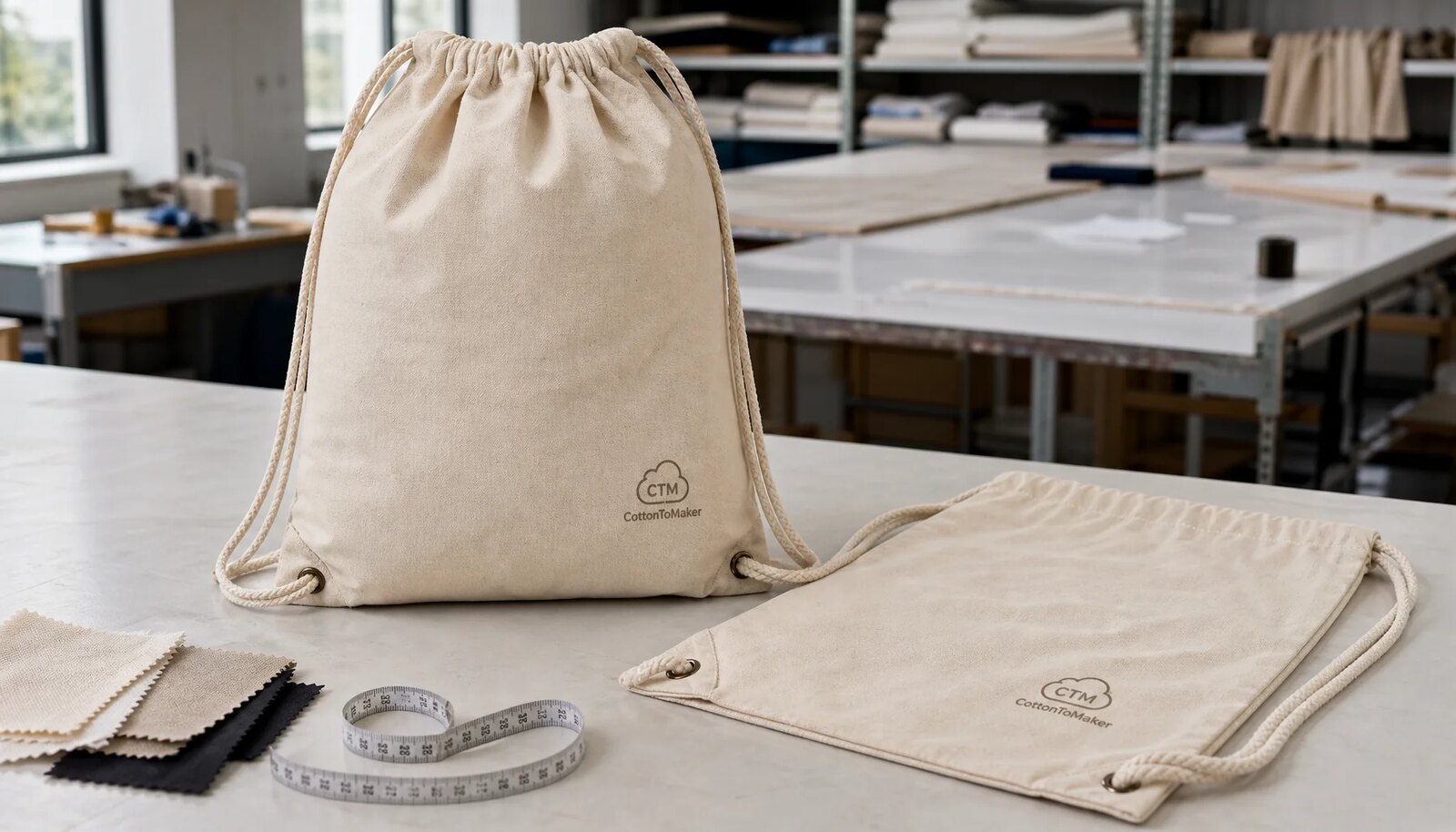
Start With Real Craft Fair Use, Not a Generic Bag
A craft fair drawstring backpack looks simple until it is used for a full event day. Visitors may start with a map and sponsor flyer, then add candles, soaps, small ceramics, apparel, packaged snacks, drink bottles, catalogs, and purchases from several booths. The bag is pulled open, cinched closed, worn on shoulders, dropped under tables, and packed into event cartons before anyone sees it. That is why B2B buyers should treat durability as a buying requirement, not a final-inspection surprise.
The biggest sourcing problem is that two suppliers can quote the same size and still mean completely different products. One factory may be pricing 5 oz cotton, narrow seams, unreinforced punched cord holes, and a basic print. Another may include 8 oz canvas, reinforced cord exits, better stitching, and a properly cured screen print. Both samples can look fine in a photo. They will not behave the same under load.
A useful custom cotton drawstring backpacks durability testing checklist for craft fairs turns casual expectations into measurable controls. It tells the supplier what the bag must carry, how it should be sewn, how the cord should move, how the logo should survive folding and rubbing, and what evidence must be shared before bulk approval. The goal is not to overbuild every order. A paper-only visitor giveaway can be lighter than a paid merchandise bag or vendor kit. The point is to make the construction match the real use case.
- Classify the order as giveaway, resale merchandise, sponsor welcome kit, vendor kit, retail stock, or replenishment inventory.
- Define expected contents, target working load, reuse expectation, artwork versions, delivery locations, and event receiving date.
- Write durability checks into the RFQ so suppliers quote the same construction and inspection workload.
- Compare quotes only after GSM, finished size, seam type, cord, reinforcement, print method, packing, and QC evidence are aligned.
Fabric Weight, Cotton Type, and Color Approval
Fabric weight is the first durability decision. For very light promotional use, 5 oz to 6 oz cotton can work when the bag carries maps, postcards, and small flat items. For reusable craft fair bags, 8 oz to 10 oz cotton canvas, approximately 270 to 340 GSM, is a safer baseline. It gives the bag more body, improves opacity, supports the drawstring channel better, and reduces stress around the bottom seam and cord exits.
Ask for both oz and GSM in the quote. Suppliers in different regions may use different fabric language, and vague terms such as “thick cotton” or “canvas style” are not enough for procurement comparison. Also define the tolerance. Cotton fabric varies by lot, so plus or minus 5% may be more realistic than demanding an exact GSM without mill confirmation. If the order requires recycled, organic, or certificate-backed cotton, ask what the certificate covers: yarn, fabric, finished goods, or transaction documentation.
Color affects both brand presentation and QC. Natural unbleached cotton is popular for handmade, local, organic, and artisan positioning, but buyers should expect seed flecks, small slubs, and shade variation within an approved range. Bleached cotton gives a cleaner print base. Dyed cotton supports brand-color programs, but it needs shade-band approval and colorfastness checks, especially if the bag may rub against light clothing. Approve physical swatches, not only photos, because hand feel, weave openness, opacity, and surface texture rarely show accurately on screen.
- Use 5 oz to 6 oz cotton only for light, short-term handout programs with low load expectations.
- Use 8 oz cotton canvas for balanced craft fair durability, print coverage, and cost control.
- Use 10 oz or heavier cotton when the bag is sold, packed with heavier samples, or positioned for repeated use.
- Approve a swatch card showing GSM, color, hand feel, opacity, surface texture, and acceptable natural-cotton variation.
- Ask whether shrinkage expectations apply after washing if the bag will be marketed as washable or reusable.
Size, Tolerances, and Sewing Details That Prevent Splits
A common flat drawstring backpack size is around 34 x 42 cm, but the right size depends on what the event team will put inside. A bag for guides and flyers can be smaller than one holding boxed soaps, apparel, or vendor sample kits. Specify finished dimensions after sewing, pressing, folding, and packing. Pattern dimensions do not help an inspector if the delivered bag is too small for sponsor inserts.
For simple flat cotton backpacks, plus or minus 1 cm is a common practical finished-size tolerance, unless a tighter tolerance is agreed. Boxed bottoms, shaped panels, or thicker fabric may need separate measurement rules. Write down how the bag should be measured: flat, unfilled, smoothed by hand, with the channel included or excluded. Small measurement disputes become expensive when the goods are already packed for an event deadline.
Most failures happen at stress points. The bottom seam carries the load. Side seams hold the shape. The top channel takes repeated cinching. The cord exit corners receive concentrated force when the bag is worn. Strong fabric can still fail if the seam allowance is narrow, stitch density is low, or backtacking is weak. For standard event bags, an overlocked bottom seam plus secure lockstitch or topstitch is often practical. For heavier contents or a retail-ready shape, a boxed bottom can improve volume and presentation, but it adds fabric, labor, carton volume, and inspection points.
- State finished width and height with tolerance, and measure the bag in the same condition in which it ships.
- Specify bottom seam, side seam, channel seam, backtack positions, stitch density target, and thread color.
- Set channel width to match cord diameter so the cord slides without jamming or abrading the fabric.
- Use reinforced patches, sewn tabs, eyelets, or bar tacks at cord exits when expected contents exceed paper-only loads.
- Document boxed bottom depth and measurement method if the bag must stand better or hold bulkier goods.
Drawcords, Eyelets, and Wearing Comfort
The drawcord is not just a closure. On a drawstring backpack, it is also the shoulder strap, so it affects durability, comfort, packing speed, and the user’s impression of the product. Cotton cord gives a natural look that fits craft fairs and maker markets. Braided polyester cord often moves more smoothly, absorbs less moisture, and holds a more consistent diameter. The right choice depends on price, brand aesthetic, expected load, and how often users will open and close the bag.
Cord diameter should match both the channel and the reinforcement opening. A thin cord can reduce cost, but it may dig into shoulders and create high stress at the bottom corners. A thick cord can feel better under load, yet it may jam in the channel, bulk up cartons, and slow packing. For many reusable cotton drawstring backpacks, a 5-7 mm cord is a practical range to test, but the approved sample should use the actual channel width and eyelet size planned for production.
Cord exits deserve close attention. Metal eyelets should be firmly set, flat, clean, and free from sharp edges that could cut cord or fabric. Fabric patches should be stitched through enough area to spread the pulling force. Bar tacks should sit at the true stress point, not simply near it. If a quote relies on unreinforced punched holes, treat it as a lower-duty construction unless the bag will carry only very light paper items.
- Request cord material, diameter, length, color, end finish, knot method, and channel compatibility in the quote.
- Test shoulder comfort using the approved target load rather than an empty sample.
- Inspect eyelets for sharp edges, loose setting, cracking, rust risk, and fabric tearing after cord pull checks.
- Run 50-100 open-close cycles on the pre-production sample to identify friction, twisting, knot slip, or channel abrasion.
- Confirm cord length after cinching because short cords make wearing difficult and long cords create dragging or safety concerns.
Logo Method and Print Durability
Screen printing is usually the most practical decoration method for cotton drawstring backpacks used at craft fairs. It works well for solid event logos, sponsor marks, and simple one- to four-color artwork when screens are registered correctly and ink is properly cured. Heat transfer can be useful for full-color artwork or low-volume sponsor versions, but it needs checks for edge lifting, cracking, and hand feel. Embroidery can look premium on heavier cotton, yet it can pucker lightweight panels or distort thin fabric.
Print problems often start with missing specifications. Dark cotton may need a white underbase for light colors to appear correctly. Natural cotton may absorb ink differently than bleached cotton. Large logo areas can feel stiff or crack if ink deposit is excessive. A low-cost transfer may look sharp when new and still lift after folding, rubbing, or compression in cartons. A digital proof confirms layout, but it does not prove opacity, curing, texture, or adhesion on actual fabric.
The artwork specification should include print method, color count, Pantone or approved color reference, maximum print size, placement tolerance, underbase requirement, curing requirement, and acceptable hand feel. For craft fairs with multiple sponsor versions, give each version a code. That same code should appear on the artwork proof, production order, packing list, carton mark, and inspection sheet. Version control prevents a technically good print from becoming a failed delivery because the wrong logo reaches the wrong booth.
- Use screen print for solid event logos, sponsor marks, and medium- to high-quantity cotton backpack programs.
- Use heat transfer for full-color or small-run artwork only after rub, fold, peel-edge, and packing checks.
- Use embroidery only on heavier stable cotton after checking puckering, backing visibility, and needle damage.
- Approve a physical printed sample showing size, placement, color, opacity, edge quality, hand feel, and underbase result.
- Set print placement tolerance, commonly plus or minus 5 mm to 10 mm depending on artwork size and sewing variation.
Durability Tests to Put in the RFQ
A practical durability checklist should tell the factory what to test, which sample to test, what result is acceptable, and what evidence must be shared. These checks do not replace formal lab testing when a retailer, regulation, or contract requires it. They do help catch common failures before shipment: weak seams, loose eyelets, cord jamming, print transfer, poor curing, and packing damage.
Start with the expected working load. If the bag may carry 3 kg of catalogs, purchases, and samples, test the production-representative sample at 3 kg. For higher-risk programs, add a short overload check at a higher weight. A simple loaded hang can run from 2 hours to 24 hours depending on the buyer’s risk level. After testing, inspect the bottom seam, side seams, channel, cord exits, eyelets, patches, knots, and fabric distortion. A short loaded wear trial is also useful because a bag behaves differently on shoulders than on a hook.
Decoration needs its own checks. A dry rub with a clean white cloth can reveal ink transfer. A fold through the logo can show cracking or weak transfer adhesion. A light fingernail scratch can expose poor curing. Packing recovery matters too: compress a printed and folded sample for 24 hours, then inspect for print blocking, hard creases, odor, cord deformation, and logo abrasion. Ask for dated photos or short videos so the test is traceable to the approved sample.
- Loaded hang: fill to the agreed test weight, hang for the agreed time, and inspect seams, channel, corners, and cord exits.
- Loaded wear: wear the packed sample for several minutes to check shoulder comfort, cord slip, knot security, and corner stress.
- Cord pull: pull each cord direction firmly and inspect eyelets, patches, bar tacks, knots, and channel stitching for damage.
- Open-close cycle: cinch and release the bag 50-100 times to detect jamming, twisting, broken stitches, and abrasion.
- Print rub and fold: rub with a dry white cloth, fold through the logo, and check transfer, cracking, peeling, or flaking.
- Packing recovery: compress a folded printed sample for 24 hours and inspect creases, blocking, odor, and cord distortion.
Sample Approval and Golden-Sample Control
A clean sample process usually moves through three stages: material confirmation, artwork proof, and pre-production sample. Material confirmation locks fabric GSM, color, cord, eyelets or reinforcement, thread, labels, and packing materials. Artwork proof locks layout, color, logo size, underbase, print method, and placement. The pre-production sample proves that all approved components work together under the intended sewing, printing, finishing, folding, and carton-packing process.
Be cautious with attractive samples that are not production representative. A handmade sales sample may use better sewing than bulk production. A look sample may use substitute fabric, substitute cord, or a different decoration method. These samples can help with design decisions, but they should not release bulk cutting unless every substitution is documented and a true production-representative sample follows.
A strong approval file includes the sealed sample, signed fabric swatch, signed cord swatch, approved print proof, measurement record, durability-test notes, packing reference, and written deviations. If natural cotton slubs are acceptable, define the visual range. If print placement can vary, state the tolerance. If the cord changes after sample approval, update the file instead of relying on email memory. Golden-sample control gives inspectors a physical reference that is clearer than wording alone.
- Approve fabric, cord, eyelet or patch, thread, label, print, and packing materials before approving the full sample.
- Measure the sample after sewing, pressing, folding, and packing so approval reflects delivered condition.
- Photograph seams, channel, cord exits, print edges, labels, hangtags, folding method, and carton packing for QC reference.
- Keep one sealed approval sample with the buyer and one sealed reference sample at the factory for higher-risk orders.
- Do not release bulk cutting until substitutions, deviations, tolerances, and test requirements are written into the final specification.
MOQ, Price Drivers, and Quote Normalization
MOQ is not only the total number of backpacks. It is shaped by fabric availability, dyeing minimums, cord color, reinforcement hardware, print setup, label type, packing style, destination sorting, and artwork count. A factory may support a lower MOQ for natural stock cotton and standard cord. The same order quantity may become difficult when it requires custom dyed fabric, five sponsor logos, special cord color, retail hangtags, and destination-specific cartons.
Cost differences usually reflect specification differences. Heavier GSM increases fabric cost, cutting effort, sewing handling time, carton weight, and freight cost. More print colors increase setup and registration work. Larger print areas use more ink and create more surface area for defects. Reinforcement adds labor but reduces the risk of cord exit failure. Individual polybags, barcode labels, hangtags, carton sorting, and inspection evidence all add operational work that should be visible in the quote.
Use the same quote template for every supplier. Ask each factory to confirm what is included and excluded. If one quote is much lower, check whether it uses lighter GSM, removes reinforcement, changes cord diameter, excludes print underbase, uses bulk packing instead of version sorting, or assumes a looser inspection plan. Quote normalization protects both price comparison and event reliability.
- Request separate price lines for bag construction, logo setup, extra print colors, reinforcement, labels, special packing, inspection, and freight if needed.
- Ask MOQ by fabric color, cord color, print method, artwork version, label type, packing style, and destination.
- Normalize quotes by GSM, finished size, cord diameter, reinforcement method, print area, artwork count, carton plan, and incoterm.
- Ask for upgrade costs from 6 oz to 8 oz and 10 oz cotton so stakeholders can see the durability-price tradeoff.
- Treat a very low quote as a reason to verify construction, not as proof that all suppliers are quoting the same product.
Packing, Carton Marks, and Version Control
Packing affects both product condition and event execution. Cotton drawstring backpacks are commonly flat packed, often in inner bundles and export cartons. The correct carton count depends on fabric weight, bag size, cord bulk, print sensitivity, and carton strength. Over-compression can leave hard creases through the logo, distort the cord channel, or create print blocking if ink is not fully cured. Loose packing can raise freight volume and allow cartons to crush or shift during handling.
Craft fair distribution is often more complicated than a single bulk shipment. Cartons may be sorted by fair location, sponsor artwork, booth number, warehouse destination, retail PO, or launch date. The packing instruction should define bundle count, carton quantity, version code, carton mark, gross weight limit, pallet requirement, and whether mixed cartons are allowed. If multiple sponsor logos are involved, each version should be physically separated and clearly identified.
Cotton can absorb humidity during storage and transport, so cartons should be clean, dry, and suitable for the route. Desiccant may be appropriate for longer transit or humid seasons. Individual polybags keep bags clean and support retail distribution, but they add cost, labor, plastic use, and unpacking time. Bulk flat packing can be better for event giveaways if the warehouse can keep cartons clean and count accurately.
- Define pieces per inner bundle, pieces per carton, fold direction, print-facing direction, carton size, and gross weight.
- Protect printed panels from heavy rubbing, sharp hardware, wet cartons, and excessive compression during packing.
- Use carton marks showing PO, artwork version, event name, quantity, destination, carton number, and mixed-carton status.
- Confirm whether polybags, bundle bags, tissue, desiccant, barcode stickers, hangtags, or retail labels are required.
- Check carton strength and handling weight against export transit, warehouse stacking, courier limits, and event-site movement.
Inspection Timing, AQL, and Schedule Risk
Plan lead time backward from the craft fair date. A realistic calendar includes artwork preparation, swatch approval, sample production, sample review, revisions, bulk fabric booking, cutting, printing, curing, sewing, trimming, inspection, packing, export documents, domestic delivery, and event receiving. Every late approval reduces the time available to correct defects.
The largest schedule risks are late artwork, custom dyed fabric, unavailable cord color, failed print proof, inspection failure close to shipment, and multiple sponsor versions that require sorting. Ask the factory for the last safe date for artwork approval, material approval, pre-production sample approval, final inspection, and shipment handover. If the order is event-critical, build in time for at least one sample correction and one production issue.
Final inspection should happen before goods leave the factory. Inspectors need access to cartons, loose units, production records, and replacement stock if defects are found. For higher-risk orders, an inline check during printing or sewing can identify problems before all units are finished. The inspection checklist should reference the approved sample, measurements, functional tests, print checks, version control, packing, and carton marks. For formal inspections, buyers may use an AQL plan such as general inspection level II with defect classifications agreed in advance, but the exact plan should match order value and risk.
- Separate sample lead time, material booking, bulk production, inspection, packing, documents, and transit in the calendar.
- Build time for sample correction when the order has custom fabric, custom cord, multiple logos, or a fixed event date.
- Do not approve bulk cutting until fabric, size, cord, reinforcement, print proof, labels, and packing method are locked.
- Book final inspection while cartons are still at the factory and before goods move to a forwarder or event warehouse.
- Define critical, major, and minor defects so inspectors know how to classify open seams, wrong logos, loose eyelets, stains, and print failure.
Specification comparison for buyers
| Spec decision | Recommended option | When it fits | Buyer risk to check |
|---|---|---|---|
| Fabric weight | 8 oz to 10 oz cotton canvas, approximately 270-340 GSM, with an agreed GSM tolerance such as plus/minus 5% unless the mill confirms another range | Reusable craft fair giveaways, sponsor merchandise, vendor kits, maker-market retail bags, and event bags carrying catalogs, small purchases, bottled drinks, and light samples | 5 oz to 6 oz cotton may be acceptable for paper-only handouts, but it can feel disposable, show print strike-through, and fail first at the cord exit, channel, or bottom seam |
| Fabric color | Natural unbleached cotton for craft positioning; dyed or bleached cotton only with approved shade band and dry/wet rub checks | Natural cotton supports handmade, local, eco, organic, and artisan branding; dyed fabric supports brand-color programs | Natural cotton commonly shows seed flecks and slubs; dyed cotton can vary by lot or rub onto light clothing if colorfastness is not checked |
| Finished size | Common event size around 34 x 42 cm, or buyer-defined size with plus/minus 1 cm finished-size tolerance for flat bags | Standard size fits fair guides, brochures, apparel, packaged goods, and small purchases; larger sizes fit vendor kits or resale programs | Oversized bags made in light cotton can sag and stress corners; undersized bags may not fit catalogs, folders, boxed items, or sponsor inserts |
| Bottom construction | Overlocked bottom seam plus secure lockstitch/topstitch; boxed bottom only when added volume or retail presentation justifies extra labor | Flat bottom works for economical giveaways; boxed bottom improves volume and shape for merchandise kits or paid retail bags | A narrow seam allowance, low stitch density, skipped stitches, or weak backtacking can split before the fabric panel tears |
| Cord material | Cotton cord for a natural look; braided polyester for smoother movement and lower moisture absorption; 5-7 mm diameter commonly suits reusable bags | Cotton cord fits craft-market aesthetics; polyester cord is practical for frequent cinching, damp storage, and high-volume handling | Thin cord can cut into shoulders and corners; oversized cord may jam in the channel, increase carton bulk, and slow packing |
| Cord exit reinforcement | Metal eyelets, sewn fabric tabs, reinforced corner patches, or bar tacks specified in the tech pack and verified by pull testing | Recommended for reusable backpacks, sponsor merchandise, vendor kits, and any bag expected to carry more than paper handouts | Unreinforced punched holes are a common failure point during cord pull, loaded wear, and repeated open-close cycling |
| Print method | Screen print for solid logos; heat transfer for full-color or low-volume artwork; embroidery only on stable heavier cotton | Screen printing suits craft fair logos, sponsor marks, and simple artwork on cotton canvas | Poor curing, excessive ink deposit, weak transfer adhesion, missing underbase, or embroidery puckering can show after folding, rubbing, or packing |
| Sample level | Pre-production sample using actual bulk fabric, cord, reinforcement, print method, label, and packing method | Necessary for distributors, event-critical orders, retail programs, multiple artwork versions, and repeat procurement | A look sample made from substitute fabric cannot validate GSM, seam strength, cord movement, print adhesion, color, or packing recovery |
| MOQ logic | Set MOQ by fabric color, print setup, cord color, label, packing style, and artwork version, not by total bag count alone | Useful when one craft fair program has multiple sponsor logos, booth drops, destination labels, or retail versions | Too many small artwork versions increase setup cost, sorting risk, carton-marking errors, and inspection complexity unless version control is agreed |
Buyer checklist before sampling
- Classify the program as visitor giveaway, sponsor welcome bag, paid merchandise, vendor kit, retail stock, or multi-event replenishment item before asking for price.
- List expected contents and target working load in kilograms, such as brochures, maps, candles, ceramics, apparel, packaged food, bottled drinks, craft supplies, or sample kits.
- Specify finished width and height, fabric weight in oz and GSM, acceptable GSM tolerance, fabric color, cotton type, shrinkage expectation, and whether recycled, organic, or certified cotton is required.
- Define bottom seam, side seams, drawstring channel, seam allowance target, stitch density target, cord exit reinforcement, labels, and boxed bottom depth before suppliers quote.
- Select cord material, approximate diameter, color, length, end finish, knot method, channel width, and whether cord ends require heat sealing, tipping, stitching, or simple knots.
- Define logo method, number of colors, print size, placement tolerance, Pantone or approved color reference, white underbase if needed, curing requirement, and acceptable hand feel.
- Request fabric, cord, eyelet, thread, label, print, and packing swatches before approving a full pre-production sample.
- Require a pre-production sample made with actual bulk fabric, actual drawcord, actual reinforcement, actual artwork method, actual label, and intended fold and carton packing.
- Set durability checks in the RFQ: loaded hang, loaded wear trial, seam stress pull, cord pull, 50-100 open-close cycles, dry rub, fold test, scratch check, and 24-hour packing recovery.
- Ask the factory to provide dated photos or short videos showing test weight, test time, cord pull setup, seam condition, print rub result, and the exact sample used for approval.
Factory quote questions to send
- What exact cotton fabric weight will you use in oz and GSM, what tolerance applies, and is the fabric stock, custom dyed, custom woven, recycled, organic, or certificate-backed material?
- What is the finished bag size after sewing, pressing, and packing, and what tolerance do you propose for width, height, channel width, cord length, and boxed bottom depth if applicable?
- What seam allowance, stitch density in stitches per inch or centimeter, thread type, overlock method, lockstitch or topstitch method, and backtack method are included?
- How will cord exits be reinforced: metal eyelet, grommet, fabric patch, stitched tab, bar tack, or no reinforcement, and what practical cord pull result can you support on the approved sample?
- What drawcord material, diameter, length, color, end finish, knot method, and replacement option are included in the unit price?
- Which print method is quoted, how many colors are included, what is the maximum print area, and does the quote include screen setup, white underbase, curing, artwork adjustment, and print proofing?
- Can the pre-production sample be made with actual bulk fabric, actual cord, actual reinforcement, actual print method, actual label, and intended packing? If not, which items are substituted and when will true materials be ready?
- What in-house durability checks can you perform before shipment, and can you share dated photo or video evidence for loaded hang, seam pull, cord pull, open-close cycling, print rub, and packing recovery?
- What MOQ applies by fabric color, cord color, print color count, artwork version, label type, packing style, and delivery destination?
- How will you control multiple sponsor or vendor artwork versions so wrong-logo packing, mixed cartons, carton-marking errors, or destination mix-ups are prevented?
Quality-control points to confirm
- Finished size should be checked against the approved pre-production sample and purchase specification, commonly with plus or minus 1 cm tolerance for simple flat cotton drawstring backpacks unless a tighter tolerance is agreed.
- Fabric GSM should be checked against the approved swatch and purchase order, with a realistic lot allowance such as plus or minus 5% only if agreed before production.
- Fabric should be inspected before cutting and during final inspection for shade variation, weaving holes, heavy slubs outside the approved range, stains, oil marks, mildew odor, loose yarns, and foreign fibers.
- Bottom seams, side seams, and drawstring channels should show even stitch density, secure backtacking, no skipped stitches, no open seams, no loose overlock tails, no broken threads, and no exposed raw edges where not intended.
- Cord exits should match the approved reinforcement method, with eyelets or patches sitting flat and showing no cracking, rust, sharp edges, detachment, or fabric tearing after pull checks.
- Drawcords should be measured for diameter and length, matched to the approved color, and tested for smooth movement through the channel without snagging, twisting, excessive friction, or cutting into corner fabric.
- Knots, sealed ends, metal tips, stitched ends, or other cord finishing should be consistent across the lot and should not unravel during repeated opening and closing.
- Print color should match the signed proof under consistent lighting, with no major pinholes, smudging, misregistration, ghosting, ink bleeding, scorching, contamination, or unacceptable opacity variation.
- Print adhesion should pass dry rub, fold, light scratch, and packing-abrasion checks suitable for the chosen method before cartons are sealed.
- Labels, hangtags, care labels, barcode stickers, retail marks, and carton labels should match the approved placement, wording, size, version code, PO, and delivery destination.