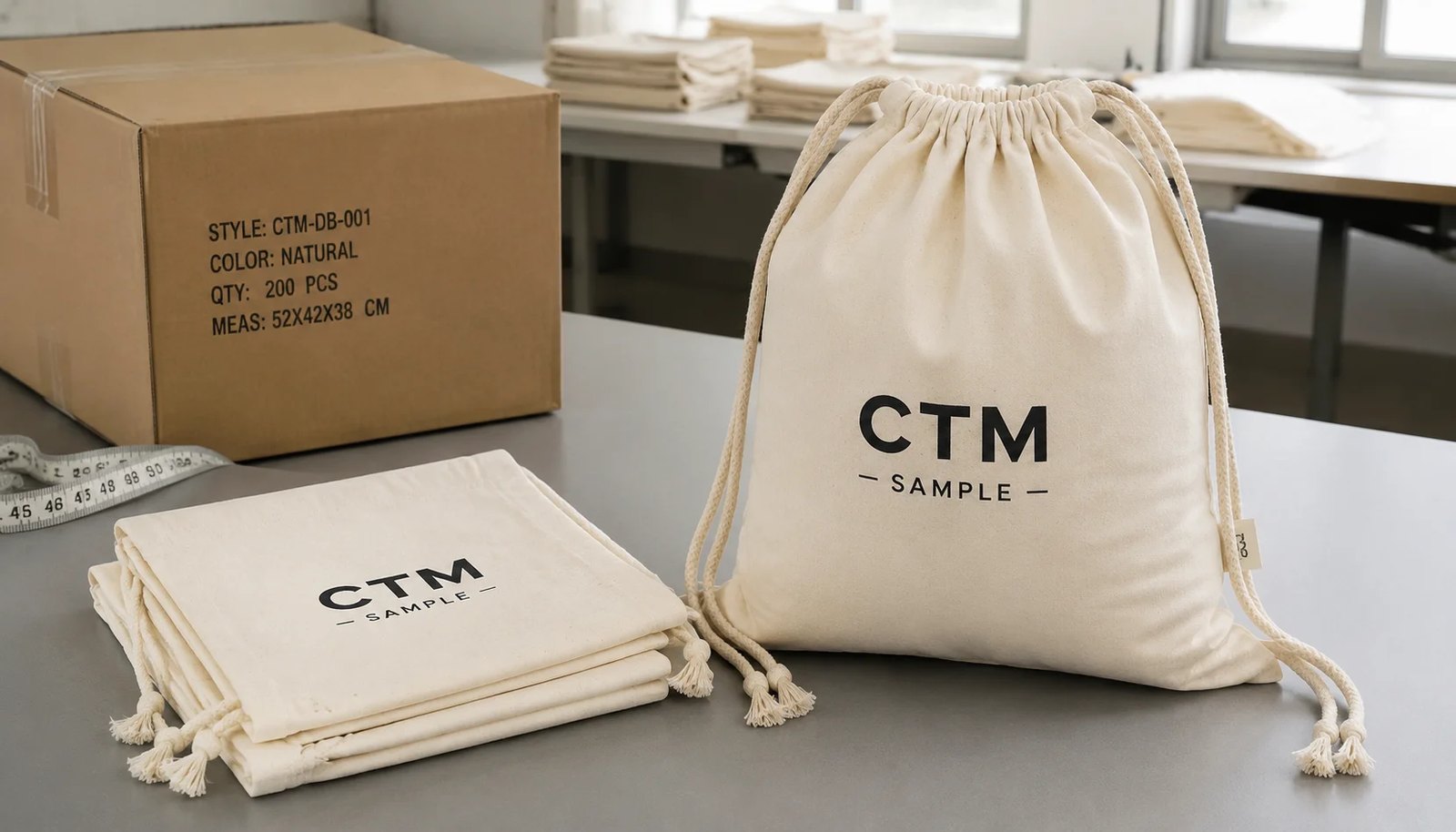
Why carton planning matters more than most backpack RFQs
For custom cotton drawstring backpacks, many RFQs still focus almost entirely on the bag body: size, fabric, logo, and unit price. For a natural grocer program, that is only part of the buying decision. The bigger operational impact often sits in the carton packing plan. Freight cost, distribution-center handling, store-level counting, unpacked appearance, and damage risk are all shaped by how the bags are folded, bundled, and loaded into export cartons.
That matters because natural grocers often operate with practical packaging expectations. They may want low-pliority packaging, limited plastic, manageable carton weights for store staff, and clean presentation when the cartons are opened. A supplier can quote a low FOB price but still create downstream costs if the bags arrive wrinkled, dusty, offset with ink transfer, or packed in cartons too heavy for manual handling. Procurement teams that compare only unit price can miss these hidden costs.
Carton planning also affects quote accuracy. One factory may assume 150 pieces per carton with high compression and thinner board. Another may assume 90 pieces in a stronger 5-ply carton with cleaner fold orientation and lower damage risk. Both quotes can look similar on the front page, but they represent very different landed-cost outcomes and very different operational realities.
For that reason, a strong RFQ for custom cotton drawstring backpacks should link product specification and packing specification from the beginning. Fabric GSM, print method, cord type, fold direction, inner bundle count, carton dimensions, gross weight target, and carton marks should all be treated as commercial terms, not as details to decide after the PO is placed.
- Carton packing affects freight cost per piece, warehouse handling speed, and in-store presentation quality.
- Overpacked cartons can lower apparent shipping cube but increase burst, corner crush, and print-transfer claims.
- Natural grocer buyers often need low-plastic pack-out, practical counting, and manageable carton weights.
- A clean RFQ should tie bag specification and packing plan together so suppliers quote on the same basis.
Choose the base bag specification before trying to optimize the carton
A sound carton packing plan starts with the right product build. For most natural grocer programs, the practical baseline is natural cotton canvas in the 170-230 GSM range, roughly 6 oz to 8 oz. This range usually gives enough body for a drawstring backpack silhouette while still allowing efficient folding and acceptable carton weights. It also supports a cleaner handfeel for store programs where the bag is expected to be reused rather than treated as a single-event giveaway.
Lighter constructions around 120-140 GSM can work for short campaigns or handout events, but they create more procurement risk for retail-oriented use. They wrinkle more easily, can feel underbuilt on first touch, and may show print-through or seam grin. They also tend to look less consistent after sea transit because compression marks are harder to recover from. At the other end, very heavy fabrics above 280 GSM may create a premium impression, but they add freight cost, reduce pieces per carton, and make the fold stack much bulkier.
Size choice matters just as much. A common finished size for custom cotton drawstring backpacks is about 35 x 45 cm. That size is practical for promotional grocery use, event materials, shoes, books, and light daily carrying without consuming excessive carton cube. Oversized bags may seem attractive from a merchandising point of view, but they often create avoidable freight inefficiency and can complicate store-level storage.
Construction details should be stated clearly. Buyers should define whether the bag uses a simple turned seam, overlock plus lockstitch, or another seam finish. The top channel width, hem finish, reinforcement at lower corners, and cord insertion method all affect durability and bulk. Even small changes here can alter how flat the bag packs and how much stress the seams face when consumers load the bag.
Drawstring specification is another area where vague RFQs create inconsistent outcomes. Thick cotton rope can look premium but adds bulk and traps air in the carton. Standard cotton cord or poly-cotton cord often packs flatter, is easier to source consistently, and can still suit a natural aesthetic if color and diameter are chosen well. Procurement teams should specify cord diameter and finished length rather than using generic wording such as normal string or standard cord.
- Common workable spec: 35 x 45 cm, 170-230 GSM natural cotton canvas, 1-color front screen print.
- If a stronger load feel is needed, increasing fabric GSM is often simpler than adding complex panels or lining.
- State seam method, top channel construction, and corner reinforcement because they affect both durability and packing bulk.
- Specify cord diameter, material, and finished length to avoid sampling-to-bulk inconsistency.
Print method changes both appearance and carton behavior
For most natural grocer programs, screen printing is the cleanest starting point for custom cotton drawstring backpacks. It offers stable economics for bulk production, works well on natural cotton fabric, and is usually durable enough for everyday use. It is also easier to standardize across repeat orders than some short-run alternatives. For simple grocer branding, one-color front printing is often the most efficient baseline because it controls setup cost and reduces registration complexity.
Digital printing can be useful when artwork includes many colors, gradients, or photo-style detail, but buyers should review total cost and consistency carefully. On cotton fabric, digital output can vary more by substrate and pretreatment conditions than a basic one-color screen print. Heat transfer may provide sharp detail, but it can stiffen the print area and make fold lines more visible after compression. For a product that will likely be stacked tightly in export cartons, that stiffness matters.
The packing effect of printing is often underestimated. Large solid ink blocks, especially dark prints on natural cotton, are more vulnerable to offset, rubbing, and visible fold stress if the bags are folded print-to-print under pressure. A bag can pass visual approval as a flat sample and still fail in bulk if print curing, cooling, and fold orientation are not controlled. That is why print planning cannot be separated from the carton plan.
Buyers should specify not only artwork but also practical production controls. That includes print area size, distance from seams, acceptable registration tolerance, curing expectations, and whether folded pieces should alternate direction in the stack. If there is two-sided printing, the RFQ should state which side faces outward in the folded bundle and whether any barrier sheet is required. These are not minor details; they directly influence claim risk once the shipment is opened at the destination.
It is also useful to ask for a folded bulk-style sample rather than approving only a presentation sample. This helps reveal whether the print surface shows cracking at the fold, whether pressure marks are visible, and whether the logo remains presentable when unpacked at store level.
- Screen print is usually the best quote baseline for custom cotton drawstring backpacks for natural grocers.
- Large solid prints on natural cotton need rub testing and a defined fold orientation before mass packing approval.
- If both sides are printed, specify the folded facing direction to reduce transfer and appearance issues.
- Approve one folded sample packed exactly like bulk, not only one flat display sample.
How MOQ logic works when bag spec and packing spec both vary
MOQ on this product is rarely just an arbitrary factory rule. For custom cotton drawstring backpacks, MOQ usually reflects cutting efficiency, screen setup, fabric allocation, labor flow, and packing workflow. A practical custom MOQ often starts around 1,000 pieces per colorway when the bag size, logo treatment, and carton packing method are straightforward. Once the program adds multiple colorways, separate logos, custom labels, or special cords, the real MOQ by variant shifts quickly.
This matters because buyers often assume a large total order guarantees efficient pricing. In reality, a 4,000-piece order split into four artworks or several bag colors may behave like multiple smaller runs. The supplier may need different print screens, separate cutting bundles, more complex in-line sorting, and different carton labeling plans. Those changes can increase both unit cost and packing complexity even if the total unit count seems healthy.
Packing assumptions are especially important here. If one supplier quotes based on one clean production lot packed at 100 pieces per carton, while another assumes split assortments requiring separate bundle identification and lower carton fill, the FOB comparison is distorted. Buyers should therefore ask MOQ questions in a structured way: by bag color, by print artwork, by size, and by packing configuration. That makes the commercial picture much clearer.
For test launches, it helps to request quotes at two or three breakpoints using the same specification and carton basis. For example, buyers might request pricing at 1,000, 3,000, and 5,000 pieces with one-color front print, 10-piece bundles, and a maximum carton gross weight target. This lets procurement teams see where the major cost changes come from and whether the savings are driven by true production efficiency or by looser assumptions on packing and carton board.
MOQ should also be discussed alongside repeat-order potential. If the first order is a trial for a natural grocer chain, suppliers may quote more flexibly if they understand the likely reorder path, provided the base specification is stable. Clear long-term intent can improve commercial cooperation, but the PO should still stand on objective technical instructions rather than verbal assumptions.
- MOQ should be broken down by bag color, print artwork, size variant, and special packing requirement.
- Mixed assortment orders often change pieces-per-carton assumptions and can distort quote comparisons.
- For trial programs, ask for pricing at multiple breakpoints using the same carton plan.
- Do not compare MOQs fairly unless you know whether screen charges, labels, and carton marks are included.
Build a carton plan around freight efficiency, manual handling, and store use
A good carton packing plan for custom cotton drawstring backpacks balances three practical goals: freight efficiency, warehouse handling, and product condition after unpacking. For many natural grocer programs, a working range of 80 to 120 pieces per export carton is sensible, depending on fabric GSM, bag size, drawstring bulk, print coverage, and fold style. This range often keeps carton cube reasonable without pushing weight or compression to problematic levels.
Trying to maximize pieces per carton can be a false economy. A compressed carton may look efficient on paper, but if it bursts, deforms, or leaves the print face heavily creased, the shipment becomes more expensive in real terms. Natural cotton also reacts to ambient humidity, which means a carton that seems acceptable in a dry factory may gain weight and soften in sea transit. Procurement buyers should therefore ask for both target piece count and target gross weight, not piece count alone.
Inner bundling is another decision that affects downstream efficiency. For natural grocer distribution, flat packing in 10-piece or 20-piece bundles secured with a paper band is often practical. It supports low-plastic positioning, makes counting easier at the DC, and keeps cartons more orderly than loose packing. However, the bundle should not be over-tightened. Excess pressure can leave fold memory or marks on the front panel, especially where a printed logo sits close to the fold line.
Carton dimensions should be designed for stacking and pallet stability, not only for maximum fill. A slightly lower piece count in a stronger, squarer carton can outperform a denser carton that crushes under warehouse stacking. Buyers should request carton length, width, height, net weight, gross weight, and cubic meters so that the logistics team can compare options accurately. This is especially important when containers are floor-loaded rather than palletized.
Carton board quality deserves its own line item. A 5-ply export carton is usually a reasonable starting point for sea freight and repeated handling. If the goods will move through a distribution network with pallet movement, cross-docking, or mixed-SKU stacking, board strength matters more than the initial saving from a thinner carton. Corner crush, tape failure, and top-load collapse are avoidable if carton specification is treated seriously early in the sourcing cycle.
Finally, the carton plan should consider how store teams will actually open and use the goods. If the cartons are too large, too heavy, or poorly marked, staff may struggle with counting and replenishment. Good carton planning makes the product easier to receive, easier to store, and less likely to generate avoidable complaints from operations teams.
- Request full carton data: L x W x H, net weight, gross weight, pieces per carton, and carton cube.
- A practical target is often 80-120 pieces per export carton, depending on actual spec and print coverage.
- Use export-grade 5-ply cartons for sea shipment and multi-touch warehouse movement unless proven otherwise.
- Set a warehouse-friendly carton gross weight limit in the RFQ and PO.
- Consider pallet stability and store opening practicality, not only maximum container utilization.
Sample approval should validate the packing method, not just the bag body
One of the most common buying mistakes on cotton bags is approving only a sales sample and leaving the factory to decide the fold method later. For custom cotton drawstring backpacks, that creates unnecessary risk. The fold controls how the print sits under pressure, how visible the logo is when the product is first unpacked, how easily bundles can be counted, and how efficiently the cartons can be stacked. If packing is not approved early, a technically acceptable bag can still become a poor shipment.
A stronger sample-approval process should include at least three views of the product lifecycle. First, a flat sample confirms fabric, construction, and print appearance. Second, a folded pre-production sample made in actual production fabric shows how the bag behaves in bulk form. Third, a mock packed bundle or sample carton layout validates piece count, fold direction, cord tucking, and whether the gross weight target is realistic. These approvals save more trouble than they add.
The sample fabric should match production quality as closely as possible. Substitute cloth can hide issues that only appear in real material, such as added bulk from heavier GSM, stronger fold memory, or a rougher print surface. The same applies to cords. Drawstring thickness, stiffness, and end finishing all influence how flat the folded bag sits and whether the bundle remains tidy.
Buyers should document the fold line relative to the logo and check that cords are tucked consistently. If the cords are trapped randomly in the fold, the bags can look messy when unpacked and can catch on neighboring units during handling. If paper bands are used, buyers should also verify that the band position does not press directly over the most visible part of the print.
Carton markings should be approved at the same time. PO number, SKU number, colorway reference, quantity, carton sequence, and destination marks should all be validated before mass packing starts. Late labeling changes are a frequent cause of shipment delays because cartons have to be reopened or reworked after the goods are already packed.
- Approve a flat sample, a folded bulk-style sample, and a sample bundle or carton layout before production.
- Use production fabric and actual print method for pre-production approval, not substitute material.
- Record fold position relative to the logo and review how cords are tucked inside the folded pack.
- Check whether bundle bands or tight stacking leave dents, shine marks, or print pressure lines.
- Approve carton marks, barcode labels, and carton numbering before final packing begins.
Set quality thresholds that prevent the most common shipment disputes
Shipment disputes on custom cotton drawstring backpacks usually come from a short list of recurring issues: off-center print, dirty natural fabric, twisted side seams, uneven cord lengths, loose threads, weak knots, and cartons that arrive crushed or leave the product badly wrinkled. None of these are unusual risks, but they become expensive when the acceptance standard is too vague. Generic wording such as inspect to normal quality level is not enough for textile promotional bags. Buyers should state the practical defect criteria in plain language.
Natural cotton requires especially clear expectations. Unbleached fabric may contain small yarn specks, light slub variation, or subtle shade movement from lot to lot. Those characteristics may be acceptable as part of the material's natural appearance. That does not mean anything goes. Oil stains, dirty handling marks, obvious panel mismatch, or visible soil on the printed front panel should be treated as defects, not as natural variation. Procurement teams should distinguish between inherent fabric character and true contamination.
Print quality needs measurable checkpoints. Buyers should state logo placement tolerance from the top seam and side seam, acceptable color density, and what level of skew is considered visibly unacceptable. A small technical variance may be normal; a logo that drifts enough to look crooked on shelf is not. On dark solid prints, rub testing is important before final packing because print transfer often appears only after folded compression in the carton.
Construction checks are equally important. Cord insertion should be secure and symmetrical. Left-right cord lengths should be consistent enough that the finished bag looks balanced when held up. Seam allowance and stitch density should be suitable for ordinary consumer use. Open seams, skipped stitches, broken stitching, or loose knots should be treated as major defects because they directly affect function.
The packed-carton condition should also be part of quality control. Before sealing the final lot, the factory should inspect whether folded bags show pressure marks, whether print surfaces are sticking, and whether cartons remain square and intact under stacking. A simple drop test or handling simulation can reveal whether the chosen carton plan is robust enough for transit. This is particularly useful when the order uses higher GSM fabric, larger print panels, or more aggressive carton counts.
- Separate acceptable natural-fabric character from true contamination defects such as stains or dirty handling marks.
- Define print placement tolerance from top edge and side seam for consistent shelf appearance.
- Require dry rub testing on printed panels before final folding and carton packing.
- Treat open seams, skipped stitches, loose knots, and major cord mismatch as major defects.
- Inspect sealed cartons for compression risk, corner crush, and print-transfer evidence before shipment release.
Lead time planning: where custom cotton drawstring backpack orders actually slip
Lead times for this product can look simple on a quotation sheet, but the real schedule risk usually appears before final sewing. Artwork approval, fabric reservation, print strike-off confirmation, and pre-production sample sign-off often determine whether the order stays on schedule. If procurement teams treat these steps casually, even a factory with good sewing capacity can miss the ex-factory date.
Standard natural cotton fabric may be readily available, which helps. But programs requiring a specific shade, recycled-content blend, custom cord color, woven label, or special packaging usually need more upstream coordination. Printing can also add revision loops, especially when the logo coverage is large or the buyer wants a precise visual result on natural fabric. Every extra approval stage should be shown explicitly in the timeline rather than hidden inside a single sample lead-time line.
Packing requirements can create their own delays. Custom carton marks, barcode labels, destination-specific labels, no-poly sustainability instructions, or pallet standards all need to be agreed before bulk packing starts. If these details are left open until the order is nearly finished, the factory may have to pause sealing, reopen cartons, or re-bundle product. Those are common avoidable delays in promotional textile programs.
A practical schedule should break the order into stages: development sample if needed, pre-production sample, material booking, bulk production, final packing, and inspection or shipment release. Each stage should have a clear approval trigger. Buyers should also ask what happens if artwork approval is late. A conditional timeline is more useful than a single optimistic date because it shows which milestone controls the shipping outcome.
For multi-SKU or split-assortment orders, buyers should build buffer time. Sorting, carton labeling, and final reconciliation become more complex when colorways or artwork versions are mixed. Even when sewing is complete, packing and verification may take longer than expected. For natural grocer launches tied to a campaign date, that extra planning time is worth including from the start.
- Break lead time into sample development, pre-production approval, material booking, bulk production, and final packing.
- Ask which approval date controls the ex-factory timeline if artwork or labels are delayed.
- Custom carton marks, barcodes, and pallet rules should be approved before bulk packing starts.
- Build extra buffer for split assortments, multiple artworks, or destination-specific labeling.
Compare landed cost, not just FOB price, when reviewing supplier quotes
A useful quote for custom cotton drawstring backpacks should allow the buyer to calculate more than unit price. Procurement teams need to know the product specification, setup charges, MOQ structure, sample terms, pieces per carton, carton dimensions, and estimated gross weight. Without that information, quote comparisons are incomplete. Two factories can be only a few cents apart on FOB pricing while being far apart in total delivered value.
Carton cube is one of the clearest examples. If Supplier A offers a slightly higher FOB price but packs the order efficiently in stable cartons with low damage risk, the landed cost per usable unit may be lower than Supplier B's cheaper quote. This is especially true for bulky textile products where compression, damaged prints, and awkward handling can reduce usable yield or create downstream labor costs.
Fabric choice also affects total value. An 8 oz option may cost more than a 6 oz option, but if it gives a better handfeel, lower complaint risk, and still fits a workable 100-piece carton plan, it may be commercially stronger for a natural grocer program. A thinner quote can look attractive at first and still become the weaker option if the bags arrive looking limp, over-creased, or underbuilt.
The quote sheet should separate one-time charges from repeat-order economics. Screen setup, sample fees, and custom labels may affect the first order but not future reorders. Procurement buyers should also ask whether carton upgrades, palletization, or compliance labels are included or extra. Otherwise, final invoice comparison can become difficult and the sourcing team may think one supplier is cheaper only because certain costs were omitted from the base quote.
Where possible, compare price against a normalized basis such as landed cost per 1,000 pieces or estimated cost per sellable unit. This encourages more disciplined sourcing decisions and makes it easier to explain vendor selection internally to logistics, merchandising, and finance stakeholders.
- Compare FOB price together with carton cube and estimated gross weight per 1,000 pieces.
- Ask suppliers to separate one-time setup charges from repeat-order unit pricing.
- Normalize quote comparisons by using the same product spec and the same packing assumptions.
- Track estimated landed cost per sellable unit, not just per shipped unit.
A workable RFQ structure for natural grocer backpack programs
The most effective RFQs for this product are concise but specific. They tell the supplier exactly what needs to be quoted and what commercial priorities matter most. For custom cotton drawstring backpacks for natural grocers, that usually means combining product specification, print specification, and carton packing specification in one document so there is less room for hidden assumptions.
The product section should state finished size, fabric composition, target GSM, color or natural finish, seam construction, drawstring material, and cord dimensions. The print section should state print method, artwork size, number of colors, print locations, and tolerance expectations. The packing section should state fold method if known, pieces per inner bundle, inner packing material, target pieces per carton, maximum gross weight, carton board requirement, and carton marks. When buyers provide all of that up front, quote accuracy improves and supplier replies become easier to compare.
The RFQ should also explain operational priorities. If the program wants low-plastic packaging, say so clearly. If the warehouse has a carton weight limit, include it. If the retailer wants easy counting in 10-piece bundles, state that. Suppliers can only optimize intelligently when they understand whether the priority is lowest ocean cube, best unpacked appearance, lowest manual handling risk, or some balance of all three.
Terms such as eco cotton, standard size, and normal packing should be avoided because they are not measurable production instructions. Procurement buyers should replace them with quantified requirements and ask suppliers to list exclusions. For example, the quote should clarify whether barcode labels, polybags, palletization, and special carton markings are included. This reduces the chance of discovering cost adders late in the process.
Finally, buyers should request visual evidence where useful. Photos of a similar folded pack, bundle layout, or export carton configuration can help validate whether the supplier's assumptions are realistic. These photos should support the technical discussion, not replace it. The goal is not to collect marketing imagery but to reduce ambiguity before production starts.
- Combine product spec, print spec, packing spec, and quote format in one RFQ document.
- State the operational priority: low plastic, easy counting, lower freight cube, or better unpacked presentation.
- Replace vague terms with measurable instructions for GSM, dimensions, cord spec, and carton limits.
- Require suppliers to list exclusions such as polybags, barcode labels, palletization, or compliance labeling.
- Ask for photos of similar folded and packed configurations to confirm the proposed carton plan is realistic.
Specification comparison for buyers
| Spec decision | Recommended option | When it fits | Buyer risk to check |
|---|---|---|---|
| Fabric weight | 6 oz to 8 oz cotton canvas, about 170-230 GSM | Best for grocery promotions, private-label eco programs, store giveaways, and repeat-use bags that still pack efficiently | Below 140 GSM can feel weak, wrinkle hard, and show print-through; above 280 GSM increases freight, lowers pieces per carton, and can create bulky folds |
| Bag size | Approx. 35 x 45 cm finished size | Fits light groceries, produce runsheets, shoes, books, event literature, and daily reuse without oversized carton cube | Larger bags raise carton cube quickly, may exceed shelf-bin storage plans, and can make print placement appear inconsistent if tolerances are loose |
| Drawstring material | Matching cotton cord or poly-cotton cord with heat-cut or securely knotted ends | Good for a natural visual look, practical daily opening and closing, and flatter carton loading than thick rope | Loose braid, frayed ends, uneven lengths, or oversized cords can create appearance complaints and reduce packing efficiency |
| Print method | 1-color screen print on natural fabric | Most cost-stable option for grocer branding, bulk repeat orders, and predictable production output | Large solid fills may crack, offset, or rub if curing and fold orientation are not controlled; multi-color work needs a stated registration tolerance |
| Individual packing | Flat packed, no polybag unless required by retail compliance or hygiene rules | Supports low-plastic positioning, lower packing cost, and easier recycling at store level | Without inner protection, poor factory handling can transfer dust, oil, or carton rub marks onto natural cotton |
| Pieces per inner bundle | 10 or 20 pieces with paper band | Helps distribution-center counting, store replenishment, and cleaner unpacking than loose mixed bags | Overtight bundling can leave pressure marks or crease the printed face panel |
| Master carton plan | 80-120 pcs per export carton depending on GSM, cord bulk, print area, and fold method | Balances manual handling, freight efficiency, and lower risk of burst cartons or crushed contents | High piece counts can create overweight cartons, seam stress, corner crush, and print transfer during sea shipment |
| Carton material | 5-ply export carton with edge crush strength suitable for sea shipment and pallet handling | Recommended for import programs with stacked storage, cross-docking, and multi-touch warehouse movement | Thin board can deform under stacking pressure, leading to carton collapse, moisture distortion, and bag wrinkling |
| MOQ logic | Start from 1,000 pcs per colorway for custom size and print | Practical baseline for custom production while keeping setup cost reasonable and output stable | Mixed sizes, multiple art files, custom labels, or special cords can split MOQ and make quote comparisons misleading |
Buyer checklist before sampling
- State finished bag size, construction, and target fabric GSM tolerance in the RFQ rather than only naming the item type.
- Clarify whether fabric is natural unbleached cotton, bleached cotton, or recycled-content cotton blend, and whether shade variation is acceptable.
- Specify print area dimensions, number of print locations, ink colors, and acceptable print registration tolerance.
- Define cord specification: material, diameter, color, finished length, insertion method, and knot or end-finishing detail.
- Request packed sample photos showing exact fold method, inner bundle quantity, carton marks, outer carton dimensions, and gross weight estimate.
- Set a maximum carton gross weight your warehouse or 3PL accepts for manual handling.
- Require suppliers to quote pieces per carton, inner bundle ratio, carton size, and carton cube in a comparable format.
- Confirm whether individual polybags are prohibited, optional, or mandatory for retail compliance, hygiene, or transit reasons.
- Approve a true pre-production sample made in production fabric and actual print method, not only a digital mockup or substitute cloth sample.
- Write defect acceptance criteria for print smudging, skew stitching, loose threads, shade issues, cord mismatch, and carton damage.
Factory quote questions to send
- What exact fabric composition, oz weight, and GSM range are you quoting for these custom cotton drawstring backpacks?
- Is the quoted fabric natural unbleached cotton, bleached cotton, recycled cotton blend, or another construction?
- What finished size tolerance do you control after cutting and sewing, and do you allow plus or minus 1 cm or another standard?
- Which print method is included in the price: screen print, heat transfer, or digital print, and what setup charges apply?
- How many print locations and ink colors are included in the quoted unit price, and what is the print size limit?
- What drawstring material, diameter, and color are included, and can you provide cord matching or stock-color alternatives?
- How many pieces fit per export carton, what are the carton dimensions, and what are the estimated net and gross weights?
- What is your standard fold method for this bag, and can you provide photos of folded pieces, inner bundles, and sealed cartons?
- What is the MOQ by bag color, logo artwork, size variant, and packing configuration if the order is split?
- How long do development sample, pre-production sample, bulk production, and final packing each take after artwork approval?
Quality-control points to confirm
- Verify finished size against approved specification using a practical tolerance such as plus or minus 1 cm unless a tighter tolerance is formally agreed.
- Measure fabric GSM from production lot fabric, not only from development swatches or mill statements.
- Check print placement from the top seam and side seam so logo position does not visibly drift across the shipment.
- Perform dry rub testing on the printed panel and confirm the print is fully cured before folding and packing.
- Inspect drawstring insertion, knot security, cord-end finishing, and left-right cord length consistency.
- Review seam allowance and stitch density on side seams and top channels to reduce split seams in consumer use.
- Confirm there is no needle damage, oil staining, holes, major slub concentration, or objectionable shade variation on visible front panels.
- Inspect fold orientation and bundle pressure marks so prints do not transfer or crack inside compressed stacks.
- Drop-test a packed master carton and reopen it to inspect for corner crush, dust transfer, and print rubbing after handling simulation.
- Check carton markings, quantity labels, and carton count sequence against the PO before final loading.