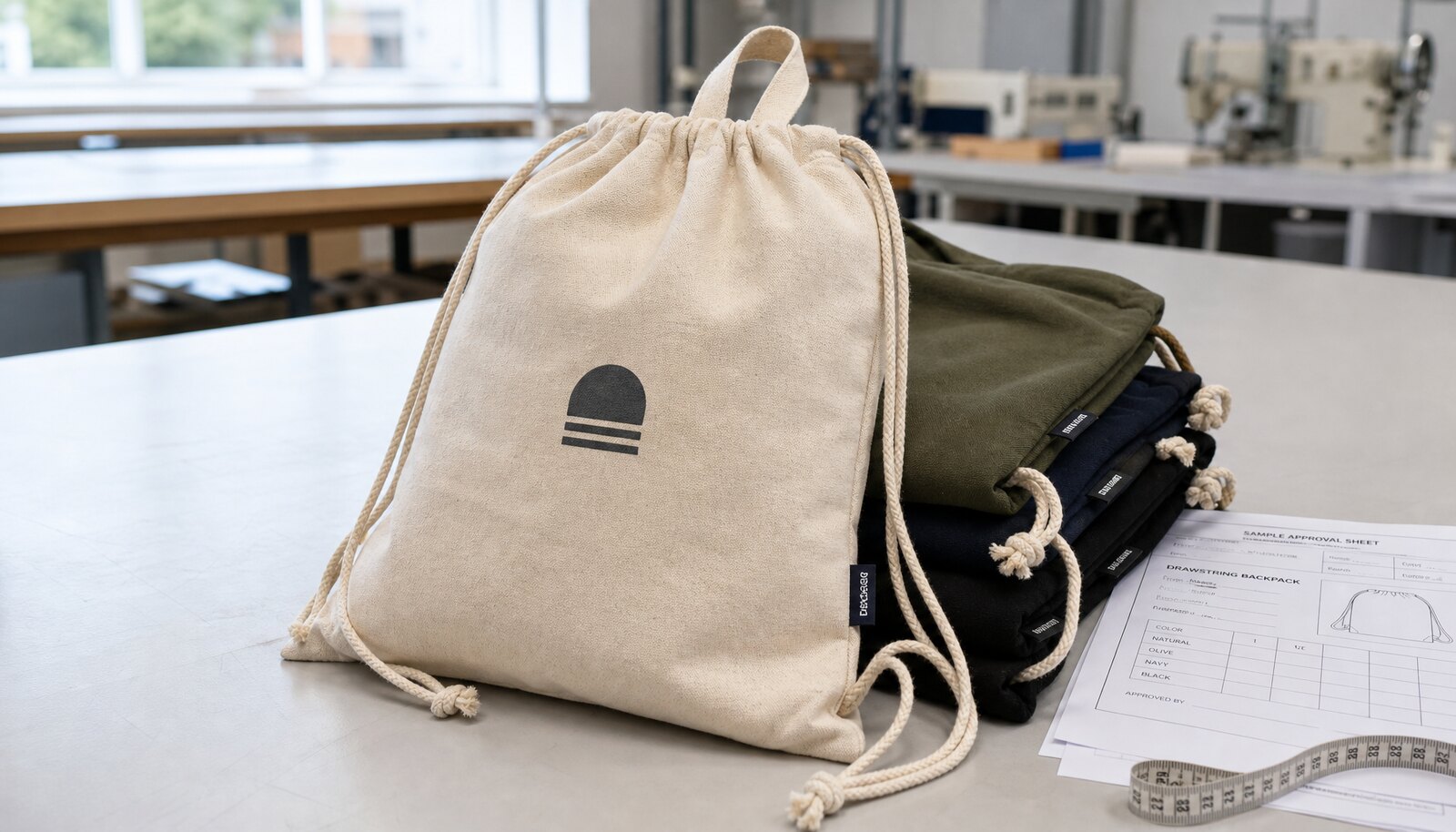
Why gift shop buyers lose margin on packing, not sewing
Custom cotton drawstring backpacks look straightforward, but the commercial failure points usually show up after the sewing line is finished. Gift shops need clean shelf presentation, predictable carton counts, and receiving that can move fast. If the packing plan is vague, the shipment arrives with crushed corners, mixed colors, missing count, or cartons that are awkward to store and unpack. That creates hidden labor costs before a single unit is sold.
For this category, the carton packing plan is part of the product spec. A useful quote should tell you the fabric weight, print method, inner packing, carton size, pack count, gross weight target, and handling marks. Without those details, you cannot compare suppliers on landed cost or see whether a low unit price is being offset by expensive freight density or repacking.
Gift shop buyers also need to think about retail behavior. These bags may be displayed folded, hung on a peg, or stacked in a backroom waiting for replenishment. A poor carton plan can turn a good product into a receiving problem: cords tangle, front panels crease, and the first store employee to open the carton has to fix what should already be sale-ready.
- A small decoration defect is usually recoverable; a mixed-carton shipment is expensive to sort.
- The cost of receiving labor, not just factory price, should be included in procurement decisions.
- Packing inefficiency can erase the savings from a lower sewing quote.
Choose fabric weight around the retail use, not around a sample swatch
For custom cotton drawstring backpacks sold into gift shops, a practical GSM band is usually 140–180 GSM, but the right point depends on the selling story and the customer’s use case. Around 140–150 GSM, the bag is lighter, easier to price aggressively, and suitable for souvenir-style programs, event gifting, and impulse retail. Around 160–180 GSM, the bag feels more substantial, hangs better on display, and typically gives a better first impression for branded retail assortments.
The best GSM is not the heaviest one the supplier can offer. A too-heavy bag increases fabric cost, makes the folded pack bulkier, and can push carton gross weight into a less convenient handling range. A too-light bag may be cheaper, but if it looks thin under store lighting or becomes semi-transparent when filled, the retail value perception drops quickly. Buyers should specify the intended use: brochure pack, small souvenir carry bag, daily carry accessory, or premium retail item.
Also ask whether the supplier is quoting finished fabric GSM or a base cloth number. Some factories quote a greige or pre-finishing weight that does not reflect the final hand feel after washing, dyeing, or finishing. If the bag will be sold in a shop where appearance matters, request a physical sample from the same fabric lot or an equivalent confirmed fabric before final approval.
- 140–150 GSM: lower cost, lighter hand feel, suitable for seasonal or souvenir programs.
- 160–180 GSM: stronger shelf presence, lower see-through risk, better for premium retail presentation.
- Confirm whether the quoted weight is finished GSM and whether fabric shrinkage is already accounted for.
Set the construction details that affect both durability and carton size
For procurement buyers, the drawstring backpack is not just a fabric pouch; it is a combination of seam construction, cord system, reinforcement points, and fold behavior. If any one of those elements is poorly defined, the supplier may optimize for sewing speed rather than retail use. The bag can look acceptable in a flat sample photo but behave badly in a carton or on the shelf.
The cord needs specific attention. Cotton rope can match the product story better, but cotton-poly blends sometimes offer smoother handling and reduced breakage risk. Either way, the cord diameter, knot stop, and stitching at the channel opening should be defined in the spec sheet. Ask how the supplier prevents pull-through. A simple knot alone may be acceptable for low-cost programs, but a bar-tack or reinforced channel gives more security when the bag is loaded repeatedly.
Edge finishing matters too. Buyers should ask whether the panel edges are overlocked, double-stitched, or bound, and whether the bottom seam is reinforced to match the intended weight load. For gift-shop use, you may not need heavy-duty school-bag construction, but you do need a bag that stays neat after handling, folding, and display rotation.
- Specify cord type, cord diameter, and end-finishing method.
- Ask for reinforcement details at the channel opening and stress points.
- Confirm how the bag folds for packing because construction affects carton count and cube.
Print method changes the quote, the appearance, and the defect profile
Screen printing is usually the best value when the logo is simple and the order is repeatable. It gives a clean retail appearance, especially for one-color and two-color artwork. The buyer should still define the exact logo size and placement, because a screen print that is too low, too small, or too close to the seam can make the bag look off-center even if the ink is technically fine.
Heat transfer can work when the art is detailed or when the design changes seasonally. It can also suit smaller runs. The tradeoff is that transfer quality depends heavily on temperature, pressure, and timing. If the factory does not control those variables well, the print may look glossy, feel overly stiff, or fail at the edge after handling. For gift shops, that can be a problem if customers touch the item before purchase.
Woven labels and sewn patches are a better fit when the brand wants a premium or durable finish and does not need full front-panel printing. They usually cost more per piece, but they can reduce the risk of ink smearing or print wear from repeated handling. Some buyers also combine a small woven label with a blank or lightly decorated bag for a cleaner retail look. The key is to decide whether brand durability, speed, or price matters most.
If you are quoting multiple suppliers, keep the print format identical across quotes. A supplier quoting screen print on one sample and heat transfer on another is not offering a true comparison. Ask for the actual decoration method, number of colors, print area in centimeters, and whether any underbase is required on dark fabric.
- Use screen print for simple logos and repeat orders.
- Use heat transfer only if the art requires it and the supplier can show stable adhesion.
- Use woven labels or patches when a premium retail look is more important than the lowest unit cost.
Build the carton packing plan before you ask for a production quote
The carton plan is where many sourcing briefs become too generic. For custom cotton drawstring backpacks, the supplier should tell you not only how the bag is sewn but how it will move through the warehouse and into the store receiving area. Start with the pack count per carton. For many medium-size cotton drawstring backpacks, 50 to 100 pcs per export carton is common, but the right count depends on finished size, fold thickness, fabric GSM, and whether the bag contains inserts or tags.
A carton that is overfilled creates compression marks, bent cords, and flattened front panels. That can make the product look used before the customer ever sees it. A carton that is underfilled wastes cubic space and can shift too much in transit. A useful carton packing spec should show: units per inner polybag, fold direction, carton inner dimensions, carton wall strength, estimated gross weight, and whether desiccant or moisture protection is used.
For gift shop buyers, receiving workflow matters. Store teams and warehouse staff need cartons that are easy to count, easy to identify, and not too heavy to lift repeatedly. Many buyers try to keep carton gross weight in a practical handling range rather than pushing every carton to the maximum. In the real world, a carton that is easy to move and open often saves more money than a marginally denser load.
If the bags are going into multiple channels, define whether all cartons are shelf-ready in the same way. Some retailers want uniform master cartons with full labeling, while others prefer inner packs that can be broken down into store-friendly units. Do not leave that choice to the factory; it affects labor cost, damage risk, and the speed of replenishment.
- Ask the supplier to propose a carton count, then challenge it against freight density and handling needs.
- Keep carton gross weight in a warehouse-friendly range rather than maximizing every box.
- Request a carton loading plan showing how the bag is folded and how many layers fit in each case.
Comparison table: sourcing and packing options for gift-shop buyers
The table below is designed to help buyers choose between realistic sourcing routes, not just compare a few unit prices. The same bag can be sourced in several ways, but the best choice depends on order size, lead time, packing discipline, and how much control you need over final appearance.
Use this table as a decision tool. If you need repeated replenishment and stable carton counts, the direct factory route usually wins. If you need very fast turn or only a short-term seasonal run, a stock-based route may be acceptable. If you want flexible communication but not full process visibility, a trading route can work—provided you audit the actual factory behind it.
- Compare the exact same fabric, print, and packing format across suppliers.
- Ask each supplier to quote the same MOQ tier so the price is meaningful.
- Do not choose on price alone if carton accuracy, lead time, or shelf presentation are important.
How to set MOQ without overbuying retail inventory
MOQ for custom cotton drawstring backpacks is usually driven by fixed setup costs: fabric cutting, print setup, sample approval, and packing labor. That is why a 1,000-piece order can look disproportionately expensive compared with 3,000 pieces. The factory is not just selling cloth and thread; it is allocating time across setup, inspection, and carton build. If your order has multiple colors, multiple logo placements, or special labels, the MOQ often rises because each variation adds handling and rejects more packing efficiency.
For gift shops, the correct MOQ is the smallest order that still gives you a stable process and a sensible replenishment path. If you buy too little, unit price rises and the factory may not prioritize your order during peak season. If you buy too much, you risk markdowns and storage cost on slow-moving colors. A better approach is to ask for a tiered quote at several quantity levels—such as 1,000, 2,000, and 3,000 pieces—so you can see where the price curve flattens and whether a larger order actually improves your landed cost enough to justify the inventory risk.
If you are launching a new retail design, keep the number of variants low. One body color, one print position, and one carton spec is much easier to manage than a range of colors, mixed labels, and different pack counts. Once sell-through data exists, you can widen the assortment or change carton strategy on the reorder.
- Request tiered pricing so you can see the real cost break between order sizes.
- Keep the first launch narrow unless you already have strong sales data.
- Separate MOQ by color if the color change affects fabric dye lots or packing efficiency.
Sample approval should test fit, logo, and packing together
A useful pre-production sample is not just a nice-looking bag; it is proof that the production system can repeat the result. Ask for the final fabric, final print method, final label, final cord, and the actual fold method that will be used in carton packing. If the sample is made from substitute materials or is hand-finished in a way that production will not repeat, you are approving the wrong thing.
Review the sample in the way the customer will experience it. Pull the cords, open and close the bag several times, check whether the front panel hangs straight, and inspect whether the logo still looks centered after folding and unpacking. Then fold the bag into the intended carton format. This is where buyers often discover that a design which looked fine on a table becomes too bulky for the agreed pack count or causes the printed area to crease in the carton.
Keep one signed reference sample and a clear photo set with measurements. That reference sample should include the approved print size, label placement, cord length, and fold direction. On repeat orders, those reference materials are often more useful than a verbal description because they reduce argument about “close enough.”
If the product is being sourced for a chain or a multi-store program, ask the supplier to confirm whether the sample will become the production benchmark. The answer should be yes. If the supplier cannot commit to that, the buyer has less control over future repeat quality.
- Approve the sample only after checking both appearance and carton fit.
- Keep a retained sample with measurements, not just photos.
- Lock artwork size in production scale, not a scaled preview file.
QC thresholds that prevent claims after arrival
QC for custom cotton drawstring backpacks should be operational, not vague. The point is to stop a bad carton before it reaches the store, not to write a checklist after the fact. Focus on defects that customers and warehouse teams will actually notice: stains, uneven seams, twisted bags, loose cords, print shift, incorrect color, and carton shortages. If a carton is short by even a few pieces per case, the shortage can add up fast across a wholesale shipment.
A practical inspection plan should separate cosmetic issues from functional issues. For example, a tiny print edge variation may be acceptable if the logo is still centered, readable, and on spec. By contrast, a stain on the front panel, a slipping cord, or a seam opening under moderate pull should be a hard reject. The supplier should know those thresholds before production starts, not after the shipment is already boxed.
Carton audits are especially important. Inspect cartons from the top, middle, and bottom of the pallet or stack to catch compression and moisture differences. Check carton marks, count per carton, mixed SKU risk, and whether the inner pack matches the approved format. If the carton label says 100 pcs but the carton only contains 96, the problem is no longer cosmetic—it is a receiving and reconciliation issue that creates claim work immediately.
For larger orders, an AQL-based inspection can be useful, but only if you define the defect classes clearly. Major defects should include wrong style, wrong logo, wrong color, missing cord, carton shortage, and visible stains. Minor defects might include small thread tails or slight fold marks, provided they do not affect retail presentation.
- Define hard rejects: stains, missing cords, wrong style, major print error, or carton shortage.
- Audit cartons from different stack positions, not just the top layer.
- Require a pre-shipment photo set of packed cartons, carton marks, and carton seal condition.
What a useful packing spec sheet should contain
A packing spec sheet is one of the most valuable documents in this category because it removes guesswork from the factory floor. If you want custom cotton drawstring backpacks packed consistently, ask the supplier to document the pack method in a single sheet that can be reviewed by purchasing, QC, and warehouse teams. That sheet should not just say “bulk packed.” It should tell the team exactly how the units are folded, counted, protected, and labeled.
At minimum, the packing spec should include finished size, fold size, units per polybag, units per carton, carton dimensions, gross and net weight targets, carton material grade, carton marks, and whether moisture protection is included. If the cartons will move through humid ports or long inland transport, ask whether an inner moisture barrier or desiccant pack is needed. If the cartons are going to a chain warehouse, ask how the cartons should be stacked and whether the receiving system requires barcode labels or style codes on two sides.
The best packing spec sheets also describe the inspection method. Who checks the count? At what stage is the carton sealed? What happens if one bag is damaged during final packing? A good supplier can answer those questions without improvising. If they cannot, the packing process is probably not standardized enough for repeat retail orders.
- Request a one-page packing spec sheet with fold method, pack count, and carton dimensions.
- Include gross-weight target, carton strength, and moisture protection requirements.
- Ask how the factory handles damaged pieces during final packing and recounts before sealing.
Specification comparison for buyers
| Sourcing option | Best-fit use case | Commercial tradeoff | What to verify before ordering |
|---|---|---|---|
| Direct factory, full in-house sewing/printing/packing | Repeat gift-shop programs where you need stable carton counts, consistent logo placement, and faster correction cycles | Usually better control and cleaner QC, but may need a higher MOQ than traders | Ask whether cutting, printing, sewing, and final packing are all in one facility; request a packing spec sheet, carton drawing, and pre-shipment photo set |
| Factory plus outsourced printing | Programs where the base bag is standard and the decoration changes by season | Can lower base sewing cost, but it adds coordination risk and can stretch lead time | Confirm who owns artwork approval, who signs off print registration, and whether outsourced printing changes the carton sequence or inspection plan |
| Trading company / sourcing agent | Small or mixed orders where you need flexible communication and multiple product options | Lower MOQ flexibility, but less visibility into where defects originate and who is responsible for fixes | Request the actual manufacturer name, factory audit summary, carton marks, and proof that the supplier controls sample retention and final inspection |
| Local stock decorator / quick-turn supplier | Fast replenishment, short seasonal windows, or urgent event programs | Fastest response, but limited customization and often weaker carton optimization | Check whether stock bags are truly cotton, whether decoration is done after stock receipt, and what carton size they ship in |
| Premium retail version with woven label or sewn patch | Museum shops, design-led gift stores, and brand-forward assortments | Higher piece price, but better shelf appearance and less wear-related complaint risk | Validate label stitch quality, label size, and whether the label affects fold size and carton count |
| Value-oriented one-color screen print | Souvenir shops, zoo stores, tourist gift programs, and impulse retail | Best unit economics if the art is simple, but print registration and ink coverage must be controlled | Approve the actual print size on a real pre-production sample and request a rub test and wash expectation if applicable |
Buyer checklist before sampling
- Lock the finished size, fabric GSM, cord type, print size, and label method before asking for a quote.
- State the carton pack count, inner packing method, carton dimensions, and maximum gross weight you will accept.
- Request a pre-production sample made from final fabric, final artwork, final cord, and final label—not a photo proof.
- Ask for the supplier’s standard tolerance on size, print shift, carton count, and carton compression.
- Confirm whether the quote includes polybags, master carton labels, desiccant, corner protection, and export marks.
- Ask for a packing spec sheet showing fold method, carton loading sequence, and whether mixed colors are allowed.
- Compare suppliers on landed cost, not just ex-factory price; include freight density and repacking risk in the math.
- Match MOQ to your sell-through plan and replenishment window instead of chasing the lowest printed price.
Factory quote questions to send
- What exact finished size, fabric GSM, and weave type are included in the quoted price? Please specify whether the GSM is finished fabric weight or greige basis weight.
- Is the backpack sewn, printed, and packed in one facility? If any step is outsourced, which step and who performs final QC?
- What is your standard carton pack count, carton size, and target gross weight for this SKU? Can you show a carton loading plan?
- How many units per inner polybag, and are units folded flat, stacked, or separated with tissue or slip sheets?
- What changes in unit price if we move from screen print to woven label, sewn patch, or heat transfer?
- What is your tolerance for print placement, size variation, cord length, and seam alignment on bulk production?
- Can you share a pre-production sample approval flow with sign-off points for artwork, material, and packing format?
- What lead time applies after sample approval, and what commonly extends production during peak season?
- Which costs are excluded from the quote: sample shipping, plates/screens, setup fees, polybags, hangtags, carton labels, and inspection?
- Can you provide carton mark examples, pallet pattern if used, and the minimum information printed on each export carton?
Quality-control points to confirm
- Fabric matches the approved GSM and appearance: no visibly thin spots, slubs outside the acceptable range, or inconsistent shade between panels.
- Cut panels are square and symmetric; the bag opens and closes without twisting when both cords are pulled evenly.
- Seams are straight and secure; seam allowance is consistent, and there is no skipped stitch, puckering, or loose thread bundle at stress points.
- Cord ends are secured with proper knots or end finishing; the cord does not slip under a reasonable hand-pull check.
- Bar-tack reinforcement at cord channels and stress points holds without fraying, tearing, or stitch breakout.
- Logo placement matches the approved reference sample; no major shift, smearing, cracked print, or weak ink coverage on dark or textured fabric.
- If a woven label or patch is used, it sits flat, is centered as approved, and has no curling edges or stitch gaps.
- Finished size stays within the agreed tolerance so the bag folds correctly and fits the planned carton pack format.
- Carton count matches the packing list exactly; no mixed styles, mixed colors, or missing pieces unless pre-approved in writing.
- Cartons are clean, dry, fully sealed, and marked with style, color, quantity, carton number, and destination code; overpacked cartons are rejected if they show panel creasing or strap damage.