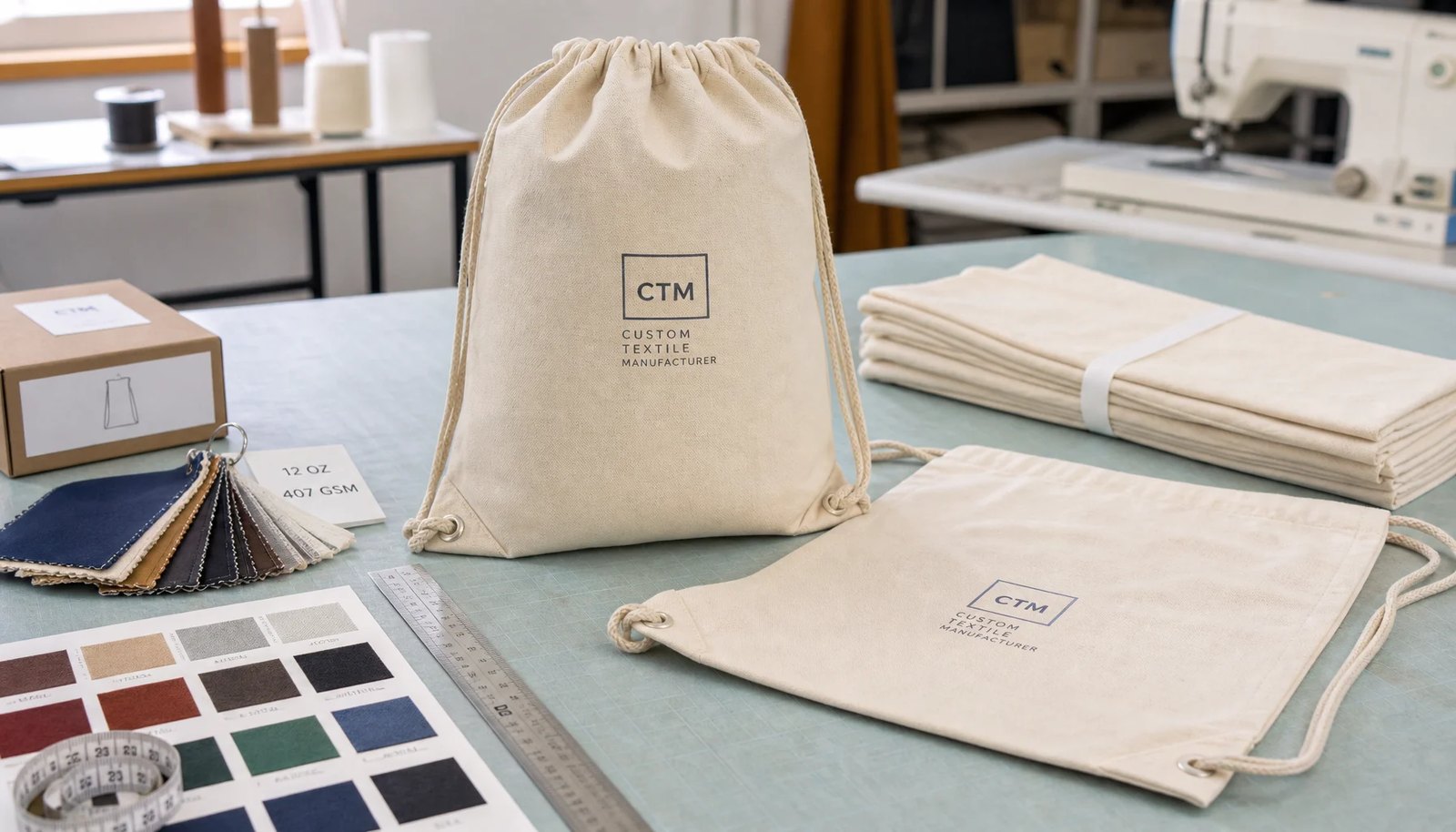
Start with the campus use case, not the cheapest unit price
A cotton drawstring backpack looks like a simple product until a bookstore starts using one order to serve six campus groups. Orientation wants volume. Admissions wants a polished welcome-kit piece. Alumni relations may care about gift value. A department may need its own logo and SKU. The retail team needs something that can sit beside apparel, drinkware, and notebooks without looking disposable. Those are not the same purchase, even if the base shape is identical.
The strongest bulk pricing plan starts with a short buying brief. Define who receives the bag, what it must carry, whether it will be sold or given away, and how it will move through campus receiving. A giveaway that holds a flyer, lanyard, and T-shirt can use a lighter construction than a paid bookstore item. A course-material kit may need a larger opening and stronger lower corners. A donor gift may justify a heavier canvas feel and cleaner packing.
This early sorting also helps internal buyers have a clearer cost conversation. Instead of asking every stakeholder to accept one vague specification, the bookstore can present tiers. Student affairs can choose a value cotton option. Retail can choose a balanced fabric with barcode labels. Alumni programs can price a premium version. The result is still a coordinated custom cotton drawstring backpacks bulk pricing plan for university bookstores, but it is built around real use rather than a single blended number.
- Orientation giveaway: keep artwork simple, packing efficient, and load expectations light.
- Bookstore retail: require cleaner stitching, barcode accuracy, consistent shade, and stronger appearance standards.
- Admissions or alumni gift: focus on hand feel, approved color, reliable delivery, and gift-ready presentation.
- Department resale: separate artwork versions, SKUs, carton marks, and setup charges before placing the order.
- Course-material kit: confirm finished size, usable opening, and load test against the actual contents.
Choose cotton GSM with the job in mind
Fabric GSM is one of the first cost drivers to control. GSM means grams per square meter, and in cotton drawstring backpacks it affects hand feel, opacity, print appearance, sewing behavior, carton weight, and freight. A 140-160 GSM cotton bag can work well for high-volume giveaways when the expected contents are light: brochures, coupons, a lanyard, a small shirt, or event materials. It should not be described as a book bag unless the sample passes the intended load test.
For bookstore retail, admissions kits, and alumni programs, many buyers move into the 180-220 GSM range. The bag feels more substantial, the fabric is usually less transparent, and the print surface can look cleaner. It also costs more. A 230 GSM or heavier canvas option can make sense for premium merchandise or donor gifts, but the buyer should price the full impact: thicker seams, more sewing effort, slower handling in production, higher gross weight, and possibly fewer pieces per carton.
Cotton type also matters. Natural cotton is popular for campus programs with a simple, low-dye look, but it needs clear acceptance rules for seed specks, slubs, shade bands, oil spots, and yarn contamination. Dyed cotton supports school colors but adds lab dips, shade approval, and time. Organic or recycled-content claims should be treated as document-based claims, not assumed from the word cotton.
- 140-160 GSM: best for light-use giveaways and cost-sensitive event distribution.
- 180-220 GSM: better for bookstore retail, admissions kits, and gifts where hand feel matters.
- 230 GSM and above: suitable for premium canvas-style programs with higher freight tolerance.
- Natural cotton: define acceptable specks, slubs, shade variation, and contamination before production.
- Dyed cotton: request lab dips, bulk shade approval, and a physical standard for inspection.
- GSM control: state target GSM and tolerance, such as +/- 5%, and confirm when the fabric is measured.
Lock finished dimensions and load requirements
Drawstring backpack size should be quoted as finished size after sewing. Cutting panels lose usable area through side seams, bottom seams, drawcord-channel folding, pressing, and trimming. A quote that says 14 x 18 inches or 35 x 45 cm is not complete unless it states whether those are finished dimensions and where the inspector should measure. The usable opening matters too. A bag can look large on a flat table and still be awkward to fill if the drawcord channel is tight.
Soft cotton bags need practical tolerances. A buyer might use +/- 1 cm for smaller bags or +/- 2% for larger sizes, but the number should be agreed with the supplier before sampling. Print placement needs the same discipline. If the logo must sit centered below the channel, the RFQ should define reference points and a realistic tolerance, often in the +/- 5 mm to +/- 10 mm range depending on print method and factory control.
Load should be written down, not implied. If the bag will only carry event papers, say so. If students may put in a hoodie, bottle, folders, tablet sleeve, or occasional books, test the sample with that load. A cotton drawstring backpack can be useful and attractive, but it needs the right fabric, cord, corner reinforcement, and seam quality for the job it is expected to do.
- Quote finished width and height after sewing, not flat cutting dimensions.
- Define measuring points for width, height, drawcord channel depth, and usable opening.
- Use practical tolerances such as +/- 1 cm or +/- 2% after supplier confirmation.
- Write the expected load in kilograms or pounds instead of using durable as a substitute.
- Test the sample with real contents such as folders, a shirt, bottle, hoodie, or tablet sleeve.
- Confirm drawcord length so the bag opens fully and fits the intended user group comfortably.
Build MOQ and price breaks around variants
The lowest bulk price usually assumes one fabric color, one artwork, one print method, one print position, one packing method, and one destination. University bookstore orders rarely stay that simple. A single order may include the bookstore logo, orientation artwork, alumni weekend graphics, residence hall versions, department marks, and event-specific designs. If the RFQ only shows total quantity, the supplier may quote an efficient single run and then add charges once the version list appears.
MOQ should be discussed by variant. Five thousand pieces with one logo and one color are very different from five thousand pieces split into ten logos of five hundred. Each version can require setup, screen preparation, ink mixing, print-table cleaning, drying space, packing separation, carton labels, and extra checking. Each fabric color can affect fabric purchasing, dye lot control, cutting efficiency, and leftover material risk.
Use a version matrix before asking for final pricing. It should show bag color, artwork file, print method, print color, quantity, SKU, barcode need, packing method, destination, and required date. If departments are still collecting commitments, ask the supplier for a base price plus surcharge lines. That gives the bookstore a clean way to explain why another low-volume logo or another packing split changes the landed cost.
- Ask for MOQ for one fabric color and one artwork before adding complexity.
- Quote price breaks at the same specification, such as 1,000, 3,000, 5,000, and 10,000 pieces.
- Separate charges for extra logos, print colors, bag colors, retail labels, and special packing.
- Spread setup charges across the real quantity for each artwork version.
- Use a version matrix to prevent mixed cartons, wrong labels, and late cost disputes.
- Confirm whether low-volume versions can share one blank cutting run and separate later at print or packing.
Control artwork, licensing, and decoration details
Screen printing is often the most predictable choice for bulk custom cotton drawstring backpacks with solid university marks, bookstore names, event graphics, or one-color mascot artwork. It is straightforward to quote and inspect, but it still needs tight instructions. The RFQ should include print size, print position, ink color, Pantone target, number of colors, number of print positions, screen or setup charges, and version-change charges.
Heat transfer and digital printing can be useful when artwork has gradients, full-color designs, or many small department versions sharing one blank bag. They solve some setup problems but introduce others. Transfers can show edge lift, press marks, cracking after folding, or a heavier hand feel. Digital color can shift with the fabric shade and absorbency. A digital mockup is not enough for final approval; buyers should see the print on the actual fabric or a clearly approved equivalent.
University marks often need licensing approval, and that timing belongs in the production calendar. The factory should receive final vector artwork, color references, placement instructions, and any restrictions from the licensing office. If the print is applied before sewing, the supplier must control panel orientation and seam allowance so the logo lands correctly after assembly. The approved sample should show actual artwork scale and placement on the finished bag size.
- Provide vector artwork when possible and keep file names aligned with the version matrix.
- Define print area in inches or centimeters and state whether one or both panels are decorated.
- Set placement reference points, such as centered on panel and measured from top edge or side seam.
- Agree on placement tolerance, often +/- 5 mm to +/- 10 mm depending on artwork sensitivity.
- Approve ink color through Pantone reference, ink drawdown, printed strike-off, or physical sample.
- For transfers, test edge lift, fold cracking, press marks, hand feel, and color on the chosen cotton.
Compare quotes line by line
Bulk pricing only works when every supplier is quoting the same thing. One quote may include screen setup, barcode labels, and export carton marks. Another may cover only the undecorated bag. One supplier may quote FOB, another domestic delivered, and another may exclude sample courier charges or inland freight. The lowest unit price can disappear once decoration, packing, inspection, freight, and receiving corrections are added.
A useful quote sheet separates the base bag, decoration, sampling, packing, inspection, and logistics. The base bag line should show fabric GSM, finished dimensions, fabric color, cotton type, drawcord material, drawcord diameter, seam construction, and lower-corner reinforcement. The decoration line should show print method, number of colors, print size, print positions, setup charges, screen charges, and version charges. Packing should be just as visible: bulk pack, individual polybag, paper band, hangtag, barcode label, inner carton, master carton, and carton marks.
Ask for carton data at the quote stage. Cotton drawstring backpacks are not fragile, but freight cost still depends on carton cube and gross weight. Heavier GSM, individual packing, paper bands, hangtags, or inner cartons can reduce pieces per carton and increase CBM. If the bookstore is comparing an overseas factory quote with a domestic delivered option, carton size, gross weight, net weight, and pieces per carton are essential for landed-cost comparison.
- Base bag: finished size, GSM, fabric type, color, cord material, cord diameter, seams, and reinforcement.
- Decoration: print method, print size, color count, position count, setup fees, and version charges.
- Sampling: development sample, pre-production sample, revision fee, courier fee, and refund terms if any.
- Packing: bulk pack, individual pack, paper band, hangtag, barcode, inner carton, master carton, and carton label.
- Inspection: in-line check, final inspection, third-party window, defect classification, and rework terms.
- Logistics: Incoterm, pieces per carton, carton size, gross weight, net weight, estimated CBM, and exclusions.
Use samples to freeze the real product
Sample approval should not be treated as a photo opportunity. A mockup can show approximate logo placement, but it cannot prove fabric thickness, hand feel, opacity, drawcord slide, seam strength, print adhesion, or retail packing. For a bookstore program, the physical sample is where the buyer learns whether the bag fits the intended contents and feels right for the audience.
A practical sampling path includes an artwork proof, a development sample, and a pre-production sample. The artwork proof confirms layout, logo scale, print color direction, and placement before materials are consumed. The development sample helps evaluate construction, but it may use available fabric or stock cord if bulk materials are not ready. The pre-production sample should represent production intent: final or bulk-equivalent fabric, target GSM, final drawcord, final thread color, final reinforcement, final print ink or transfer, final packing, and carton label format.
When schedule pressure forces approval of a reference sample, the approval notes must say which details are binding. A sample may approve finished size and construction but not bulk shade. It may approve logo placement but not final ink color. Clear sample notes prevent a familiar dispute: the factory follows the physical sample, while the buyer expected the written spec to override it.
- Measure sample width, height, channel depth, and opening after sewing and record the numbers.
- Check fabric opacity and hand feel against the intended giveaway, retail, or gift tier.
- Load the sample with intended contents and inspect seams, channel, and lower corners after handling.
- Open and close the drawcord repeatedly to check friction, slipping, and wearer comfort.
- Fold the printed panel as packed and check ink cracking, transfer edge lift, and ink transfer.
- Approve packing samples when units will be scanned, shelved, gifted, or sorted by receiving teams.
Write QC standards inspectors can actually measure
Instructions like clean print, good stitching, or strong enough leave too much room for interpretation. Factory inspectors and third-party teams need measurable standards for fabric GSM, finished size, shade, stitch quality, drawcord length, print placement, print defects, packing count, barcode readability, and carton labels. Attach those standards to the purchase order or approved specification sheet before production begins.
The highest functional risks usually sit at the drawcord channel, side seams, bottom seam, and lower corners. If the cord is too thin, the fabric is too light, or the corner construction is weak, the cord can pull through the fabric under load. For bookstore retail items, the appearance bar should be higher than for one-day giveaways because customers will compare the backpack with licensed apparel and accessories.
Defect classification should be plain. Critical defects may include wrong logo, unsafe sharp hardware, metal contamination, mildew, or a construction issue that makes normal use unsafe. Major defects may include open seams, severe stains, wrong color, unreadable barcode, badly misplaced print, missing drawcord, or mixed artwork in cartons. Minor defects may include slight loose threads, small approved slubs, or minor shade variation within the agreed range. Whether the buyer uses an AQL-style plan or another sampling method, pass and fail rules must match the program risk.
- Fabric checks: GSM, shade, holes, stains, odor, slubs, specks, contamination, and roll variation.
- Measurement checks: finished width, height, channel depth, opening, drawcord length, and tolerance.
- Sewing checks: stitch density, skipped stitches, open seams, puckering, bartacks, loose threads, and reinforcement.
- Functional checks: drawcord pull, opening and closing cycles, lower-corner stress, and handling with the intended load.
- Print checks: color, placement, registration, coverage, bleeding, pinholes, smears, fold resistance, and transfer edge lift.
- Packing checks: count, SKU, artwork version, barcode scan, carton mark, destination, gross weight, and carton sequence.
Plan packing for receiving, retail, and sustainability
Packing can change cost, labor, freight cube, receiving accuracy, sustainability profile, and shelf presentation. For a campus event giveaway, bulk packing by carton may be enough. For paid bookstore retail, the same backpack may need an individual polybag, paper band, hangtag, barcode label, inner carton, or shelf-ready grouping. Each option should be quoted separately so the buyer can see both product cost and operational cost.
Receiving accuracy becomes important when several departments, logos, or destinations share one purchase order. Mixed cartons can turn a simple delivery into hours of manual sorting. They also raise the chance that the wrong department receives the wrong logo. Carton marks should match the bookstore receiving workflow, not just the factory’s packing list. For multi-campus systems, labels should identify destination clearly so one store does not receive overstock while another waits for missing cartons.
Sustainability preferences should be specified, not assumed. Some bookstores want to reduce individual plastic and choose paper bands or bulk packing. Others need individual protection because products pass through a distribution center, sit on shelves, or are handled by customers before purchase. The best packing choice depends on how the backpack travels from factory carton to end user.
- Bulk pack: lowest material and labor cost, suitable for event distribution and internal programs.
- Individual polybag: protects from dust and handling but increases plastic use, labor, and carton cube.
- Paper band: lower-plastic retail presentation with less protection during shipping and repeated handling.
- Hangtag or barcode label: important for POS scanning, inventory control, price changes, and receiving.
- Inner carton or divider: useful when multiple logos, SKUs, or departments share one master shipment.
- Carton mark: include PO number, SKU, artwork version, fabric color, quantity, carton number, gross weight, and destination.
Protect campus dates with a backward calendar
Bookstore programs often revolve around dates that will not move. Orientation, admissions days, move-in week, homecoming, alumni weekend, and semester launches are fixed on the campus calendar. Buyers should not plan only around sewing time. A realistic schedule includes RFQ clarification, artwork cleanup, licensing approval, proofing, sample production, sample courier, sample review, revisions, fabric booking, dyeing if needed, printing, drying, sewing, trimming, inspection, packing, export handling, freight, customs, domestic delivery, receiving, and campus allocation.
Schedule risk grows when the order includes custom dyed fabric, many artwork versions, multi-color printing, heat transfers, retail labels, paper bands, individual packing, or several destinations. Those choices may be worthwhile, but together they reduce flexibility. If the required date is close, simplify the specification rather than assuming every step can compress. Natural cotton may be faster than dyed cotton. One-color screen print may be safer than full-color decoration. Bulk pack may be faster than retail-ready packing. For emergency replenishment, domestic blanks with local decoration may be more realistic.
A backward calendar is the safest tool. Start with the date the backpacks must be in the bookstore or event staging area. Work backward through campus receiving, domestic transit, customs, international freight, export cutoff, final inspection, packing, production, pre-production approval, and sample review. Add decision deadlines for the bookstore, licensing office, campus department, and supplier. Many delays come from late artwork changes or slow approvals, not just factory capacity.
- Artwork phase: include file cleanup, licensing review, Pantone confirmation, proof approval, and version signoff.
- Sample phase: include sample making, courier transit, internal review, revision decision, and pre-production approval.
- Material phase: stock natural cotton can be faster; custom dyed cotton requires lab dips and bulk shade control.
- Production phase: include printing, drying, sewing, trimming, thread cleaning, packing, and carton labeling.
- Inspection phase: leave time for rework if sewing, print, packing, barcode, or label issues are found.
- Freight phase: compare ocean, air, rail, courier, or domestic production based on deadline and landed cost.
Specification comparison for buyers
| Sourcing decision | Recommended specification | Typical buying fit | Quote or QC risk to control |
|---|---|---|---|
| Use-case tiering | Quote separate tiers for giveaway, bookstore retail, alumni gift, admissions kit, department resale, and course-material kits | Best when one bookstore supports several campus programs under one purchasing cycle | One blended quantity can hide different fabric weights, artwork versions, packing needs, and inspection standards |
| Value cotton tier | 140-160 GSM cotton, simple one-color print, bulk packed by event, department, or destination | High-volume orientation, admissions, tabling, welcome-week, and light kit giveaways | Do not call it a book bag unless the construction and load test support that claim |
| Balanced retail tier | 180-220 GSM cotton, cleaner stitching, controlled print placement, barcode or hangtag option | Bookstore merchandise, alumni gifts, admissions kits, and programs needing better perceived value | Require a pre-production sample because hand feel, opacity, shrinkage, shade, and print absorption vary by fabric lot |
| Premium canvas tier | 230 GSM or heavier cotton canvas with stronger drawcord channel and reinforced lower corners | Premium alumni, donor, or retail programs where durability and hand feel matter more than lowest unit price | Higher fabric weight can increase sewing time, carton gross weight, carton cube, drying time, and freight cost |
| Finished size control | State finished size after sewing with a practical tolerance such as +/- 1 cm or +/- 2% by dimension | Any program where the bag must fit a folder, T-shirt bundle, hoodie, tablet sleeve, bottle, or welcome kit | Cutting size is not finished size; channel folding and seam allowance reduce usable dimensions |
| Direct factory route | Use when the buyer, licensing office, distributor, or bookstore team can approve specs, samples, inspection, and shipment terms | Planned orders, repeat programs, and buyers needing transparent fabric, decoration, packing, and carton cost inputs | Confirm the supplier controls cutting, sewing, print coordination, packing, and final inspection rather than forwarding workshop photos only |
| Importer or domestic decorator route | Use when local billing, small replenishment, domestic inventory, or urgent delivery matters more than full custom control | Rush events, smaller orders, stock blank reorders, or programs that cannot manage overseas documentation | Unit price may exclude decoration, repacking, inland freight, barcode work, and margin layers; confirm cotton GSM and print area match the RFQ |
| One-color screen print | Specify print size, ink color, Pantone target, placement reference points, and number of print positions | Most bookstore logos, school names, event graphics, and solid mascot art at bulk quantities | Control setup charges, ink drawdown approval, registration for multi-color marks, and placement tolerance such as +/- 5 mm to +/- 10 mm |
| Heat transfer or digital print | Use for gradients, full-color art, short version runs, or many department graphics sharing one blank bag | Useful when departments share one backpack spec but require different artwork files | Test transfer edge lift, press marks, fold cracking, hand feel, and color shift on natural or dyed cotton |
Buyer checklist before sampling
- Define the program type before quoting: orientation giveaway, paid bookstore retail, alumni gift, admissions kit, department resale, course-material kit, or replenishment item.
- List the intended contents and maximum expected load, such as brochures only, T-shirt plus bottle, hoodie, tablet sleeve, folders, or occasional books.
- Specify finished bag dimensions after sewing, not cutting size; include measuring points for width, height, channel depth, and usable opening.
- Set practical dimension tolerance, commonly +/- 1 cm for small soft cotton bags or +/- 2% for larger sizes, unless the supplier proposes a tighter workable range.
- Choose fabric weight by use: 140-160 GSM for light giveaways, 180-220 GSM for balanced retail or gifts, and 230 GSM or heavier canvas for premium programs.
- Define GSM tolerance in writing, such as target GSM with +/- 5% or another agreed range confirmed by bulk fabric test reports or in-line weighing.
- Identify cotton type and finishing: natural, bleached, dyed, washed, organic, recycled blend, or conventional cotton; do not assume certifications unless documents are provided.
- Specify fabric color by approved swatch, lab dip, or Pantone target; for natural cotton, define acceptable seed specks, slubs, shade bands, and contamination limits.
- Confirm drawcord material, diameter, finished length, color, end treatment, and whether the cord is cotton rope, polyester cord, recycled cord, or blended cord.
- Lock lower-corner construction: sewn-in cord, reinforced fabric tab, metal eyelet, bartack, folded seam, or other method matching the approved sample.
Factory quote questions to send
- What finished backpack size is included in the quote, and what tolerance can you hold after sewing and drawcord-channel folding?
- What cotton GSM options are available for this construction, and is the quoted GSM measured before dyeing, after finishing, or from finished bulk fabric?
- What GSM tolerance do you use for production control, and can bulk fabric be checked by cut-and-weigh method before full cutting starts?
- Is the fabric natural, bleached, dyed, washed, organic, recycled blend, or conventional cotton, and which claims can be supported with documents?
- For dyed cotton, can you provide lab dips and define the acceptable shade range for bulk production against the approved dip or swatch?
- For natural cotton, how do you control seed specks, slubs, oil spots, yarn contamination, and shade variation between rolls?
- What is the MOQ for one fabric color with one artwork, and how does MOQ change by extra bag color, logo version, print color, or packing style?
- Can you quote the same specification at 1,000, 3,000, 5,000, and 10,000 pieces, plus setup and surcharge lines for each extra artwork version?
- Which drawcord is included: cotton rope, polyester cord, recycled cord, or blended cord, and what diameter and finished length will be used?
- How are the lower corners reinforced, and can you describe the bartack, fabric tab, folded seam, eyelet, or sewn-in cord construction?
Quality-control points to confirm
- Fabric GSM should be verified on bulk fabric by a cut-and-weigh method or agreed supplier test record before full cutting; record the target GSM and tolerance, such as +/- 5% if accepted.
- Finished size should be measured after sewing and channel folding, using agreed points for width, height, channel depth, and opening; soft cotton bags need written practical tolerance rather than rigid molded-product limits.
- Fabric shade should be compared with the approved swatch or lab dip under consistent lighting; natural cotton should have separate acceptance rules for seed specks, slubs, shade variation, and contamination.
- Fabric defects should be checked for holes, stains, oil marks, yarn contamination, heavy slubs outside the approved range, odor, mildew, and uneven finishing.
- Seams at the side, bottom, and drawcord channel should show consistent stitch density, no skipped stitches, no open seams, no broken threads, no severe puckering, and trimmed loose threads.
- Lower-corner reinforcement should match the approved sample exactly, including bartack, eyelet, fabric tab, folded seam, or sewn-in cord method.
- Drawcord length, diameter, color, and material should be measured because short cords reduce wearability and thin cords can cut into the fabric under load.
- Functional testing should use the buyer's intended load, such as a written 2 kg, 3 kg, or 5 kg handling test, rather than a vague strong-enough instruction.
- Print position should be measured from defined reference points, with a written tolerance such as +/- 5 mm or +/- 10 mm depending on artwork and production method.
- Print defects should reject visible misalignment, pinholes, smears, excessive bleeding, poor coverage, wrong color, ghosting, transfer edge lift, cracking after folding, and ink transfer where applicable.