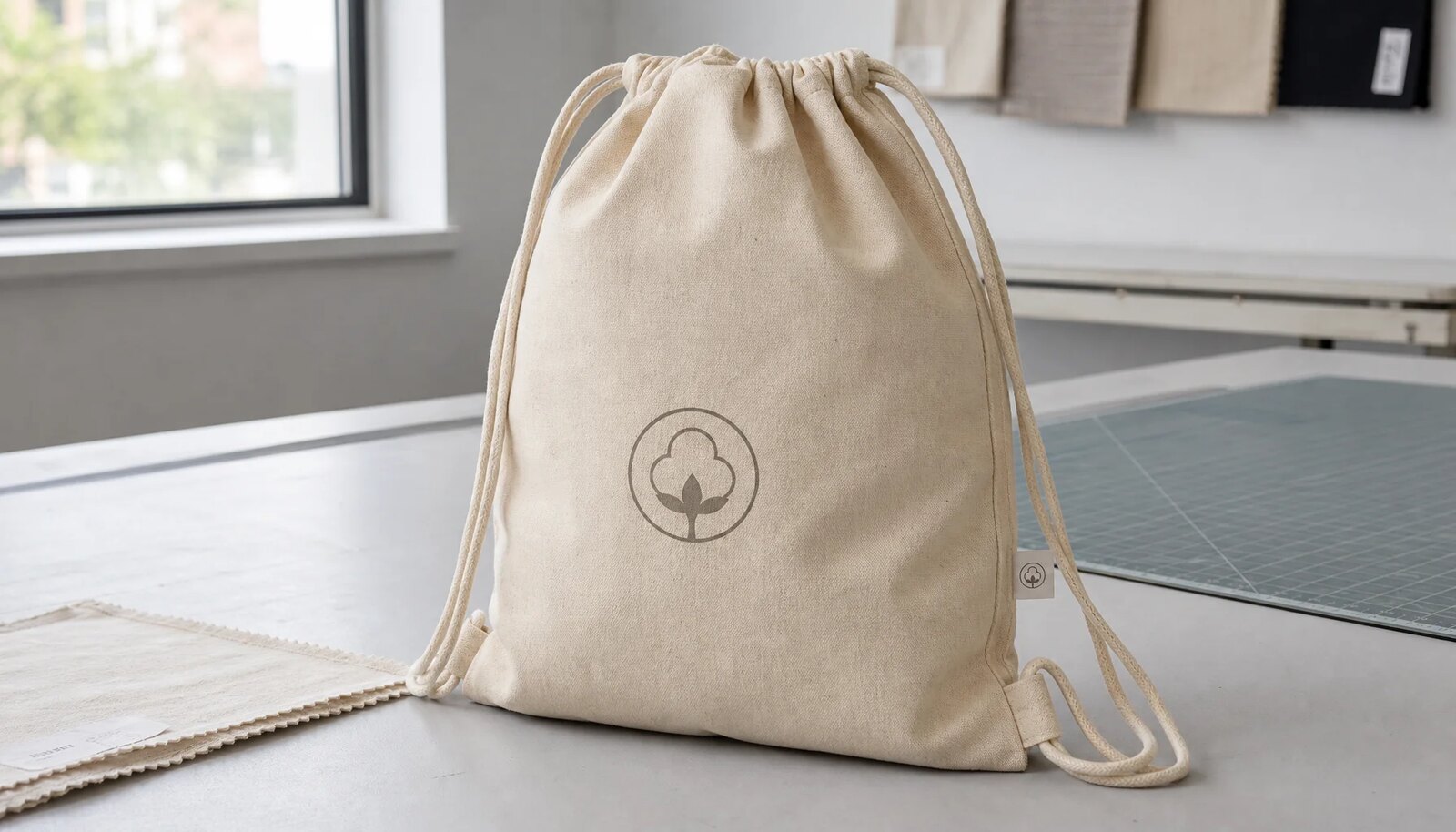
Start with the buying job, not the cheapest bag
A custom cotton drawstring backpack can play several roles for an eco apparel brand. It might be a simple event giveaway, a retail accessory, a gift-with-purchase, a reusable apparel packing bag, a staff kit, or part of a seasonal launch. Those are not the same product in procurement terms. A giveaway bag can lean toward fast production, a lighter cotton, and one clean print. A resale accessory needs stronger construction, better shade control, neater finishing, and packaging that protects the item before it reaches the customer.
The first step in a custom cotton drawstring backpacks bulk pricing plan for eco apparel brands is to define what the order must protect. Procurement may be protecting margin. Marketing may be protecting brand presentation. Logistics may be protecting receiving accuracy and carton flow. If the purpose is vague, suppliers fill in the blanks. One factory may quote a 140 GSM plain cotton flat bag with bulk packing. Another may quote 180 GSM twill, cotton rope, a woven side label, barcode stickers, and separated cartons. Both quotes can be reasonable, but they are not comparable.
A good RFQ should name the buying job before the technical details. A bag used to hold folded T-shirts for direct-to-consumer fulfillment needs predictable opening width, clean folding, and carton consistency. A retail add-on needs better handfeel, tidy stitch lines, and controlled logo placement. An event bag needs deadline confidence and decoration that is unlikely to fail at scale. This context helps the supplier quote the correct bag instead of reaching for the lowest default construction.
- Identify the use case: resale, bundle packaging, event merchandise, gift-with-purchase, staff kit, or warehouse accessory.
- Define the priority: lowest unit cost, retail appearance, repeatability, delivery date, sustainability documentation, or packing accuracy.
- Do not compare supplier prices until size, fabric, decoration, label, packing, and quote terms are normalized.
- Make procurement, design, QA, and logistics approve one shared written specification before supplier comparison.
Turn the base spec into buying language
A reliable quote begins with measurable specifications. For cotton drawstring backpacks, the minimum RFQ should include finished width and height, usable opening width, optional gusset, fabric composition, fabric weight, weave, color, drawcord type, decoration method, label requirements, packing format, and target quantity. Without these details, suppliers usually quote their standard version. That can work for a quick promotional order, but it creates price movement when the buyer later asks for heavier fabric, a larger print, a woven label, or carton-level separation.
Small construction details affect cost more than they appear to. A flat bag is usually cheaper than a gusseted bag because it uses less fabric and simpler sewing. A reinforced top tunnel adds sewing time, but it helps the cord slide and reduces tearing. A woven side label may be small, yet it adds label sourcing, placement control, and another sewing operation. A folded bottom can be economical; a separate bottom panel can add structure and cost. The buyer should put these choices in writing so they are priced openly instead of discovered after sampling.
Use numbers wherever possible. Replace vague phrases such as heavy cotton, large logo, strong cord, or premium stitching with production language. A clearer line would be: 160-180 GSM cotton twill, natural color, finished size 38 x 45 cm, usable opening width at least 34 cm, one-color screen print 220 mm wide, front center, print position tolerance plus or minus 10 mm, cotton rope cord 6 mm diameter. The same language later becomes a QC reference.
- Size: finished width, height, opening width, optional gusset, bottom construction, and expected loading use.
- Material: cotton composition, weave, GSM or ounce weight, fabric color, cord material, label material, and accessory exclusions.
- Decoration: method, print colors, print locations, artwork file type, Pantone references, print size, and placement tolerance.
- Packing: inner bundle quantity, master carton quantity, SKU separation, carton marks, barcode rules, polybag policy, and hangtag needs.
Choose cotton weight and claim with care
Fabric is the most visible quality signal on a cotton drawstring backpack. For many commercial programs, 140-180 GSM is the practical range. A 140-160 GSM fabric can suit cost-sensitive giveaways, light apparel packaging, and event merchandise. A 160-180 GSM twill or light canvas usually gives better opacity, handfeel, and print stability for retail-facing programs. Heavier cotton can create a more substantial product, but it also increases material cost, carton weight, closure stiffness, and sometimes sewing difficulty around the top tunnel.
The weave matters as much as the GSM. Plain weave cotton can be economical and soft, but if the weave is loose, it may shift during cutting, printing, or sewing. Cotton twill tends to feel denser and can make a simple drawstring style look more finished. Light canvas gives structure, yet it can feel too rigid if the bag is small or the cord tunnel is narrow. Two fabrics with the same GSM can behave differently because of yarn count, finishing, shrink control, and dye process, so buyers should approve a real swatch before relying on a supplier description.
Eco apparel brands also need discipline around material claims. Cotton is not automatically organic, recycled, undyed, low-impact, or certified. If the brand intends to make a sustainability claim, the RFQ should state the exact material requirement and ask what order-specific documentation is available. Certification, chain-of-custody, recycled content, and organic claims may affect MOQ, cost, and lead time. If the purchase is conventional cotton, the brand should avoid implying a certified claim in product copy or hangtags.
- 140-160 GSM: lower unit cost and lighter freight profile; suitable for giveaways, event bags, and light packaging.
- 160-180 GSM: stronger balance for repeat apparel programs, private-label merchandise, and retail-adjacent use.
- 180-220 GSM: sturdier handfeel; check closure function, carton weight, print handfeel, and target retail price.
- Natural or unbleached cotton should be checked for shade variation because lot-to-lot color can move.
Specify the parts that usually fail first
Drawstring backpacks tend to fail in predictable places: the top tunnel, side seams, lower corners, and cord ends. These areas should be described in the spec instead of left to factory habit. A double-fold top tunnel generally protects raw edges better than a narrow single fold. Stronger stitching at cord exit points helps reduce tearing. Lower corners need secure seams because they carry load stress when the bag contains garments, shoes, catalogs, or bottles. A simple promotional bag may not need heavy reinforcement, but the buyer should make that choice knowingly.
Cord selection affects both cost and user experience. Cotton rope gives a natural look and is common for eco-focused bags, but diameter matters. A cord that is too thin feels weak and can dig into the shoulder. A cord that is too thick may not slide well through the tunnel. Flat cotton tape can be comfortable, but it may twist if the tunnel is tight. Braided cotton cord can look clean and handle repeated pulling. The RFQ should specify diameter or width, color, length, end finish, knot style, and whether plastic tips, metal eyelets, or synthetic cords are allowed.
Size tolerance also needs attention. Soft textile goods will not measure like rigid packaging, but the buyer still needs a standard. Finished width and height tolerances of plus or minus 0.5-1.0 cm may be practical for many simple cotton bags, depending on design and factory capability. Print placement tolerance may be set separately: wide enough to reflect textile production, tight enough to protect brand appearance. Agree on these numbers before production starts, not during final inspection.
- Ask for tunnel construction: fold type, stitch line, tunnel width, raw-edge control, and reinforcement at cord exits.
- Specify cord: material, diameter or width, color, length, knot or sewn end, and acceptable length tolerance.
- Check stress areas: side seams, lower corners, top tunnel, and any point where the cord bears load.
- Write size and placement tolerances into the PO so inspection has a measurable standard.
Price decoration as its own risk center
Decoration can change the cost more than the bag body. A one-side, one-color screen print is usually the lowest-risk baseline for bulk custom cotton drawstring backpacks. It works well for bold logos, keeps setup simple, and makes supplier quotes easier to compare. When artwork adds multiple colors, tight registration, large ink coverage, fine reversed text, gradients, or front-and-back printing, both cost and defect risk increase. The buyer may still need those brand details, but they should be treated as deliberate priced decisions.
Screen printing is not the only option. Embroidery can look premium on heavier cotton, but high stitch density can pucker lightweight fabric and slow production. Woven side labels and flag labels are often useful for apparel brands because they create a retail signal without covering the bag with ink. Sewn patches add weight and texture, but they require additional material sourcing and placement control. Heat transfers can handle detailed graphics, but buyers should test handfeel, adhesion, and durability on the selected cotton fabric.
Decoration placement should be approved against the actual bag pattern. A flat artwork mockup may ignore the top tunnel, bottom fold, side seams, cord path, and safe print area. Printing too close to these zones can make the logo look warped after sewing or closure. The RFQ should state print size, print location, Pantone or color reference, artwork file format, acceptable placement tolerance, and whether a strike-off is required. For repeat orders, keep a print placement template so the second run does not drift from the approved standard.
- Baseline option: one-side, one-color screen print with bold vector artwork and moderate ink coverage.
- Retail option: small front print plus woven side label, flag label, or clean sewn patch.
- Higher-risk option: multi-color artwork, large ink coverage, fine text, gradients, or print close to seams.
- Confirm whether screen charges, Pantone matching, artwork cleanup, setup fees, and strike-offs are included or separate.
Build MOQ tiers that reveal the price curve
Bulk pricing is shaped by fixed setup costs and variable production costs. Fixed costs may include sample development, screen setup, artwork preparation, line setup, label setup, and material sourcing. Variable costs include fabric consumption, cutting, sewing, cord, labels, printing labor, packing materials, carton handling, and inspection. As order quantity increases, fixed costs spread across more units. That is why a clear pricing plan asks for volume tiers rather than a single number.
For many buyers, 500, 1,000, 3,000, and 5,000 pcs are useful comparison points. The purpose is not only to chase the lowest quote. It is to see where efficiency changes. A sharp drop from 500 to 1,000 pcs may show setup amortization. A smaller drop from 3,000 to 5,000 pcs may show that fabric, labor, and packing have already stabilized. If pricing barely changes, the supplier may have averaged the cost or excluded setup fees that will appear later. Ask the supplier to identify which charges are fixed and which are included in the unit price.
MOQ should also be reviewed by production variable. A supplier may accept 2,000 pcs total, but fabric MOQ may apply per color, screen setup per artwork, cord MOQ per color, and label MOQ per version. Four fabric colors with two artwork versions each create eight production combinations. That affects setup, inspection, carton sorting, and receiving accuracy. Procurement should ask for the effective MOQ and price per design-color combination, not just the headline order quantity.
- Quote identical specs at 500, 1,000, 3,000, and 5,000 pcs so the comparison is clean.
- Confirm MOQ per fabric color, bag style, print version, cord color, label version, and packing format.
- Separate fixed costs from unit costs to avoid hidden setup charges inside vague pricing.
- Watch for cost increases caused by too many variants, individual packing, hangtags, or complex carton sorting.
Compare supplier routes by control
The supplier route affects communication, accountability, and quality control. A direct factory can be efficient for repeat bulk orders because procurement can discuss fabric sourcing, sewing details, production capacity, and inspection standards close to the production line. Direct sourcing works best when the buyer can provide a clear RFQ and manage approvals. It is not automatically better if the buyer lacks technical detail, because unclear instructions can still lead to sample revisions and cost movement.
A trading company or sourcing partner may be useful for early-stage programs, mixed product orders, or teams that need more coordination across materials, decoration, labels, and logistics. The buyer should still confirm where cutting, sewing, printing, labeling, and packing happen. If any step is subcontracted, quality control must remain traceable. Ask who owns the production schedule, who approves inline issues, and who is financially responsible if bulk does not match the approved sample.
A local decorator or converter can work for urgent domestic orders, small runs, or blank cotton bags decorated close to the event date. This route can reduce import timing risk, but it may limit construction options and produce a higher unit cost. For eco apparel brands, the best route depends on repeat volume, launch timing, required material documentation, customization depth, and internal QA resources. The lowest unit price is not the best route if it creates unclear responsibility.
- Direct factory: best for repeat specs, volume orders, production-level QA discussion, and clearer cost visibility.
- Trading partner: useful for coordination, but confirm production site, subcontracted steps, and inspection responsibility.
- Local converter: useful for speed and small runs, but usually limited for full custom construction and lowest landed cost.
- Any route should provide a spec sheet, sample approval trail, production photos, packing list, and inspection evidence.
Use sampling to close gaps early
Sampling is the buyer’s strongest protection against disputes. A photo proof can confirm artwork direction, but it cannot prove fabric handfeel, print ink behavior, cord function, or seam strength. For cotton drawstring backpacks that will represent an apparel brand, a physical sample should be treated as a production reference, not a formality. The approved sample should show the fabric, color, construction, logo placement, label placement, cord behavior, and packing presentation expected in bulk.
Different samples answer different questions. A fabric swatch confirms texture, GSM impression, shade, and weave. A blank sewn sample confirms finished size, opening width, tunnel construction, seam quality, and loading practicality. A print strike-off confirms ink color, coverage, edge sharpness, curing, and adhesion on the actual fabric. A pre-production sample confirms the full approved build before bulk cutting, printing, and sewing. Buyers do not always need every sample for every order, but they should know which risk each sample removes.
Approval comments should be specific and written. If the print is approved but should move 10 mm lower, record that. If cord length should be 140 cm instead of the sample’s 130 cm, write it into the approval note. If natural cotton shade variation is acceptable within a defined swatch range, save the reference. Keep the approved sample and approval notes linked to the PO, because they become the standard for inspection and repeat orders.
- Approve the fabric swatch before judging final handfeel or print result.
- Use a blank sample to check size, opening width, seams, tunnel, cord pull, and load practicality.
- Use a print strike-off for Pantone-sensitive logos, large ink areas, new fabric colors, or repeat brand standards.
- Use the pre-production sample as the final reference before bulk cutting, printing, sewing, and packing begin.
Write QC around measurable defects
Quality control should focus on the defects most likely to affect customer experience: wrong branding, open seams, weak tunnels, poor cord pull, print defects, stains, odor, and mixed cartons. A cotton drawstring backpack may be simple, but it is still a textile product with functional and visual standards. If it is used for retail or apparel packaging, the end customer will judge the brand, not the supplier. Procurement should define critical, major, and minor defects before inspection.
Critical defects include wrong logo, mold, strong odor, unsafe sharp parts, unusable closure, severe size error, or product that cannot be sold or used. Major defects include open seams, broken stitches, missing labels, large stains, poor print adhesion, wrong print position, mixed variants, or carton shortages. Minor defects may include small loose threads, slight fold marks, or minor shade variation within the approved range. The defect classification should match the brand’s use case; resale programs need stricter visible-quality standards than internal utility bags.
Inspection should include both inline and final checks when possible. Inline checks can catch print placement, stitch quality, or tunnel issues before the whole lot is finished. Final random inspection should include opened cartons, unit counts, front and back views, measurement photos, seam close-ups, cord pull checks, print close-ups, label verification, barcode scans if applicable, and carton mark checks. Rework instructions should be written, photographed, and approved before shipment release.
- Measure finished width, height, opening width, cord length, print size, and print placement against the PO tolerance.
- Check seams for skipped stitches, broken threads, open seams, exposed raw edges, needle cuts, and weak reinforcement.
- Test function with repeated open-close movement and a moderate cord pull on sampled units.
- Release shipment only after inspection results, packing list, count reconciliation, and rework evidence are reviewed.
Control packing before it controls cost
Packing decisions affect unit cost, carton density, freight efficiency, warehouse labor, and retail presentation. Bulk packing in master cartons is usually the most economical option for importers and apparel brands that will handle the bags internally. It reduces material and labor costs and often improves carton density. However, it may not work if each bag needs a hangtag, barcode, insert card, paper wrap, or direct-to-consumer presentation.
Individual packing adds cost through bags, paper bands, tissue, stickers, barcode labels, extra handling, and slower packing. Some eco apparel brands want to avoid individual plastic packaging, so the RFQ should state whether polybags are allowed, prohibited, or replaced by paper-based alternatives. If the drawstring backpack will be packed together with apparel, clarify whether it ships flat, folded, rolled, or pre-loaded. Folding method can affect print creasing, carton size, and warehouse handling.
Warehouse teams need predictable carton rules. The PO should state units per inner bundle, units per master carton, carton dimensions if required, gross weight estimate, SKU separation rules, shipping mark format, barcode placement, and any retailer routing labels. Mixed cartons should be avoided unless there is a written assortment plan. A carton with unclear marks or mixed designs can create receiving errors even when the product itself is acceptable.
- Lowest-cost format: fixed inner bundles, bulk packed in master cartons with clean SKU separation.
- Retail-ready format: individual packing, barcode, hangtag, insert card, or paper band, with higher labor and material cost.
- Eco-sensitive format: confirm plastic policy, paper packaging options, recycled-content packaging, and retailer rules.
- Operational requirement: lock carton marks, carton quantity, bundle quantity, assortment rules, and packing list format before production.
Specification comparison for buyers
| Spec decision | Recommended option | When it fits | Buyer risk to check |
|---|---|---|---|
| Finished size | Common range: 33 x 42 cm to 40 x 50 cm; confirm usable opening width and flat finished dimensions | Apparel bundles, event kits, resale accessories, gift-with-purchase programs, staff merchandise, and warehouse packing bags | A larger bag increases fabric consumption and carton volume; a narrow opening can make folded apparel hard to insert |
| Fabric weight | 140-180 GSM cotton canvas, sheeting, or twill; 160-180 GSM for retail-facing or repeat programs | Eco apparel brands that need a natural handfeel, stable print surface, and controlled freight weight | Below 120 GSM can feel thin and disposable; above 200 GSM raises material cost, carton weight, closure stiffness, and sewing stress |
| Fabric construction | Plain weave for budget-sensitive runs; twill or light canvas for better drape, opacity, and structure | Useful when the bag carries folded garments, footwear, launch kits, catalogs, or branded resale merchandise | Loose weave can distort during cutting and printing; heavy canvas can pucker around the drawcord tunnel |
| Material claim | Conventional cotton unless organic, recycled, undyed, unbleached, or certified material is written into the RFQ | Brands that need a clear cost baseline before adding sustainability documentation requirements | Do not market organic, recycled, or certified claims unless the supplier can provide applicable order-specific documentation |
| Print method | One-side, one-color screen print as the baseline; add colors, locations, or specialty decoration only when brand standards require them | Best for clean brand impact, efficient sampling, stable bulk output, and supplier quote comparison | Large ink coverage, gradients, tight registration, and print near seams increase setup cost, rejects, and handfeel issues |
| Decoration placement | Front center print with a defined safe zone; optional woven side label, flag label, small sewn patch, or hangtag | Works for apparel bundles, retail accessory lines, college events, brand activations, and private-label merchandise | Artwork too close to side seams, bottom fold, or top tunnel can warp, crack, or appear off-center after sewing |
| Cord and closure | Cotton rope, braided cotton cord, or flat cotton tape; specify diameter or width, length, and end finishing | Appropriate for eco-focused brands that want a natural material story and practical daily use | Thin cords, frayed ends, uneven lengths, weak knots, or tight tunnels create functional complaints |
| Reinforcement | Double-fold top tunnel, secure side seams, and bartack or reinforced stitch points where cords pull | Needed when bags may carry apparel sets, shoes, catalogs, water bottles, or event materials | Skipping reinforcement lowers cost but can cause torn tunnels, opened seams, and early customer returns |
| MOQ strategy | Quote 500, 1,000, 3,000, and 5,000 pcs per approved design/color using identical specs | Good for brands testing a seasonal line, retail add-on, influencer kit, or packaging accessory | Multiple colorways, artwork versions, labels, and packing formats can raise the effective MOQ beyond the headline order size |
Buyer checklist before sampling
- Define the business role of the bag: retail resale item, apparel bundle packaging, event merchandise, gift-with-purchase, staff kit, or warehouse packing accessory.
- Set the target finished size, usable opening width, optional gusset, bottom construction, expected load weight, and whether the bag must fit folded garments, boxed products, footwear, or catalogs.
- Specify fabric composition, weave, GSM or ounce weight, color standard, shrinkage expectation, shade tolerance, and whether the cotton is conventional, organic, recycled, undyed, unbleached, or certified.
- Confirm drawcord type, diameter or width, length, end finish, knot style, tunnel width, reinforcement method, and whether metal eyelets, plastic tips, or synthetic parts are excluded.
- Send vector artwork with Pantone references, print size, print position, safe zone, number of colors, number of locations, and whether screen charges, artwork cleanup, or setup fees are included.
- Ask for price tiers at 500, 1,000, 3,000, and 5,000 pcs using the same size, GSM, artwork, cord, label, packing, and Incoterm assumptions.
- Separate bag body cost from decoration, labels, hangtags, individual packing, carton packing, sample fees, setup charges, compliance documents, inspection, inland delivery, and freight terms.
- Check MOQ per bag color, fabric color, artwork version, label version, cord color, packing format, and carton assortment so the true production split is visible.
- Approve fabric swatch, blank sample if needed, print strike-off for color-sensitive logos, and one physical pre-production sample before bulk fabric cutting starts.
- Record tolerances for finished width and height, print placement, print color, cord length, seam strength, shade variation, carton quantity, barcode accuracy, and carton marking.
Factory quote questions to send
- What exact fabric composition, weave, GSM or ounce weight, yarn construction if available, finishing process, and color are included in this price?
- Is the cotton conventional, organic, recycled, undyed, unbleached, or dyed, and what order-specific documentation can be supplied for any sustainability claim?
- What finished size, opening width, gusset, bottom construction, and size tolerance are you quoting?
- What cord material, cord diameter or width, cord length tolerance, tunnel width, reinforcement stitch, and cord-end finishing are included?
- Does the quoted price include one print location, one print color, screen setup, Pantone matching, artwork proofing, and a print strike-off, or are these separate charges?
- What MOQ applies per total order, per bag color, per fabric color, per cord color, per artwork version, per label version, and per packing format?
- Please quote the same specification at 500, 1,000, 3,000, and 5,000 pcs and identify fixed setup costs versus variable unit costs.
- Which costs are excluded: sample fee, screen fee, label setup, barcode application, individual packing, inspection, export carton, domestic trucking, bank charges, or freight?
- What sample types are available: fabric swatch, blank sample, print strike-off, sales sample, size set, and pre-production sample?
- When does bulk lead time start: deposit date, artwork approval, fabric approval, accessory approval, or signed pre-production sample approval?
Quality-control points to confirm
- Fabric weight should match the approved GSM or ounce range and show no obvious thin spots, heavy slubs, shade streaks, oil marks, stains, holes, dampness, mildew risk, or uneven weave across the inspected lot.
- Finished bag dimensions should stay within the written tolerance for width, height, opening width, gusset if used, bottom shape, and drawcord length; many standard soft goods programs use plus or minus 0.5-1.0 cm, but the PO should state the exact requirement.
- Side seams, bottom seams, top tunnel seams, and reinforcement points should be straight and secure, with no open seams, skipped stitches, broken stitches, exposed raw edges, needle cuts, or excessive loose threads.
- Drawcords should pull smoothly, close the bag evenly, and show no fraying, sharp knots, weak ends, cord-length mismatch beyond tolerance, tunnel puckering, or snagging inside the top channel.
- Print should match the approved artwork size, Pantone or color reference, placement, registration standard, and ink coverage, with no cracking, bleeding, smearing, ghosting, pinholes, excessive ink buildup, poor curing, or off-center placement.
- Labels, patches, hangtags, care labels, barcodes, and stickers should match the PO version and approved sample, with no missing, upside-down, wrong-size, wrong-language, or mixed branding.
- Finished bags should be checked for odor, dampness, mildew, dirt, sharp residues, needle damage, heavy fold marks, loose lint, and surface defects that would make the product unsuitable for retail or apparel packaging use.
- Functional checks should include a moderate cord pull, repeated open-close movement on sampled units, visual stress check at tunnel exits, and review of lower corner seams where load stress concentrates.
- Carton packing should match the packing list, with correct unit counts, correct color and design separation, fixed inner bundle quantity, clear carton marks, and no mixed variants unless a written assortment plan is approved.
- Inspection photos should include fabric close-ups, front and back views, seam close-ups, cord and tunnel details, print close-ups, measured size photos, label placement, barcode scans if required, carton marks, and opened-carton count checks.