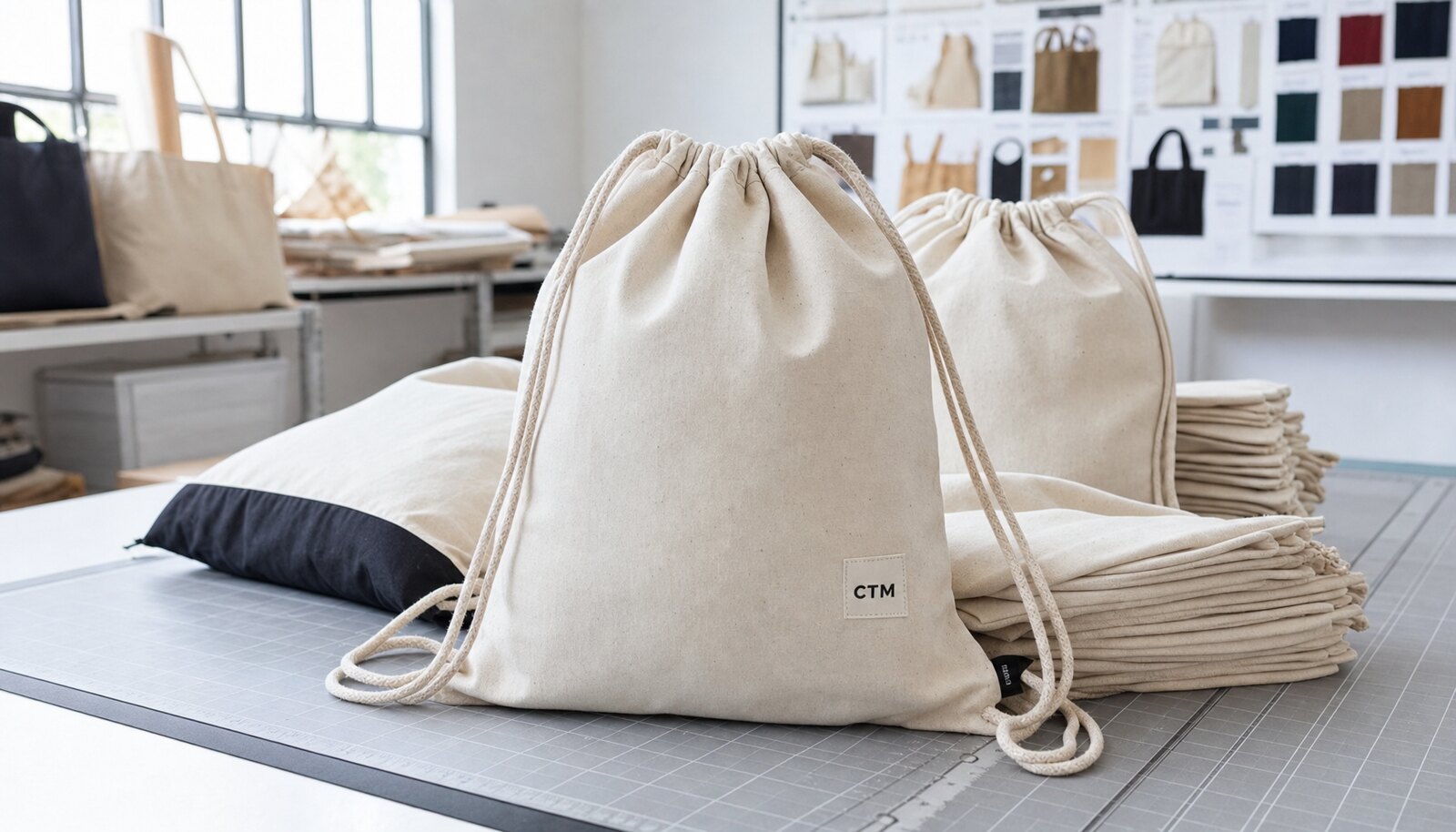
Start With Retail Math, Not Factory Math
Custom cotton drawstring backpacks for gift shops are not bought like commodity promo bags. They sit on a shelf, compete with other impulse items, and have to leave enough margin for display, markdowns, and retailer handling. A low ex-works quote can still be a poor buy if packing, freight, labels, and duties push the landed cost too close to the shelf price. In practice, buyers usually need landed cost to stay well below one-third of the expected shelf tag, and lower than that if the item will be sold through wholesale or distribution.
The right way to source this product is to define the retail role first. Is it a souvenir add-on, a museum store item, a children’s accessory, or a branded giveaway with a higher perceived value? That answer determines whether a lightweight promotional cloth is acceptable or whether the bag needs a heavier, cleaner finish. Once the channel is clear, you can build a spec that the factory can reproduce and the store can actually sell without rework.
- A bag that looks too thin on a shelf can lose the sale even if the print is good.
- When the landed cost creeps too close to shelf price, there is no room left for display, shrink, or markdowns.
- If the bag is meant to be a retail item, presentation is part of the product, not an optional extra.
What Buyers Are Actually Paying
For planning purposes, buyers often see the following broad bands for custom cotton drawstring backpacks. At 500 pieces with a simple one-color print and basic packing, a factory-direct ex-works quote may land roughly around 0.95 to 1.80 USD per unit. At 1,000 to 3,000 pieces, the same style is more often in the 0.60 to 1.25 USD range if the spec stays simple. Larger repeat runs can fall lower, but only when the fabric, print, and packing are tightly standardized. These are planning bands, not promises, but they are useful for spotting quotes that are too cheap to be complete.
Landed cost usually adds another layer on top of the factory quote. Freight, duties, local receiving, and any retail prep can add 0.20 to 0.75 USD per bag depending on carton density, lane, and packing format. If one supplier is more than about 15 to 20 percent below the cluster of other bids, check whether they are excluding labels, using thinner cloth, or assuming a different packing count. Very often the cheapest quote is simply missing a line item that you will pay for later.
- Use the price band to test whether a quote is realistic before you waste time on samples.
- A quote that is far below the market should trigger a scope check, not immediate approval.
- For gift shop programs, the right comparison is landed margin, not factory price alone.
The Specs That Move Cost Fastest
Fabric weight is one of the biggest levers. A 110 to 120 gsm cotton body is usually seen as promo grade, while 140 to 180 gsm feels more retail-ready and less see-through. Moving up in gsm usually raises unit cost, but it can also support a higher shelf price and fewer quality complaints. The decision is not just about durability; it changes how the bag feels in hand, how the print sits on the cloth, and how the product reads on a display hook.
Size, cord construction, and print complexity also move the quote. Bigger bags consume more cloth and increase carton volume. A simple one-color screen print is usually the most economical choice for destination art, museum logos, and tourist graphics. A second color adds setup and registration risk, and heat transfer or digital approaches can work for complex art but often change the durability profile. Small details like metal aglets, custom labels, and individual polybags can add more cost than buyers expect when the order is scaled across thousands of units.
- Use 140 to 180 gsm when the bag has to feel like a retail item, not a throwaway giveaway.
- Keep artwork simple if the order needs to stay price-competitive at smaller quantities.
- Treat labels, hangtags, and polybags as cost items, not packaging afterthoughts.
Match The Supplier Route To The Order Size
Direct factory sourcing is usually the best fit when the program is repetitive, the artwork is stable, and the buyer wants tight control over sewing, print, and packing. That route often gives the cleanest first-order structure because the people quoting the bag are the people controlling the line. A trading company can still make sense when the order includes multiple products, mixed materials, or several factories, but the buyer should expect a markup for coordination and a little more work to verify who is actually making the bags. Local decorators are useful for very small runs, but once you need custom packing or a real wholesale quantity, they usually become expensive fast.
Geography matters too. Mainland China is often strong on sample speed, print coordination, and carton discipline. India and Pakistan can be very competitive on cotton body cost and soft-goods capacity, especially on larger runs, but buyers should check packing accuracy, documentation, and consistency line by line. Vietnam is less common for this exact product unless the supplier already has drawstring-bag capacity in place. The point is not that one country is always better; it is that the route and the factory type affect lead time, communication load, and how much of the process you have to police yourself.
- Use direct factory quotes when the order is repeatable and the spec is locked.
- Use a trading company when you need multiple items in one shipment or a single source for mixed programs.
- Do not assume the lowest quote comes from a factory with the same production setup as the next bid.
Write The RFQ So Quotes Are Comparable
A usable RFQ for custom cotton drawstring backpacks should look like a build sheet, not a marketing brief. Include finished size, target gsm, weave type, cord length, print area, print colors, label location, and packing format. Attach one annotated sketch and one final artwork file so every supplier prices the same product. If the buyer only sends a logo and a rough dimension, each factory will fill in the missing details differently, and the resulting quotes will not be comparable in any meaningful way.
Ask for line items wherever possible. Separate the bag body, print, label sewing, packing, sample fees, and any setup charges. This is especially important for reorders, because setup fees often disappear from the first comparison and then show up later as a surprise. A supplier that refuses to break out the big cost drivers is not automatically wrong, but you should then compare on total first-order cost, not on the advertised unit price.
- Attach both front and back views, even if the back is blank.
- State the required incoterm and the destination port or warehouse.
- Ask suppliers to confirm whether the quote assumes one sample round or multiple sample revisions.
Use The Sample As A Production Gate
For this product, the pre-production sample is the point where retail risk gets reduced, not a formality to tick off. The sample should use the actual cloth, cord, print method, and label construction that will run in bulk. A hand-made mockup or a reference photo is not enough. If the supplier cannot produce a near-final sample, then they are asking you to approve a result that may change once the order is in motion. That is where expensive surprises usually start.
The approval checklist should be practical and tied to shelf presentation. Measure the finished size, check cord length, verify print placement, inspect stitch lines, and look at how the bag folds and hangs. The buyer should also decide whether the approved sample is the visual standard for shade, print depth, and label position. Once that sample is sealed, bulk production can be measured against it rather than against memory or a screenshot.
- Approve one sealed sample as the reference for the entire order.
- Reject samples that look acceptable in a photo but miss the actual handfeel or fold.
- If the order has retail labels or barcode stickers, make sure those are on the sample too.
Compliance Depends On Who Will Use The Bag
Compliance requirements are easier to manage when the buyer separates adult retail from children’s retail. For a general gift shop program aimed at adults, the usual focus is on fiber content labeling, country-of-origin marking, and any market-specific documentation. If the bag will be sold to children, the standard becomes stricter: the buyer should ask about drawstring safety, lead content, small-parts risk, and the testing regime required by the destination market. In the U.S., that can mean CPSIA-related checks for children’s products; in the EU, the ask often includes REACH restrictions and azo dye considerations.
The best time to discuss compliance is before pricing, not after a sample has already been approved. Ask the supplier which documents they can actually provide and whether they have experience producing for the destination market. If the cloth is bleached, heavily dyed, or printed with specialty inks, ask for the material declarations and any testing the factory already has on file. That way, compliance does not become a late-stage blocker after you have already committed to the order.
- Separate adult gift retail from children’s use early, because the test burden changes.
- Ask for market-specific declarations instead of a generic promise that the product is compliant.
- Do not assume a textile quote includes compliance testing unless it is written into the scope.
Packing And Freight Can Erase A Cheap Unit Price
Soft goods look easy to ship, but packing changes the economics quickly. A flat-packed bag with a simple carton count is efficient. Add individual polybags, barcode stickers, hangtags, and strict color sorting, and the labor starts climbing. That is why some suppliers with slightly higher unit prices still produce a better landed result: the receiving process is cleaner, the cartons are more stable, and the buyer spends less time reworking inventory when it arrives.
Freight should be modeled by carton volume as well as by weight. A softer fold can improve carton density and reduce the number of cartons you pay to move. A sample landed-cost illustration helps show the effect: if the ex-works bag is 0.88 USD, printing adds 0.18 USD, packing and label work add 0.12 USD, and freight plus duty plus local handling add 0.28 USD, the landed cost is already around 1.46 USD before domestic distribution. On a low-ticket gift shop item, that difference can decide whether the product earns its shelf space.
- Ask for carton dimensions and pack count before you compare freight.
- If the product is going to retail shelves, packing accuracy is part of the margin equation.
- A cleaner fold and tighter carton plan can matter as much as a small price concession.
Compare Quotes With A Simple Decision Filter
When the bids arrive, compare them against one frozen scope. Same fabric weight, same size, same print count, same label location, same packing, same incoterm. If even one of those changes, the price comparison is distorted. A quote that looks cheap because it assumes no labels or a lower gsm is not a better price; it is a different product. That sounds obvious, but it is the most common mistake buyers make when they are trying to move quickly.
A useful decision filter is to check three things in order: first, whether the factory understood the spec; second, whether the price sits inside the expected market band; and third, whether the lead time is believable. If a supplier is unusually cheap but vague about who is doing the work, or unusually fast without a clear material plan, treat that as risk rather than efficiency. The cleanest commercial offer is the one that can be reproduced without constant follow-up.
- Compare only like-for-like offers with the same incoterm and packing scope.
- Treat a quote that sits far below the cluster as a scope problem until proven otherwise.
- If the lead time looks aggressive, ask what materials are already in stock and what still has to be sourced.
A Practical Buying Sequence For A Gift Shop Launch
The easiest way to keep this category under control is to buy it in a fixed sequence. First, decide the shelf price and the gross margin you need. Second, choose one base spec that fits the channel instead of trying to cover every use case at once. Third, send the same RFQ to a small group of suppliers and insist on the same assumptions across all of them. Fourth, approve a sample that uses the real materials. Fifth, place the bulk order only after the packing and inspection plan is confirmed. That sequence keeps the buying process from turning into a series of unrelated price checks.
For a seasonal or destination-retail program, this sequence also reduces launch risk. Gift shop assortments are often time-sensitive, so the late-stage problems are usually not dramatic defects; they are small delays that turn into missed selling weeks. A reliable supplier can still lose the order if the buyer did not freeze artwork, carton counts, or compliance documents early enough. The safest program is the one where the quote, sample, and QC plan all describe the same bag.
- Lock the shelf price and target margin before comparing suppliers.
- Choose one core spec first, then add color or label variations only if the economics still work.
- Do not release bulk production until sample approval, packing scope, and inspection timing are all written down.
Specification comparison for buyers
| Spec decision | Planning range | Lead-time or cost effect | Buyer risk to check |
|---|---|---|---|
| Sourcing route | Direct export factory with cut, sew, print, and packing under one roof | Usually the cleanest path for repeat orders; production often runs 25 to 40 days after sample approval, plus freight | Confirm who actually makes each component and whether any step is subcontracted |
| Fabric weight | 110 to 120 gsm for promo grade; 140 to 180 gsm for retail-ready cotton | Heavier cloth usually adds a visible premium, but it improves handfeel and reduces complaints about thinness or print show-through | Check shrinkage, weave consistency, and whether the bag still folds and hangs the way your channel needs |
| Print method | 1-color screen print for most gift-shop art; 2-color max for simple retail programs | Each extra color adds setup time, registration risk, and often a higher minimum run | Ask for print tolerance, rub resistance, and whether the quote still holds if artwork changes |
| MOQ strategy | 500 to 3,000 pcs per design is the common planning band for custom retail runs | Lower quantities usually carry a higher unit price; splitting one design across too many colors pushes cost up fast | Confirm the MOQ by color and by artwork, not only by total order size |
| Packing format | Flat packed or retail-folded with simple carton labeling | Individual polybags, hangtags, and barcode stickers can add meaningful labor on soft-goods programs | Make sure packing is included in the quote or priced separately and transparently |
| Supplier type | Factory direct for repeatable bulk; trading company for mixed programs; local decorator for very small runs | The right route can change both lead time and first-order cost by a noticeable margin | Do not compare a factory-direct price with a bundled trading-company quote unless the scope is identical |
| QC gate | Pre-production sample plus inline and final inspection | Adds time upfront, but it is cheaper than correcting a whole lot after sewing and packing | Never approve from a render only; lock the actual materials and packaging before bulk cutting starts |
Buyer checklist before sampling
- Set a target shelf price and target landed cost before asking for quotes; if landed cost is above about 25 to 30 percent of shelf price, margin gets tight quickly.
- Lock the finished size, fabric weight in gsm, cord length, and print area on a tech pack or annotated sketch.
- State whether the supplier must include printing, labels, packing, carton marks, and barcode stickers in the unit price.
- Ask for a quote on the exact same incoterm from every supplier so freight and export handling do not hide in the comparison.
- Request the MOQ by design and by color, not just a total order number.
- Require a pre-production sample made from the actual body fabric, actual cord, and the final print method.
- Confirm carton pack count, carton dimensions, and whether the order ships flat, folded, polybagged, or retail-ready.
- Ask for the documents your market needs, such as fiber content labeling, country-of-origin marking, and any required compliance declarations.
Factory quote questions to send
- What exact fabric weight, weave, and shrinkage allowance are included in the quote?
- Is the unit price based on factory-direct ex-works terms, and what handling items are excluded?
- Does the quote include print setup, screens, label sewing, packing, and carton marks, or are those separate lines?
- What is the MOQ per design and per color, and how does pricing change if we split the run across multiple colors?
- Which print method is being assumed, and what changes if the artwork moves from one color to two colors?
- Who is actually cutting, printing, sewing, and packing the bags if part of the work is subcontracted?
- What is the normal production lead time after sample approval, and what material items could delay it?
- Can you confirm carton size, pack count, gross weight, and any spare allowance for defects?
Quality-control points to confirm
- Finished bag size matches the approved spec within the agreed tolerance, typically around plus or minus 1 cm for soft goods.
- Print placement is centered and aligned to the approved artwork, with no obvious smearing, pinholes, or registration drift.
- Fabric weight and handfeel match the approved sample, with no thin spots, loose weave areas, or unexpected stiffness.
- Top seam, side seams, and cord tunnel survive a pull check without skipped stitches, puckering, or seam opening.
- Cord ends are finished consistently and do not fray excessively after repeated tugging.
- Labels, hangtags, and care markings sit in the agreed position and do not interfere with the retail artwork.
- Carton counts match the packing list, and random carton opens confirm the color mix and quantity are correct.
- After packing, a few random pieces are checked again for rub marks, dust, fold damage, or mix-ups before dispatch.