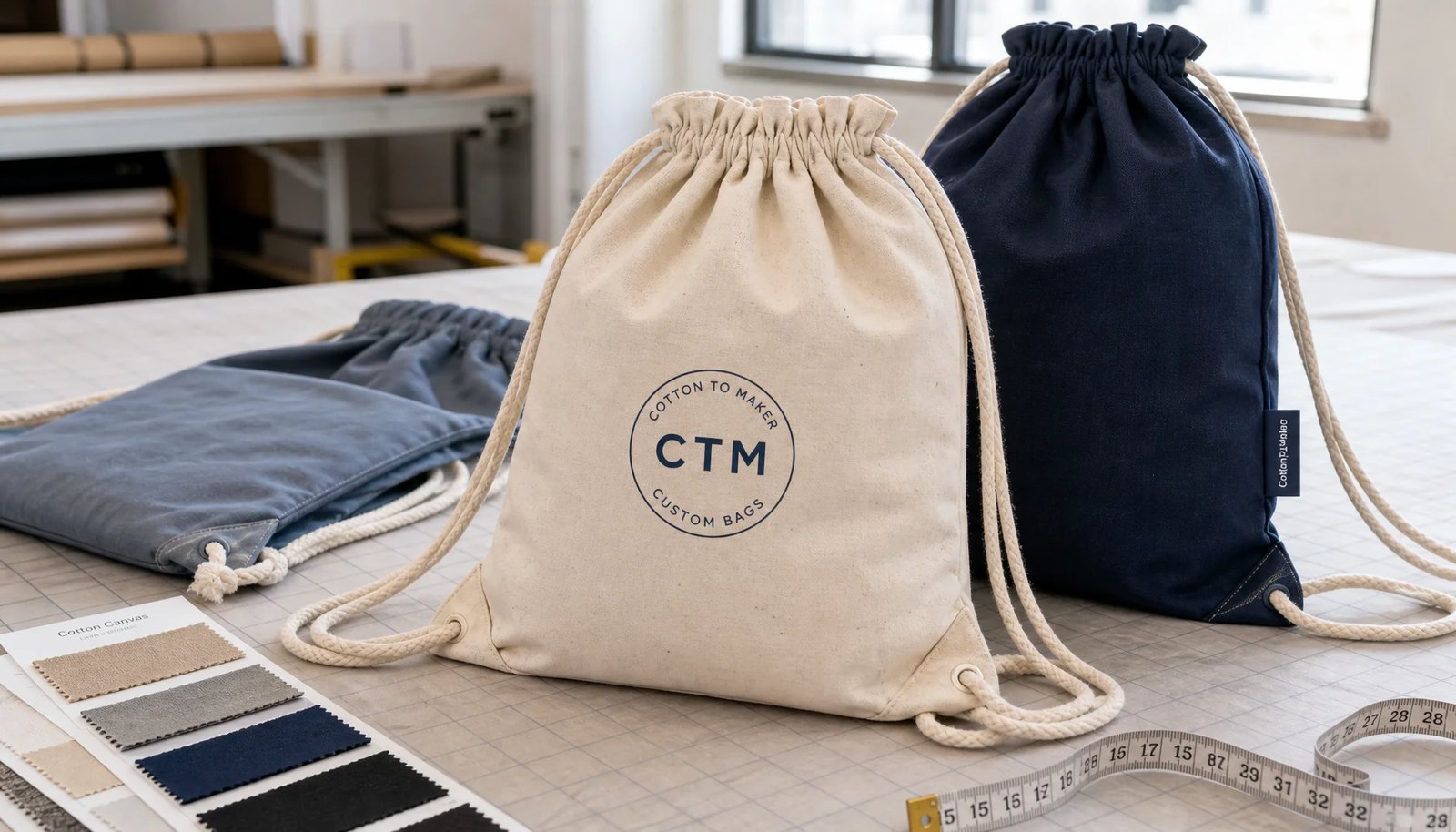
Start With The Event Load, Not The Lowest Unit Price
A custom cotton drawstring backpack for a trade show is usually judged twice: once by the buyer comparing quotes, and once by the attendee carrying it around a hall for several hours. The cheapest version can look acceptable flat on a table, then fail when it holds a catalog, water bottle, charger, sample pack, and badge wallet. Before discussing bulk pricing, define what the backpack must carry and how long it must remain presentable.
For most exhibitor programs, the buying problem is not only finding a low unit price. It is building a price plan that connects quantity, fabric weight, print choice, packing, and delivery risk. A quote for 1,000 pieces in 5 oz natural cotton with one-color print is not comparable to a quote for 1,000 pieces in 8 oz dyed canvas with custom cotton rope and individual packing. The RFQ should force suppliers to price the same product at each quantity tier, then show optional upgrades separately.
- Light paper inserts and vouchers can work with 5 oz to 6 oz cotton.
- Catalogs, bottled drinks, boxed samples, or apparel bundles usually need 6 oz with reinforcement or 8 oz canvas.
- If booth staff will reuse the backpack after the event, upgrade fabric and cord before adding decorative extras.
- When freight is tight, avoid oversized bags that increase carton volume without improving the attendee experience.
Build Quantity Tiers That Explain The Price Drop
Bulk pricing for cotton drawstring backpacks normally improves when the factory can buy fabric efficiently, reduce cutting waste, run printing continuously, and pack cartons in a stable rhythm. The price break is rarely a straight line. A jump from 500 to 1,000 pieces may spread print setup and sampling cost. A jump from 1,000 to 2,500 pieces may improve fabric purchasing. A jump to 5,000 pieces may justify better dyeing or cord procurement terms.
Procurement teams should request a tiered plan using the exact same specification. Do not let one supplier quote 500 pieces with stock natural fabric and 5,000 pieces with a thinner substituted fabric unless the change is clearly marked. If the specification changes at each tier, the unit price becomes a sales number rather than a planning tool.
- Quote tiers: 500, 1,000, 2,500, and 5,000 pieces are useful for many exhibitor programs.
- Keep body size, GSM, color, print area, drawcord, and packing identical across tiers.
- List setup charges separately so finance can calculate true cost per usable bag.
- Request a second column showing optional savings, such as natural cotton instead of dyed fabric or bulk packing instead of individual polybags.
Choose Cotton Weight By Function And Freight Impact
Cotton drawstring backpacks are often specified by ounces per square yard, while some buyers use GSM. A practical reference is 5 oz at roughly 170 GSM, 6 oz at roughly 200 GSM, and 8 oz at roughly 270 GSM, depending on weave and finishing. GSM alone does not describe strength; yarn count, weave density, seam construction, and fabric finish also matter. Still, fabric weight is one of the biggest cost and performance drivers.
For trade show exhibitors, 6 oz cotton is often the balanced starting point because it gives better body than very light promotional cotton while still controlling price and shipping volume. 8 oz cotton canvas feels more durable and supports a premium brand position, but it adds material cost and carton weight. Heavier fabric can be worthwhile for retail buyers, distributor sample kits, and campaigns where the bag will be reused after the show.
- 5 oz cotton: suitable for very light giveaways, short event use, and strict budget programs.
- 6 oz cotton: common for general trade show drawstring backpacks carrying leaflets and small samples.
- 8 oz cotton canvas: better for premium exhibitor kits, employee event packs, and retail promotional bundles.
- 10 oz and above: consider only when the backpack must carry heavier goods and freight cost is acceptable.
Size, Cord, And Reinforcement Affect Real Usability
A common drawstring backpack size is around 34 x 42 cm, but exhibitors should not copy that size blindly. If the bag must hold A4 literature, a folded T-shirt, and a small sample box, internal space and opening width matter. If the body is too narrow, the attendee bends catalogs. If it is too tall, the bottom sags and the logo may sit awkwardly when worn.
Cord selection is another quote trap. Thin polyester cord may reduce cost but can clash with a natural cotton brand story and feel uncomfortable under weight. Cotton rope, flat cotton cord, or thicker braided cord improves perceived quality. The cord channel and bottom corners need clean stitching because those points take repeated pull force when the backpack is opened, closed, and worn.
- Specify finished size after sewing, not only cut panel size.
- Define cord material, diameter or width, color, and whether the cord must pass through metal eyelets or sewn channels.
- Use reinforced bottom corners when the filled test weight is above a light brochure load.
- Keep the front print area away from heavy seam distortion and drawcord folds.
Match Print Method To Artwork And Cotton Surface
Screen printing is usually the strongest choice for solid exhibitor logos, event marks, sponsor names, and simple brand graphics. It gives good opacity, predictable cost at bulk quantities, and a clean commercial look on cotton. The buyer should provide vector artwork, Pantone references, print size, and placement. The factory should confirm whether the quoted price includes one side or two sides, one color or multiple colors, and the maximum print area.
Full-color artwork requires more caution. DTF, heat transfer, or digital print can handle gradients and photographic effects, but the hand feel and wash resistance need physical approval. On textured cotton, very small text can break up, and on dyed cotton, low-opacity ink may shift color. A trade show deadline is a bad place to discover that legal text is unreadable or a sponsor logo looks dull.
- Use screen print for bold 1-color to 3-color logos and predictable bulk runs.
- Use transfer or DTF only after checking edge feel, cracking resistance, and color on the actual fabric.
- Avoid tiny text below a practical readable size, especially on coarse canvas.
- Confirm print curing and packing time so fresh ink is not stacked too early.
Read The Quote Like A Cost Engineer
A useful factory quote separates the pieces that drive cost. The unit price should not hide sample charges, screen setup, custom dyeing, packing materials, carton marks, inland trucking, or export handling. For an exhibitor program, these extras can decide whether the apparent low supplier is actually cheaper after all usable costs are included.
A good bulk pricing plan also shows what changes move the price. Natural cotton normally costs less and moves faster than custom dyed cotton. One-color screen print is usually more economical than multi-color transfer. Bulk master carton packing is cheaper than individual polybags. A slightly smaller size may improve fabric yield. These changes should be presented as controlled options, not quiet substitutions.
- Product cost: fabric, cutting, sewing, cord, reinforcement, and trims.
- Branding cost: screen setup, ink mixing, print labor, transfer film, or digital print time.
- Packing cost: individual bag, paper band, carton, silica gel if required, and carton label.
- Logistics cost: carton CBM, gross weight, export carton strength, local delivery, and freight method.
MOQ Logic For Cotton Backpacks
MOQ is not only a supplier preference. It comes from fabric availability, dyeing minimums, printing setup, labor scheduling, and trim purchasing. A natural cotton backpack in a standard size can often start at a lower MOQ because fabric is easier to source. A custom dyed body, matched cotton cord, multiple artwork versions, or special packing plan may raise the minimum because each variation creates setup and handling work.
For trade show exhibitors, SKU discipline is important. Five colorways at 500 pieces each are more complex than one color at 2,500 pieces. Three sponsor logos in small quantities can make print setup inefficient. If the buying team needs several versions, group them by fabric color and print method, then show the factory the total program quantity and per-version quantity.
- Lower MOQ is more realistic with natural cotton, stock size, and one-color print.
- Dyed fabric may need minimum fabric yardage before cutting can start.
- Each print version may carry its own setup and approval process.
- Custom cord color, woven label, or retail packing can increase MOQ even when the bag body is simple.
Sample Approval Must Lock The Production Standard
A digital proof is useful for layout, but it does not prove fabric hand feel, print opacity, cord strength, or sewing quality. For an event order, the pre-production sample should represent the approved bulk construction as closely as possible. The sample should use the correct cotton weight, correct body size, correct cord, correct print method, and correct logo placement. If a substitute sample is used only to save time, mark every difference in writing.
Approval should include measurable points. A buyer can say the logo is centered, but production needs a tolerance from top edge and side seam. A buyer can approve fabric color, but bulk dyeing needs a reference swatch and acceptable shade range. A signed sample, clear photos, and an approval sheet reduce arguments later when the goods are already packed.
- Measure finished width and height flat, after sewing and pressing.
- Record fabric weight, color reference, drawcord type, and reinforcement details.
- Measure print size and placement from fixed edges in millimeters.
- Test opening and closing several times to catch tight cord channels before bulk production.
Packing Choices Can Save Or Waste Budget
Packing is often treated as an afterthought, but it affects cost, sustainability claims, warehouse handling, and event setup. Individual polybags keep bags clean and easy to distribute, but they add material cost and waste. Bulk packing reduces cost and volume, but the goods must still be protected from moisture, dust, and carton damage. Paper bands or belly bands can work when the presentation matters and the buyer accepts the extra labor.
For distributors and retail buyers, carton discipline matters. Mixed colors or mixed logo versions should be clearly labeled, or the booth team may spend hours sorting product on site. Cartons should be strong enough for export handling, and carton marks should match the PO and event delivery plan. If the bags are going directly to a convention warehouse, labels may need destination, booth number, advance warehouse date, or receiving code.
- Confirm pieces per carton and whether colors or artwork versions are mixed.
- Request carton dimensions, gross weight, net weight, and total CBM before booking freight.
- Use individual packing only when cleanliness, kit assembly, or distribution control justifies it.
- Define carton marks early if goods ship to an event warehouse or third-party logistics center.
Lead Time Risk Is Mostly Approval Risk
Factories often quote lead time from confirmed order, but buyers may assume it starts from the first email or PO draft. In practice, production starts when deposit, artwork, sample approval, fabric confirmation, and packing instructions are ready enough for the factory to book materials and line time. A trade show date does not move, so unclear approval ownership can become the most expensive part of the order.
A realistic schedule separates each gate. Natural cotton with simple screen print can move faster than custom dyed canvas with multiple print versions. Air freight can rescue late production, but it can destroy the budget on bulky cotton goods. The better plan is to decide which details must be perfect and which can be standardized to protect the delivery date.
- Artwork proof: allow time for vector cleanup, Pantone confirmation, and print placement approval.
- Material approval: allow extra days for dyed cotton lab dip or fabric swatch confirmation.
- Pre-production sample: approve construction and print before bulk cutting when the deadline allows.
- Inspection and shipping: reserve time for final QC, carton correction, export documents, and freight handover.
Specification comparison for buyers
| Spec decision | Recommended option | When it fits | Buyer risk to check |
|---|---|---|---|
| Sourcing route for first bulk order | Direct factory with clear spec sheet and pre-production sample | Best when the exhibitor or distributor controls artwork, delivery date, and repeat orders | Low quote may exclude inner packing, drawcord upgrade, export carton marks, or sample remake cost |
| Sourcing route for mixed small programs | Distributor or trading partner consolidating several bag styles | Useful when one PO includes totes, pouches, and backpacks for the same event calendar | Margin and communication layers can hide fabric substitutions and slow artwork approvals |
| Fabric weight for standard giveaway | 6 oz cotton, about 200 GSM, plain weave | Good for brochures, light samples, apparel inserts, and high-volume trade show handouts | Too light for bottled drinks, catalogs, or sharp boxed samples unless reinforced |
| Fabric weight for premium exhibitor kit | 8 oz cotton canvas, about 270 GSM | Fits brand owners wanting better hand feel, longer use, and stronger print coverage | Higher unit cost, larger carton volume, and possible longer dyeing lead time |
| Print method for booth branding | Screen print for solid 1-3 color logos | Most reliable for bold logos, sponsor marks, event names, and repeat bulk orders | Fine gradients, tiny legal text, or low-contrast ink can fail on textured cotton |
| Print method for full-color artwork | DTF or heat transfer after wash and rub testing | Works for short runs, many colors, or artwork that cannot be separated cleanly | Film edge, hand feel, cracking, and heat mark risk need sample approval before bulk |
| Drawcord construction | Cotton rope or flat cotton cord with reinforced side channels | Matches natural cotton positioning and gives better perceived value than thin PP cord | Cord thickness can change closing smoothness and carton weight; require pull test |
| Packing format for trade show distribution | Individual polybag or paper band only when needed; master carton sorted by color and print version | Useful for event kit packing, booth storage, and distributor pick-and-pack operations | Unnecessary individual packing adds cost, waste, and CBM; mixed cartons can cause on-site sorting errors |
| Pricing plan by quantity tier | Quote 500, 1,000, 2,500, and 5,000 pcs with the same confirmed spec | Shows real cost breaks from fabric buying, print setup, labor balance, and carton utilization | Comparing tiers with different GSM, print area, or packing makes the price ladder meaningless |
Buyer checklist before sampling
- Define the trade show use case: light giveaway, attendee kit, staff welcome pack, retail sample bag, or sponsor bundle.
- Set the filled weight target in kilograms and list the heaviest likely item, such as catalog, bottle, apparel, or boxed sample.
- Choose cotton weight by function: 5 oz for very light handout, 6 oz for standard giveaway, 8 oz for premium kit, heavier only when durability justifies freight cost.
- Specify finished bag size, drawcord type, corner reinforcement, seam allowance, and whether the cord must match body color.
- Provide artwork as vector files with Pantone references, print size in millimeters, placement from top edge, and tolerance for logo position.
- Request the same spec at several quantity tiers so the supplier can show a real bulk pricing plan instead of a single isolated price.
- Separate product unit price, printing setup, sample charge, packing, carton marking, inland freight, and export charges in the quote.
- Approve a physical pre-production sample before bulk cutting, especially for dyed fabric, full-color transfer, or tight event deadlines.
- Confirm carton packing quantity, gross weight, carton size, and total CBM before comparing ocean, air, or courier freight.
- Build approval dates into the schedule: artwork confirmation, fabric approval, sample approval, bulk production, inspection, and shipping handover.
Factory quote questions to send
- What cotton fabric weight, weave, and shrinkage range are included in your quoted unit price?
- Is the fabric greige cotton, bleached cotton, reactive dyed cotton, or pigment dyed cotton, and what color tolerance will you hold?
- What is the MOQ for natural cotton, dyed cotton, custom size, custom cord color, and each print version?
- Which print method are you quoting, and what is the maximum print area included before extra charge applies?
- Are screen setup, film, ink mixing, digital proof, sample freight, and pre-production sample fees included or listed separately?
- What is the recommended carton quantity, carton size, gross weight, and estimated CBM for each quantity tier?
- Can you quote 500, 1,000, 2,500, and 5,000 pieces using the same specification so we can compare true price breaks?
- What fabric, print, and packing changes would reduce cost without changing the visible buyer experience too much?
- What lead time starts after deposit, after artwork approval, or after sample approval, and which date controls production booking?
- What inspection standard will you accept for stitching, print position, color deviation, stains, broken cords, and packing errors?
Quality-control points to confirm
- Fabric weight tolerance should be agreed before bulk cutting, commonly within a practical production range such as plus or minus 5 percent unless a stricter standard is contracted.
- Finished size tolerance should be stated in millimeters; for simple drawstring backpacks, many buyers use plus or minus 10 mm for body width and height.
- Print position tolerance should be visible and measurable, such as plus or minus 5 mm from approved sample placement for front logo prints.
- Screen print must pass dry rub and basic tape adhesion checks on the approved fabric surface before bulk packing.
- Drawcords should close smoothly without catching in the channel, and side seams should not distort when the bag is filled to the agreed test weight.
- Bottom corners and cord entry points should be reinforced if the backpack will carry catalogs, bottles, or heavier retail samples.
- Bulk color should be compared against the approved lab dip or fabric swatch under consistent light, not only from phone photos.
- Carton labels should match PO number, SKU, color, print version, quantity, gross weight, carton number, and destination marking requirement.