Start With the Fair Use Case
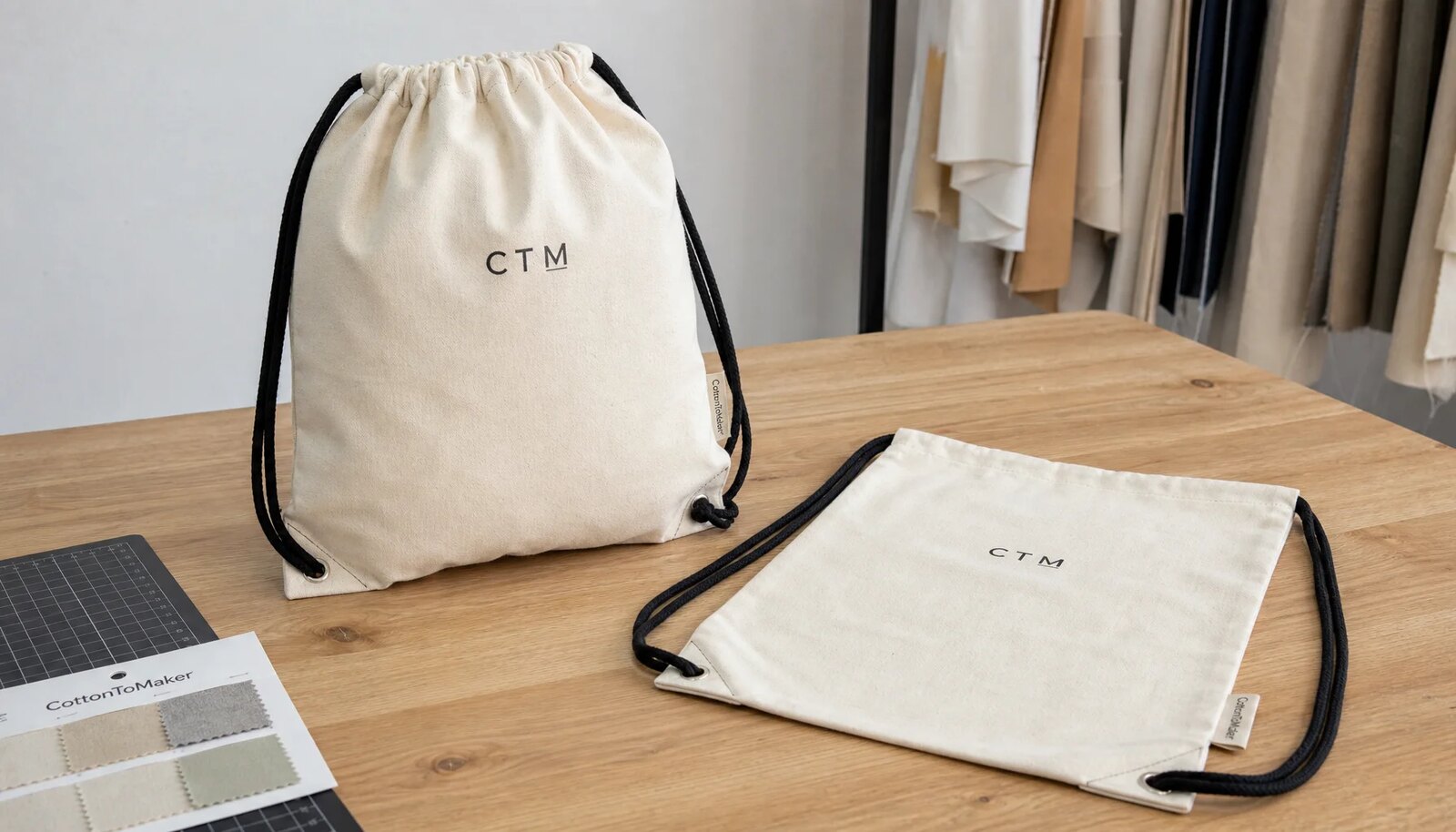
A cotton drawstring backpack for a craft fair can be a simple visitor giveaway, a sponsor activation item, a vendor welcome kit, a staff identifier, or a paid merchandise product. Those uses may look similar in photos, but they need different specifications and cost controls. A free giveaway can prioritize clean printing, reliable seams, and efficient bulk packing. A retail bag needs stronger hand feel, tidier sewing, clearer folding, labels or hangtags, and a defect standard that protects resale value.
Before asking for bulk pricing, define what the bag must do after cartons arrive. Will volunteers hand bags out at registration? Will sponsor versions need separate staging? Will merchandise bags go to a booth, warehouse, or fulfillment partner? These operating details affect packing format, carton marks, lead time, and inspection scope.
This is where a custom cotton drawstring backpacks bulk pricing plan for craft fairs becomes more than a unit-price request. The useful plan connects product specification, version splits, packing rules, and delivery dates so suppliers quote the same job.
- State the bag role before selecting fabric weight or print method.
- List receiving location, distribution method, and event deadline.
- Separate must-have specifications from optional upgrades.
- Treat artwork versions, packing styles, and destinations as cost drivers.
- Compare complete quotes, not the lowest incomplete price.
Specify Cotton Fabric Clearly
Fabric weight should be written in both ounces and GSM. For many craft fair drawstring backpacks, 6 oz to 8 oz cotton canvas, roughly 200 to 270 GSM before sewing, is a practical sourcing range. Six-ounce cotton can work for light visitor giveaways when the construction is sound. Eight-ounce cotton gives more body and is often the safer starting point for merchandise, sponsor kits, or bags expected to carry heavier purchases.
Going lighter or heavier changes cost and performance. A 4 oz cotton bag may feel thin, wrinkle quickly, and show ink strike-through with large prints. A 10 oz canvas bag can feel premium, but it increases fabric cost, shipping weight, carton volume, and closure stiffness. Buyers should avoid vague specifications such as cotton canvas only. Ask for weight, tolerance, weave, finish, color process, and whether the stated weight is measured before or after washing or finishing.
Finish also affects appearance. Natural greige cotton can show seed specks, slubs, and shade variation that suits handmade events. Bleached cotton gives a cleaner print background. Dyed cotton supports brand color direction but may require lab dip approval and minimum dye quantities. Washed cotton can feel softer but may widen size tolerances.
- Use 6 oz cotton for economical light-use giveaways.
- Use 8 oz cotton for merchandise or heavier event contents.
- Specify GSM, ounce weight, weave, finish, color process, and slub limits.
- Approve shade and hand feel with a swatch, lab dip, or pre-production sample.
Lock Size and Construction
A finished size around 35 x 40 cm or 36 x 42 cm works for many fair programs, notebooks, brochures, yarn, small apparel, and light purchases. Larger bags can improve perceived value but consume more fabric and increase carton cube. Smaller bags may reduce cost while failing the simple test of fitting the event materials.
Write the finished size and measurement method into the RFQ. For basic unwashed cotton bags, +/- 1 cm for width and height is often workable when the bag is measured flat and empty. If the fabric is washed, heavy, or unusually constructed, agree on a wider tolerance before production. Clarify whether height includes the drawcord channel and where inspectors should measure.
Load strength depends on construction as much as fabric. Craft fair visitors may carry candles, ceramics, catalogs, jars, or multiple small purchases. Stress concentrates at side seams, the drawcord channel, and lower cord anchors. Reinforcement should be named, not assumed.
- State width, height, channel position, and flat measurement method.
- Use a written size tolerance, commonly +/- 1 cm for unwashed cotton.
- Specify lockstitch seams, secure backstitching, and clean trimming.
- Require reinforced lower cord anchor points for realistic carry loads.
- Test the approved sample with expected fair contents.
Choose Cord and Closure Details
The drawcord affects comfort, closure function, and perceived quality. A 5 to 7 mm cord is usually more comfortable than a very thin cord because it spreads pressure better on the shoulder. Cotton cord supports a natural look and pairs well with unbleached canvas. Braided polyester cord can run more smoothly, hold bright colors more consistently, and absorb less moisture.
The RFQ should name cord material, diameter, color target, length tolerance, knot or end treatment, and channel width. If the cord is too short, the backpack is awkward over a jacket. If it is too long, it may hang poorly or drag when hand-carried. Left and right lengths should balance so the bag closes evenly and sits level when worn.
Cord function also depends on the channel. A thick cord in a narrow channel will feel cheap even if the front print looks sharp. During sample review, open and close the bag repeatedly and check whether seams, bulky fabric, or printing pressure restrict movement.
- Specify 5-7 mm cord unless the design requires another diameter.
- Choose cotton or polyester cord based on comfort, color control, and brand feel.
- Check cord length balance after the bag is fully closed.
- Approve knot security, end finishing, and acceptable fray limits.
- Inspect channel stitching and cord movement as functional QC points.
Match Print Method to Artwork
Screen printing is usually efficient for bulk cotton drawstring backpacks with one to three solid colors. It suits fair names, sponsor logos, bold illustrations, and simple retail graphics. The quote still needs detail: print dimensions, color count, ink requirements, placement, screen charges, color-change fees, and oversized print rules.
Transfers or digital methods can make sense for gradients, photographs, many colors, or short artist editions. They may reduce screen setup work when there are many small versions, but large transfer areas can feel less natural on cotton and may crease differently after folding. Buyers should approve the actual print on the selected fabric, not only a digital mockup.
Cotton texture influences print results. Natural slubs can interrupt fine lines. Pale ink may lose opacity on natural cotton. Heavy ink coverage can feel stiff or create blocking when stacked. Fine lines or small text under about 1 mm should be reviewed carefully.
- Use screen print for repeatable logos and one to three solid colors.
- Use transfer methods for complex color, photos, gradients, or many short versions.
- Provide vector artwork, color references, print size, and placement measurements.
- Approve a strike-off for opacity, edge clarity, adhesion, hand feel, and odor.
- Ask when oversized artwork, screen remakes, and color changes add cost.
Build Pricing by Version
Bulk pricing becomes complicated when an order is split. The practical costing unit is often the version: one fabric color, one finished size, one artwork, one print method, one packing format, and one destination rule. A 2,000-piece order with one natural cotton fabric and one black logo is efficient. A 2,000-piece order divided across sponsor logos, two fabric colors, staff bags, and venue-specific cartons behaves like several smaller jobs.
Build a version matrix before sending the RFQ. List quantities by design, fabric color, size, print color count, packing style, and destination. The supplier can then identify shared costs and repeated costs. Fabric cutting may be combined, but screens, ink changes, carton labels, packing checks, and inspection records may not be.
Ask for price tiers such as 500, 1,000, 2,000, and 5,000 pieces using the same version assumptions at each tier. If sponsor approvals are not final, ask how late artwork or quantity splits can change without repricing or delaying production.
- Quote MOQ by fabric color, size, artwork version, print color count, and packing format.
- Use the same version matrix in the RFQ, PO, packing list, and inspection plan.
- Ask which costs are shared and which repeat per version.
- Request tiered pricing that matches realistic sponsor and event scenarios.
- Confirm reorder MOQ when artwork and construction repeat.
Compare Landed Cost
The lowest ex-factory unit price is not always the best buy. A useful quote should state fabric weight, finished size, print method, print area, color count, cord specification, reinforcement, labels, packing, samples, setup charges, carton data, Incoterm, lead time, payment terms, and quote validity. If one supplier quotes 8 oz cotton with reinforced corners and another quotes 6 oz cotton with basic stitching, the prices are not comparable.
Carton data should be requested early. Cotton bags are not fragile, but freight still depends on weight and volume. Heavier fabric, individual polybags, hangtags, retail folds, and inner cartons can increase carton cube. Ask for pieces per carton, carton dimensions, net weight, gross weight, carton material, carton marks, and pallet requirements if relevant.
Write the Incoterm clearly. EXW may look cheap because pickup, export handling, and freight coordination are outside the supplier price. FOB works when the buyer or agent controls forwarding. CIF, DAP, or DDP can support landed-cost planning only when included charges are clear. Procurement should compare landed cost per usable bag after freight, duties, handling, receiving labor, and expected defect allowance.
- Separate unit price, setup charges, samples, labels, packing, inspection support, and inland transport.
- Request carton dimensions, weights, units per carton, and carton marks.
- Confirm EXW, FOB, CIF, DAP, or DDP and what charges are included.
- Compare landed cost per usable bag, not only quoted unit price.
- Check quote validity and the latest PO date needed to meet the fair.
Approve Samples Before Bulk Work
A pre-production sample should prove the actual product: cotton weight, finish, cord diameter, print method, print size, seam construction, reinforcement, and packing fold. A showroom sample may help early discussion, but it should not approve bulk production unless it matches the final specification.
Photo approval is useful for speed, but it cannot confirm everything. A photo may hide thin fabric, stiff ink, odor, uneven cord lengths, seam puckering, or weak lower anchors. A physical sample lets the buyer load the bag, wear it briefly, open and close the cord, measure print placement, and compare artwork scale to the real front panel.
Keep the approval record specific. Measure width, height, channel width, cord length, print dimensions, and print position. Attach the artwork file version, fabric swatch, cord detail, label detail, and packing method to the production file. Any change after approval should trigger a written specification update.
- Approve actual fabric, cord, print, stitching, reinforcement, and packing when schedule allows.
- Measure sample dimensions and print placement against written tolerances.
- Load the sample with realistic fair contents and check stress points.
- Keep photos, swatches, artwork files, and tolerances in one record.
- Review price and lead time for every post-sample change.
Set Practical QC Standards
Quality control should be agreed before production, not debated after defects appear. Cotton drawstring backpack inspection should include dimensional checks, fabric checks, print checks, sewing checks, cord function checks, cleanliness checks, and packing accuracy. AQL inspection works best when critical, major, and minor defects are defined in advance.
Size checks should use the agreed flat measurement method. Fabric weight should be checked against the quoted GSM where practical, not judged by hand feel alone. Shade should be compared with the approved swatch, lab dip, or pre-production sample under consistent lighting. Natural specks and slubs may be acceptable only within agreed limits.
Print checks should cover size, placement, opacity, edge clarity, adhesion, odor, stiffness, and blocking between stacked bags. Sewing checks should cover side seams, channel stitching, lower cord anchors, skipped stitches, open seams, loose threads, uneven bar tacks, and frayed cord ends. Packing checks should confirm artwork version, fabric color, carton marks, quantities, and destination sorting.
- Define critical, major, and minor defects before final inspection.
- Measure size, print placement, cord length, and carton quantity.
- Treat stains, mildew, oil marks, rust spots, strong odor, insects, and unsafe foreign matter as unacceptable.
- Stress check seams, channels, and lower cord anchors with realistic carry weight.
- Verify packing by version, color, carton mark, destination, and quantity.
Plan Packing for Fair Operations
Packing affects cost, receiving labor, and event-day control. Bulk packing 50 to 100 pieces per export carton is efficient for registration desks, volunteer teams, sponsor giveaways, and high-volume handouts. It reduces individual packaging and factory labor, but event staff may still need clear carton marks and accurate counts.
Retail packing needs a different plan. If bags will be sold at a merchandise booth, online store, or partner retail table, the order may need individual polybags, hangtags, barcode labels, price stickers, insert cards, or required warnings. These items affect artwork approval, packing time, carton quantity, and final inspection.
Multi-location craft fairs need a packing matrix. Cartons may need sorting by city, venue, sponsor, booth group, delivery date, or event team. The packing list should match carton marks exactly so receiving staff can identify goods without opening every box.
- Use bulk packing for low-waste giveaways and fast handout operations.
- Use individual packing for retail, e-commerce, cleaner presentation, or barcode tracking.
- Define carton assortment by artwork, color, destination, booth group, or event date.
- Approve hangtags, barcode labels, sticker position, and polybag format before packing.
- Require carton marks that receiving staff can use without opening every carton.
Specification comparison for buyers
| Buying scenario | Practical specification | Pricing drivers | Landed-cost risk to check |
|---|---|---|---|
| Low-cost visitor giveaway | 6 oz cotton, natural color, one-color screen print, bulk packed 50-100 pcs per carton | Fabric weight, one screen setup, simple carton marks, standard sewing | Thin fabric, weak lower cord anchors, missing carton cube, and freight cost that erases unit-price savings |
| Sponsor-branded fair bag | 6-8 oz cotton, 1-3 solid print colors, separate artwork versions, destination or sponsor carton marks | Screen changes, artwork approvals, version separation, packing accuracy | A total quantity may look large, but each sponsor version may price like a smaller production run |
| Paid merchandise bag | 8 oz cotton canvas, cleaner sewing, stronger cord, retail fold, hangtag or barcode if needed | Heavier fabric, tighter QC, individual handling, label or tag application | Retail packing and defect allowance must be included before comparing margin |
| Artist or limited-edition versions | Same base bag with multiple short-run prints; screen print for simple art or transfer for complex color | Setup per design, print method, strike-offs, picking and packing by design | Many small versions can increase setup cost, inspection time, and packing errors |
| Multi-location craft fair program | Standardized bag spec with cartons sorted by venue, date, sponsor, or booth group | Carton labeling, split packing, destination lists, pallet or warehouse instructions | Local sorting labor, mis-delivery, and rush relabeling can cost more than factory pre-sorting |
| Repeat annual fair | Approved fabric, saved artwork, repeated size, documented packing plan, reorder-ready QC standard | Reorder MOQ, archived screens or artwork, lead-time reliability, shade continuity | Small spec changes between years can trigger new samples, repricing, or shade mismatch |
Buyer checklist before sampling
- Define the commercial role: giveaway, sponsor activation, vendor welcome kit, staff bag, retail merchandise, or online resale stock.
- Confirm finished size, size tolerance, cotton weight in GSM and ounces, weave, finish, fabric color, and acceptable natural slub level.
- Specify drawcord material, diameter, color target, length tolerance, channel width, knot treatment, and lower-corner reinforcement.
- Provide artwork files with print size, placement measurements, color references, version quantities, and print method preference.
- Build the RFQ by version: fabric color, bag size, artwork, print color count, packing style, destination, and required in-hand date.
- Request tiered pricing at practical quantities such as 500, 1,000, 2,000, and 5,000 pieces using the same version split at each tier.
- Separate unit price, screen/setup charge, sample charge, lab dip or strike-off charge, label cost, packing cost, inspection support, and inland transport.
- Ask for carton quantity, carton dimensions, net weight, gross weight, units per carton, carton marks, and pallet requirements if applicable.
- Approve a physical pre-production sample or a construction sample plus print strike-off before bulk cutting, printing, and packing.
- Define QC tolerances for size, fabric weight, shade, print placement, print adhesion, seam strength, cord function, stains, odor, loose threads, and packing accuracy.
Factory quote questions to send
- What cotton fabric weight are you quoting in GSM and ounces, and is it measured before or after washing or finishing?
- Is the fabric natural greige, bleached, dyed, pigment-dyed, washed, or unwashed, and what shade or slub variation should we expect?
- What is the MOQ per finished size, fabric color, artwork version, print method, print color count, and packing format?
- Can you quote 500, 1,000, 2,000, and 5,000 pieces using our exact version matrix rather than one mixed total?
- Which print method is included, what print area is covered, and when do oversized artwork, color changes, or heavy ink coverage increase cost?
- Are screen charges, setup charges, sample cost, strike-off cost, lab dip cost, label cost, hangtag cost, barcode cost, and courier cost included or separate?
- What drawcord material, diameter, color matching method, cord length tolerance, knot treatment, and channel width are included?
- What stitch type, seam allowance, reinforcement method, bottom-corner construction, and loose-thread trimming standard will be used?
- What finished size tolerance, print placement tolerance, fabric weight tolerance, and acceptable shade range can you support in bulk production?
- What are the carton dimensions, carton weight, units per carton, carton marks, Incoterm, production lead time, quote validity, and latest PO date?
Quality-control points to confirm
- Finished size should normally be controlled within +/- 1 cm for width and height when measured flat unless washed cotton, heavy canvas, or special construction requires a wider written tolerance.
- Fabric weight should be checked against the quoted GSM by measuring or weighing a known fabric area where practical; hand feel alone is not a reliable acceptance method.
- Fabric shade should be compared with the approved swatch, lab dip, or pre-production sample under consistent lighting, with natural specks and slubs accepted only within agreed limits.
- Print size and placement should be measured from fixed reference points, usually the top edge below the drawcord channel and both side seams, with an agreed tolerance such as +/- 5 mm to +/- 10 mm.
- Screen print adhesion should pass reasonable dry rub and fold checks after curing, with no obvious ink transfer, flaking, cracking, surface tackiness, or strong odor.
- Heavy ink areas should be checked for stiffness, blocking between stacked bags, and transfer onto adjacent cotton after packing pressure.
- Side seams, drawcord channel stitching, lower cord anchors, and reinforcement points should be stress checked with realistic carry weight before shipment release.
- Cord length and left-right balance should be consistent across the lot so the backpack closes evenly and sits level when worn.
- Loose threads, skipped stitches, open seams, needle holes, uneven bar tacks, and frayed cord ends should be classified by severity before final inspection.
- Oil marks, rust spots, mildew, large stains, strong chemical odor, insect contamination, and unsafe foreign matter should be treated as unacceptable, not natural cotton variation.